

In 2022 a short video gave a name to something that had existed for as long as employment has, and within weeks the entire business press was writing about a generational crisis. Quiet quitting. Employees doing their job and nothing more. Refusing to answer emails at midnight. Declining the unpaid extra project. Leaving at the time their contract says they leave.
The commentary split immediately into two camps that have been shouting past each other ever since. One says workers have become entitled and lazy. The other says workers have finally discovered boundaries. Both are mostly wrong, and both are arguing about a term that was invented for a video, not for a research paper.
I am an Industrial and Organizational Psychologist, and what interests me is that the underlying phenomenon has been studied carefully for over thirty years under a different name, with a large body of evidence that almost nobody quoting the trend has read. This article covers what the 2026 data actually shows, what the research called this before it went viral, why the group disengaging fastest is the one nobody expected, and what genuinely reverses it.
“Quiet quitting is not a new behaviour. It is an old behaviour that finally got a name catchy enough to argue about. The behaviour is an employee withdrawing effort that was never in the contract and was always assumed to be free.”
— Workplace Psychology Analysis, ShahzebSpeaks
📊 What the 2026 numbers actually say
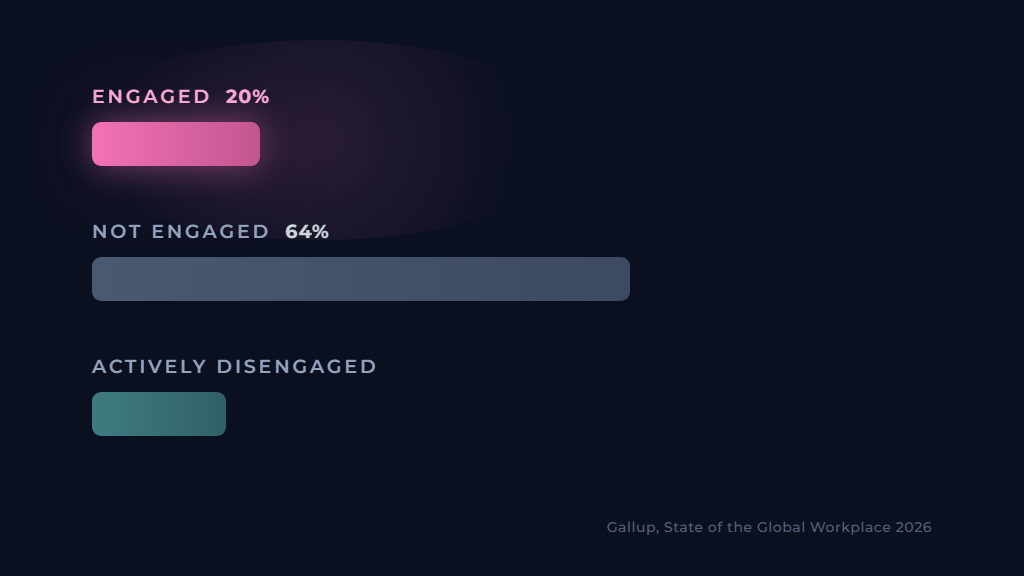
Gallup’s State of the Global Workplace is the most-cited dataset here, and the 2026 edition reports the following.
Global employee engagement fell to 20% in 2025, the lowest level since 2020. Gallup puts the associated productivity loss at an estimated $10 trillion to the world economy, a figure worth treating as a broad modelled estimate rather than an audited number.
64% of workers worldwide were “not engaged” in 2025. This is the category the press calls quiet quitting, and I want to be precise about what it means, because the label misleads. Not engaged does not mean actively hostile. It means psychologically uncommitted: present, doing the job, doing nothing beyond it. Gallup separates this from “actively disengaged,” which is a smaller and genuinely destructive group.
In the United States, reporting through 2026 puts at least half of workers in the quiet quitting category, meeting requirements and going no further.
On business impact, Gallup’s long-running comparison between engaged and disengaged units finds roughly 37% higher absenteeism, 18% lower productivity and 15% lower profitability. These are correlational unit comparisons rather than experimental results, and I would read them as a strong signal about direction rather than a precise causal multiplier.
The number nobody quotes correctly
“64% of workers are quiet quitting” reads as a catastrophe. But the not-engaged category has hovered in a similar range for well over a decade, long before the phrase existed. The dramatic part of the 2026 data is not the size of that middle group. It is that engagement dropped, and that the drop is concentrated in a specific population, which is the section below.
📚 Chapter 2: This is not new, and the old name was better
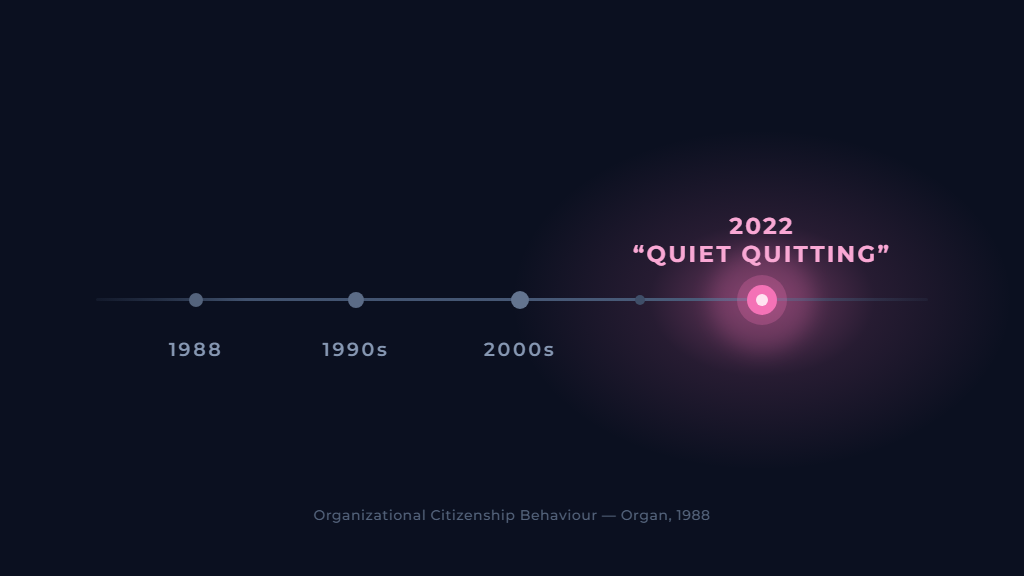
Here is the part that changes how you should think about the whole debate.
What quiet quitting describes is the withdrawal of organizational citizenship behaviour, a construct Dennis Organ defined in 1988. OCB covers the discretionary things employees do that are not in the job description and are not formally rewarded: helping a colleague, staying late during a crunch, mentoring a junior, speaking well of the employer, volunteering for something nobody asked you to do.
Two properties of OCB matter enormously and are almost always missed in the popular debate.
It is discretionary by definition. An employee who stops doing OCB has not broken any agreement. They have stopped donating unpaid labour. Whether you consider that a moral failure depends entirely on whether you had quietly begun treating a gift as an entitlement.
It is the first thing to go. Decades of research show OCB is highly sensitive to how fairly people feel treated, and it withdraws long before formal performance drops. That makes it a genuinely useful early warning signal, and it is precisely the signal most performance management systems are blind to, because they measure required output rather than voluntary effort.
So the honest framing is this. Quiet quitting is not employees doing less than their job. It is employees doing exactly their job, after a period in which more than their job had become the unspoken standard. The change is not in the worker’s output. It is in the expectation that was never written down.
🤝 Chapter 3: The mechanism is a broken agreement, not a broken generation
The best-supported explanation is one I have written about in a different context, in my article on why return-to-office mandates backfire: the psychological contract.
Denise Rousseau’s work describes the unwritten set of mutual expectations that accumulates between employee and employer. Not the employment contract, but the accumulated understanding of what each side owes the other, built from what was said at hiring, what has been rewarded, and what has become normal.
Extra effort is a term in that contract for most people. It is exchanged, implicitly, for things like advancement, security, recognition, development, or simply being treated well. When employees perceive that the other side has stopped delivering, the research on contract breach is unambiguous about what follows: reduced organisational commitment, lower satisfaction, increased cynicism, higher turnover intention, and, first and most reliably, reduced organizational citizenship behaviour.
That last item is the point. Quiet quitting is the textbook, predicted, thirty-year-documented response to perceived psychological contract breach. It is not a TikTok trend and it is not a generational trait. It is what the literature says people do when they conclude the exchange has become one-sided.
This also explains the pattern that confuses managers most: the person who quiet quits is often a former high performer. Someone who was never giving extra effort has nothing to withdraw. The withdrawal is only visible in people who were giving it, which means the behaviour that reads as disengagement is usually evidence of prior engagement that was not reciprocated.
🎯 Chapter 4: Why “quiet quitting” is a bad name, in three ways
Names shape what people conclude, so it is worth being specific about the damage this one does.
It implies deception. “Quiet” suggests something covert, as though the employee is secretly cheating. In reality, doing your contracted job openly and going home on time is the least covert behaviour available. The word smuggles in an accusation.
It implies quitting. The person has not quit. They are present and delivering what was agreed. Calling that quitting redefines the baseline as failure, which is exactly how expectations creep upward without anyone negotiating them.
It locates the problem in the individual. This is the most expensive error. If the phenomenon is a personal attitude, the solution is talking to the person. If it is a predictable response to an environment, the solution is changing the environment. The research supports the second, and the name pushes managers toward the first, which is why so many organisations respond to it with engagement surveys and pizza rather than with structural change.
The honest term is uglier and more useful: discretionary effort withdrawal. It describes exactly what happens, contains no accusation, and points at the cause.
⚠️ Chapter 5: The finding nobody expected — managers are the crisis
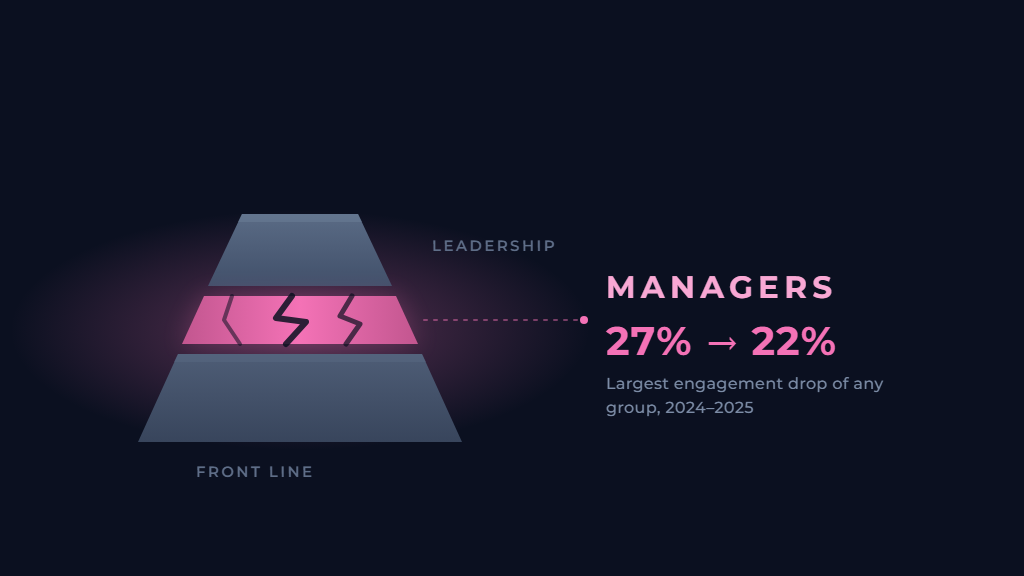
This is the most important section in the article and it receives almost no coverage.
The sharpest year-over-year decline in the recent data is not among young employees or remote workers. It is among managers. Gallup’s 2026 reporting shows manager engagement fell five points between 2024 and 2025, from 27% to 22%, the largest drop of any group, with employees under 35 also declining sharply.
Why this matters more than the headline number: the manager is the mechanism. Gallup’s own long-running finding is that a large share of the variance in team engagement is attributable to the manager. Every intervention an organisation designs to fix disengagement, from feedback conversations to recognition to development planning, is delivered by that layer.
So a disengaged manager is not one more disengaged employee. It is the delivery system for engagement failing, and it propagates downward. A manager with nothing left to give does not run the development conversation, does not notice the withdrawal, does not advocate for the raise, and does not model the discretionary effort they are supposed to inspire.
The cause is not mysterious. Managers absorbed restructuring, hybrid coordination, larger spans of control after flattening exercises, and the emotional labour of delivering decisions they did not make and often did not agree with. I wrote about the specific version of this in my article on layoff survivor syndrome, where the middle layer carries the aftermath while being told to maintain morale.
If I could give an executive team a single sentence from this whole article, it would be this: you cannot solve a disengagement problem through a layer that is itself disengaging faster than everyone else.
🗣️ Chapter 6: What employees actually say they want
This is worth taking seriously because it contradicts most of what gets implemented in response.
When Gallup asked people in the quiet quitting category what single change would most improve their workplace, 85% of answers fell into three areas: engagement and culture, pay and benefits, or wellbeing and work-life balance. The single largest group, around 41%, named team engagement and company culture rather than pay.
I want to handle that finding carefully, because it is frequently abused. Executives read “they didn’t say money” and conclude that pay is not the issue, which is not what the data supports. Pay is a well-documented hygiene factor in Herzberg’s sense: inadequate pay reliably produces dissatisfaction, while adequate pay does not by itself produce engagement. People below a fair threshold will absolutely name money. People above it name relationships, meaning and treatment, because those become the binding constraint.
The practical reading, then, is not “culture beats pay.” It is: fix pay to the point where it stops being the answer, and after that, the answer becomes how people are treated. Organisations that skip the first half and go straight to culture initiatives are why so many engagement programmes fail visibly.
🔍 Chapter 7: The honest part — where this topic is oversold
An article on quiet quitting that only stacks up alarming statistics is doing the same thing as the trend pieces. Here is what I think is genuinely shaky.
The 64% figure is less dramatic than it sounds
The not-engaged share has sat in a broadly similar band for many years, well before the term existed. Presenting it as evidence of a sudden collapse is misleading. The meaningful signal in the 2026 data is the direction of change and where it is concentrated, not the absolute size of the middle group.
Engagement measurement has real limitations
Most of these numbers come from self-report survey items, collected at a moment in time, from people who know their employer may see the aggregate. Survey engagement and actual behaviour correlate, but imperfectly. Anyone building a strategy on a two-point movement in an engagement score is over-reading the instrument.
The $10 trillion figure is a model, not a measurement
It is derived by applying estimated productivity differentials across the global workforce. That is a legitimate way to communicate scale and a poor basis for a business case. I include it because it is widely cited, and I would not put it in a board paper without that caveat attached.
Some of this is a correction, not a decline
Part of what is measured as falling engagement is people reverting to contracted hours after a period of sustained over-extension, particularly during and after the pandemic. An employee who stops working unpaid overtime has not become worse at their job. Treating that as a productivity crisis assumes the over-extension was the correct baseline, which is an assumption worth stating out loud rather than smuggling in.
And a genuinely uncomfortable one
There is a version of quiet quitting that is not a fair response to anything. Some people withdraw effort while continuing to expect advancement, and some teams carry colleagues who have simply stopped. Framing every case as a righteous boundary is as lazy as framing every case as entitlement. The research explains the pattern at population level. It does not automatically justify any individual instance, and pretending otherwise makes the analysis useless to the managers who have to deal with real situations.
🛠️ Chapter 8: What actually reverses it

- Fix the manager layer before anything else. Reduce span of control, remove administrative load, give them decision authority that matches their accountability, and train them properly. Every other intervention runs through this layer, and the 2026 data says the layer is failing. Nothing else you do will land until this is addressed.
- Repair the exchange, not the attitude. Ask what was implicitly promised and quietly stopped being delivered. Career progression that stalled, workload that expanded after headcount cuts, flexibility that was withdrawn. The withdrawal of effort is a response to something. Find the something.
- Make the process fair and visible. Organizational justice research is consistent that people accept unfavourable outcomes far better when the process was fair and honestly explained. Voice matters even when it does not change the decision. This is the cheapest high-return intervention available and it is skipped constantly.
- Stop treating discretionary effort as the baseline. If your operating model only functions when everyone works beyond contract, you do not have an engagement problem. You have a resourcing problem wearing an engagement problem’s clothes.
- Give autonomy back where you can. Deci and Ryan’s self-determination theory identifies autonomy, competence and relatedness as the basis of intrinsic motivation. Of the three, autonomy is the one most organisations have been steadily removing, and it is the cheapest to return.
- Measure what people do, not what they say. Watch voluntary participation, internal applications, referral rates and who is helping whom. These move before survey scores do, and they cannot be gamed the way an engagement questionnaire can.
👤 If you are the employee
Almost every article on this addresses management, which is not useful if you are the one being labelled.
Know what you are actually doing. Doing your job fully and going home is not quitting. It is the agreement. If you are performing to your role and someone calls that disengagement, ask which specific expectation is not being met, because there is a difference between a real performance conversation and an expectation that was never negotiated.
Distinguish boundaries from stagnation, honestly. Withdrawing effort from an employer that stopped reciprocating is a rational response. Withdrawing effort from your own skills and career is a cost you pay yourself, and the employer will not notice. Those two can look identical from the inside and they are not the same thing.
Treat sustained disengagement as information. If the exchange has broken and there is no realistic route to repairing it, quiet quitting is a holding pattern rather than a solution. It is a reasonable place to rest. It is a poor place to stay for three years.
📝 The takeaway
Quiet quitting is a viral name attached to a well-documented behaviour: the withdrawal of discretionary effort in response to a psychological contract that people believe has been broken. It is not new, it is not generational, and it is not primarily an attitude problem.
The 2026 data adds one genuinely important thing to that old story, and it is not the headline. The group disengaging fastest is management, which means the mechanism organisations rely on to fix engagement is the mechanism that is breaking. That single fact should reorder most of the interventions currently being planned in response.
And the framing matters more than any statistic here. If an organisation concludes its people have become lazy, it will spend money on communication, recognition schemes and surveys, and none of it will work. If it concludes that an exchange has become one-sided, it will look at workload, progression, fairness and manager capacity, and some of that will. The behaviour is the same in both cases. What differs is whether the organisation is willing to consider that it might be the variable that changed.
❓ Frequently asked questions
What is quiet quitting?
Doing the work your job requires and nothing beyond it. No unpaid overtime, no volunteering for extras, no answering messages outside hours. Researchers describe it more precisely as withdrawal of organizational citizenship behaviour, or discretionary effort withdrawal.
How many people are quiet quitting?
Gallup’s 2026 reporting puts 64% of workers worldwide in the “not engaged” category during 2025, with global engagement at 20%, its lowest since 2020. In the US, reporting suggests at least half of workers fit the description. The not-engaged share has been in a broadly similar band for years, so the trend direction matters more than the raw figure.
Is quiet quitting laziness?
The research does not support that reading. Withdrawal of discretionary effort is a documented response to perceived psychological contract breach, and it appears most visibly in people who were previously giving extra effort, since only they have something to withdraw.
Who is quiet quitting the most in 2026?
The sharpest recent decline is among managers, whose engagement fell from 27% to 22% between 2024 and 2025, alongside a steep drop among workers under 35. That matters disproportionately because managers are the delivery mechanism for every engagement intervention.
What do quiet quitters say they want?
When asked what one change would most improve their workplace, around 85% of answers fell into engagement and culture, pay and benefits, or wellbeing and work-life balance. The largest single group, roughly 41%, named team engagement and culture.
How do you fix quiet quitting?
Fix the manager layer first, since everything else runs through it. Then repair the specific exchange that broke, make decision processes fair and honestly explained, return autonomy where possible, and stop building operating models that only work if everyone exceeds their contract.
🧠 Losing discretionary effort and not sure why?
I’m Muhammad Shahzeb, an MSc Industrial and Organizational Psychologist. I diagnose engagement problems using organizational justice and motivation research, including the part where I tell you honestly whether the issue is your people or your operating model.
📚 References and further reading
- Gallup. State of the Global Workplace: 2026 Report. Engagement, not-engaged share, manager engagement decline and productivity estimates. gallup.com
- Organ, D. W. (1988). Organizational Citizenship Behavior: The Good Soldier Syndrome. Lexington Books.
- Organ, D. W., Podsakoff, P. M., & MacKenzie, S. B. (2006). Organizational Citizenship Behavior: Its Nature, Antecedents, and Consequences. Sage.
- Rousseau, D. M. (1995). Psychological Contracts in Organizations. Sage.
- Robinson, S. L., & Rousseau, D. M. (1994). “Violating the psychological contract: Not the exception but the norm.” Journal of Organizational Behavior, 15(3), 245-259.
- Zhao, H., Wayne, S. J., Glibkowski, B. C., & Bravo, J. (2007). “The impact of psychological contract breach on work-related outcomes: A meta-analysis.” Personnel Psychology, 60(3), 647-680.
- Colquitt, J. A. (2001). “On the dimensionality of organizational justice.” Journal of Applied Psychology, 86(3), 386-400.
- Deci, E. L., & Ryan, R. M. (2000). “The ‘what’ and ‘why’ of goal pursuits.” Psychological Inquiry, 11(4), 227-268.
- Herzberg, F. (1968). “One more time: How do you motivate employees?” Harvard Business Review. (Hygiene factors.)
- Harter, J. K., Schmidt, F. L., & Hayes, T. L. (2002). “Business-unit-level relationship between employee satisfaction, employee engagement, and business outcomes.” Journal of Applied Psychology, 87(2), 268-279.
- Maslach, C., & Leiter, M. P. (2016). “Understanding the burnout experience.” World Psychiatry, 15(2), 103-111.
- Contemporary 2026 industry analyses of quiet quitting prevalence and engagement statistics. Treat survey-based figures with appropriate caution.
Written by Muhammad Shahzeb, MSc Industrial & Organizational Psychology | Workplace Psychology Specialist | Full-Stack Web Developer
Learn more about my approach →