
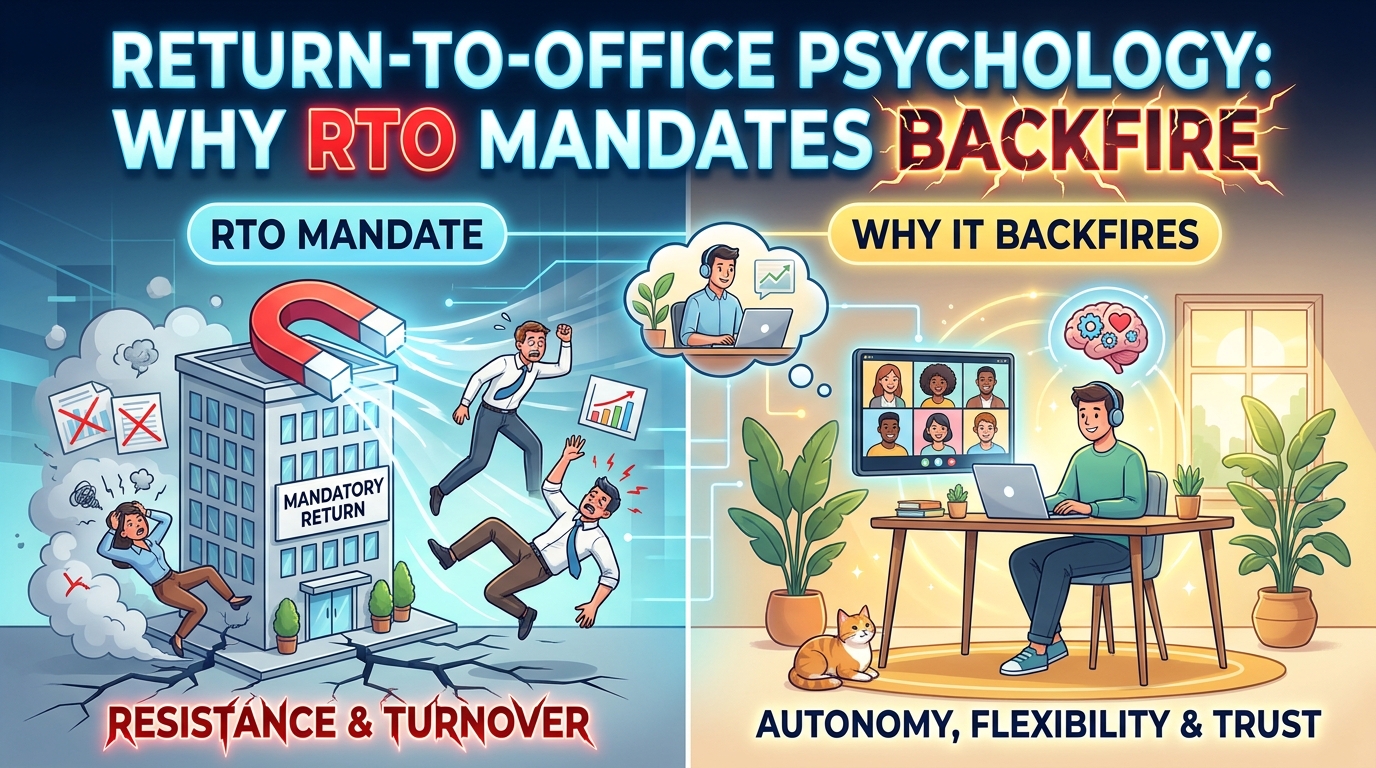
The email always reads the same way. It talks about collaboration, culture, mentorship and energy. It uses the word “together” at least twice. It announces that from a specific date, everyone is expected in the office three days a week, or four, or five. And it is almost always written by people who are genuinely surprised by what happens over the following six months.
What happens is this: engagement drops, the loudest complaints come from the people management least expected, some of the best performers quietly start interviewing, and productivity does not improve. Then a second memo goes out about commitment. Then a third about accountability. By that point the damage is structural, and it is usually blamed on the wrong thing.
I am an Industrial and Organizational Psychologist, and I want to be direct about my position before I lay out the evidence. I do not think RTO mandates fail because people are lazy, and I do not think they fail because of the commute. They fail because of what a mandate means, and meaning is the thing organisations consistently forget to manage. This article covers what the research actually shows in 2026, the six psychological mechanisms that make mandates backfire so reliably, the honest case for when going back to the office is the right call, and what to do instead.
“A mandate does not just change where people work. It tells them what the organisation believes about them, and people respond to that message far more strongly than to the policy attached to it. Most companies think they are moving desks. Their employees think they are being called untrustworthy.”
— Workplace Psychology Analysis, ShahzebSpeaks

📊 What the research actually shows
Let me get the evidence out of the way first, honestly, including the parts that complicate the popular narrative.
On productivity, the case for mandates is remarkably thin. The most rigorous single study remains Nicholas Bloom’s randomised controlled trial at Trip.com, published in Nature in 2024, covering more than 1,600 employees. Hybrid working, roughly two days at home, produced no measurable drop in performance or promotion rates, and cut quit rates by about a third. Separate analysis of S&P 500 firms by researchers at the University of Pittsburgh found no significant improvement in financial performance or productivity following RTO mandates, though it did find declines in employee satisfaction.
On attrition, the picture is worse for mandates. Research from teams at the University of Michigan and University of Chicago examining strict mandates at large technology firms found that departures were concentrated among senior employees, and that a disproportionate share went to direct competitors. Broader analyses in 2026 have put turnover increases associated with strict mandates in the region of fourteen percent, with women and senior staff over-represented in the exits.
On what employees say they will do, take the numbers with some care. Survey findings that around half of remote-capable workers would look for another job under a full-time mandate are widely quoted. Stated intentions consistently overstate actual behaviour, so I would not treat that as a prediction of resignations. What it does reliably measure is how the policy feels, and that is the variable this article is about.
Two honest caveats, because an article that only presents one side is advocacy rather than analysis. First, most of this research covers knowledge work at large firms, mainly in the United States, and it does not automatically transfer to every industry, country or company size. Second, remote work does show real costs in some studies, particularly around the mentoring and development of junior employees, weaker informal knowledge transfer, and the difficulty of forming trust between people who have never met. Those costs are genuine. The problem is that a blanket mandate is a poor instrument for fixing them, which is what the rest of this article is about.
🤝 Mechanism 1: Psychological contract breach
This is the central mechanism, and everything else in the article sits on top of it.
Denise Rousseau’s work on the psychological contract describes the set of unwritten, mutual expectations that build up between an employee and an employer. It is not the employment contract. It is the accumulated understanding of what each side owes the other, formed from what was said at hiring, what has been tolerated, what has been rewarded, and what has quietly become normal.
Between 2020 and 2024, in an enormous number of organisations, flexibility entered that contract. Not through a signed document, but through the far stronger route: it was granted, it worked, and it was never taken back. People restructured their lives around it. They moved further out, changed childcare arrangements, took on caring responsibilities, arranged their weeks around it. In psychological contract terms, it stopped being a concession and became a term.
A mandate does not read as a policy update. It reads as breach, and the research on contract breach is unambiguous about what follows: reduced organisational commitment, lower job satisfaction, decreased organisational citizenship behaviour meaning people stop doing the unrewarded extras, increased cynicism, and higher turnover intention. Robinson and Rousseau documented these effects in the 1990s, and they have replicated consistently since.
Here is the part leaders miss most often. Breach is not evaluated against fairness in the abstract. It is evaluated against what the person believed was promised. An employee who was hired in 2019 as fully office-based and asked to return has experienced a policy change. An employee who was hired in 2022 into a remote role and is now asked to relocate has experienced something much closer to betrayal, and will behave accordingly. Same memo, completely different psychology, and almost no organisation segments the message.

🎛️ Mechanism 2: Autonomy removal, and what it does to motivation
Self-determination theory, developed by Edward Deci and Richard Ryan, holds that human motivation depends on three basic psychological needs: autonomy, competence and relatedness. When those are supported, people show intrinsic motivation, persistence and better wellbeing. When they are thwarted, motivation shifts from intrinsic to controlled, and controlled motivation produces compliance rather than commitment.
Flexible work is, in this framework, an unusually pure autonomy input. It is not really about location. It is about who decides. That is why the difference between “you may work from home two days” and “you must attend Tuesday, Wednesday and Thursday” is far larger emotionally than it appears on paper, even though the number of office days is identical. One preserves agency. The other removes it and happens to land in the same place.
The downstream effect is what I would flag to any executive team. When autonomy is removed, you do not usually lose output immediately. You lose discretionary effort: the extra hour, the unasked-for fix, the willingness to pick up something outside the job description. That effort is invisible on a dashboard, which is exactly why its disappearance is so often mistaken for a performance problem in individuals rather than a motivation problem in the system.
There is also a well-documented crowding effect. Deci’s early experiments showed that introducing external control over an activity people were doing willingly can reduce their intrinsic interest in it. Mandating attendance at something people were often doing voluntarily converts a choice into an obligation, and obligations are met to the minimum standard.
🚫 Mechanism 3: Reactance, or why telling people makes it worse
Jack Brehm’s theory of psychological reactance, developed in 1966, states that when people perceive a freedom being restricted, they experience an aversive arousal that motivates them to restore it, and the restricted option becomes more attractive than it was before.
This explains something that genuinely puzzles managers: employees who rarely used their flexibility become some of the angriest people in the room. Someone who came in four days a week voluntarily now objects loudly to being required to come in three. From a logistics view that is irrational. From a reactance view it is textbook, because what has been taken is not the days. It is the option, and the option had value even when unused.
Reactance also predicts the specific form the resistance takes, and it is rarely open confrontation. It shows up as malicious compliance: badging in and leaving, attending in body and working exactly as before, taking video calls from a desk in the office everyone can see is pointless, sitting in a room alone talking to people in other cities. Every organisation that mandated attendance without redesigning what happens in the office has watched this play out, and it produces the worst possible outcome, which is all the cost of the commute and none of the collaboration that justified it.

📉 Mechanism 4: Loss aversion turns a benefit into a wound
Kahneman and Tversky’s prospect theory established that losses loom roughly twice as large as equivalent gains. That single asymmetry explains why the emotional response to an RTO mandate is so much larger than the logistics would suggest.
Consider the arithmetic from the employee’s side. In 2019, being in the office five days was neutral, because it was the baseline. By 2024, working from home had become the new reference point, and the endowment effect means people value what they already hold more highly than they valued acquiring it. Being asked to give back two days is therefore not experienced as returning to normal. It is experienced as losing something that was theirs, and the reference point has moved permanently.
Leaders frequently make the same error in response, and it is worth naming because it is so avoidable. They frame the change as a return: “we are going back to how things were.” That framing maximises the felt loss, because it explicitly compares the present to a past the employee no longer identifies with. The person is not going back anywhere. They have a different life now, and the memo is asking them to dismantle parts of it.
There is also a concrete, quantifiable loss underneath the psychological one. A daily commute of ninety minutes each way is roughly fifteen hours a week, unpaid, plus fuel or fares. A mandate is, in real terms, a pay cut expressed in time, and framing it as a cultural improvement while never acknowledging its cost is the single fastest way to make people feel their employer is not being straight with them.
⚖️ Mechanism 5: Procedural injustice, which is usually the real complaint
This is the mechanism I would fix first if I could only fix one, because it costs the least and is skipped the most.
Organizational justice research, particularly Jason Colquitt’s work synthesising the field, separates fairness into distinct components. Distributive justice is about outcomes. Procedural justice is about how the decision was made. Interactional justice is about how it was communicated and whether people were treated with dignity and given an honest explanation.
The consistent finding across decades of this research is that people accept unfavourable outcomes far better when the process was fair. Voice matters enormously, even when it does not change the decision. Explanation matters. Consistency matters. Being told the actual reason matters more than being told a comfortable one.
Most RTO rollouts fail every one of these tests simultaneously. The decision arrives without consultation. The stated reasons, collaboration and culture, are usually unmeasured and sometimes visibly untrue. Enforcement is inconsistent, with senior people exempt in practice while everyone below badges in. And when leadership has a real reason it does not want to say out loud, such as a property lease it is committed to, a headcount reduction it hopes to achieve through voluntary attrition, or pressure from investors or a government, employees generally work it out. They almost always work it out.
That last case deserves naming plainly. Using an RTO mandate as a quiet redundancy programme is a strategy some firms have used, and it is the most corrosive version, because the people who leave are not the ones the company wanted to lose, and everyone who stays now knows the organisation will lie to them to save a severance line.
🔍 Mechanism 6: The message the mandate sends about trust
Every policy is also a statement about the people it applies to, and this is where mandates do their deepest damage.
A rule requiring physical presence communicates something specific: we need to see you to believe you are working. Leaders rarely intend this and frequently deny it, but it is the plain reading, and employees read it that way almost universally. Microsoft’s Work Trend Index gave this a useful name a few years ago, productivity paranoia, describing the gap between managers who doubted their teams were productive and employees who reported working more than ever.
Trust is reciprocal, and the reciprocity runs in both directions. There is a substantial literature showing that being monitored or distrusted reduces trustworthy behaviour rather than increasing it, partly by signalling that the relationship is transactional. If the organisation communicates that goodwill is not assumed, the rational employee response is to stop extending goodwill either, and discretionary effort is exactly the currency of goodwill.
Underneath the management side of this sits a well-documented cognitive error. The fundamental attribution error leads observers to explain other people’s behaviour with character rather than circumstance. A manager who cannot see someone working tends to fill the gap with a trait explanation, usually a negative one, while explaining their own unproductive afternoon with situation. Presence does not fix this. It only removes the discomfort of not knowing, which is a manager’s problem being solved at the employee’s expense.
🎯 Mechanism 7: Adverse selection, or why the wrong people leave
This is the strategic argument, and it is the one that gets executive attention when the psychological arguments do not.
Attrition following a mandate is not random. It is filtered by who has options. The employees most able to leave are the ones with the strongest external market: senior specialists, high performers, people with in-demand skills, and people who have been there long enough to hold the institutional knowledge nobody documented. The employees least able to leave are those with fewer options, and there is no reason to think that is the group a company would choose to retain if it were choosing deliberately.
The research on technology firm mandates supports exactly this shape, finding departures concentrated among senior staff, with a meaningful share moving to competitors. Women appear over-represented in several analyses, which is consistent with the unequal distribution of caring responsibilities and makes a mandate a diversity problem as well as a retention one, whatever the intent.
So the true cost of a mandate is not the headline turnover percentage. It is the composition of that percentage, plus replacement cost, plus lost institutional knowledge, plus the quiet productivity hit while a team absorbs departures, set against a productivity gain that the current evidence does not show exists.
The pattern in one sentence
A mandate breaches an unwritten agreement, removes autonomy, triggers reactance, registers as a loss rather than a return, is usually delivered through an unfair process with a reason nobody believes, communicates distrust, and then loses disproportionately the people who could most easily go elsewhere. Any one of those is manageable. All seven arriving in the same email is not.

🧑⚖️ The honest counter-case: when the office genuinely wins
I would not trust this article if it did not argue the other side properly, so here it is at full strength.
Junior development is the strongest argument, and it is a real one. Early-career employees learn enormously from ambient observation, overheard conversations, informal correction and the low-stakes questions people ask when someone is sitting nearby. Remote work makes that expensive and easy to skip. Several studies find weaker feedback and slower skill development for junior staff working remotely, and I think anyone dismissing this is not being honest about how professional learning works.
Trust formation between strangers is harder remotely. Teams that already know each other coordinate well at a distance. New teams, new hires and cross-functional groups meeting for the first time do not, and video does not fully substitute for the social information people gather in person.
Some work genuinely benefits from co-location. Early-stage creative work with high ambiguity, crisis response, complex negotiation, and hands-on training are all easier in a room. So is anything where the useful part is the tangent nobody scheduled.
Weak ties decay without incidental contact. Mark Granovetter’s classic work on the strength of weak ties shows that loose connections carry disproportionately valuable information. Remote work strengthens close collaboration and thins the loose network around it, and the loss is invisible until you need something from someone you no longer know.
Every one of those is legitimate. Notice, though, what none of them argues for: a uniform, enforced, badge-counted number of days applied identically across every role in the company. They argue for structured onboarding periods, deliberate team gatherings, in-person time timed to the work rather than to the calendar, and offices designed for collaboration rather than for rows of people on headsets. A mandate is a blunt answer to a set of specific problems, which is why it produces so much resentment relative to the benefit it delivers.
🛠️ What to do instead, if you are the one deciding
- Say the real reason, even if it is unflattering. If the driver is a lease, investor pressure, a government requirement or a belief that remote collaboration has weakened, say so. Procedural justice research is clear that an honest unwelcome explanation outperforms a pleasant unbelievable one, and employees usually discover the truth anyway. The credibility you keep is worth more than the discomfort you avoid.
- Give voice before the decision, not after. Consultation changes acceptance even when it does not change the outcome. This is one of the most robust findings in organisational justice, and it is nearly free.
- Anchor on the work, not the days. “Teams decide their own in-person pattern and must justify it against how they actually work” preserves autonomy while achieving most of the collaboration benefit. Team-level choice is the single highest-leverage adjustment available.
- Make the office worth the journey. If people travel ninety minutes to sit alone on video calls, the policy has disproved its own rationale in front of everyone. Attendance days should contain things that only work in person: planning, teaching, review, onboarding, decisions.
- Segment by tenure and life stage. New hires and junior staff genuinely benefit from more in-person time. Senior specialists with fifteen years of relationships usually do not. Treating both identically is fair in form and unfair in substance.
- Acknowledge the cost out loud. Naming the commute, the childcare implication and the money involved does not weaken the decision. It signals that leadership understands what it is asking for, and being understood absorbs an enormous amount of resentment.
- Apply it to yourself, visibly. Inconsistent enforcement is the fastest destroyer of perceived fairness. If the executive team is exempt in practice, the policy is not a policy, it is a hierarchy statement, and everyone can read it.
👤 If you are the employee on the receiving end
Most articles on this topic are addressed only to management, which is not much use if you are the one who just got the email.
Separate the two feelings, because they need different responses. There is anger at the loss of flexibility, and there is anger at how the decision was made. The first is about the outcome and rarely movable. The second is about process and is where any actual conversation exists.
Negotiate in the specific, not the general. “I do not want to come in” is a position. “These two days are when my team actually needs me, and Thursday is deep work I cannot do in an open plan office” is a proposal. Managers have far more discretion at the individual level than at the policy level, and most of the flexibility that survived mandates was negotiated quietly rather than granted publicly.
Watch what the policy tells you about the organisation. A mandate delivered with consultation, honesty and consistency tells you something reasonable about how this place makes decisions. One delivered with a reason nobody believes, exemptions for the top and enforcement for everyone else tells you something too, and it is information worth acting on calmly rather than reactively.
Be honest with yourself about the real cost. Time, money, caring responsibilities and health are legitimate inputs to a career decision, and treating them as complaints rather than facts is a habit that serves nobody. If the arithmetic no longer works, that is a real finding, not a character weakness.
📝 The takeaway
RTO mandates do not usually fail because working from an office is bad. Offices are fine. Many people prefer them, and there are real things they do better that no amount of software has solved.
They fail because of how they arrive. A mandate takes back something people had reorganised their lives around, removes their say in it, delivers a reason they can tell is not the real one, applies it unevenly, and communicates in the process that they are not trusted to work unobserved. Then it is surprised when the strongest performers, who have the most options, use them.
The uncomfortable summary for anyone holding this decision is that the mechanism you need is trust, and a mandate is what organisations reach for when they have already lost it. The policy is not the cause of the problem. It is usually the first visible symptom, and adding enforcement to a trust deficit has never once worked in the history of organisational psychology.
❓ Frequently asked questions
Do return-to-office mandates actually improve productivity?
The available research does not show that they do. A randomised controlled trial at Trip.com published in Nature found hybrid work produced no drop in performance or promotions while cutting quit rates by about a third, and analysis of S&P 500 firms found no significant productivity or financial improvement after RTO mandates, alongside falling employee satisfaction.
Why do employees react so strongly to RTO mandates?
Because a mandate is experienced as a loss rather than a change. Flexibility became part of the unwritten psychological contract, losses feel roughly twice as large as equivalent gains, and removing a choice triggers reactance even in people who rarely used it.
Who actually leaves after an RTO mandate?
The people with the most options. Research on strict mandates at large technology firms found departures concentrated among senior employees, with many moving to direct competitors, and several analyses find women over-represented in exits.
Is there any good reason to bring people back to the office?
Yes. Junior development, trust formation among people who have never met, ambiguous early-stage creative work and weak-tie networks all genuinely benefit from in-person time. None of those, however, argues for a uniform badge-counted quota applied identically to every role.
What is a psychological contract breach?
It is the perception that an employer has failed to meet unwritten mutual expectations built up over time. Research links it to lower commitment and job satisfaction, reduced discretionary effort, higher cynicism and greater turnover intention.
What is the single best fix for a badly received mandate?
Honest explanation plus genuine voice. Organizational justice research consistently finds people accept unwelcome outcomes far better when the process was fair, and both cost almost nothing compared with replacing senior staff.
🧠 Rolling out a workplace policy that people will actually accept?
I’m Muhammad Shahzeb, an MSc Industrial and Organizational Psychologist. I help organisations design and communicate policy changes using organizational justice and motivation research, including the part where I tell you honestly which reason your employees will not believe.
📚 References and further reading
- Bloom, N., Han, R., & Liang, J. (2024). “Hybrid working from home improves retention without damaging performance.” Nature, 630, 920-925.
- Ding, Y., & Ma, M. (2024). “Return-to-Office Mandates.” Working paper, University of Pittsburgh. (S&P 500 firm outcomes and employee satisfaction.)
- Van Dijcke, D., Gunsilius, F., & Wright, A. L. (2024). “Return to Office Mandates and Brain Drain.” Working paper, University of Michigan and University of Chicago.
- Rousseau, D. M. (1995). Psychological Contracts in Organizations: Understanding Written and Unwritten Agreements. Sage.
- Robinson, S. L., & Rousseau, D. M. (1994). “Violating the psychological contract: Not the exception but the norm.” Journal of Organizational Behavior, 15(3), 245-259.
- Deci, E. L., & Ryan, R. M. (2000). “The ‘what’ and ‘why’ of goal pursuits: Human needs and the self-determination of behavior.” Psychological Inquiry, 11(4), 227-268.
- Brehm, J. W. (1966). A Theory of Psychological Reactance. Academic Press.
- Kahneman, D., & Tversky, A. (1979). “Prospect theory: An analysis of decision under risk.” Econometrica, 47(2), 263-291.
- Colquitt, J. A. (2001). “On the dimensionality of organizational justice: A construct validation of a measure.” Journal of Applied Psychology, 86(3), 386-400.
- Granovetter, M. S. (1973). “The strength of weak ties.” American Journal of Sociology, 78(6), 1360-1380.
- Ross, L. (1977). “The intuitive psychologist and his shortcomings: Distortions in the attribution process.” Advances in Experimental Social Psychology, 10, 173-220.
- Microsoft. Work Trend Index reports. (Productivity paranoia.)
- Stanford Institute for Economic Policy Research. Hybrid work and resignation findings, 2026.
- Various 2026 industry analyses of RTO mandate rates, badge data and attrition. Treat survey-based intention figures with appropriate caution.
Written by Muhammad Shahzeb, MSc Industrial & Organizational Psychology | Workplace Psychology Specialist | Full-Stack Web Developer
Learn more about my approach →