
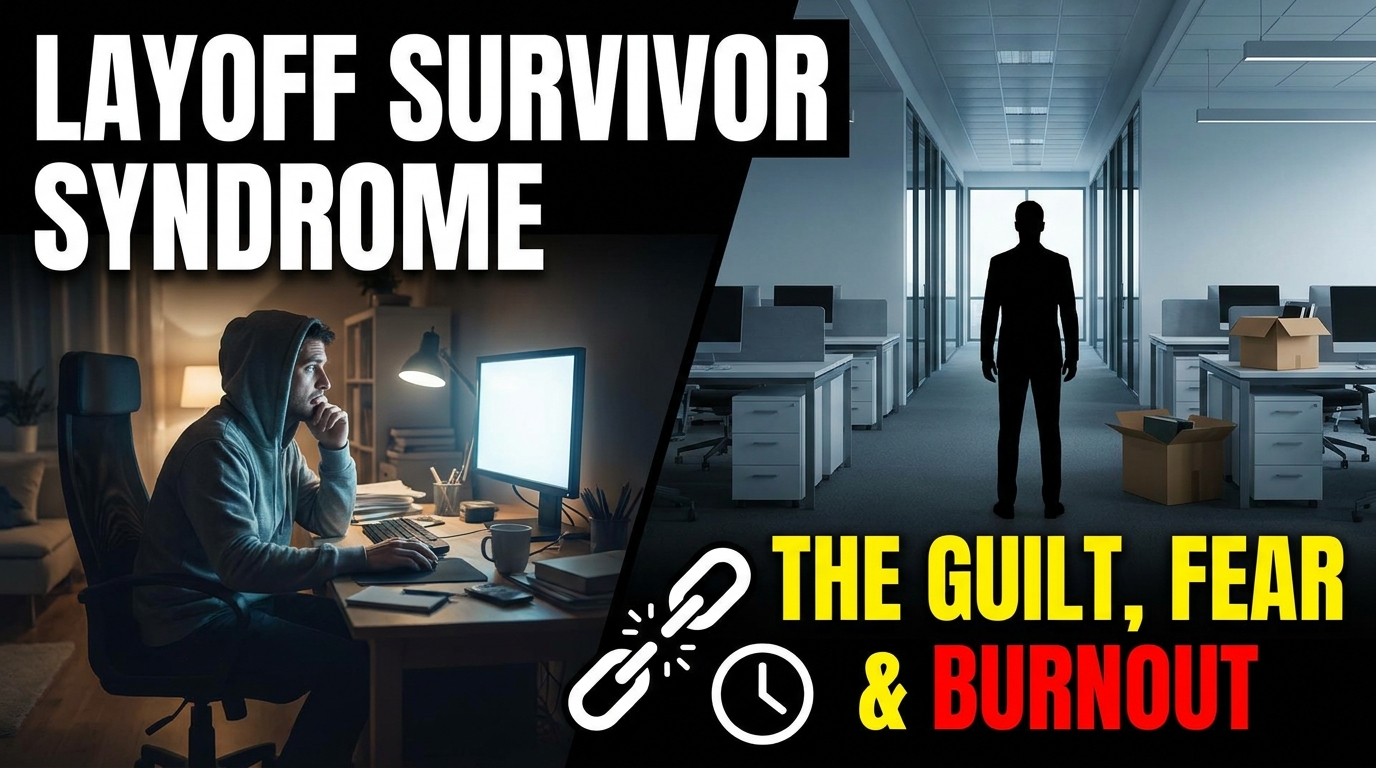
The email went out on a Tuesday. By Wednesday afternoon, eleven desks were empty and the rest of the floor was very quiet. You still have your job. You are supposed to feel relieved, and for about an hour you did. Then came the strange, heavy thing nobody prepared you for: you cannot concentrate, you feel guilty for being here, you are doing your work and half of someone else’s, and you have started scrolling job listings at midnight for a role you are not sure you even want.
You are not being dramatic and you are not ungrateful. What you are experiencing has a name in organizational psychology, layoff survivor syndrome, sometimes called survivor sickness, and it has been documented in research since the 1980s. Here is the part that should worry every executive who has ever signed off on a restructuring: the evidence consistently shows that survivors often end up more stressed, less engaged and less healthy than they were before the cuts, and a significant share leave voluntarily within a year, which is precisely the opposite of what a cost-saving exercise is supposed to achieve.
I am an Industrial and Organizational Psychologist, and this article covers what layoff survivor syndrome actually is, the four psychological mechanisms that drive it, why companies keep making it worse, what employees can do, and what leaders should do differently. It is written for both sides, because both are usually suffering and neither is usually talking about it.
“Companies think a layoff ends on the day it is announced. Psychologically, that is the day it begins for everyone who is still there, and nobody schedules a meeting for that part.”
— Workplace Psychology Analysis, ShahzebSpeaks

🧠 What layoff survivor syndrome actually is
The term was popularised by organizational consultant David Noer in his 1993 book Healing the Wounds, which studied what happened inside companies after downsizing waves. Noer found something counterintuitive: the remaining employees were not quietly grateful and productive. They were anxious, guilty, angry, exhausted and disengaged, and the effects lingered for years.
The syndrome is not one feeling. It is a cluster, and most survivors report a confusing mix of several at once:
- Guilt at having kept a job that a colleague, sometimes a better one, lost
- Fear that the next round has their name in it, and a constant background scanning for signs
- Grief for people, teams and a workplace identity that no longer exists
- Anger at leadership, often suppressed because expressing it now feels dangerous
- Exhaustion from absorbing the work of people who left
- Detachment, the quiet decision to never emotionally invest in an employer again
That last one is the most expensive for the organization and the least visible. It does not show up in an exit interview, because the person has not left. It shows up eighteen months later as a competent employee who does exactly their job description and nothing more, and whom nobody can quite explain the change in.
⚙️ The four mechanisms that drive it
Understanding why this happens matters, because the wrong intervention makes it worse. Four psychological forces are doing the work.
1. The psychological contract breaks
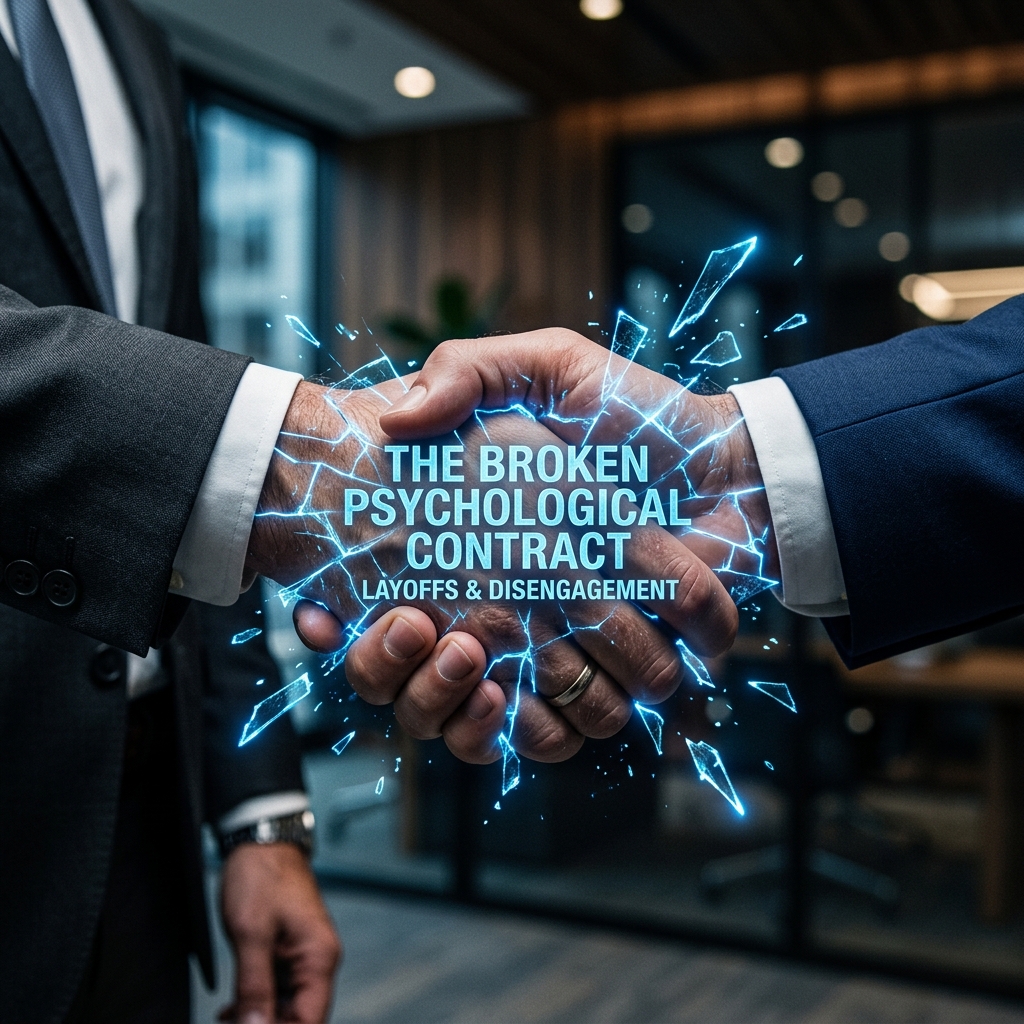
Every employee holds an unwritten set of beliefs about the deal: work hard, be loyal, be useful, and you will be treated fairly and kept. Denise Rousseau’s research on the psychological contract shows this unwritten agreement drives commitment far more than the written one does. A layoff, especially one that removes people who did nothing wrong, is a visible breach of that contract in front of everyone still in the building.
Once the contract is broken, employees rationally rewrite it. The new version is transactional: I give hours, you give money, and neither of us pretends this is more than that. Managers then complain that “nobody goes the extra mile anymore,” which is not a culture problem. It is an accurate response to new information.
2. Organizational justice collapses
Justice research distinguishes three types, and layoffs can damage all three at once. Distributive justice asks whether the outcomes were fair: were the right people let go, or did politics decide? Procedural justice asks whether the process was fair and consistent. Interactional justice asks whether people were treated with dignity, or escorted out by security with their belongings in a box.
Here is the finding that surprises most executives: survivors’ reactions depend more on how the layoff was handled than on the fact that it happened. Brockner’s extensive research on layoff survivors found that when survivors perceived the process as fair and the leavers as treated decently, the damage to their commitment was dramatically smaller. When it looked arbitrary or callous, the damage was severe. Cruelty toward departing employees is not a cost saving; it is a bill charged to the people who remain.
3. Job insecurity becomes chronic stress
There is a robust body of research showing that job insecurity is associated with worse mental and physical health outcomes, and some studies find the anticipation of job loss can be as damaging as the loss itself. The reason is that uncertainty prevents resolution. A person who is fired grieves and eventually adapts; a person who might be fired next quarter remains in a state of low-grade threat activation for months, and chronic threat activation is exactly the condition that produces sleep disruption, anxiety and burnout.
This is also why “we don’t anticipate further reductions at this time” is such a corrosive sentence. Everyone hears the escape clause, and the ambiguity keeps the alarm running.

4. Workload dumping and role chaos
The most concrete mechanism is the simplest. Eleven people left; their work did not. Survivors absorb it, usually without new resources, often without acknowledgment, sometimes without even a redefined role. This produces role overload and role ambiguity, two of the most reliably documented predictors of burnout in the occupational health literature.
And the timing is cruel: the extra workload lands precisely when psychological resources are lowest. The company has effectively increased demand and reduced coping capacity simultaneously, which is close to a textbook recipe for the exhaustion I covered in my burnout statistics article.

📉 Why the cost-saving often does not arrive
Executives approve layoffs on a spreadsheet: remove headcount, reduce salary cost, improve margin. The spreadsheet is missing a column.
Research on downsizing outcomes has repeatedly found that companies which cut staff do not reliably outperform those that do not, and a well-known body of work by Wayne Cascio and others documents that many downsizing firms fail to achieve the expected gains in profitability or productivity. The reasons are psychological rather than financial: productivity falls among distracted, exhausted survivors; voluntary turnover rises, often among the most employable people who can leave most easily; institutional knowledge walks out uncounted; rehiring and retraining costs appear a year later; and the employer brand takes a hit that shows up in future recruitment difficulty.
The uncomfortable summary is that a badly handled layoff can remove salary cost while quietly removing something more valuable, and the second removal never appears in the business case that justified the first.
💬 What survivors actually experience (and why they stay silent)
One reason this syndrome is under-discussed is that survivors feel they have no standing to complain. Their colleague lost a livelihood; they kept theirs. Expressing distress feels indecent, so it goes underground, and the silence is then read by leadership as “the team has moved on.”
Watch for the pattern instead of waiting for the disclosure. Survivors commonly show a sharp drop in discretionary effort, meaning they do the job but stop volunteering. They become conflict-avoidant, because visibility now feels risky. They over-monitor signals, reading meaning into calendar invites, closed doors, and consultants in the lobby. Many quietly update their CV as a coping behaviour rather than a plan, which is how a company loses people it never realised were leaving. And some develop what I would call anticipatory detachment, deliberately reducing emotional investment so the next round will hurt less.
None of this is disloyalty. It is a rational adaptation to an environment that has just demonstrated its own instability.
🛡️ If you are a survivor: what actually helps
Advice here has to be honest, because most of what circulates is either denial or resignation. Neither works.
Name it accurately. Knowing this is a documented syndrome, not a personal weakness, removes a layer of secondary distress. You are not fragile for having a strong reaction to a workplace that just proved it can remove people without warning.
Separate the guilt from the responsibility. Survivor guilt is a feeling, not evidence of wrongdoing. You did not select the list. Staying was not something you did to your colleague. The guilt is worth acknowledging and not worth obeying, and one useful outlet is doing something concrete for those who left, a genuine reference, an introduction, a check-in message, which converts a useless emotion into a useful action.
Get the workload renegotiated in writing. This is the single most practical move. Absorbing three people’s work silently is not resilience, it is an unfunded liability with your name on it. Ask directly which of the added responsibilities are permanent, which are temporary, and what is now allowed to be deprioritised. Managers under pressure will rarely volunteer this clarity; requesting it is legitimate and professional.
Rebuild your own security instead of waiting for theirs. The most effective antidote to chronic job insecurity is employability rather than reassurance from an employer that has already broken one promise. Keep skills current, keep the network warm, keep the CV honest and updated. This is not disloyalty; it is the only form of job security that a restructuring cannot revoke.
Watch for the line into something clinical. Persistent insomnia, panic symptoms, hopelessness, or an inability to function are beyond the scope of workplace coping advice. If that is where you are, speak to a doctor or a mental health professional. Work stress that has become a health problem is a health problem, and treating it as a character test is how people end up much worse.
🏢 If you are a leader: how to not destroy what you kept
This section is where most organizations still have real leverage, because the research is unusually clear about what protects survivors.
Treat the leavers well, publicly and generously. Survivors are watching how departing colleagues are handled and reading it as a preview of their own future. Dignity, notice, decent severance, references and a respectful exit are not only ethical obligations; they are the strongest available signal to the people staying. Escorting long-serving employees out under guard saves nothing and costs the trust of everyone who witnesses it.
Over-communicate the reasoning, including the parts you would rather not say. Procedural justice depends on people understanding why, on what criteria, and what happens next. Vague corporate language (“streamlining for agility”) is heard as evasion and increases anxiety. If further cuts are genuinely possible, saying so honestly is less damaging than a false reassurance that gets exposed in three months, because a broken reassurance destroys the credibility of every future statement.
Redistribute work deliberately, and say what stops. If the same output is expected from fewer people, you have not restructured, you have simply moved the cost to your remaining team’s health. Publish what the organization will now stop doing. A leader who explicitly kills projects protects survivors far more effectively than one who thanks them for their resilience.
Give managers something real to say. Frontline managers absorb the emotional impact of layoffs from both directions and are usually given a script and no support. Equip them, and remember that only around half of people leaders report feeling equipped to support an employee through a mental health issue, which means the person you are relying on to steady the team may need steadying themselves.
Do not run an engagement campaign in the first month. Pizza, team-building and a values workshop immediately after a layoff read as insulting, because they attempt to restore mood without addressing cause. Fix workload and clarity first. Culture activities are for after the trust repair, not instead of it.
⚠️ An honest caveat: layoffs are sometimes genuinely necessary
I want to be fair here, because this topic attracts easy villains. Some layoffs are unavoidable. A company that delays a necessary restructuring until it collapses harms everyone, and leaders sometimes face genuinely bad options with no good one among them. Nothing in this article argues that no company should ever reduce headcount.
The argument is narrower and, I think, harder to dismiss: the psychological damage to survivors is driven far more by how the process is run than by whether it happens. Fair criteria, honest communication, decent treatment of leavers and realistic workload redesign do not cost much relative to the exercise itself, and the evidence suggests they substantially reduce the productivity and turnover losses that quietly eat the savings. Most of the harm I see in organizations is not caused by the necessity of the cut. It is caused by the carelessness of the execution.
🌍 A note for readers in Pakistan and South Asia
Two local factors intensify all of this. First, weaker formal safety nets mean job loss carries harsher consequences, so the fear among survivors is proportionally sharper, and the reluctance to raise concerns is stronger, because the cost of being noticed feels higher. Second, in many organizations here layoffs are handled with minimal process, sometimes verbally and abruptly, which is precisely the procedural and interactional injustice that research identifies as the most damaging variant for those who remain.
There is also a cultural layer worth naming: in workplaces where a job supports an extended family, survivor guilt is compounded by an acute awareness of what a colleague’s household has just lost. That is not a soft observation; it materially increases the emotional load survivors carry, and any leader here who treats a restructuring as a purely administrative event has misread the room badly.
❓ Frequently asked questions
What is layoff survivor syndrome?
A documented cluster of psychological reactions in employees who keep their jobs after layoffs, including guilt, fear of the next round, grief, anger, exhaustion from absorbed workload, and emotional detachment from the employer. It was popularised by David Noer’s research on downsizing.
Why do I feel guilty for keeping my job?
Survivor guilt arises when we benefit from an outcome that harmed others through no merit of our own. It is a normal moral response, not evidence that you did something wrong. You did not choose the list, and staying was not an action taken against your colleague.
Do layoffs actually save companies money?
Often less than expected. Research on downsizing, including work by Wayne Cascio, has found that firms which cut staff do not reliably outperform those that do not, because productivity losses, voluntary turnover among high performers, lost knowledge and rehiring costs offset much of the salary saving.
How long does layoff survivor syndrome last?
It varies widely and depends heavily on how the process was handled and whether workload was realistically redesigned afterwards. Where trust is repaired and roles are clarified, recovery can take months; where the process was seen as unjust and the workload was simply dumped, effects can persist for years and often end in resignation.
What should managers do after a layoff?
Treat departing staff with visible dignity, explain the criteria and process honestly, explicitly state what work will now stop, renegotiate workloads in writing, support frontline managers, and avoid morale campaigns until the structural problems are actually fixed.
A note on this topic: if the stress described here has become persistent insomnia, panic, hopelessness, or difficulty functioning, that is worth discussing with a doctor or mental health professional rather than managing alone. Work stress that turns into a health issue deserves proper support, and seeking it is a practical step rather than an admission of weakness.
🧠 Restructuring, or recovering from one?
I’m Muhammad Shahzeb, an MSc Industrial and Organizational Psychologist. I advise organizations on restructuring communication, workload redesign and post-layoff trust repair, the work that decides whether your remaining team recovers or quietly resigns over the following year.
📚 References and further reading
- Noer, D. M. (1993). Healing the Wounds: Overcoming the Trauma of Layoffs and Revitalizing Downsized Organizations. Jossey-Bass.
- Brockner, J. (1988). “The effects of work layoffs on survivors: Research, theory and practice.” Research in Organizational Behavior, 10, 213-255.
- Brockner, J., Grover, S., Reed, T. F., & DeWitt, R. L. (1992). “Layoffs, job insecurity, and survivors’ work effort: Evidence of an inverted-U relationship.” Academy of Management Journal, 35(2), 413-425.
- Rousseau, D. M. (1995). Psychological Contracts in Organizations. Sage Publications.
- Colquitt, J. A. (2001). “On the dimensionality of organizational justice.” Journal of Applied Psychology, 86(3), 386-400.
- Cascio, W. F. (1993). “Downsizing: What do we know? What have we learned?” Academy of Management Executive, 7(1), 95-104.
- Sverke, M., Hellgren, J., & Näswall, K. (2002). “No security: A meta-analysis and review of job insecurity and its consequences.” Journal of Occupational Health Psychology, 7(3), 242-264.
- Maslach, C., & Leiter, M. P. (2016). “Understanding the burnout experience.” World Psychiatry, 15(2), 103-111.
- Gallup. “State of the Global Workplace” reports, 2025-2026. gallup.com/workplace
- Spring Health. “Mental Health Trends for 2026.” springhealth.com
Written by Muhammad Shahzeb, MSc Industrial & Organizational Psychology | Workplace Psychology Consultant | Full-Stack Web Developer
Learn more about my approach →