
How many employees are burned out in 2026? It depends on who you ask. SHRM says 44% of US workers. Gallup-linked research puts the global figure closer to 67%. Both numbers are defensible, and the gap between them tells you something important about how burnout gets measured. I have spent the past weeks pulling together every credible burnout statistic published this year, and this page is the result: the numbers, where each one comes from, and a few honest notes about which ones I trust more than others.
I compiled this as an Industrial and Organizational Psychologist because most burnout statistics floating around the internet are either outdated, stripped of their source, or quietly recycled from a 2019 survey with a new year stamped on top. Every figure below is attributed. If you are a journalist, HR leader, or researcher, you can cite anything here. A link back is appreciated.
“Burnout is not the price of ambition. It’s the price of working in a system designed without humans in mind.”
— Christina Maslach, PhD, creator of the Maslach Burnout Inventory
📌 The headline numbers (copy these)
- 66% of US employees report experiencing burnout in some form in 2026 (Grow Therapy compilation of workplace mental health research)
- 44% of US employees say they feel burned out at work; 45% feel emotionally drained; 51% feel “used up” at the end of the workday (SHRM)
- 67% of workers globally are affected by burnout, with higher rates among remote and hybrid workers (Gallup-linked research, 2026)
- Global employee engagement fell to roughly 20-21%, its lowest point in a decade (Gallup State of the Global Workplace; Fortune’s June 2026 analysis of Gallup data covering 88 million employees)
- Burnout costs US employers an estimated $322 billion per year in lost productivity and turnover (Gallup)
- Healthcare spending for burned-out employees runs 46% higher than for engaged peers, roughly $4,129 extra per person per year
- 71% of employees now rate mental health benefits as more important than conventional perks (Spring Health, 2026)
- Only 56% of people leaders feel equipped to support an employee through a mental health issue (Spring Health, 2026)
🌍 How many workers are burned out in 2026?
Here is the honest answer: the range across credible surveys runs from about 44% to 67%, and the spread comes down to definitions. Ask people “are you burned out?” and you get one number. Ask about specific symptoms like emotional exhaustion or feeling used up at the end of the day, and you get a higher one. Neither approach is wrong. They measure different things.
| Statistic | Figure | Source |
| US employees reporting burnout in some form | 66% | Grow Therapy, 2026 |
| US employees who feel burned out at work | 44% | SHRM |
| US employees feeling emotionally drained | 45% | SHRM |
| US employees feeling “used up” at day’s end | 51% | SHRM |
| Workers affected globally | 67% | Gallup-linked research, 2026 |
| Global employee engagement rate | ~20-21% | Gallup, 2025-2026 (decade low) |
One methodological note worth keeping in mind: burnout is not a clinical diagnosis. The WHO classifies it in ICD-11 as an occupational phenomenon with three dimensions: emotional exhaustion, cynicism or mental distance from one’s job, and reduced professional efficacy. Surveys that measure all three dimensions produce lower, more conservative numbers than surveys asking a single self-report question. When you see a burnout figure above 70%, check whether it measured symptoms or just asked people to self-label.
👔 Manager burnout: the story of 2026
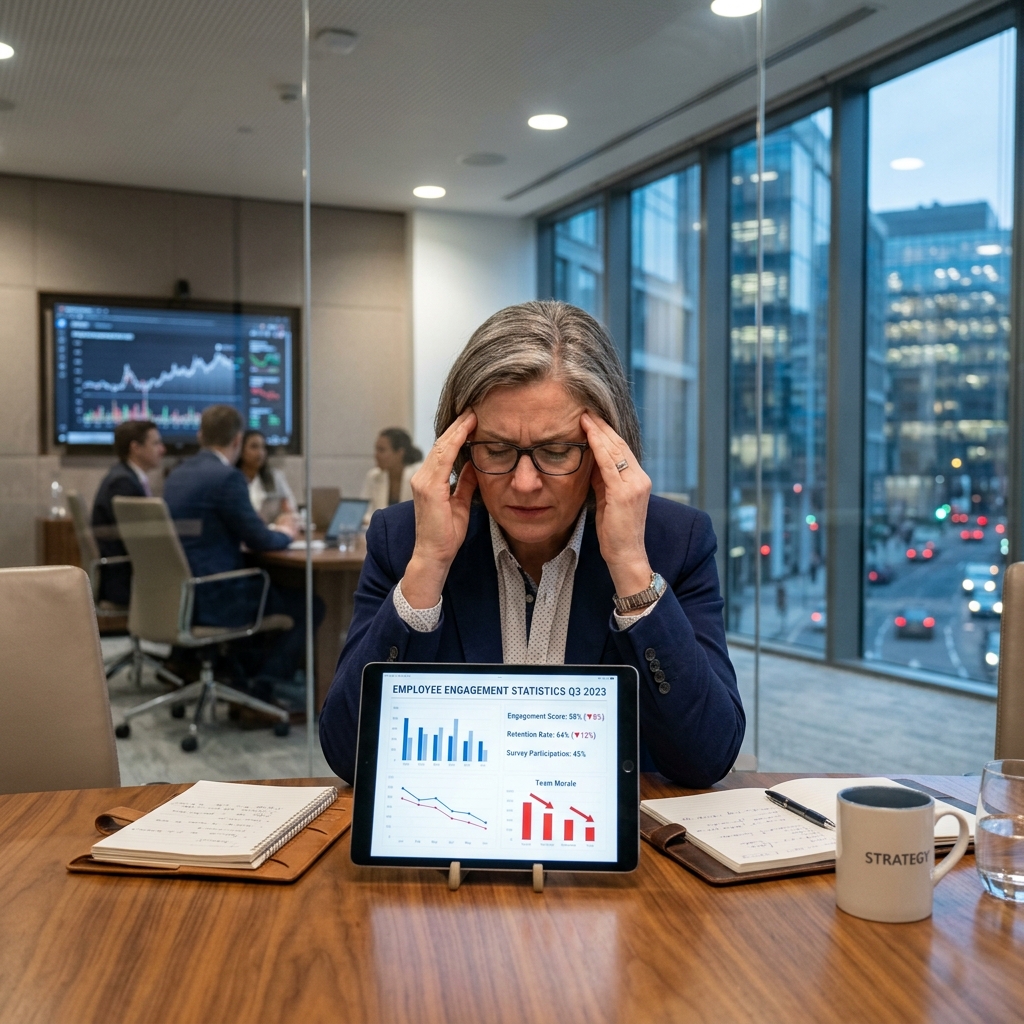
If 2022 was the year of quiet quitting, 2026 is the year the managers cracked. Gallup’s data, analyzed by Fortune in June 2026 across 88 million employees, found that the global engagement decline was driven largely by managers themselves, not frontline staff. This matters more than any other finding on this page, because manager wellbeing sets the ceiling for team wellbeing.
- Global worker engagement hit a decade low, and Gallup’s analysis points at the widening psychological safety gap between what leaders say and what employees experience (Fortune, June 2026)
- Only 56% of people leaders feel equipped to support an employee experiencing a mental health issue (Spring Health)
- Managers consistently report higher burnout rates than the individual contributors they manage, a pattern Gallup has tracked since 2023
My read on this, having consulted inside organizations on both the psychology side and the tech side: companies spent 2020 to 2024 adding wellbeing programs for employees while simultaneously squeezing the layer of people responsible for delivering those programs. Middle managers absorbed return-to-office friction, layoff survivor anxiety, and AI uncertainty all at once. The bill arrived in 2026.
💸 What burnout costs
| Cost item | Figure | Source |
| Annual cost of burnout to US employers (productivity + turnover) | $322 billion | Gallup |
| Global cost of employee disengagement | $438 billion | Gallup State of the Global Workplace |
| Extra healthcare spend per burned-out employee per year | $4,129 (+46%) | Workplace health research, 2026 compilations |
| Gallup’s broader estimate of what low engagement costs the world economy | ~9% of global GDP | Gallup (multi-year estimate) |

A caution about cost figures, because this is where statistics pages usually go wrong. The $322 billion and $438 billion numbers measure different things (US burnout costs vs global disengagement costs) and cannot be added together. Burnout and disengagement overlap heavily but are not the same construct. A burned-out high performer can still be engaged, which is arguably the most dangerous combination for retention, since those are the people who leave suddenly and expensively.
The per-person healthcare number is the one I would put in front of a CFO. Abstract billions wash over people. “Each burned-out employee costs us about four thousand dollars extra in healthcare, before we count their lost output or the cost of replacing them” is a sentence that changes budget conversations.
🏠 Remote, hybrid and the flexibility numbers

- 83% of employees say they prefer hybrid work arrangements (2026 workplace surveys)
- Nearly 40% of job postings now offer remote or hybrid options
- Remote and hybrid workers report higher burnout rates than the global average in Gallup-linked 2026 data, which surprises people until you look at why: blurred boundaries, longer effective workdays, and social disconnection
- Work-life balance has now displaced workplace trauma as the number one concern reported by American employees (APA workforce trends, 2026)
The remote burnout finding deserves a comment because it gets misused in return-to-office debates. Remote workers burning out at higher rates does not mean the office protects people. The same research consistently shows employees value flexibility and would trade other benefits for it. What it means is that flexibility without boundaries just relocates the burnout from the commute to the kitchen table. The variable that predicts burnout is not location. It is whether the workload is sustainable and whether anyone notices when it is not.
🧠 Mental health benefits: what employees actually want
- 71% of employees consider mental health benefits more important than conventional perks (Spring Health, 2026)
- 66% of US employees report burnout in some form, yet most workplace wellbeing budgets still go to perks employees rank below mental health support
- A growing share of employees now experiment with AI chatbots for emotional support, which HR researchers flag as a trust and privacy problem when consumer tools substitute for clinical care (Spring Health, 2026)
- Job insecurity tied to AI and economic uncertainty is now a measurable driver of workplace anxiety, with the APA describing 2026 as an “age of uncertainty” for workers
That last point is where I think the 2027 numbers will move. Burnout research spent two decades focused on workload. The newer driver showing up in the data is uncertainty: employees who feel replaceable, whether by AI or by the next restructuring round, show stress patterns similar to employees who are simply overworked. You cannot yoga-class your way out of feeling disposable.
📉 The trend: 2020 to 2026
| Period | What the data showed |
| 2020-2021 | Pandemic spike. Burnout enters mainstream vocabulary; WHO’s ICD-11 classification (adopted 2019) starts appearing in HR policy. |
| 2022 | Quiet quitting becomes shorthand for disengagement-as-self-protection. Engagement begins sliding. |
| 2023-2024 | Layoff waves in tech plus return-to-office mandates. Manager burnout starts outpacing employee burnout in Gallup tracking. |
| 2025 | Global engagement falls to ~20-21%, the lowest since 2020 per Gallup, with disengagement costing an estimated $438 billion. |
| 2026 | Decade-low engagement confirmed across 88 million employees. AI-driven job insecurity emerges as a distinct burnout driver. Work-life balance becomes employees’ top stated concern. |
🛡️ What actually reduces burnout (according to the research, not the wellness industry)
Since this page will get cited, I want the intervention data here too, because the gap between what works and what companies buy is its own statistic.
The interventions with the strongest evidence base are structural: workload redesign, increased job control and autonomy, fair and transparent processes, and trained managers who hold regular one-on-ones. Christina Maslach’s research has argued this for decades, and the 2026 engagement data backs her up. The psychological safety gap Fortune highlighted in Gallup’s numbers is a leadership variable, not an employee resilience variable.
The interventions with the weakest evidence are the ones easiest to purchase: meditation app subscriptions, wellness stipends, and one-off resilience workshops. They are not useless. For an individual, mindfulness practice measurably helps with stress symptoms. But treating a workload problem with a meditation app is like treating a broken leg with painkillers. The pain relief is real and the leg is still broken.
If you take one number from this section: only 56% of managers feel equipped to have a mental health conversation. Training that missing 44% is cheaper than any wellness platform contract I have seen, and it targets the variable Gallup’s own data says is driving the decline.
❓ Frequently asked questions
What percentage of employees are burned out in 2026?
Between 44% and 67%, depending on measurement. SHRM’s symptom-based US figures cluster around 44-51%. Broader self-report compilations put US burnout at 66% and global burnout at 67%.
How much does burnout cost companies?
Gallup estimates burnout costs US employers about $322 billion annually in lost productivity and turnover. Each burned-out employee also generates roughly $4,129 in additional healthcare costs per year, 46% more than an engaged colleague.
Is burnout a medical diagnosis?
No. The WHO classifies burnout in ICD-11 as an occupational phenomenon, not a medical condition. It has three dimensions: emotional exhaustion, cynicism toward one’s job, and reduced professional efficacy. This distinction matters for how surveys measure it and for how employers should respond to it.
Are remote workers more burned out than office workers?
Recent Gallup-linked data shows remote and hybrid workers reporting somewhat higher burnout rates, largely due to boundary erosion and social disconnection. The same body of research shows employees still strongly prefer flexible arrangements, so the finding argues for better boundaries, not office mandates.
Who is most burned out?
The 2026 story is managers. Gallup’s decade-low engagement finding was driven disproportionately by the manager layer, and only 56% of people leaders feel equipped to support struggling team members, while facing the same pressures themselves.
A note on this topic: burnout statistics describe populations, but if you recognize yourself in these numbers, that is worth taking seriously. Chronic exhaustion that rest does not fix deserves attention from a professional, not just a statistics page. If work stress is affecting your mental health, speaking with a doctor or therapist is a reasonable next step, not an overreaction.
Citing these statistics?
You’re welcome to use any figure on this page with attribution. I’m Muhammad Shahzeb, an MSc Industrial and Organizational Psychologist. I update this page as new data is published. For workplace psychology consulting or media queries, get in touch.
📚 References and sources
- Gallup. “State of the Global Workplace Report.” gallup.com/workplace (2025-2026 editions)
- Fortune. “Worker engagement just hit a decade low, and new data from 88 million employees shows why managers are the problem.” June 23, 2026. fortune.com
- SHRM. “Employee Mental Health and Burnout Research.” shrm.org
- Spring Health. “8 Mental Health Trends for 2026 and What They Mean for Your Workplace.” springhealth.com
- American Psychological Association. “Workers are facing an age of uncertainty.” APA Monitor on Psychology, January-February 2026
- Grow Therapy. “45+ Workplace Mental Health Statistics for 2026.” growtherapy.com
- WorkTime. “Employee Burnout Statistics 2026: 40 Key Trends and Costs.” worktime.com
- World Health Organization. “Burn-out an ‘occupational phenomenon’: International Classification of Diseases (ICD-11).” who.int, 2019
- Maslach, C., & Leiter, M. P. (2016). “Understanding the burnout experience: recent research and its implications for psychiatry.” World Psychiatry, 15(2), 103-111.
- Maslach, C., Jackson, S. E., & Leiter, M. P. (1996). Maslach Burnout Inventory Manual (3rd ed.). Consulting Psychologists Press.
Compiled by Muhammad Shahzeb, MSc Industrial & Organizational Psychology | Workplace Psychology Consultant | Full-Stack Web Developer
Learn more about my approach →