
Organizational Psychology in Crisis: Managing Employee Mental Health & Productivity During Geopolitical Instability
It is 9:00 AM. Your employee opens their laptop. Before checking their first work email, they have already scrolled through 47 news alerts about escalating conflict in the Middle East, seen three graphic videos shared on WhatsApp groups, and had an argument with a family member about politics. Their workday has not started, but their cognitive resources are already depleted.
Now multiply this by every member of your team. Every day. For weeks or months. And ask yourself: what happens to organizational performance when the entire workforce is operating under a baseline of chronic psychological distress?
This is not a hypothetical scenario. This is the reality facing organizations across Pakistan, the Middle East, and globally in 2024-2026. And most business leaders are catastrophically unprepared — not because they lack business acumen, but because they lack organizational psychology expertise.
The Hard Truth: According to the World Health Organization, every $1 invested in mental health treatment returns $4 in improved health and productivity. During geopolitical crises, this ROI increases to $7, because the baseline mental health impact is more severe and more widespread.
The Invisible Crisis Inside Your Organization
There is a crisis happening inside every organization right now, and it is not on any dashboard, KPI report, or quarterly review. It is invisible because we do not measure it — and we do not measure it because most organizations still treat employee psychology as a “soft” issue rather than a hard business variable.
Let me make this concrete with data:
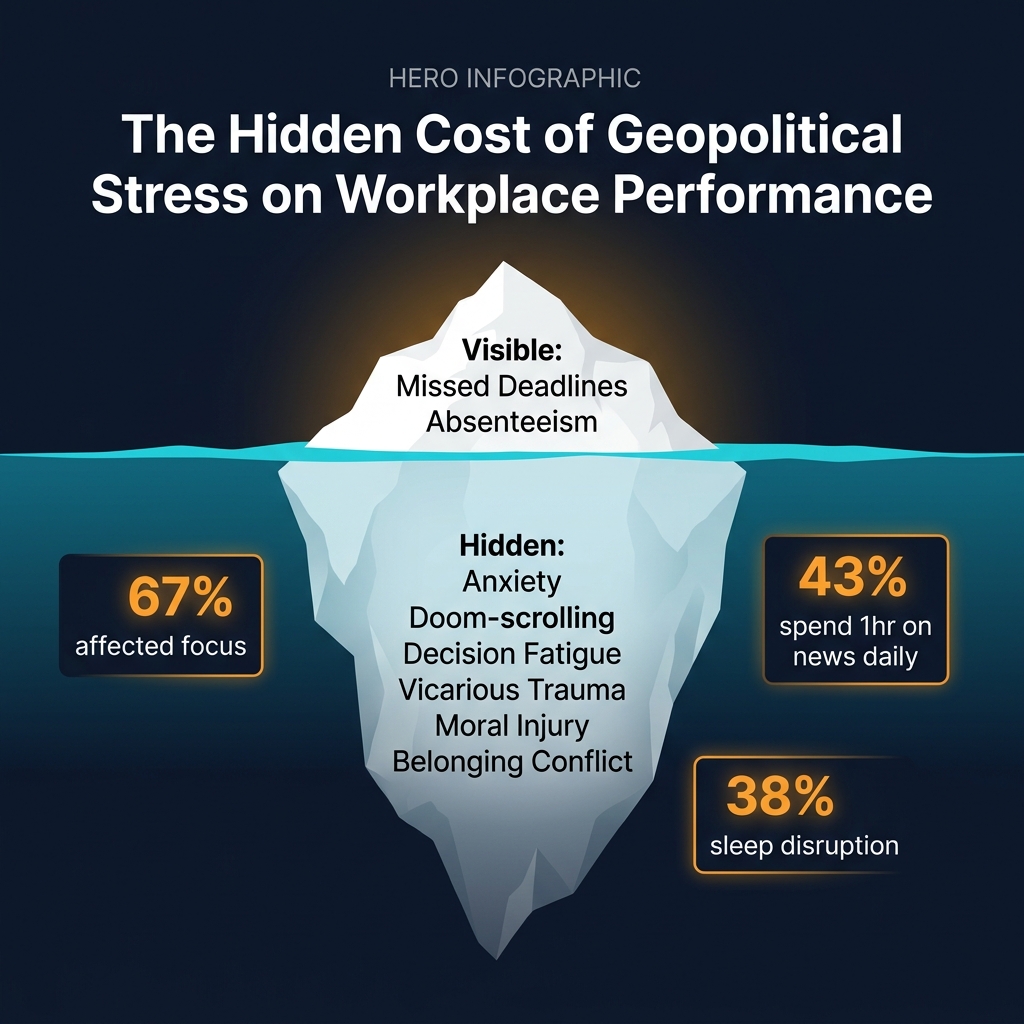
- 67% of employees report that geopolitical news significantly affects their ability to focus at work (APA Stress in America Survey, 2024)
- 43% of workers say they spend at least 1 hour per workday consuming conflict-related news (Pew Research)
- 38% of employees report sleep disruption due to geopolitical anxiety, directly impacting next-day performance
- 29% of workers describe experiencing symptoms consistent with vicarious traumatization from conflict coverage
- 52% of managers say they feel unequipped to support team members experiencing geopolitical distress
These numbers represent a massive, measurable drag on organizational performance. And unlike supply chain disruptions or market volatility, this crisis cannot be solved with spreadsheets — it requires Industrial & Organizational Psychology.
Understanding the Psychology: Why Distant Wars Affect Your Team
One of the most common responses I hear from business leaders is: “The war is thousands of miles away. Why would it affect my employees?” This reveals a fundamental misunderstanding of how human psychology works in the age of constant digital connectivity.
1. Vicarious Traumatization Through Digital Media
Dr. Charles Figley’s research on compassion fatigue and vicarious traumatization demonstrated that exposure to others’ suffering — even through media — can produce trauma-like symptoms in observers. In the age of social media, this effect is amplified exponentially.
Your employees are not watching carefully edited evening news broadcasts. They are seeing raw, unfiltered footage — graphic videos shared on Telegram, real-time suffering documented on X (Twitter), and emotionally manipulative content algorithmically amplified by platforms designed to maximize engagement through outrage.
The psychological impact is comparable to secondary trauma experienced by:
- Emergency first responders who witness aftermath of disasters
- Therapists who absorb their clients’ traumatic narratives
- Journalists covering conflict zones
The critical difference? First responders receive trauma training and psychological support. Your employees receive nothing.
2. Identity Threat and Belonging Conflict
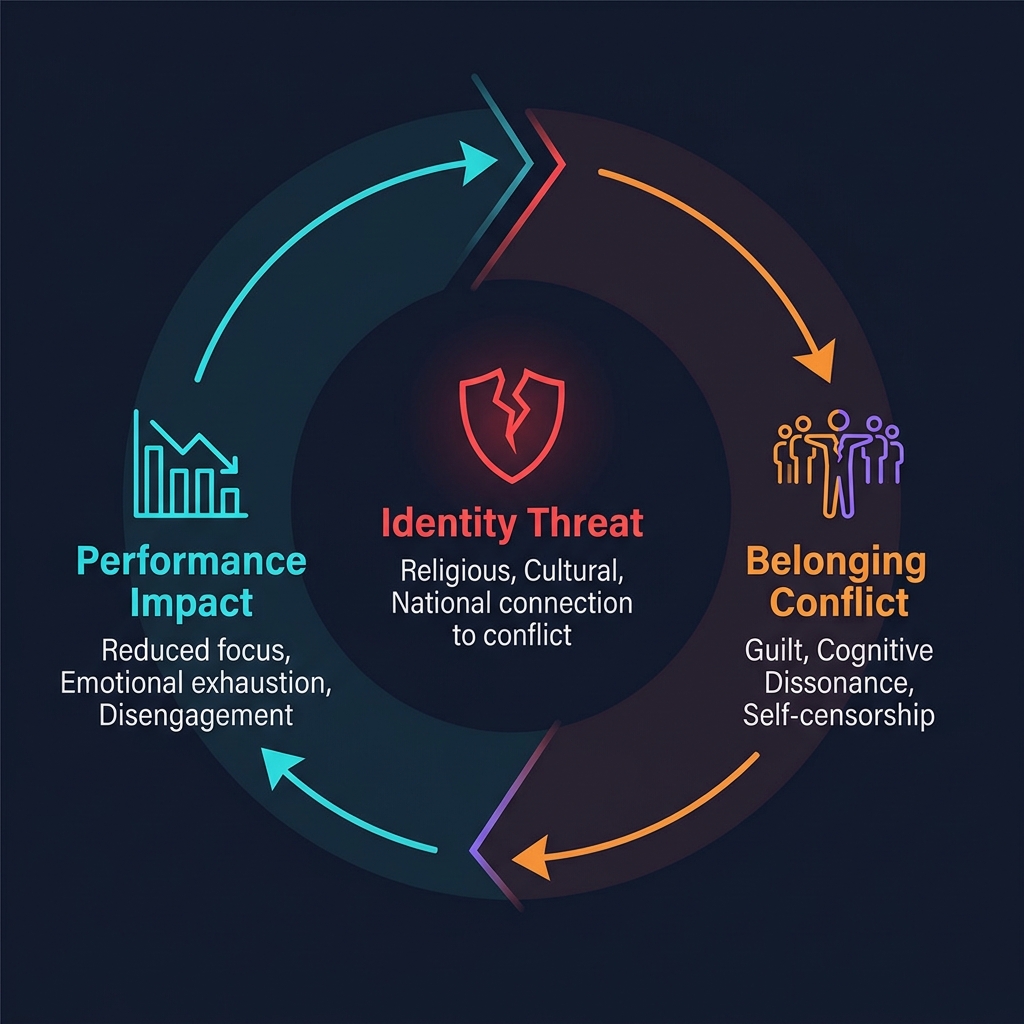
For employees in Pakistan and across the Muslim world, Middle East conflicts trigger a specific psychological response called identity threat. When a group you identify with is under attack — whether directly or perceived — your brain’s threat detection system activates as though you personally are under threat.
This creates what I/O psychologists call a belonging conflict:
- Employees feel they should be doing something about the crisis, but their professional role requires focus on work
- They feel guilty about “normal life” activities while people who share their identity are suffering
- They experience cognitive dissonance between personal values and organizational neutrality
- They fear judgment from colleagues who may hold different perspectives on the conflict
This belonging conflict creates a persistent drain on emotional and cognitive resources that no amount of project management software can solve.
3. The Doom-Scrolling Addiction Cycle
Neuroscience research reveals that consuming negative news creates a paradoxical addiction cycle. The brain releases cortisol (stress hormone) in response to threatening information, but it also releases dopamine when you find a new piece of information — creating a stress-reward loop that is incredibly difficult to break.
This is why your employees cannot stop checking their phones. It is not a lack of discipline. It is a neurochemical hijacking exploited by platform algorithms designed to maximize time-on-screen. The result:
- Attention fragmentation: The average employee checks their phone 96 times per day — during crisis periods, this can exceed 150 times
- Context-switching cost: Each interruption requires 23 minutes to return to full focus (University of California research)
- Cumulative productivity loss: A conservative estimate of 2-3 hours of productive work lost daily per employee
The Five Stages of Organizational Crisis Response
Through my work in I/O Psychology, I have observed that organizations move through five distinct psychological stages during geopolitical crises. Understanding where your organization is helps you apply the right interventions.
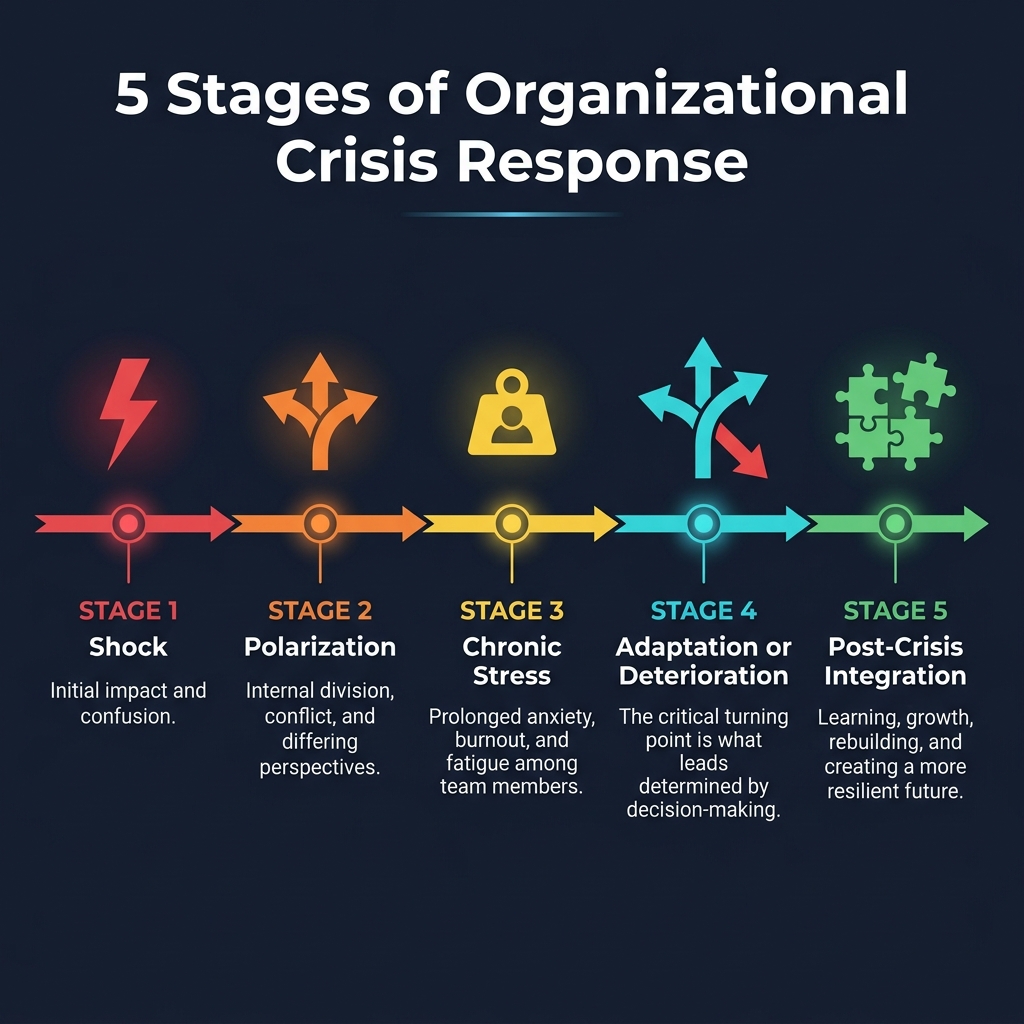
Stage 1: Shock and Hyper-Attention (Days 1-7)
When a crisis erupts, the organization experiences collective shock. News consumption spikes. Informal conversations dominate. Productivity drops sharply as attention diverts to the crisis. This is natural and healthy — trying to suppress it creates worse outcomes.
What to do: Acknowledge the crisis openly. Allow space for processing. Do not expect normal productivity. Cancel non-essential meetings. The psychological cost of pretending nothing is happening far exceeds the productivity loss of acknowledging reality.
Stage 2: Polarization and Fracturing (Weeks 2-4)
As the initial shock fades, differing perspectives emerge. Team members may have fundamentally different views on the conflict, creating interpersonal tension, self-censorship, and tribal dynamics. This is the most dangerous stage for organizational culture.
What to do: Establish clear guidelines for respectful discourse. Create psychological safety where people can express distress without expressing political positions that divide the team. Focus conversations on shared human values (compassion, safety, peace) rather than political analysis.
Stage 3: Chronic Stress Normalization (Months 1-3)
The crisis becomes “normal.” Headlines continue, but the organization stops actively responding. This is when the silent damage accelerates. Burnout rates spike. Cynicism increases. Performance metrics gradually decline without any obvious trigger.
What to do: This is when proactive mental health support matters most. Implement regular check-ins. Monitor for signs of chronic stress (increased errors, decreased communication, withdrawal from social interactions). Maintain — do not reduce — psychological support resources.
Stage 4: Adaptation or Deterioration (Months 3-6)
Organizations either adapt — developing new norms, enhanced resilience, and stronger team bonds — or they deteriorate. The difference is entirely determined by leadership’s psychological intervention during stages 1-3.
What to do: Assess organizational health honestly. Survey employees. Measure engagement. If deterioration is occurring, invest in targeted interventions — team rebuilding, conflict resolution, renewed purpose articulation.
Stage 5: Post-Crisis Integration (6+ months)
When the acute crisis passes (or enters a new phase), organizations must integrate the experience rather than simply “moving on.” Unprocessed collective trauma becomes organizational scar tissue that weakens response to future crises.
What to do: Conduct retrospectives focused on psychological learnings, not just operational ones. “What did we learn about supporting our people? What will we do differently next time?”
The Manager’s Toolkit: Practical I/O Psychology Interventions
Most managers receive extensive training in technical skills, project management, and financial analysis. Almost none receive training in psychological first aid — the ability to recognize and respond to team members experiencing distress. Here is the toolkit I teach in my organizational psychology practice:
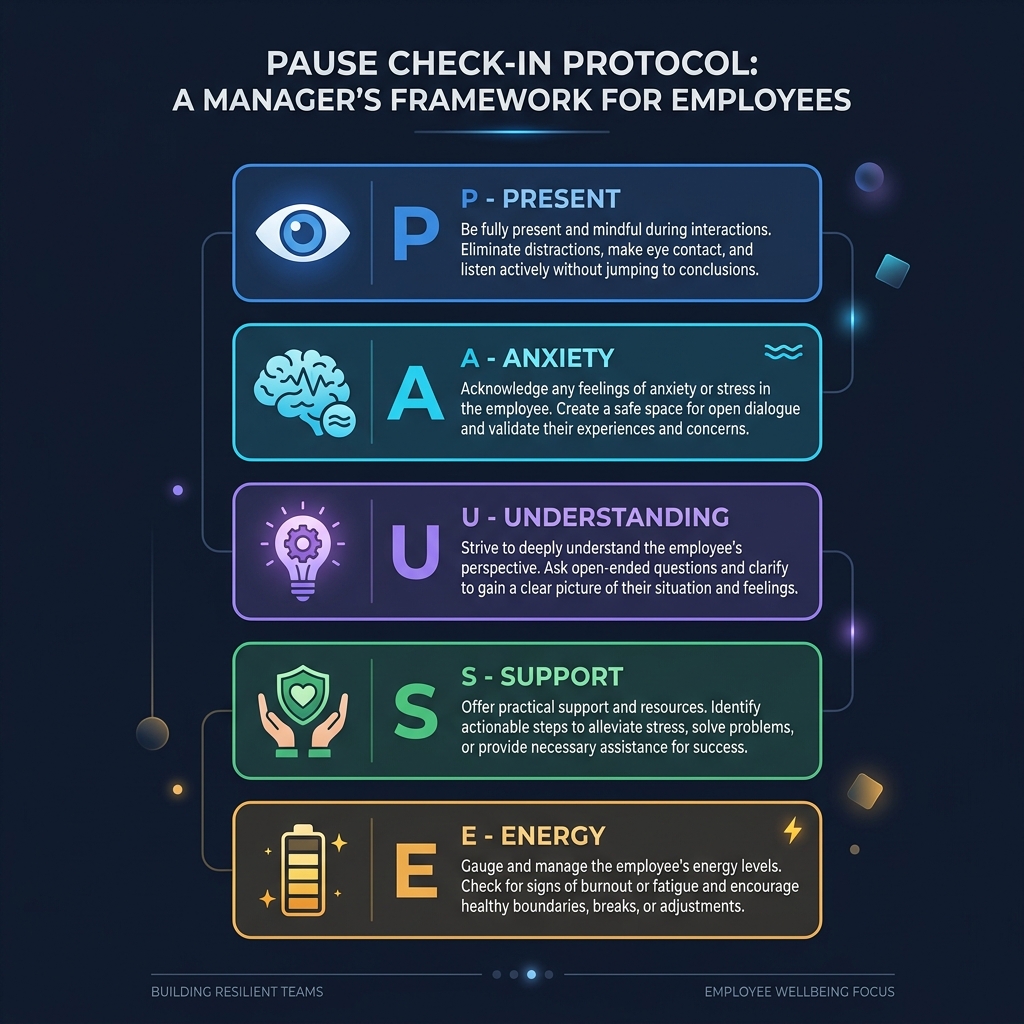
Intervention 1: The PAUSE Check-In Protocol
A structured weekly team check-in designed specifically for crisis periods:
- P — Present: “How present do you feel this week? 1-10?” (Measures attention fragmentation)
- A — Anxiety: “How much is external news affecting your work? Low/Medium/High?” (Normalizes the impact)
- U — Understanding: “Is there anything you need from me or the team to manage this better?” (Opens support channels)
- S — Support: “What support would be most helpful right now?” (Creates actionable paths)
- E — Energy: “Where is your energy level? What is draining it?” (Identifies specific interventions)
This takes 15 minutes and provides more actionable insight into team wellbeing than any performance dashboard.
Intervention 2: Cognitive Load Redistribution
When team members are cognitively impaired by crisis-related anxiety, the traditional approach of “push through” creates exactly the wrong outcome. Instead, apply cognitive load redistribution:
- Identify high-cognitive-load tasks: Complex analysis, creative work, strategic planning
- Schedule them for peak cognitive periods: Usually early morning, before news consumption peaks
- Batch low-cognitive-load tasks: Administrative work, routine communications, data entry — assign these during afternoon slumps
- Reduce simultaneous demands: Single-task assignments outperform multi-task assignments by 40% during crisis periods
- Extend deadlines where possible: Pressure amplifies anxiety; relief reduces it
Intervention 3: Psychological Safety Reinforcement
Google’s Project Aristotle — the company’s massive study of team effectiveness — found that psychological safety is the #1 predictor of high-performing teams. During geopolitical crises, psychological safety is the first thing to erode, as people fear expressing unpopular opinions or admitting vulnerability.
Reinforce psychological safety by:
- Leading with vulnerability: “I’m also finding it hard to focus this week” from a leader normalizes the experience for everyone
- Separating performance from presence: Do not penalize people for reduced output during acute crisis periods
- Celebrating honesty: When someone says “I’m struggling,” respond with support, not solutions
- Creating non-work spaces: Allow team channels or meeting segments where people can simply connect as humans
Intervention 4: The “News Hygiene” Workshop
One of the most effective interventions I have delivered is teaching teams “news hygiene” — the practice of intentionally managing news consumption to maintain psychological health without disengaging from reality.
The framework:
- Designated news times: Check news 2-3 times per day at scheduled times, not continuously
- Source curation: Choose 2-3 reliable sources rather than consuming the algorithmic firehose
- No news before bed: Cortisol disruption from evening news consumption degrades sleep quality by 30%
- No news in the first hour: Starting the day with crisis content primes the brain for threat detection all day
- Action orientation: After consuming news, take one constructive action (donate, volunteer, support someone) rather than passive consumption
Intervention 5: Purpose Reconnection
During crisis, individual work can feel meaningless — “Why am I writing this report when people are dying?” This is a normal psychological response, but left unaddressed, it leads to existential disengagement.
Counter this by explicitly connecting daily work to meaningful outcomes:
- “Your work provides jobs for 50 families who depend on this company”
- “The product we build helps [specific people] solve [specific problems]”
- “Our financial health enables us to support [charitable causes, community initiatives]”
- “Every person who does their job well contributes to stability and normalcy — which is itself a form of resistance against chaos”
The Leadership Psychology of Crisis Communication
How leaders communicate during geopolitical crises has a disproportionate impact on organizational outcomes. Research by Jim Kouzes and Barry Posner shows that during uncertainty, employees look to leaders not for answers (which are often unavailable) but for emotional stability, authentic empathy, and clear direction.
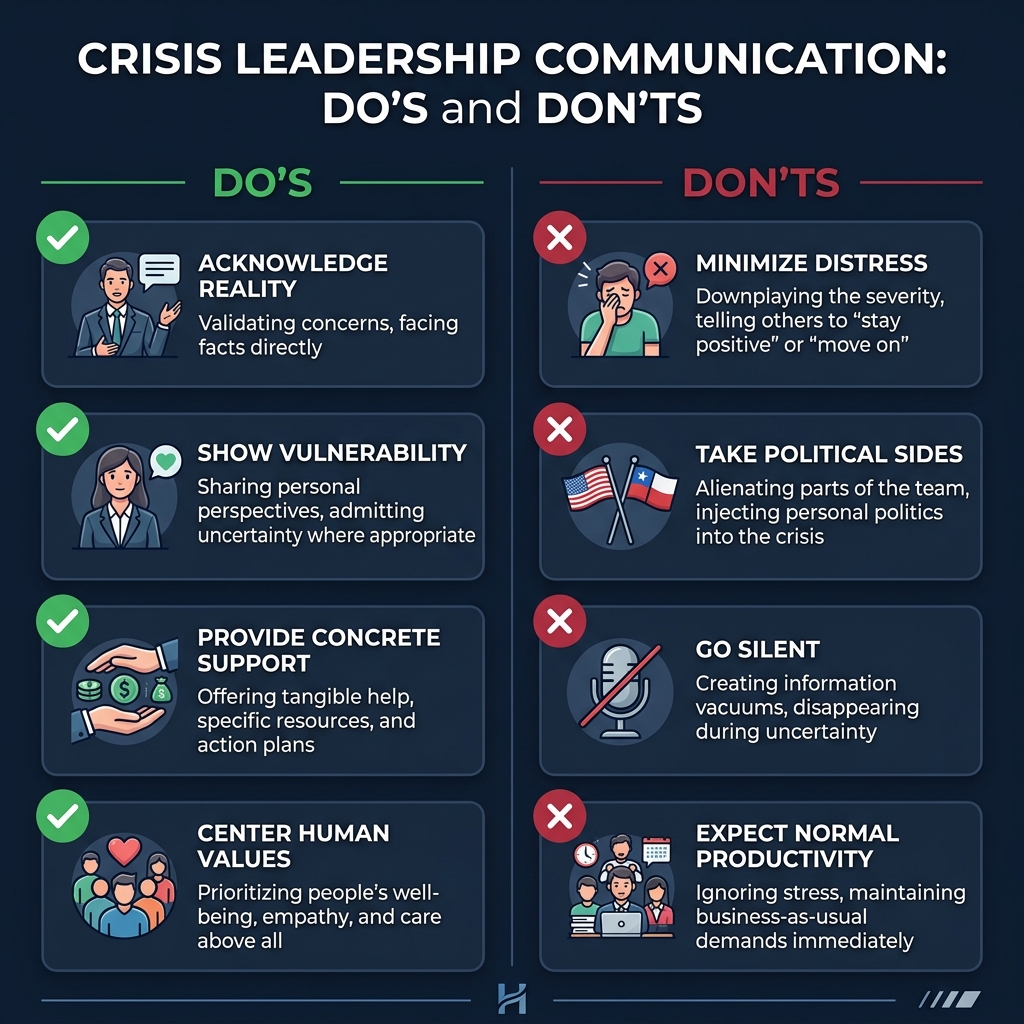
What Effective Crisis Communication Looks Like
Do: Acknowledge Without Solving
“I want to acknowledge that many of us are deeply affected by what is happening in the Middle East. There are no easy answers, and I will not pretend to have them. What I can tell you is that we are here for each other, and your wellbeing matters as much as any business objective.”
Do: Provide Concrete Support
“We have activated our Employee Assistance Program for anyone who needs someone to talk to. We are also offering flexible schedules this month for anyone who needs to manage their energy differently. Please use these resources — that is what they are for.”
Don’t: Minimize or Dismiss
“Let’s focus on work and not get distracted by things we cannot control.” This statement, while well-intentioned, communicates that leadership does not understand or care about employees’ psychological reality. It destroys trust.
Don’t: Take Political Sides (As an Organization)
Unless your organization is explicitly political or advocacy-focused, taking sides on geopolitical conflicts alienates portions of your team and customer base. Instead, center your communication on human values: compassion for suffering, support for peace, concern for civilians.
Measuring the Impact: KPIs for Organizational Mental Health
You cannot manage what you do not measure. Here are the Organizational Mental Health KPIs I recommend tracking during geopolitical crises:
- Engagement Score: Monthly pulse surveys measuring emotional connection to work (target: maintain within 15% of baseline)
- Absenteeism Rate: Track unplanned absences — increases above 20% of baseline indicate organizational distress
- Error Rate: Monitor quality metrics — increased errors indicate cognitive impairment across the team
- Communication Volume: Sharp drops in internal communication indicate withdrawal and disengagement
- Turnover Intent: Anonymous survey asking “Have you considered leaving in the past 30 days?” — early warning system
- Manager Check-In Completion: Are managers actually conducting wellbeing check-ins? (Track compliance)
- EAP Utilization Rate: Promote and measure usage of mental health support resources
Special Considerations for Pakistani Organizations
Pakistani organizations face unique challenges during Middle East crises that require culturally informed psychological interventions:
1. Religious and Cultural Connection
For many Pakistani employees, Middle East conflicts have deep religious and cultural significance. The psychological impact is not about “foreign affairs” — it is about threats to sacred identity. Organizations must recognize this heightened emotional investment rather than comparing it to how employees might feel about conflicts in unrelated regions.
2. Diaspora Anxiety
Millions of Pakistanis have family members working in Gulf states. During Middle East instability, these employees experience direct personal anxiety about loved ones’ safety. Standard “work-life balance” advice is insufficient — these employees need specific support: communication time with family, flexible schedules, and genuine empathy from leadership.
3. Economic Ripple Effects
Pakistani employees are often acutely aware that Middle East instability directly affects oil prices, remittance flows, and the national economy. This creates a layered anxiety: personal safety concerns + national economic concerns + job security concerns. Addressing only one layer while ignoring the others is ineffective.
4. Stigma Around Mental Health
Despite progress, mental health remains stigmatized in many Pakistani organizational cultures. During crises, employees may suffer in silence rather than seeking support. Organizations must actively normalize mental health conversations through leadership example, anonymous support channels, and culturally sensitive communication.
Building a Crisis-Resilient Organization: The Long-Term Blueprint
Geopolitical crises are not exceptions — they are features of the modern global landscape. Organizations that treat each crisis as an isolated disruption are perpetually unprepared. The alternative is building structural psychological resilience into your organization’s DNA.
- Embed I/O Psychology into HR: Every HR team should include or consult with organizational psychology expertise — not just for crisis response, but for ongoing employee development
- Train managers in psychological first aid: This is as important as technical training — managers are the front line of employee wellbeing
- Build emotional infrastructure before you need it: EAPs, mental health benefits, and support systems must be established during calm periods, not scrambled during crises
- Develop crisis communication playbooks: Pre-written communication frameworks reduce response time and improve quality during acute stress
- Measure organizational psychological health continuously: Annual engagement surveys are insufficient — monthly pulse checks create actionable data
- Create a culture of psychological safety: This is not a program — it is a practice that must be reinforced daily through leadership behavior
Conclusion: The Organizations That Win Are the Ones That Care
In my years of practice as an Industrial & Organizational Psychologist, I have seen a pattern repeat itself with remarkable consistency: the organizations that prioritize their people during crisis are the ones that emerge stronger afterward.
This is not idealism. It is data. Companies with high employee engagement during crisis periods outperform their peers by 147% in earnings per share (Gallup). Organizations that invest in employee mental health during downturns retain 90% more top talent than those who don’t (Deloitte). Businesses that maintain psychological safety during geopolitical instability see 30% faster recovery in productivity (Harvard Business Review).
The war in the Middle East is a human tragedy. Its impact on business is real and measurable. But within every crisis lies an opportunity — not to profit from suffering, but to build the kind of organization where people feel valued, supported, and capable of doing their best work even when the world outside is uncertain.
That is not just good psychology. That is good business.
Muhammad Shahzeb is an Industrial & Organizational Psychologist (MSc) and Web Developer who helps organizations build psychologically resilient teams and data-driven workplace cultures. For organizational psychology consulting, workshops, and mental health strategy development, explore Psychology Counseling Services | Career Coaching | UX Psychology | Brand Psychology Audits