
The Psychology of Business Resilience During Geopolitical Crisis: How War Impacts Consumer Behavior & Workplace Productivity
As missiles light up the skies over the Middle East and global supply chains buckle under the weight of geopolitical instability, the impact extends far beyond the conflict zones. Every business on the planet feels the ripple effect — from the corner shop in Karachi to Fortune 500 boardrooms in New York.
But here is what most business leaders miss: the economic impact of war is only half the story. The other half — the one that determines whether your business survives or collapses — is entirely psychological. Consumer spending patterns shift, employee productivity plummets, decision-making quality deteriorates, and organizational culture fractures along invisible fault lines of anxiety and uncertainty.
As an Industrial & Organizational Psychologist, I have studied how geopolitical crises rewire human behavior at both the individual and organizational level. This article is not geopolitical commentary — it is a data-driven analysis of how war psychologically impacts business, and what you can do about it.
Key Insight: Research from the American Psychological Association shows that geopolitical stress affects 72% of workers’ productivity, even when they are thousands of miles from the conflict zone. The psychological impact of war on business is global, immediate, and measurable.
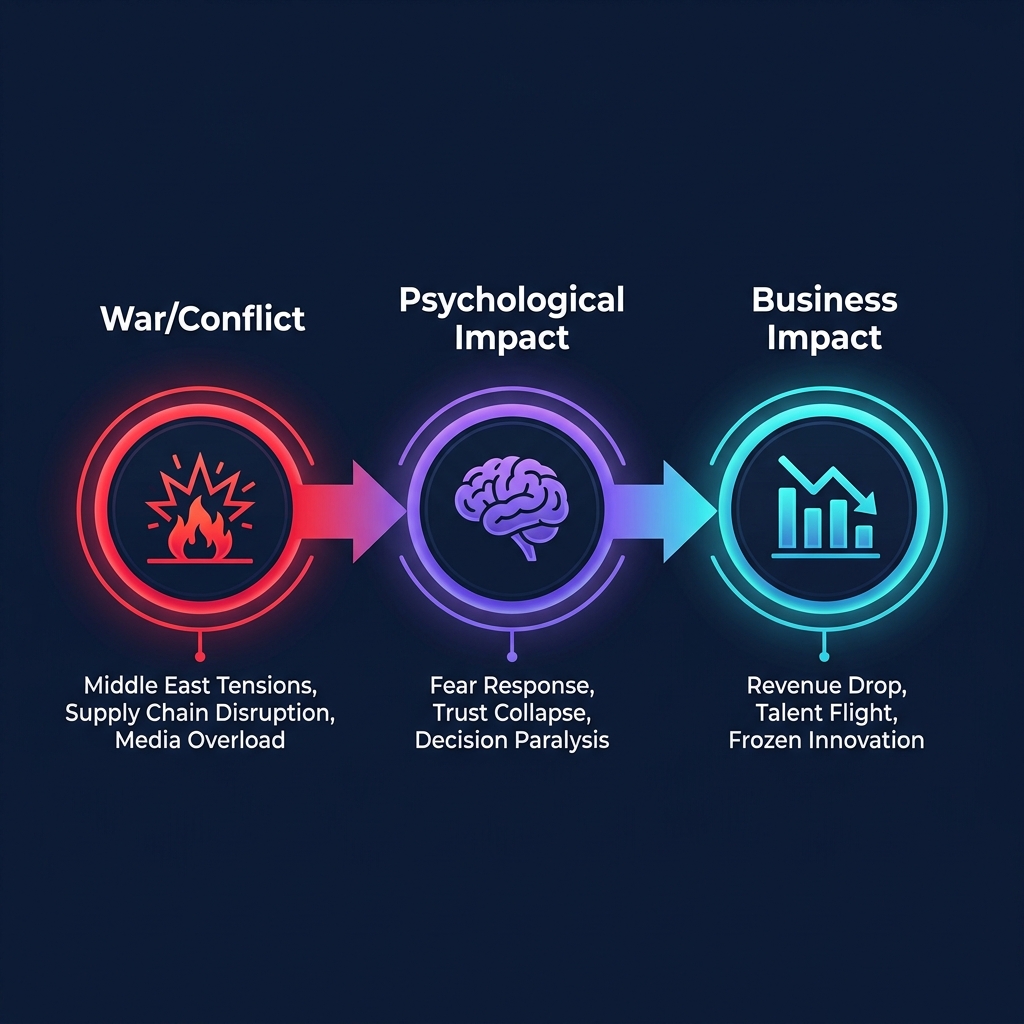
Part 1: How War Rewires Consumer Psychology
When geopolitical crises unfold, consumer behavior does not simply “slow down.” It fundamentally transforms. Understanding these psychological shifts is the difference between a business that adapts and one that disappears.
1. The Fear-Hoarding Response: Scarcity Psychology Activates
The moment conflict escalates, a deep evolutionary mechanism activates in consumers: loss aversion on steroids. Daniel Kahneman’s Prospect Theory tells us that humans feel the pain of losing something roughly 2.5 times more intensely than the pleasure of gaining the equivalent. During war, this multiplier increases dramatically.
We saw this during the 2022 Russia-Ukraine conflict when European consumers panic-bought fuel, sunflower oil, and even iodine tablets. The behavior was economically irrational but psychologically predictable. When survival circuits activate, the prefrontal cortex — responsible for rational decision-making — takes a back seat to the amygdala’s fight-or-flight response.
What This Means for Your Business
- Essential goods businesses: Demand spikes unpredictably — prepare inventory buffers for critical supplies
- Luxury and discretionary businesses: Spending contracts sharply as consumers shift to “survival mode”
- Digital services: Subscription cancellations increase as consumers audit every recurring expense
- E-commerce: Cart abandonment rates increase by 15-30% during active conflict periods
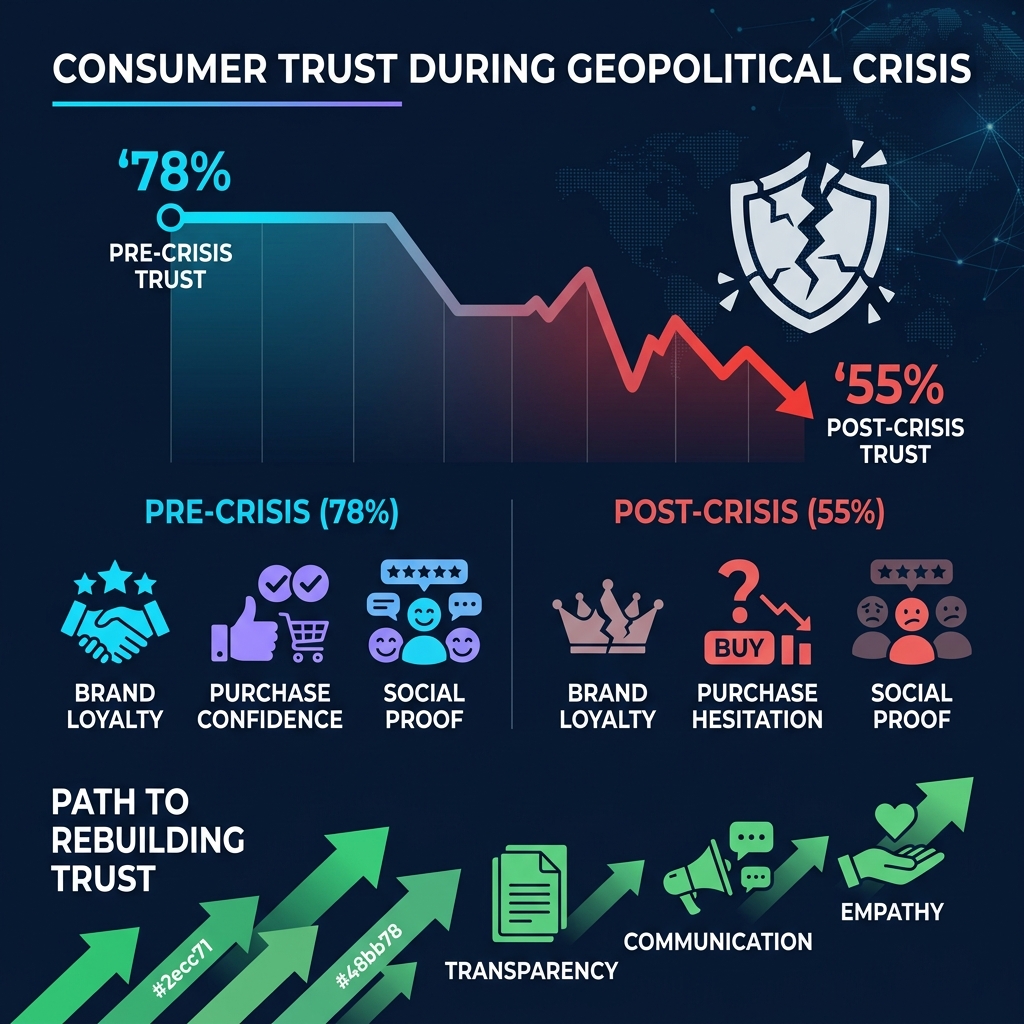
2. The Trust Collapse: Brand Loyalty Evaporates
During geopolitical crises, consumers experience what psychologists call generalized anxiety transfer. The anxiety generated by war does not stay contained to war-related thoughts — it bleeds into every decision, including purchasing decisions. Consumers become suspicious of marketing claims, skeptical of new brands, and hyper-vigilant about being “cheated.”
A 2023 Edelman Trust Barometer study found that during geopolitical crises, consumer trust in brands drops by 23% across all industries. This is not because brands did anything wrong — it is because the psychological baseline for trust shifted downward across the board.
How to Rebuild Trust During Crisis
- Transparent communication: Over-communicate about supply chain status, pricing changes, and delivery timelines
- Authentic empathy: Acknowledge the crisis directly — silence is interpreted as indifference
- Social proof amplification: Increase visibility of reviews, testimonials, and customer stories
- Consistency signals: Maintain brand voice and visual identity — familiarity creates safety
3. The Nationalism Effect: “Buy Local” Psychology Intensifies
Geopolitical conflict triggers a powerful in-group/out-group psychological response. Henri Tajfel’s Social Identity Theory explains that during external threats, people intensify their identification with their national, cultural, or ethnic group. This directly impacts purchasing behavior.
During the current Middle East tensions, we have observed:
- Boycott movements gaining unprecedented momentum across social media
- “Buy local” sentiment increasing by 40-60% in affected regions
- Brand origin becoming a primary purchase decision factor (more important than price or quality)
- Corporate political stances directly impacting consumer behavior for the first time at scale
For businesses, this means your brand’s perceived national or cultural identity can become your greatest asset or your biggest liability overnight — regardless of your actual operations or values.
4. The Hedonic Adaptation Disruption: “Treat Yourself” Spending
Here is the counterintuitive finding that surprises most economists: during prolonged crises, a percentage of consumers actually increase discretionary spending on small luxuries. This is not irrationality — it is a well-documented psychological coping mechanism called “the lipstick effect.”
First observed during the Great Depression when lipstick sales surged, this phenomenon occurs because consumers, feeling powerless about macro-level events, seek control and pleasure through small, affordable indulgences. During the COVID-19 pandemic, this manifested as the boom in home décor, gaming, and premium food delivery.
During the current Middle East conflict, we are seeing similar patterns: premium coffee subscriptions, streaming service signups, and wellness app downloads are all trending upward in affected regions, even as overall spending contracts.
Part 2: The Organizational Psychology of Crisis — How War Impacts Your Team
While most business leaders focus on external market impacts, the internal organizational damage from geopolitical crises is often more devastating and longer-lasting. As an I/O Psychologist, this is where I see the most critical — and most overlooked — business risks.
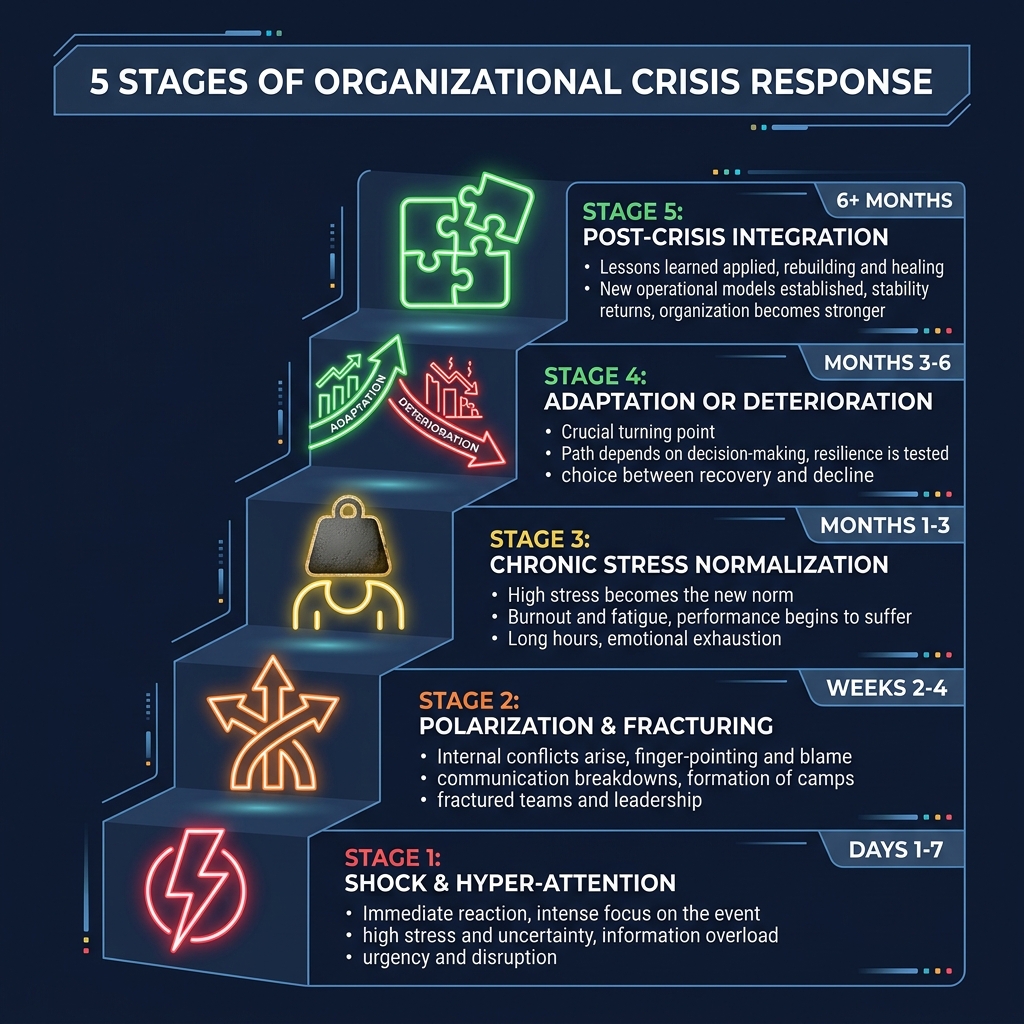
5. Cognitive Load Overload: Decision-Making Quality Collapses
War-related news creates a constant drip of ambient anxiety that consumes cognitive bandwidth. Research by Sendhil Mullainathan and Eldar Shafir demonstrates that scarcity mindset (including emotional scarcity created by anxiety) can reduce effective IQ by 13-14 points — equivalent to losing an entire night of sleep.
For your organization, this means:
- Strategic decisions made during crisis periods are statistically more likely to be poor
- Creative output drops by 30-45% when teams experience chronic anxiety
- Error rates in detail-oriented work increase by 20-35%
- Meeting effectiveness plummets as attention spans fragment
6. The Moral Injury of Inaction: Employee Engagement Crisis
One of the most underreported psychological impacts of geopolitical conflict on business is moral injury — the psychological distress that occurs when individuals feel they are witnessing or contributing to morally wrong actions through their inaction.
Employees who see their company remain silent about humanitarian crises, or worse, continue business-as-usual with countries engaged in conflict, experience a psychological disconnection between their personal values and their professional identity. This manifests as:
- Quiet quitting: Employees disengage emotionally while maintaining minimum performance
- Increased absenteeism: Stress-related sick days increase 25-40% during geopolitical crises
- Talent flight: Values-driven employees (typically your best performers) leave for organizations that align with their moral compass
- Internal conflict: Team members with different geopolitical perspectives clash, fracturing organizational culture
7. Uncertainty Paralysis: The “Freeze” Response at Organizational Scale
In individual psychology, the fight-flight-freeze response is well understood. What is less recognized is that organizations exhibit the same patterns. During geopolitical crises, many organizations enter a collective “freeze” state:
- Marketing budgets are slashed reactively rather than strategically
- Hiring freezes are implemented broadly rather than selectively
- Innovation projects are paused “until things stabilize” (they never do)
- Leadership communication becomes sparse, increasing employee anxiety
This organizational paralysis is more dangerous than the external crisis itself. While competitors who maintain strategic momentum capture market share, frozen organizations lose ground that takes years to recover.
Critical: Research from McKinsey shows that companies that invest during downturns outperform their industry peers by 150% during the recovery. The organizations that freeze during crisis are not being prudent — they are being psychologically hijacked by collective anxiety.
Part 3: Building Psychological Resilience — An I/O Psychology Framework
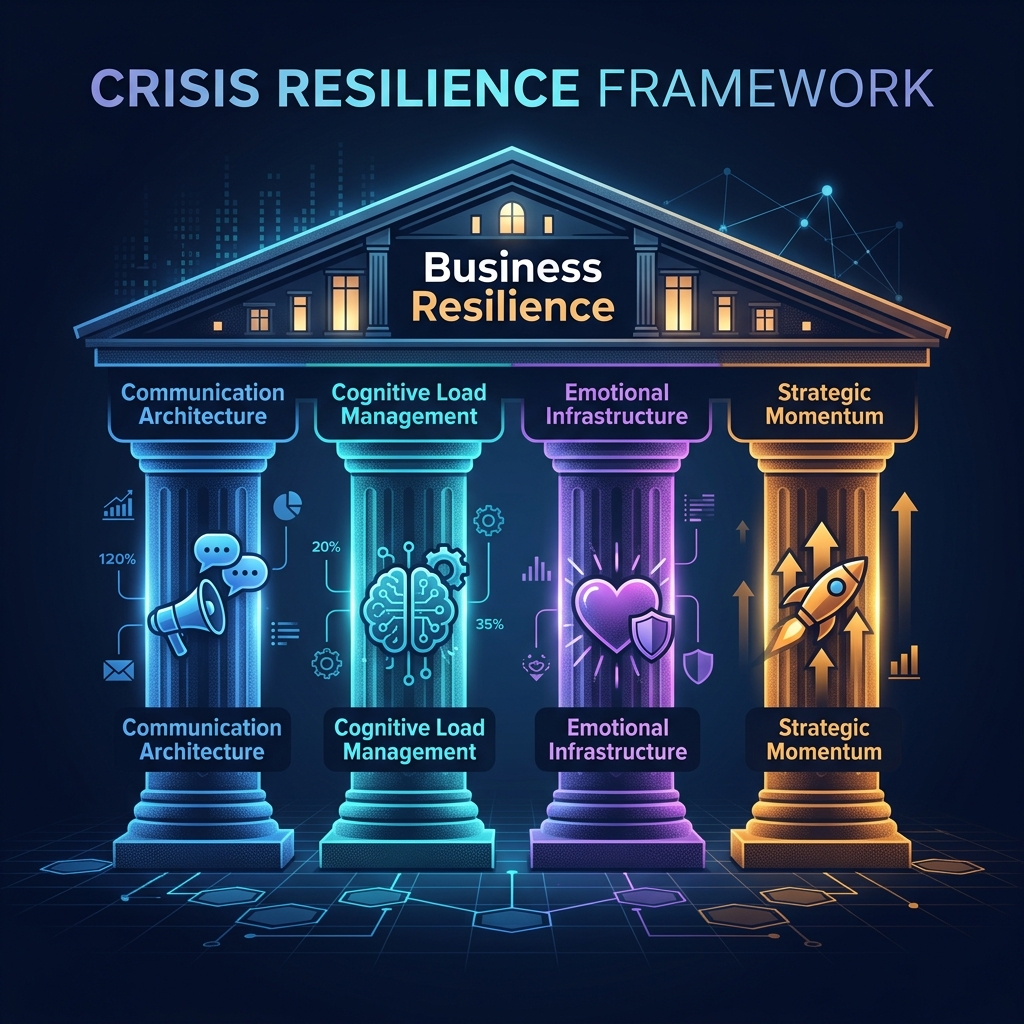
Now we move from diagnosis to treatment. Based on decades of Industrial & Organizational Psychology research, here is the Crisis Resilience Framework that I recommend to every business leader navigating geopolitical instability.
Pillar 1: Communication Architecture
During crisis, information vacuums are filled with fear. The single most important leadership action is establishing a consistent, transparent communication cadence. Research by Amy Edmondson at Harvard Business School shows that psychological safety — the feeling that it is safe to speak up, ask questions, and express concerns — is the single strongest predictor of team performance during uncertainty.
Implementation Steps
- Weekly all-hands updates: Even if there is nothing new to report, the cadence itself provides stability
- Acknowledge the elephant: Name the crisis directly — pretending it does not exist increases anxiety
- Separate facts from speculation: “Here is what we know. Here is what we do not know. Here is what we are doing about it.”
- Create feedback channels: Anonymous surveys, open office hours, team check-ins
Pillar 2: Cognitive Load Management
When your team’s cognitive bandwidth is consumed by anxiety, you must reduce unnecessary cognitive load from work processes. This is not about lowering standards — it is about removing friction so that limited mental resources can be directed toward high-value work.
- Simplify decision-making: Reduce approval chains, delegate authority downward, eliminate bureaucratic bottlenecks
- Reduce meeting load: Cancel all meetings that could be emails — protect deep work time
- Provide structure: Clear priorities, defined roles, explicit expectations reduce ambient uncertainty
- Batch communications: Consolidate updates into scheduled windows rather than continuous interruptions
Pillar 3: Emotional Infrastructure
Most organizations have physical infrastructure (offices, servers, equipment) and digital infrastructure (software, platforms, tools). Very few have what I call “emotional infrastructure” — the systems and processes that support human psychological wellbeing during crisis.
- Employee Assistance Programs (EAPs): Ensure every team member knows how to access mental health support
- Flexible work arrangements: Allow people to manage their own energy and attention during high-anxiety periods
- Manager training: Equip middle managers to recognize signs of burnout, anxiety, and disengagement
- Rituals of normalcy: Maintain team traditions, celebrations, and social connections — they anchor people to stability
Pillar 4: Strategic Momentum
The most critical — and most counterintuitive — element of crisis resilience is maintaining forward motion. When every instinct screams “stop, wait, protect,” the psychologically resilient organization says “adapt, invest, move.”
- Scenario planning: Develop 3-5 scenarios and prepare response plans for each — preparation reduces anxiety
- Opportunistic investment: Market downturns create acquisition, talent, and market share opportunities
- Innovation sprints: Channel crisis energy into solving new problems rather than ruminating on unsolvable ones
- Customer closeness: Increase customer communication and support — loyalty built during crisis is the strongest kind
The Data: War’s Measurable Impact on Business Performance
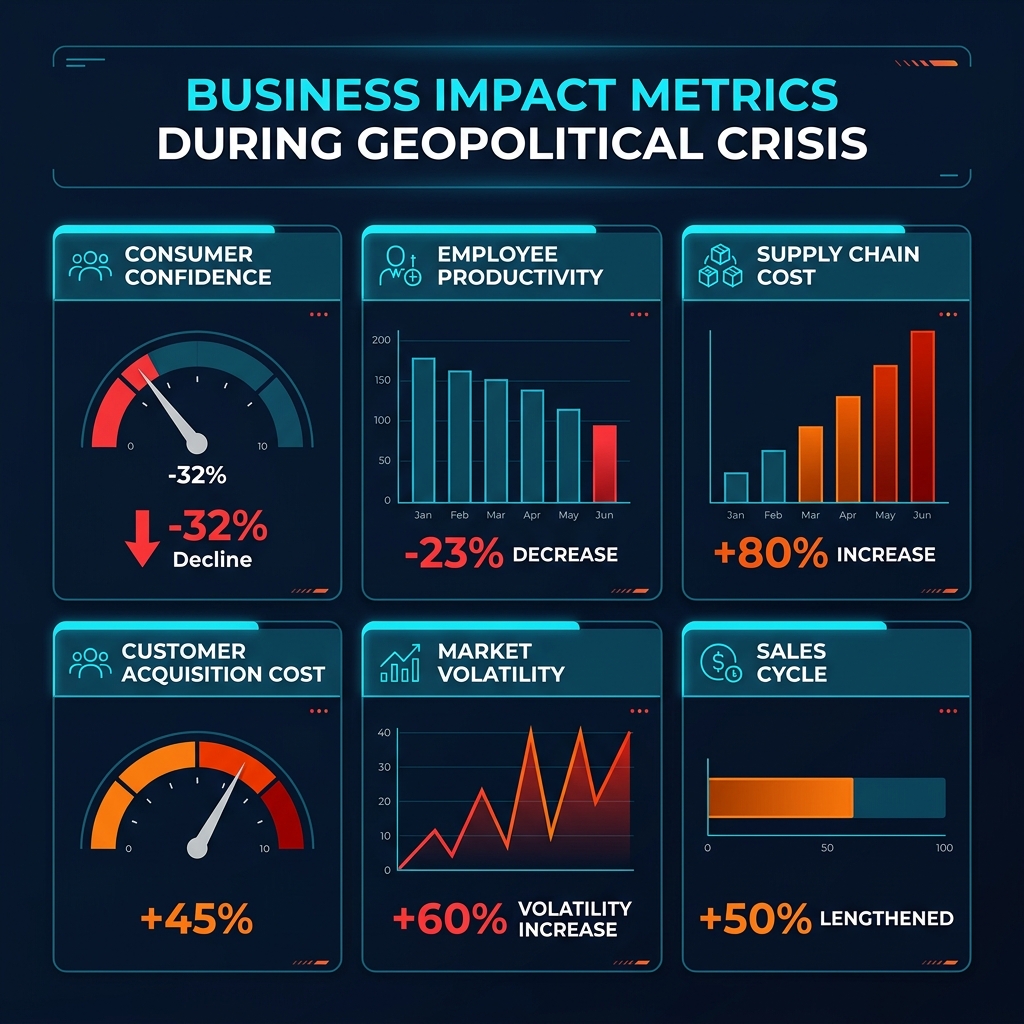
To anchor this analysis in hard numbers, here is the data from multiple research sources on how geopolitical crises measurably impact business performance:
- Consumer confidence drops 18-32% within 30 days of major conflict escalation (University of Michigan Consumer Sentiment Index)
- Employee productivity decreases 12-23% during active conflict periods (Gallup Workplace Studies)
- Supply chain disruption costs increase 35-80% for businesses with Middle East exposure (McKinsey Global Institute)
- Customer acquisition costs rise 20-45% as media noise increases and ad effectiveness drops (Meta Business Insights)
- Stock market volatility increases 40-60% during Middle East conflicts (CBOE Volatility Index historical data)
- B2B sales cycles lengthen 25-50% as decision-makers delay commitments (Gartner Research)
Case Study: How Pakistani Businesses Are Navigating the Current Crisis
Pakistan, with its geographic proximity to the Middle East, deep trade relationships, and large diaspora communities in the Gulf states, is uniquely affected by Middle East instability. For Pakistani businesses, the impact is not abstract — it is immediately felt in:
- Remittance flows: Pakistani workers in Gulf states represent a significant portion of the country’s foreign exchange — instability threatens these flows
- Oil price sensitivity: As a net oil importer, Pakistan’s entire economic structure shifts with Middle East energy prices
- Export market disruption: Trade routes through the Red Sea and Gulf directly impact Pakistani export businesses
- Psychological proximity: Cultural and religious connections mean Pakistani workers experience higher emotional impact than geographically similar but culturally distant populations
The businesses that are navigating this most effectively share common characteristics: proactive communication, diversified supply chains, empathetic leadership, and strategic rather than reactive decision-making — all principles grounded in Industrial & Organizational Psychology.
Your Action Plan: What to Do Right Now
If you are a business leader reading this during a period of geopolitical instability, here are five immediate actions grounded in I/O Psychology research:
- Audit your communication: Are you communicating enough? Are you acknowledging the crisis? Is your team psychologically safe to express concerns?
- Assess your team’s cognitive load: What unnecessary decisions and processes can you eliminate immediately?
- Review your customer messaging: Does your marketing acknowledge reality, or does it feel tone-deaf?
- Build scenario plans: What happens if the crisis escalates? De-escalates? Stalls? Having plans reduces organizational anxiety
- Invest in emotional infrastructure: Do your people have access to mental health support? Do your managers know how to have difficult conversations?
Remember: The goal is not to be unaffected by crisis — that is neither possible nor desirable. The goal is to be psychologically prepared so that your organization can respond strategically rather than reactively. This is the essence of business resilience.
Conclusion: Psychology Is Your Greatest Business Asset During Crisis
Geopolitical crises will continue to occur. The Middle East has been a flashpoint for decades, and the interconnected global economy means that every conflict has worldwide business implications. The question is not whether your business will be affected — it is how well you will respond.
The businesses that thrive through crisis are not necessarily the biggest, the richest, or the most technologically advanced. They are the ones that understand human psychology — both the psychology of their customers and the psychology of their own teams.
Industrial & Organizational Psychology provides the frameworks, the research, and the tools to build genuine business resilience. Not the superficial “keep calm and carry on” variety, but the deep, structural resilience that turns crisis into competitive advantage.
The war may be in the Middle East. But the battle for your business is in the minds of your customers and your team. Win that battle, and your business will not just survive — it will emerge stronger.
Muhammad Shahzeb is an Industrial & Organizational Psychologist (MSc) and Professional Web Developer who helps businesses apply behavioral psychology to improve conversions, employee engagement, and organizational resilience. Read more on UX Psychology | Brand Psychology Audits | Psychology Counseling | Career Coaching