
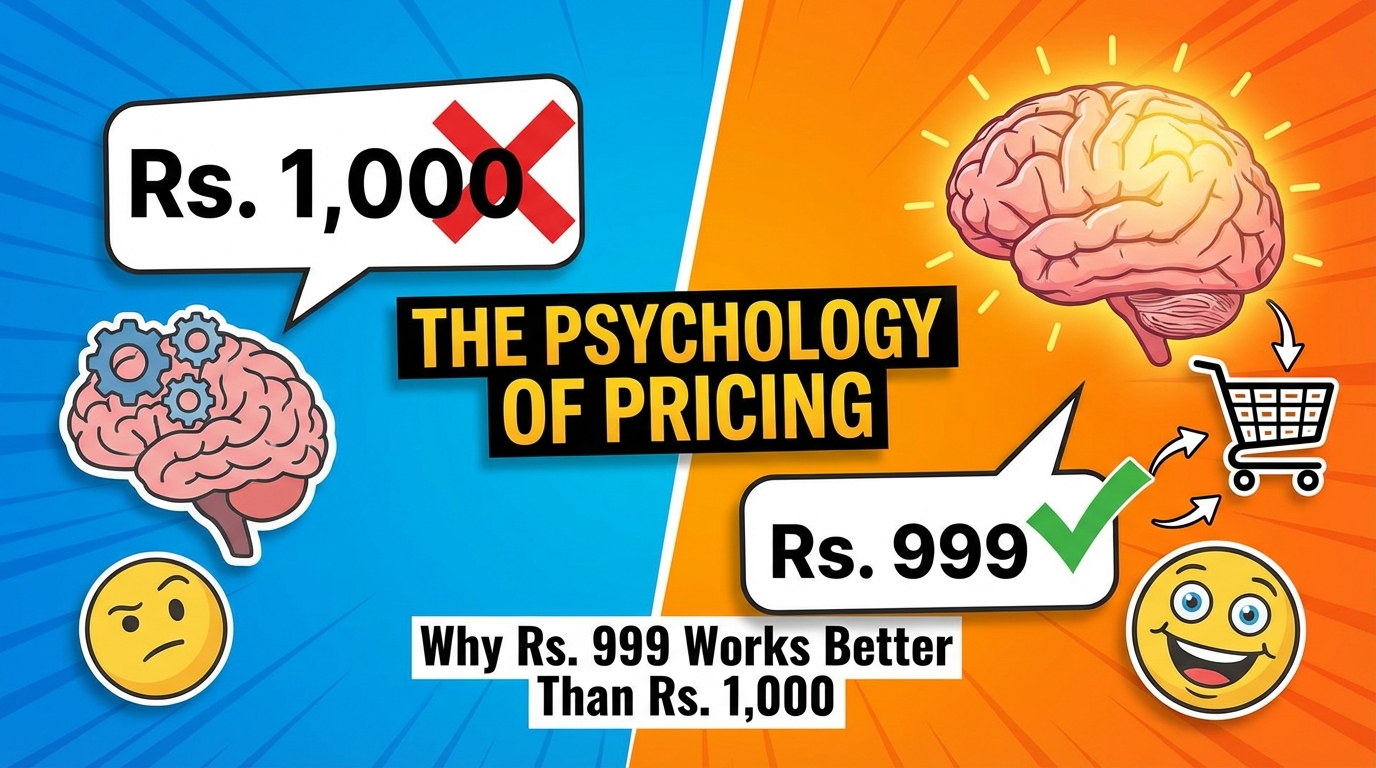
The Psychology of Pricing: Why Rs. 999 Works Better Than Rs. 1,000 — A Pakistani Consumer Behavior Study
Walk into any Imtiaz Super Market in Karachi, open Daraz on your phone, or scroll through a FoodPanda menu — you will notice something that every Pakistani business does, but very few understand why it actually works.
Prices end in 9. Everywhere. Rs. 999. Rs. 1,499. Rs. 4,999. Rs. 49,999.
Most people assume this is a simple trick — “it just looks cheaper.” But as an Industrial & Organizational Psychologist, I can tell you that pricing psychology is one of the deepest, most researched areas in behavioral economics, and what is happening inside your brain when you see “Rs. 999” versus “Rs. 1,000” is far more complex and fascinating than you think.
This article breaks down 12 scientifically-proven pricing psychology principles, explains them with Pakistani brand examples, and gives you actionable strategies to implement in your own business — whether you are selling chai at a dhaba or SaaS subscriptions to enterprise clients.
Key Insight: Research from MIT and the University of Chicago found that items priced at $39 outsold identical items priced at $34 — simply because the “9” ending triggered a subconscious “bargain” signal in the brain. Price is not about math. It is about perception. And perception is psychology.
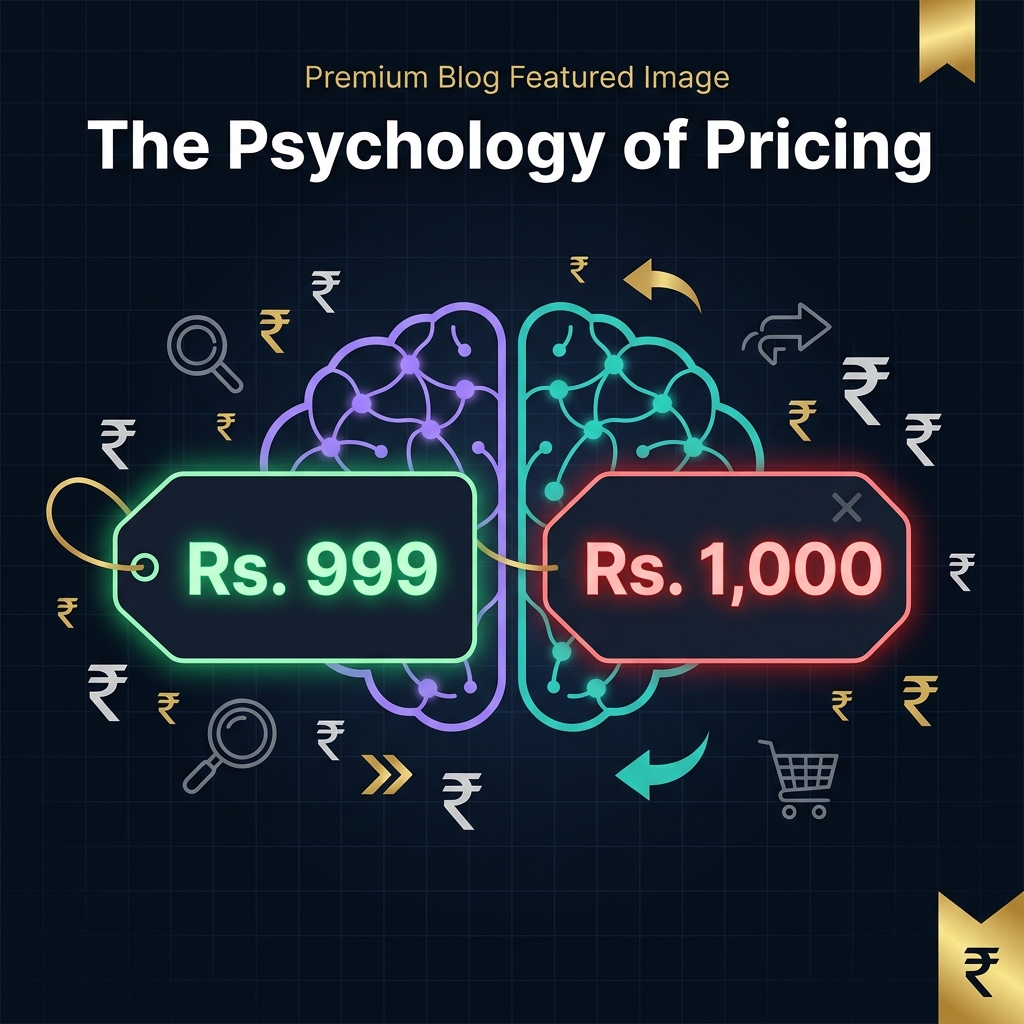
Part 1: The Science Behind Rs. 999 — Why Your Brain Cannot Do Simple Math
The difference between Rs. 999 and Rs. 1,000 is exactly one rupee. Logically, this should make zero difference in a purchasing decision. But humans are not logical creatures — we are psychological creatures. And our brains process prices in ways that consistently violate basic arithmetic.
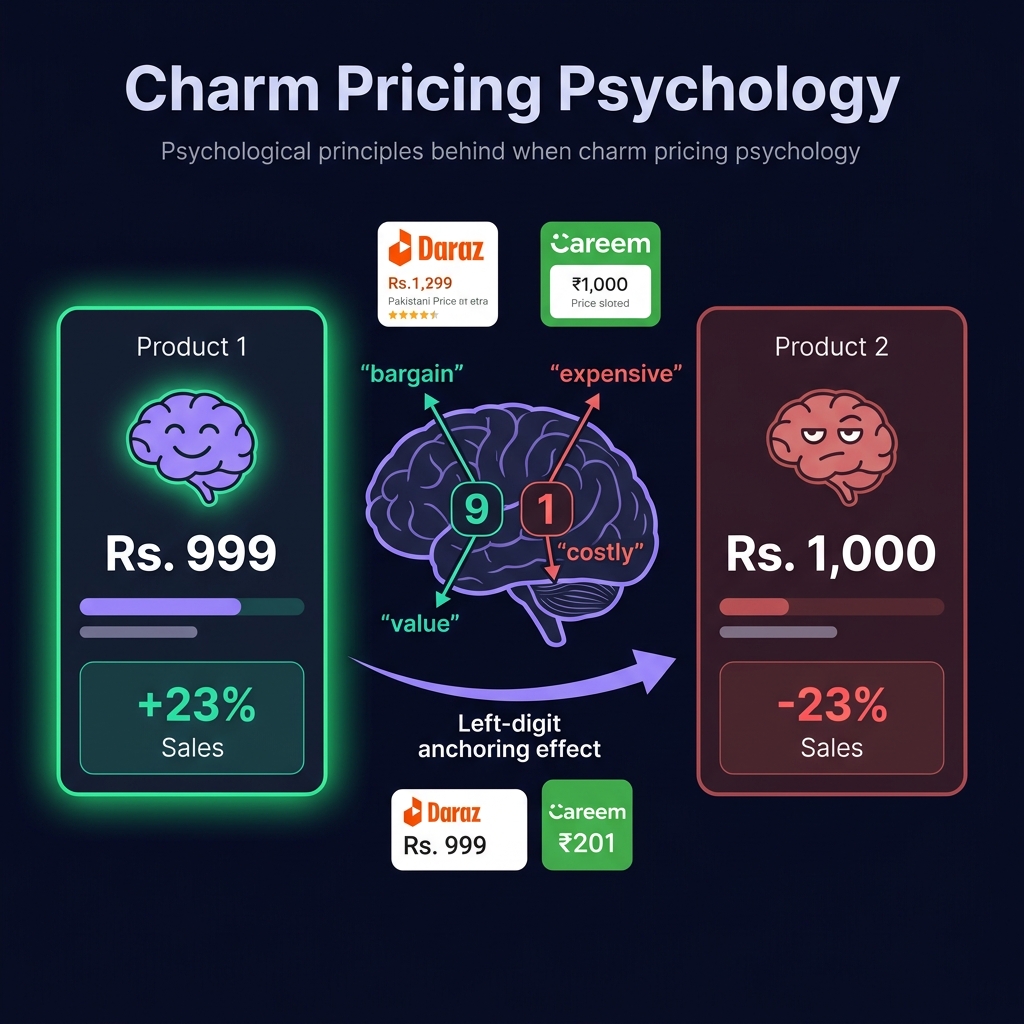
1. The Left-Digit Anchoring Effect: Why “9” Beats “0”
When you see a price tag showing Rs. 999, your brain does not process it as “nine hundred and ninety-nine.” Instead, it anchors on the left-most digit — the “9” in the hundreds column. Your brain reads it as “nine hundred something” rather than “basically one thousand.”
This is called the Left-Digit Anchoring Effect, first documented by researchers Manoj Thomas and Vicki Morwitz at Cornell University in 2005. Their landmark study found that:
- Our brains encode the magnitude of a price before we finish reading it — the left digit gets disproportionate weight
- A price drop from Rs. 1,000 to Rs. 999 is perceived as a much larger discount than from Rs. 998 to Rs. 997 — even though both are exactly Rs. 1
- This effect increases with price magnitude — the jump from Rs. 99,999 to Rs. 100,000 feels massive, but Rs. 98,999 to Rs. 99,000 feels trivial
- The effect works across cultures, age groups, and education levels — even when people know about it
Pakistani Example: Daraz Flash Sales
Open Daraz during any sale event and notice the price displays: a product originally “Rs. 3,500” is shown at “Rs. 2,499.” The original price anchors your brain at “three thousand,” and the sale price anchors at “two thousand” — making you perceive a Rs. 1,001 discount as psychologically equivalent to saving almost Rs. 2,000. Your brain is doing estimation, not calculation.
2. Charm Pricing: The Magic of the Number 9
Charm pricing — ending prices in 9, 99, or 999 — is the single most widely used pricing psychology technique in the world. And despite being ubiquitous, it continues to work with remarkable consistency.
A groundbreaking study published in the Journal of Consumer Research tested identical women’s clothing at three price points: $34, $39, and $44. The result shocked economists:
- The $39 item outsold the $34 item by 24%
- The $39 item outsold the $44 item by only 8%
- The “9-ending” price generated more sales than a lower price
Why? Because the number 9 has acquired a learned cultural association with “deal” or “sale price.” Decades of exposure to sale prices ending in 9 have trained our brains to automatically associate 9-endings with value — regardless of the actual price level.
The Pakistani Rs. 99 Culture
In Pakistan, this effect is amplified by our price-sensitive consumer culture. Walk through any bazaar in Lahore, Karachi, or Islamabad:
- Street food: Shawarma at Rs. 299, not Rs. 300
- Mobile packages: Jazz Weekly at Rs. 199, not Rs. 200
- E-commerce: Every product on Daraz ends in 9
- Retail: Khaadi sale items always at Rs. X,999
- Restaurants: McDonald’s meals at Rs. 699, not Rs. 700
Pakistani consumers are among the most price-conscious in the world — making charm pricing even more effective here than in Western markets where research was originally conducted.
3. The Weber-Fechner Law: Why Discounts Feel Different at Different Prices
Here is a thought experiment. Which feels like a better deal?
- Option A: Buying a shirt for Rs. 1,500 instead of Rs. 2,000 (saving Rs. 500)
- Option B: Buying a laptop for Rs. 149,500 instead of Rs. 150,000 (saving Rs. 500)
The saving is identical — Rs. 500 in both cases. But Option A feels dramatically more valuable. This is the Weber-Fechner Law in action — our perception of change is proportional to the original stimulus, not absolute.
For the shirt, Rs. 500 is a 25% discount. For the laptop, it is a 0.33% discount. Your brain processes proportions, not absolutes.
Business Application
- Low-price items (under Rs. 5,000): Show discounts as percentages — “Save 30%!” feels bigger
- High-price items (above Rs. 10,000): Show discounts as absolute numbers — “Save Rs. 5,000!” feels bigger
- This is called the Rule of 100 — below Rs. 10,000 use percentages, above Rs. 10,000 use absolutes
Part 2: Advanced Pricing Psychology — The Techniques Behind Pakistan’s Biggest Brands
Now that we understand the fundamentals, let us explore the more sophisticated pricing psychology techniques that Pakistan’s leading brands deploy — often without their own marketing teams fully understanding the psychology behind them.
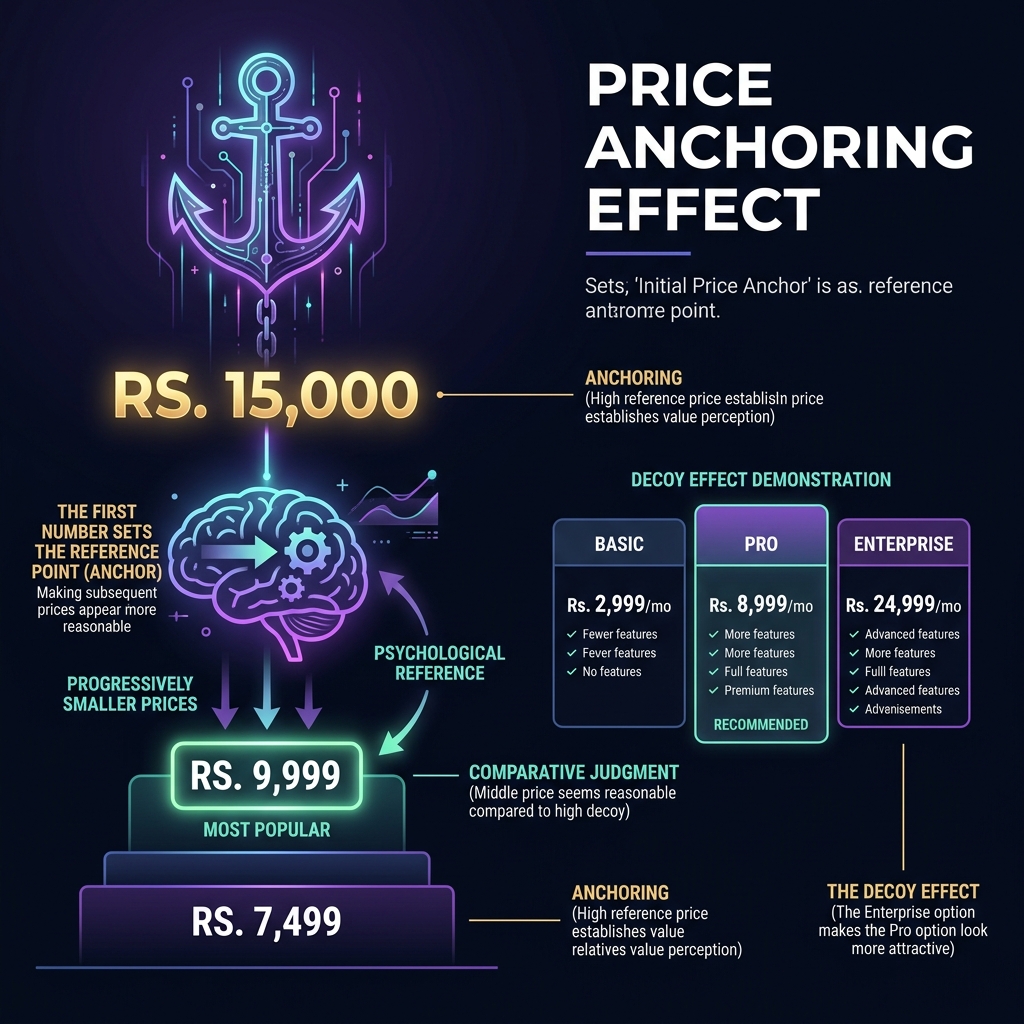
4. Price Anchoring: The First Number Wins
Anchoring is arguably the most powerful cognitive bias in all of psychology — and pricing is where it shines brightest. First described by Amos Tversky and Daniel Kahneman (Nobel Prize winner), anchoring occurs when the first piece of information we receive disproportionately influences all subsequent judgments.
In pricing, this means the first price a customer sees becomes their reference point — their “anchor” — and every subsequent price is judged relative to it.
How Pakistani Brands Use Anchoring
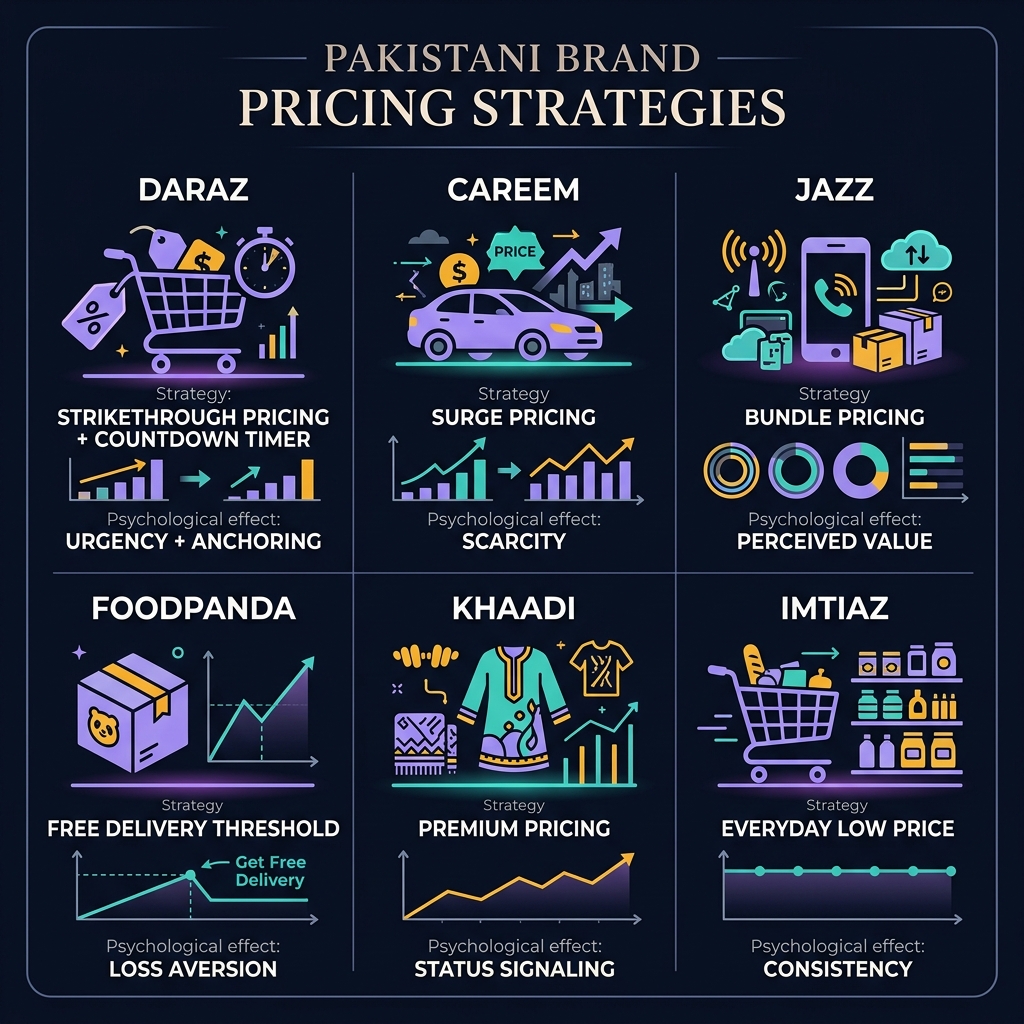
- Daraz: Shows “original” price with strikethrough (Rs.
5,999) next to sale price (Rs. 2,999) — the original price anchors perception - Careem: Shows “estimated fare” before ride — if actual fare is lower, you feel you got a deal
- Real estate: Pakistani property dealers always start with an inflated asking price — they know the final price will be judged against the anchor
- Restaurants: Premium items like lobster or steak at Rs. 4,999 on the menu make the Rs. 1,299 biryani seem reasonable by comparison
Research Finding: A study in the Journal of Marketing Research found that simply showing a higher “regular price” next to a sale price increased purchase likelihood by 34%, even when customers did not believe the “regular price” was real. The anchor works even when people are skeptical of it.
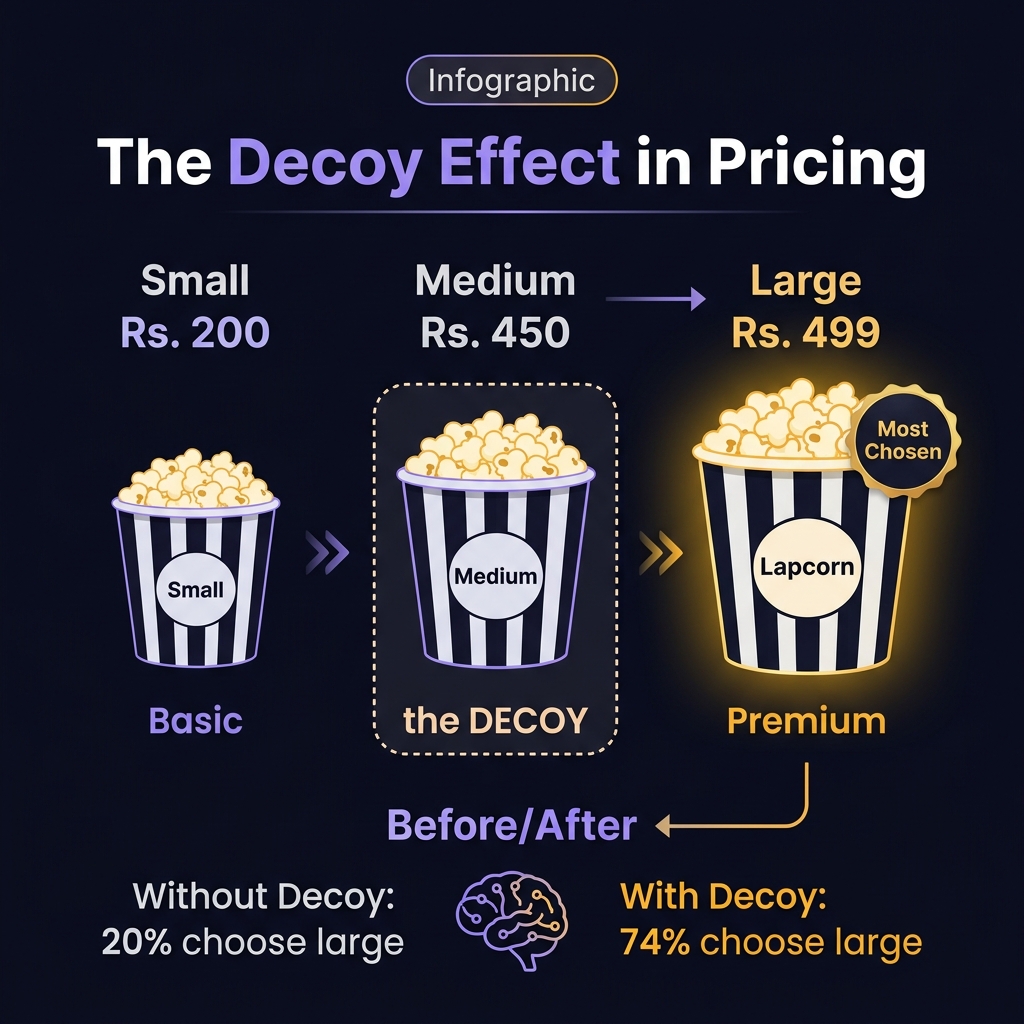
5. The Decoy Effect: The Brilliant Strategy Behind 3-Tier Pricing
Have you ever noticed that most subscription services, meal deals, and product bundles come in exactly three options? This is not coincidence — it is the Decoy Effect (also called Asymmetric Dominance), and it is one of the most elegant manipulation techniques in pricing psychology.
Here is how it works with a Pakistani cinema example:
- Small Popcorn: Rs. 250
- Medium Popcorn: Rs. 450 (the DECOY)
- Large Popcorn: Rs. 499
Without the medium option, most people would buy small. But the medium at Rs. 450 makes the large at Rs. 499 look like an incredible deal — “only Rs. 49 more for way more popcorn!” The medium exists solely to make the large look irresistible.
Real Pakistani Examples
- Jazz Packages: The middle package is always designed to push you toward the highest tier
- Careem Rides: Showing Go, Go+, and Executive — Go+ makes Executive look marginally more expensive but significantly better
- FoodPanda: “Add Rs. 50 more for free delivery” — you spend Rs. 50 to save Rs. 70 delivery fee, but FoodPanda gets a bigger order
- Netflix Pakistan: Basic (Rs. 250), Standard (Rs. 480), Premium (Rs. 550) — the Standard-to-Premium gap is tiny, pushing you up
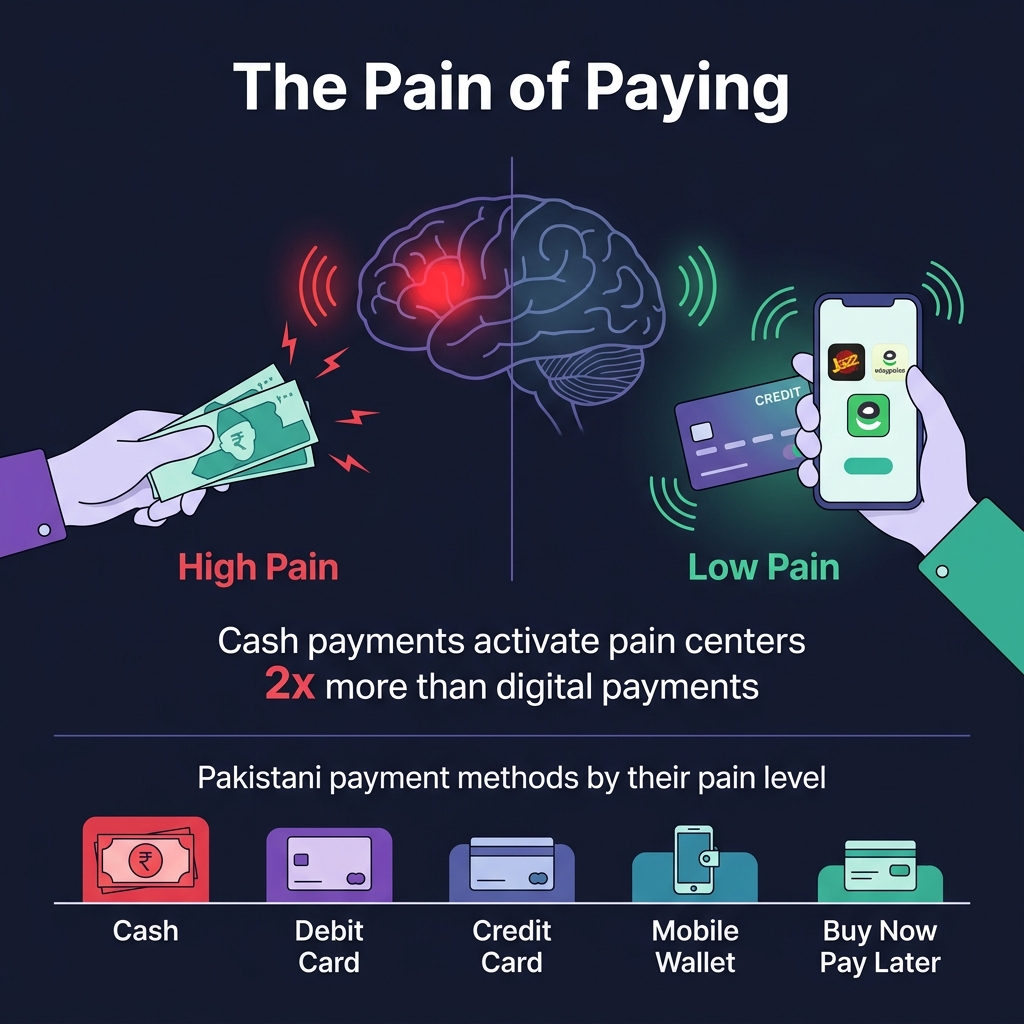
6. The Pain of Paying: Why Digital Payments Make You Spend More
Every time you hand over physical cash, a region of your brain called the insula activates — the same region that processes physical pain. This is why behavioral economists call it the “Pain of Paying.”
Research by Drazen Prelec and George Loewenstein at MIT found that:
- Cash payments create the highest “pain” — you can see and feel money leaving
- Debit card payments reduce pain significantly — the abstraction of plastic creates distance
- Credit card payments reduce pain further — the delay between purchase and payment creates temporal separation
- Mobile payments (JazzCash, Easypaisa) reduce pain even more — a tap does not feel like spending
- Buy Now Pay Later creates almost zero pain — the payment feels like a future problem, not a present cost
The JazzCash/Easypaisa Revolution Through a Psychological Lens
Pakistan’s mobile banking revolution is not just a technology story — it is a psychological story. When Pakistanis shifted from paying cash to paying through JazzCash and Easypaisa, they unknowingly reduced the “pain of paying” in every transaction. This has measurable consequences:
- Average transaction size increases 15-25% when switching from cash to mobile payments
- Impulse purchases increase by 20-40% — the friction of counting cash creates a “cooling-off” period that digital payments remove
- Subscription services become viable — automatic deductions create almost zero payment pain
- FoodPanda and Careem usage increases — the psychological cost of ordering drops when payment is invisible
Key Insight: If you run a Pakistani business, moving customers from cash to digital payments does not just improve your operations — it psychologically unlocks 15-40% more spending by reducing the neural pain signal that cash creates.
7. The Endowment Effect: Why Free Trials Convert at 60%
Once a person possesses something — even temporarily — they assign it significantly higher value than before they had it. This is the Endowment Effect, discovered by Richard Thaler (Nobel Prize, 2017).
This is why free trials are devastatingly effective:
- You sign up for a 30-day free trial of Spotify Premium
- For 30 days, ad-free music becomes “yours” — part of your identity and routine
- When the trial ends, canceling does not feel like “not buying something” — it feels like losing something you already have
- Loss aversion kicks in — losing is 2.5x more painful than gaining — and you keep paying
Pakistani Application
- Telecom: Jazz, Telenor, and Ufone all offer “free trial” data packages — once you experience 4G speeds, going back to 2G feels like a loss
- Food delivery: FoodPanda’s “Free Delivery” for first orders creates a habit; paying delivery fee later feels painful
- Real estate: “Site visit” is the ultimate free trial — once you walk through a house, you mentally own it
- SaaS: If you sell software in Pakistan, a free trial converts 3-5x better than a demo video
8. Price-Quality Heuristic: Why Expensive = Good (Even When It Is Not)
In a famous experiment, researchers gave identical wine to participants, telling them one bottle cost $5 and the other cost $45. Brain scans showed that the “expensive” wine literally activated more pleasure centers in the brain — identical liquid, different price, genuinely different experience.
This is the Price-Quality Heuristic — our brain uses price as a shortcut to judge quality when we do not have enough information to evaluate objectively.
In Pakistan, This Manifests As:
- Restaurant pricing: A biryani at Rs. 199 feels like “street food quality” while the same biryani at Rs. 599 feels “restaurant quality” — even if both came from the same pot
- Wedding industry: A photographer charging Rs. 50,000 is “risky”; one charging Rs. 250,000 is “professional” — the price itself builds confidence
- Freelancing: Pakistani freelancers on Fiverr charging $5/hour are perceived as low-skill; the same person charging $50/hour (with the same portfolio) gets premium clients
- Healthcare: A doctor charging Rs. 500 per visit raises suspicion; one charging Rs. 3,000 signals expertise
Strategic Lesson: If your Pakistani business is competing on lowest price, you may actually be signaling lowest quality. Sometimes raising your price increases sales — because the higher price itself becomes a quality signal.
Part 3: The Dark Side of Pricing Psychology — Ethical Boundaries
As an Industrial & Organizational Psychologist, I believe it is crucial to address the ethical dimension of pricing psychology. These techniques are powerful — and power requires responsibility.
9. Drip Pricing: The Hidden Cost Trap
Drip pricing — revealing the total cost gradually through the purchase process — is one of the most psychologically manipulative pricing techniques. It exploits the Sunk Cost Fallacy: once a customer invests time and mental energy into a purchase, they are increasingly reluctant to abandon it, even as hidden costs pile up.
How It Works in Pakistan
- Airline tickets: PIA and AirSial show base fare prominently, then add fuel surcharge, airport tax, baggage fee, and booking fee — the final price is often 40-60% higher than advertised
- E-commerce: A product at Rs. 999 becomes Rs. 1,349 after shipping, handling, and “platform fee”
- Real estate: A plot advertised at Rs. 50 lakh omits development charges, transfer fees, utility connections, and “society dues” that add Rs. 8-10 lakh
- Wedding venues: “Hall rental” of Rs. 100,000 becomes Rs. 350,000 after mandatory catering, décor, and “service charges”
Drip pricing works in the short term but destroys trust in the long term. Brands that practice aggressive drip pricing see 60% lower repeat purchase rates.
10. Artificial Scarcity: The Countdown Timer Epidemic
Open any Pakistani e-commerce app and you will be assaulted by:
- “Only 2 items left!” (there are 200 in warehouse)
- “Sale ends in 02:34:17!” (it restarts tomorrow)
- “47 people are viewing this item!” (this number is fabricated)
- “Limited time offer!” (it has been “limited” for 6 months)
These scarcity signals exploit the Scarcity Heuristic — our evolutionary instinct to value scarce resources more than abundant ones. When something is “running out,” our brain’s fear-of-missing-out circuitry overrides rational evaluation.
However, when customers discover the scarcity is artificial, the trust damage is severe. A study in the Journal of Consumer Psychology found that perceived deceptive scarcity claims reduced brand trust by 42% and future purchase intention by 35%.
11. Subscription Traps: Easy to Start, Impossible to Cancel
This is where pricing psychology crosses into dark patterns. Many services — including some Pakistani telecom bundles — make sign-up effortless (one-tap activation) but cancellation deliberately difficult (call this number, wait 20 minutes, speak to a retention agent, confirm via CNIC).
This exploits Status Quo Bias (humans prefer to keep things as they are rather than make changes) and Default Effect (we tend to accept whatever the default option is, even if changing it is technically free).
Pakistani Telecom Example
How many Pakistanis are currently paying for Jazz, Telenor, or Ufone “value-added services” they never signed up for? These auto-enrolled subscriptions — charging Rs. 2-5 daily — exploit the psychological complexity of deactivation. Each individual charge feels too small to bother canceling, but collectively they drain Rs. 1,800-3,600 per year from millions of subscribers.
Part 4: Pricing Psychology for Pakistani Entrepreneurs — Your Action Plan
Now let us move from theory to practice. Whether you run a local chai dhaba, an e-commerce store, or a professional services firm, here are evidence-based pricing strategies you can implement immediately.
12. The Pricing Psychology Toolkit: 8 Strategies You Can Use Today
Strategy 1: Use Charm Pricing (But Know When Not To)
- Use Rs. X99 for: Consumer products, e-commerce, fast food, subscriptions — anything where “bargain” perception matters
- Use round numbers for: Premium/luxury products, professional services, B2B — round numbers (Rs. 5,000, Rs. 50,000) signal quality and prestige
- Rule: If your brand is positioned as affordable, use 9-endings. If positioned as premium, use round numbers.
Strategy 2: Always Show the Anchor Price
- Show the “original” or “regular” price next to your sale price — always
- Even if the anchor is aspirational, it shifts the customer’s reference point
- Format: Rs.
2,499→ Rs. 1,499 (the cross-through is psychologically essential)
Strategy 3: Implement 3-Tier Pricing
- Always offer three options: Basic, Standard, Premium
- Design the middle option as the decoy — make it close in price to Premium but far inferior in value
- Most customers (60-70%) will choose Premium because the decoy makes it look like the best deal
Strategy 4: Remove the Rs. Sign When Possible
- Research from Cornell University found that removing the currency symbol from restaurant menus increased average spending by 8%
- Instead of “Rs. 1,499” — write “1,499” — the currency symbol activates the “money” concept and increases payment pain
- Pakistani application: Restaurants, service menus, e-commerce product cards
Strategy 5: Use Price Bundling
- Instead of pricing items individually, bundle them: “Complete Package: Rs. 4,999 (worth Rs. 7,500)”
- Bundles obscure individual item prices, reducing the ability to comparison-shop
- The “savings” versus individual prices triggers loss aversion — “I would lose Rs. 2,500 in value if I do not buy the bundle”
Strategy 6: Frame Payment as Daily Cost
- Instead of “Rs. 3,000/month” — frame it as “less than Rs. 100/day” or “less than a cup of chai per day”
- The daily frame reduces perceived cost by making it comparable to trivial daily expenses
- Example: “Professional website for your business — just Rs. 166/day” (Rs. 60,000/year)
Strategy 7: Offer a “Free” Option
- The word “free” is the most powerful word in pricing psychology — it creates an emotional response that “Rs. 1” does not
- “Free shipping on orders above Rs. 2,000” increases average order value by 23-30%
- “Buy 2 Get 1 Free” generates 73% more revenue than “33% off entire purchase” — even though the math is identical
Strategy 8: Use Precise Pricing for High-Value Items
- For items above Rs. 50,000, precise prices (Rs. 47,350) feel more researched and justified than round numbers (Rs. 50,000)
- Research shows precise prices are perceived as more fair and calculated — the seller “must have done the math”
- Pakistani application: Professional services (design, development, consulting), electronics, furniture
The Bottom Line: Price Is a Psychological Signal, Not a Number
After reading this article, I hope one thing is crystal clear: price is not math — price is communication. Every price tag you see is a psychological message designed to influence your perception of value, quality, and urgency.
Understanding pricing psychology does not make you immune to it — research shows these effects persist even when people are aware of them. But it does give you two superpowers:
- As a consumer: You can pause and ask yourself, “Am I responding to actual value, or to psychological framing?” This question alone can save you thousands of rupees every month
- As a business owner: You can design your pricing to communicate the right value signals — ethically — and increase revenue without changing your actual product or service
The Rs. 1 difference between Rs. 999 and Rs. 1,000 is the most profitable single rupee in Pakistani commerce. Now you know why.
Remember: The most successful Pakistani businesses do not just set prices — they design pricing experiences. From Daraz’s anchored sale prices to Jazz’s tiered packages to FoodPanda’s delivery thresholds — every number you see has been psychologically engineered to influence your decision. The question is: will you be the one doing the engineering, or the one being engineered?
Muhammad Shahzeb is an Industrial & Organizational Psychologist (MSc) and Professional Web Developer who helps businesses apply behavioral psychology to improve conversions, employee engagement, and organizational resilience. Read more on UX Psychology | Brand Psychology Audits | Psychology Counseling | Career Coaching