
A bright graduate walks into a quiet room for the final round of interviews. Instead of an interviewer, she finds a laptop and ninety-three forced-choice questions: “You tend to value justice more than mercy.” An hour later the screen glows: ENFJ — “The Protagonist.” She screenshots it proudly, never knowing that personality tests at work have a split reputation — and that the publisher of the world’s most popular test says it was never meant for hiring. The honest version, from eighty-five years of selection research: personality tests at work can predict job performance — but only the right traits, the right instruments, and honest expectations about how modest “predict” really is.
This guide covers the evidence on personality tests at work: what the Myers-Briggs Type Indicator really measures, what its own publisher admits, what decades of Big Five meta-analyses show, why faking matters less than most people think, and the practical playbook for using tests legally and honestly. Every figure below is traceable to its source, and where the evidence is second-hand — for example, several reviews of MBTI retest studies I could only verify through reputable summaries — I say so.
I am an Industrial and Organizational Psychologist in Karachi. Selection testing is my home ground — I read the meta-analyses so you do not have to, including the admissions the testing industry would rather you skipped.
“The MBTI is the most popular personality test on earth, and its own publisher says it was never meant for hiring. That gap between popularity and proof is the single most important thing to understand about personality tests at work.”
— Workplace Psychology Analysis, ShahzebSpeaks
⚡ Chapter 1: The short answer
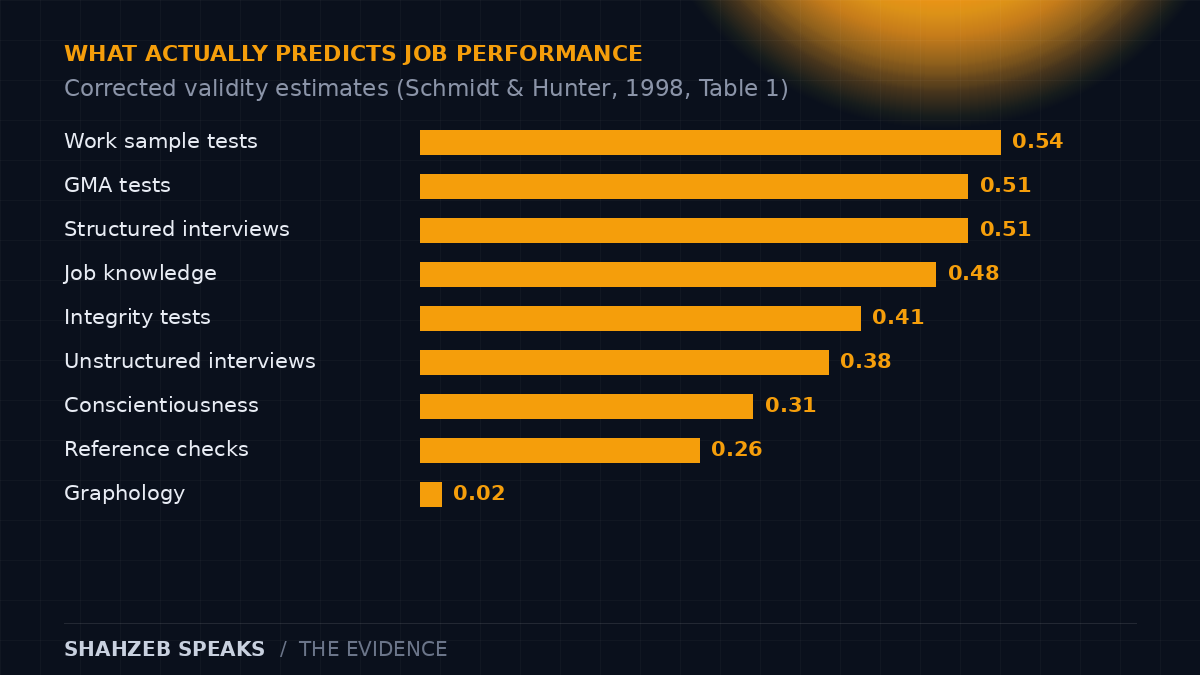
Do personality tests at work predict job performance? For the Big Five: yes, modestly. Across meta-analyses, the strongest trait is conscientiousness — Hurtz and Donovan (2000), who restricted their analysis to scales explicitly designed to measure the Big Five, confirmed an estimated true-score correlation of about .22 and a true validity of .20 with job performance. In Schmidt and Hunter’s (1998) famous summary of 85 years of selection research, conscientiousness tests reach a corrected validity of .31 — respectable, but below work samples (.54), general mental ability (.51) and structured interviews (.51).
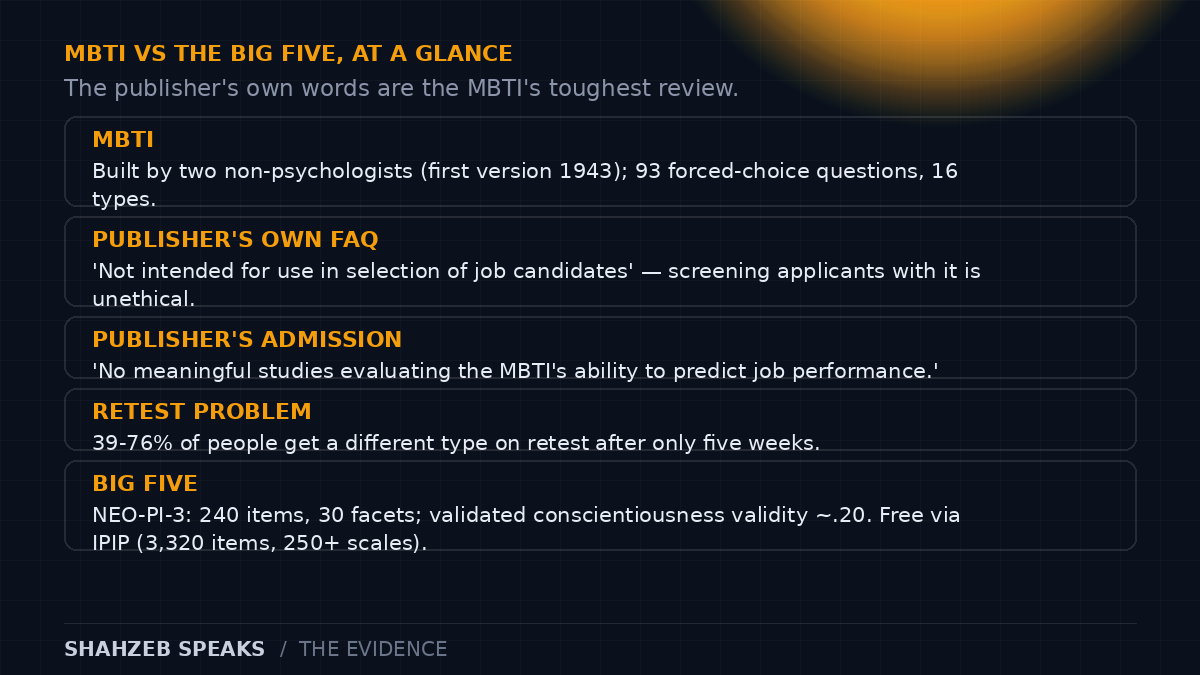
And for the MBTI: there is no meaningful evidence at all, because, as the publisher itself states, “there have (appropriately) been no meaningful studies evaluating the MBTI’s ability to predict job performance.” The Myers & Briggs Foundation calls using it to screen applicants unethical. So the short answer is: personality tests at work can work — unless the test is the one most employers have actually heard of.
🧪 Chapter 2: The MBTI story — and what its own publisher admits
The Myers-Briggs Type Indicator was developed by Katharine Cook Briggs and her daughter Isabel Briggs Myers, who built it on Swiss psychiatrist Carl Jung’s theory of psychological types. The company is open about an awkward fact: neither founder was a psychologist. The timeline, per the company’s own history page: the first version in 1943, an updated form published by the Educational Testing Service in 1962, the first commercial version (Form G) from CPP in 1977, Form M in 1998, Form Q in 2001, and the global editions in 2018. The current test uses 93 forced-choice questions, sorting people into 16 types across four dichotomies: Extraversion–Introversion, Sensing–Intuition, Thinking–Feeling, Judging–Perceiving. (Instrument details via secondary reporting of company material.)
The scale of it is staggering. The Myers-Briggs Company claims that “more than 2 million assessments are administered to individuals annually — including employees of many Fortune 500 companies.” That is a company claim, not an independent finding, but the cultural footprint is undeniable: another business publication reports the test is used by 88% of Fortune 500 companies in 115 countries. In a US survey of 2,366 HR professionals, SHRM (2024) found 54% of organisations use pre-employment assessments, with personality tests used by 14% of the organisations that test — and 78% of HR professionals said the assessments had improved the quality of their hires. (Note: the SHRM figures describe US employers, not the world.)
Here is what makes the MBTI chapter of this story unusual: the strongest evidence against using it for hiring comes from its own publisher. The company’s FAQ asks, “Can the MBTI assessment be used for selection or hiring?” and answers, flatly: “No. The MBTI assessment is not intended for use in selection of job candidates, nor for making internal decisions regarding job placement, selection for teams or task forces, or other similar activities.” The Myers & Briggs Foundation is blunter still: “It is unethical to require job applicants to take the assessment if the results will be used to screen out applicants.”
The company gives its reasons. The items are “clear-purpose,” so candidates “could easily fake their responses to generate what they might see as an ‘ideal’ profile.” The instrument “does not incorporate any sort of ‘lie scale’.” It measures preferences, not skill or competence — “No preference is seen as ‘bad’ or as something that should be screened out.” And then the admission that should end every debate about MBTI-based hiring: “Given that it is not appropriate for selection, there have (appropriately) been no meaningful studies evaluating the MBTI’s ability to predict job performance. Established researchers in the field of predicting job performance would not use the MBTI assessment for this purpose.”
The reliability problem
The company publishes its own reliability figures: internal consistency of “around .90” for the four preference scales and “test-retest correlations are over .80 for periods up to 15 weeks.” Those are company claims. The independent literature tells a different story about the thing that actually matters — the type label. Psychologist David Pittenger’s 2005 review, summarised in reputable secondary sources I could not verify from the primary paper itself, found studies in which 39–76% of respondents obtained a different type classification on retest after only five weeks. The company acknowledges the criticism exists — “It is common to find quotes indicating that 50 percent of participants received a different classification” — while noting that all four letter-pairs must match for the full type to stay the same. That caveat does not rescue the labels; it describes how fragile they are.
A 1991 committee of the US National Research Council reviewed the instrument and concluded there was not sufficient, well-designed research to justify its use even in career counselling — and called “the popularity of this instrument in the absence of proven scientific worth… troublesome.” (The conclusion is paraphrased from secondary reporting; the committee’s appraisal chapter was verified directly at the National Academies site.) A 2023 summary in Discover magazine reported that two literature reviews, more than a decade apart, both concluded there was not enough evidence to support the test’s utility, and that using it for employee selection “may be unjustified because of the lack of empirical evidence.”
📊 Chapter 3: What actually predicts performance — the Schmidt and Hunter table
The most useful single table in hiring science comes from Frank Schmidt and John Hunter’s 1998 paper in Psychological Bulletin, which summarised 85 years of selection research across 19 procedures. Below are the corrected validity estimates for predicting overall job performance — corrected, meaning adjusted for measurement error in performance ratings and for range restriction in incumbent samples. The ordering is the point.
| Selection procedure | Corrected validity |
| Work sample tests | .54 |
| General mental ability (GMA) tests | .51 |
| Structured employment interviews | .51 |
| Job knowledge tests | .48 |
| Integrity tests | .41 |
| Unstructured interviews | .38 |
| Conscientiousness tests | .31 |
| Reference checks | .26 |
| Graphology (handwriting analysis) | .02 |
| Age | −.01 |
Three lessons fall out of that table. First, personality is real but mid-table: conscientiousness at .31 beats unstructured interviews, reference checks and handwriting analysis — and loses to work samples, GMA and structured interviews. (The .31 comes from Mount and Barrick’s 1995 meta-analysis, which Schmidt and Hunter adopted; it used a composite-score procedure that yields a higher figure than the 1991 estimate.) Second, combinations beat single tests: GMA plus a work sample reaches a multiple R of .63 (+24% over GMA alone); GMA plus an integrity test reaches .65 (+27%); GMA plus a structured interview .63 (+24%); GMA plus conscientiousness .60 (+18%). Third, Schmidt and Hunter’s summary line is worth memorising: “for hiring employees without previous experience in the job the most valid predictor of future performance and learning is general mental ability (GMA).” And the reason any of this matters in money terms: “the predictive validity coefficient is directly proportional to the practical economic value (utility) of the assessment method.”
The structured interview finding deserves emphasis, because most hiring still ignores it: a properly structured interview (.51) predicts nearly as well as a work sample, while the casual chat most managers call an interview (.38) sits below integrity tests. I have covered that gap in depth in my guide to structured interviews vs unstructured interviews.
🎯 Chapter 4: The Big Five, honestly
The Big Five — openness, conscientiousness, extraversion, agreeableness and emotional stability — is what modern personality science actually uses. The headline trait is conscientiousness: being organised, dependable and hard-working. But I want to give you the honest numbers, not the marketing version.
Hurtz and Donovan (2000) ran a meta-analysis with a strict rule: they included only scales explicitly designed to measure the Big Five, stripping out the loose “personality-ish” measures that had inflated earlier estimates. Their conclusion for conscientiousness: an estimated true-score correlation of about .22 and a true validity of .20 — “virtually identical in magnitude” to Barrick and Mount’s foundational 1991 finding. Then they added the sentence the testing industry rarely quotes: a true validity of .20 “is not as impressive as one would expect, given the recent enthusiasm surrounding its use as a predictor of job performance.”
The uncorrected numbers are even more sobering. In Hurtz and Donovan’s Table 4, the raw observed correlations with task performance were: conscientiousness .10, emotional stability .09, agreeableness .05, extraversion .04, openness −.01. For “job dedication” (effort, persistence): conscientiousness .12, emotional stability .09. These raw figures are small partly because they are uncorrected for measurement error — but they are a useful cold shower. Nobody should buy a personality test expecting it to identify top performers the way a work sample does.
Two findings strengthen the honest case. First, Barrick and Mount’s 1991 meta-analysis found conscientiousness valid across every occupational group studied — professionals, police, managers, sales, skilled and semi-skilled workers. No other Big Five trait had that record. (Instrument details and exact table values verified only through secondary sources; the headline conclusion is consistent with the directly-read Hurtz and Donovan confirmation.) Second, compound personality scales — measures built for work, like integrity, stress tolerance and managerial potential — do better than the broad traits. Ones, Viswesvaran and Dilchert (2005) reported operational validities of .41 for integrity (N = 7,550), .39 for customer service orientation (N = 6,944), .41 for violence and aggression (N = 4,003), .41 for stress tolerance (N = 1,010), .19 for drug and alcohol use (N = 1,436), and .42 for managerial potential (N = 11,009). Their verdict: “only general mental ability has superior criterion-related validities for the same criterion.” The Big Five as a set, they wrote, produce operational validities “in the .30s and .40s” — with multiple Rs as high as .47 for teamwork, .44 for training performance and .43 for citizenship behaviour.
And here is the line that separates the MBTI from the Big Five in one stroke. Ones and colleagues warned: “We should not judge the merits of a construct domain by its poorest indicators, especially when these indicators have nothing to do with modern-day conceptualizations of the construct domain” — and the example they named was the Myers-Briggs Type Indicator. Do not throw out personality testing because of the MBTI. Throw out the MBTI.
Are personality traits even stable enough to test?
A fair question. Roberts and DelVecchio (2000) meta-analysed 152 longitudinal studies and found rank-order consistency rises with age: about .31 in childhood, .54 in the college years, .64 at age 30, plateauing near .74 between ages 50 and 70. Traits are not set in stone, but by working age they are stable enough to measure. The standard research instrument, the NEO-PI-3, runs 240 items across 30 facets (via a Costa and McCrae chapter); and if cost is the objection, the International Personality Item Pool offers over 3,320 items and 250 scales in the public domain, free to use for any purpose. Good measurement of the Big Five does not require a licence fee.
🎭 Chapter 5: Can you fake a personality test?
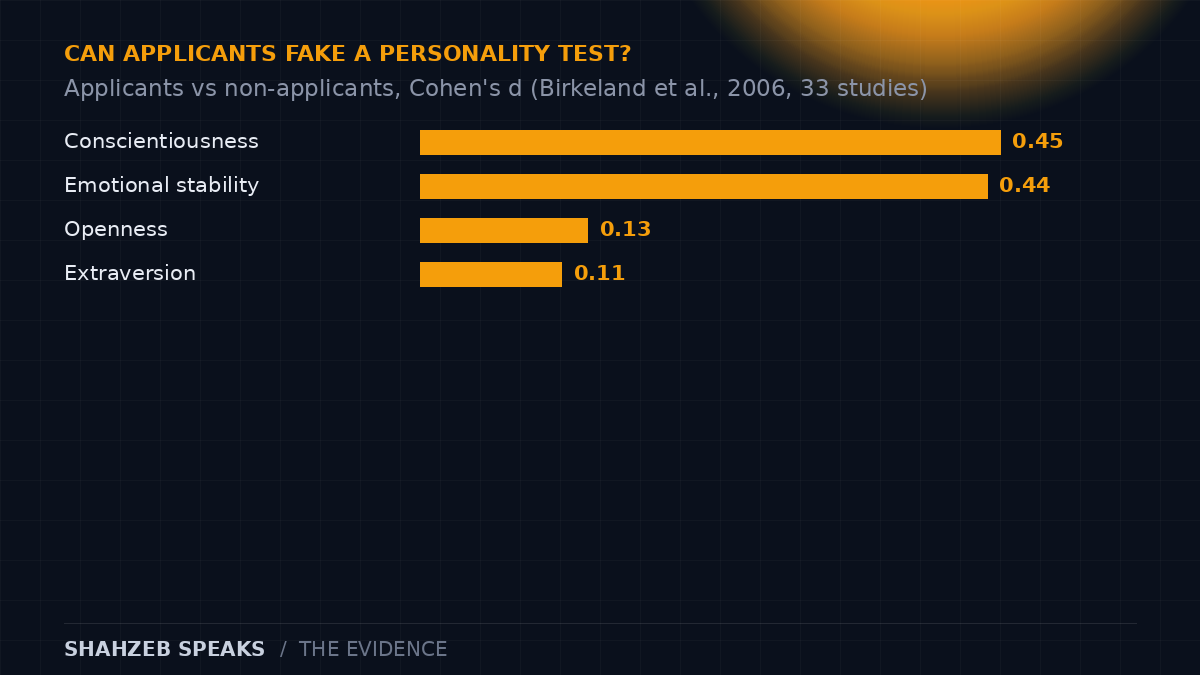
Applicants absolutely try. Birkeland and colleagues (2006) meta-analysed 33 studies comparing real job applicants with non-applicants taking the same personality measures. Applicants scored higher on extraversion (d = .11), emotional stability (d = .44), conscientiousness (d = .45) and openness (d = .13) — an average shift of about 0.30 standard deviations. (Findings verified through reputable summaries; the original paper was not opened directly.) In directed “fake-good” conditions, Viswesvaran and Ones (1999) found participants shifted their responses by nearly half a standard deviation. Morgeson and colleagues (2007) added that even modest faking can change who gets ranked at the top and reduce the test’s selection utility.
But here is the honest counterpoint, and it matters more than the scare stories. Ones, Dilchert, Viswesvaran and Judge (2007) and others have argued that faking does not materially reduce criterion-related validity coefficients — and that correcting scores for social desirability can actually attenuate validity. The effect of faking on validity remains debated, but the weight of the literature says something counterintuitive: applicants polish their answers, rankings shuffle at the margins, and the test keeps predicting anyway. That is partly because everyone fakes a little, which compresses differences rather than scrambling them.
Two practical implications. First, if you are an applicant, know that trying to game the test is normal and largely futile as a strategy — and the clearer the items, the easier they are to fake, which is exactly why the MBTI’s publisher admits its “clear-purpose” items make ideal profiles easy to manufacture. Second, if you are hiring, design for faking at the margins: warn applicants that the test has consistency checks, consider forced-choice formats, and never let a personality score be the only gate. My companion guide on how to pass psychometric tests explains the applicant’s side of the same science.
🔮 Chapter 6: Why bad personality profiles feel so accurate
If the MBTI is so weak, why does your type description feel like it was written about you? The answer is older than the test: the Barnum effect, named after the showman P. T. Barnum, whose acts succeeded by telling every audience member exactly what they wanted to hear.
In 1949, psychologist Bertram Forer gave his students a personality profile supposedly built from a test they had taken. Every student received the identical profile, assembled from a newsstand astrology book. They rated its accuracy at an average of 4.26 out of 5. (Findings verified through a peer-reviewed replication paper and secondary summaries; the 1949 paper itself was not opened directly.) More than seventy years later, the effect is still robust: a modern replication exposing over 2,000 psychology students to a fake personality test found 85% rated its effectiveness above the neutral point.
This is the engine under every “I am such an INTJ” moment. Vague, flattering, two-sided statements (“You have a need for others to like you, yet you are critical of yourself”) feel personal because they apply to almost everyone. The MBTI’s dichotomous labels add a second trick: being told you are a “Thinker” rather than a “Feeler” feels like a discovery about your nature, even when the underlying scores were near the middle. Feeling seen is not evidence of being measured.
⚖️ Chapter 7: The rules — what the profession and the law require
Personality testing in hiring is not a free-for-all. The profession has standards, and in the United States the law sets a floor.
The Society for Industrial and Organizational Psychology’s Principles for the Validation and Use of Personnel Selection Procedures (5th edition, August 2018, adopted as policy by the American Psychological Association) is the authoritative guidance for selection testing. (Details verified through reputable secondary references to the document.) The legal backbone is the Uniform Guidelines on Employee Selection Procedures (1978), 29 CFR §1607.14, which I read directly. Its core demands:
- Start with a job analysis. “Any validity study should be based upon a review of information about the job for which the selection procedure is to be used.”
- Show a real statistical relationship. A procedure counts as job-related “when the relationship between performance on the procedure and performance on the criterion measure is statistically significant at the 0.05 level” — while noting “there are no minimum correlation coefficients applicable to all employment situations.”
- Validate cutoffs and rankings. “Users should evaluate each selection procedure to assure that it is appropriate for operational use, including establishment of cutoff scores or rank ordering.”
Notice what this framework does to the MBTI: with no meaningful validity studies for job performance — the publisher’s own admission — it cannot satisfy the job-relatedness requirement, which is why the Myers & Briggs Foundation’s ethical-use page states plainly that “The MBTI assessment is not designed to be used for hiring purposes. It does not measure ability, competence, or skill.” This is the difference between I-O psychology and HRM as usually practised: the science insists on evidence of job-relatedness before the test touches a hiring decision.
🧰 Chapter 8: Using personality tests at work — the honest playbook
If you are hiring and want personality testing done properly, here is what the evidence supports:
- Start with a job analysis. The Uniform Guidelines require it. Define what the job actually demands before choosing any test — a warehouse role and a sales role need different traits.
- Use a validated Big Five or compound measure. The NEO-PI-3 family, an integrity test, or a well-built IPIP-based scale — all have published validity evidence. Never the MBTI for selection; its publisher calls that unethical.
- Combine tests; never rely on one. Conscientiousness alone is modest (.31). GMA plus a work sample (.63), GMA plus a structured interview (.63), or GMA plus an integrity test (.65) are the combinations the science supports.
- Interview properly. A structured interview (.51) is nearly as predictive as a work sample; an unstructured chat (.38) is not. Fix the interview before buying more tests.
- Design for faking, but do not panic about it. Applicants will polish answers (about 0.30 SD on average). Warnings, consistency checks and forced-choice formats help at the margins; the validity mostly survives anyway.
- Validate locally and watch adverse impact. A test valid in one context is not automatically valid in yours. Track pass rates by group and keep your evidence file current — significance at the .05 level is the floor, not the ceiling.
- Remember the modest truth. The best-supported personality finding in hiring science is a validity of about .20. That is real, useful, and worth paying for — and it is not a crystal ball. Anyone selling certainty is selling something else.
If you are hiring in South Asia, the same principles apply with local validation — see my notes on psychometric tests for jobs in Pakistan.
❓ Questions I am asked most often
Does the MBTI predict job performance?
No. There are no meaningful studies of the MBTI’s ability to predict job performance — the publisher says so itself, noting that “established researchers in the field of predicting job performance would not use the MBTI assessment for this purpose.” It was designed for self-understanding and development, not selection. Use a validated Big Five measure for hiring instead.
Is the MBTI reliable?
The company’s own figures look strong — internal consistency around .90 and test-retest correlations above .80 over 15 weeks — but those are company claims. Independent reviews (Pittenger, 2005, via secondary summaries) find 39–76% of people receive a different type classification on retest after five weeks. The scale scores are fairly stable; the type labels are not.
Which personality trait predicts job performance best?
Conscientiousness — being organised, dependable and hard-working. Its true validity is about .20 (Hurtz & Donovan, 2000), rising to .31 corrected in Schmidt and Hunter’s table. It is the only Big Five trait valid across every occupational group studied, from police to professionals to sales. No other trait comes close as a general predictor.
Can you fail a personality test?
Most personality tests have no right answers, but employers using validated scales can and do screen out low scorers on job-relevant traits like conscientiousness or integrity. You cannot “fail” the MBTI in any meaningful sense — it measures preferences, not competence, and the publisher states that no preference should be screened out.
Do people fake personality tests in hiring?
Yes, modestly. Job applicants score about 0.30 standard deviations higher than non-applicants on desirable traits, especially conscientiousness (d = .45) and emotional stability (d = .44) — Birkeland et al., 2006. But research suggests faking rarely destroys a test’s validity; it mostly reshuffles rankings at the margins, partly because nearly everyone polishes a little.
Is it legal to use personality tests in hiring?
In the US, the Uniform Guidelines require the test to be job-related, supported by a job analysis, and statistically significant at the .05 level. A validated, non-discriminatory Big Five or integrity test meets that bar. Using the MBTI to screen applicants fails it — the test’s own publisher calls the practice unethical.
🧠 Want Psychology That Actually Sells?
I’m Muhammad Shahzeb, an MSc Industrial Psychologist and web and app developer. I write evidence-based guides on the psychology behind buying, hiring and building — no invented stats, no hype.
More hiring psychology, all evidence-based: structured interviews vs unstructured, the psychology of performance reviews, and how to pass psychometric tests. And if you work in hiring, my field is industrial psychology in Pakistan — the evidence on selection science is on this site too.
Sources
- Schmidt, F. L., & Hunter, J. E. (1998). The validity and utility of selection methods in personnel psychology: Practical and theoretical implications of 85 years of research findings. Psychological Bulletin, 124(2), 262–274.
- Hurtz, G. M., & Donovan, J. J. (2000). Personality and job performance: The Big Five revisited. Journal of Applied Psychology, 85(6), 869–879.
- Barrick, M. R., & Mount, M. K. (1991). The Big Five personality dimensions and job performance: A meta-analysis. Personnel Psychology, 44(1), 1–26.
- Ones, D. S., Viswesvaran, C., & Dilchert, S. (2005). Personality at work: Raising awareness and correcting misconceptions. Human Performance, 18(4), 389–404.
- Birkeland, S. A., Manson, T. M., Kisamore, J. L., Brannick, M. T., & Smith, M. A. (2006). A meta-analytic investigation of job applicant faking on personality measures. International Journal of Selection and Assessment, 14(4), 317–335. (Findings verified via reputable summaries.)
- Viswesvaran, C., & Ones, D. S. (1999). Meta-analyses of fakability estimates: Implications for personality measurement. Educational and Psychological Measurement, 59(2), 197–210. (Via secondary summary.)
- Morgeson, F. P., Campion, M. A., Dipboye, R. L., Hollenbeck, J. R., Murphy, K., & Schmitt, N. (2007). Reconsidering the use of personality tests in personnel selection contexts. Personnel Psychology, 60(3), 683–729. (Via secondary review of the faking literature.)
- Roberts, B. W., & DelVecchio, W. F. (2000). The rank-order consistency of personality traits from childhood to old age: A quantitative review of longitudinal studies. Psychological Bulletin, 126(1), 3–25.
- Forer, B. R. (1949). The fallacy of personal validation: A classroom demonstration of gullibility. Journal of Abnormal and Social Psychology, 44(1), 118–123. (Findings verified via a peer-reviewed replication paper and secondary summaries.)
- National Research Council (Druckman, D., & Bjork, R. A., Eds.). (1991). In the Mind’s Eye: Enhancing Human Performance. Washington, DC: National Academy Press. (MBTI appraisal conclusions verified via the book’s chapter page and secondary reporting.)
- Pittenger, D. J. (2005). Cautionary comments regarding the Myers-Briggs Type Indicator. Consulting Psychology Journal: Practice and Research, 57(3), 210–221. (Findings verified via reputable secondary summaries.)
- The Myers-Briggs Company. MBTI facts: history, reliability figures, and the FAQ on selection use (company statements). themyersbriggs.com.
- The Myers & Briggs Foundation. Ethical use of the MBTI assessment (company/Foundation statements). myersbriggs.org.
- SHRM. (2024). 2024 Talent Trends research: survey of 2,366 US HR professionals. shrm.org. (US employers only.)
- Society for Industrial and Organizational Psychology. (2018). Principles for the Validation and Use of Personnel Selection Procedures (5th ed.). (Verified via reputable secondary references.)
- Uniform Guidelines on Employee Selection Procedures. (1978). 29 CFR §1607.14. US Government Publishing Office.
- Costa, P. T., & McCrae, R. R. NEO-PI-3 structure (240 items, 30 facets): via a Costa & McCrae chapter summary.
- International Personality Item Pool. Official site: 3,320+ items and 250+ scales in the public domain. ipip.ori.org.
- Discover magazine. (2023). Summary of MBTI literature reviews (1993, 2006) on the test’s utility for selection. (Via secondary reporting.)