
Every year, thousands of fresh graduates in Pakistan sit the same kind of test: a timed screen full of number series, reading passages, odd-one-out shapes, and a long list of statements about themselves to agree or disagree with. For a bank’s management trainee programme, a multinational’s graduate scheme, the CSS exam or the ISSB, this test decides who gets to the interview. Most candidates prepare with past papers. Almost none understand what the test is actually measuring, or how the employer uses the score.
That gap matters. The past-paper websites that dominate searches in Pakistan are useful for practice, but they treat every test as a quiz with right answers to memorise. Psychometric tests are not built that way, and the personality sections in particular reward a very different kind of preparation.
I am an Industrial and Organizational Psychologist based in Karachi, and this is the field I trained in: how organisations measure people, and what those measurements can and cannot tell them. This guide explains the types of tests used in Pakistani hiring, what each one measures, how employers really use the results, what the research says about which methods predict job performance, and how to prepare honestly and effectively.
“A psychometric test is not an exam you pass. It is a measurement with an error margin, used mostly to decide who gets a closer look. Understanding that changes how you should prepare, and how much a single score should worry you.”
— Workplace Psychology Analysis, ShahzebSpeaks
🔍 Chapter 1: What a psychometric test is, and what it is not
A psychometric test is a standardised way of measuring a psychological characteristic, such as reasoning ability or a personality trait, so that people can be compared fairly. “Standardised” means everyone gets the same questions, the same time and the same scoring, and the results are compared with a reference group.
In hiring, psychometric tests generally fall into two families:
- Ability or aptitude tests have right and wrong answers and measure how well you reason: with numbers, words, patterns and rules. They are usually timed.
- Personality and behavioural questionnaires have no right answers. They measure your typical preferences and style: how organised, sociable, calm or open to new experience you tend to be.
The mistake most candidates make is treating both families the same way. Ability tests do respond to practice, as Chapter 6 shows. Personality questionnaires are designed to detect answers that are too good to be true, and trying to game them usually backfires.
It also helps to know what these tests are not. They are not IQ verdicts on your worth, and a single score is not a precise measurement of you. Every test score has an error margin, which Chapter 5 explains, and that matters a great deal when a company uses a cut-off.
🗺️ Chapter 2: The tests you will meet in Pakistan
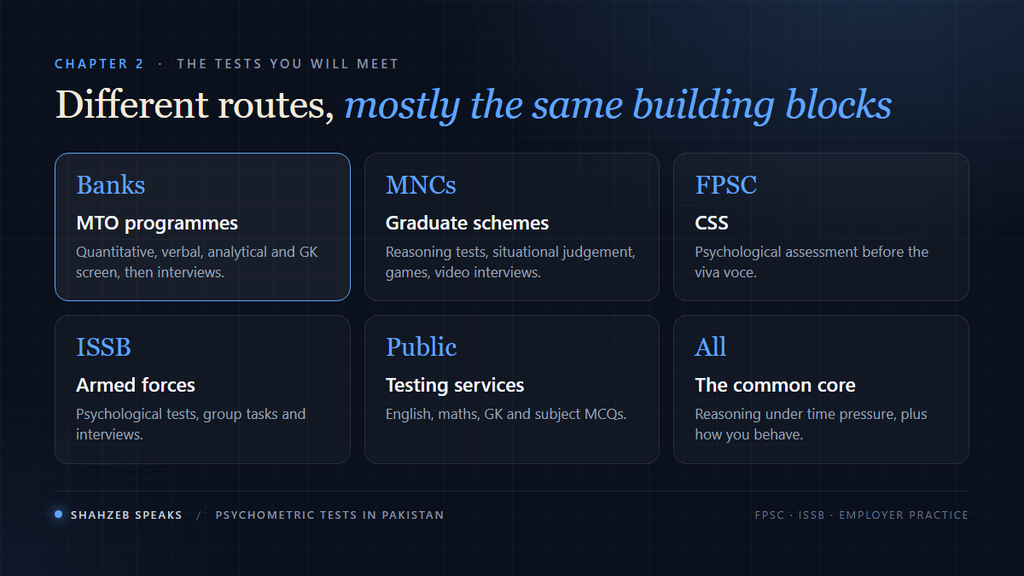
Different employers in Pakistan use different combinations, but the building blocks are similar. Here is what candidates typically encounter.
Bank management trainee (MTO) programmes
Large banks recruit graduates into management trainee programmes through a screening test followed by interviews, and sometimes group exercises. The screening test usually combines quantitative reasoning, English or verbal ability, analytical or logical reasoning and general knowledge. It is often administered by an external testing organisation. The test’s main job is to reduce a very large applicant pool to a manageable shortlist.
Multinational and FMCG graduate programmes
Global companies operating in Pakistan often use the same online assessment platforms they use worldwide. Depending on the company, these can include timed numerical, verbal and logical reasoning tests; situational judgement tests, which describe workplace scenarios and ask what you would do; game-based assessments; and recorded video interviews. Shortlisted candidates may then attend an assessment centre with group tasks, case studies and interviews.
CSS: psychological assessment before the viva
The Federal Public Service Commission lists a psychological assessment alongside the viva voce for candidates who clear the written CSS examination. Candidates commonly describe ability tests and personality questionnaires, sometimes with group exercises. The assessment feeds into the interview panel’s overall judgement rather than standing alone as a separate pass or fail.
ISSB: three kinds of assessment
The Inter Services Selection Board, which selects officers for the armed forces, describes a three-part system: psychological tests, group testing and interviews. The psychological part includes intelligence tests and projective-style tasks such as word association, sentence completion and writing stories about pictures, reviewed by psychologists. These are very different from a bank’s aptitude test, and I will cover them in detail in a separate guide.
Public testing services and entry tests
Many public-sector and some private-sector jobs in Pakistan use testing services for recruitment, with multiple-choice papers covering English, mathematics, general knowledge, Islamic studies or Pakistan studies and subject knowledge. These are closer to knowledge tests than psychometric tests, although many include an analytical or IQ-style section.
🧠 Chapter 3: What each section actually measures
| Section | What it measures | Does practice help? |
| Numerical reasoning | Working with percentages, ratios, tables and charts under time pressure | Yes: speed and familiarity with formats improve |
| Verbal reasoning | Reading carefully and judging what a passage does or does not say | Yes: especially the “true / false / cannot say” logic |
| Abstract / logical reasoning | Spotting rules in patterns and sequences you have not seen before | Some: learning common rule types helps |
| Situational judgement | How you would handle realistic workplace situations, often scored against the company’s values | Some: researching the employer’s values helps most |
| Personality questionnaire | Your typical preferences: organisation, sociability, calm, openness, cooperation | No: honesty and consistency matter more than strategy |
| Knowledge / GK sections | What you already know: current affairs, English usage, subject knowledge | Yes: this is where past papers are genuinely useful |
The pattern is worth noticing. Past papers help most with knowledge sections and least with personality questionnaires. Candidates who spend all their preparation time memorising past MCQs are preparing for only part of what is being measured.
📈 Chapter 4: What actually predicts job performance
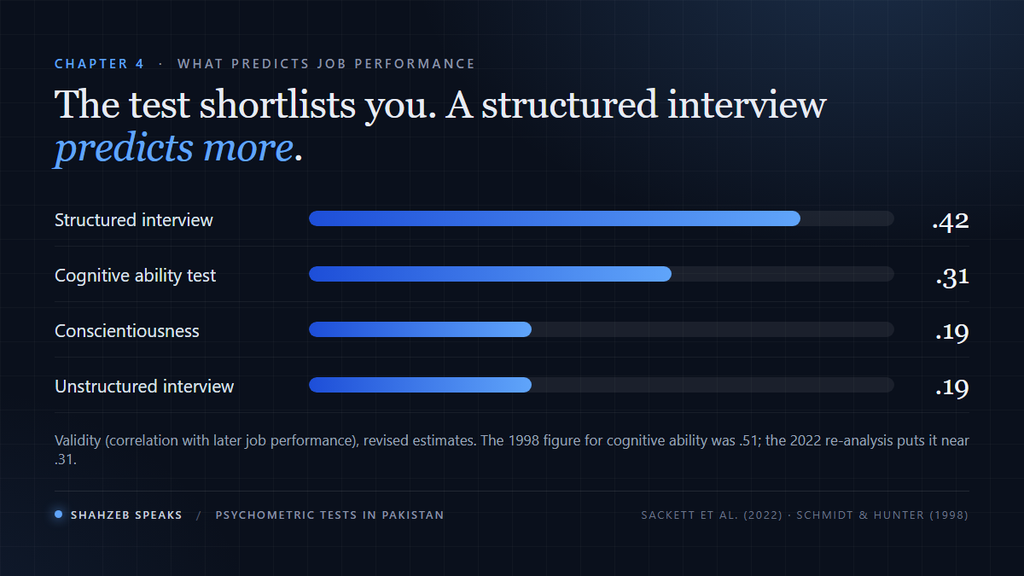
Industrial psychologists measure how well a selection method predicts later job performance using a statistic called validity, usually expressed as a correlation between 0 (no prediction) and 1 (perfect prediction). The research here is one of the most important in my field, and it changed recently.
For two decades, the most cited source was a 1998 review by Frank Schmidt and John Hunter, which estimated that general mental ability tests had a validity of about 0.51, making them look like the single best predictor available. In 2022, Paul Sackett and colleagues published a re-analysis in the Journal of Applied Psychology arguing that earlier corrections had overstated many of these figures. Their revised estimates put structured interviews at about 0.42, cognitive ability tests at about 0.31, and conscientiousness and unstructured interviews at around 0.19.
Three practical conclusions follow for candidates in Pakistan.
The aptitude test is mainly a screen. It is efficient and inexpensive for sorting thousands of applicants, which is why banks and multinationals use it first. But it predicts performance moderately, not strongly. A good score gets you a closer look; it does not prove you will be a great employee.
The interview matters more than many candidates think, if it is structured. Structured interviews, where every candidate is asked the same job-related questions and answers are scored against clear criteria, were the strongest predictor in the revised analysis. Preparing concrete examples of what you have actually done is often a better use of time than one more set of number series.
Personality adds something, modestly. Conscientiousness, being organised, dependable and hardworking, predicts performance across many jobs, but only modestly. No personality test can tell an employer with confidence whether you will succeed.
If you run hiring in a Pakistani organisation, the same research applies to you. I built a free selection accuracy calculator to show what a test’s validity and your applicant pool mean in practice, and I review hiring processes through my hiring assessment audit.
🎯 Chapter 5: How employers use your score, and the error margin
Most employers use aptitude scores in one of two ways.
- Cut-off: everyone above a certain score goes to the next round, everyone below is rejected.
- Ranking: candidates are ordered by score and the top group is invited forward, however many that is.
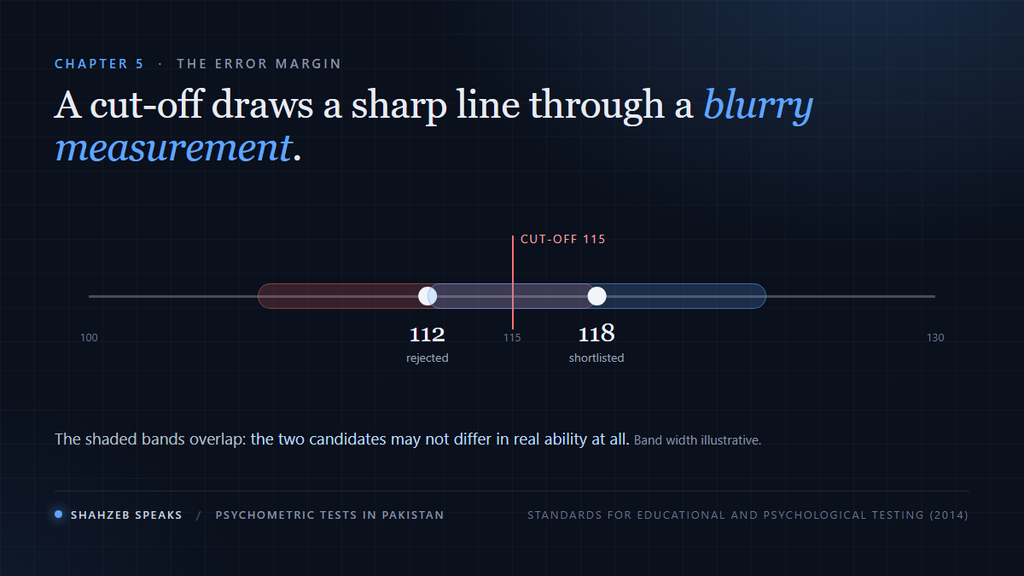
Both approaches treat the score as more precise than it really is. Every test has a standard error of measurement: the range within which a person’s score would vary if they took equivalent versions of the test on different days. Two candidates who score 112 and 118 may have no real difference in ability at all, but if the cut-off is 115, one moves forward and the other is rejected.
For candidates, this has two important implications. First, a rejection close to the cut-off says very little about your ability. It says you fell on the wrong side of a line drawn through a blurry measurement on one particular day. Second, retaking a test later, where the employer allows it, is reasonable: your score next time may genuinely differ.
For employers, it means scores near the cut-off should be treated as ties, not as clear differences. My Test Score Interpreter calculates these error bands so that HR teams can see when two scores are effectively the same.
📚 Chapter 6: How to prepare, section by section
Ability tests: practice works, within limits
A 2007 meta-analysis by John Hausknecht and colleagues in the Journal of Applied Psychology, combining 50 studies with more than 134,000 participants, found that scores on cognitive ability tests improved with retesting by about a quarter of a standard deviation on average, with larger gains when practice was combined with coaching. Practice helps mainly by making you familiar with question formats and faster under time pressure.
- Practise under real time limits. Most people lose marks to time, not to difficulty.
- Learn the formats: data tables, “true / false / cannot say” passages, number series and pattern rules.
- Review mistakes by type, not by question. If percentages trip you up, practise percentages.
- Skip and return. Most aptitude tests do not reward spending three minutes on one question.
Situational judgement tests: know the employer
These are usually scored against what the organisation considers effective behaviour. Read the company’s stated values and the job description, and think about how someone in that role would reasonably handle the situation. Extreme responses, such as ignoring a problem or escalating everything immediately, are rarely the intended answer.
Personality questionnaires: be consistent, not perfect
- Answer honestly and consistently. Many questionnaires include items that check for consistency or for an unrealistically positive self-image.
- Avoid extreme answers everywhere. Claiming you are always calm, always organised and never make mistakes looks less credible, not more.
- Think about yourself at work, not at home, when answering.
Knowledge and GK sections: past papers are useful here
For public-sector tests and knowledge-heavy papers, past papers and current affairs preparation genuinely help, because these sections test what you know rather than how you think.
For a broader, general guide to preparing for psychometric tests, read my article on how to pass psychometric tests.
⚠️ Chapter 7: The honest part — problems with testing in Pakistan
Tests built for other countries
Many online assessments are developed and standardised abroad. Verbal reasoning passages, cultural references and even the comparison groups used to score them may not reflect Pakistani candidates. A candidate who studied in Urdu-medium schools may be disadvantaged on a fast English verbal test in ways that say more about language than reasoning ability.
Test anxiety and unfamiliar formats
Candidates from smaller cities, or those without access to coaching and practice platforms, may be less familiar with online test formats. Since practice improves scores, unequal access to practice becomes unequal scores, which is a fairness problem, not just a preparation problem.
Personality tests used as pass or fail
Personality questionnaires are designed to describe preferences, not to rank people as good or bad. When they are used as strict pass or fail filters, especially for roles where the trait is not clearly relevant, they can screen out capable people for no good reason.
Paid “guaranteed” preparation
Be sceptical of anyone who promises the exact questions or a guaranteed pass, particularly for personality sections. Legitimate practice builds familiarity. It cannot guarantee a result, and leaked-paper schemes can get candidates disqualified.
🎓 Chapter 8: Why this is an I/O psychology question
Designing, choosing and interpreting these tests is exactly what industrial and organizational psychologists are trained to do. In Pakistan, the field is still small compared with its importance: many organisations buy off-the-shelf tests without checking whether they are valid for their jobs or fair to their applicants.
If you are a student interested in this work, it is one of the most practical areas of industrial psychology in Pakistan, with roles in HR, talent assessment, recruitment consulting and testing organisations. My I/O Psychology Career Starter Kit sets out the routes into the field, and I offer one-to-one guidance through career coaching.
📝 The takeaway
Psychometric tests in Pakistani hiring are mostly screening tools: an efficient way to reduce a very large number of applicants to a shortlist. The ability sections respond to practice, especially under realistic time limits. The personality sections reward honesty and consistency, not strategy. And every score carries an error margin, so a rejection close to a cut-off says very little about your real ability.
Prepare for each section differently, take the interview as seriously as the test, and if you are rejected by a narrow margin, remember what the research shows: the line was sharp; the measurement was not.
❓ Frequently asked questions
What is a psychometric test for jobs in Pakistan?
It is a standardised test used to measure abilities such as numerical, verbal and logical reasoning, or personality traits, so that candidates can be compared fairly. Banks, multinationals, the CSS process and the ISSB all use psychometric assessment in some form.
How do I prepare for a bank MTO test in Pakistan?
Practise quantitative, verbal and analytical reasoning questions under real time limits, review your mistakes by type, and prepare general knowledge and current affairs for any knowledge section. Then prepare concrete examples for the interview, which often matters as much as the test.
Can you fail a personality test?
Personality questionnaires have no right answers, but employers may compare your profile with what they want for a role. Answering honestly and consistently is the best approach; trying to appear perfect often triggers consistency checks and looks less credible.
Is there a psychological test in CSS?
Yes. The Federal Public Service Commission conducts a psychological assessment for candidates who pass the written examination, before the viva voce. It typically includes ability tests and personality questionnaires, and its findings inform the interview panel.
Do practice tests improve aptitude scores?
Yes, modestly. A 2007 meta-analysis of 50 studies found that retesting improved cognitive ability test scores by about a quarter of a standard deviation on average, with larger gains when practice was combined with coaching.
What predicts job performance best?
A 2022 re-analysis by Sackett and colleagues found structured interviews to be the strongest common predictor (about 0.42), ahead of cognitive ability tests (about 0.31). Tests are useful screens, but they do not decide performance on their own.
🧠 Hiring in Pakistan? Are your tests measuring what you think?
I’m Muhammad Shahzeb, an MSc Industrial and Organizational Psychologist in Karachi. I review selection tests and interviews for validity and fairness, and help organisations use scores the way the research says they should be used.
📚 References and further reading
- Sackett, P. R., Zhang, C., Berry, C. M., & Lievens, F. (2022). “Revisiting meta-analytic estimates of validity in personnel selection: Addressing systematic overcorrection for restriction of range.” Journal of Applied Psychology, 107(11), 2040-2068.
- Schmidt, F. L., & Hunter, J. E. (1998). “The validity and utility of selection methods in personnel psychology: Practical and theoretical implications of 85 years of research findings.” Psychological Bulletin, 124(2), 262-274.
- Hausknecht, J. P., Halpert, J. A., Di Paolo, N. T., & Moriarty Gerrard, M. O. (2007). “Retesting in selection: A meta-analysis of coaching and practice effects for tests of cognitive ability.” Journal of Applied Psychology, 92(2), 373-385.
- Federal Public Service Commission. “Psychological Assessment & Viva Voce.” fpsc.gov.pk
- Inter Services Selection Board. “Selection System.” issb.gov.pk
- American Educational Research Association, American Psychological Association, & National Council on Measurement in Education (2014). Standards for Educational and Psychological Testing. (Standard error of measurement and score interpretation.)
Written by Muhammad Shahzeb, MSc Industrial & Organizational Psychology | Karachi, Pakistan | Workplace Psychology Specialist
Learn more about my approach →