
Validity in employee selection is the evidence that scores on a hiring tool (a test, an interview, an assessment centre) mean what we claim and predict job performance. The classic types are content, criterion-related (predictive and concurrent), construct and face validity. A validity coefficient is the correlation between predictor scores and later job performance.
This guide is for psychology, HRM and MBA students who need “types of validity” for an exam or a thesis, and for anyone who has read that structured interviews or ability tests “predict performance” and wants to know what the numbers mean. You get each type in simple words with a workplace example, a comparison table, the Schmidt and Hunter (1998) validity table next to the 2022 revision by Sackett and colleagues, a 10-mark answer plan and practice MCQs.
Validity is one part of the wider personnel psychology course. The personnel psychology notes pillar shows where it sits between job analysis and the hiring decision.
What does validity mean in selection?
In everyday speech we say “this test is valid”. Measurement experts say something more careful. The Standards for Educational and Psychological Testing (AERA, APA and NCME, 2014) treat validity as the degree to which evidence and theory support a particular interpretation and use of test scores. So the question is never just “is the test valid?” but “is it valid to use these scores to choose bank tellers?” A typing test can be valid for data entry clerks and useless for sales managers.
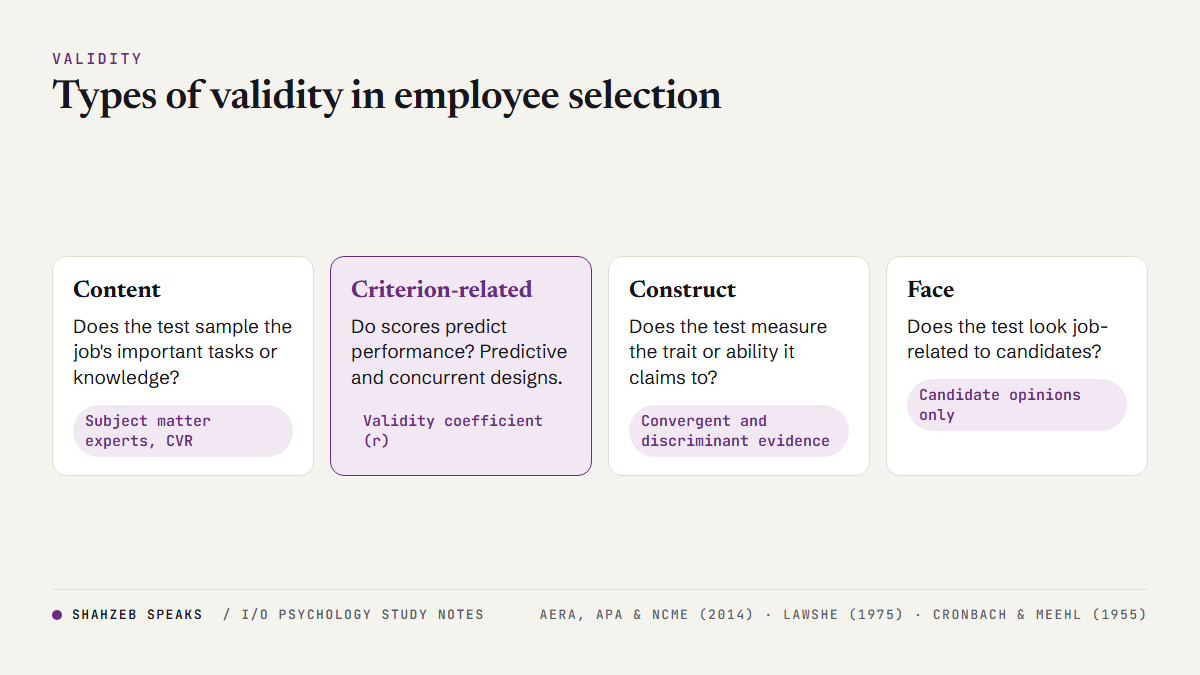
The Standards describe five sources of validity evidence: test content, response processes, internal structure, relations to other variables, and the consequences of testing. Most I/O textbooks and exam papers still teach the older labels (content, criterion-related, construct and face), so this page uses those, and the FAQ shows how they map onto the modern view. In selection, the Society for Industrial and Organizational Psychology’s Principles for the Validation and Use of Personnel Selection Procedures (2018) apply the same thinking to hiring.
One more idea before the types. Validity needs reliability. A test that gives different scores each time cannot predict anything well. The upper limit on a validity coefficient is the square root of (predictor reliability multiplied by criterion reliability). If a test has a reliability of .80 and supervisor ratings have a reliability of .52 (the mean interrater figure Viswesvaran, Ones and Schmidt found in 1996), the highest validity you could observe is the square root of .80 × .52 = .416, which is about .64. Reliability is covered in detail in reliability in psychological testing.
Content validity: does the test sample the job?
Content validity is the evidence that the content of a selection tool is a fair, representative sample of the job’s important tasks or knowledge. It is judged by subject matter experts (SMEs), not by correlations. The steps are:
- Do a job analysis to list the important tasks and KSAOs (knowledge, skills, abilities and other characteristics).
- Write test items or exercises that sample those tasks.
- Ask SMEs to rate whether each item is essential to the job.
- Keep items that enough experts agree on, and check that no important part of the job is left out.
Lawshe (1975) turned step 3 into a number, the content validity ratio (CVR): CVR = (ne − N/2) ÷ (N/2), where ne is the number of experts who rate the item “essential” and N is the total number of experts. If 8 of 10 experts say essential, CVR = (8 − 5) ÷ 5 = 0.60. You can run this on your own items with the content validity ratio calculator, or use Aiken’s V for rating-scale judgements with the Aiken’s V calculator.
Example: a hospital in Lahore builds a medication-calculation test for staff nurses. Senior nurses and the pharmacist check that the problems match the doses nurses actually calculate on the ward. That is content evidence. Content validity works best for tests of knowledge and skill that are directly visible in the job (work samples, job knowledge tests). It is weaker for broad traits such as personality, where the link to tasks is less direct.
Criterion-related validity: predictive vs concurrent
Criterion-related validity is the evidence that scores on the predictor (the test) are statistically related to a criterion, which is a measure of job success such as supervisor ratings, sales, errors or training results. The result is a correlation called the validity coefficient. There are two designs, and examiners love to ask the difference.
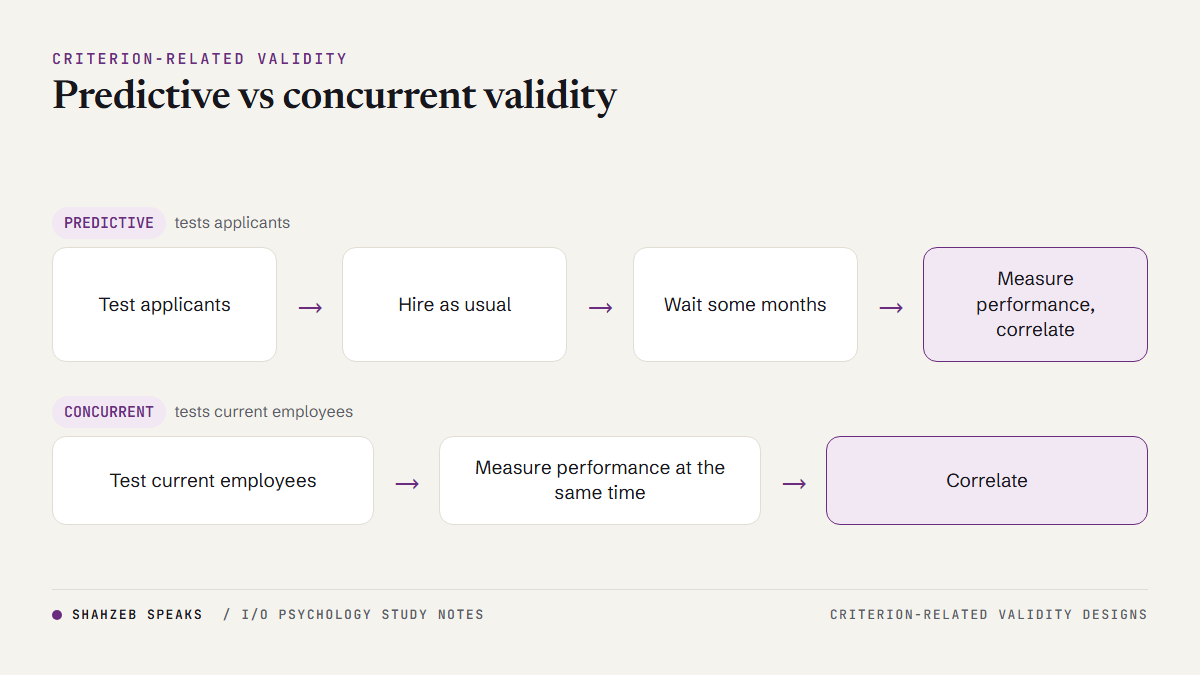
Predictive validity
Test the applicants, hire them without using the test scores (or using them only loosely), wait some months, then collect performance data and correlate the two. Example: a call centre in Manila gives a listening and typing test to every applicant for a year, hires as usual, and after six months correlates test scores with quality-assurance ratings. Predictive designs match the real use of the test (predicting the future of applicants), but they take time, and the organisation must wait before it knows whether the test works.
Concurrent validity
Test current employees and collect their performance data at about the same time, then correlate. Example: the same call centre gives the test to its 200 current agents this month and correlates scores with this month’s quality ratings. Concurrent designs are fast and cheap. Their weaknesses are that current employees have already been selected (the weakest have left or were never hired), they have job experience the applicants do not have, and they may be less motivated to do well on a test that does not affect them.
Range restriction
Both designs suffer from range restriction. You can only collect performance data for people who were hired, so the low scorers are missing from the sample. When the range of scores is narrower, the correlation shrinks, which makes the test look weaker than it really is among all applicants. Researchers correct for this statistically (the site’s range restriction calculator shows how), but as the next section explains, how much to correct is itself a debate.
Construct validity and face validity
Construct validity is the evidence that a test measures the psychological quality (the construct) it claims to measure, such as conscientiousness, numerical reasoning or customer orientation. Cronbach and Meehl (1955) set out the idea: we build a network of predictions about how the construct should relate to other things, and check whether the test scores behave that way. Campbell and Fiske (1959) added two practical checks:
- Convergent validity: the test correlates with other measures of the same construct (a new conscientiousness scale correlates with an established one).
- Discriminant validity: the test does not correlate too strongly with measures of different constructs (the conscientiousness scale is not just another measure of intelligence).
Factor analysis of the items (does the scale have the structure the theory says?) is also construct evidence. Thesis students report this as composite reliability, AVE and HTMT, which you can compute with the composite reliability and AVE calculator.
Face validity is whether the test looks relevant to the people taking it. A numerical test for an accounts officer that uses invoices and ledgers has high face validity; the same reasoning written as abstract puzzles has less. Face validity is not technical evidence that the test predicts anything, so many textbooks say it is not a true type of validity. It still matters, because applicants who think a test is unrelated to the job may see the process as unfair, withdraw, or complain.
Types of validity compared (table)
| Type | Question it answers | How it is shown | Selection example |
|---|---|---|---|
| Content | Does the test sample the job’s important tasks or knowledge? | Job analysis plus subject matter expert judgements (CVR, Aiken’s V) | Medication-calculation test for ward nurses |
| Criterion-related: predictive | Do applicants’ scores predict later performance? | Correlation between applicant scores and performance measured months later | Call-centre applicants tested, QA ratings after six months |
| Criterion-related: concurrent | Do employees’ scores relate to their current performance? | Correlation between employee scores and performance at the same time | Current agents tested, this month’s QA ratings |
| Construct | Does the test measure the trait or ability it claims to? | Convergent and discriminant correlations, factor structure | New conscientiousness scale checked against an established one |
| Face | Does the test look job-related to candidates? | Candidate opinions; not statistical evidence | Numerical test using invoices for an accounts officer |
What is a good validity coefficient? Schmidt and Hunter vs Sackett et al.
A validity coefficient (r) runs from −1 to +1. Squaring it gives the share of performance differences the predictor accounts for: r = .30 means .30 × .30 = .09, or 9%. That sounds small, but a selection tool is used on many hires, and even modest validity improves the average quality of people hired. Whether a given r is worth it also depends on how many applicants you have per job (the selection ratio) and how many applicants would succeed anyway (the base rate). Taylor and Russell (1939) published tables for exactly this, and you can try them with the Taylor-Russell calculator. The money side, utility analysis, goes back to Brogden (1949); try the utility analysis calculator.
For 25 years the standard reference was Schmidt and Hunter (1998), who summarised 85 years of meta-analyses and reported the validity of 19 selection procedures. Their table put general mental ability (GMA) at .51, structured interviews at .51 and work samples at .54, and found that GMA combined with an integrity test reached a multiple validity of .65.
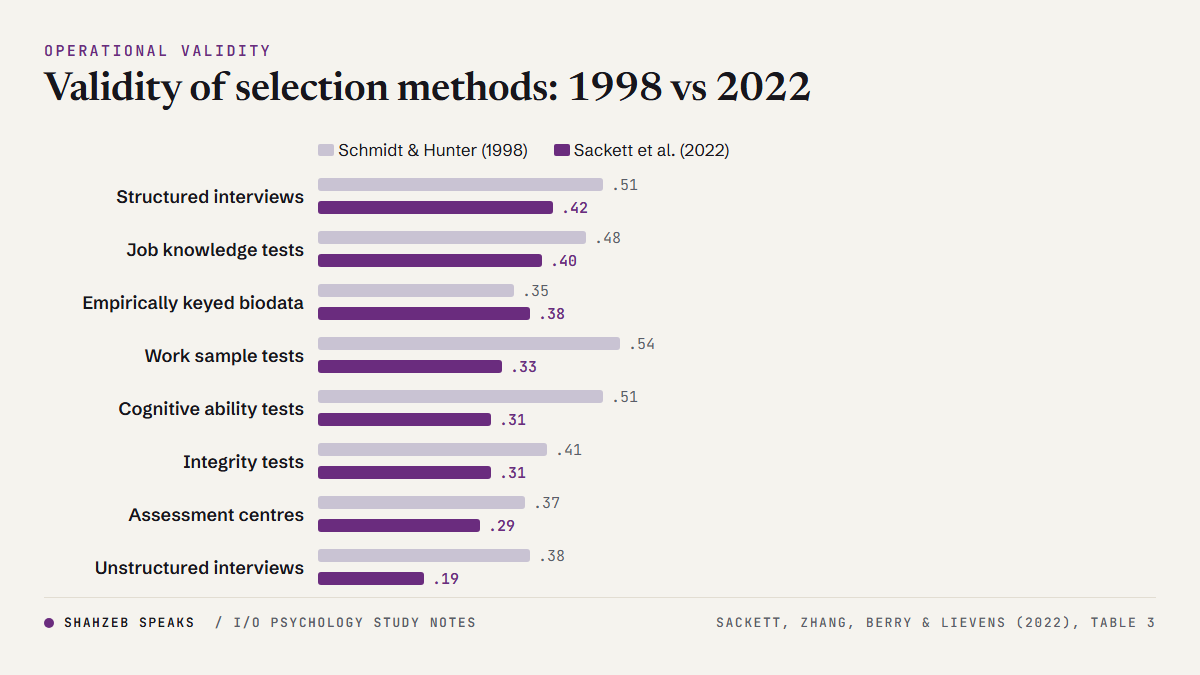
In 2022, Sackett, Zhang, Berry and Lievens re-examined the same meta-analyses in the Journal of Applied Psychology. They argued that the earlier work over-corrected for range restriction, especially by applying corrections meant for predictive studies to concurrent ones. Their revised estimates kept most procedures in a similar rank order but lowered mean validities by .10 to .20, and structured interviews came out on top. Here are selected values from their Table 3:
| Selection procedure | Schmidt and Hunter (1998) | Sackett et al. (2022) |
|---|---|---|
| Structured interviews | .51 | .42 |
| Job knowledge tests | .48 | .40 |
| Empirically keyed biodata | .35 | .38 |
| Work sample tests | .54 | .33 |
| Cognitive ability tests | .51 | .31 |
| Integrity tests | .41 | .31 |
| Assessment centres | .37 | .29 |
| Conscientiousness (overall) | .31 | .19 |
| Unstructured interviews | .38 | .19 |
| Job experience (years) | .18 | .07 |
How to use this in an exam: quote both, and say that the 2022 paper did not show that selection tools stop working. Its authors concluded that selection procedures remain useful, but that predictor-criterion relationships are considerably lower than previously thought. The practical message for an HR department in Karachi or Mumbai is the same in both papers: a structured interview and a job-related knowledge or ability test beat an unstructured chat. The site’s structured vs unstructured interviews article goes deeper on that point.
Validity and fairness
A valid test can still screen out one group more than another. In the United States, the Uniform Guidelines (1978) use the four-fifths rule: if one group’s selection rate is less than 80% of the highest group’s rate, that is generally regarded as evidence of adverse impact, and the employer needs validity evidence for the tool. You can test your own numbers with the adverse impact calculator. Note that group differences in average scores do not by themselves prove a test is biased. Test bias, in the technical sense, means the test predicts performance differently for different groups. Sackett et al. (2022) paired their validity estimates with subgroup differences for this reason: some valid tools also show large group differences (cognitive ability tests had a Black-White difference of d = .79 in their table), while structured interviews combined the highest validity with a relatively small difference (d = .23).
10-mark answer structure
- Definition: validity is the degree to which evidence supports the intended interpretation and use of test scores (AERA, APA and NCME, 2014); in selection, whether scores predict job performance.
- Content validity: SME judgement based on job analysis; Lawshe’s (1975) CVR with the formula.
- Criterion-related validity: validity coefficient; predictive vs concurrent with one example each and one weakness each.
- Construct validity: Cronbach and Meehl (1955); convergent and discriminant evidence (Campbell and Fiske, 1959).
- Face validity: appearance only; matters for applicant reactions.
- Evidence: Schmidt and Hunter (1998) and the Sackett et al. (2022) revision (structured interview .42, cognitive ability .31).
- Link to reliability and fairness: reliability limits validity; the four-fifths rule.
- Conclusion: validity is built from several kinds of evidence, not a single number.
Model opening line: “In personnel selection, validity refers to how well the evidence supports using a predictor’s scores to make hiring decisions; it is established through content, criterion-related and construct evidence, of which criterion-related validity, expressed as a validity coefficient, is the most direct test of whether a tool predicts job performance.”
Practice MCQs: validity in employee selection
Practice questions written to the published syllabus, not past-paper items.
-
A company tests its current employees and correlates their scores with this month’s performance ratings. This design is:
- predictive validity
- concurrent validity
- content validity
- face validity
Show answer
B. Current employees and performance measured at the same time make it concurrent. Predictive tests applicants and waits; content and face validity do not use performance data.
-
Subject matter experts rate whether each test item is essential to the job. This provides evidence of:
- construct validity
- criterion-related validity
- content validity
- test-retest reliability
Show answer
C. Expert judgement of how well items sample the job is content evidence (Lawshe’s CVR). No correlations with performance or retesting are involved.
-
If 7 of 10 experts rate an item “essential”, Lawshe’s CVR is:
- 0.70
- 0.40
- 0.20
- 1.40
Show answer
B. CVR = (7 − 5) ÷ 5 = 0.40. 0.70 is just the proportion; 0.20 and 1.40 come from using the wrong denominator.
-
A validity coefficient of .40 means the predictor accounts for about what share of performance differences?
- 40%
- 16%
- 4%
- 60%
Show answer
B. Square the correlation: .40 × .40 = .16. Reading r directly as a percentage (40%) is a common mistake.
-
A new customer-orientation scale correlates highly with an established customer-orientation scale. This is:
- discriminant validity
- convergent validity
- face validity
- predictive validity
Show answer
B. Agreement with another measure of the same construct is convergent evidence. Discriminant validity is about low correlation with different constructs.
-
According to Sackett et al. (2022), which selection procedure had the highest mean operational validity?
- Cognitive ability tests
- Work sample tests
- Structured interviews
- Unstructured interviews
Show answer
C. Structured interviews (.42) came first. Cognitive ability fell to .31 and work samples to .33; unstructured interviews were .19.
-
Which statement about face validity is correct?
- It is the strongest statistical evidence of validity
- It is how job-related a test looks to test takers
- It requires a predictive study
- It is the same as construct validity
Show answer
B. Face validity is appearance to candidates. It is not statistical evidence, needs no study, and is not construct validity.
-
Why can a concurrent validity study underestimate a test’s validity?
- Employees are always more motivated than applicants
- Range restriction: low scorers were never hired or have left
- The test items are too easy for experts
- Concurrent designs do not use correlations
Show answer
B. A narrower range of scores shrinks the correlation. Employees are often less motivated, not more, and concurrent designs do use correlations.
-
Which is NOT one of the five sources of validity evidence in the 2014 Standards?
- Test content
- Internal structure
- Consequences of testing
- Test length
Show answer
D. The five are test content, response processes, internal structure, relations to other variables and consequences. Test length affects reliability but is not a source of validity evidence.
-
Group A is hired at a rate of 50% and Group B at 30%. Under the four-fifths rule:
- there is no adverse impact because both groups were hired
- there is evidence of adverse impact because 30 ÷ 50 = 0.60, below 0.80
- adverse impact exists only if the difference is above 50 points
- the rule cannot be applied without validity data
Show answer
B. The impact ratio is 0.60, which is below four-fifths (0.80). The rule uses the ratio of rates, not a fixed point gap, and it is applied before any validity question.
Try the selection calculators
Work the numbers yourself with the free content validity ratio calculator, Taylor-Russell calculator and selection accuracy calculator. For revision on the go, the free I/O Psychology Prep app has 410 explained questions and flashcards, and works offline: Get it on Google Play.
More practice: the selection, reliability and validity MCQs set has 25 questions.
Questions students ask
What are the types of validity in psychology?
The classic types are content validity, criterion-related validity (with predictive and concurrent designs), construct validity (with convergent and discriminant evidence) and face validity. Modern standards treat validity as one idea supported by several sources of evidence rather than separate types.
What is the difference between predictive and concurrent validity?
Predictive validity tests applicants and correlates their scores with performance measured later. Concurrent validity tests current employees and correlates their scores with performance measured at about the same time. Predictive is closer to real use; concurrent is faster but affected by range restriction and experience.
What is a good validity coefficient for a selection test?
There is no single cut-off. In Sackett et al. (2022), the best procedures were around .30 to .42. A coefficient in that range is useful, especially with a low selection ratio. In the same table, years of job experience (.07) added very little.
Is face validity real validity?
Not in the technical sense, because it is not evidence that scores predict or measure anything. It is still worth having, because candidates judge fairness partly by whether a test looks related to the job.
How do content, construct and criterion validity relate to the modern view?
Content validity maps onto “evidence based on test content”. Construct evidence such as factor structure maps onto “internal structure”. Criterion-related, convergent and discriminant evidence fall under “relations to other variables”. The 2014 Standards add response processes and consequences of testing.
Can a test be reliable but not valid?
Yes. A test can give consistent scores but measure the wrong thing, such as a reliable typing test used to choose sales managers. A test cannot be valid without some reliability, because random error limits how strongly it can correlate with anything.
Practise on your phone
The free I/O Psychology Prep app has 410 explained
questions, flashcards and an exam countdown, and works offline. Get it on Google Play
· About the app
References
- American Educational Research Association, American Psychological Association, & National Council on Measurement in Education. (2014). Standards for educational and psychological testing. American Educational Research Association.
- Brogden, H. E. (1949). When testing pays off. Personnel Psychology, 2(2), 171-183. https://doi.org/10.1111/j.1744-6570.1949.tb01397.x
- Campbell, D. T., & Fiske, D. W. (1959). Convergent and discriminant validation by the multitrait-multimethod matrix. Psychological Bulletin, 56(2), 81-105. https://doi.org/10.1037/h0046016
- Cronbach, L. J., & Meehl, P. E. (1955). Construct validity in psychological tests. Psychological Bulletin, 52(4), 281-302. https://doi.org/10.1037/h0040957
- Lawshe, C. H. (1975). A quantitative approach to content validity. Personnel Psychology, 28(4), 563-575. https://doi.org/10.1111/j.1744-6570.1975.tb01393.x
- Sackett, P. R., Zhang, C., Berry, C. M., & Lievens, F. (2022). Revisiting meta-analytic estimates of validity in personnel selection: Addressing systematic overcorrection for restriction of range. Journal of Applied Psychology, 107(11), 2040-2068. https://doi.org/10.1037/apl0000994
- Schmidt, F. L., & Hunter, J. E. (1998). The validity and utility of selection methods in personnel psychology: Practical and theoretical implications of 85 years of research findings. Psychological Bulletin, 124(2), 262-274. https://doi.org/10.1037/0033-2909.124.2.262
- Society for Industrial and Organizational Psychology. (2018). Principles for the validation and use of personnel selection procedures. Industrial and Organizational Psychology, 11(S1), 1-97. https://doi.org/10.1017/iop.2018.195
- Taylor, H. C., & Russell, J. T. (1939). The relationship of validity coefficients to the practical effectiveness of tests in selection: Discussion and tables. Journal of Applied Psychology, 23(5), 565-578. https://doi.org/10.1037/h0057079
- Uniform guidelines on employee selection procedures, 29 C.F.R. pt. 1607 (1978). https://www.ecfr.gov/current/title-29/subtitle-B/chapter-XIV/part-1607
- Viswesvaran, C., Ones, D. S., & Schmidt, F. L. (1996). Comparative analysis of the reliability of job performance ratings. Journal of Applied Psychology, 81(5), 557-574. https://doi.org/10.1037/0021-9010.81.5.557
Back to the hub: Personnel psychology notes. Related: reliability in psychological testing, job analysis methods, recruitment vs selection and personality tests at work.