

Industrial psychology (industrial and organizational, or I/O, psychology) is the scientific study of people at work. These notes cover its ten core exam topics in short printable blocks: history, job analysis, selection, appraisal, training, motivation, job design, job attitudes, leadership and stress, each with key names, years, a mini table and exam points.
These are short notes for BS, BA and MSc psychology students, and for anyone revising for a lecturer test, CSS, UGC NET or the psychometrician board exam. Each topic is one compact block you can learn in ten minutes. If you want the full explanation, every block links to a longer post.
How to print these notes or save them as a PDF
Use your browser. On a computer, press Ctrl + P (or Cmd + P on a Mac), then choose your printer, or choose Save as PDF as the destination. On an Android phone in Chrome, open the menu (three dots), tap Share, then Print, and pick Save as PDF. On an iPhone, tap the Share button, then Print, and share the preview as a PDF. Printing only the pages you need saves paper: the ten blocks are in the same order as the topic map below.
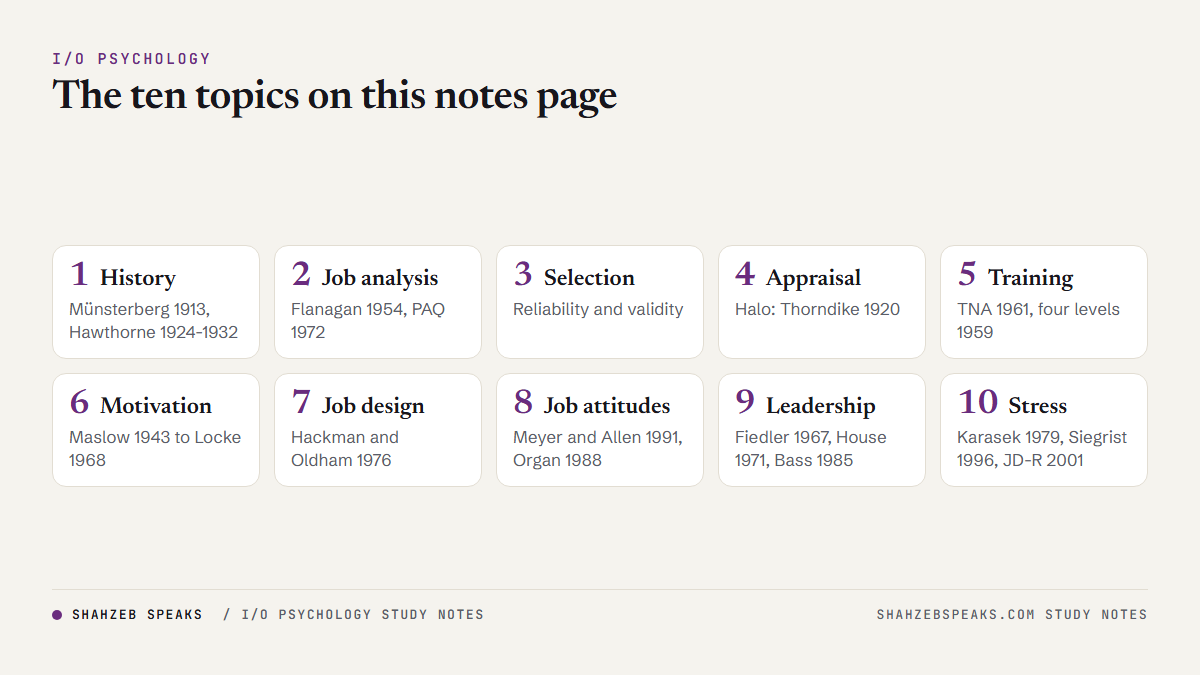
Foundations: what I/O psychology is and where it came from
1. History of industrial psychology
Definition: I/O psychology applies psychological methods and findings to work. The “industrial” side deals with personnel decisions (job analysis, selection, training, appraisal); the “organizational” side deals with motivation, attitudes, leadership and groups.
Key names: Hugo Münsterberg, Psychology and Industrial Efficiency (1913); Robert Yerkes and colleagues, Army Alpha and Army Beta tests in the First World War (1917-1918); the Hawthorne studies at Western Electric (1924-1932).
| Period | Main event | What it added |
|---|---|---|
| 1910s | Münsterberg (1913); Army Alpha and Beta (1917-1918) | Testing and selection at scale |
| 1920s-1930s | Hawthorne studies (1924-1932) | Social and group factors at work |
| 1950s-1970s | Motivation and job design theories (Herzberg 1959, Vroom 1964, Hackman and Oldham 1976) | Why people work and how to design jobs |
- Exam point: name Münsterberg as an early founder and give the year of his 1913 book.
- Exam point: Hawthorne showed that informal groups and attention shape output, which started the human relations movement.
Full notes: history of I/O psychology, Hawthorne studies, Hugo Münsterberg and industrial vs organizational psychology.
Personnel notes: job analysis, selection, appraisal and training
2. Job analysis
Definition: a systematic study of a job to find its tasks (what is done) and the knowledge, skills, abilities and other characteristics (KSAOs) needed to do it. It produces the job description and the job specification.
Key names: Flanagan’s critical incident technique (1954); the Position Analysis Questionnaire, PAQ (McCormick, Jeanneret and Mecham, 1972).
| Method | Type | Best for |
|---|---|---|
| Interview and observation | Task-oriented | Simple jobs, small firms |
| Critical incidents (1954) | Task/behaviour examples | Building appraisal scales |
| PAQ (1972) | Worker-oriented questionnaire | Comparing many jobs |
- Exam point: job description = the job; job specification = the person needed.
- Exam point: job analysis is the base for selection, training, appraisal and pay.
Full notes: job analysis methods and job description vs job specification.
3. Selection: reliability and validity
Definition: selection is choosing among applicants using predictors (tests, interviews, assessment centres). A good predictor must be reliable (consistent) and valid (measures what it should and predicts job performance).
| Concept | Types | One-line meaning |
|---|---|---|
| Reliability | Test-retest, parallel forms, split-half, internal consistency | Same result each time |
| Validity | Content, criterion-related (concurrent, predictive), construct | Right thing, and predicts performance |
- Exam point: a test can be reliable but not valid; it cannot be valid without being reliable.
- Exam point: structured interviews predict performance better than unstructured ones (Schmidt and Hunter, 1998).
Full notes: validity in employee selection, reliability in testing, recruitment vs selection and structured vs unstructured interviews.
4. Performance appraisal: methods and errors
Definition: a formal evaluation of how well an employee does the job, used for feedback, pay, promotion and training decisions.
Key name: Thorndike (1920) described the halo effect as “a constant error in psychological ratings”.
| Error | What happens |
|---|---|
| Halo | One good or bad trait colours all ratings |
| Leniency / strictness | Everyone rated too high or too low |
| Central tendency | Everyone rated in the middle |
| Recency | Only the last few weeks remembered |
- Exam point: methods include graphic rating scales, BARS, forced distribution, MBO and 360-degree feedback.
- Exam point: rater training and behaviour-based scales reduce errors.
Full notes: performance appraisal errors and methods of performance appraisal.
5. Training: needs analysis and evaluation
Definition: training is a planned effort to help employees learn job-related knowledge, skills and behaviour. It starts with training needs analysis (TNA) and ends with evaluation.
Key names: McGehee and Thayer (1961) set out three levels of needs analysis: organization, task (operations) and person. Kirkpatrick (1959) proposed four levels of evaluation.
| Stage | Levels |
|---|---|
| Needs analysis (1961) | Organization, task, person |
| Evaluation (1959) | Reaction, learning, behaviour, results |
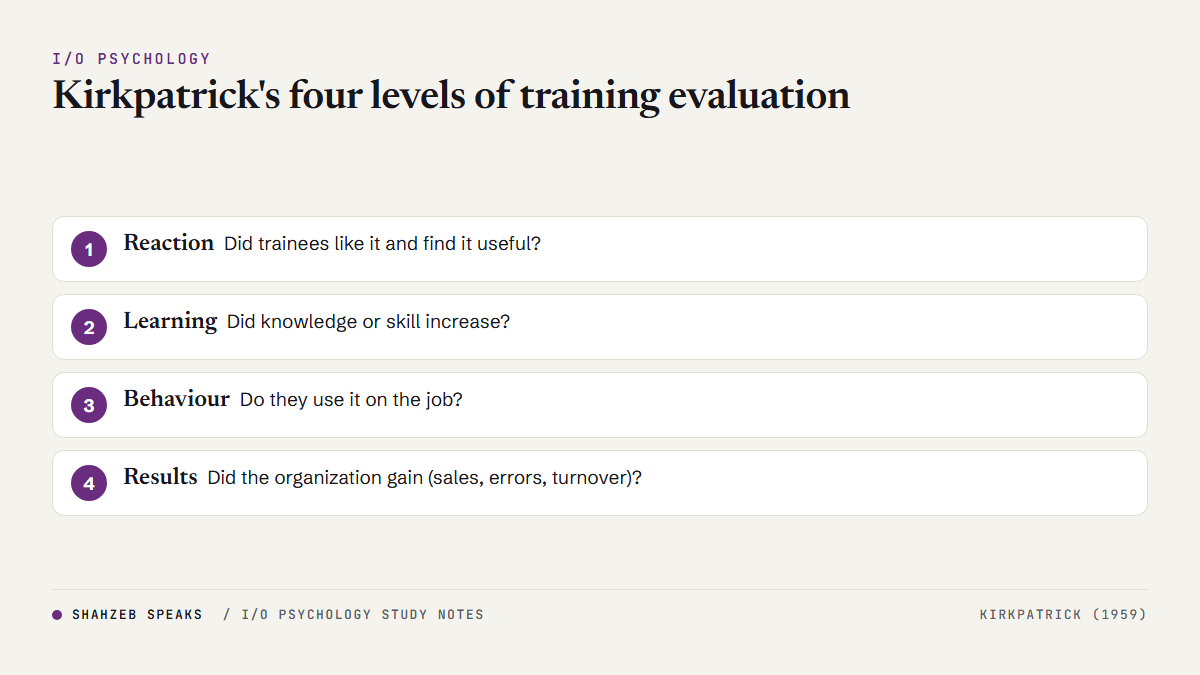
- Exam point: trainees liking a course (reaction) does not prove they learned or changed behaviour.
- Exam point: transfer of training needs support from the supervisor back on the job.
Full notes: training needs analysis and Kirkpatrick’s four levels.
Organizational notes: motivation, job design and job attitudes
6. Work motivation
Definition: the forces that start, direct and keep up work behaviour. Need theories say what motivates; process theories say how people decide how hard to try.
| Theory | Author, year | Core idea |
|---|---|---|
| Hierarchy of needs | Maslow, 1943 | Five levels, lower needs first |
| Two-factor | Herzberg, Mausner and Snyderman, 1959 | Hygiene factors vs motivators |
| Expectancy (VIE) | Vroom, 1964 | Effort depends on expectancy, instrumentality, valence |
| Equity | Adams, 1965 | Compare outcome/input ratios with others |
| Goal setting | Locke, 1968 | Specific, difficult goals raise performance |
- Exam point: Herzberg’s hygiene factors (pay, conditions) remove dissatisfaction but do not motivate.
- Exam point: in Vroom’s model, if any one of the three parts is zero, motivation is zero.
Full notes: work motivation theories, Maslow vs Herzberg, equity theory and goal-setting theory.
7. Job design and the job characteristics model
Definition: job design is how tasks are grouped into a job. Hackman and Oldham’s (1976) job characteristics model names five core dimensions (skill variety, task identity, task significance, autonomy, feedback) that create three psychological states (meaningfulness, responsibility, knowledge of results).
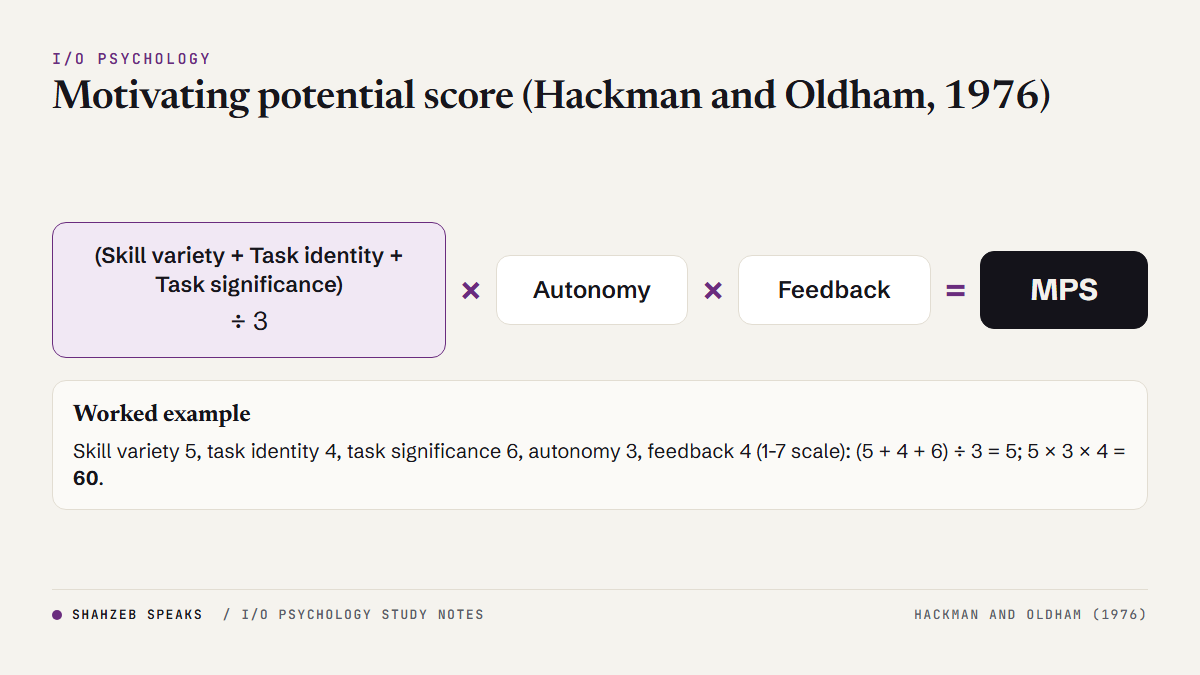
Worked example: on a 1-7 scale, skill variety 5, task identity 4, task significance 6, autonomy 3 and feedback 4 give (5 + 4 + 6) ÷ 3 = 5, and 5 × 3 × 4 = 60. Check your own numbers with the motivating potential score calculator.
| Approach | What changes |
|---|---|
| Job rotation | Move between jobs |
| Job enlargement | More tasks at the same level |
| Job enrichment | More responsibility and control |
- Exam point: enrichment is vertical loading; enlargement is horizontal loading.
- Exam point: growth need strength moderates how people respond to enriched jobs.
Full notes: job characteristics model and job enrichment vs enlargement vs rotation.
8. Job attitudes: satisfaction, commitment and OCB
Definition: job satisfaction is how much people like their jobs. Organizational commitment is attachment to the organization. Organizational citizenship behaviour (OCB) is helpful behaviour beyond the formal job, described by Organ (1988); counterproductive work behaviour (CWB) is the harmful opposite.
| Commitment component (Meyer and Allen, 1991) | Why the person stays |
|---|---|
| Affective | Wants to |
| Continuance | Needs to (leaving costs too much) |
| Normative | Feels obliged to |
- Exam point: Organ’s five OCB dimensions are altruism, conscientiousness, sportsmanship, courtesy and civic virtue.
- Exam point: in a meta-analysis, affective commitment had the strongest links with performance and with staying (Meyer, Stanley, Herscovitch and Topolnytsky, 2002).
Full notes: job satisfaction theories and measures, Meyer and Allen’s model, OCB and CWB.
Leadership and stress notes
9. Leadership theories
Definition: leadership is influencing a group towards shared goals. Theories moved from traits, to behaviours, to situations, to relationships and change.
| Approach | Key names, years | Core idea |
|---|---|---|
| Behavioural | Ohio State and Michigan studies | Task-focused vs people-focused behaviour (initiating structure, consideration) |
| Contingency | Fiedler, 1967; House, 1971 (path-goal) | Effectiveness depends on the situation |
| Relationship | Graen and Uhl-Bien, 1995 (LMX) | Different quality exchanges with each follower |
| Transformational | Burns, 1978; Bass, 1985 | Inspire followers beyond self-interest |
- Exam point: Fiedler treats style as fixed, so you change the situation, not the leader.
- Exam point: transactional leaders exchange rewards for performance; transformational leaders change values and goals.
Full notes: leadership theories, Fiedler, path-goal theory, LMX and transformational vs transactional. For teams and culture, see Tuckman’s stages and Schein’s culture model.
10. Occupational stress
Definition: occupational stress is the strain that results when job demands exceed a person’s resources or control.
| Model | Author, year | Stress comes from |
|---|---|---|
| Demand-control | Karasek, 1979 | High demands with low decision latitude |
| Effort-reward imbalance | Siegrist, 1996 | High effort with low reward |
| Job demands-resources | Demerouti, Bakker, Nachreiner and Schaufeli, 2001 | Demands drive exhaustion; lack of resources drives disengagement |
- Exam point: Karasek’s “high-strain” job is high demand plus low control.
- Exam point: the JD-R model explains both burnout and engagement.
Full notes: occupational stress models, the JD-R model and the psychological contract.
10-mark answer structure for any topic on this page
- Definition with the author and year (the bold line in each block).
- The core parts: list them from the mini table (for example the five JCM dimensions or the three commitment components).
- One diagram or formula if the topic has one (MPS, four levels, Maslow’s pyramid).
- A workplace example from your own country: a bank branch, call centre, textile mill or hospital ward.
- Research support or criticism in two lines.
- Practical use: what a manager or HR officer would do with it.
- Conclusion: one sentence tying it back to the question.
Model opening line: “The job characteristics model, proposed by Hackman and Oldham (1976), explains how five core features of a job create three psychological states that lead to motivation, satisfaction and performance.”
Practice MCQs: industrial psychology notes check (8)
Eight quick questions to test whether the notes stuck. For full topic sets of 20-25 questions each, go to the I/O psychology MCQ hub.
-
Who wrote Psychology and Industrial Efficiency (1913)?
- Frederick Taylor
- Hugo Münsterberg
- Elton Mayo
- Walter Dill Scott
Show answer
B. Münsterberg’s 1913 book is a founding text of industrial psychology. Taylor wrote on scientific management (1911), Mayo is linked to Hawthorne, and Scott wrote on advertising and selection.
-
Which job analysis method is worker-oriented and uses a structured questionnaire to compare many jobs?
- Critical incident technique
- Position Analysis Questionnaire
- Direct observation
- Work diary
Show answer
B. The PAQ (McCormick, Jeanneret and Mecham, 1972) describes jobs in terms of worker behaviours, which allows comparison across jobs. The other methods are less standardised.
-
A supervisor rates an employee high on every dimension because he is always punctual. Which error is this?
- Central tendency
- Halo effect
- Recency
- Strictness
Show answer
B. One trait colouring all ratings is the halo effect (Thorndike, 1920). Central tendency puts everyone in the middle; recency overweights recent events; strictness rates everyone too low.
-
After a customer-service course, trainees pass a knowledge test, but their complaint-handling on the job does not change. Which level of Kirkpatrick’s four levels shows the gap?
- Reaction
- Learning
- Behaviour
- All levels show success
Show answer
C. Passing the test shows learning (level 2), but no change on the job is a failure at the behaviour level (level 3). This is a transfer-of-training problem.
-
A job scores skill variety 6, task identity 6, task significance 6, autonomy 1 and feedback 2. What is its MPS?
- 12
- 21
- 36
- 72
Show answer
A. (6 + 6 + 6) ÷ 3 = 6; 6 × 1 × 2 = 12. Low autonomy pulls the score down even though the first three dimensions are high. Option D forgets to divide by 3.
-
An employee stays because she feels it would be wrong to leave the company that paid for her MBA. Which commitment component is this?
- Affective
- Continuance
- Normative
- Instrumental
Show answer
C. A felt obligation to stay is normative commitment. Affective is wanting to stay; continuance is needing to stay because leaving is costly; “instrumental” is not one of Meyer and Allen’s three components.
-
Which statement fits Fiedler’s contingency model?
- Leaders should change their style for each situation
- A leader’s style is fairly fixed, so the situation should be matched to the leader
- Only traits matter
- Leaders form different exchanges with each follower
Show answer
B. Fiedler (1967) treated style as stable and recommended matching or changing the situation. A is closer to situational approaches, C is the trait view, and D is LMX theory.
-
In the job demands-resources model, which outcome is mainly driven by a lack of job resources?
- Exhaustion
- Disengagement
- Higher pay
- Faster promotion
Show answer
B. Demerouti and colleagues (2001) linked high demands mainly to exhaustion and low resources mainly to disengagement. Pay and promotion are not outcomes in the model.
Practise on your phone
The free I/O Psychology Prep app has 410 explained questions, flashcards and an exam countdown, and works offline. Get it on Google Play · About the app
Questions students ask
Can I download industrial psychology notes as a PDF?
Yes. Open this page in your browser and use Print, then choose Save as PDF as the destination (Ctrl + P on a computer, Share then Print on a phone). You get a clean copy of all ten blocks to keep offline.
What are the main topics in industrial psychology?
Most syllabi cover history and methods, job analysis, selection and testing, performance appraisal, training, motivation, job design, job attitudes, leadership, groups and culture, and occupational stress. The ten blocks above follow that order.
Which book should I use with these notes?
Many university courses use Aamodt’s Industrial/Organizational Psychology: An Applied Approach or Landy and Conte’s Work in the 21st Century. See best books for I/O psychology.
Is industrial psychology the same as HRM?
No. They overlap on selection, training and appraisal, but I/O psychology is a branch of psychology that studies work behaviour scientifically, while HRM is a management function. See I/O psychology vs HRM.
Are these notes enough for an exam?
They are enough for revision and MCQs. For long answers, read the full post linked under each block and practise the 10-mark structure in the exam box.
What is the scope of industrial psychology in Pakistan?
I/O psychologists work in HR, assessment, training and consulting, and in universities. My page on industrial psychology in Pakistan and the scope page cover this in detail.
Practise on your phone
Turn these notes into daily practice: the free I/O Psychology Prep app has flashcards for every topic above, 410 explained questions and an exam countdown, all offline. Get it on Google Play · About the app
References
- Adams, J. S. (1965). Inequity in social exchange. Advances in Experimental Social Psychology, 2, 267-299. https://doi.org/10.1016/S0065-2601(08)60108-2
- Bass, B. M. (1985). Leadership and performance beyond expectations. Free Press.
- Burns, J. M. (1978). Leadership. Harper & Row.
- Demerouti, E., Bakker, A. B., Nachreiner, F., & Schaufeli, W. B. (2001). The job demands-resources model of burnout. Journal of Applied Psychology, 86(3), 499-512. https://doi.org/10.1037/0021-9010.86.3.499
- Fiedler, F. E. (1967). A theory of leadership effectiveness. McGraw-Hill.
- Flanagan, J. C. (1954). The critical incident technique. Psychological Bulletin, 51(4), 327-358. https://doi.org/10.1037/h0061470
- Graen, G. B., & Uhl-Bien, M. (1995). Relationship-based approach to leadership: Development of leader-member exchange (LMX) theory of leadership over 25 years. The Leadership Quarterly, 6(2), 219-247. https://doi.org/10.1016/1048-9843(95)90036-5
- Hackman, J. R., & Oldham, G. R. (1976). Motivation through the design of work: Test of a theory. Organizational Behavior and Human Performance, 16(2), 250-279. https://doi.org/10.1016/0030-5073(76)90016-7
- Herzberg, F., Mausner, B., & Snyderman, B. B. (1959). The motivation to work. Wiley.
- House, R. J. (1971). A path goal theory of leader effectiveness. Administrative Science Quarterly, 16(3), 321-339. https://doi.org/10.2307/2391905
- Karasek, R. A. (1979). Job demands, job decision latitude, and mental strain: Implications for job redesign. Administrative Science Quarterly, 24(2), 285-308. https://doi.org/10.2307/2392498
- Kirkpatrick, D. L. (1959). Techniques for evaluating training programs. Journal of the American Society of Training Directors, 13(11), 3-9.
- Locke, E. A. (1968). Toward a theory of task motivation and incentives. Organizational Behavior and Human Performance, 3(2), 157-189. https://doi.org/10.1016/0030-5073(68)90004-4
- Maslow, A. H. (1943). A theory of human motivation. Psychological Review, 50(4), 370-396. https://doi.org/10.1037/h0054346
- McCormick, E. J., Jeanneret, P. R., & Mecham, R. C. (1972). A study of job characteristics and job dimensions as based on the Position Analysis Questionnaire (PAQ). Journal of Applied Psychology, 56(4), 347-368. https://doi.org/10.1037/h0033099
- McGehee, W., & Thayer, P. W. (1961). Training in business and industry. Wiley.
- Meyer, J. P., & Allen, N. J. (1991). A three-component conceptualization of organizational commitment. Human Resource Management Review, 1(1), 61-89. https://doi.org/10.1016/1053-4822(91)90011-Z
- Meyer, J. P., Stanley, D. J., Herscovitch, L., & Topolnytsky, L. (2002). Affective, continuance, and normative commitment to the organization: A meta-analysis of antecedents, correlates, and consequences. Journal of Vocational Behavior, 61(1), 20-52. https://doi.org/10.1006/jvbe.2001.1842
- Münsterberg, H. (1913). Psychology and industrial efficiency. Houghton Mifflin.
- Organ, D. W. (1988). Organizational citizenship behavior: The good soldier syndrome. Lexington Books.
- Schmidt, F. L., & Hunter, J. E. (1998). The validity and utility of selection methods in personnel psychology: Practical and theoretical implications of 85 years of research findings. Psychological Bulletin, 124(2), 262-274. https://doi.org/10.1037/0033-2909.124.2.262
- Siegrist, J. (1996). Adverse health effects of high-effort/low-reward conditions. Journal of Occupational Health Psychology, 1(1), 27-41. https://doi.org/10.1037/1076-8998.1.1.27
- Thorndike, E. L. (1920). A constant error in psychological ratings. Journal of Applied Psychology, 4(1), 25-29. https://doi.org/10.1037/h0071663
- Vroom, V. H. (1964). Work and motivation. Wiley.
Where to go next: the full I/O psychology study guide (the hub for these notes), the personnel psychology notes, is I/O psychology worth it? and how to become an I/O psychologist.