
Meyer and Allen’s three-component model (TCM) of organizational commitment, set out by John Meyer and Natalie Allen in 1991, says employees stay with an organisation for three different reasons: affective commitment (they want to), continuance commitment (they need to, because leaving costs too much) and normative commitment (they feel they ought to).
This guide is for psychology, HRM and management students who meet the TCM in an exam, an assignment or a thesis. It explains the three components with workplace examples, shows how the model grew from 1990 to 2002, sums up what the research found, lists the main criticisms, and tells you how to measure commitment in a thesis without breaking the scale’s licence. At the end there is a 10-mark answer plan, 10 practice MCQs with explanations and the original references.
Commitment is a common thesis variable, often paired with job satisfaction or turnover intention. It is a good choice if you understand what each component really measures. A thesis that treats “commitment” as one single score misses the whole point of the model.
What is the three-component model of organizational commitment?
Organizational commitment is the psychological bond between an employee and the organisation that makes the employee less likely to leave. Before 1990, researchers measured this bond in two separate ways:
- The side-bet view. Howard Becker (1960) argued that people stay because of “side bets”: things they would lose by leaving, such as pension rights, seniority or friendships.
- The attitudinal view. Mowday, Steers and Porter (1979) built the Organizational Commitment Questionnaire (OCQ) around identification with, and involvement in, the organisation.
Natalie Allen and John Meyer, at the University of Western Ontario in Canada, saw that these were not rival definitions of one thing. They were different mindsets that can exist side by side. Allen and Meyer (1990) built a separate scale for each, and Meyer and Allen (1991) published the full conceptual model in Human Resource Management Review. The model is usually summarised in three phrases: employees stay because they want to, need to or ought to.
The key point for exams: the three components are not types of employees. One person holds all three at the same time, each at its own strength. Meyer and Allen called this a person’s commitment profile.
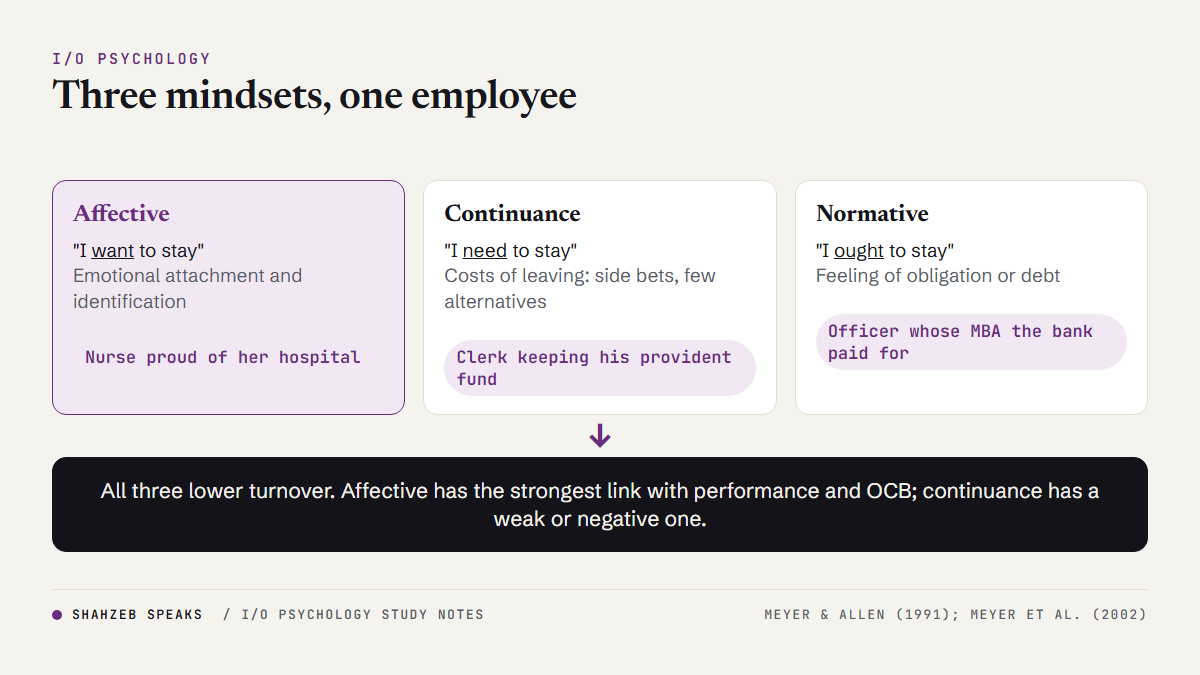
Affective, continuance and normative commitment explained
1. Affective commitment: “I want to stay”
Allen and Meyer (1990) defined the affective component as the employee’s emotional attachment to, identification with, and involvement in the organisation. Example: a nurse in a Lahore hospital ward who is proud of her hospital, defends it to relatives and feels its problems are her problems. Work experiences such as fair treatment, support from supervisors and interesting work are the main roots of this component.
2. Continuance commitment: “I need to stay”
The continuance component is commitment based on the costs the employee links with leaving. This is Becker’s side-bet idea. Example: a clerk in a textile mill in Faisalabad who dislikes the job but stays because the provident fund, the company house and fifteen years of seniority would be lost, and there are few other jobs in the area. McGee and Ford (1987) found that the continuance scale itself splits into two parts: high personal sacrifice (what I would give up) and few alternatives (where else could I go).
3. Normative commitment: “I ought to stay”
The normative component is a feeling of obligation to remain. Example: a young officer in a bank branch whose employer paid for his MBA, or an employee in a family business who feels loyal to the owner who gave his father a job. The feeling comes from a sense of debt, or from family and cultural norms that say loyalty is right.
| Component | Mindset | Where it comes from | Workplace example | Link with work behaviour |
|---|---|---|---|---|
| Affective | Want to stay (desire) | Good work experiences, support, fair treatment, identification | Nurse proud of her hospital | Strongest positive link with attendance, performance and OCB |
| Continuance | Need to stay (cost) | Side bets (pension, seniority) and few job alternatives | Mill clerk who would lose his provident fund | Lowers turnover, but weak or negative link with performance and OCB |
| Normative | Ought to stay (obligation) | Feeling of debt, family and cultural norms of loyalty | Officer whose MBA the bank paid for | Positive links, weaker than affective |
How did the model develop? From 1960 to 2002
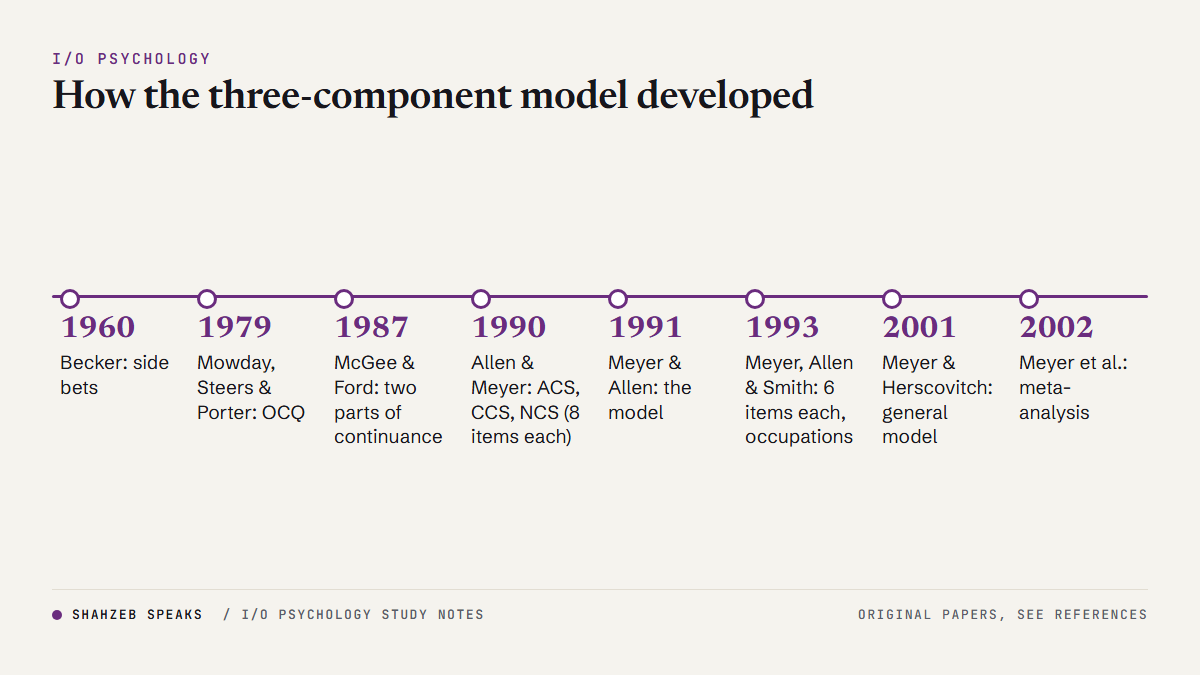
Students often write “Meyer and Allen (1991) developed the TCM scales”. That is not quite right. Here is the order of events:
- 1960: Becker’s side-bet theory (the root of continuance commitment).
- 1979: Mowday, Steers and Porter’s OCQ (the attitudinal tradition, close to affective commitment).
- 1987: McGee and Ford show the continuance scale has two sub-dimensions.
- 1990: Allen and Meyer publish the three scales, the Affective, Continuance and Normative Commitment Scales (ACS, CCS, NCS), with 8 items each, in the Journal of Occupational Psychology.
- 1991: Meyer and Allen publish the conceptual model.
- 1993: Meyer, Allen and Smith revise the scales to 6 items each and show the same three components apply to commitment to an occupation (they tested it with student and registered nurses).
- 1997: Meyer and Allen’s book Commitment in the Workplace.
- 2001: Meyer and Herscovitch propose a general model: commitment can bind a person to any target (a team, a union, a change programme), with the same three mindsets.
- 2002: Meyer, Stanley, Herscovitch and Topolnytsky publish a meta-analysis of the model’s antecedents, correlates and consequences.
What does the research say about the three components?
The largest summary is the meta-analysis by Meyer and colleagues (2002), which pooled studies that used the TCM scales. The main results, as reported in that paper and in later reviews that cite it:
- The three components are related to each other but can be told apart, and they are distinct from job satisfaction and job involvement.
- All three are linked with lower intention to leave and lower turnover.
- Affective commitment has the strongest favourable links with attendance, job performance and organizational citizenship behaviour (OCB), and with lower stress and work-family conflict.
- Normative commitment shows similar links, but weaker.
- Continuance commitment shows little or no relation with these behaviours, and sometimes a negative one.
The practical lesson: an organisation that keeps people only through continuance commitment (golden handcuffs, non-transferable benefits) may keep bodies but not effort. The employees stay, but they do the minimum. This is why HR teams that want both retention and performance try to build affective commitment through fair treatment and support. If you are interested in the “staying but not trying” pattern, see the existing site post on quiet quitting research.
Criticisms of the three-component model
A good exam answer always has a critique paragraph. The four you can defend with sources:
- Affective and normative commitment overlap. Allen and Meyer (1990) themselves reported that the two were distinguishable but “somewhat related”. In two South Korean samples, Ko, Price and Mueller (1997) found that the ACS and NCS lacked discriminant validity, and they questioned the construct validity of the continuance and normative scales.
- Continuance commitment is not one thing. McGee and Ford (1987) showed the CCS splits into personal sacrifice and lack of alternatives, which behave differently.
- It may be a model of staying, not of commitment. Solinger, van Olffen and Roe (2008) argued, using attitude theory, that affective commitment is an attitude towards the organisation, while continuance and normative commitment are attitudes towards a behaviour (staying or leaving). They concluded that the TCM works best as a model for predicting turnover.
- Translation and culture. The scales were built in Canada. When students translate them into Urdu, Hindi or Filipino, items about obligation and loyalty may be read differently. This is a reason to check the factor structure in your own sample, not a reason to avoid the scale.
How to measure the TCM in a thesis (and the licence)
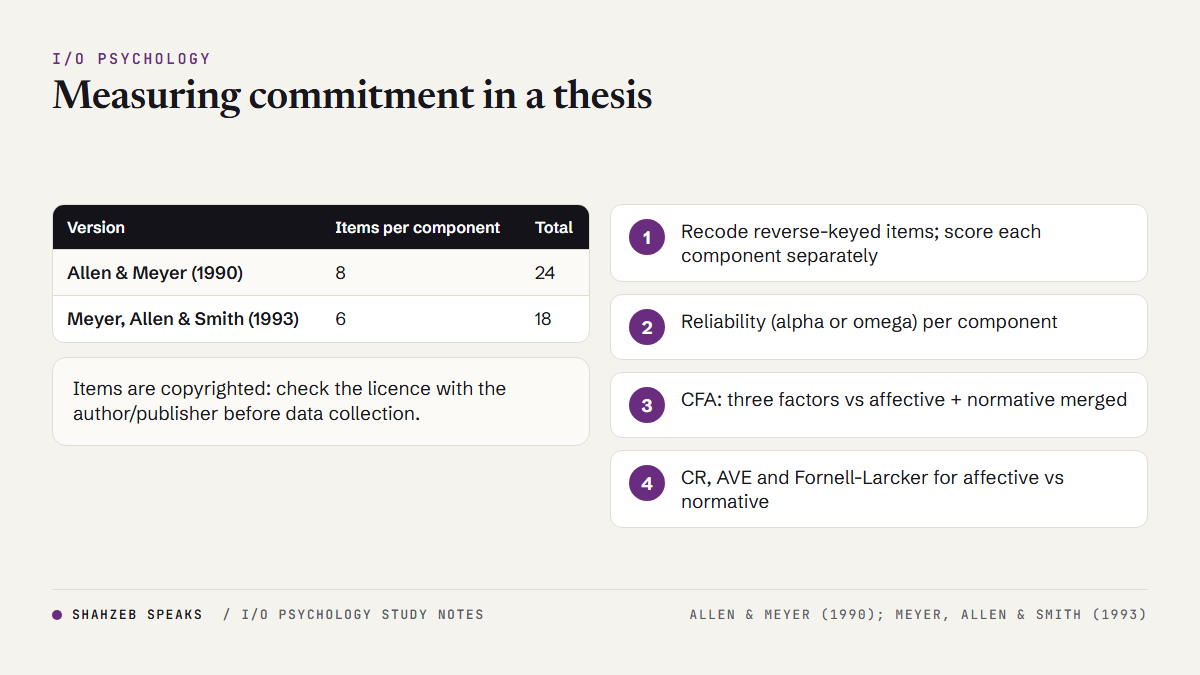
The two published versions are the 1990 scales (8 items per component, 24 in all) and the 1993 revised scales (6 items per component, 18 in all). Many theses use the 1993 version because it is shorter. Do not mix items from the two versions without saying so. Some items are reverse-keyed, so recode them before you compute scores.
Licence. The TCM items are copyrighted, so this page does not reprint them. On 3 November 2026, Western University’s technology-transfer office listed a commercial licence for the “TCM Employee Commitment Survey”, priced by the number of respondents. The listing says nothing about free academic use, so before a thesis survey, check with the author/publisher (the Western office), and ask your supervisor how your university handles permission. Keep the reply in your appendix.
Analysis steps that examiners look for:
- Report reliability for each component separately (Cronbach’s alpha or omega), never one alpha for all items. Use the free item analysis calculator to find weak items.
- Run a confirmatory factor analysis that compares the three-factor model with a model that merges affective and normative commitment. Given the overlap above, this is the check examiners ask about first.
- Report composite reliability and average variance extracted (AVE) for each factor, and check discriminant validity between affective and normative commitment with the Fornell-Larcker test. The composite reliability and AVE calculator does this from your standardised loadings.
- Analyse the three components as three separate variables in your correlations and regressions.
For the full method (sampling, back-translation, common method bias), read the guide to research methods for an I/O thesis, and for other commitment measures, see the scales for I/O psychology theses table.
10-mark answer structure
- Definition (1 mark): organizational commitment as the bond that makes leaving less likely; the TCM of Meyer and Allen (1991), scales by Allen and Meyer (1990).
- Background (1 mark): Becker’s side bets (1960) and the attitudinal OCQ of Mowday, Steers and Porter (1979), joined into one model.
- The three components (3 marks): affective (want to), continuance (need to), normative (ought to), each with a definition and a local example.
- Commitment profile (1 mark): one person holds all three at different strengths.
- Research evidence (2 marks): Meyer et al. (2002): all three lower turnover; affective has the strongest links with performance and OCB; continuance has weak or negative links.
- Critique (1 mark): affective-normative overlap (Ko et al., 1997); continuance has two sub-dimensions (McGee and Ford, 1987); Solinger et al. (2008).
- Conclusion (1 mark): for managers, build affective commitment; retention through cost alone keeps people but not effort.
Model opening line: “Meyer and Allen (1991) argued that organizational commitment is not a single attitude but three mindsets: employees stay because they want to (affective), need to (continuance) or feel they ought to (normative).”
Practice MCQs: Meyer and Allen’s three-component model
Practice questions written to the published syllabus, not past-paper questions.
-
Which pair of authors published the three scales (ACS, CCS, NCS) in 1990?
- Mowday and Steers
- Allen and Meyer
- Meyer and Herscovitch
- McGee and Ford
Show answer
B. Allen and Meyer (1990) published the scales in the Journal of Occupational Psychology. Mowday and Steers built the OCQ (1979), Meyer and Herscovitch wrote the 2001 general model, and McGee and Ford (1987) re-examined the scales.
-
Ayesha has worked at a Karachi call centre for nine years. She dislikes the work, but leaving would mean losing her seniority bonus, and she has found no other job. Which component is strongest for her?
- Affective commitment
- Normative commitment
- Continuance commitment
- Occupational commitment
Show answer
C. Her reason to stay is the cost of leaving and the lack of alternatives, which is continuance commitment. She feels no emotional attachment (affective) and no duty (normative). Occupational commitment is commitment to a profession, not to this employer.
-
Whose 1960 “side-bet” theory is the root of continuance commitment?
- Howard Becker
- Lyman Porter
- Dennis Organ
- Frederick Herzberg
Show answer
A. Becker (1960) said people stay because of investments they would lose by leaving. Porter worked on the attitudinal OCQ, Organ on OCB, and Herzberg on the two-factor theory of motivation.
-
According to the Meyer et al. (2002) meta-analysis, which component had the strongest favourable links with job performance and OCB?
- Continuance
- Normative
- Affective
- All three were equal
Show answer
C. Affective commitment had the strongest favourable links. Normative commitment had weaker links of the same kind, and continuance commitment had little or no relation, sometimes a negative one, so the components are not equal.
-
Which of these is NOT a criticism of the TCM found in the research literature?
- Affective and normative commitment overlap
- Continuance commitment has two sub-dimensions
- The model cannot predict turnover at all
- It mixes an attitude to the organisation with attitudes to staying
Show answer
C. All three components relate to lower turnover, and Solinger et al. (2008) even said the TCM works best as a turnover model. A, B and D are real criticisms (Ko et al., 1997; McGee and Ford, 1987; Solinger et al., 2008).
-
McGee and Ford (1987) found that the Continuance Commitment Scale contains which two sub-dimensions?
- Desire and obligation
- High personal sacrifice and low perceived alternatives
- Identification and involvement
- Calculative and moral
Show answer
B. The two parts are what the person would sacrifice and the lack of other options. Desire and obligation are the affective and normative mindsets; identification and involvement describe affective commitment; calculative and moral are older labels not used in that study.
-
A bank paid for Bilal’s MBA. He now feels it would be wrong to leave before he has “repaid” the bank. This is an example of:
- Normative commitment
- Affective commitment
- Continuance commitment
- Job involvement
Show answer
A. A feeling of debt or obligation is normative commitment. He has not said he loves the bank (affective), and he is not staying because leaving costs money (continuance). Job involvement is about how central the job is to his identity.
-
A student reports one Cronbach’s alpha of .88 for all 18 TCM items. What is the main problem?
- Alpha must be below .70 for the TCM
- The three components are separate variables and need separate reliability estimates
- Alpha cannot be computed for Likert items
- 18 items are too few for alpha
Show answer
B. The TCM measures three distinct mindsets, so each needs its own reliability, and a single total score hides the differences between them. There is no rule that alpha must be low, alpha works with Likert items, and 18 items are plenty.
-
Meyer, Allen and Smith (1993) extended the model by showing that the three components also apply to commitment to:
- A union
- An occupation
- A supervisor
- A change programme
Show answer
B. They tested occupational commitment with student and registered nurses. Unions and change programmes were covered later under the general model of Meyer and Herscovitch (2001); commitment to supervisors is a separate research line.
-
A manager wants staff who stay and also work hard. Which strategy fits the TCM evidence best?
- Add benefits that are lost on resignation
- Build fair treatment and supervisor support
- Make employees sign longer bonds
- Reduce outside job information
Show answer
B. Fair treatment and support build affective commitment, the component linked with performance and OCB. Options A, C and D raise continuance commitment, which keeps people but shows weak or negative links with effort.
Practise on your phone
The free I/O Psychology Prep app has 410 explained
questions, flashcards and an exam countdown, and works offline. Get it on Google Play
· About the app
Questions students ask
What are the three components of organizational commitment?
Affective commitment (emotional attachment: you want to stay), continuance commitment (awareness of the costs of leaving: you need to stay) and normative commitment (a sense of obligation: you feel you ought to stay). Meyer and Allen (1991) presented them as three mindsets that one employee holds at the same time.
Is it Allen and Meyer 1990 or Meyer and Allen 1991?
Both, for different things. Cite Allen and Meyer (1990) for the original scales and their development, and Meyer and Allen (1991) for the conceptual model. If you use the 6-item scales, cite Meyer, Allen and Smith (1993).
Which component is best for an organisation?
Affective commitment. In the Meyer et al. (2002) meta-analysis it had the strongest links with attendance, performance and citizenship behaviour, and with lower stress. Continuance commitment keeps people in the job but is not linked with better work.
Can I use the TCM questionnaire free for my thesis?
Not without checking. The items are copyrighted, and Western University lists a commercial licence for the TCM Employee Commitment Survey. The listing does not mention free academic use, so ask the author/publisher before you collect data, and keep the reply.
How is the TCM scored?
Each component is scored separately: recode the reverse-keyed items, then average (or sum) the items of each scale. You get three scores per person, not one. Do not add the three together into a “total commitment” score.
What is the difference between organizational commitment and job satisfaction?
Job satisfaction is how you feel about your job; commitment is your bond with the organisation. You can dislike your current tasks and still feel strongly attached to the employer. Meyer et al. (2002) found the two are related but distinct. See the guide to job satisfaction theories and measures.
Free calculators for your commitment thesis
Check your TCM scales with the free composite reliability and AVE calculator, the item analysis calculator and the Spearman-Brown calculator (to see what shortening a scale does to reliability). For exam revision, the free I/O Psychology Prep app is on Google Play.
References
- Allen, N. J., & Meyer, J. P. (1990). The measurement and antecedents of affective, continuance and normative commitment to the organization. Journal of Occupational Psychology, 63(1), 1-18. https://doi.org/10.1111/j.2044-8325.1990.tb00506.x
- Becker, H. S. (1960). Notes on the concept of commitment. American Journal of Sociology, 66(1), 32-40. https://doi.org/10.1086/222820
- Ko, J.-W., Price, J. L., & Mueller, C. W. (1997). Assessment of Meyer and Allen’s three-component model of organizational commitment in South Korea. Journal of Applied Psychology, 82(6), 961-973. https://doi.org/10.1037/0021-9010.82.6.961
- McGee, G. W., & Ford, R. C. (1987). Two (or more?) dimensions of organizational commitment: Reexamination of the affective and continuance commitment scales. Journal of Applied Psychology, 72(4), 638-641. https://doi.org/10.1037/0021-9010.72.4.638
- Meyer, J. P., & Allen, N. J. (1991). A three-component conceptualization of organizational commitment. Human Resource Management Review, 1(1), 61-89. https://doi.org/10.1016/1053-4822(91)90011-Z
- Meyer, J. P., & Allen, N. J. (1997). Commitment in the workplace: Theory, research, and application. Sage. https://doi.org/10.4135/9781452231556
- Meyer, J. P., Allen, N. J., & Smith, C. A. (1993). Commitment to organizations and occupations: Extension and test of a three-component conceptualization. Journal of Applied Psychology, 78(4), 538-551. https://doi.org/10.1037/0021-9010.78.4.538
- Meyer, J. P., & Herscovitch, L. (2001). Commitment in the workplace: Toward a general model. Human Resource Management Review, 11(3), 299-326. https://doi.org/10.1016/S1053-4822(00)00053-X
- Meyer, J. P., Stanley, D. J., Herscovitch, L., & Topolnytsky, L. (2002). Affective, continuance, and normative commitment to the organization: A meta-analysis of antecedents, correlates, and consequences. Journal of Vocational Behavior, 61(1), 20-52. https://doi.org/10.1006/jvbe.2001.1842
- Mowday, R. T., Steers, R. M., & Porter, L. W. (1979). The measurement of organizational commitment. Journal of Vocational Behavior, 14(2), 224-247. https://doi.org/10.1016/0001-8791(79)90072-1
- Solinger, O. N., van Olffen, W., & Roe, R. A. (2008). Beyond the three-component model of organizational commitment. Journal of Applied Psychology, 93(1), 70-83. https://doi.org/10.1037/0021-9010.93.1.70
This post is part of the I/O psychology thesis topics hub. Related: organizational citizenship behaviour (OCB), the psychological contract, work motivation theories compared and the job attitudes MCQs. For the local career picture, see industrial psychology in Pakistan.