
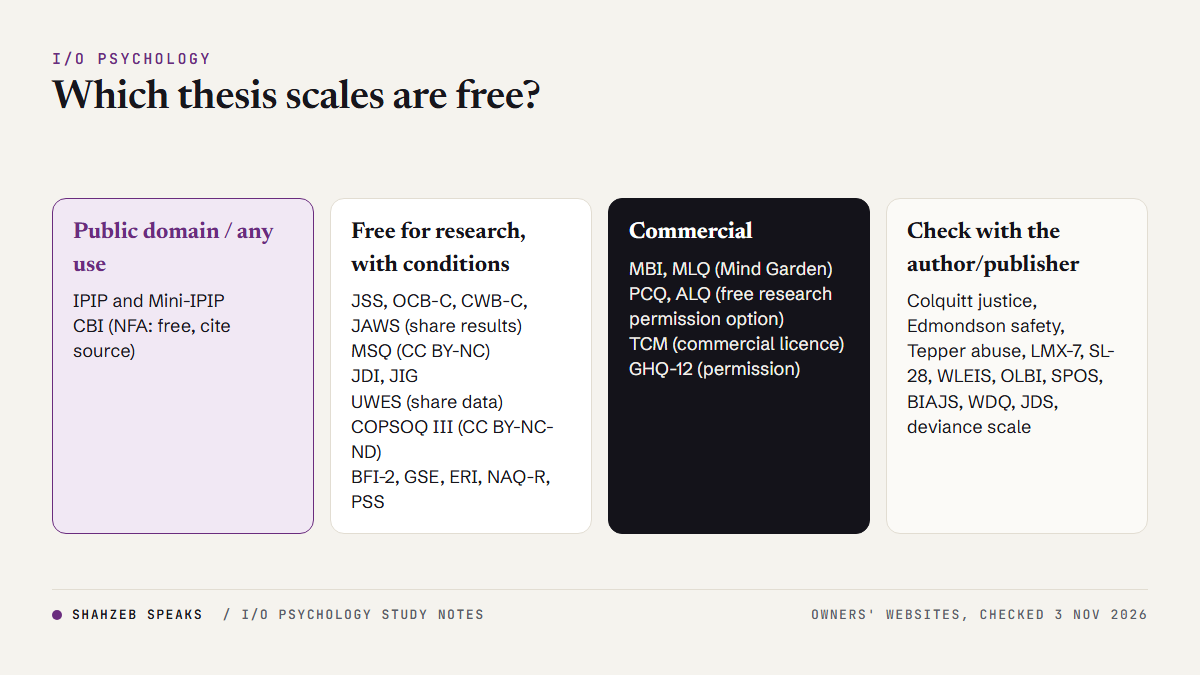
Several widely used I/O scales are free for a student thesis. Paul Spector’s Job Satisfaction Survey and CWB and OCB checklists are free for non-commercial research if you share results. The MSQ is under a non-commercial Creative Commons licence, and IPIP items are public domain. Others, such as the MBI and MLQ, are sold by Mind Garden. Always read the owner’s terms before you print a scale.
This page is for BS, MS and MPhil students in psychology, HRM and management who need ready-made scales for a thesis on job attitudes, stress, leadership or personality. For each scale it gives the authors, year, number of items, dimensions and, most importantly, the licence status as I found it on the owner’s own website on 3 November 2026. Where the owner says nothing I could find, the table says “check with the author/publisher”. Terms change, so open the owner’s page again before you collect data.
This page does not reprint any items. Copying items from a journal article or a random PDF into your questionnaire is the most common copyright mistake in student theses, and the scale’s owner, not the website where you found the PDF, decides how it may be used.
How to read the licence column
I sorted every scale into one of four groups:
- Public domain / free for any use: no permission needed, even for commercial work. Example: the International Personality Item Pool (IPIP).
- Free for research, with conditions: no fee, but you must meet the owner’s conditions, such as sharing your results, crediting the source, using it only for non-commercial work, or registering first. Most scales students use are in this group.
- Commercial: you buy a licence, usually priced per respondent. Some publishers also offer a free research permission for certain scales.
- Check with the author/publisher: the scale was published in a journal, but I could not find any statement from the owner about permission. This does not mean it is free. Ask, or check the scale’s record in APA PsycTESTS through your university library, which shows a “Permissions” field for each test.
Two licence terms worth knowing. Non-commercial means nobody makes money from using the scale; a university thesis is non-commercial, but a paid consultancy survey for a bank is not. Creative Commons BY-NC means you may use and share the material if you give credit (BY) and do not use it commercially (NC); the extra ND (no derivatives) means you may not distribute modified versions.
Job attitude scales: satisfaction, commitment, engagement, OCB and CWB
| Scale | Authors (year) | Items | Dimensions | Licence status (3 Nov 2026) |
|---|---|---|---|---|
| Job Satisfaction Survey (JSS) | Spector (1985) | 36 | 9 facets of 4 items: pay, promotion, supervision, fringe benefits, contingent rewards, operating procedures, co-workers, nature of work, communication | Free for research with conditions: non-commercial use (theses included), share your results with the author, keep the copyright notice. The newer JSS-2 is commercial. |
| Minnesota Satisfaction Questionnaire (MSQ) | Weiss, Dawis, England & Lofquist (1967) | 100 (long), 20 (short) | 20 facets; short form gives intrinsic, extrinsic and general scores | Free for research with conditions: Creative Commons BY-NC 4.0 since July 2016, credit Vocational Psychology Research, University of Minnesota; no commercial use or sale. |
| Job Descriptive Index (JDI) and Job in General (JIG) | Smith, Kendall & Hulin (1969); Ironson et al. (1989) | 72; 18 | JDI: work, pay, promotion, supervision, co-workers; JIG: global | Free for research with conditions: free download for research or workplace projects from the JDI Office at Bowling Green State University; guides and scoring syntax are paid; the office can issue a permission letter. |
| Brief Index of Affective Job Satisfaction (BIAJS) | Thompson & Phua (2012) | 4 | Global affective satisfaction | Check with the author/publisher. |
| TCM commitment scales (ACS, CCS, NCS) | Allen & Meyer (1990); Meyer, Allen & Smith (1993) | 8 per scale (1990); 6 per scale (1993) | Affective, continuance, normative commitment | Commercial licence listed by Western University’s technology-transfer office; nothing stated on academic use, so check with the author/publisher. |
| Utrecht Work Engagement Scale (UWES-17, UWES-9) | Schaufeli et al. (2002); Schaufeli, Bakker & Salanova (2006) | 17; 9 | Vigour, dedication, absorption | Free for research with conditions: academic use only (theses and papers), on condition that you send the authors your raw item scores with age, gender, occupation and sample details. Other uses need a contract. |
| OCB Checklist (OCB-C) | Fox, Spector et al. (2012) | 43, 36, 20 or 10 | Frequency of citizenship acts | Free for research with conditions: same Spector terms as the JSS. |
| CWB Checklist (CWB-C) | Spector et al. (2006) | 45, 32 or 10 | 32-item version: abuse, production deviance, sabotage, theft, withdrawal | Free for research with conditions: same Spector terms as the JSS. |
| Workplace Deviance Scale | Bennett & Robinson (2000) | 19 | 12 organisational, 7 interpersonal | Check with the author/publisher. |
| OCB scales (Organ’s five dimensions) | Podsakoff, MacKenzie, Moorman & Fetter (1990) | 24 | Altruism, conscientiousness, sportsmanship, courtesy, civic virtue | Check with the author/publisher. |
| Survey of Perceived Organizational Support (SPOS) | Eisenberger, Huntington, Hutchison & Sowa (1986) | 36 (short forms widely used) | One dimension | Check with the author/publisher. |
For the theory behind these, see job satisfaction theories and measures, Meyer and Allen’s three-component model, OCB and CWB.
Stress, burnout and well-being scales
| Scale | Authors (year) | Items | Dimensions | Licence status (3 Nov 2026) |
|---|---|---|---|---|
| Copenhagen Burnout Inventory (CBI) | Kristensen, Borritz, Villadsen & Christensen (2005) | 19 | Personal, work-related and client-related burnout | Free for any use: Denmark’s National Research Centre for the Working Environment (NFA) says it may be used freely, including commercially, if you cite the source. |
| Maslach Burnout Inventory (MBI) | Maslach & Jackson (1981) | 22 (HSS, ES); 16 (GS) | Emotional exhaustion, depersonalisation, personal accomplishment (GS: exhaustion, cynicism, professional efficacy) | Commercial: Mind Garden licence to administer, priced per respondent (US$2.75 each, minimum 50, on 3 Nov 2026); no free research option listed. |
| Oldenburg Burnout Inventory (OLBI) | Demerouti et al. (2003) | 16 | Exhaustion, disengagement | Check with the author/publisher. |
| Perceived Stress Scale (PSS) | Cohen, Kamarck & Mermelstein (1983) | 14, 10 or 4 | Appraised stress in the past month | Free to request: permission requests go through Mapi Research Trust’s ePROVIDE platform, which the lab says is free to submit. |
| Effort-Reward Imbalance (ERI) questionnaire | Siegrist (1996) | Long and short versions on the owner’s site | Effort, reward, over-commitment | Free for research with conditions: scientific use (research and teaching) only; other uses need Siegrist’s permission. |
| Job Content Questionnaire (JCQ) | Karasek et al. (1998) | Several versions | Decision latitude, psychological demands, social support | Check with the author/publisher (owner site could not be reached on 3 Nov 2026). |
| COPSOQ III | International COPSOQ Network (COPSOQ II: Pejtersen et al., 2010) | Core, middle and long versions | Many psychosocial work factors | Free for research with conditions: Creative Commons BY-NC-ND 4.0; follow the network guidelines; modified versions may not be called COPSOQ; check before translating. |
| Negative Acts Questionnaire-Revised (NAQ-R) | Einarsen, Hoel & Notelaers (2009) | 22 | Personal, work-related and physically intimidating bullying | Free for research with conditions: non-commercial only; contact the Bergen Bullying Research Group before use; one project per permission; send them your data and any translation. |
| Job-related Affective Well-being Scale (JAWS) | Van Katwyk, Fox, Spector & Kelloway (2000) | 30 or 20 | Positive and negative emotions at work | Free for research with conditions: Spector terms. |
| ICAWS, OCS, QWI | Spector & Jex (1998) | 4; 11; 5 | Interpersonal conflict; organisational constraints; workload | Free for research with conditions: Spector terms. |
| General Health Questionnaire (GHQ-12) | Goldberg (GL Assessment) | 12 | Short screener of psychological distress | Permission required: GL Assessment for the UK, Ireland and Channel Islands, Mapi Research Trust elsewhere (including Pakistan); fees not stated on the pages I read. |
| Workplace Incivility Scale | Cortina, Magley, Williams & Langhout (2001) | 7 | Experienced incivility | Check with the author/publisher. |
The free Copenhagen Burnout Inventory calculator scores the CBI for you. For the theory, see occupational stress models and the job demands-resources model.
Leadership, justice and work-design scales
| Scale | Authors (year) | Items | Dimensions | Licence status (3 Nov 2026) |
|---|---|---|---|---|
| Multifactor Leadership Questionnaire (MLQ 5X) | Bass & Avolio | 45 | Transformational, transactional, passive-avoidant leadership and outcomes | Commercial: Mind Garden licence to administer, priced per respondent; no free research permission listed. |
| Authentic Leadership Questionnaire (ALQ) | Avolio, Gardner & Walumbwa (sold by Mind Garden) | 16 | Self-awareness, transparency, ethical/moral, balanced processing | Commercial, or a free Mind Garden “research permission” (minimum 200) for non-commercial, unfunded research. |
| LMX-7 | Graen & Uhl-Bien (1995) | 7 | Quality of leader-member exchange | Check with the author/publisher. |
| Servant Leadership (SL-28, SL-7) | Liden et al. (2008, 2015) | 28; 7 | 7 dimensions (SL-28); global (SL-7) | Check with the author/publisher. |
| Ethical Leadership Scale | Brown, Treviño & Harrison (2005) | 10 | One dimension | Check with the author/publisher. |
| Abusive Supervision Scale | Tepper (2000) | 15 | One dimension | Check with the author/publisher. |
| Organizational Justice Scale | Colquitt (2001) | 20 | Distributive, procedural, interpersonal, informational | Check with the author/publisher. |
| Team Psychological Safety | Edmondson (1999) | 7 | One team-level dimension | Check with the author/publisher. |
| Psychological Empowerment | Spreitzer (1995) | 12 | Meaning, competence, self-determination, impact | Check with the author/publisher. |
| Work Design Questionnaire (WDQ) | Morgeson & Humphrey (2006) | 77 | Task, knowledge, social and contextual characteristics | Check with the author/publisher (items are posted on the author’s site, but I found no licence text). |
| Job Diagnostic Survey (JDS) | Hackman & Oldham (1975) | Several versions | Core job dimensions, psychological states, growth need strength | Check with the author/publisher. |
| Work-family conflict | Netemeyer, Boles & McMurrian (1996); Carlson, Kacmar & Williams (2000) | 10; 18 | Work-to-family and family-to-work conflict | Check with the author/publisher. |
For the theories, see leadership theories in I/O psychology, LMX theory and the job characteristics model.
Personality and individual-difference scales
| Scale | Authors (year) | Items | Dimensions | Licence status (3 Nov 2026) |
|---|---|---|---|---|
| IPIP scales and Mini-IPIP | Goldberg et al. (2006); Donnellan, Oswald, Baird & Lucas (2006) | Mini-IPIP: 20 | Big Five, 4 items each | Public domain: free for any purpose, commercial or not, without asking. |
| Big Five Inventory-2 (BFI-2) | Soto & John (2017) | 60 | 5 domains, 15 facets | Free for research with conditions: non-commercial research after a short sign-up on the lab’s site; send the lab any translation. |
| Psychological Capital Questionnaire (PCQ-24) | Luthans, Avolio, Avey & Norman (2007) | 24 | Hope, efficacy, resilience, optimism | Commercial, or a free Mind Garden “research permission” (minimum 200) for non-commercial, unfunded research. |
| General Self-Efficacy Scale (GSE) | Schwarzer & Jerusalem (1995) | 10 | One dimension | Free for research: the authors grant permission for research use if you cite the source; a permission letter is in their FAQ. |
| Wong and Law Emotional Intelligence Scale (WLEIS) | Wong & Law (2002) | 16 | Self-emotion appraisal, others’ emotion appraisal, use of emotion, regulation of emotion | Check with the author/publisher. |
| Proactive Personality Scale | Bateman & Crant (1993) | 17 | One dimension | Check with the author/publisher. |
Personality tests used for hiring raise different issues; see personality tests at work.
How to ask for permission (and what to keep)
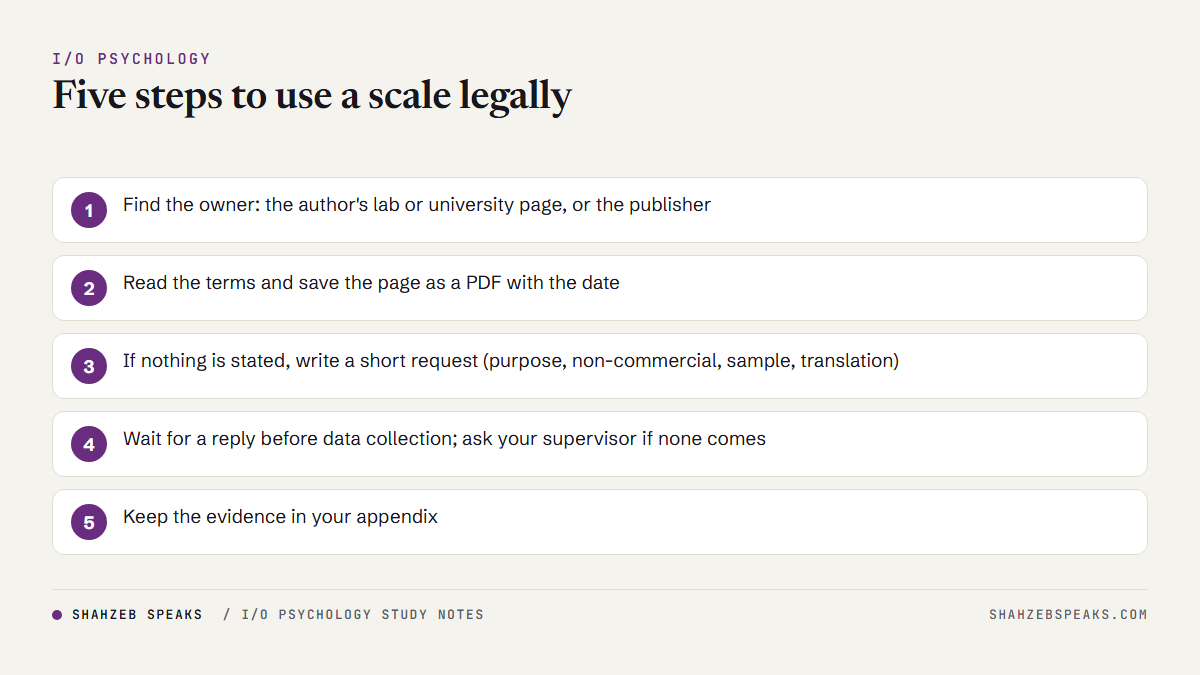
- Find the owner. Search for the scale name plus the first author’s name and “permission”, and look for a page on the author’s university site, lab site or publisher site.
- Read the terms. If the page grants use on conditions (as Spector, Schaufeli and the University of Minnesota do), save a PDF of the page with the date. That is your permission.
- If nothing is stated, write a short request. Say who you are, your university and supervisor, the study’s purpose, that it is non-commercial, the sample size, whether you will translate it, and that you will share a summary of results. Keep it under 150 words.
- Wait for a reply before data collection. If you get no answer after two reminders, discuss with your supervisor whether to choose a scale with clear terms instead.
- Put the evidence in your appendix: the saved terms page or the reply.
Translating a scale into Urdu, Hindi or Filipino
Translation is also covered by the owner’s terms. Spector allows translations if you send him a copy; the BFI-2 lab asks for a copy of any translation; the NAQ-R group asks you to send translations; COPSOQ asks you to check with the network first. A translated version needs forward translation, back-translation, expert review and a pilot test, and you must report its reliability in your own sample. The full procedure is in research methods for an I/O thesis.
Reporting a scale in your thesis
Examiners look for the same five facts for each instrument: the name and original citation, number of items and dimensions, response format and scoring, reliability in the original study and in your sample, and the permission. Report reliability per dimension, never one value for a multi-dimensional scale. The free tools help:
- Item analysis calculator for item-total correlations and alpha-if-deleted.
- Composite reliability and AVE calculator after a CFA.
- Spearman-Brown calculator to see what a short form does to reliability.
- Intraclass correlation calculator and rwg and ICC calculator if you aggregate ratings to team level.
Instruments section structure (per scale)
- Name and source: full scale name, abbreviation and original citation (for example, Spector, 1985).
- Content: number of items, dimensions and what each measures.
- Response format and scoring: the rating scale, reverse-keyed items and how scores are formed.
- Original reliability and validity: one sentence from the development paper.
- Your sample: alpha or omega for each dimension, and any items dropped (with reasons).
- Translation: who translated, back-translation and pilot results, if used.
- Permission: the owner’s terms or written permission, with the date, in the appendix.
Model line: “Job satisfaction was measured with the 36-item Job Satisfaction Survey (Spector, 1985), which assesses nine facets; it was used under the author’s terms for non-commercial research.”
Practice MCQs: scales and permissions for an I/O thesis
Practice questions written to the published syllabus, not past-paper questions.
-
Which of these scales has items that are in the public domain, free for any use?
- Maslach Burnout Inventory
- International Personality Item Pool (IPIP)
- Multifactor Leadership Questionnaire
- GHQ-12
Show answer
B. The IPIP site says its items are public domain and free for any purpose. The MBI and MLQ are sold by Mind Garden, and the GHQ needs permission from GL Assessment or Mapi.
-
A student wants to use the JSS for an MS thesis in Lahore. Which condition does Paul Spector’s site attach?
- Pay a fee per respondent
- Share the results with the author and keep the copyright notice
- Use only in the United States
- Get approval from Mind Garden
Show answer
B. Spector’s scales are free for non-commercial research if you share results and keep the copyright notice. There is no fee, no country limit, and Mind Garden does not sell the JSS.
-
What does “Creative Commons BY-NC 4.0” (the MSQ’s licence) allow?
- Any use including resale
- Non-commercial use with credit to the source
- Use only after paying a licence fee
- No use without written permission
Show answer
B. BY means credit the source; NC means non-commercial only. Resale is excluded, no fee is needed, and the licence itself is the permission.
-
Which statement about the UWES is correct, according to the author’s site?
- It is free for academic use if you share your data with the authors
- It is sold per respondent by Mind Garden
- It is public domain for commercial consultancy
- It may be used only in the Netherlands
Show answer
A. Schaufeli’s site allows free academic use (such as theses) on condition that you send the authors your raw data and sample details. It is not sold by Mind Garden, and commercial use needs a contract.
-
A student finds the full items of a scale in a journal article but no permission statement anywhere. What is the right step?
- Use it, because published means free
- Ask the author/publisher, or check the scale’s PsycTESTS permissions field
- Change two words so it is a new scale
- Use it but do not cite it
Show answer
B. Publication does not grant permission, so check with the owner. Rewording items still copies the scale, and not citing it adds plagiarism to the copyright problem.
-
Which burnout measure does Denmark’s NFA say can be used freely, even for commercial purposes?
- MBI
- Oldenburg Burnout Inventory
- Copenhagen Burnout Inventory
- Shirom-Melamed Burnout Measure
Show answer
C. The NFA allows free use of the CBI with a citation. The MBI is commercial, and I found no owner terms for the OLBI.
-
According to the Bergen Bullying Research Group, a permission to use the NAQ-R covers:
- One research project
- All your future studies
- Paid consultancy work
- Every student at your university
Show answer
A. The group asks you to contact them before use, and each permission covers one project. It is for non-commercial research only, so consultancy is excluded, and it does not pass to other students.
-
A team-level thesis averages team members’ ratings of team psychological safety. Which check should come before averaging?
- Within-team agreement (rwg) and ICC
- Spearman-Brown on each item
- A t-test on every item
- Nothing; averaging is always fine
Show answer
A. Aggregating to team level needs evidence that members agree (rwg) and that teams differ (ICC). Spearman-Brown predicts reliability for a changed length, and item t-tests do not justify aggregation.
-
Which Mind Garden scale on this page has a free research permission option for non-commercial, unfunded studies?
- MBI
- MLQ 5X
- PCQ-24
- None of them
Show answer
C. On 3 November 2026 Mind Garden listed a $0 research permission (minimum 200) for the PCQ and the ALQ. The MBI and MLQ showed paid licences only.
Free calculators for your thesis scales
Score and check your scales with the free CBI calculator, item analysis calculator, composite reliability and AVE calculator and Spearman-Brown calculator. All tools are on the free tools page.
Questions students ask
Which job satisfaction scale is free for a thesis?
The Job Satisfaction Survey (Spector, 1985) is free for non-commercial research if you share results; the MSQ is under a non-commercial Creative Commons licence; and the JDI and JIG can be downloaded free for research from Bowling Green State University. Check each owner’s page on the day you start.
Is the Maslach Burnout Inventory free?
No. On 3 November 2026 Mind Garden sold a licence to administer the MBI, priced per respondent, with no free research option. A free alternative with clear terms is the Copenhagen Burnout Inventory.
Can I get the Meyer and Allen commitment scale for free?
Western University lists a commercial licence for the TCM Employee Commitment Survey and says nothing about academic use. Ask the author/publisher before you use it, and keep the reply.
Do I need permission if a senior already used the scale?
Yes. Permission usually covers one project or one researcher, and the NAQ-R group, for example, says each permission covers one project. Check the terms for your own study.
Can I shorten a scale or change the wording?
Only if the owner’s terms allow it, and you must report the change. COPSOQ’s licence, for example, does not allow modified versions to be distributed under the COPSOQ name. Shortening also changes reliability, so recheck it.
Where can I find more scales?
APA PsycTESTS (through your library) lists thousands of tests with a permissions field. The thesis topic ideas in the I/O psychology thesis topics guide suggest a measure family for each idea.
Practise on your phone
The free I/O Psychology Prep app has 410 explained
questions, flashcards and an exam countdown, and works offline. Get it on Google Play
· About the app
References
- Allen, N. J., & Meyer, J. P. (1990). The measurement and antecedents of affective, continuance and normative commitment to the organization. Journal of Occupational Psychology, 63(1), 1-18. https://doi.org/10.1111/j.2044-8325.1990.tb00506.x
- Bateman, T. S., & Crant, J. M. (1993). The proactive component of organizational behavior: A measure and correlates. Journal of Organizational Behavior, 14(2), 103-118. https://doi.org/10.1002/job.4030140202
- Bennett, R. J., & Robinson, S. L. (2000). Development of a measure of workplace deviance. Journal of Applied Psychology, 85(3), 349-360. https://doi.org/10.1037/0021-9010.85.3.349
- Brown, M. E., Treviño, L. K., & Harrison, D. A. (2005). Ethical leadership: A social learning perspective for construct development and testing. Organizational Behavior and Human Decision Processes, 97(2), 117-134. https://doi.org/10.1016/j.obhdp.2005.03.002
- Carlson, D. S., Kacmar, K. M., & Williams, L. J. (2000). Construction and initial validation of a multidimensional measure of work-family conflict. Journal of Vocational Behavior, 56(2), 249-276. https://doi.org/10.1006/jvbe.1999.1713
- Cohen, S., Kamarck, T., & Mermelstein, R. (1983). A global measure of perceived stress. Journal of Health and Social Behavior, 24(4), 385-396. https://doi.org/10.2307/2136404
- Colquitt, J. A. (2001). On the dimensionality of organizational justice: A construct validation of a measure. Journal of Applied Psychology, 86(3), 386-400. https://doi.org/10.1037/0021-9010.86.3.386
- Cortina, L. M., Magley, V. J., Williams, J. H., & Langhout, R. D. (2001). Incivility in the workplace: Incidence and impact. Journal of Occupational Health Psychology, 6(1), 64-80. https://doi.org/10.1037/1076-8998.6.1.64
- Demerouti, E., Bakker, A. B., Vardakou, I., & Kantas, A. (2003). The convergent validity of two burnout instruments: A multitrait-multimethod analysis. European Journal of Psychological Assessment, 19(1), 12-23. https://doi.org/10.1027//1015-5759.19.1.12
- Donnellan, M. B., Oswald, F. L., Baird, B. M., & Lucas, R. E. (2006). The Mini-IPIP scales: Tiny-yet-effective measures of the Big Five factors of personality. Psychological Assessment, 18(2), 192-203. https://doi.org/10.1037/1040-3590.18.2.192
- Edmondson, A. (1999). Psychological safety and learning behavior in work teams. Administrative Science Quarterly, 44(2), 350-383. https://doi.org/10.2307/2666999
- Einarsen, S., Hoel, H., & Notelaers, G. (2009). Measuring exposure to bullying and harassment at work: Validity, factor structure and psychometric properties of the Negative Acts Questionnaire-Revised. Work & Stress, 23(1), 24-44. https://doi.org/10.1080/02678370902815673
- Eisenberger, R., Huntington, R., Hutchison, S., & Sowa, D. (1986). Perceived organizational support. Journal of Applied Psychology, 71(3), 500-507. https://doi.org/10.1037/0021-9010.71.3.500
- Fox, S., Spector, P. E., Goh, A., Bruursema, K., & Kessler, S. R. (2012). The deviant citizen: Measuring potential positive relations between counterproductive work behaviour and organizational citizenship behaviour. Journal of Occupational and Organizational Psychology, 85(1), 199-220. https://doi.org/10.1111/j.2044-8325.2011.02032.x
- Goldberg, L. R., Johnson, J. A., Eber, H. W., Hogan, R., Ashton, M. C., Cloninger, C. R., & Gough, H. G. (2006). The international personality item pool and the future of public-domain personality measures. Journal of Research in Personality, 40(1), 84-96. https://doi.org/10.1016/j.jrp.2005.08.007
- Graen, G. B., & Uhl-Bien, M. (1995). Relationship-based approach to leadership: Development of leader-member exchange (LMX) theory of leadership over 25 years. The Leadership Quarterly, 6(2), 219-247. https://doi.org/10.1016/1048-9843(95)90036-5
- Hackman, J. R., & Oldham, G. R. (1975). Development of the Job Diagnostic Survey. Journal of Applied Psychology, 60(2), 159-170. https://doi.org/10.1037/h0076546
- Ironson, G. H., Smith, P. C., Brannick, M. T., Gibson, W. M., & Paul, K. B. (1989). Construction of a Job in General scale: A comparison of global, composite, and specific measures. Journal of Applied Psychology, 74(2), 193-200. https://doi.org/10.1037/0021-9010.74.2.193
- Karasek, R., Brisson, C., Kawakami, N., Houtman, I., Bongers, P., & Amick, B. (1998). The Job Content Questionnaire (JCQ): An instrument for internationally comparative assessments of psychosocial job characteristics. Journal of Occupational Health Psychology, 3(4), 322-355. https://doi.org/10.1037/1076-8998.3.4.322
- Kristensen, T. S., Borritz, M., Villadsen, E., & Christensen, K. B. (2005). The Copenhagen Burnout Inventory: A new tool for the assessment of burnout. Work & Stress, 19(3), 192-207. https://doi.org/10.1080/02678370500297720
- Liden, R. C., Wayne, S. J., Meuser, J. D., Hu, J., Wu, J., & Liao, C. (2015). Servant leadership: Validation of a short form of the SL-28. The Leadership Quarterly, 26(2), 254-269. https://doi.org/10.1016/j.leaqua.2014.12.002
- Liden, R. C., Wayne, S. J., Zhao, H., & Henderson, D. (2008). Servant leadership: Development of a multidimensional measure and multi-level assessment. The Leadership Quarterly, 19(2), 161-177. https://doi.org/10.1016/j.leaqua.2008.01.006
- Luthans, F., Avolio, B. J., Avey, J. B., & Norman, S. M. (2007). Positive psychological capital: Measurement and relationship with performance and satisfaction. Personnel Psychology, 60(3), 541-572. https://doi.org/10.1111/j.1744-6570.2007.00083.x
- Maslach, C., & Jackson, S. E. (1981). The measurement of experienced burnout. Journal of Occupational Behaviour, 2(2), 99-113. https://doi.org/10.1002/job.4030020205
- Meyer, J. P., Allen, N. J., & Smith, C. A. (1993). Commitment to organizations and occupations: Extension and test of a three-component conceptualization. Journal of Applied Psychology, 78(4), 538-551. https://doi.org/10.1037/0021-9010.78.4.538
- Morgeson, F. P., & Humphrey, S. E. (2006). The Work Design Questionnaire (WDQ): Developing and validating a comprehensive measure for assessing job design and the nature of work. Journal of Applied Psychology, 91(6), 1321-1339. https://doi.org/10.1037/0021-9010.91.6.1321
- Netemeyer, R. G., Boles, J. S., & McMurrian, R. (1996). Development and validation of work-family conflict and family-work conflict scales. Journal of Applied Psychology, 81(4), 400-410. https://doi.org/10.1037/0021-9010.81.4.400
- Pejtersen, J. H., Kristensen, T. S., Borg, V., & Bjorner, J. B. (2010). The second version of the Copenhagen Psychosocial Questionnaire. Scandinavian Journal of Public Health, 38(3 Suppl.), 8-24. https://doi.org/10.1177/1403494809349858
- Podsakoff, P. M., MacKenzie, S. B., Moorman, R. H., & Fetter, R. (1990). Transformational leader behaviors and their effects on followers’ trust in leader, satisfaction, and organizational citizenship behaviors. The Leadership Quarterly, 1(2), 107-142. https://doi.org/10.1016/1048-9843(90)90009-7
- Schaufeli, W. B., Bakker, A. B., & Salanova, M. (2006). The measurement of work engagement with a short questionnaire: A cross-national study. Educational and Psychological Measurement, 66(4), 701-716. https://doi.org/10.1177/0013164405282471
- Schaufeli, W. B., Salanova, M., González-Romá, V., & Bakker, A. B. (2002). The measurement of engagement and burnout: A two sample confirmatory factor analytic approach. Journal of Happiness Studies, 3(1), 71-92. https://doi.org/10.1023/A:1015630930326
- Schwarzer, R., & Jerusalem, M. (1995). Generalized Self-Efficacy scale. In J. Weinman, S. Wright, & M. Johnston (Eds.), Measures in health psychology: A user’s portfolio. Causal and control beliefs (pp. 35-37). NFER-NELSON.
- Siegrist, J. (1996). Adverse health effects of high-effort/low-reward conditions. Journal of Occupational Health Psychology, 1(1), 27-41. https://doi.org/10.1037/1076-8998.1.1.27
- Smith, P. C., Kendall, L. M., & Hulin, C. L. (1969). The measurement of satisfaction in work and retirement. Rand McNally.
- Soto, C. J., & John, O. P. (2017). The next Big Five Inventory (BFI-2): Developing and assessing a hierarchical model with 15 facets to enhance bandwidth, fidelity, and predictive power. Journal of Personality and Social Psychology, 113(1), 117-143. https://doi.org/10.1037/pspp0000096
- Spector, P. E. (1985). Measurement of human service staff satisfaction: Development of the Job Satisfaction Survey. American Journal of Community Psychology, 13(6), 693-713. https://doi.org/10.1007/BF00929796
- Spector, P. E., Fox, S., Penney, L. M., Bruursema, K., Goh, A., & Kessler, S. (2006). The dimensionality of counterproductivity: Are all counterproductive behaviors created equal? Journal of Vocational Behavior, 68(3), 446-460. https://doi.org/10.1016/j.jvb.2005.10.005
- Spector, P. E., & Jex, S. M. (1998). Development of four self-report measures of job stressors and strain: Interpersonal Conflict at Work Scale, Organizational Constraints Scale, Quantitative Workload Inventory, and Physical Symptoms Inventory. Journal of Occupational Health Psychology, 3(4), 356-367. https://doi.org/10.1037/1076-8998.3.4.356
- Spreitzer, G. M. (1995). Psychological empowerment in the workplace: Dimensions, measurement, and validation. Academy of Management Journal, 38(5), 1442-1465. https://doi.org/10.2307/256865
- Tepper, B. J. (2000). Consequences of abusive supervision. Academy of Management Journal, 43(2), 178-190. https://doi.org/10.2307/1556375
- Thompson, E. R., & Phua, F. T. T. (2012). A brief index of affective job satisfaction. Group & Organization Management, 37(3), 275-307. https://doi.org/10.1177/1059601111434201
- Van Katwyk, P. T., Fox, S., Spector, P. E., & Kelloway, E. K. (2000). Using the Job-Related Affective Well-Being Scale (JAWS) to investigate affective responses to work stressors. Journal of Occupational Health Psychology, 5(2), 219-230. https://doi.org/10.1037/1076-8998.5.2.219
- Weiss, D. J., Dawis, R. V., England, G. W., & Lofquist, L. H. (1967). Manual for the Minnesota Satisfaction Questionnaire (Minnesota Studies in Vocational Rehabilitation, No. 22). University of Minnesota, Industrial Relations Center.
- Wong, C.-S., & Law, K. S. (2002). The effects of leader and follower emotional intelligence on performance and attitude: An exploratory study. The Leadership Quarterly, 13(3), 243-274. https://doi.org/10.1016/S1048-9843(02)00099-1
This post is part of the I/O psychology thesis topics hub. Related: research methods for an I/O thesis, reliability in psychological testing and validity in employee selection. Students in Pakistan can also read about industrial psychology in Pakistan.