
Counterproductive work behaviour (CWB) is deliberate behaviour by employees that harms, or is meant to harm, the organisation or the people in it: theft, sabotage, abuse of colleagues, working slowly on purpose, skipping work. Robinson and Bennett (1995) sorted it into four types; Spector and Fox explain it as a reaction to stressors through anger and other negative emotions.
This guide is for students who need CWB for an exam answer or a thesis. It explains what counts as CWB, the Robinson and Bennett (1995) typology with examples, Spector and Fox’s stressor-emotion model, the main measures (including the free CWB Checklist), how CWB relates to OCB, and the measurement traps that examiners ask about. You also get a 10-mark answer plan, 10 practice MCQs and the original references.
What is counterproductive work behavior?
Several research groups studied the same family of behaviours under different names: workplace deviance (Robinson and Bennett), counterproductive work behaviour (Spector and Fox; Sackett), and also aggression, retaliation and incivility. Three features run through the definitions:
- It is intentional. Sackett (2002) defined CWB as intentional behaviour by a member of an organisation that the organisation sees as against its legitimate interests. An honest mistake that breaks a machine is not CWB; breaking it on purpose is.
- It harms, or is meant to harm, the organisation, its members or its clients.
- It breaks the organisation’s norms. Robinson and Bennett (1995) framed deviance as voluntary behaviour that violates significant organisational norms and threatens the organisation or its members.
A note for students: whistle-blowing on real wrongdoing is not CWB, even if management dislikes it, because it serves the organisation’s legitimate interests. Students often get this point wrong.
Robinson and Bennett’s (1995) typology of workplace deviance
Sandra Robinson and Rebecca Bennett asked people to judge how similar different deviant acts were, then used multidimensional scaling to find the hidden structure. Two dimensions came out: minor vs serious, and interpersonal vs organisational (who is harmed). Crossing them gives four types:
| Type | Target | Severity | Examples |
|---|---|---|---|
| Production deviance | Organisation | Minor | Leaving early, long breaks, working slowly on purpose, wasting materials |
| Property deviance | Organisation | Serious | Stealing stock, sabotaging equipment, taking kickbacks, lying about hours worked |
| Political deviance | Individuals | Minor | Gossip, blaming co-workers, showing favouritism |
| Personal aggression | Individuals | Serious | Verbal abuse, sexual harassment, threats, stealing from co-workers, endangering others |
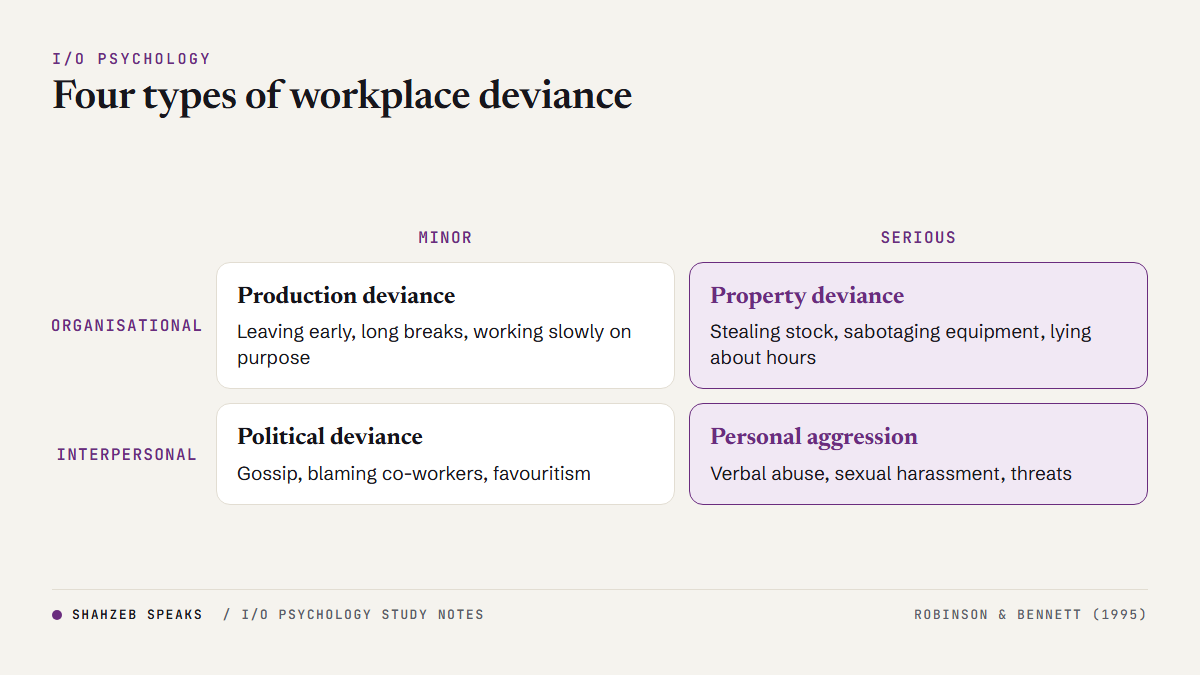
Applied to a textile mill in Faisalabad: a worker who keeps the machine idle to slow the line shows production deviance; one who sells off yarn shows property deviance; a supervisor who spreads rumours about a rival shows political deviance; one who shouts abuse at workers or harasses a female employee shows personal aggression. Harassment is also a legal matter; Pakistani readers can see the existing post on workplace harassment law in Pakistan.
Bennett and Robinson (2000) then built a measure on the interpersonal-organisational split: a 12-item organisational deviance scale and a 7-item interpersonal deviance scale, with reliabilities of .81 and .78, and a two-factor structure supported by confirmatory factor analysis.
Are the two really separate? Berry, Ones and Sackett (2007) meta-analysed this. Interpersonal and organisational deviance were highly correlated (rho = .62), but they related differently to some Big Five traits and to OCB, which supports keeping them apart. Both had their strongest (negative) links with OCB, agreeableness, conscientiousness and emotional stability; links with organisational justice were small to moderate, and links with demographic variables were generally negligible.
Why do employees engage in CWB? The stressor-emotion model
Paul Spector and Suzy Fox proposed an emotion-centred model of voluntary work behaviour (Spector and Fox, 2002), later developed as the stressor-emotion model of CWB (Spector and Fox, 2005). In simple steps:
- Job stressors appear: organisational constraints (things that stop you doing your job, such as broken equipment or missing information), interpersonal conflict, unfair treatment, heavy workload.
- The employee appraises them as threats or obstacles.
- This produces negative emotions such as anger, frustration and anxiety.
- The emotions lead to CWB, aimed at the organisation or at people.
- Moderators change the strength of the chain: how much control the person feels they have, and personality traits such as trait anger and locus of control.
Fox, Spector and Miles (2001) tested parts of this model with stressors and organisational justice as causes, and with emotions as the link between them and CWB. Their paper is the one to cite for the mediating role of emotions. The same model also explains OCB: positive emotions push towards citizenship, negative ones towards CWB.
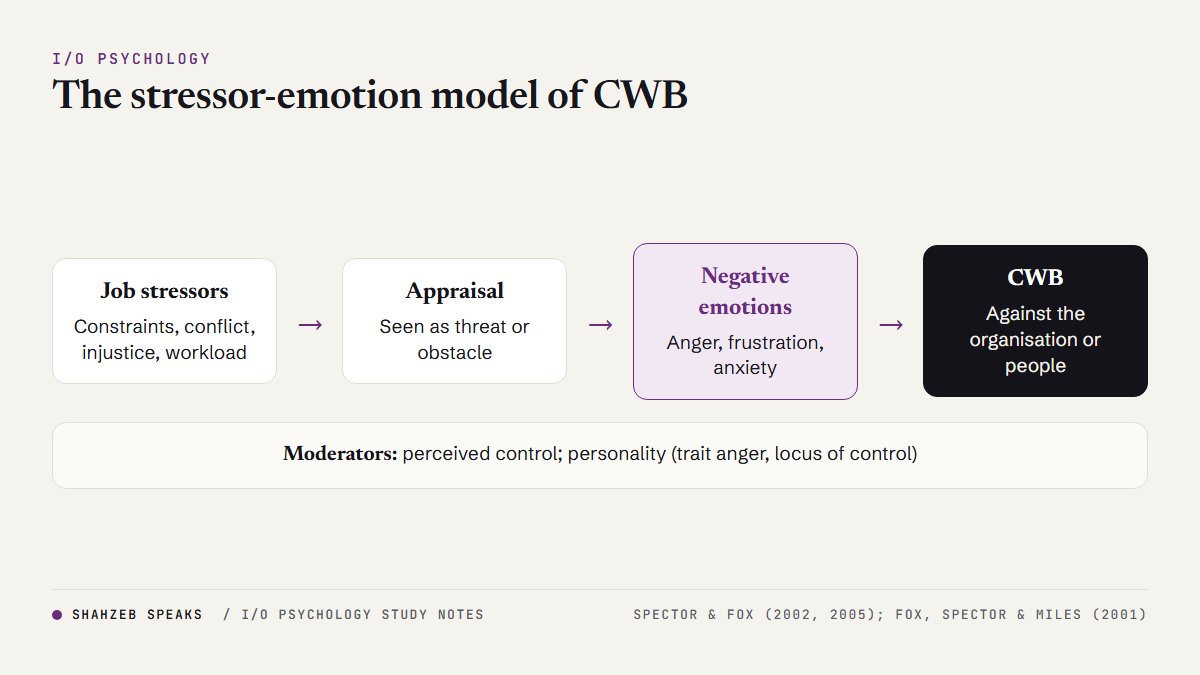
Example: a call-centre agent in Manila faces a system that crashes ten times a shift (constraint), a supervisor who shouts (conflict), and a bonus cut she sees as unfair (injustice). She feels angry, has little control over any of it, and starts taking longer breaks and being rude to customers. The model tells managers to fix the stressors and give people more control, rather than only adding surveillance. For the justice part, see organisational justice and workplace fairness; for stress models more generally, see occupational stress models.
How is CWB measured?
| Measure | Authors, year | Items and structure | Use terms (checked 3 Nov 2026) |
|---|---|---|---|
| Workplace Deviance Scale | Bennett & Robinson, 2000 | 19 items: 12 organisational, 7 interpersonal | No owner statement found: check with the author/publisher |
| CWB Checklist (CWB-C), full | Spector, Fox and colleagues (Spector et al., 2006) | 45 items: organisation-directed and person-directed | Free for non-commercial research and teaching, including theses, if you share results with Paul Spector and keep the copyright notice |
| CWB-C, 32 items | Spector et al., 2006 | 5 subscales: abuse, production deviance, sabotage, theft, withdrawal | Same as above |
| CWB-C, 10 items | Spector and Fox | 5 organisation and 5 person items; total score only | Same as above |
The CWB-C asks how often the person did each act, from never to every day, which is a frequency format. Spector et al. (2006) argued that the five subscales should not be lumped together without checking, because different kinds of CWB can have different causes. A note from Spector’s site on 3 November 2026: the 32-item version is the old 33-item version with one abuse item removed, so cite the version you actually used.
Self-report or supervisor report?
Students worry that people will not admit to CWB. Berry, Carpenter and Barratt (2012) meta-analysed this question. Self- and other-ratings of CWB correlated moderately to strongly. People reported more CWB about themselves than others reported about them, suggesting that supervisors see only a narrow slice of it. Other-ratings added little beyond self-ratings in predicting common correlates. Their conclusion supports self-report CWB as a workable option in most research, provided you guarantee anonymity.
For anonymity, translation and common method bias, see research methods for an I/O thesis. Other scales are listed in scales for I/O psychology theses.
CWB vs OCB: opposites or not?
It seems obvious that good citizens do not misbehave. The evidence is more interesting:
- Dalal (2005) meta-analysed the OCB-CWB link and found a modest negative relationship (rho = -.32), with somewhat different antecedents for each. So they are not two ends of one scale.
- Spector, Bauer and Fox (2010) ran an experiment and found that OCB-CWB correlations were higher when people rated agreement rather than frequency, when OCB items overlapped in content with CWB items, and with supervisor rather than self-ratings. They concluded the two are likely unrelated rather than opposite.
| Point | OCB | CWB |
|---|---|---|
| Core idea | Voluntary acts that help | Intentional acts that harm |
| Classic model | Organ (1988): five dimensions | Robinson and Bennett (1995): four types |
| Split by target | OCB-I vs OCB-O | Interpersonal vs organisational deviance |
| Free checklist | OCB-C (Fox and Spector) | CWB-C (Spector and Fox) |
| Main emotion link | Positive emotions, satisfaction | Anger and frustration from stressors |
So in a thesis, measure both with frequency checklists and treat them as two separate variables. More on the positive side in organizational citizenship behaviour.
10-mark answer structure
- Definition (1 mark): intentional behaviour that harms or is meant to harm the organisation or its members (Sackett, 2002; Spector and Fox).
- Typology (3 marks): Robinson and Bennett (1995): minor-serious and interpersonal-organisational dimensions; production, property, political, personal aggression, each with an example.
- Measurement (1 mark): Bennett and Robinson (2000) 12 + 7 items; CWB-C with five dimensions (Spector et al., 2006).
- Causes (2 marks): stressor-emotion model: stressors, appraisal, negative emotions, CWB; control and personality as moderators.
- Relation to OCB (1 mark): modest negative link (Dalal, 2005), not opposites.
- Implications (1 mark): reduce constraints, conflict and injustice; increase control; select for conscientiousness and emotional stability (Berry et al., 2007).
- Conclusion (1 mark): CWB is a reaction to the work environment as well as a trait of “bad apples”.
Model opening line: “Counterproductive work behaviour is intentional behaviour by employees that harms, or is intended to harm, the organisation or the people in it, and Robinson and Bennett (1995) showed it varies along two dimensions: minor to serious, and interpersonal to organisational.”
Practice MCQs: counterproductive work behavior
Practice questions written to the published syllabus, not past-paper questions.
-
A storekeeper in a Karachi pharmacy chain sells boxes of medicine from the stockroom for himself. In Robinson and Bennett’s typology, this is:
- Production deviance
- Property deviance
- Political deviance
- Personal aggression
Show answer
B. Stealing company property is serious and aimed at the organisation, which is property deviance. Production deviance is minor (slowing down, long breaks), and political deviance and personal aggression are aimed at people.
-
A shift supervisor repeatedly shouts insults at a junior worker and threatens him. Which type is this?
- Personal aggression
- Political deviance
- Production deviance
- Property deviance
Show answer
A. Verbal abuse and threats are serious and interpersonal. Political deviance is the minor interpersonal type (gossip, favouritism); the other two are aimed at the organisation.
-
How many items did Bennett and Robinson’s (2000) organisational and interpersonal deviance scales have?
- 7 and 12
- 12 and 7
- 10 and 10
- 16 and 16
Show answer
B. 12 organisational items and 7 interpersonal items (19 in total). Option A reverses the two; C and D are not the published counts.
-
In the stressor-emotion model, what links job stressors to CWB?
- Cognitive ability
- Negative emotions such as anger
- Pay level
- Job tenure
Show answer
B. Stressors are appraised and produce negative emotions, which lead to CWB (Spector and Fox, 2002, 2005; Fox et al., 2001). Ability, pay and tenure are not the link in this model.
-
Which statement fits Sackett’s (2002) definition of CWB?
- Any behaviour that lowers output, including honest mistakes
- Intentional behaviour seen by the organisation as against its legitimate interests
- Only illegal acts such as theft
- Behaviour that managers personally dislike
Show answer
B. Intention and harm to legitimate interests are the key features. Honest mistakes are not intentional, CWB includes legal acts such as gossip or slowing down, and a manager’s personal dislike is not the test.
-
Berry, Ones and Sackett (2007) found that interpersonal and organisational deviance correlated at about:
- .10
- .32
- .62
- .95
Show answer
C. The meta-analytic correlation was .62: high, but with different links to some traits and to OCB, so the two are still treated as separate. -.32 is Dalal’s OCB-CWB figure, and .95 would mean they are the same thing.
-
A student fears that self-reported CWB is useless because people hide it. What did Berry, Carpenter and Barratt (2012) find?
- Self-raters reported more CWB than others reported about them, and other-ratings added little
- Self-reports had no relation with other-reports
- Only supervisor reports are valid
- People report no CWB at all
Show answer
A. Self- and other-ratings correlated moderately to strongly, self-raters admitted more CWB, and other-ratings added little incremental variance. This supports anonymous self-report in most studies. The other options contradict their findings.
-
Which of these is NOT one of the measurement features that Spector, Bauer and Fox (2010) found inflated the OCB-CWB correlation?
- Agreement rather than frequency ratings
- Overlapping content between OCB and CWB items
- Supervisor rather than self-ratings
- Using a sample of more than 200 people
Show answer
D. Sample size was not one of their manipulated features. Agreement formats, overlapping content and supervisor ratings all raised the correlation in their experiment.
-
A manager wants to reduce CWB in a busy call centre. Which action follows most directly from the stressor-emotion model?
- Install more cameras only
- Fix the systems that keep crashing and give agents more say over breaks
- Hire only graduates
- Cut break times to raise output
Show answer
B. Removing constraints and raising perceived control attacks the causes in the model. Cameras only target the behaviour, graduate hiring is unrelated, and cutting breaks adds a stressor.
-
A thesis uses the 32-item CWB-C. Which set of subscales can it report?
- Altruism, courtesy, sportsmanship, conscientiousness, civic virtue
- Abuse, production deviance, sabotage, theft, withdrawal
- Production, property, political, personal aggression
- Vigour, dedication, absorption
Show answer
B. These are the five CWB-C subscales. Option A is Organ’s OCB dimensions, C is Robinson and Bennett’s typology (a different model), and D is the UWES engagement dimensions.
Practise on your phone
The free I/O Psychology Prep app has 410 explained
questions, flashcards and an exam countdown, and works offline. Get it on Google Play
· About the app
Questions students ask
What are examples of counterproductive work behavior?
Coming late or leaving early without permission, long unauthorised breaks, working slowly on purpose, wasting materials, theft, damaging equipment, lying about hours, gossip, blaming others, verbal abuse, bullying and harassment. Robinson and Bennett (1995) group these into production, property, political and personal-aggression types.
What are the 4 types of workplace deviance?
Production deviance (minor, against the organisation), property deviance (serious, against the organisation), political deviance (minor, against people) and personal aggression (serious, against people). They come from crossing Robinson and Bennett’s two dimensions: minor vs serious and interpersonal vs organisational.
Is the CWB Checklist free to use?
Yes, for non-commercial research and teaching, including student theses. On 3 November 2026 Paul Spector’s site set two conditions: share your results (means, sample size and a short sample description) with him, and keep the copyright notice. Commercial use needs separate permission.
What is the difference between CWB and workplace deviance?
They describe largely the same behaviours. “Workplace deviance” (Robinson and Bennett) stresses breaking organisational norms; “counterproductive work behaviour” (Spector and Fox; Sackett) stresses harm to the organisation’s legitimate interests. Most reviews treat them as overlapping labels.
What causes CWB?
Both the situation and the person. On the situation side: constraints, conflict, injustice and stress, acting through anger and frustration (stressor-emotion model). On the person side: low agreeableness, low conscientiousness and low emotional stability showed the strongest links in Berry et al. (2007).
Is CWB the opposite of OCB?
No. Dalal (2005) found only a modest negative correlation (-.32), and Spector et al. (2010) showed that much of the apparent opposition comes from how the scales are worded. Treat them as separate variables.
Free calculators for your CWB thesis
Check your CWB-C or deviance scale with the free item analysis calculator and the composite reliability and AVE calculator; if you collect peer or supervisor ratings, use the rwg and ICC calculator. For revision, the free I/O Psychology Prep app is on Google Play.
References
- Bennett, R. J., & Robinson, S. L. (2000). Development of a measure of workplace deviance. Journal of Applied Psychology, 85(3), 349-360. https://doi.org/10.1037/0021-9010.85.3.349
- Berry, C. M., Carpenter, N. C., & Barratt, C. L. (2012). Do other-reports of counterproductive work behavior provide an incremental contribution over self-reports? A meta-analytic comparison. Journal of Applied Psychology, 97(3), 613-636. https://doi.org/10.1037/a0026739
- Berry, C. M., Ones, D. S., & Sackett, P. R. (2007). Interpersonal deviance, organizational deviance, and their common correlates: A review and meta-analysis. Journal of Applied Psychology, 92(2), 410-424. https://doi.org/10.1037/0021-9010.92.2.410
- Dalal, R. S. (2005). A meta-analysis of the relationship between organizational citizenship behavior and counterproductive work behavior. Journal of Applied Psychology, 90(6), 1241-1255. https://doi.org/10.1037/0021-9010.90.6.1241
- Fox, S., Spector, P. E., & Miles, D. (2001). Counterproductive work behavior (CWB) in response to job stressors and organizational justice: Some mediator and moderator tests for autonomy and emotions. Journal of Vocational Behavior, 59(3), 291-309. https://doi.org/10.1006/jvbe.2001.1803
- Robinson, S. L., & Bennett, R. J. (1995). A typology of deviant workplace behaviors: A multidimensional scaling study. Academy of Management Journal, 38(2), 555-572. https://doi.org/10.2307/256693
- Sackett, P. R. (2002). The structure of counterproductive work behaviors: Dimensionality and relationships with facets of job performance. International Journal of Selection and Assessment, 10(1-2), 5-11. https://doi.org/10.1111/1468-2389.00189
- Spector, P. E., Bauer, J. A., & Fox, S. (2010). Measurement artifacts in the assessment of counterproductive work behavior and organizational citizenship behavior: Do we know what we think we know? Journal of Applied Psychology, 95(4), 781-790. https://doi.org/10.1037/a0019477
- Spector, P. E., & Fox, S. (2002). An emotion-centered model of voluntary work behavior: Some parallels between counterproductive work behavior and organizational citizenship behavior. Human Resource Management Review, 12(2), 269-292. https://doi.org/10.1016/S1053-4822(02)00049-9
- Spector, P. E., & Fox, S. (2005). The stressor-emotion model of counterproductive work behavior. In S. Fox & P. E. Spector (Eds.), Counterproductive work behavior: Investigations of actors and targets (pp. 151-174). American Psychological Association. https://doi.org/10.1037/10893-007
- Spector, P. E., Fox, S., Penney, L. M., Bruursema, K., Goh, A., & Kessler, S. (2006). The dimensionality of counterproductivity: Are all counterproductive behaviors created equal? Journal of Vocational Behavior, 68(3), 446-460. https://doi.org/10.1016/j.jvb.2005.10.005
This post is part of the I/O psychology thesis topics hub. Related: OCB, toxic workplace signs, job satisfaction theories and measures and the job attitudes MCQs. Students in Pakistan can also read about industrial psychology in Pakistan.