
Job satisfaction is how positively a person feels about, and judges, their job. Locke (1976) called it “a pleasurable or positive emotional state” that comes from appraising one’s job. Theories explain its sources: the job itself (Herzberg, Hackman and Oldham), the gap between what you want and get (Locke), your personality (the dispositional approach) and daily events (affective events theory). It is measured with scales such as the JDI, MSQ and JSS.
This page is for students who need job satisfaction for an exam answer, an assignment or a thesis. It covers the definition, the six theories that come up most in BS and MS papers, a comparison table, the main measures with their item counts and licence terms, what the research says about satisfaction and performance, and how to choose a scale for your own study. It ends with a 10-mark answer plan, 10 practice MCQs and the original references.
Job satisfaction is one of the most studied ideas in I/O psychology. Ironson and colleagues (1989) noted that Locke had estimated 3,350 articles on the subject by 1976, and it is still the most common outcome variable in student theses.
What is job satisfaction?
Two ideas sit inside every good definition:
- Feeling and judging. Locke’s (1976) definition stresses emotion. Weiss (2002) later argued that job satisfaction is better treated as an evaluative judgement about the job, separate from the moods and emotions people feel at work. For an exam, say that satisfaction has an affective (feeling) side and a cognitive (judging) side, and that scales differ in which side they capture.
- Global and facet satisfaction. Global satisfaction is your overall view of the job (“all in all, I am satisfied”). Facet satisfaction is your view of one part of it, such as pay, promotion, supervision, co-workers or the work itself. A teller in a bank branch can be happy with co-workers and unhappy with pay at the same time.
Ironson et al. (1989) showed that a global scale is not the same as the sum of facet scores. Adding up facets gives a different number from asking about the job as a whole, so choose the type of measure that matches your research question.
Theories of job satisfaction
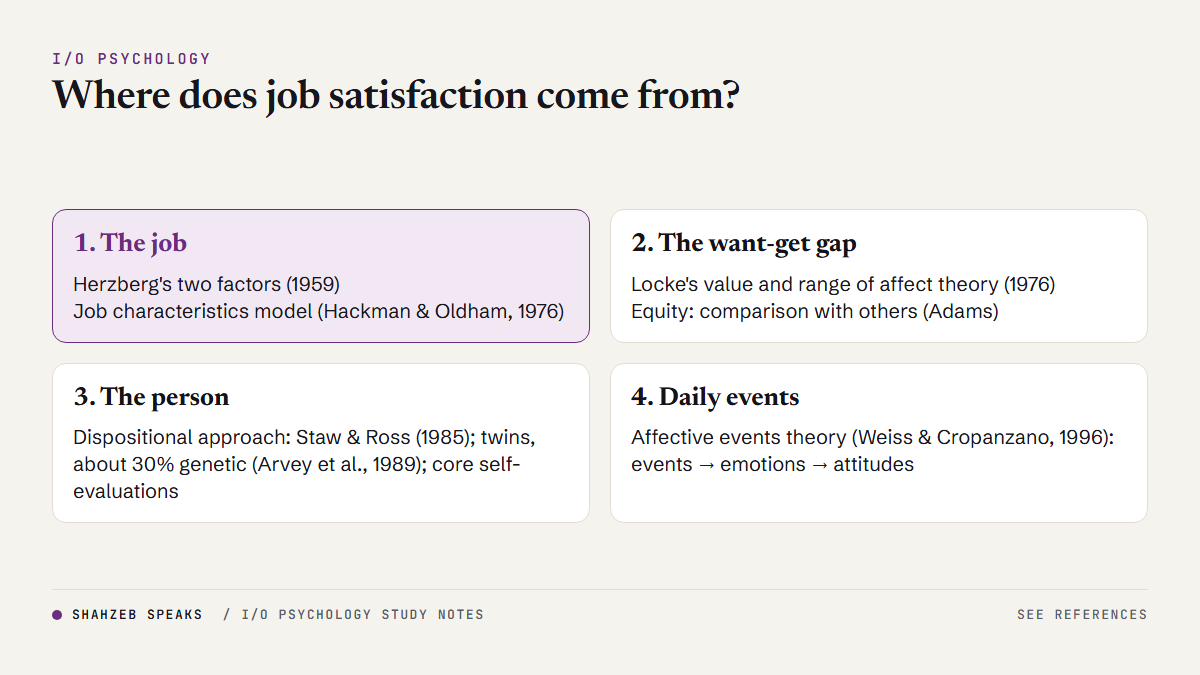
Theories answer one question: where does satisfaction come from? I group them by their answer, because that is the easiest way to remember them in an exam.
1. Herzberg’s two-factor theory (the job’s content)
Herzberg, Mausner and Snyderman (1959) asked engineers and accountants to describe times they felt very good or very bad about their jobs. Good times were linked with motivators (achievement, recognition, the work itself, responsibility, advancement). Bad times were linked with hygiene factors (company policy, supervision, pay, working conditions, relations with others). Their claim: satisfaction and dissatisfaction are not two ends of one scale, so fixing hygiene factors removes dissatisfaction but does not create satisfaction. Read the full explanation in Herzberg’s two-factor theory.
2. Job characteristics model (the design of the job)
Hackman and Oldham (1976) proposed that five core job characteristics (skill variety, task identity, task significance, autonomy and feedback) create three psychological states, which lead to internal motivation and satisfaction. Satisfaction, in this view, is built into how the job is designed. See the job characteristics model page and the free motivating potential score calculator.
3. Locke’s value theory and range of affect theory (the gap)
Locke (1976) argued that satisfaction depends on the gap between what a person wants (values) from a job and what the person perceives they get. The range of affect idea adds that the importance of a facet changes how strongly the gap is felt. Example: two lecturers in a university department both get no research funding. The one who values research is very dissatisfied; the one who mainly values teaching hardly cares. Same job, same gap, different importance, different satisfaction.
4. The dispositional approach (the person)
This approach says some people are satisfied in almost any job, and some in almost none. The evidence:
- Staw and Ross (1985) analysed a national sample of over 5,000 middle-aged men in the United States. Job satisfaction was stable over five years, even for men who changed employer or occupation, and earlier satisfaction predicted later satisfaction better than changes in pay or job status did.
- Staw, Bell and Clausen (1986) found that measures of affective disposition taken as early as adolescence predicted job attitudes across nearly fifty years.
- Arvey, Bouchard, Segal and Abraham (1989) studied 34 pairs of identical twins reared apart. About 30% of the variance in general job satisfaction was due to genetic factors.
- Judge, Locke and Durham (1997) proposed core self-evaluations: four traits (self-esteem, generalised self-efficacy, locus of control and emotional stability). In Judge and Bono’s (2001) meta-analysis, their true-score correlations with job satisfaction ranged from .24 (emotional stability) to .45 (generalised self-efficacy).
5. Affective events theory (daily events)
Weiss and Cropanzano (1996) proposed that things that happen at work (a rude customer, praise from a manager, a system crash) cause emotional reactions, and that these reactions, added up over time, shape job attitudes such as satisfaction. Some behaviour follows directly from the emotion (snapping at a colleague), and some follows from the settled attitude (deciding to look for another job). A call-centre agent’s satisfaction, on this view, is partly the sum of hundreds of small calls.
6. Equity and social comparison (compared with others)
Adams’ equity theory, usually taught under motivation, also explains dissatisfaction: people compare their ratio of outcomes to inputs with that of others, and feel dissatisfied when the comparison looks unfair. See equity theory of motivation.
| Theory | Author(s), year | Satisfaction comes from | Key idea in one line | Common critique |
|---|---|---|---|---|
| Two-factor | Herzberg, Mausner & Snyderman, 1959 | Job content | Motivators satisfy; hygiene factors only prevent dissatisfaction | Method: people credit themselves for good events and blame others for bad ones |
| Job characteristics model | Hackman & Oldham, 1976 | Job design | Five core characteristics create three psychological states | Works best for people who want growth at work |
| Value / range of affect | Locke, 1976 | The want-get gap | The gap matters more when the facet is important to you | Hard to measure values and perceptions separately |
| Dispositional | Staw & Ross, 1985; Judge et al., 1997 | The person | Satisfaction is stable across time and jobs; partly genetic | Underplays how much changing a job can help |
| Affective events | Weiss & Cropanzano, 1996 | Daily work events | Events cause emotions; emotions build attitudes | Needs repeated (diary) measurement to test |
| Equity | Adams, 1963, 1965 | Comparison with others | Unfair outcome-input ratios cause dissatisfaction | Hard to know whom people compare with |
How is job satisfaction measured?
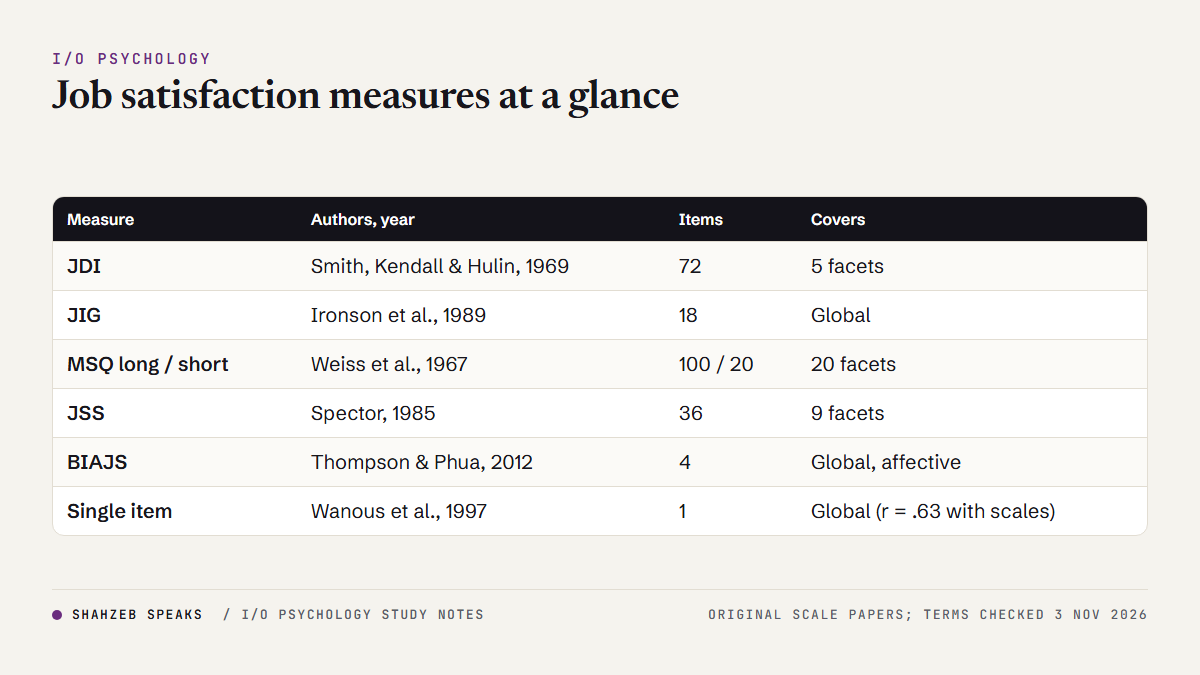
These are the measures you will see most in journals and student theses. The table gives facts only; this page does not reprint any items, because most scales are copyrighted.
| Measure | Authors, year | Items | What it covers | Use terms (checked 3 Nov 2026) |
|---|---|---|---|---|
| Job Descriptive Index (JDI) | Smith, Kendall & Hulin, 1969 | 72 | 5 facets: work, pay, promotion, supervision, co-workers; answered Yes, No or ? | Free download for research from the JDI Office at Bowling Green State University; guides and scoring syntax are paid |
| Job in General (JIG) | Ironson, Smith, Brannick, Gibson & Paul, 1989 | 18 | Global satisfaction, to go with the JDI | Same JDI Office terms |
| Minnesota Satisfaction Questionnaire (MSQ), long form | Weiss, Dawis, England & Lofquist, 1967 | 100 | 20 facet scales | Creative Commons BY-NC 4.0 since July 2016: free for research with credit to Vocational Psychology Research, University of Minnesota |
| MSQ short form | Weiss et al., 1967 | 20 | One item per facet; intrinsic, extrinsic and general scores | Same as the long form |
| Job Satisfaction Survey (JSS) | Spector, 1985 | 36 | 9 facets of 4 items: pay, promotion, supervision, fringe benefits, contingent rewards, operating procedures, co-workers, nature of work, communication | Free for non-commercial research (theses included) if you share your results with the author; the newer JSS-2 is commercial |
| Brief Index of Affective Job Satisfaction (BIAJS) | Thompson & Phua, 2012 | 4 | Global, overtly affective satisfaction | No owner statement found: check with the author/publisher |
| Single overall item | Reviewed by Wanous, Reichers & Hudy, 1997 | 1 | Global satisfaction | Write your own item; cite the review |
Three facts that help when you defend your choice in a viva:
- Single items are not useless. Wanous et al. (1997) combined 28 correlations from 17 studies (7,682 people) and found that single-item measures correlated .63 with multi-item scales of overall satisfaction (.67 corrected for reliability).
- The JSS was built for public and non-profit settings. Spector (1985) developed it for human service, public and non-profit organisations, which makes it a natural fit for hospitals, schools and government departments.
- Short does not mean weak. The 4-item BIAJS was validated across nationality, job level and job type (Thompson & Phua, 2012), which matters if you collect data in more than one country.
Does job satisfaction predict performance?
The “happy worker is a productive worker” idea is old, and the answer is “yes, moderately”. Judge, Thoresen, Bono and Patton (2001) meta-analysed 312 samples with a combined N of 54,417 and estimated the mean true correlation between overall job satisfaction and job performance at .30. That is a real relationship, but it leaves most of the variation in performance unexplained, and a correlation does not show which causes which.
Satisfaction also goes with staying. In Spector’s (1985) data, JSS scores correlated most strongly with perceptions of the job and supervisor, intention to quit and organisational commitment, and more modestly with absenteeism and actual turnover. For the commitment side, see Meyer and Allen’s three-component model, and for the extra-role behaviour that satisfied employees show, see organizational citizenship behaviour.
Choosing a job satisfaction scale for your thesis
- Match the scale to the question. If you want to know which part of the job upsets nurses, use a facet measure (JSS or JDI). If satisfaction is one variable in a bigger model, a global measure (JIG, MSQ general score, BIAJS) keeps the questionnaire short.
- Check the terms before you print. The JSS, MSQ and JDI can be used free for research on the conditions in the table. Keep a copy of the terms page in your appendix.
- Translate properly. If your respondents answer in Urdu, Hindi or Filipino, use forward and back-translation and pilot the scale. The steps are in research methods for an I/O thesis.
- Report reliability per facet. A JSS facet has only four items, so alphas will be lower than for the total. Use the item analysis calculator to spot weak items, and the Spearman-Brown calculator if you need to judge what a shorter or longer facet would do to reliability.
More scales, with their licence status, are in the table of scales for I/O psychology theses.
10-mark answer structure
- Definition (1 mark): Locke (1976): a pleasurable or positive emotional state from appraising one’s job; mention global vs facet satisfaction.
- Framework (1 mark): theories differ in where satisfaction comes from: job, gap, person, events.
- Job-based theories (2 marks): Herzberg’s two factors (1959); Hackman and Oldham’s JCM (1976).
- Gap theory (1 mark): Locke’s value and range of affect theory, with an example.
- Person-based theory (2 marks): Staw and Ross (1985) stability; Arvey et al. (1989) twins, about 30% genetic; core self-evaluations.
- Events (1 mark): affective events theory, Weiss and Cropanzano (1996).
- Measurement (1 mark): JDI (5 facets), MSQ (20 facets), JSS (9 facets).
- Conclusion (1 mark): satisfaction comes from both the job and the person; it correlates about .30 with performance (Judge et al., 2001), so managers should improve jobs and also select carefully.
Model opening line: “Job satisfaction is a person’s positive or negative evaluation of their job (Locke, 1976), and theories disagree mainly about its source: the job, the person, or the events of the working day.”
Practice MCQs: job satisfaction theories and measures
Practice questions written to the published syllabus, not past-paper questions.
-
Two lecturers get no research grants this year. Sana, who values research highly, is very dissatisfied; Omar, who cares mostly about teaching, is not bothered. Which theory explains this best?
- Herzberg’s two-factor theory
- Locke’s range of affect theory
- The dispositional approach
- The job characteristics model
Show answer
B. Range of affect theory says the importance of a facet changes how strongly the want-get gap is felt. Herzberg does not deal with personal importance, the dispositional approach would predict stable traits rather than facet-specific reactions, and the JCM is about job design.
-
Arvey and colleagues (1989) studied identical twins reared apart. Roughly what share of the variance in general job satisfaction did they attribute to genetic factors?
- About 5%
- About 30%
- About 60%
- About 90%
Show answer
B. They reported that about 30% of the observed variance was due to genetic factors, in 34 twin pairs. The other values are not from that study; 60% or 90% would mean jobs hardly matter, which the authors did not claim.
-
In Staw and Ross (1985), what predicted later job satisfaction better than changes in pay or job status?
- Earlier job satisfaction
- Supervisor ratings
- Hours worked
- Age at first job
Show answer
A. Prior attitudes were the stronger predictor, even when men changed employer or occupation. This was their main evidence for a dispositional view. The study did not use supervisor ratings, hours or age at first job as the key predictor.
-
According to affective events theory, a call-centre agent’s job satisfaction is shaped mainly by:
- Genes alone
- Emotional reactions to events at work, built up over time
- The five core job characteristics
- Comparing pay with friends
Show answer
B. Weiss and Cropanzano (1996) said work events trigger emotions, and these build attitudes. Genes are the dispositional view, core characteristics are Hackman and Oldham, and pay comparison is equity theory.
-
Which of these is NOT one of the four core self-evaluation traits?
- Self-esteem
- Locus of control
- Conscientiousness
- Emotional stability
Show answer
C. The four traits are self-esteem, generalised self-efficacy, locus of control and emotional stability (Judge et al., 1997). Conscientiousness is a Big Five trait but not part of core self-evaluations.
-
A researcher needs a global satisfaction score to add to the five JDI facet scores. Which scale was built for this purpose?
- Job in General (JIG)
- MSQ long form
- Brayfield-Rothe index
- Job Diagnostic Survey
Show answer
A. Ironson et al. (1989) built the 18-item JIG to go with the JDI facets. The MSQ is a separate instrument, the Brayfield-Rothe index predates both, and the Job Diagnostic Survey measures job characteristics.
-
How many items does the short form of the Minnesota Satisfaction Questionnaire have?
- 9
- 18
- 20
- 36
Show answer
C. The short form has 20 items, one for each of the 20 facets of the 100-item long form. 18 is the JIG, 36 is the JSS, and 9 is the number of JSS facets.
-
Wanous, Reichers and Hudy (1997) found that single-item measures of overall job satisfaction:
- Have no relation with multi-item scales
- Correlate about .63 with multi-item scales
- Are more reliable than any scale
- Should never be used in research
Show answer
B. The average uncorrected correlation was .63 (about .67 corrected for reliability). This makes a single item acceptable in some designs. They did not say single items beat scales, or that they are unusable.
-
A student in Manila wants a free, facet-level satisfaction scale for public-sector hospital staff. Which is the most suitable choice?
- The JSS, used on Spector’s no-cost research terms
- A scale copied from a paid textbook test bank
- The MBI
- Any scale, since theses need no permission
Show answer
A. The JSS was designed for human service and public organisations and is free for non-commercial research if you share results. Test-bank copying breaks copyright, the MBI measures burnout (and is licensed through Mind Garden), and theses do need permission where the owner requires it.
-
Ironson et al. (1989) compared global and facet measures. Which conclusion did they reach?
- A global scale equals the sum of the facets
- Global scales are not equivalent to summed facet scales
- Facet scales should never be used
- Pay is the most important facet
Show answer
B. They showed that global scales are not equivalent to summed facets, and both have uses. Their data suggested that work itself, not pay, may be the most important facet for general satisfaction.
Practise on your phone
The free I/O Psychology Prep app has 410 explained
questions, flashcards and an exam countdown, and works offline. Get it on Google Play
· About the app
Questions students ask
What are the main theories of job satisfaction?
The ones most papers expect are Herzberg’s two-factor theory, Hackman and Oldham’s job characteristics model, Locke’s value and range of affect theory, the dispositional approach, affective events theory and equity theory. Group them by where satisfaction comes from: the job, the want-get gap, the person or daily events.
What is the difference between JDI and MSQ?
The JDI (Smith, Kendall and Hulin, 1969) has 72 items on five facets: work, pay, promotion, supervision and co-workers. The MSQ (Weiss et al., 1967) has 20 facets, in a 100-item long form and a 20-item short form. The JDI asks people to describe their job; the MSQ asks how satisfied they are with each aspect.
How is the MSQ short form scored?
Each of the 20 items is rated for satisfaction, and the items are combined into intrinsic, extrinsic and general satisfaction scores. Use the official manual from Vocational Psychology Research at the University of Minnesota for the item-to-scale key; the VPR says it does not give scoring help, so follow the manual exactly.
Is the Job Satisfaction Survey free?
Yes, for non-commercial research and teaching, including student theses. Paul Spector’s conditions are that you keep the copyright notice and share your results (means, sample size and a short sample description) with him. His newer JSS-2 is a separate commercial scale.
Is job satisfaction the same as motivation?
No. Satisfaction is an attitude: how you evaluate your job. Motivation is the force that drives effort. A satisfied employee can still put in little effort, and an unhappy one can work very hard for a promotion. See work motivation theories.
Does a happy worker work harder?
Somewhat. The best estimate is a true correlation of .30 between overall satisfaction and performance (Judge et al., 2001). That is a moderate link, and the causal direction is not settled by that analysis.
Free calculators for your satisfaction thesis
Check your scale with the free item analysis calculator, the composite reliability and AVE calculator and the Spearman-Brown calculator. For revision, the free I/O Psychology Prep app is on Google Play.
References
- Adams, J. S. (1963). Towards an understanding of inequity. Journal of Abnormal and Social Psychology, 67(5), 422-436. https://doi.org/10.1037/h0040968
- Adams, J. S. (1965). Inequity in social exchange. In L. Berkowitz (Ed.), Advances in experimental social psychology (Vol. 2, pp. 267-299). Academic Press. https://doi.org/10.1016/S0065-2601(08)60108-2
- Arvey, R. D., Bouchard, T. J., Segal, N. L., & Abraham, L. M. (1989). Job satisfaction: Environmental and genetic components. Journal of Applied Psychology, 74(2), 187-192. https://doi.org/10.1037/0021-9010.74.2.187
- Hackman, J. R., & Oldham, G. R. (1976). Motivation through the design of work: Test of a theory. Organizational Behavior and Human Performance, 16(2), 250-279. https://doi.org/10.1016/0030-5073(76)90016-7
- Herzberg, F., Mausner, B., & Snyderman, B. B. (1959). The motivation to work. Wiley.
- Ironson, G. H., Smith, P. C., Brannick, M. T., Gibson, W. M., & Paul, K. B. (1989). Construction of a Job in General scale: A comparison of global, composite, and specific measures. Journal of Applied Psychology, 74(2), 193-200. https://doi.org/10.1037/0021-9010.74.2.193
- Judge, T. A., & Bono, J. E. (2001). Relationship of core self-evaluations traits (self-esteem, generalized self-efficacy, locus of control, and emotional stability) with job satisfaction and job performance: A meta-analysis. Journal of Applied Psychology, 86(1), 80-92. https://doi.org/10.1037/0021-9010.86.1.80
- Judge, T. A., Locke, E. A., & Durham, C. C. (1997). The dispositional causes of job satisfaction: A core evaluations approach. Research in Organizational Behavior, 19, 151-188.
- Judge, T. A., Thoresen, C. J., Bono, J. E., & Patton, G. K. (2001). The job satisfaction-job performance relationship: A qualitative and quantitative review. Psychological Bulletin, 127(3), 376-407. https://doi.org/10.1037/0033-2909.127.3.376
- Locke, E. A. (1976). The nature and causes of job satisfaction. In M. D. Dunnette (Ed.), Handbook of industrial and organizational psychology (pp. 1297-1349). Rand McNally.
- Smith, P. C., Kendall, L. M., & Hulin, C. L. (1969). The measurement of satisfaction in work and retirement. Rand McNally.
- Spector, P. E. (1985). Measurement of human service staff satisfaction: Development of the Job Satisfaction Survey. American Journal of Community Psychology, 13(6), 693-713. https://doi.org/10.1007/BF00929796
- Staw, B. M., Bell, N. E., & Clausen, J. A. (1986). The dispositional approach to job attitudes: A lifetime longitudinal test. Administrative Science Quarterly, 31(1), 56-77. https://doi.org/10.2307/2392766
- Staw, B. M., & Ross, J. (1985). Stability in the midst of change: A dispositional approach to job attitudes. Journal of Applied Psychology, 70(3), 469-480. https://doi.org/10.1037/0021-9010.70.3.469
- Thompson, E. R., & Phua, F. T. T. (2012). A brief index of affective job satisfaction. Group & Organization Management, 37(3), 275-307. https://doi.org/10.1177/1059601111434201
- Wanous, J. P., Reichers, A. E., & Hudy, M. J. (1997). Overall job satisfaction: How good are single-item measures? Journal of Applied Psychology, 82(2), 247-252. https://doi.org/10.1037/0021-9010.82.2.247
- Weiss, D. J., Dawis, R. V., England, G. W., & Lofquist, L. H. (1967). Manual for the Minnesota Satisfaction Questionnaire (Minnesota Studies in Vocational Rehabilitation, No. 22). University of Minnesota, Industrial Relations Center.
- Weiss, H. M. (2002). Deconstructing job satisfaction: Separating evaluations, beliefs and affective experiences. Human Resource Management Review, 12(2), 173-194. https://doi.org/10.1016/S1053-4822(02)00045-1
- Weiss, H. M., & Cropanzano, R. (1996). Affective events theory: A theoretical discussion of the structure, causes and consequences of affective experiences at work. Research in Organizational Behavior, 18, 1-74.
This post is part of the I/O psychology thesis topics hub. Related: Maslow vs Herzberg, counterproductive work behaviour and the job attitudes MCQs. Students in Pakistan can also read about industrial psychology in Pakistan.