
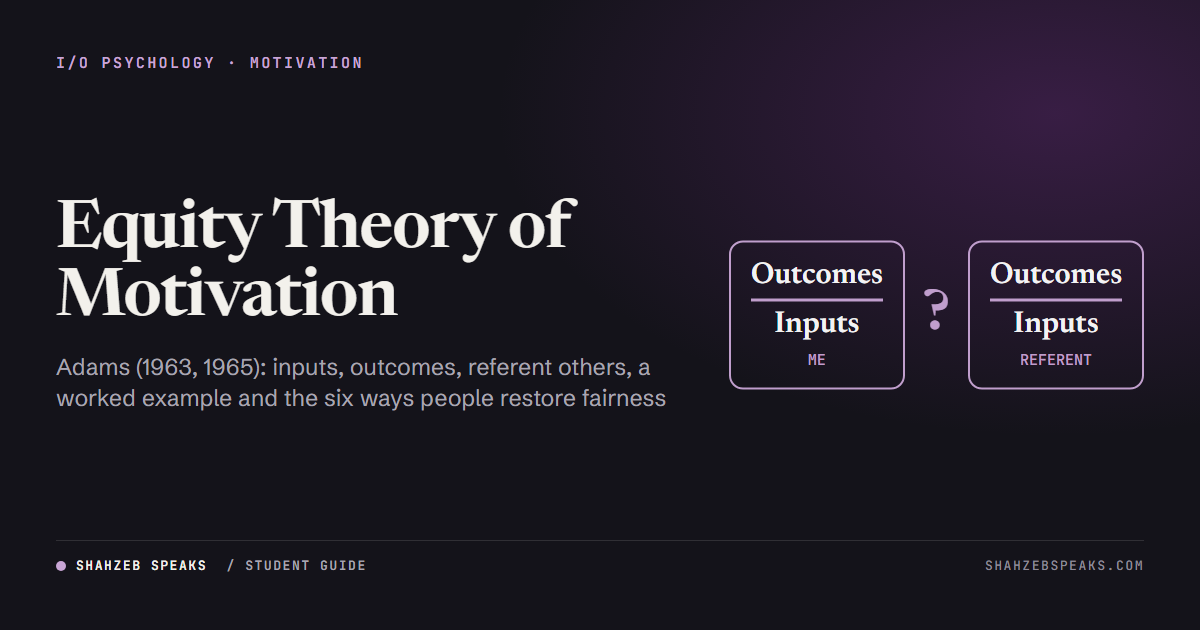
Equity theory of motivation was proposed by J. Stacy Adams (1963, 1965). It says people compare the ratio of what they get from a job (outcomes) to what they put in (inputs) with the same ratio for a referent other. If the ratios feel unequal, the person feels tension and acts to restore fairness.
This page is for students who have equity theory in an exam, an assignment or a thesis chapter on motivation. It gives you the inputs and outcomes, the formula with a worked number example, the referent others, the six ways people reduce inequity, the research and the criticism. At the end there is a 10-mark answer structure, 10 practice MCQs with explanations and the original references.
Equity theory is a process theory of motivation. It does not ask which needs a person has (that is Maslow, Herzberg or McClelland). It asks how a person thinks about fairness, and how that thinking changes effort. If you want all the theories side by side first, start with the work motivation theories pillar.
What is equity theory? Adams in plain words
J. Stacy Adams was a psychologist working on behaviour in organisations. His first paper, “Towards an understanding of inequity”, appeared in the Journal of Abnormal and Social Psychology in 1963. The full version, “Inequity in social exchange”, appeared in 1965 in Advances in Experimental Social Psychology, Volume 2. Exams usually accept “Adams (1963)” or “Adams (1965)”; giving both is safest.
The core idea is simple. A job is an exchange. You give something and you get something back. You judge whether the exchange is fair, not by looking at your pay alone, but by comparing your exchange with someone else’s. Adams treated the feeling of inequity as a motivating force: the bigger the inequity, the stronger the push to reduce it.
So two people on the same salary can feel very differently. A bank officer in Lahore earning a good salary may still feel cheated if a colleague who works fewer hours earns the same. That feeling, not the salary itself, drives what happens next.
Inputs and outcomes: what goes into the ratio
Inputs are what a person believes they contribute to the job. Outcomes are what they believe they receive. The word “believe” matters: both sides are perceptions, not facts written in an HR file.
| Inputs (what I give) | Outcomes (what I get) |
|---|---|
| Time and hours worked | Pay, bonus and allowances |
| Effort and performance | Promotion and job title |
| Education, degrees and skills | Recognition and praise |
| Experience and seniority | Working conditions, status, a good shift |
| Loyalty, opportunities given up | Friendship, interesting work (and also stress or fatigue, as negative outcomes) |
The comparison is written as a pair of ratios:
My outcomes ÷ my inputs compared with referent’s outcomes ÷ referent’s inputs
Three results are possible. If the ratios are about equal, the person feels equity. If their own ratio is lower, they feel underpayment (under-reward) inequity, which tends to produce anger or resentment. If their own ratio is higher, they feel overpayment (over-reward) inequity, which can produce guilt. People are much less sensitive to being over-rewarded than to being under-rewarded, so overpayment inequity is weaker and does not last long.
Equity theory example with numbers (worked step by step)
Students often ask for an equity theory example in the workplace that uses real arithmetic. Here is one. The names and amounts are invented for teaching. Two customer service agents work in the same call centre in Karachi. To keep the sums simple, we use weekly hours as the only input and monthly pay as the only outcome. Real people weigh many inputs at once, but the logic is the same.
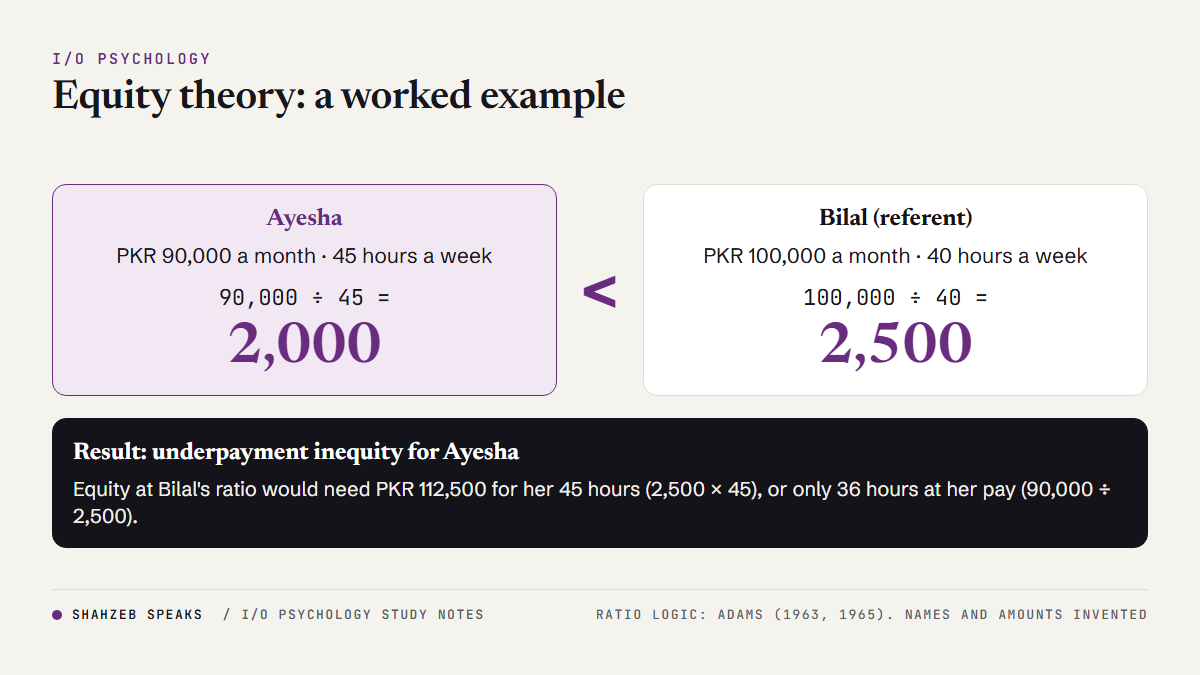
- Ayesha’s ratio. She works 45 hours a week and earns PKR 90,000 a month. 90,000 ÷ 45 = 2,000.
- Bilal’s ratio. He works 40 hours a week and earns PKR 100,000 a month. 100,000 ÷ 40 = 2,500.
- Compare. 2,000 is less than 2,500, so Ayesha perceives underpayment inequity. Bilal, if he notices, may feel slightly over-rewarded.
- What would restore equity for Ayesha? At Bilal’s ratio of 2,500, her 45 hours would be worth 2,500 × 45 = PKR 112,500. Or, at her current pay, her hours would need to fall to 90,000 ÷ 2,500 = 36 hours.
- Overpayment check. If Ayesha were paid PKR 120,000 for 45 hours, her ratio would be about 2,667, above Bilal’s 2,500. Now she is the over-rewarded one.
The useful lesson for an exam: equity theory predicts that Ayesha will not simply “accept” the gap. She may cut her hours or effort towards 36 hours’ worth, ask for a raise, tell herself that Bilal has skills she lacks, compare herself with someone else, or start looking for another job. Those are the methods in the next chapter.
Who is the referent other?
The referent other (or comparison other) is the person or group someone compares themselves with. Adams mostly discussed a co-worker, but later research widened the idea. Paul Goodman (1974) studied how managers evaluate their pay and found that people use several referents at the same time. He grouped them into three classes:
- Other: another person or group, inside or outside the organisation (a colleague, a friend at another bank, people with the same degree).
- Self: your own past (what you earned in your last job) or what you expected for yourself.
- System: what the organisation has promised or implied, such as the pay scale or a promise made at hiring.
Which referent a person picks changes the result. A lecturer in a university department who compares herself with a classmate now working in a multinational may feel underpaid; the same lecturer compared with her own salary five years ago may feel fine. Kulik and Ambrose (1992) reviewed the personal and situational factors that shape this choice, such as what information is available and how similar the other person seems. Choosing the referent is one reason equity theory is hard to test: the researcher often does not know who the employee is comparing with.
Six ways people reduce inequity
Adams (1965) described six broad ways a person can reduce felt inequity. Some change the real situation; others change only how the person sees it. Some textbooks, such as OpenStax Organizational Behavior, split “acting on the other” into two items (the other’s inputs and the other’s outcomes) and so list seven. The content is the same.
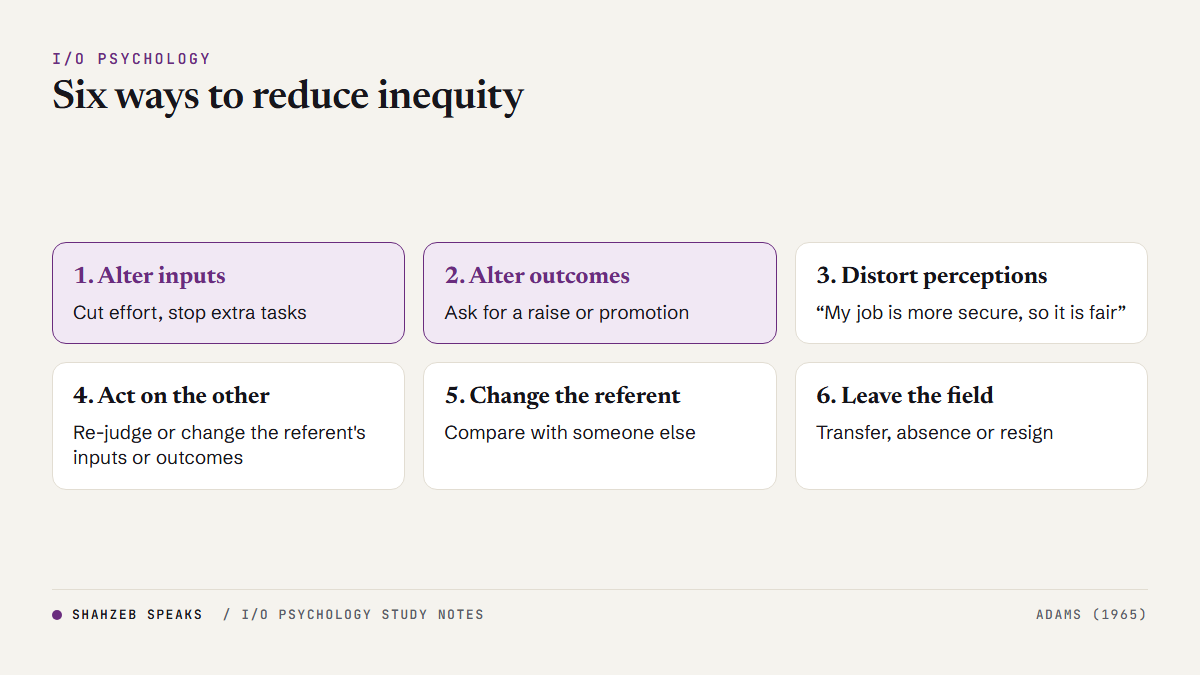
- Alter your inputs. An under-rewarded worker reduces effort, takes longer breaks or stops volunteering for extra tasks.
- Alter your outcomes. Ask for a raise, push for a promotion, claim overtime. Greenberg’s (1990) study, below, shows a darker version: taking outcomes by theft.
- Distort your own inputs or outcomes in your mind. “My job is more secure, so the lower pay is fair.”
- Act on the other. Try to change the referent’s inputs or outcomes, or how you see them: “Bilal must be doing harder calls than I thought”, or pressure him to work more.
- Change the referent. Stop comparing with Bilal and compare with agents at another firm who earn less.
- Leave the field. Ask for a transfer, take more days off, or resign. This is the most extreme response.
What does the research say?
Underpayment is well supported; overpayment much less. Early laboratory studies, such as Adams and Rosenbaum (1962), looked at how feeling over- or underpaid for piece-rate or hourly work changed output. Across later reviews, predictions for underpayment have held up better than predictions for overpayment, which fits the point that people tolerate being over-rewarded more easily.
Greenberg (1990): pay cuts and employee theft. In a field study published in the Journal of Applied Psychology, a company facing losses cut pay for ten weeks at two of its plants, while a third plant had no cut. Theft rose at the plants with the cut. It rose much less at the plant where managers explained the cut fully and showed regret than at the plant where the explanation was brief. When pay returned to normal, theft fell back. This is one of the most cited links between equity theory and organisational justice: the same pay cut felt different depending on how it was explained.
People differ in how much equity matters. Huseman, Hatfield and Miles (1987) proposed equity sensitivity. “Benevolents” tolerate getting less than others, “equity sensitives” want the standard balance, and “entitleds” prefer getting more than others. So the same ratio can upset one employee and not another.
Culture changes the comparison. Bolino and Turnley (2008) argued that culture affects who people choose as referents and how they respond to inequity. In more collectivist or hierarchical workplaces, common in South Asia, people may compare with in-group members or accept seniority-based differences that would feel unfair elsewhere.
Equity theory vs organisational justice and other theories
Equity theory is the root of what is now called distributive justice: the fairness of outcomes. Later research added procedural justice (fair process), interpersonal justice (respectful treatment) and informational justice (honest explanations). Colquitt and colleagues’ (2001) meta-analysis, “Justice at the millennium”, reviewed 25 years of research across these dimensions. The Greenberg study is a good bridge: the outcome (pay cut) was the same, but the explanation changed reactions. The site’s post on organisational justice and workplace fairness covers the other types.
| Point | Equity theory (Adams) | Expectancy theory (Vroom) | Two-factor theory (Herzberg) |
|---|---|---|---|
| Type | Process theory | Process theory | Content theory |
| Main question | Is my exchange fair compared with others? | Will effort lead to rewards I value? | Which job factors satisfy or dissatisfy? |
| Role of pay | Pay is judged relative to inputs and a referent | Pay matters if it is valued and linked to performance | Pay is a hygiene factor |
| Key terms | Inputs, outcomes, referent other, under- and overpayment | Expectancy, instrumentality, valence | Hygiene factors, motivators |
| Main criticism | Hard to predict the referent and the response chosen | Assumes people calculate rationally | Method (critical incidents) biased by self-serving recall |
For the other two in more depth, see Herzberg’s two-factor theory and the Vroom expectancy theory calculator, which has its own student notes.
Criticism of equity theory
- Prediction is weak. The theory says inequity causes tension, but not which of the six methods a person will choose or which referent they will use.
- Inputs and outcomes are subjective. One employee counts a degree as a big input; a manager may not count it at all. Most people also rate their own inputs higher than others do.
- Overpayment predictions are weak. People rarely work harder for long because they feel overpaid.
- Individual and cultural differences. Equity sensitivity and culture both change reactions, so one rule does not fit everyone.
- Outcomes are not the whole story. Process and treatment (procedural and interactional justice) matter as much as the ratio.
Using equity theory at work: pay, pay gaps and HR
For HR and managers in Pakistan, India or the Philippines, the practical message is about comparison. Salary secrecy does not stop comparison; employees guess, and guesses are often worse than the truth. Clear pay bands, consistent rules for raises and honest explanations for differences reduce the felt inequity that leads to effort cuts and resignations. Pay compression, where new hires earn close to long-serving staff, is a classic case: the experienced employee’s inputs (years, skill) rise while their outcome stays near the newcomer’s.
If you want to see how an organisation’s pay gap is actually measured, try the free pay gap calculator (mean against median) or the EU pay transparency gap calculator. Both are listed with the other tools on the free tools page. A real gap is not the same as perceived inequity, but students writing a thesis on pay fairness often need both.
10-mark answer structure
- Definition (who, year): Equity theory, J. Stacy Adams (1963, 1965), a process theory based on social comparison of outcome/input ratios.
- Inputs and outcomes: define both with 3-4 examples each; stress that they are perceptions.
- The formula: Op/Ip compared with Oo/Io; three states (equity, underpayment, overpayment) and the feelings each produces.
- Referent other: Goodman’s (1974) other, self and system.
- Six ways to reduce inequity: list all six with one line each.
- Example: a short number example (like Ayesha and Bilal) or a pay compression case from a Pakistani workplace.
- Evidence: Greenberg (1990) pay cut and theft; underpayment better supported than overpayment; equity sensitivity (Huseman et al., 1987).
- Criticism: referent and response hard to predict, subjectivity, culture.
- Conclusion: link to distributive justice and to practice (transparent pay bands, explaining decisions).
Model opening line: “Equity theory, proposed by J. Stacy Adams (1963, 1965), holds that employees are motivated not by the absolute size of their rewards but by whether the ratio of their outcomes to inputs feels equal to that of a chosen referent other.”
Practice MCQs: equity theory
Practice questions written to the published syllabus (not past-paper questions).
-
Who proposed the equity theory of motivation?
- Victor Vroom
- J. Stacy Adams
- Edwin Locke
- Clayton Alderfer
Show answer
B. Adams published it in 1963 and 1965. Vroom gave expectancy theory, Locke goal-setting theory, Alderfer ERG theory.
-
In equity theory, which of these is an input?
- A promotion
- A company car
- A master’s degree the employee brings to the job
- Praise from the manager
Show answer
C. Education is something the person contributes. Promotion, a car and praise are outcomes the person receives.
-
Sana earns PKR 80,000 for 40 hours a week. Her referent earns PKR 90,000 for 45 hours. What does equity theory predict?
- Underpayment inequity for Sana
- Overpayment inequity for Sana
- Equity, because both ratios are 2,000
- Nothing, because pay is a hygiene factor
Show answer
C. 80,000 ÷ 40 = 2,000 and 90,000 ÷ 45 = 2,000. The ratios match, so she should feel equity even though the referent earns more. D mixes in Herzberg’s theory.
-
Overpayment inequity is most likely to produce which feeling?
- Anger
- Guilt
- Boredom
- Fear of failure
Show answer
B. Being over-rewarded can produce guilt; underpayment produces anger or resentment. Boredom and fear of failure are not the theory’s predictions.
-
Which is NOT one of Adams’s ways of reducing inequity?
- Changing the referent other
- Leaving the field
- Raising one’s self-actualisation needs
- Cognitively distorting inputs or outcomes
Show answer
C. Self-actualisation is Maslow’s term. The other three are among Adams’s six methods.
-
An under-rewarded clerk tells himself, “My job is more secure than hers, so it evens out.” This is an example of:
- Leaving the field
- Cognitive distortion of outcomes
- Acting on the other
- Altering inputs
Show answer
B. Nothing real has changed; he has re-valued his own outcomes in his mind. He has not quit (A), changed the other (C) or changed his effort (D).
-
Goodman (1974) grouped pay referents into which three classes?
- Other, self and system
- Existence, relatedness and growth
- Inside, outside and upward
- Expectancy, instrumentality and valence
Show answer
A. Goodman found people use several referents at once: other people, their own past or expectations, and the organisation’s system. B is Alderfer’s ERG; D is Vroom.
-
In Greenberg’s (1990) pay-cut study, what most reduced the rise in employee theft?
- Cancelling the pay cut on the first day
- A full, respectful explanation of the pay cut
- Installing cameras in the plants
- Paying a one-time bonus
Show answer
B. Theft rose at both plants with the cut, but much less where managers explained it fully and with regret. The cut was not cancelled early, and cameras or bonuses were not the manipulation.
-
An employee who is content to receive less than co-workers for the same inputs would be called, in equity sensitivity terms, a:
- Benevolent
- Entitled
- Equity sensitive
- High nAch
Show answer
A. Huseman, Hatfield and Miles (1987) called this group benevolents. Entitleds prefer more than others; equity sensitives want balance. nAch is McClelland’s need for achievement.
-
Equity theory is the main root of which type of organisational justice?
- Procedural justice
- Distributive justice
- Interpersonal justice
- Informational justice
Show answer
B. Distributive justice is the fairness of outcomes, which is what the outcome/input ratio judges. The others concern process, respectful treatment and explanations.
Practise on your phone
The free I/O Psychology Prep app has 410 explained
questions, flashcards and an exam countdown, and works offline. Get it on Google Play
· About the app
For a mixed set across all the motivation theories, try the work motivation MCQs.
Questions students ask
What is equity theory in simple words?
It is the idea that people judge fairness by comparing what they give and get at work with what someone else gives and gets. If the balance feels unequal, they feel tense and do something to make it feel fair again, such as working less or asking for more.
What is the formula of equity theory?
Your outcomes divided by your inputs, compared with the referent’s outcomes divided by the referent’s inputs. Equal ratios mean equity. A lower ratio for you means underpayment inequity; a higher ratio means overpayment inequity.
What is a referent in equity theory?
The referent (or comparison other) is whoever you compare yourself with: a colleague, a friend in another company, your own past job, or what the organisation promised. Goodman (1974) grouped these into other, self and system.
Is equity theory a content or process theory?
A process theory. It explains how motivation works through thinking about fairness, rather than listing the needs that motivate people, which content theories such as Maslow’s and McClelland’s do.
What is the difference between equity theory and expectancy theory?
Expectancy theory asks whether effort will lead to performance and to rewards the person values. Equity theory asks whether those rewards are fair compared with what others get. A reward can score high on expectancy and still feel unfair.
What are the limitations of equity theory?
It cannot predict which referent people choose or which way they will reduce inequity, inputs and outcomes are subjective, overpayment effects are weak, and people and cultures differ in how much equity matters to them.
Practise on your phone
The free I/O Psychology Prep app has 410 explained
questions, flashcards and an exam countdown, and works offline. Get it on Google Play
· About the app
References
- Adams, J. S. (1963). Towards an understanding of inequity. Journal of Abnormal and Social Psychology, 67(5), 422-436. https://doi.org/10.1037/h0040968
- Adams, J. S. (1965). Inequity in social exchange. In L. Berkowitz (Ed.), Advances in Experimental Social Psychology (Vol. 2, pp. 267-299). Academic Press. https://doi.org/10.1016/S0065-2601(08)60108-2
- Adams, J. S., & Rosenbaum, W. B. (1962). The relationship of worker productivity to cognitive dissonance about wage inequities. Journal of Applied Psychology, 46(3), 161-164. https://doi.org/10.1037/h0047751
- Bolino, M. C., & Turnley, W. H. (2008). Old faces, new places: Equity theory in cross-cultural contexts. Journal of Organizational Behavior, 29(1), 29-50. https://doi.org/10.1002/job.454
- Colquitt, J. A., Conlon, D. E., Wesson, M. J., Porter, C. O. L. H., & Ng, K. Y. (2001). Justice at the millennium: A meta-analytic review of 25 years of organizational justice research. Journal of Applied Psychology, 86(3), 425-445. https://doi.org/10.1037/0021-9010.86.3.425
- Goodman, P. S. (1974). An examination of referents used in the evaluation of pay. Organizational Behavior and Human Performance, 12(2), 170-195. https://doi.org/10.1016/0030-5073(74)90045-2
- Greenberg, J. (1990). Employee theft as a reaction to underpayment inequity: The hidden cost of pay cuts. Journal of Applied Psychology, 75(5), 561-568. https://doi.org/10.1037/0021-9010.75.5.561
- Huseman, R. C., Hatfield, J. D., & Miles, E. W. (1987). A new perspective on equity theory: The equity sensitivity construct. Academy of Management Review, 12(2), 222-234. https://doi.org/10.2307/258531
- Kulik, C. T., & Ambrose, M. L. (1992). Personal and situational determinants of referent choice. Academy of Management Review, 17(2), 212-237. https://doi.org/10.2307/258771
- Black, J. S., & Bright, D. S. (2019). Organizational behavior (Section 7.3, Process theories of motivation). OpenStax. https://openstax.org/books/organizational-behavior/pages/7-3-process-theories-of-motivation
Equity theory is one of nine theories compared in the work motivation theories guide. Read it next to goal-setting theory, Maslow vs Herzberg, the job characteristics model and Theory X and Theory Y. For how the field is taught and practised locally, see industrial psychology in Pakistan.