

Work motivation MCQs test two families of theory. Content theories say what motivates: Maslow (1943), Alderfer’s ERG (1969), Herzberg’s two factors (1959) and McClelland’s needs. Process theories say how: Vroom’s expectancy (1964), Adams’s equity (1965), Locke and Latham’s goal setting and self-determination theory. Hackman and Oldham’s Job Characteristics Model (1976) adds job design.
This page is for students revising work motivation for a BS or MSc paper, a PPSC or FPSC lecturer test, a psychometrician board review or a first-year I/O course in the US or UK. It gives a short summary of the theories examiners ask about, 25 practice questions with answers and explanations, and an exam answer plan. The questions are practice questions written to the published syllabus. They are not past-paper or board questions.
Try each question before you open the answer. If you get one wrong, read the explanation of why the other options are wrong too: that is where most of the learning happens. When you are done, move to the topic posts linked under each section, or go back to the I/O psychology MCQs hub for the other nine sets.
Work motivation in one page: what the exam expects
Work motivation means the forces inside and around a person that start work behaviour and decide its direction, effort and persistence. Exams sort the theories into groups, so learn the groups first and the names second.
Content (need) theories ask what people need. Maslow’s hierarchy (1943) has five levels: physiological, safety, love or belonging, esteem and self-actualisation. Alderfer’s ERG theory (1969) folds these into three needs (existence, relatedness, growth) and adds frustration-regression: when growth is blocked, people fall back on lower needs. Herzberg, Mausner and Snyderman (1959) split work factors into hygiene factors (pay, supervision, policy, conditions), which only prevent dissatisfaction, and motivators (achievement, recognition, the work itself, responsibility, advancement), which create satisfaction. McClelland studied learned needs for achievement, affiliation and power.
Process theories ask how people decide how hard to try. Vroom (1964) says motivation depends on expectancy (effort leads to performance), instrumentality (performance leads to an outcome) and valence (how much the outcome is wanted). Adams (1965) says people compare their ratio of outcomes to inputs with a comparison person and act to remove unfairness. Goal-setting theory (Locke, 1968; Locke and Latham, 2002) shows that specific, difficult goals beat “do your best” goals when people are committed and get feedback. Self-determination theory (Ryan and Deci, 2000) says intrinsic motivation grows when the needs for autonomy, competence and relatedness are met.
Job design sits between the two. Hackman and Oldham’s Job Characteristics Model (1976) names five core job dimensions and combines them in the motivating potential score (MPS). McGregor’s Theory X and Theory Y (1960) is about the assumptions managers hold, not a theory of the worker’s mind, and it often appears in the same unit.
What the research says matters for “most supported” questions. Wahba and Bridwell (1976) found little support for Maslow’s strict order of needs. Herzberg’s method was criticised because people tend to credit themselves for good events and blame the setting for bad ones. Goal-setting theory has the strongest evidence of the group. Read the full comparison in work motivation theories compared.
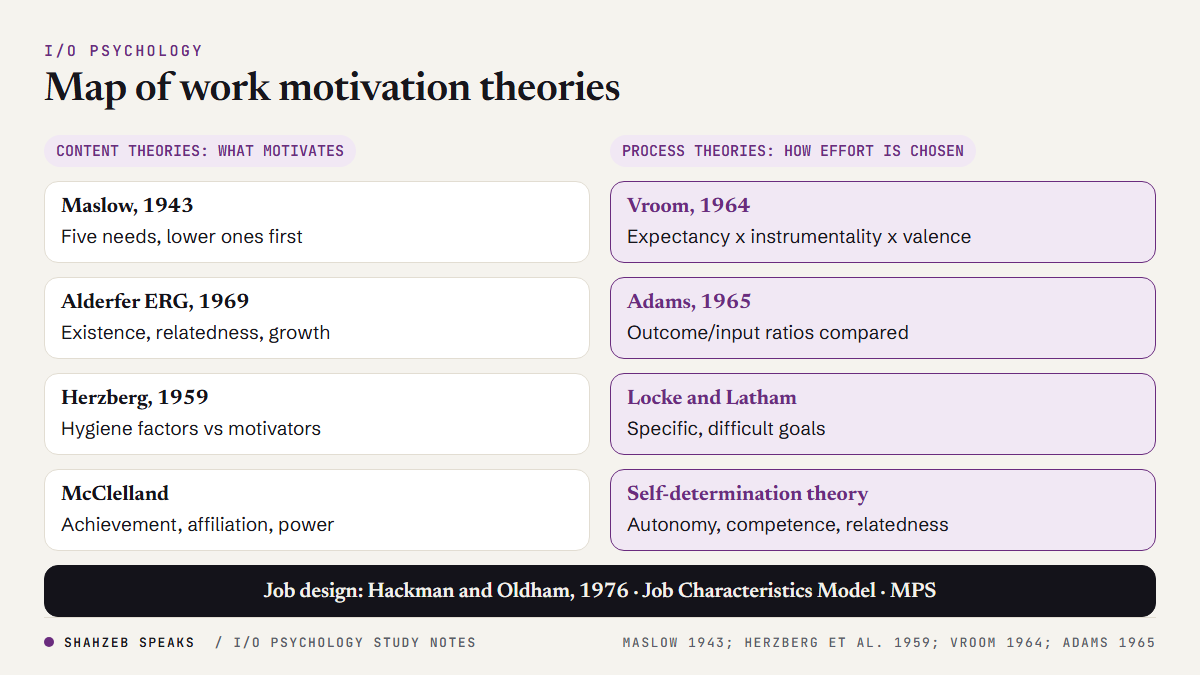
Summary table: the theories behind these questions
| Theory | Who, year | Type | Core idea in one line | Topic post |
|---|---|---|---|---|
| Hierarchy of needs | Maslow, 1943 | Content | Five needs, lower ones first | Maslow vs Herzberg |
| ERG theory | Alderfer, 1969 | Content | Existence, relatedness, growth; frustration-regression | ERG vs Maslow |
| Two-factor theory | Herzberg, Mausner and Snyderman, 1959 | Content | Hygiene factors stop dissatisfaction; motivators create satisfaction | Two-factor theory |
| Theory of needs | McClelland, 1961 | Content | Learned needs for achievement, affiliation and power | McClelland |
| Expectancy (VIE) | Vroom, 1964 | Process | Motivation = expectancy x instrumentality x valence | Vroom calculator |
| Equity theory | Adams, 1965 | Process | Compare outcome/input ratios with a comparison person | Equity theory |
| Goal setting | Locke, 1968; Locke and Latham, 2002 | Process | Specific, difficult, accepted goals with feedback | Goal setting |
| Self-determination | Deci and Ryan; Ryan and Deci, 2000 | Process | Autonomy, competence and relatedness feed intrinsic motivation | SDT at work |
| Job Characteristics Model | Hackman and Oldham, 1976 | Job design | Five core dimensions combine into the MPS | JCM and MPS |
| Theory X and Theory Y | McGregor, 1960 | Managerial assumptions | What a manager believes about workers shapes how they manage | Theory X and Y |
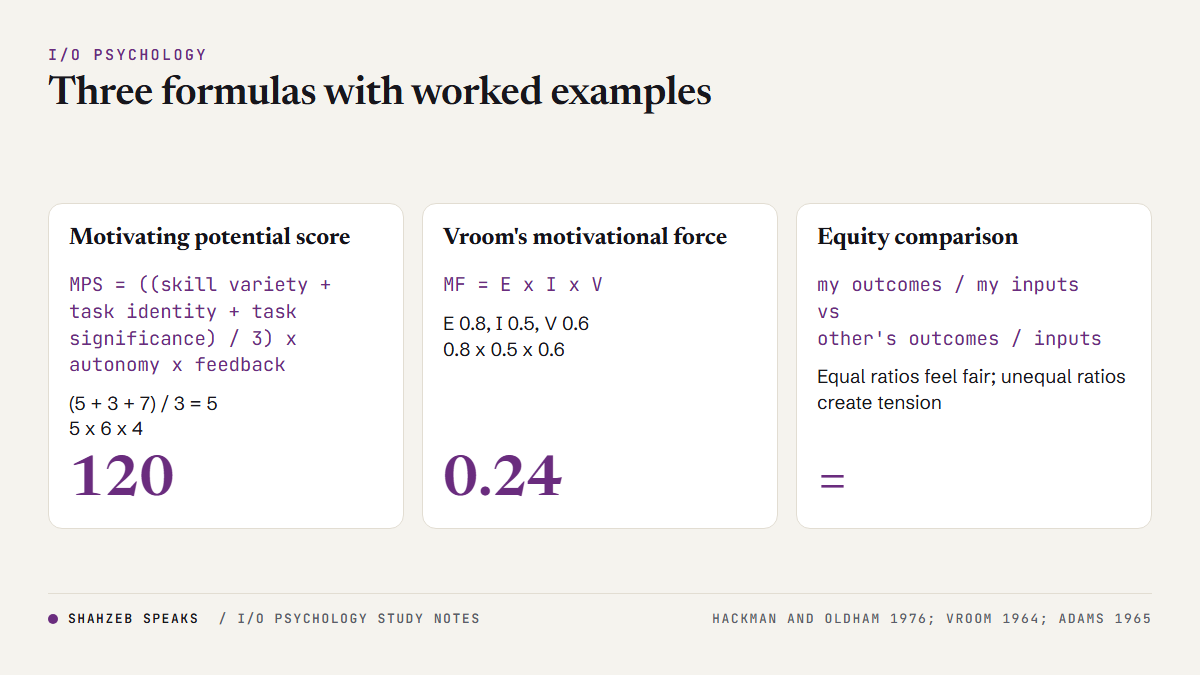
The three formulas that turn up as numerical MCQs
Most motivation questions are words, but three need arithmetic. Learn them with one worked example each.
- Motivating potential score: MPS = ((skill variety + task identity + task significance) / 3) x autonomy x feedback. Each dimension is rated 1 to 7, so the MPS runs from 1 to 343. Because autonomy and feedback multiply, a very low score on either one pulls the whole MPS down. You can check your answers with the MPS calculator.
- Vroom’s motivational force: in the classroom form, MF = E x I x V. Expectancy and instrumentality are probabilities from 0 to 1; valence runs from -1 (strongly unwanted) to +1 (strongly wanted). A zero on any one of them makes the force zero.
- Equity comparison: my outcomes / my inputs compared with the other person’s outcomes / inputs. Equal ratios feel fair; unequal ratios create tension in either direction.
Practice MCQs: work motivation
-
Which statement about Alderfer’s ERG theory is correct?
- It has five levels, the same as Maslow’s
- Needs must be satisfied strictly one level at a time, from the bottom up
- Several needs can be active at the same time, and a frustrated higher need can lead people back to a lower one
- It was built from critical incident interviews with accountants
Show answer
C. Alderfer (1969) grouped needs into existence, relatedness and growth, allowed more than one to operate at once, and added frustration-regression. The strict bottom-up order is Maslow’s, ERG has three needs rather than five, and critical incident interviews were Herzberg’s method.
-
Which of these is NOT one of Herzberg’s motivators?
- Achievement
- Recognition
- Company policy and administration
- The work itself
Show answer
C. Company policy and administration is a hygiene factor: when it is poor it causes dissatisfaction, but improving it does not create satisfaction. Achievement, recognition and the work itself are all motivators, along with responsibility and advancement.
-
Which result, if a well-designed study found it, would most contradict Herzberg’s two-factor theory?
- Recognition for good work raised satisfaction
- Better working conditions produced a lasting rise in satisfaction and motivation, not just fewer complaints
- Poor supervision caused complaints
- Interesting work raised motivation
Show answer
B. Herzberg said conditions are hygiene factors: improving them removes dissatisfaction but does not create satisfaction. A lasting rise from better conditions would go against that. Options A and D fit his motivators, and option C fits his hygiene factors.
-
Morgeson and Humphrey’s (2006) Work Design Questionnaire widened the Job Characteristics Model. Besides task characteristics, which groups of work characteristics did it add?
- Existence, relatedness and growth
- Pay, pension and leave
- Knowledge, social and contextual characteristics
- Achievement, affiliation and power
Show answer
C. The WDQ covers 21 work characteristics grouped as task, knowledge, social and contextual, so things like social support and physical demands are measured too. Pay benefits are not its focus, ERG and McClelland’s needs are motivation theories, not job characteristics.
-
In The Achieving Society (1961), McClelland linked a society’s level of achievement motivation to:
- Its religion alone, regardless of motivation
- Its average height
- Its rate of economic growth and development
- Its number of trade unions
Show answer
C. McClelland argued that societies with stronger achievement themes showed more entrepreneurial activity and economic growth. The other options were not his claims.
-
How does McClelland’s view of needs differ from Maslow’s?
- McClelland saw needs as learned through experience and culture, and did not arrange them in a fixed hierarchy
- McClelland had seven levels instead of five
- McClelland said only physiological needs matter at work
- McClelland’s needs must be satisfied strictly from bottom to top
Show answer
A. McClelland treated achievement, affiliation and power as acquired needs that differ in strength between people, which is why he thought they could be developed through training. Fixed levels and bottom-to-top order are Maslow’s ideas. See McClelland’s theory of needs.
-
A call-centre agent rates expectancy at 0.8, instrumentality at 0.5 and the valence of the bonus at 0.6. Using MF = E x I x V, her motivational force is:
- 1.9
- 0.63
- 0.40
- 0.24
Show answer
D. 0.8 x 0.5 x 0.6 = 0.24. Adding the three gives 1.9, which is the most common mistake: the model multiplies. 0.40 is only E x I, and 0.63 is the average. Check yourself with the expectancy theory calculator.
-
A sales officer believes that bonuses in his team go to whoever the manager likes, not to the best performers. In Vroom’s terms, which part of his motivation is low?
- Instrumentality
- Expectancy
- Valence
- Self-efficacy
Show answer
A. Instrumentality is the belief that performance will lead to the outcome. He may still believe effort raises sales (expectancy) and may still want the bonus (valence). Self-efficacy is Bandura’s term, not part of the VIE model.
-
A promotion would require an engineer to move from Karachi to a remote site she very much does not want to live in. In expectancy theory, this outcome has:
- Zero expectancy
- Negative valence
- High instrumentality
- Underpayment inequity
Show answer
B. Valence is how attractive an outcome is and can be negative when the outcome is unwanted. Expectancy is about effort and performance, not the outcome’s appeal. Instrumentality could be high (good work would bring the transfer), which is exactly why she might hold back. Inequity is a different theory.
-
What is the main difference between equity theory and expectancy theory?
- Equity theory judges fairness by comparing my outcome-to-input ratio with someone else’s; expectancy theory looks at my own beliefs about effort, performance and rewards
- Equity theory is a content theory and expectancy theory is a need theory
- Both theories ignore rewards
- Expectancy theory was proposed by Adams
Show answer
A. Adams (1965) built a social comparison theory; Vroom (1964) built a theory of individual choice. Both are process theories, both include rewards, and expectancy theory is Vroom’s.
-
According to Locke and Latham (2002), for a person who is committed to the goal and has the ability to reach it, performance tends to:
- Fall as goals become harder
- Rise as goal difficulty rises
- Stay the same whatever the goal
- Rise only if the goal is easy
Show answer
B. Their review describes a roughly linear relationship: harder goals bring higher performance until the limits of ability or commitment are reached. The other options contradict the finding.
-
Locke and Latham name several moderators that change how strongly goals affect performance. Which of these is NOT one of them?
- Goal commitment
- Feedback on progress
- Task complexity
- The employee’s need for affiliation
Show answer
D. Goal effects are stronger when people are committed, get feedback and work on simpler tasks (on complex tasks the effect is smaller). Need for affiliation comes from McClelland and is not a goal-setting moderator.
-
New agents at a Manila call centre are learning a complex customer system they have never used. Based on goal-setting research, what is the best first goal?
- A specific learning goal, such as finding five ways to solve a common customer problem
- A very high output target from the first day
- No goal, because goals always harm learning
- A goal set by the agents’ peers, with no feedback
Show answer
A. When people do not yet have the skills for a complex task, a specific learning goal tends to work better than a hard performance goal (see Seijts and Latham, 2001). A high output target pushes effort before strategy. “No goal” overstates the finding, and removing feedback weakens any goal.
-
In the Job Characteristics Model, skill variety, task identity and task significance together create which critical psychological state?
- Knowledge of results
- Experienced meaningfulness of the work
- Experienced responsibility for outcomes
- Growth need strength
Show answer
B. These three dimensions make work feel worthwhile, so they feed experienced meaningfulness. Autonomy creates responsibility for outcomes, feedback creates knowledge of results, and growth need strength is a moderator, not a psychological state.
-
Which characteristic did Hackman and Oldham propose as a moderator, so that enriched jobs motivate some people more than others?
- Need for power
- Equity sensitivity
- Growth need strength
- Organisational tenure
Show answer
C. People with high growth need strength respond more strongly to jobs high in the core dimensions. Need for power is McClelland’s, equity sensitivity is a later addition to equity theory, and tenure is not a JCM moderator.
-
A job scores skill variety 5, task identity 3, task significance 7, autonomy 6 and feedback 4. What is its motivating potential score?
- 25
- 120
- 360
- 2,520
Show answer
B. (5 + 3 + 7) / 3 = 5; then 5 x 6 x 4 = 120. 25 is the plain sum of all five ratings, 360 forgets to divide the first three by 3 (15 x 6 x 4), and 2,520 multiplies all five ratings together. Try it in the MPS calculator.
-
Which of these is NOT one of the outcomes the Job Characteristics Model predicts when the critical psychological states are high?
- High internal work motivation
- High satisfaction with the work
- Low absenteeism and turnover
- A higher base salary
Show answer
D. Hackman and Oldham (1976) linked the psychological states to motivation, quality of work, satisfaction, and lower absence and turnover. Pay is not an outcome of the model. Try the MPS calculator to see how the job dimensions combine.
-
Bandura’s idea of self-efficacy (belief that you can perform a task) is closest to which part of Vroom’s expectancy theory?
- Valence
- Instrumentality
- Expectancy
- Equity
Show answer
C. Expectancy is the belief that effort will lead to performance, which depends heavily on how capable you feel. Valence is the value of the reward, instrumentality is the performance-to-reward link, and equity is a different theory.
-
A sales manager wants to support her team’s competence need, as self-determination theory describes it. Which action fits best?
- Giving each person optimal challenges and clear, useful feedback on progress
- Monitoring every call and docking pay for errors
- Letting people choose their hours but never commenting on their work
- Organising a team lunch every Friday
Show answer
A. Competence is the need to feel effective, which grows with tasks that stretch people a little and feedback that shows progress (Ryan and Deci, 2000). Close monitoring threatens autonomy, choice of hours supports autonomy rather than competence, and team lunches mainly serve relatedness.
-
Deci’s (1971) experiments, in which students were paid for solving puzzles they already found interesting, are cited as early evidence that:
- Pay always increases intrinsic interest
- Expected, tangible rewards for an interesting task can reduce later intrinsic interest
- Puzzles are a poor way to study motivation
- Verbal praise always lowers intrinsic motivation
Show answer
B. Paid students spent less free time on the puzzles once the pay stopped, which became known as the undermining effect. The finding is the opposite of option A, it says nothing against puzzles as a method, and a later meta-analysis (Deci, Koestner and Ryan, 1999) found that positive verbal feedback tended to raise intrinsic motivation rather than lower it.
-
A junior doctor finds patient record-keeping dull but completes it carefully because she values what it does for patient safety. In SDT’s continuum, this is:
- Intrinsic motivation
- External regulation
- Introjected regulation
- Identified regulation
Show answer
D. Identified regulation means doing an activity because you personally value its purpose, even if it is not enjoyable. Intrinsic motivation would mean she enjoys the task itself. External regulation is acting for a reward or to avoid punishment, and introjected regulation is acting to avoid guilt or to protect self-worth.
-
In expectancy theory, “meeting the monthly sales target” and “receiving the bonus” are, respectively:
- Second-level and first-level outcomes
- First-level and second-level outcomes
- Two valences
- Two expectancies
Show answer
B. Performance is the first-level outcome and the rewards that follow it are second-level outcomes; instrumentality links the two. Valence and expectancy are beliefs about outcomes, not the outcomes themselves.
-
Which statement about Maslow and Herzberg is most accurate?
- Herzberg’s hygiene factors roughly match Maslow’s lower needs, and motivators roughly match esteem and self-actualisation
- Herzberg’s motivators match Maslow’s physiological and safety needs
- Both theories say pay is the strongest motivator
- Herzberg tested Maslow’s five levels in the relay assembly test room
Show answer
A. Textbooks map hygiene factors (pay, security, conditions) onto lower needs and motivators onto higher needs. Option B reverses the mapping, neither theory treats pay as the main motivator (Herzberg calls it hygiene), and the relay room belongs to the Hawthorne studies. See Maslow vs Herzberg.
-
An employee sees no point in a compulsory task and has no reason at all, inner or outer, to do it. Self-determination theory calls this:
- Amotivation
- Identified regulation
- Intrinsic motivation
- Introjected regulation
Show answer
A. Amotivation is the absence of any intention to act. Identified regulation means valuing the task, intrinsic motivation means enjoying it, and introjected regulation means acting from guilt or pride. See SDT at work.
-
Which pair contains two content theories of motivation?
- Vroom’s expectancy theory and Adams’s equity theory
- Herzberg’s two-factor theory and Locke’s goal setting
- Alderfer’s ERG theory and Vroom’s expectancy theory
- Maslow’s hierarchy and McClelland’s theory of needs
Show answer
D. Maslow and McClelland both describe which needs drive people, so both are content theories. Vroom and Adams are both process theories, and options B and C each mix one content theory with one process theory.
Practise on your phone
The free I/O Psychology Prep app has 410 explained
questions, flashcards and an exam countdown, and works offline. Get it on Google Play
· About the app
How to write a motivation answer in your exam
MCQs check recall. Long questions such as “Compare content and process theories of motivation” or “Critically evaluate Herzberg’s theory in the Pakistani context” check whether you can organise it. Use this plan.
10-mark answer structure
- Definition: work motivation as the forces that start work behaviour and set its direction, effort and persistence.
- Name the two families: content theories (Maslow 1943, Alderfer 1969, Herzberg 1959, McClelland) and process theories (Vroom 1964, Adams 1965, Locke and Latham, SDT).
- Explain two theories in detail, one from each family, with a small diagram (Herzberg’s two columns, or the VIE chain).
- Give a workplace example for each: a bank branch where pay is fair but the work is dull (hygiene met, motivators missing); a sales team where bonuses feel unrelated to results (low instrumentality).
- Evaluation: Wahba and Bridwell (1976) on Maslow; the critical incident method behind Herzberg; goal setting as the best supported theory.
- Application: what a manager should do, such as job enrichment, clear goals with feedback, and a visible link between performance and reward.
- Conclusion: content theories tell you what to offer; process theories tell you how to connect effort to it. A good system uses both.
Model opening line: “Work motivation is the set of forces, inside a person and in the job, that start work behaviour and decide its direction, intensity and persistence; theories of it fall into content theories, which ask what people need, and process theories, which ask how they decide how hard to try.”
Questions students ask
Which motivation theory has the most research support?
Goal-setting theory. Locke and Latham’s 2002 review summarised decades of studies showing that specific, difficult goals raise performance when people are committed and get feedback. Self-determination theory also has strong support. Maslow’s strict hierarchy has the weakest.
What is the difference between content and process theories?
Content theories describe what motivates people: the needs or factors inside them or in the job. Process theories describe how motivation works: how people weigh effort, fairness and goals before deciding how hard to try. Maslow is content; Vroom is process.
Is pay a motivator or a hygiene factor?
In Herzberg’s theory, salary is a hygiene factor: poor pay causes dissatisfaction, but good pay alone does not create lasting satisfaction. Expectancy theory sees it differently: pay motivates when it is wanted and clearly tied to performance.
How do I calculate the motivating potential score?
Average skill variety, task identity and task significance, then multiply by autonomy and by feedback. With ratings of 5, 3, 7, 6 and 4, the MPS is 5 x 6 x 4 = 120. The maximum is 343.
Do these questions come from PPSC or board papers?
No. They are practice questions written to the published syllabus of typical I/O courses. For exam-specific guidance, see the PPSC and FPSC guide and the psychometrician reviewer.
How many motivation questions should I practise before an exam?
Enough to get every theory right twice in different forms: a definition, a scenario and a “which is NOT” item. This set covers each theory at least twice. After that, timed mixed sets help more than more of the same topic.
Practise on your phone
The free I/O Psychology Prep app has 410 explained
questions, flashcards and an exam countdown, and works offline. Get it on Google Play
· About the app
References
- Adams, J. S. (1965). Inequity in social exchange. Advances in Experimental Social Psychology, 2, 267-299. https://doi.org/10.1016/S0065-2601(08)60108-2
- Alderfer, C. P. (1969). An empirical test of a new theory of human needs. Organizational Behavior and Human Performance, 4(2), 142-175. https://doi.org/10.1016/0030-5073(69)90004-X
- Deci, E. L. (1971). Effects of externally mediated rewards on intrinsic motivation. Journal of Personality and Social Psychology, 18(1), 105-115. https://doi.org/10.1037/h0030644
- Deci, E. L., Koestner, R., & Ryan, R. M. (1999). A meta-analytic review of experiments examining the effects of extrinsic rewards on intrinsic motivation. Psychological Bulletin, 125(6), 627-668. https://doi.org/10.1037/0033-2909.125.6.627
- Hackman, J. R., & Oldham, G. R. (1976). Motivation through the design of work: Test of a theory. Organizational Behavior and Human Performance, 16(2), 250-279. https://doi.org/10.1016/0030-5073(76)90016-7
- Herzberg, F., Mausner, B., & Snyderman, B. B. (1959). The motivation to work. Wiley.
- Locke, E. A. (1968). Toward a theory of task motivation and incentives. Organizational Behavior and Human Performance, 3(2), 157-189. https://doi.org/10.1016/0030-5073(68)90004-4
- Locke, E. A., & Latham, G. P. (2002). Building a practically useful theory of goal setting and task motivation: A 35-year odyssey. American Psychologist, 57(9), 705-717. https://doi.org/10.1037/0003-066X.57.9.705
- Maslow, A. H. (1943). A theory of human motivation. Psychological Review, 50(4), 370-396. https://doi.org/10.1037/h0054346
- McClelland, D. C. (1961). The achieving society. Van Nostrand.
- McGregor, D. (1960). The human side of enterprise. McGraw-Hill.
- Morgeson, F. P., & Humphrey, S. E. (2006). The Work Design Questionnaire (WDQ): Developing and validating a comprehensive measure for assessing job design and the nature of work. Journal of Applied Psychology, 91(6), 1321-1339. https://doi.org/10.1037/0021-9010.91.6.1321
- Ryan, R. M., & Deci, E. L. (2000). Self-determination theory and the facilitation of intrinsic motivation, social development, and well-being. American Psychologist, 55(1), 68-78. https://doi.org/10.1037/0003-066X.55.1.68
- Seijts, G. H., & Latham, G. P. (2001). The effect of distal learning, outcome, and proximal goals on a moderately complex task. Journal of Organizational Behavior, 22(3), 291-307. https://doi.org/10.1002/job.70
- Vroom, V. H. (1964). Work and motivation. Wiley.
- Wahba, M. A., & Bridwell, L. G. (1976). Maslow reconsidered: A review of research on the need hierarchy theory. Organizational Behavior and Human Performance, 15(2), 212-240. https://doi.org/10.1016/0030-5073(76)90038-6
Next: go back to the I/O psychology MCQs hub, read the full work motivation theories pillar, or try the leadership MCQs and performance appraisal MCQs. If you are studying in Karachi or Lahore, my page on industrial psychology in Pakistan explains where this subject leads.