
Herzberg’s two-factor theory (Herzberg, Mausner and Snyderman, 1959) says job satisfaction and dissatisfaction come from different causes. Hygiene factors, such as pay, supervision and working conditions, prevent dissatisfaction but do not motivate. Motivators, such as achievement, recognition, responsibility and the work itself, create satisfaction and effort.
This page is for students who need the two-factor theory for an exam, an assignment or a thesis chapter. It gives you the full list of hygiene factors and motivators in a table, the 1959 Pittsburgh study explained step by step, two diagrams, the main criticisms with their original sources, a ready 10-mark answer structure and 10 practice MCQs with explanations.
The theory is also called the motivation-hygiene theory and the dual-factor theory. All three names mean the same thing, and examiners use them interchangeably.
What is Herzberg’s two-factor theory?
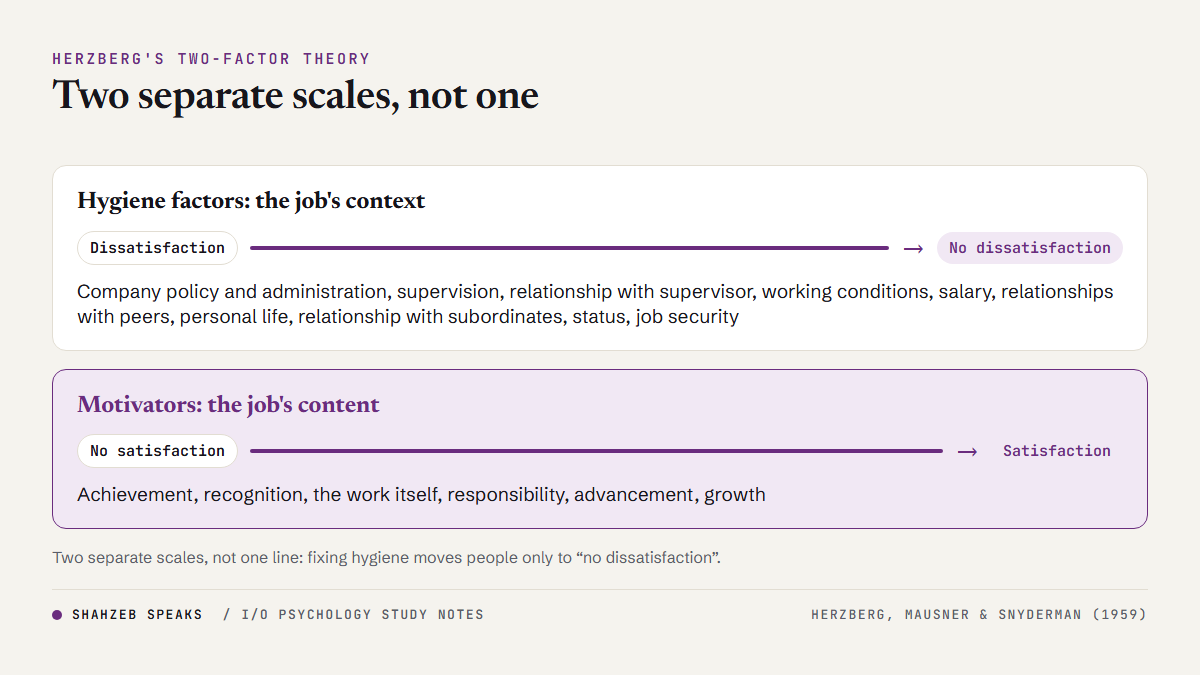
Before the 1950s, most people assumed that job satisfaction and job dissatisfaction were two ends of one line. If you improved pay or conditions, people would move from dissatisfied towards satisfied. Frederick Herzberg and his colleagues at Pittsburgh challenged this. They argued that there are two separate lines:
- One runs from dissatisfaction to no dissatisfaction. It is controlled by the hygiene factors, which belong to the context of the job: the policies, the boss, the pay, the office.
- The other runs from no satisfaction to satisfaction. It is controlled by the motivators, which belong to the content of the job: what you actually do and what it lets you become.
Herzberg chose the word “hygiene” on purpose. Like hygiene in medicine, these factors prevent a problem rather than produce health. A clean water supply stops disease but does not make you fit. In the same way, fair pay and decent supervision stop complaints, but they do not make people eager to do excellent work. In his 1968 Harvard Business Review article he summed this up by saying the opposite of satisfaction is “no satisfaction”, not dissatisfaction.
What did the 1959 Pittsburgh study find?
The theory was published in the book The Motivation to Work by Frederick Herzberg, Bernard Mausner and Barbara Bloch Snyderman (Wiley, 1959). Here is the study in four steps:
- Who: about 200 engineers and accountants working in the Pittsburgh area of the United States. Britannica gives the exact number as 203. These were white-collar professionals, and the sample was largely male.
- How: each person was interviewed and asked to describe a time when they felt exceptionally good about their job, and a time when they felt exceptionally bad. This way of collecting specific stories is the critical incident method, a technique described by John Flanagan (1954).
- What they found: the good stories were mostly about achievement, recognition, the work itself, responsibility and advancement. The bad stories were mostly about company policy, supervision, pay, relations with others and working conditions. The two lists hardly overlapped.
- What they concluded: the things that make people satisfied are different from the things that make them dissatisfied, so the two need to be managed separately.
One detail that good students mention: the factors did not split perfectly. The SAGE Encyclopedia of Industrial and Organizational Psychology notes that there was considerable overlap between the two sets in the good and bad stories, and that the 1959 book itself reported these overlaps, which popular summaries often leave out. Salary is the usual example: mainly a dissatisfier, but not only one.
Hygiene factors vs motivators: the full list
Here are the two lists as they are usually taught, with an example from a call centre so you can see each factor at work.
| Factor | Type | What it looks like in a call centre |
|---|---|---|
| Achievement | Motivator | Solving a difficult customer complaint on the first call |
| Recognition | Motivator | A team leader naming you for a well-handled escalation |
| The work itself | Motivator | Varied, interesting cases instead of one script all day |
| Responsibility | Motivator | Being allowed to approve a refund without asking a supervisor |
| Advancement | Motivator | A real path from agent to quality analyst or team leader |
| Growth | Motivator | Training that builds new skills |
| Company policy and administration | Hygiene | Clear, fair rules on breaks, leave and shift changes |
| Supervision | Hygiene | A supervisor who knows the job and is competent |
| Relationship with supervisor | Hygiene | Being treated with respect on the floor |
| Working conditions | Hygiene | Working headsets, a cool room, a reliable system |
| Salary | Hygiene | Pay that is fair and arrives on time |
| Relationships with peers | Hygiene | Getting on with the agents around you |
| Personal life | Hygiene | Shift timings that let you get home safely |
| Relationship with subordinates | Hygiene | For team leaders: a team that cooperates |
| Status | Hygiene | Job title and the respect that comes with it |
| Job security | Hygiene | A permanent contract rather than month-to-month |
A quick memory aid: motivators are about what you do; hygiene factors are about where and how you do it. If a factor would still be the same when you changed the actual tasks, it is probably hygiene.
The four combinations of hygiene and motivators
Because the two sets are separate, a job can be strong on one and weak on the other. Textbooks often show this as four combinations. This grid is a teaching summary built from the theory, not a figure from the 1959 book.
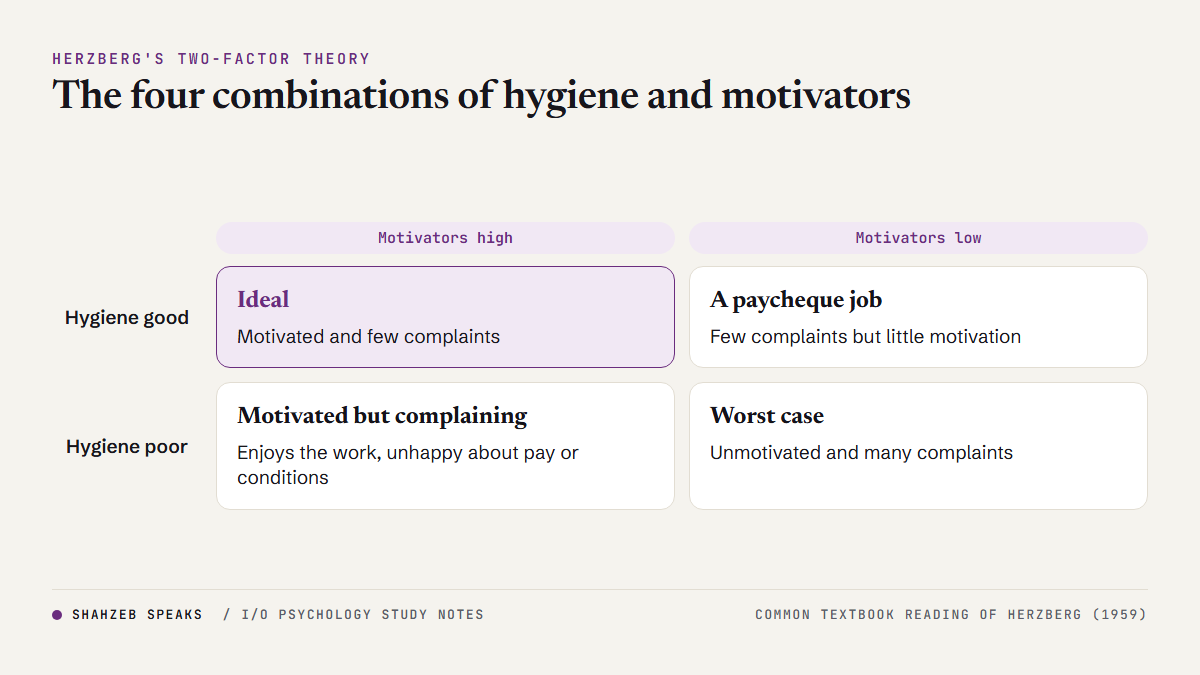
- Ideal (hygiene good, motivators high): motivated and few complaints.
- A paycheque job (hygiene good, motivators low): few complaints but little motivation. People come for the salary and do the minimum.
- Motivated but complaining (hygiene poor, motivators high): enjoys the work, unhappy about pay or conditions. Many young doctors, teachers and NGO workers describe this.
- Worst case (hygiene poor, motivators low): unmotivated and many complaints.
From theory to practice: job enrichment
Herzberg’s practical message, set out in his 1968 article, was that you cannot buy motivation with more pay, nicer offices or friendlier supervisors. You build it into the job. He called this job enrichment, and he separated it from simply adding more tasks:
- Horizontal loading adds more tasks of the same level (answer more calls, file more forms). This is job enlargement, and Herzberg did not expect it to motivate.
- Vertical loading adds depth: more control over how the work is done, more accountability for results, complete pieces of work rather than fragments, and feedback that goes directly to the employee rather than only to the supervisor.
These ideas fed straight into Hackman and Oldham’s Job Characteristics Model, which turned “enrich the job” into five measurable dimensions and a formula. If your syllabus asks about job design, read my page on job enrichment vs job enlargement vs job rotation next.
Criticism of Herzberg’s two-factor theory
The theory is still one of the most taught in management courses, but researchers have been critical of it since the 1960s. These are the points to write, with the people who made them.
1. The critical incident method may have created the result
This is the main criticism. When people tell stories about their best and worst moments at work, they tend to take credit for the good events (“I solved it”, “I was promoted”) and blame outside things for the bad events (“the policy”, “my boss”, “the pay”). Psychologists call this a self-serving bias in how we explain events. If that is what happened in the interviews, the two-factor split could come from the way the question was asked rather than from how motivation really works. Vroom (1964) raised this point, and House and Wigdor (1967) and King (1970) reviewed the evidence and argued the theory depended on this method. Studies using other methods, such as questionnaires, often found that the same factor could both satisfy and dissatisfy.
2. A narrow sample
About 200 engineers and accountants in one American city in the 1950s, mostly men, is a small base for a theory applied to factory workers, nurses and call-centre agents around the world.
3. Pay does not fit neatly
Even in Herzberg’s own data the factors overlapped, and salary is the clearest case. Many later writers argue that pay can motivate, especially when it is linked to performance or seen as fair compared with others. Adams’s equity theory treats pay as a signal of fairness, which helps explain why the same raise can please one person and anger another.
4. Satisfaction was measured, performance was not
The study asked how people felt, not how well they worked. A satisfied employee is not automatically a productive one.
5. Individual differences are ignored
The theory treats everyone alike. For a worker supporting a large family, pay may matter more than recognition; for someone else it may be the opposite. Vroom’s expectancy theory handles these differences through valence, the value a person places on an outcome.
What still holds up: the theory’s lasting gift is the focus on the content of the job. The Job Characteristics Model, which grew from the same idea, has much better research support (Fried and Ferris, 1987, reviewed nearly 200 studies). So in an exam, a fair conclusion is that Herzberg was wrong in detail but right that enriching the work matters.
A Pakistani workplace example
Here is an illustration (not a study) you can adapt for an assignment. A call centre in Lahore raises salaries by 15 per cent after many agents leave. For two months complaints drop, but quality scores and turnover hardly change. Herzberg would explain this neatly: the raise fixed a hygiene problem, so agents moved to “no dissatisfaction”, but nothing about the job itself changed. The same scripts, the same lack of authority, the same invisible career path.
The centre then lets experienced agents resolve refunds up to a set limit on their own, rotates strong agents into quality checking, and publishes a clear route to team-leader roles. Those are motivators: responsibility, the work itself and advancement. That is the kind of change the theory predicts will lift motivation.
A thoughtful exam answer adds the caution: in a city where living costs are rising, pay can matter far more than Herzberg’s American engineers suggested, so a manager should not assume salary is “only hygiene”. For more on the field here, see my page on industrial psychology in Pakistan, and for how recognition works in practice, my article on the psychology of employee recognition.
10-mark answer structure: “Explain Herzberg’s two-factor theory with criticism”
- Definition (who, year): Herzberg, Mausner and Snyderman (1959), The Motivation to Work; also called motivation-hygiene theory.
- The study: about 200 engineers and accountants, Pittsburgh, critical incident interviews about very good and very bad times at work.
- Two sets of factors: list 5-6 motivators (achievement, recognition, work itself, responsibility, advancement, growth) and 5-6 hygiene factors (policy, supervision, salary, conditions, peers, security).
- Diagram: two separate scales: dissatisfaction to no dissatisfaction; no satisfaction to satisfaction.
- Application: job enrichment, vertical vs horizontal loading; one workplace example.
- Criticism (3-4 points): critical incident method and self-serving bias (Vroom, 1964; House and Wigdor, 1967; King, 1970); narrow sample; pay ambiguity; individual differences.
- Link to later theory: led to the Job Characteristics Model (Hackman and Oldham, 1976).
- Conclusion: weak as a strict two-way split, valuable for its focus on the content of the job.
Model opening line: “Herzberg, Mausner and Snyderman (1959) proposed that the factors which make people satisfied at work, such as achievement and responsibility, are different from those which make them dissatisfied, such as pay and supervision.”
Practice MCQs: Herzberg’s two-factor theory
Practice questions written to the published syllabus (not past-paper questions).
-
Which method did Herzberg’s team use to collect data in the 1959 study?
- Laboratory experiments
- Critical incident interviews about very good and very bad times at work
- A large national questionnaire
- Observation of assembly-line workers
Show answer
B. Interviewees described specific events when they felt exceptionally good or bad. It was not an experiment, a mass survey or factory observation.
-
The 1959 sample consisted mainly of:
- Factory workers in Detroit
- Engineers and accountants in the Pittsburgh area
- Nurses in London
- Managers at Western Electric
Show answer
B. About 200 (Britannica: 203) engineers and accountants near Pittsburgh. Western Electric is the Hawthorne studies, a different line of research.
-
Which of the following is a motivator?
- Job security
- Relationship with supervisor
- Responsibility
- Working conditions
Show answer
C. Responsibility is part of the job’s content. The other three are hygiene factors about the job’s context.
-
Which is NOT a hygiene factor?
- Company policy and administration
- Status
- Advancement
- Salary
Show answer
C. Advancement is a motivator. Policy, status and salary are all hygiene factors.
-
An office installs new air-conditioning and complaints stop, but output does not rise. Herzberg would say employees have moved to:
- Satisfaction
- No dissatisfaction
- Self-actualisation
- High motivation
Show answer
B. Improving a hygiene factor (working conditions) removes dissatisfaction but does not create satisfaction or motivation.
-
Giving a clerk the authority to approve small payments herself, and sending her performance reports to her directly, is an example of:
- Horizontal job loading
- Vertical job loading (job enrichment)
- Job rotation
- Improving hygiene
Show answer
B. More authority, accountability and direct feedback add depth. Horizontal loading adds more tasks of the same level; rotation moves people between jobs.
-
The main methodological criticism of the two-factor theory is that:
- People tend to credit themselves for good events and blame the environment for bad events
- The study used too many participants
- The factors were chosen by managers, not employees
- The study measured performance but not satisfaction
Show answer
A. This self-serving bias could create the split by itself. The sample was small, factors came from employees’ own stories, and the study measured feelings, not performance.
-
Who argued in a 1967 review in Personnel Psychology that the evidence for the dual-factor theory was weak?
- Hackman and Oldham
- House and Wigdor
- Locke and Latham
- Wahba and Bridwell
Show answer
B. House and Wigdor (1967). Hackman and Oldham built the Job Characteristics Model, Locke and Latham goal-setting theory, and Wahba and Bridwell reviewed Maslow.
-
Why did Herzberg use the word “hygiene”?
- Because the factors were about cleanliness at work
- Because, like hygiene in medicine, the factors prevent a problem rather than create health
- Because the study took place in hospitals
- Because hygiene factors are the most powerful motivators
Show answer
B. Hygiene prevents illness without making you fit; these factors prevent dissatisfaction without motivating. A and C are literal misreadings, and D reverses the theory.
-
Which later theory grew most directly out of Herzberg’s focus on job content?
- Equity theory
- The Job Characteristics Model
- Theory X and Theory Y
- The Hawthorne effect
Show answer
B. Hackman and Oldham turned job enrichment into five core job dimensions. Equity theory is about fairness, McGregor’s theory about managers’ assumptions, and the Hawthorne effect predates Herzberg.
Practise on your phone
The free I/O Psychology Prep app has 410 explained
questions, flashcards and an exam countdown, and works offline. Get it on Google Play
· About the app
More practice: the 25-question work motivation MCQ set covers Herzberg alongside the other theories.
Questions students ask
What are hygiene factors in Herzberg’s theory?
Hygiene factors are features of the job’s context: company policy and administration, supervision, relationship with the supervisor, working conditions, salary, relationships with peers, personal life, relationship with subordinates, status and job security. When they are poor, people are dissatisfied. When they are good, people are not dissatisfied, but they are not motivated either.
What are motivators in Herzberg’s theory?
Motivators are features of the job’s content: achievement, recognition, the work itself, responsibility, advancement and growth. According to Herzberg, these are the factors that create real satisfaction and make people willing to put in extra effort.
Is money a motivator or a hygiene factor?
In Herzberg’s theory, salary is a hygiene factor. Poor pay causes dissatisfaction, but more pay alone does not create lasting motivation. This is the most debated part of the theory: the two sets overlapped even in the original data, and many later researchers argue pay can motivate when it is tied to performance or fairness.
Why is it called the two-factor theory?
Because it proposes two separate groups of factors with two separate effects: hygiene factors affect dissatisfaction, and motivators affect satisfaction. It is also called the motivation-hygiene theory or the dual-factor theory.
What is the difference between Herzberg and Maslow?
Maslow (1943) described one hierarchy of five needs met roughly in order. Herzberg (1959) described two separate sets of job factors with no order. Maslow’s lower needs roughly match hygiene factors and his higher needs roughly match motivators. See my full Maslow vs Herzberg comparison.
Is Herzberg’s theory still valid today?
Not as a strict two-way split: research using other methods often found that one factor can both satisfy and dissatisfy. But its central practical idea, that the content of the work itself drives motivation, lives on in job enrichment and the Job Characteristics Model, which has much stronger research support.
Practise on your phone
The free I/O Psychology Prep app has 410 explained
questions, flashcards and an exam countdown, and works offline. Get it on Google Play
· About the app
References
- Flanagan, J. C. (1954). The critical incident technique. Psychological Bulletin, 51(4), 327-358. https://doi.org/10.1037/h0061470
- Fried, Y., & Ferris, G. R. (1987). The validity of the job characteristics model: A review and meta-analysis. Personnel Psychology, 40(2), 287-322. https://doi.org/10.1111/j.1744-6570.1987.tb00605.x
- Hackman, J. R., & Oldham, G. R. (1976). Motivation through the design of work: Test of a theory. Organizational Behavior and Human Performance, 16(2), 250-279. https://doi.org/10.1016/0030-5073(76)90016-7
- Herzberg, F. (1968). One more time: How do you motivate employees? Harvard Business Review, 46(1), 53-62.
- Herzberg, F., Mausner, B., & Snyderman, B. B. (1959). The motivation to work. Wiley.
- House, R. J., & Wigdor, L. A. (1967). Herzberg’s dual-factor theory of job satisfaction and motivation: A review of the evidence and a criticism. Personnel Psychology, 20(4), 369-390. https://doi.org/10.1111/j.1744-6570.1967.tb02440.x
- King, N. (1970). Clarification and evaluation of the two-factor theory of job satisfaction. Psychological Bulletin, 74(1), 18-31. https://doi.org/10.1037/h0029444
- Two-factor theory. (2017). In S. G. Rogelberg (Ed.), The SAGE encyclopedia of industrial and organizational psychology (2nd ed.). SAGE. https://doi.org/10.4135/9781483386874.n571
- Vroom, V. H. (1964). Work and motivation. Wiley.
This page belongs to my guide to work motivation theories. Related reading: Maslow vs Herzberg, the Job Characteristics Model and job satisfaction theories and measures.