
The Job Characteristics Model (Hackman and Oldham, 1975, 1976) says five core job dimensions (skill variety, task identity, task significance, autonomy and feedback) create three psychological states: meaningfulness, responsibility and knowledge of results. These lead to high internal motivation, quality performance and satisfaction, especially for people high in growth need strength.
If your syllabus has a week on job design, this model will be in it, and it is a favourite for both long questions and MCQs. This page explains the model piece by piece, gives the Motivating Potential Score (MPS) formula with a fully worked example, shows the model as a diagram, summarises what the research found, and ends with a 10-mark exam structure and 10 practice MCQs with explanations. You can also check your own numbers with my free Motivating Potential Score calculator.
What is the Job Characteristics Model?
J. Richard Hackman and Greg Oldham built the model in the mid-1970s to answer a practical question: which features of a job make people want to do it well? It grew out of Herzberg’s idea that motivation lives in the content of the job (see Herzberg’s two-factor theory), but it turned that idea into something you can measure.
Three sources matter, and examiners like you to know which is which:
- Hackman and Oldham (1975), Journal of Applied Psychology: the Job Diagnostic Survey (JDS), the questionnaire that measures the five dimensions. The paper reports data from 658 employees on 62 different jobs in seven organisations.
- Hackman and Oldham (1976), Organizational Behavior and Human Performance: “Motivation through the design of work: Test of a theory”, the paper that sets out and tests the model. Students often cite this as “Hackman and Oldham, 1976”.
- Hackman and Oldham (1980), the book Work Redesign: the final version, with two extra moderators.
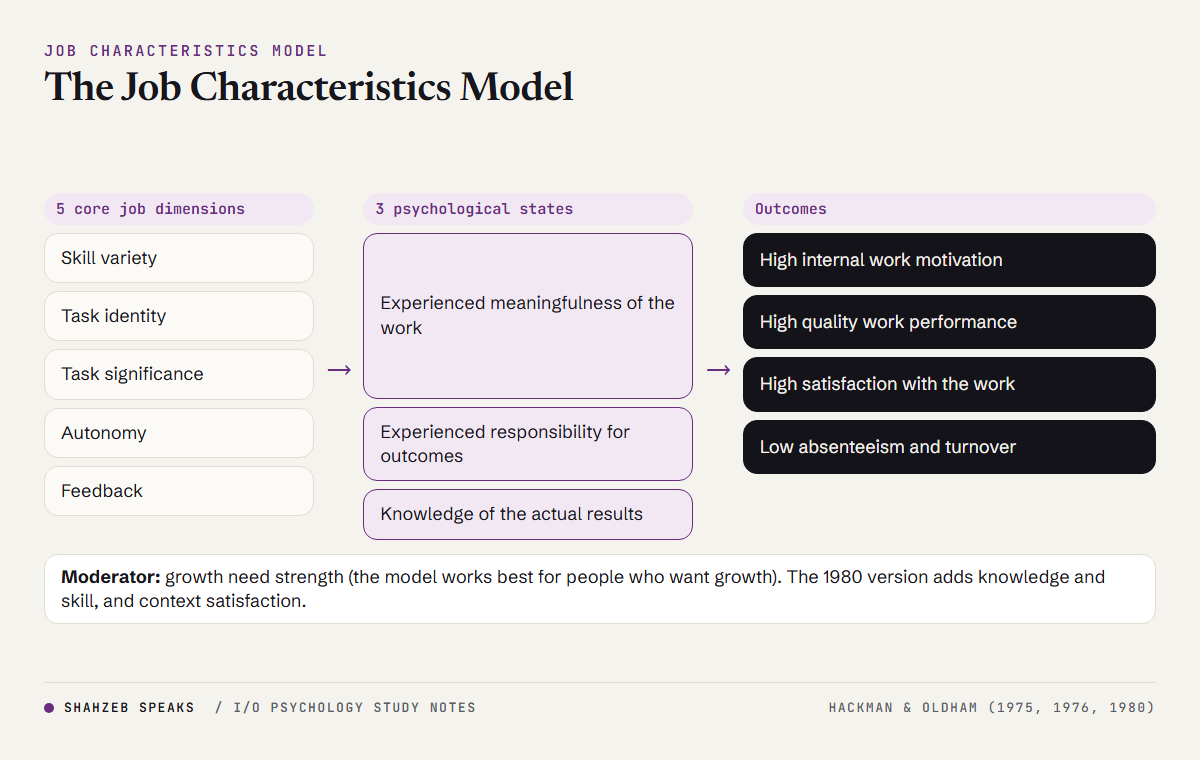
The model has three parts that run from left to right: five core job dimensions, three critical psychological states and outcomes, with growth need strength acting as a moderator.
The 5 core job dimensions
| Dimension | What it means | Low example | High example | Feeds which state |
|---|---|---|---|---|
| Skill variety | The range of different activities and skills the job needs | Entering the same data all day | A nurse who assesses patients, gives medicine, teaches families and keeps records | Meaningfulness |
| Task identity | Doing a whole, identifiable piece of work from start to finish | Stitching only one seam on a garment line | A tailor who makes the whole suit | Meaningfulness |
| Task significance | How much the job affects other people’s lives, inside or outside the organisation | Filing forms nobody reads | Checking medicine doses on a hospital ward | Meaningfulness |
| Autonomy | Freedom and discretion in planning the work and deciding how to do it | Every step set by a script and approved by a supervisor | A lecturer who designs her own course and assessments | Responsibility |
| Feedback | Clear information about how well you are doing, coming from the work itself | Results reach only the manager, months later | A software developer whose tests pass or fail as soon as the code runs | Knowledge of results |
Two points students miss. First, feedback in this model means feedback from the job itself, not only praise from a boss. Second, task significance is about impact on other people, not about how important the job title sounds.
The 3 critical psychological states
The psychological states are the bridge between the job and the person. Hackman and Oldham argued that all three need to be present for high internal motivation.
- Experienced meaningfulness of the work: the feeling that the work matters. It comes from skill variety, task identity and task significance together, so a weakness in one can be partly made up by the others.
- Experienced responsibility for outcomes: the feeling that results depend on your own effort and decisions. It comes from autonomy.
- Knowledge of the actual results: knowing how well you are doing. It comes from feedback.
If you want to read more about why meaningful work matters to people, my article on the psychology of meaningful work goes further than the exam needs.
Outcomes and growth need strength
In the 1975 and 1976 versions, the states lead to four outcomes:
- High internal work motivation (you work well because doing it well feels good, not because someone is watching)
- High quality work performance
- High satisfaction with the work
- Low absenteeism and turnover
In the 1980 book the outcome list was revised; absenteeism and turnover were dropped. If your textbook shows slightly different outcomes, that is the reason.
Growth need strength (GNS) is a person’s desire for challenge, learning and personal growth at work. The model predicts that enriched jobs help most for people high in GNS. The 1975 JDS paper describes it as the readiness of individuals to respond to enriched jobs. A person low in GNS may find a highly autonomous, varied job stressful rather than motivating. In Work Redesign (1980), Hackman and Oldham added two more moderators: knowledge and skill (can the person actually do the enriched job?) and context satisfaction (are pay, security, co-workers and supervision acceptable?). Notice how context satisfaction echoes Herzberg’s hygiene factors.
The MPS formula with a worked example
The Motivating Potential Score combines the five dimensions into one number:
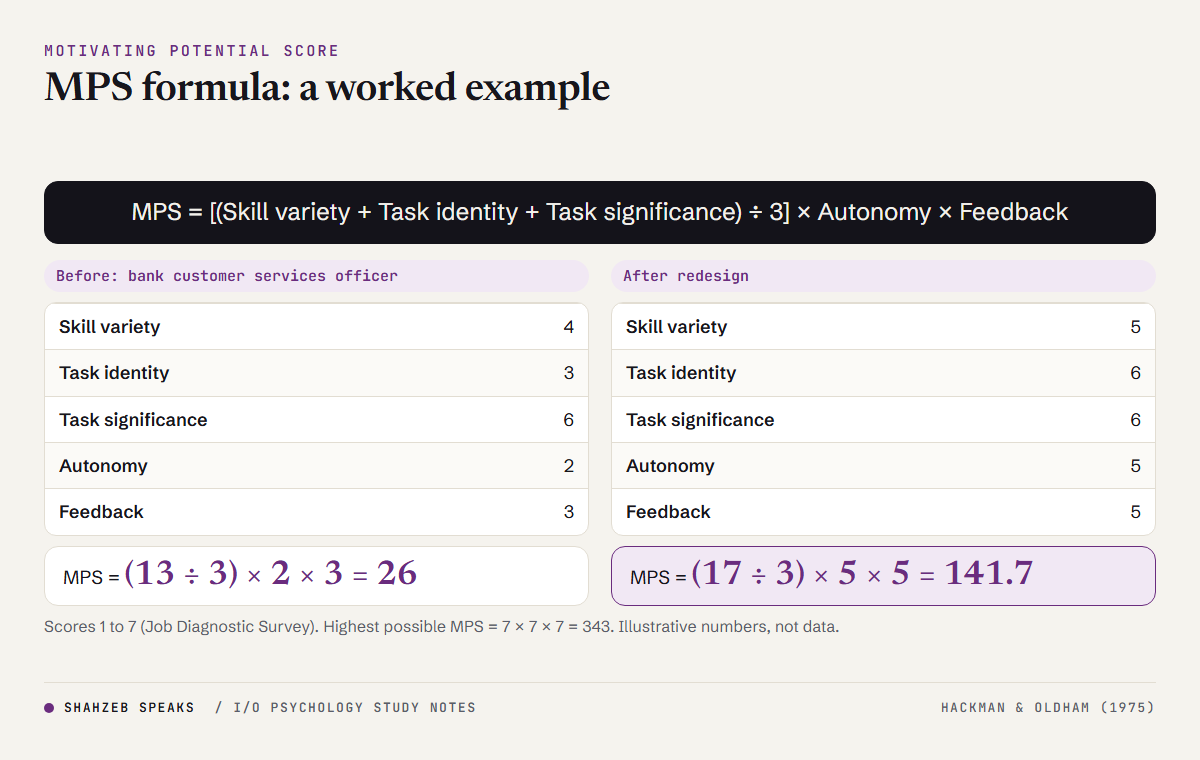
MPS = [(Skill variety + Task identity + Task significance) ÷ 3] × Autonomy × Feedback
Each dimension is scored from 1 to 7 on the Job Diagnostic Survey. The three “meaningfulness” dimensions are averaged because they can make up for each other. Autonomy and feedback are multiplied because they cannot. The highest possible score is 7 × 7 × 7 = 343, and the lowest is 1.
Why multiplication matters: imagine a job that scores 7 on skill variety, task identity and task significance, but 1 on autonomy and 1 on feedback. Its MPS is 7 × 1 × 1 = 7, almost the bottom of the scale. A job can be varied and important and still have very low motivating potential if people have no say in how they do it and never learn how they did.
Worked example: a bank customer services officer
These numbers are illustrative, not data from a real bank. A customer services officer in a branch takes account-opening forms, checks documents and passes the file to another desk for approval. She never learns whether the account was opened on time, and every exception needs the manager’s signature. Suppose her JDS scores are:
- Skill variety 4, task identity 3, task significance 6, autonomy 2, feedback 3
- Step 1: (4 + 3 + 6) ÷ 3 = 13 ÷ 3 = 4.33
- Step 2: 4.33 × 2 × 3 = 26 (more exactly, 13 ÷ 3 × 6 = 26)
Now the branch redesigns the job. She owns each account opening from first meeting to activation (task identity up to 6), also advises small-business customers (skill variety up to 5), can approve standard exceptions within a set limit (autonomy up to 5), and sees a weekly screen of her own turnaround times and customer comments (feedback up to 5). Task significance stays at 6.
- Step 1: (5 + 6 + 6) ÷ 3 = 17 ÷ 3 = 5.67
- Step 2: 5.67 × 5 × 5 = 141.7
The score rose more than five times, and most of the rise came from autonomy and feedback, the two multiplied terms. That is the practical lesson of the formula. There is no official “good” MPS cut-off; compare jobs measured the same way in the same organisation. You can repeat this calculation for any job with the MPS calculator.
How do managers raise the MPS?
Hackman, Oldham, Janson and Purdy (1975) suggested five practical ways to enrich a job:
- Combine tasks so one person does more of the whole job (skill variety, task identity).
- Form natural work units, for example one officer for one set of customers (task identity, task significance).
- Establish client relationships so workers deal with the people who use their work (skill variety, autonomy, feedback).
- Load the job vertically by giving decisions that used to belong to supervisors (autonomy).
- Open feedback channels so people learn their results directly (feedback).
This is job enrichment, which is different from simply adding more tasks of the same kind. See job enrichment vs job enlargement vs job rotation for the full comparison.
What does the research say? Evidence and criticism
The JCM is one of the most tested models in I/O psychology, and the evidence is mixed but mostly positive.
- Fried and Ferris (1987) reviewed nearly 200 studies and ran a meta-analysis. Job characteristics were related to both psychological outcomes (such as satisfaction) and behavioural outcomes. The psychological states did seem to act as a bridge, but the exact pattern of which dimension feeds which state was less supportive of the model, and there was less agreement on whether there are exactly five dimensions. Growth need strength did moderate the link between job characteristics and performance.
- Roberts and Glick (1981) criticised the research for relying on employees’ own perceptions of their jobs. If a satisfied person also rates their job as more varied and autonomous, the link between “job features” and satisfaction can be inflated.
- Humphrey, Nahrgang and Morgeson (2007) combined 259 studies with 219,625 participants. They found that motivational work characteristics explained 34 per cent of the variance in job satisfaction, and that adding social features of work (such as support from others) explained even more of some outcomes. Their work led to wider measures such as the Work Design Questionnaire (Morgeson and Humphrey, 2006).
A fair exam conclusion: the five dimensions do relate to satisfaction and motivation, the model is more useful than Herzberg’s strict two-factor split, but the multiplicative MPS formula, the exact three-state structure and the reliance on self-reports are open to question, and the model leaves out the social side of work.
A Pakistani workplace example
Garment and textile factories in Pakistan often organise work as long production lines where each worker does one operation, such as attaching a collar, all shift. In JCM terms, that design is low on skill variety, task identity and autonomy, and feedback often reaches only the supervisor. As an illustration (not a study of a particular factory), a manager could form small cells that complete a whole garment, rotate members across operations, and post each cell’s quality results on the floor every day. That raises task identity, skill variety and feedback. The model would also warn the manager about growth need strength: not every worker will welcome the change, and training (knowledge and skill) and fair pay (context satisfaction) need to come first. For the wider picture of the field, see my page on industrial psychology in Pakistan.
10-mark answer structure: “Explain the Job Characteristics Model”
- Definition (who, year): Hackman and Oldham (1975, 1976); a job design model of how features of the work create motivation.
- Diagram: five dimensions, three psychological states, outcomes, moderator (GNS). Draw it; it carries marks.
- Five dimensions: define each in one line with a short example.
- Three states: meaningfulness (SV, TI, TS), responsibility (autonomy), knowledge of results (feedback).
- Outcomes: internal motivation, quality performance, satisfaction, low absenteeism and turnover.
- MPS: write the formula and a short worked example; explain why autonomy and feedback are multiplied.
- Application: job enrichment methods (combine tasks, natural work units, client relationships, vertical loading, feedback channels).
- Evaluation: Fried and Ferris (1987) support with caveats; Roberts and Glick (1981) self-report criticism; GNS means it does not suit everyone.
- Conclusion: one of the best supported job design models, a practical tool for enriching jobs, best used alongside social and context factors.
Model opening line: “Hackman and Oldham’s (1976) Job Characteristics Model proposes that five core job dimensions create three critical psychological states, which in turn lead to high internal work motivation, performance and satisfaction, particularly for employees high in growth need strength.”
Practice MCQs: Job Characteristics Model
Practice questions written to the published syllabus (not past-paper questions).
-
Which of these is NOT one of the five core job dimensions?
- Task identity
- Autonomy
- Pay level
- Feedback
Show answer
C. Pay is a context factor (closer to Herzberg’s hygiene). The five dimensions are skill variety, task identity, task significance, autonomy and feedback.
-
Autonomy leads mainly to which psychological state?
- Experienced meaningfulness
- Experienced responsibility for outcomes
- Knowledge of results
- Growth need strength
Show answer
B. Freedom to decide how to work makes outcomes feel like your own responsibility. Meaningfulness comes from SV, TI and TS; knowledge of results from feedback; GNS is a moderator, not a state.
-
A job scores skill variety 5, task identity 4, task significance 6, autonomy 3 and feedback 4. What is its MPS?
- 22
- 60
- 12
- 180
Show answer
B. (5 + 4 + 6) ÷ 3 = 5; 5 × 3 × 4 = 60. A (22) is the plain sum of all five scores, C (12) adds the last step (5 + 3 + 4) instead of multiplying, and D (180) forgets to divide the first three by 3.
-
Why are autonomy and feedback multiplied in the MPS formula?
- Because they are the easiest to measure
- Because a very low score on either one pulls the whole score down, whatever the other dimensions are
- Because Herzberg called them motivators
- Because they matter only for managers
Show answer
B. Multiplying means near-zero autonomy or feedback makes motivating potential near zero. The other options are not the reason.
-
A garment worker who sees only one seam and never the finished shirt has low:
- Task significance
- Task identity
- Feedback
- Growth need strength
Show answer
B. Task identity is completing a whole, identifiable piece of work. Significance is impact on others, feedback is knowing results, and GNS is a trait of the person, not the job.
-
Growth need strength in the JCM is best described as:
- A sixth core job dimension
- A moderator: enriched jobs help most for people who want growth and challenge
- An outcome of the model
- The same as task significance
Show answer
B. GNS changes how strongly job features affect people. It is not a job dimension, an outcome or task significance.
-
Which instrument did Hackman and Oldham develop to measure the core dimensions?
- The Minnesota Satisfaction Questionnaire
- The Job Diagnostic Survey
- The Position Analysis Questionnaire
- The Job Descriptive Index
Show answer
B. The JDS (1975). The MSQ and JDI measure job satisfaction, and the PAQ is a job analysis tool.
-
The highest possible MPS on the 1 to 7 scale is:
- 35
- 49
- 343
- 2,401
Show answer
C. The average of three 7s is 7, so 7 × 7 × 7 = 343. 35 is the sum of five 7s, 49 is 7 × 7, and 2,401 is 7 to the fourth power.
-
Roberts and Glick (1981) criticised JCM research mainly because:
- It used only laboratory students
- It relied on employees’ own perceptions of their jobs, which mix job features with attitudes
- It ignored autonomy
- It used critical incident interviews
Show answer
B. Self-reported job features can be coloured by how satisfied the person already is. Critical incident interviews were Herzberg’s method, not the JCM’s.
-
A bank lets officers approve standard requests within a limit instead of sending every case to the manager. Which enrichment method is this?
- Opening feedback channels
- Vertical loading
- Job rotation
- Combining tasks
Show answer
B. Moving decisions down from supervisors to workers is vertical loading, which raises autonomy. Feedback channels inform people of results; rotation moves people between jobs; combining tasks joins pieces of work.
Practise on your phone
The free I/O Psychology Prep app has 410 explained
questions, flashcards and an exam countdown, and works offline. Get it on Google Play
· About the app
Doing a thesis or assignment on job design? Score real jobs with the free MPS calculator, and see more questions in the work motivation MCQ set.
Questions students ask
What are the 5 core dimensions of the Job Characteristics Model?
Skill variety (range of skills used), task identity (doing a whole piece of work), task significance (impact on other people), autonomy (freedom in how to do the work) and feedback (knowing how well you are doing from the work itself).
What is the formula for the Motivating Potential Score?
MPS = [(Skill variety + Task identity + Task significance) ÷ 3] × Autonomy × Feedback. Each dimension is scored 1 to 7 on the Job Diagnostic Survey, so scores run from 1 to 343.
Who developed the Job Characteristics Model and when?
J. Richard Hackman and Greg Oldham. The Job Diagnostic Survey appeared in 1975, the model was tested and published in 1976 in Organizational Behavior and Human Performance, and the final version appeared in their 1980 book Work Redesign.
What are the three critical psychological states?
Experienced meaningfulness of the work (from skill variety, task identity and task significance), experienced responsibility for outcomes (from autonomy) and knowledge of the actual results (from feedback).
What is a good MPS score?
There is no official cut-off. The score is most useful for comparing jobs, or the same job before and after redesign, when all are measured the same way in the same organisation. Look at which dimension is lowest, especially autonomy or feedback, because those pull the score down the most.
What is the difference between the JCM and Herzberg’s theory?
Both say motivation comes from the content of the job. Herzberg (1959) named broad motivators from interviews. Hackman and Oldham turned job content into five measurable dimensions, explained how they work through psychological states, and added growth need strength to show it does not suit everyone equally.
What are the criticisms of the Job Characteristics Model?
Research relies heavily on employees’ self-reports (Roberts and Glick, 1981); the link from each dimension to its psychological state is weaker than predicted (Fried and Ferris, 1987); the multiplicative formula is debated; and the model leaves out social features of work that later research found important.
Practise on your phone
The free I/O Psychology Prep app has 410 explained
questions, flashcards and an exam countdown, and works offline. Get it on Google Play
· About the app
References
- Fried, Y., & Ferris, G. R. (1987). The validity of the job characteristics model: A review and meta-analysis. Personnel Psychology, 40(2), 287-322. https://doi.org/10.1111/j.1744-6570.1987.tb00605.x
- Hackman, J. R., & Oldham, G. R. (1975). Development of the Job Diagnostic Survey. Journal of Applied Psychology, 60(2), 159-170. https://doi.org/10.1037/h0076546
- Hackman, J. R., & Oldham, G. R. (1976). Motivation through the design of work: Test of a theory. Organizational Behavior and Human Performance, 16(2), 250-279. https://doi.org/10.1016/0030-5073(76)90016-7
- Hackman, J. R., & Oldham, G. R. (1980). Work redesign. Addison-Wesley.
- Hackman, J. R., Oldham, G., Janson, R., & Purdy, K. (1975). A new strategy for job enrichment. California Management Review, 17(4), 57-71. https://doi.org/10.2307/41164610
- Humphrey, S. E., Nahrgang, J. D., & Morgeson, F. P. (2007). Integrating motivational, social, and contextual work design features: A meta-analytic summary and theoretical extension of the work design literature. Journal of Applied Psychology, 92(5), 1332-1356. https://doi.org/10.1037/0021-9010.92.5.1332
- Morgeson, F. P., & Humphrey, S. E. (2006). The Work Design Questionnaire (WDQ): Developing and validating a comprehensive measure for assessing job design and the nature of work. Journal of Applied Psychology, 91(6), 1321-1339. https://doi.org/10.1037/0021-9010.91.6.1321
- Roberts, K. H., & Glick, W. (1981). The job characteristics approach to task design: A critical review. Journal of Applied Psychology, 66(2), 193-217. https://doi.org/10.1037/0021-9010.66.2.193
This page is part of my guide to work motivation theories. Related: Herzberg’s two-factor theory, job enrichment vs enlargement, self-determination theory at work and the expectancy theory calculator.