
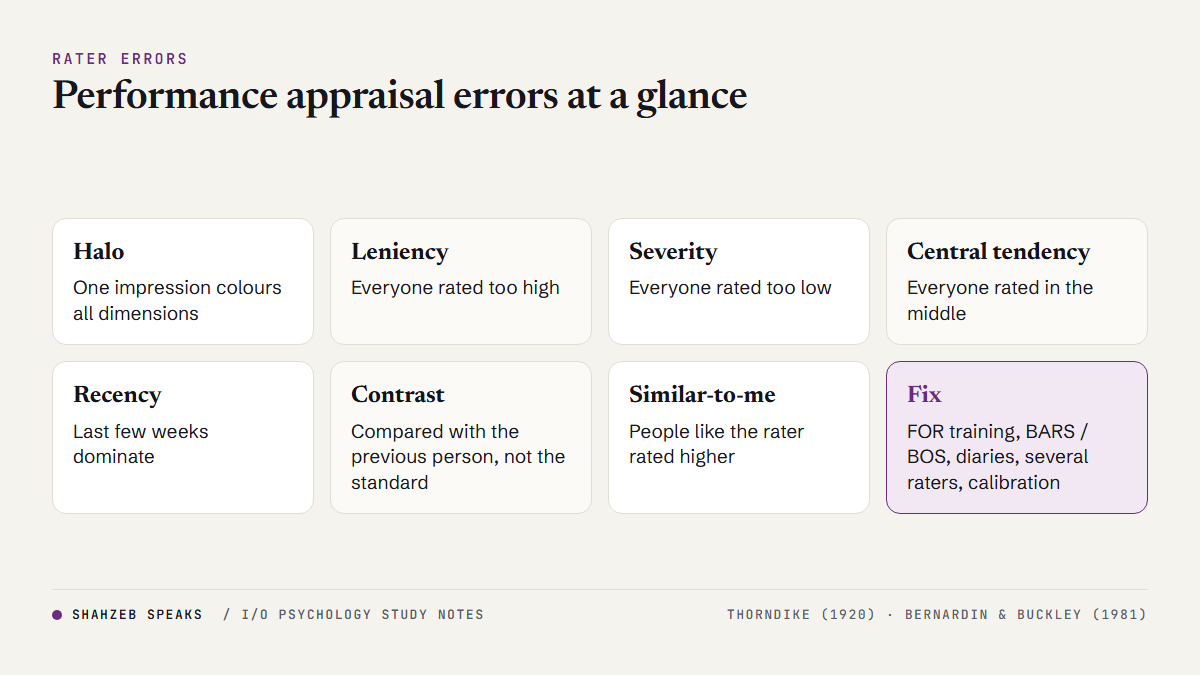
Performance appraisal errors are systematic mistakes raters make when judging employees. The main ones are the halo effect (named by Thorndike in 1920), leniency, severity, central tendency, recency, contrast and similar-to-me errors. They make ratings less accurate and less fair. Frame-of-reference training, behaviour-based rating scales and performance diaries are the best-supported fixes.
This page is for students who need to define and give examples of rater errors for an I/O psychology, HRM or organisational behaviour exam, and for anyone who has wondered why their own appraisal felt unfair. It gives each error with a plain definition and a workplace example, a summary table, the research on rater training, a 10-mark answer plan and 10 practice MCQs with explanations.
Appraisal errors sit inside the performance management unit of personnel psychology. For the full unit, see the personnel psychology notes; for the formats raters use, see methods of performance appraisal.
Why do appraisal errors happen?
Most appraisals rely on a manager’s judgement. That manager has seen only part of each employee’s work, remembers some of it, and has to compress months of behaviour into a few numbers, often at the same time as rating twenty other people. Rater errors are the predictable shortcuts and biases that creep into that process.
Some causes are cognitive: limited memory, a general impression that colours everything, comparing people with each other instead of with a standard. Others are motivational: a manager who does not want an argument, who wants a bigger bonus pool for the team, or who likes some people more. Either way, the result is that ratings reflect the rater as much as the employee.
How big is the problem? Viswesvaran, Ones and Schmidt (1996) found that the average agreement between two supervisors rating the same people’s overall job performance (inter-rater reliability) was only .52. Two managers looking at the same employee often see different things. That is why errors and rater training are on every I/O syllabus.
Performance appraisal errors explained, with examples
1. Halo effect (halo error)
The halo effect is letting one strong impression, good or bad, spill over onto ratings of unrelated dimensions. Edward Thorndike named it in a 1920 paper in the Journal of Applied Psychology. He studied officers’ ratings of soldiers on qualities such as physique, intelligence, leadership and character, ratings that were used for pay and promotion decisions, and found that the qualities were correlated too highly and too evenly to reflect real differences. The raters seemed to form one overall impression and apply it to everything.
Example: a call-centre agent in Karachi has the highest number of calls handled per hour. Her team leader rates her 5 out of 5 on “customer empathy”, “accuracy of records” and “teamwork” too, even though quality-assurance audits show frequent data-entry mistakes. One salient strength has coloured the other dimensions. The negative version (sometimes called the horns effect) is the same process in reverse: an employee who arrives late is marked down on everything.
Cooper (1981), in a review titled “Ubiquitous halo”, argued that halo appears in almost all rating situations, and that some of the correlation between dimensions is real (people who are good at one thing are often good at related things), so not all halo is error. For students, the key point is that ratings on separate dimensions should be made separately, on the evidence for each.
The same bias shows up in marketing and branding; the site’s article on halo effect branding examples covers that side.
2. Leniency error
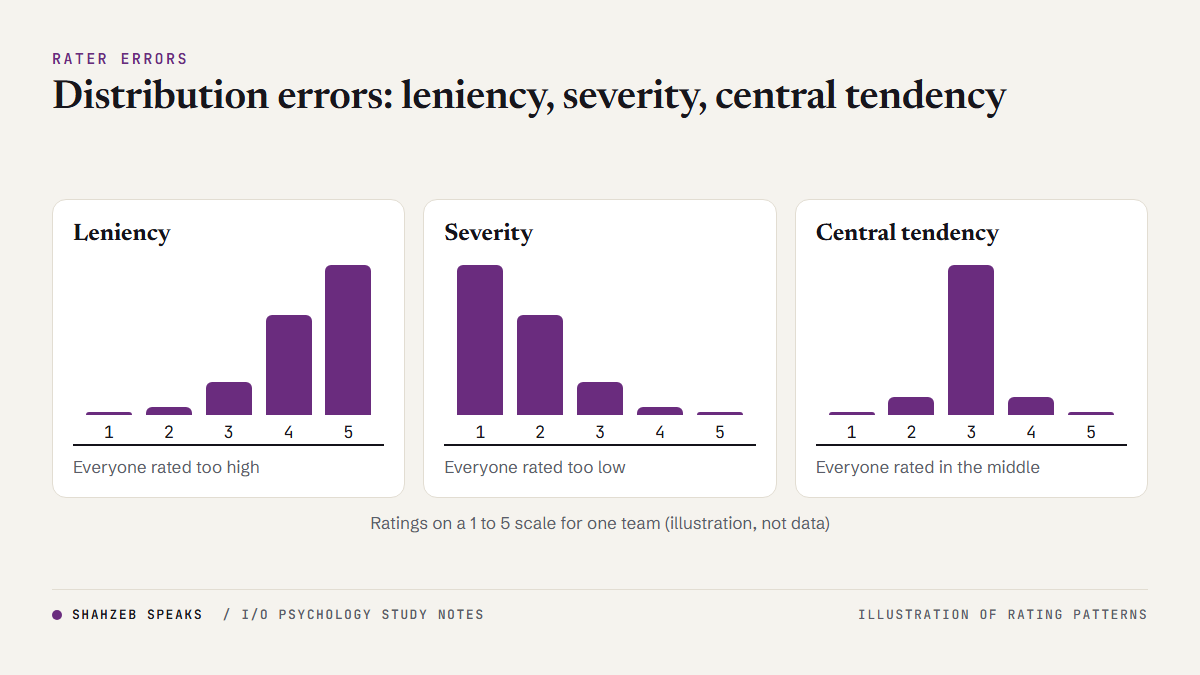
Leniency is rating everyone higher than their performance deserves. A department head at a university gives every lecturer “exceeds expectations” to avoid difficult conversations and to protect the department’s annual increment. Leniency makes ratings useless for decisions, because they no longer separate strong performers from weak ones, and it causes problems later if a poor performer must be let go despite years of good ratings.
3. Severity (strictness) error
Severity is the opposite: rating everyone lower than they deserve. A new production manager in a textile mill who believes “nobody is excellent” gives 2s and 3s across the board. Employees in that unit look worse than equally good employees in other units, which is unfair when ratings feed bonuses or promotions across the company.
4. Central tendency error
Central tendency is putting almost everyone in the middle of the scale, such as a 3 on a 5-point scale. It often happens when raters do not know the employees well, when the form demands written justification for extreme ratings, or when managers want to avoid standing out. Like leniency and severity, it shrinks the real differences between people.
5. Recency error
The recency error is giving too much weight to what happened just before the appraisal and too little to the rest of the period. A bank relationship officer who had a strong first ten months but lost a large client in November is rated as an average performer in December. The opposite, where early events dominate, is called a first-impression or primacy error. The cure for both is records kept through the year.
6. Contrast error
The contrast error is rating a person against the person rated just before, instead of against the standard. An average employee looks weak if rated straight after the department’s star, and strong if rated after its weakest member. Wexley, Yukl, Kovacs and Sanders (1972) demonstrated contrast effects in employment interviews, where ratings of a candidate depended on the candidates seen before; the same mechanism works in appraisal.
7. Similar-to-me error
The similar-to-me error is rating people more favourably when they resemble the rater in background, attitudes, education or interests. Rand and Wexley (1975) showed this in simulated interviews: when a candidate’s biographical background was similar to the interviewer’s, the interviewer rated the candidate’s job suitability higher. In a workplace, a manager may rate the employee from the same university, city or language group more highly without noticing. This error matters for fairness, because it can disadvantage people from groups that are under-represented among managers.
Other errors you may see
- First-impression (primacy) error: early information dominates the final rating.
- Spillover error: last year’s rating carries into this year’s.
- Attribution bias: blaming poor results on the person’s effort or ability while ignoring situational causes such as broken equipment or an unrealistic target.
Performance appraisal errors: summary table
| Error | What happens | Workplace example | Best fix |
|---|---|---|---|
| Halo | One impression colours all dimensions | Fastest call handler rated top on accuracy too | Rate each dimension on its own evidence; FOR training |
| Leniency | Everyone rated too high | Every lecturer “exceeds expectations” | Clear standards, calibration meetings, accountability |
| Severity | Everyone rated too low | New mill manager gives only 2s and 3s | Behavioural anchors, calibration across units |
| Central tendency | Everyone rated in the middle | All staff get a 3 out of 5 | Behavioural anchors, know the employees, training |
| Recency | Last few weeks dominate | Ten good months forgotten after one lost client | Performance diary through the year |
| Contrast | Compared with the previous person, not the standard | Average agent rated after the star | Rate against written standards, not each other |
| Similar-to-me | People like the rater rated higher | Same university or hometown gets higher marks | Multiple raters, structured criteria, awareness training |
How to reduce rater errors: what the research supports
Rater training
Woehr and Huffcutt (1994) reviewed the research on four kinds of rater training: rater error training (teaching raters the names of errors and telling them to avoid them), performance dimension training (teaching what each dimension means), frame-of-reference training and behavioural observation training (improving how raters watch and record behaviour). They judged training on four outcomes: halo, leniency, rating accuracy and observational accuracy.
An important early warning came from Bernardin and Buckley (1981). They found no evidence that training raters simply to change the shape of their ratings (for example, to spread them out to avoid central tendency) makes ratings more accurate or valid. Such training may only produce a temporary response set. A manager told “do not give everyone a 3” may give random 2s and 4s instead, which is no more accurate.
Frame-of-reference (FOR) training
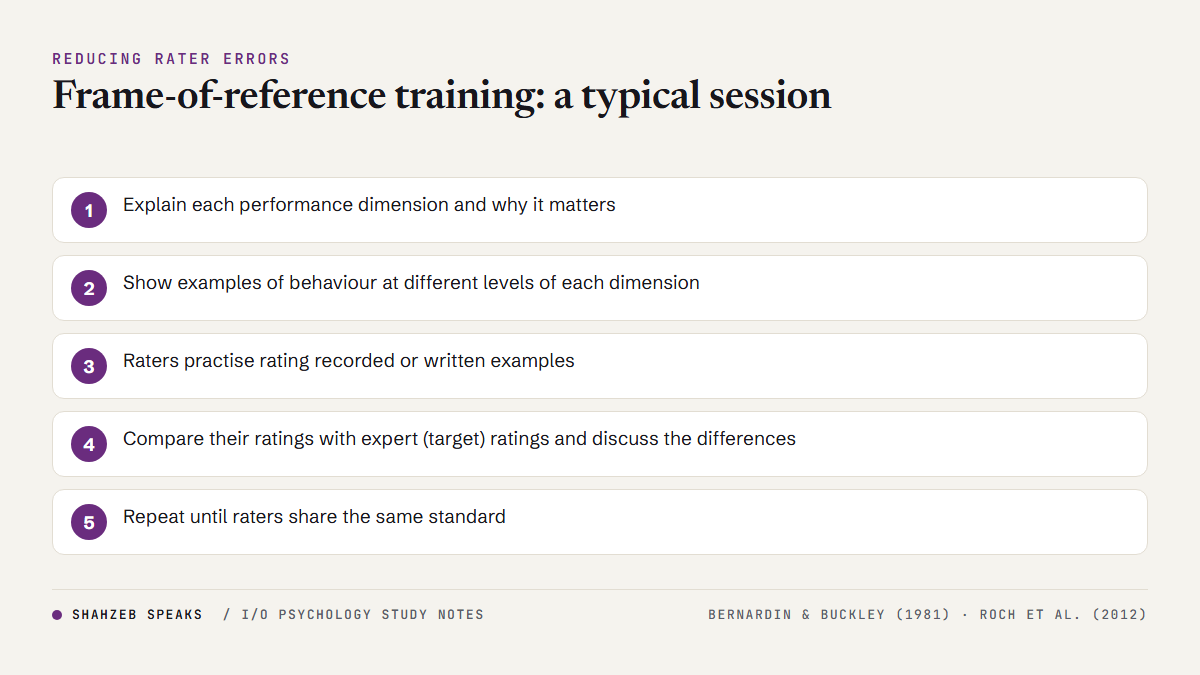
Frame-of-reference training aims to give all raters the same mental picture of what good, average and poor performance look like on each dimension. Bernardin and Buckley (1981) called for it, and later reviews support it: Roch, Woehr, Mishra and Kieszczynska (2012), in an updated meta-analysis with more than four times as many studies as the 1994 review, concluded that FOR training is an effective way of improving rating accuracy.
A typical FOR session runs like this:
- The trainer explains each performance dimension and why it matters.
- Raters see examples of behaviour at different levels of each dimension.
- Raters practise rating recorded or written examples of performance.
- Their ratings are compared with expert (target) ratings, and the differences are discussed.
- Practice is repeated until raters share the same standard.
Better forms and better records
- Behaviour-based scales: behaviourally anchored rating scales (BARS) and behavioural observation scales (BOS) describe what each level looks like, so raters judge behaviour rather than vague traits. See methods of performance appraisal.
- Performance diaries: short notes of specific incidents through the year, which Bernardin and Buckley (1981) also recommended. Diaries are the main cure for recency and first-impression errors.
- Several raters: combining ratings from more than one person averages out some individual bias. 360-degree feedback does this for development purposes. You can check how far raters agree with the rwg and ICC calculator.
- Calibration meetings: managers compare their rating distributions and the evidence behind them before ratings are final, which targets leniency and severity across units. Talent-review grids such as the nine-box grid generator are often used in these meetings.
- Treat small differences with care: if ratings are unreliable, a 3.4 and a 3.6 are not meaningfully different. The standard error of measurement and banding calculator shows how to think in bands.
The psychology of how people experience appraisal, and why many organisations have changed their review systems, is covered in the site’s article on the psychology of performance reviews.
10-mark answer structure
- Definition: rater errors are systematic biases in performance ratings that reduce their accuracy and fairness.
- Why they matter: ratings drive pay, promotion and training; average inter-rater reliability of supervisor ratings is only .52 (Viswesvaran et al., 1996).
- Halo: Thorndike (1920), definition and one local example.
- Distribution errors: leniency, severity and central tendency, one line each (draw the three distributions if you can).
- Time and comparison errors: recency, contrast, similar-to-me, with examples.
- Remedies: FOR training (Bernardin and Buckley, 1981; Roch et al., 2012), BARS/BOS, diaries, multiple raters, calibration.
- Critical point: rater error training alone may change rating patterns without improving accuracy.
- Conclusion: errors cannot be removed completely, but well-designed forms, records and trained raters reduce them.
Model opening line: “Performance appraisal errors are systematic distortions in a rater’s judgement, such as the halo, leniency and central tendency errors, which cause ratings to reflect the rater’s biases rather than the employee’s actual performance.”
Practice MCQs: performance appraisal errors
Practice questions written to the published syllabus, not past-paper items.
-
A supervisor rates an employee highly on all dimensions because the employee is very punctual. This is:
- leniency error
- halo effect
- contrast error
- recency error
Show answer
B. One salient trait colours unrelated dimensions. Leniency would mean everyone is rated high; contrast and recency involve other people or timing.
-
Who first named the halo error in rating research?
- Flanagan
- Thorndike
- Kirkpatrick
- Lawshe
Show answer
B. Thorndike, 1920, “A constant error in psychological ratings”. Flanagan gave us critical incidents, Kirkpatrick training evaluation, Lawshe the CVR.
-
A manager rates nearly all her 15 staff as 3 on a 5-point scale. This is:
- severity error
- central tendency error
- similar-to-me error
- halo effect
Show answer
B. Clustering everyone in the middle is central tendency. Severity would push ratings down; the other two are about specific people, not the whole distribution.
-
An average agent is rated poorly because she was evaluated straight after the top performer. This is:
- contrast error
- recency error
- leniency error
- first-impression error
Show answer
A. She is judged against the previous person, not the standard. Recency and first impression concern timing within one person’s record.
-
Which tool most directly reduces recency error?
- Forced distribution
- A performance diary kept through the year
- A shorter rating form
- Rating only overall performance
Show answer
B. Notes made throughout the period stop the last few weeks from dominating. The other options do nothing for memory.
-
Frame-of-reference training mainly aims to:
- teach raters the names of rating errors
- give raters a shared understanding of performance standards on each dimension
- reduce the number of dimensions on the form
- replace supervisors with peers
Show answer
B. FOR training builds a common standard through examples, practice and feedback. Naming errors is rater error training, which is less effective for accuracy.
-
According to Bernardin and Buckley (1981), training raters only to change their rating distributions:
- reliably increases accuracy
- has no evidence that it increases accuracy or validity
- eliminates halo completely
- is the same as FOR training
Show answer
B. They argued such training may produce a temporary response set, not better judgement, and called instead for diaries, a common frame of reference and mastery-based training.
-
A manager gives higher ratings to staff who went to his own university. This is:
- similar-to-me error
- central tendency error
- severity error
- contrast error
Show answer
A. Favouring people who resemble the rater is similar-to-me (shown by Rand and Wexley, 1975, in interviews). The others are not about similarity.
-
Which of these is NOT a distribution error?
- Leniency
- Severity
- Central tendency
- Similar-to-me
Show answer
D. Leniency, severity and central tendency shift or squeeze the whole set of ratings. Similar-to-me affects particular employees who resemble the rater.
-
The mean inter-rater reliability of supervisors’ ratings of overall job performance reported by Viswesvaran, Ones and Schmidt (1996) was about:
- .92
- .75
- .52
- .20
Show answer
C. .52, which means two supervisors often disagree substantially. That is the evidence base for rater training and multiple raters.
Practise on your phone
The free I/O Psychology Prep app has 410 explained
questions, flashcards and an exam countdown, and works offline. Get it on Google Play
· About the app
More practice: the performance appraisal MCQs set has 25 questions.
Questions students ask
What is the halo effect in performance appraisal, with an example?
It is when one strong impression of an employee spills over onto ratings of unrelated dimensions. For example, a sales officer with excellent sales figures is also rated excellent at paperwork and teamwork without evidence. Thorndike named it in 1920.
What are the most common errors in performance appraisal?
The halo effect, leniency, severity, central tendency, recency, contrast and similar-to-me errors. Some textbooks add first-impression, spillover and attribution errors.
What is the difference between leniency and halo?
Leniency is rating everyone too high, so it affects the whole team. Halo is about one person: a single impression of that person colours all of their dimensions, whether high or low.
How can performance appraisal errors be reduced?
Use frame-of-reference training, behaviour-based scales such as BARS or BOS, performance diaries through the year, several raters where possible and calibration meetings across units. Simply telling raters to avoid errors is not enough.
What is central tendency error?
It is rating almost everyone near the midpoint of the scale, such as a 3 out of 5. It hides real differences between strong and weak performers and makes the ratings useless for decisions.
Is the halo effect always an error?
Not completely. Cooper (1981) noted that some correlation between dimensions is real, because people who are good at one thing are often good at related things. The error is the part of the correlation that comes from the rater’s general impression rather than the evidence.
Revise appraisal errors with flashcards
The free I/O Psychology Prep app has 410 explained
questions, flashcards and an exam countdown, and works offline. Get it on Google Play
· About the app
References
- Bernardin, H. J., & Buckley, M. R. (1981). Strategies in rater training. Academy of Management Review, 6(2), 205-212. https://doi.org/10.5465/amr.1981.4287782
- Cooper, W. H. (1981). Ubiquitous halo. Psychological Bulletin, 90(2), 218-244. https://doi.org/10.1037/0033-2909.90.2.218
- Rand, T. M., & Wexley, K. N. (1975). Demonstration of the effect, “similar to me,” in simulated employment interviews. Psychological Reports, 36(2), 535-544. https://doi.org/10.2466/pr0.1975.36.2.535
- Roch, S. G., Woehr, D. J., Mishra, V., & Kieszczynska, U. (2012). Rater training revisited: An updated meta-analytic review of frame-of-reference training. Journal of Occupational and Organizational Psychology, 85(2), 370-395. https://doi.org/10.1111/j.2044-8325.2011.02045.x
- Thorndike, E. L. (1920). A constant error in psychological ratings. Journal of Applied Psychology, 4(1), 25-29. https://doi.org/10.1037/h0071663
- Viswesvaran, C., Ones, D. S., & Schmidt, F. L. (1996). Comparative analysis of the reliability of job performance ratings. Journal of Applied Psychology, 81(5), 557-574. https://doi.org/10.1037/0021-9010.81.5.557
- Wexley, K. N., Yukl, G. A., Kovacs, S. Z., & Sanders, R. E. (1972). Importance of contrast effects in employment interviews. Journal of Applied Psychology, 56(1), 45-48. https://doi.org/10.1037/h0032132
- Woehr, D. J., & Huffcutt, A. I. (1994). Rater training for performance appraisal: A quantitative review. Journal of Occupational and Organizational Psychology, 67(3), 189-205. https://doi.org/10.1111/j.2044-8325.1994.tb00562.x
Back to the hub: Personnel psychology notes. Related: methods of performance appraisal, reliability in psychological testing and Kirkpatrick’s four levels of training evaluation.