
Performance appraisal MCQs test four areas: why organisations rate (administrative and developmental purposes), what makes a good criterion (avoiding deficiency and contamination), the rating methods (ranking, forced distribution, graphic scales, BARS from Smith and Kendall 1963, BOS, MBO, 360-degree feedback) and rater errors such as halo, leniency, central tendency and recency.
This page is for students preparing the appraisal chapter of an industrial or personnel psychology paper, an HRM course, a lecturer test or a board review. It gives a short topic summary, a table of methods, 25 practice questions with explanations and a plan for the long question. The questions are practice questions written to the published syllabus, not past-paper or board items.
Most students lose marks here on two things: mixing up similar rater errors (leniency vs central tendency, halo vs similar-to-me) and mixing up BARS with BOS. The questions below are built to separate those pairs, so read the explanations even when you get the answer right.
Performance appraisal in one page
Performance appraisal is the regular, formal evaluation of how well an employee does the job, usually by a supervisor, followed by feedback. Organisations use it for administrative decisions (pay rises, promotion, confirmation, termination), developmental purposes (feedback, training needs, career planning), documentation that protects fair decisions, and as a criterion in research, for example when validating a selection test. Using one rating for both pay and development is hard, because people talk about their weaknesses less openly when money depends on it.
Criteria. The ultimate criterion is everything that makes up success in a job, which can never be measured completely. The actual criterion is the measure we use. Where the actual criterion misses part of the job, we have criterion deficiency; where it picks up things outside the person’s control, we have criterion contamination. Objective measures (units produced, errors, sales) are easy to count but are often contaminated by equipment, territory or luck. Subjective ratings cover more of the job but bring rater errors.
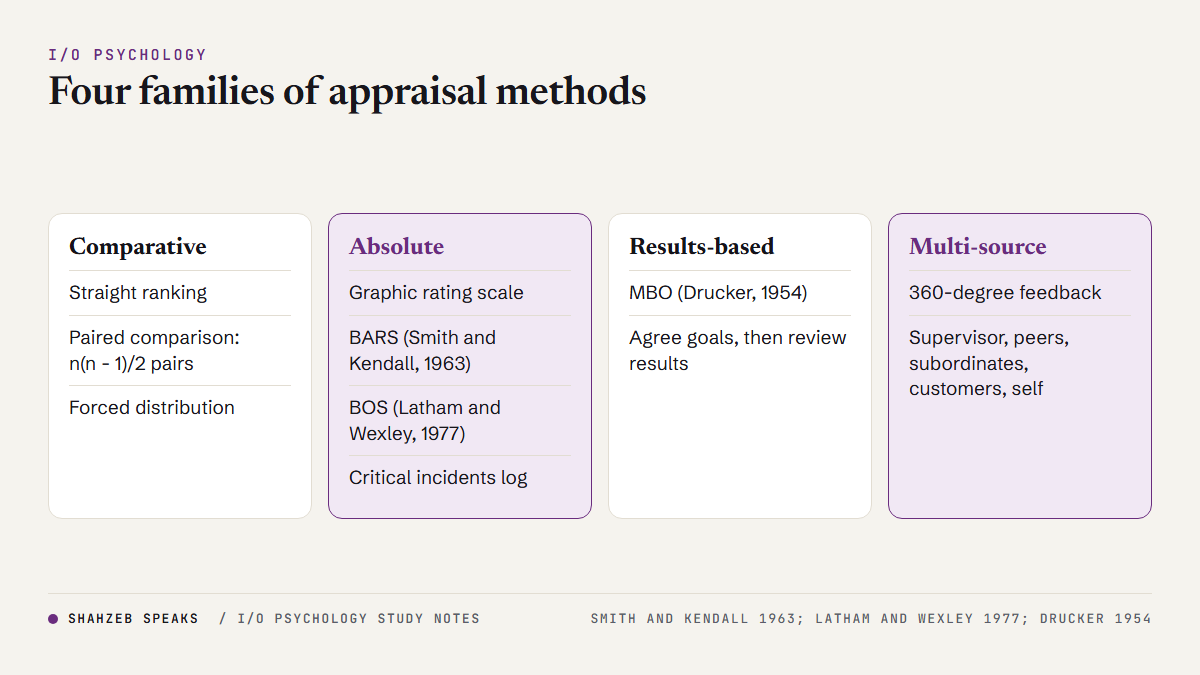
Methods. Comparative methods rank people against each other: straight ranking, paired comparison and forced distribution. Absolute methods rate each person against a standard: graphic rating scales, behaviourally anchored rating scales (BARS; Smith and Kendall, 1963), behavioural observation scales (BOS; Latham and Wexley, 1977) and a log of critical incidents (from Flanagan’s 1954 technique). Results-based methods such as management by objectives (MBO; Drucker, 1954) rate goals met. Multi-source or 360-degree feedback adds peers, subordinates, customers and the employee’s own view.
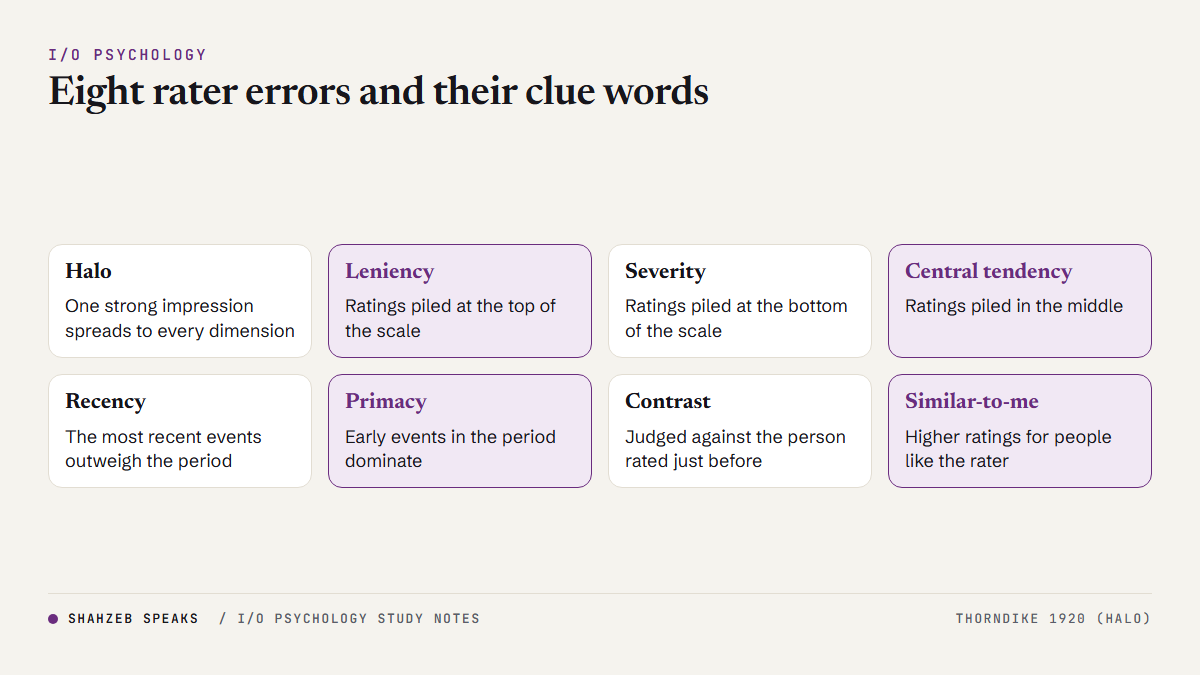
Rater errors. Thorndike (1920) described the “constant error” we now call the halo effect: one strong impression colours every other rating. Others are leniency, severity, central tendency, recency, primacy, contrast and similar-to-me. Training raters to share the same standards, called frame-of-reference training (Bernardin and Buckley, 1981), improved rating accuracy in meta-analytic reviews (Woehr and Huffcutt, 1994; Roch, Woehr, Mishra and Kieszczynska, 2012).
Feedback. Kluger and DeNisi (1996) found that feedback improved performance on average, but in over a third of cases it made performance worse, especially when it pointed attention at the person rather than the task. Read more in performance appraisal errors and methods of performance appraisal.
Summary table: appraisal methods compared
| Method | Type | How it works | Main strength | Main weakness |
|---|---|---|---|---|
| Straight ranking | Comparative | Order everyone from best to worst | Quick, stops leniency | No size of difference; hard with big teams |
| Paired comparison | Comparative | Compare each pair; n(n – 1)/2 pairs | Careful ordering | Grows fast with team size |
| Forced distribution | Comparative | Fixed share of people in each band | Spreads ratings out | Unfair when the whole team is strong |
| Graphic rating scale | Absolute | Rate traits or duties on a number scale | Simple, common | Vague anchors invite rater errors |
| BARS | Absolute, behavioural | Scale points anchored by behaviour examples (Smith and Kendall, 1963) | Clear, job-specific | Slow and costly to build |
| BOS | Absolute, behavioural | Rate how often each behaviour is seen (Latham and Wexley, 1977) | Concrete feedback | Needs good observation |
| Critical incidents log | Absolute, behavioural | Record specific effective and ineffective acts through the year | Fights recency | Time-consuming; hard to compare people |
| MBO | Results | Agree goals, then review results (Drucker, 1954) | Links to strategy | Ignores how results were achieved |
| 360-degree feedback | Multi-source | Ratings from supervisor, peers, reports, customers, self | Many viewpoints | Best for development, risky for pay |
Practice MCQs: performance appraisal
-
A bank uses year-end ratings to decide each officer’s annual increment and who is promoted to branch manager. This is the appraisal’s:
- Developmental purpose
- Training purpose
- Research purpose
- Administrative purpose
Show answer
D. Using ratings for pay and promotion decisions is administrative. Developmental use is feedback and growth, research use is treating ratings as a criterion, and training needs analysis is one developmental use, not the decision itself.
-
A hospital’s rating form for staff nurses counts only how complete their paperwork is and leaves out patient care. The form suffers mainly from:
- Criterion contamination
- Leniency error
- Criterion deficiency
- Halo effect
Show answer
C. A measure that misses an important part of the job is deficient. Contamination is the opposite problem: the measure picks up things that are not part of performance. Leniency and halo are rater errors, not problems with what the form covers.
-
Sales officers are rated only on revenue, but some are given rich city territories and others poor rural ones. The revenue measure is:
- Contaminated by a factor outside the employee’s control
- Deficient because it covers too many duties
- Free of error because it is objective
- An example of the similar-to-me error
Show answer
A. Territory affects revenue regardless of effort or skill, so the measure is contaminated. “Objective” does not mean “uncontaminated”. Deficiency means missing parts of the job, and similar-to-me is a rater error.
-
The “ultimate criterion” in performance measurement refers to:
- The final rating given at the end of the year
- The single most important objective number, such as sales
- The supervisor’s overall impression
- The full, ideal concept of success in the job, which can never be measured completely
Show answer
D. The ultimate criterion is theoretical: everything that makes someone successful. Every real measure (the actual criterion) captures only part of it. A year-end rating, a sales figure and an overall impression are all actual criteria.
-
A branch manager notices one officer’s messy desk and then rates him low on accuracy, teamwork and customer service, even though his error records and customer feedback are good. This is:
- Leniency error
- Central tendency error
- Recency error
- Halo effect (in its negative form)
Show answer
D. One impression, here a negative one, spreading across unrelated dimensions is the halo effect; the negative version is sometimes called the horns effect. Leniency is rating everyone high, recency overweights late events, and central tendency avoids the extremes.
-
Thorndike’s (1920) paper on the “constant error” in ratings was based mainly on:
- Ratings of soldiers and officers by their superiors
- Customer satisfaction surveys
- Students rating their teachers online
- Self-ratings of factory workers
Show answer
A. Thorndike noticed that superiors rated their men similarly across very different qualities, such as intelligence and physique, which suggested one general impression was colouring all the ratings. The other sources were not his data.
-
A department head gives all 14 of her lecturers a 4 or 5 on a 5-point scale, although their teaching scores vary widely. This pattern is:
- Central tendency error
- Severity error
- Leniency error
- Primacy error
Show answer
C. Rating nearly everyone at the top is leniency. Central tendency piles ratings in the middle, severity piles them at the bottom, and primacy weights early events in the period.
-
A new manager known as “tough” rates almost everyone in her team 1 or 2 on a 5-point scale, although the team meets its targets. This is:
- Severity error
- Central tendency error
- Halo effect
- Recency error
Show answer
A. Rating nearly everyone at the bottom is severity (also called strictness). Central tendency piles ratings in the middle, halo spreads one impression across dimensions, and recency overweights late events.
-
An officer worked well for eleven months but made one serious mistake in the month before appraisal, and his rating is low. The main error is:
- Primacy error
- Leniency error
- Contrast effect
- Recency error
Show answer
D. The most recent event outweighed the whole period. Primacy is the opposite (early events dominate), leniency is rating too high, and contrast means judging someone against the previous person rated. Keeping a critical incidents log through the year is the usual fix.
-
Which rater error is most likely to disadvantage a capable employee whose background, language or interests differ from the rater’s?
- Leniency error
- Similar-to-me error
- Central tendency error
- Primacy error
Show answer
B. Raters tend to rate people like themselves more highly, so people who differ lose out even when they perform well. Leniency lifts everyone, central tendency squeezes everyone to the middle, and primacy is about early events.
-
An officer made a very strong impression in her first month, but her work was weak for the rest of the year. She is still rated “excellent”. This is:
- Recency error
- Primacy error
- Severity error
- Contrast effect
Show answer
B. Primacy is letting early events dominate the rating. Recency is the reverse (late events dominate), severity is rating everyone low, and contrast is judging someone against the person rated just before.
-
Which of these is NOT a rater error?
- Leniency
- Halo
- Central tendency
- Criterion deficiency
Show answer
D. Criterion deficiency is a weakness of the measure itself (it leaves out part of the job), which exists even if the rater is perfect. Leniency, halo and central tendency are errors in how a rater uses the scale.
-
What is the main practical drawback of behaviourally anchored rating scales?
- They give no feedback at all
- They take a lot of time and expert input to build, usually separately for each job
- They cannot be used with numbers
- They always produce leniency
Show answer
B. BARS need many critical incidents, expert sorting and scaling, so they are slow and costly, and a scale for one job rarely fits another. They do give concrete feedback, they produce numbers, and they were designed to reduce errors, not cause them.
-
How do behavioural observation scales (BOS) differ from BARS?
- BOS ask how often each listed behaviour was seen; BARS ask which anchor best describes the person’s level
- BOS use only objective production data
- BOS rank employees against each other
- BOS are results-based, like MBO
Show answer
A. Latham and Wexley (1977) had raters judge the frequency of specific behaviours, for example from “almost never” to “almost always”. BARS place the person at one anchored point. BOS are neither production data, ranking nor results-based.
-
A software house tells every manager to place exactly 10% of staff in “needs improvement”, whatever the team’s real performance. The main problem with this forced distribution is:
- It makes ratings too lenient
- It takes too long to complete
- In a strong team, someone must be labelled poor even if nobody performs poorly
- It cannot be used for pay decisions
Show answer
C. Forced distribution assumes performance follows a fixed shape in every team. It is designed to stop leniency, not cause it, it is quick, and it is in fact often used for pay, which is where the unfairness hurts.
-
Why is the paired comparison method impractical for a department of 30 staff?
- It cannot rank people
- Every pair must be compared, which means 435 comparisons
- It needs a computer
- It only works for sales jobs
Show answer
B. Pairs = n(n – 1) / 2 = 30 x 29 / 2 = 435. The method does produce a ranking, needs no special equipment and is not limited to sales. It suits small teams.
-
Management by objectives (MBO), where manager and employee agree goals and later review results against them, is most associated with:
- Frederick Taylor (1911)
- Peter Drucker (1954)
- Elton Mayo (1933)
- Edward Thorndike (1920)
Show answer
B. Drucker described management by objectives in The Practice of Management (1954). Taylor wrote on scientific management, Mayo on the human problems of industry, and Thorndike on rating errors.
-
A ward supervisor keeps a written log through the year of specific things each nurse did that were especially effective or ineffective, and uses it at appraisal time. This method is based on:
- The paired comparison method
- Forced distribution
- The critical incident technique
- Graphic rating scales
Show answer
C. Flanagan (1954) described collecting critical incidents: specific examples of behaviour that made a clear difference. In appraisal it gives concrete feedback and reduces recency error. The other three methods do not require recording events.
-
When subordinates rate their own manager’s behaviour, for example how well she gives feedback and shares information, this is called:
- Upward feedback (upward appraisal)
- Self-appraisal
- Forced distribution
- Management by objectives
Show answer
A. Upward feedback comes from the people a manager leads and is one part of a full 360-degree process. Self-appraisal is the manager’s own view, forced distribution is a rating rule, and MBO is goal-based appraisal. See 360-degree feedback.
-
Harris and Schaubroeck (1988) found that self-ratings agreed only moderately with supervisor ratings (about .35). What is the most sensible practical response?
- Use self-ratings as the only basis for pay
- Ban self-appraisal completely
- Use self-ratings to open a discussion and compare views, not as the sole basis for decisions
- Assume supervisors are always right
Show answer
C. Moderate agreement means self-ratings carry a different view, useful for a conversation about gaps, but too different to decide pay alone. Banning them loses that view, and supervisors have their own biases.
-
A company trains raters by discussing what good, average and poor performance look like on each dimension, then lets them practise rating sample cases and gives feedback on their accuracy. This is:
- Rater error training
- Behavioural modelling
- Frame-of-reference training
- Forced distribution training
Show answer
C. Frame-of-reference training (Bernardin and Buckley, 1981) gives raters a shared standard. Meta-analyses (Woehr and Huffcutt, 1994; Roch and colleagues, 2012) found that it improves rating accuracy. Rater error training only warns raters about errors such as halo, behavioural modelling is a skills training method, and forced distribution is a rating method.
-
According to Kluger and DeNisi (1996), feedback was more likely to lower performance when it:
- Focused attention on the task and how to do it better
- Drew attention to the person and their self-image rather than the task
- Was given in writing
- Was linked to a goal
Show answer
B. Their feedback intervention theory says feedback that shifts attention to the self (for example, praise or criticism of the person) tends to help less or even harm, while feedback about the task and how to improve it helps more. Written feedback and goal-linked feedback are not the problem.
-
In talent reviews, the nine-box grid places each employee on two axes. They are:
- Performance and potential
- Salary and seniority
- Attendance and punctuality
- Personality and intelligence
Show answer
A. The grid crosses current performance (low, medium, high) with judged potential (low, medium, high), giving nine boxes for succession and development decisions. The other pairs are not its axes. Try the nine-box grid generator.
-
What is the main weakness of a basic graphic rating scale, such as rating “dependability” from 1 (poor) to 5 (excellent)?
- It takes too long to build
- It cannot give a number
- Vague labels let each rater read the scale differently, which invites rater errors
- It compares employees only with each other
Show answer
C. Without behavioural anchors, “3” means different things to different raters, so leniency, halo and central tendency creep in. Graphic scales are quick to build, they do give numbers, and they are absolute, not comparative. BARS were designed to fix this weakness.
-
For a bank teller, which of these is an objective (production) measure of performance?
- The supervisor’s rating of attitude
- Number of transactions processed and cash-balancing errors per month
- A peer’s rating of teamwork
- The teller’s self-rating of customer care
Show answer
B. Counts of output and errors are objective measures. The other three are judgements by people, so they are subjective ratings. Objective measures still need checking for contamination, for example by a branch’s workload.
Practise on your phone
The free I/O Psychology Prep app has 410 explained
questions, flashcards and an exam countdown, and works offline. Get it on Google Play
· About the app
Pairs students confuse, side by side
- Leniency vs central tendency: leniency piles ratings at the top; central tendency piles them in the middle. Both shrink the spread, so both make ratings useless for decisions.
- Halo vs similar-to-me: halo is one trait of the employee spreading to others; similar-to-me is the rater liking people who resemble them.
- Recency vs primacy vs contrast: recency and primacy are about when in the period an event happened; contrast is about who was rated just before.
- BARS vs BOS: BARS asks “which anchor describes this person?”; BOS asks “how often did this person do each behaviour?”
- Deficiency vs contamination: deficiency leaves something out; contamination lets something extra in.
For a fuller treatment of the human side, including why many reviews fail, see the psychology of performance reviews and organisational justice.
How to write a performance appraisal answer in your exam
10-mark answer structure
- Definition: performance appraisal as the formal, periodic evaluation of an employee’s job performance, followed by feedback.
- Purposes: administrative (pay, promotion), developmental (feedback, training), documentation and research.
- Criteria: ultimate vs actual criterion; deficiency and contamination with one example each.
- Methods: one comparative (forced distribution), one behavioural (BARS, Smith and Kendall 1963), one results-based (MBO, Drucker 1954) and 360-degree feedback, with a strength and a weakness for each.
- Rater errors: halo (Thorndike, 1920), leniency, central tendency and recency, with a short workplace example.
- Improvements: frame-of-reference training (Bernardin and Buckley, 1981), behavioural anchors, multiple raters, a critical incidents log, and feedback that focuses on the task (Kluger and DeNisi, 1996).
- Conclusion: an appraisal is only as good as its criteria and its raters; separating pay and development conversations helps both.
Model opening line: “Performance appraisal is the formal and periodic evaluation of an employee’s job performance against agreed standards, used both to make administrative decisions such as pay and promotion and to give developmental feedback.”
Questions students ask
What is the most common rater error?
There is no single answer that holds in every organisation. Leniency is a frequent worry when ratings decide pay, because raters avoid conflict and protect their teams. Halo is the oldest described error (Thorndike, 1920) and a favourite of examiners. Learn both, with an example of each.
What is the difference between BARS and graphic rating scales?
A graphic rating scale has number points with vague labels such as “poor” to “excellent”. BARS replaces the labels with descriptions of real behaviour at each level, written by job experts, so raters share the same meaning for each point.
Is 360-degree feedback good for deciding pay?
Most writers recommend it mainly for development. When ratings affect pay, peers and subordinates may rate strategically, and self-ratings agree only moderately with others (Harris and Schaubroeck, 1988).
How can halo error be reduced?
Rate one dimension for all employees before moving to the next, use behavioural anchors, keep a critical incidents log, and train raters with frame-of-reference training so they share a standard for each dimension.
What is the difference between administrative and developmental appraisal?
Administrative appraisal feeds decisions such as increments, promotion and termination. Developmental appraisal focuses on feedback, learning and career plans. Many organisations hold the two conversations at different times.
Does feedback always improve performance?
No. Kluger and DeNisi (1996) found that over a third of feedback interventions lowered performance. Feedback works better when it is specific, about the task and paired with a goal.
Practise on your phone
The free I/O Psychology Prep app has 410 explained
questions, flashcards and an exam countdown, and works offline. Get it on Google Play
· About the app
References
- Bernardin, H. J., & Buckley, M. R. (1981). Strategies in rater training. Academy of Management Review, 6(2), 205-212. https://doi.org/10.5465/amr.1981.4287782
- Drucker, P. F. (1954). The practice of management. Harper & Row.
- Flanagan, J. C. (1954). The critical incident technique. Psychological Bulletin, 51(4), 327-358. https://doi.org/10.1037/h0061470
- Harris, M. M., & Schaubroeck, J. (1988). A meta-analysis of self-supervisor, self-peer, and peer-supervisor ratings. Personnel Psychology, 41(1), 43-62. https://doi.org/10.1111/j.1744-6570.1988.tb00631.x
- Kluger, A. N., & DeNisi, A. (1996). The effects of feedback interventions on performance: A historical review, a meta-analysis, and a preliminary feedback intervention theory. Psychological Bulletin, 119(2), 254-284. https://doi.org/10.1037/0033-2909.119.2.254
- Latham, G. P., & Wexley, K. N. (1977). Behavioral observation scales for performance appraisal purposes. Personnel Psychology, 30(2), 255-268. https://doi.org/10.1111/j.1744-6570.1977.tb02092.x
- Roch, S. G., Woehr, D. J., Mishra, V., & Kieszczynska, U. (2012). Rater training revisited: An updated meta-analytic review of frame-of-reference training. Journal of Occupational and Organizational Psychology, 85(2), 370-395. https://doi.org/10.1111/j.2044-8325.2011.02045.x
- Smith, P. C., & Kendall, L. M. (1963). Retranslation of expectations: An approach to the construction of unambiguous anchors for rating scales. Journal of Applied Psychology, 47(2), 149-155. https://doi.org/10.1037/h0047060
- Thorndike, E. L. (1920). A constant error in psychological ratings. Journal of Applied Psychology, 4(1), 25-29. https://doi.org/10.1037/h0071663
- Woehr, D. J., & Huffcutt, A. I. (1994). Rater training for performance appraisal: A quantitative review. Journal of Occupational and Organizational Psychology, 67(3), 189-205. https://doi.org/10.1111/j.2044-8325.1994.tb00562.x
Next: go back to the I/O psychology MCQs hub, read the personnel psychology notes, or continue with the selection and validity MCQs and the training and development MCQs.