
Maslow (1943) said people have five needs, from physiological to self-actualisation, and a higher need becomes important once lower ones are mostly met. Herzberg (1959) said satisfaction and dissatisfaction at work come from two separate sets of factors: hygiene factors such as pay only prevent dissatisfaction, while motivators such as achievement create satisfaction.
“Distinguish between Maslow’s and Herzberg’s theories of motivation” is one of the most common long questions in BS, MSc, BBA, CSS and university psychology papers. This page is written for that question. You get the two theories in plain words, a comparison table you can copy into your notes, a diagram that shows how the five needs line up with the two factors, a ready structure for a 10-mark answer, a workplace example from Pakistan, and 10 practice MCQs with explanations.
I teach and write about I/O psychology from Karachi, and this is the comparison my students get wrong most often. The usual mistake is to say “Herzberg is just Maslow at work”. The two theories overlap, but they make different claims, rest on different evidence and lead to different advice for a manager. That difference is where the marks are.
Maslow’s hierarchy of needs in one minute
Abraham Maslow published “A Theory of Human Motivation” in Psychological Review in 1943. He wrote that the theory came most directly from clinical experience, not from a workplace study. He named five groups of needs:
- Physiological needs: food, water, sleep, shelter.
- Safety needs: security, stability, freedom from danger.
- Love (belonging) needs: friendship, family, acceptance in a group.
- Esteem needs: self-respect, achievement, respect from others.
- Self-actualisation: becoming what you are capable of becoming.
The key idea is prepotency: when a lower need is badly unmet, it dominates behaviour, and a higher need comes forward as the lower one becomes more satisfied. Students often forget two things Maslow himself said in 1943. First, the order is “not nearly as rigid” as people assume, and he listed exceptions. Second, a need does not have to be 100 per cent satisfied before the next one appears. He gave an illustration (he called the figures arbitrary) of an average person who might be 85 per cent satisfied in physiological needs, 70 per cent in safety, 50 per cent in love, 40 per cent in esteem and 10 per cent in self-actualisation. He also wrote that most behaviour is multi-motivated.
One more fact that impresses examiners: Maslow never drew a pyramid. Bridgman, Cummings and Ballard (2019) traced the famous pyramid to management writers around 1960, not to Maslow’s own papers.
Herzberg’s two-factor theory in one minute
Frederick Herzberg, Bernard Mausner and Barbara Snyderman published The Motivation to Work in 1959. Their team interviewed about 200 engineers and accountants in the Pittsburgh area (Britannica gives the number as 203). Each person described a time they felt exceptionally good about their job and a time they felt exceptionally bad. This interview style is called the critical incident method.
The good stories were mostly about the content of the job. The bad stories were mostly about the context around the job. From this, Herzberg proposed two separate sets of factors:
- Motivators (satisfiers): achievement, recognition, the work itself, responsibility, advancement and growth. When present, they create satisfaction and effort.
- Hygiene factors (dissatisfiers): company policy and administration, supervision, relationship with the supervisor, working conditions, salary, relationships with peers, personal life, relationship with subordinates, status and job security. When poor, they cause dissatisfaction. When good, they remove dissatisfaction but do not motivate.
The surprising claim is that satisfaction and dissatisfaction are not two ends of one line. In his 1968 Harvard Business Review article, Herzberg put it this way: the opposite of satisfaction is “no satisfaction”, and the opposite of dissatisfaction is “no dissatisfaction”. For a full treatment of the study and its critics, see my page on Herzberg’s two-factor theory.
Maslow vs Herzberg: differences in a table
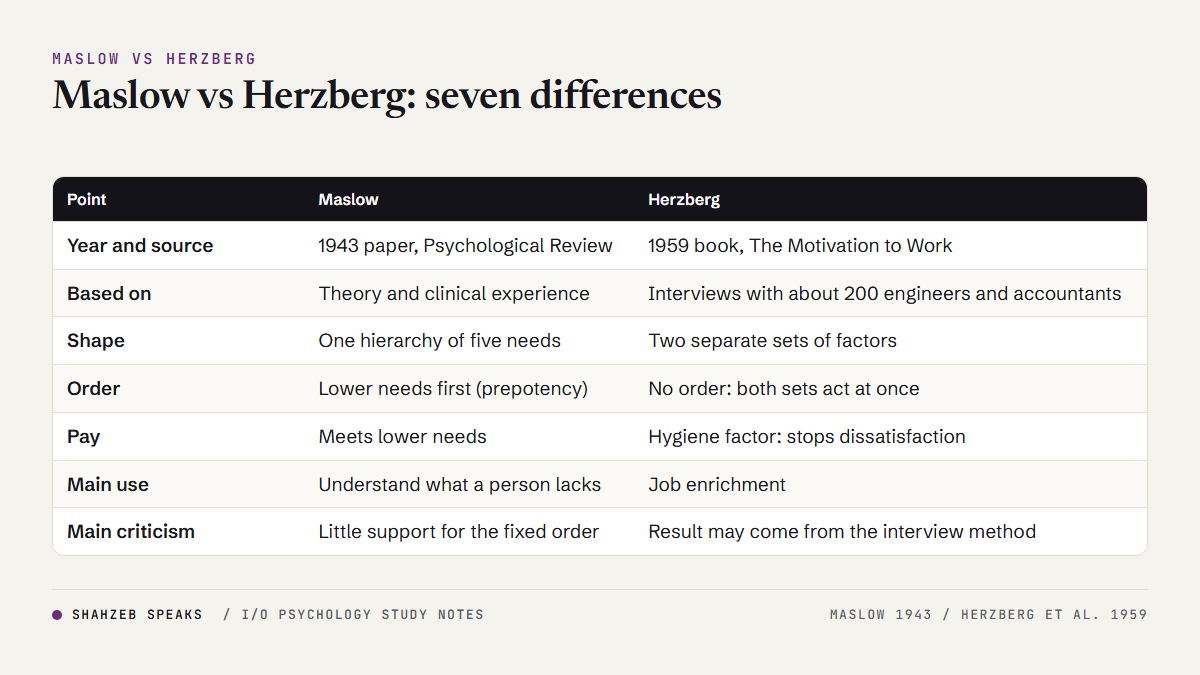
| Point of difference | Maslow (1943) | Herzberg (1959) |
|---|---|---|
| Year and source | 1943 paper, Psychological Review | 1959 book, The Motivation to Work (with Mausner and Snyderman) |
| Based on | Theory and clinical experience | Interviews with about 200 engineers and accountants |
| Scope | All human motivation, in and out of work | Job attitudes at work |
| Shape of the theory | One hierarchy of five needs | Two separate sets of factors |
| Order | Lower needs first (prepotency), though not rigid | No order: both sets act at the same time |
| Satisfaction and dissatisfaction | Not separated; an unmet need simply drives behaviour | Two separate scales: hygiene factors affect dissatisfaction, motivators affect satisfaction |
| Pay | Usually read as meeting lower needs (food, shelter, security) | Hygiene factor: stops dissatisfaction, does not create lasting motivation |
| Main use for managers | Understand which need a person is short of | Job enrichment: put achievement, responsibility and growth into the job |
| Main criticism | Little evidence for five distinct needs in a fixed order (Wahba & Bridwell, 1976) | The two-factor split may be produced by the interview method (House & Wigdor, 1967; King, 1970) |
| Exam label | Content theory (needs) | Content theory (factors in the job) |
Similarities between Maslow and Herzberg
Examiners often ask for similarities as well as differences. These four are safe to write:
- Both are content theories. They answer the question “what motivates people?” rather than “how does the motivation process work?” (which is what process theories such as expectancy and equity theory ask).
- Both separate lower and higher needs. Maslow’s lower levels sit close to Herzberg’s hygiene factors. Maslow’s esteem and self-actualisation sit close to Herzberg’s motivators.
- Both say money is not the whole story. Once basic needs are met, both point to growth, achievement and recognition.
- Both are weakly supported by later research in their strict form, and both remain popular because they are easy to apply.
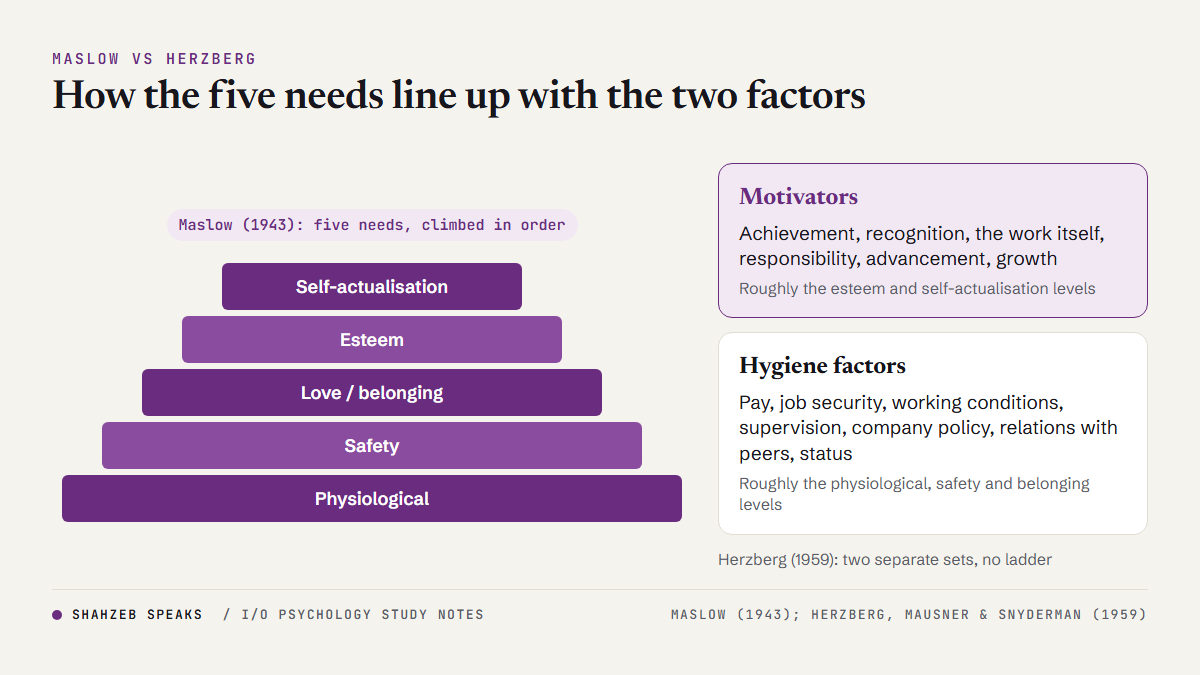
Look closely at the diagram and you will see where the mapping breaks. Status sounds like an esteem need, but Herzberg listed it as a hygiene factor. Relationships with peers sound like belonging, and Herzberg also put them under hygiene. Recognition sounds like esteem and is a motivator. If you point out one of these mismatches in an exam, you show the examiner you understand both theories rather than a memorised chart.
Which is better, Maslow or Herzberg?
Neither wins on evidence. Wahba and Bridwell (1976) reviewed the research on Maslow’s hierarchy and found only partial support, with little evidence for five distinct needs in a fixed order. Herzberg’s split has a different problem. Reviewers such as House and Wigdor (1967) and King (1970) argued that the clean two-factor result depends on the critical incident method. When people tell stories, they tend to credit themselves for good events (achievement, recognition) and blame their surroundings for bad events (policy, supervisor, pay). Studies using other methods often found that one factor could both satisfy and dissatisfy.
So the honest answer is this. Maslow is more useful for understanding a person: what is this employee short of right now? Herzberg is more useful for designing a job: what can we put into the work itself? Herzberg’s ideas led directly to job enrichment and later to Hackman and Oldham’s Job Characteristics Model, which is better supported than either. If you need a more flexible needs theory, Alderfer’s ERG theory (1969) dropped the strict order and allowed several needs to act at once.
A Pakistani workplace example
A CSS-style question asks which theory you would prefer in the Pakistani context. Here is how I would build the example. The people below are illustrations, not a study.
Case 1: a teller in a Karachi bank branch. Sana has a permanent job, a fixed salary that arrives on time, medical cover and a clean, air-conditioned branch. Her hygiene factors are mostly fine, and she does not complain much. But she has done the same cash-counter work for four years, nobody asks her opinion, and she cannot see a path to promotion. Herzberg would say she is “not dissatisfied” but also not motivated. A pay rise would not change much. Giving her responsibility for a small customer portfolio, training a new joiner, or a clear route to an officer role would. Maslow would describe the same gap as unmet esteem needs.
Case 2: a contract worker in a Faisalabad textile mill. Bilal is paid daily, wages are sometimes late, and he does not know if the contract will be renewed next month. Telling Bilal his work is meaningful will not help much. Maslow’s point that pressing physiological and safety needs dominate is the better guide here, and Herzberg would agree that poor hygiene factors (pay, security, conditions) must be fixed first because they create strong dissatisfaction.
My answer to “which suits Pakistan?” Use both, for different jobs. Where pay and job security are weak, which is common in informal and contract work, Maslow’s warning about lower needs is the right starting point. Where pay and security are reasonable, as in many banks, multinationals, universities and government offices, Herzberg’s motivators explain why people still feel flat. Add one caution in the exam: Herzberg’s sample was 1950s American engineers and accountants, so his lists should be tested, not assumed, in a different culture. If you want the wider context of the field here, read my page on industrial psychology in Pakistan.
10-mark answer structure: “Compare Maslow’s and Herzberg’s theories of motivation”
- Introduction (2-3 lines): both are content theories of work motivation; Maslow (1943, Psychological Review); Herzberg, Mausner and Snyderman (1959, The Motivation to Work).
- Maslow in brief: five needs, prepotency, “not rigid”, draw the five levels as a simple ladder or pyramid.
- Herzberg in brief: about 200 engineers and accountants, critical incident interviews; list 4-5 motivators and 4-5 hygiene factors; two separate scales.
- Differences (the core, 4-5 points): source of evidence, one hierarchy vs two sets, order vs no order, single vs two scales, role of pay. A short table earns marks.
- Similarities (2 points): both content theories; lower needs map roughly to hygiene, higher needs to motivators. Mention one mismatch (status is hygiene).
- Example: one workplace example, ideally local (bank teller vs daily-wage mill worker).
- Criticism: Wahba and Bridwell (1976) on Maslow; House and Wigdor (1967) or King (1970) on Herzberg’s method.
- Conclusion: Maslow helps diagnose the person, Herzberg helps design the job; both are simplified, and later theories (ERG, Job Characteristics Model) built on them.
Model opening line: “Maslow (1943) and Herzberg (1959) both explain what motivates people, but Maslow describes one ladder of human needs while Herzberg argues that the factors that satisfy us at work are different from the factors that dissatisfy us.”
Practice MCQs: Maslow vs Herzberg
These are practice questions written to the published syllabus, not past-paper questions.
-
Herzberg’s two-factor theory was first set out in which source?
- A 1943 paper in Psychological Review
- The 1959 book The Motivation to Work by Herzberg, Mausner and Snyderman
- A 1960 book on Theory X and Theory Y
- A 1976 test of the Job Characteristics Model
Show answer
B. The two-factor theory comes from the 1959 book. A is Maslow’s paper, C is McGregor, and D is Hackman and Oldham.
-
A bank pays well, on time, and has a pleasant office, but staff say they feel flat and bored. According to Herzberg, what is missing?
- Hygiene factors
- Motivators such as achievement, responsibility and growth
- Safety needs
- Better supervision
Show answer
B. Good hygiene removes dissatisfaction but does not create motivation; the job itself lacks motivators. A and D are hygiene factors, which are already fine. C is a Maslow term, and safety looks met.
-
Which of these is a hygiene factor in Herzberg’s theory, even though it sounds like an esteem need?
- Recognition
- Achievement
- Status
- Growth
Show answer
C. Herzberg listed status among the hygiene factors. Recognition, achievement and growth are motivators.
-
What did Maslow mean by “prepotency”?
- Higher needs always matter more than lower needs
- A strongly unmet lower need dominates, and higher needs come forward as lower ones are satisfied
- All five needs are equally strong at all times
- Pay is the strongest motivator
Show answer
B. Prepotency is the idea that lower needs take priority when they are badly unmet. A reverses it, C denies the hierarchy, and Maslow said nothing like D.
-
Which statement about Maslow’s 1943 paper is NOT true?
- He said the hierarchy is not as rigid as it may seem
- He said a need must be 100 per cent satisfied before the next one appears
- He named five groups of needs
- He said the theory came most directly from clinical experience
Show answer
B. Maslow explicitly rejected the 100 per cent idea and gave illustrative partial percentages. A, C and D are all in the paper.
-
Herzberg argued that the opposite of job satisfaction is:
- Job dissatisfaction
- No job satisfaction
- Low pay
- Unmet esteem needs
Show answer
B. In his model satisfaction and dissatisfaction sit on two separate scales, so the opposite of satisfaction is no satisfaction. A is the single-scale view he rejected.
-
The main criticism of Herzberg’s evidence is that:
- The sample was too large
- People in critical incident interviews tend to credit themselves for good events and blame their surroundings for bad ones
- He used a questionnaire with no open questions
- He studied only factory workers
Show answer
B. Critics such as House and Wigdor (1967) and King (1970) argued the split depends on the story-telling method. The sample was small (about 200), the method was interviews, and the people were engineers and accountants.
-
A daily-wage worker whose pay is often late is offered an “Employee of the Month” certificate. Which reading of both theories fits best?
- It will motivate him because recognition is a motivator
- It will help little until pay and security are fixed
- It will satisfy his self-actualisation need
- It proves Herzberg wrong
Show answer
B. Maslow would say pressing lower needs dominate; Herzberg would say poor hygiene causes strong dissatisfaction that recognition does not remove. A ignores the hygiene problem, C and D do not follow.
-
Which statement is a SIMILARITY between Maslow and Herzberg?
- Both were based on interviews with engineers
- Both are content theories about what motivates people
- Both say needs must be met in a fixed order
- Both treat pay as the main motivator
Show answer
B. Both are content theories. Only Herzberg used interviews, only Maslow proposed an order, and neither treats pay as the main motivator.
-
Who showed that Maslow never drew the famous pyramid himself?
- Wahba and Bridwell (1976)
- Bridgman, Cummings and Ballard (2019)
- House and Wigdor (1967)
- Alderfer (1969)
Show answer
B. Bridgman, Cummings and Ballard traced the pyramid to management writers around 1960. A reviewed evidence for the hierarchy, C criticised Herzberg, and D proposed ERG theory.
Practise on your phone
The free I/O Psychology Prep app has 410 explained
questions, flashcards and an exam countdown, and works offline. Get it on Google Play
· About the app
Want 25 more questions across all motivation theories? Try the work motivation MCQ set.
Questions students ask
What is the main difference between Maslow and Herzberg?
Maslow describes one ladder of five needs that people move up as lower needs are met. Herzberg describes two separate sets of job factors: hygiene factors that only prevent dissatisfaction and motivators that create satisfaction. Maslow is about the person’s needs in general; Herzberg is about features of the job.
Is salary a motivator according to Herzberg?
No. Herzberg classed salary as a hygiene factor. Poor or unfair pay causes dissatisfaction, and fixing it removes that dissatisfaction, but in his theory more pay does not create lasting motivation. Many later researchers disagree and argue pay can motivate, especially when it is tied to performance or seen as fair.
How are Maslow’s needs related to Herzberg’s factors?
Roughly, Maslow’s physiological, safety and belonging needs match Herzberg’s hygiene factors, and esteem and self-actualisation match the motivators. The match is not exact: status sounds like esteem but is a hygiene factor, and peer relations sound like belonging but are also hygiene.
Which theory is better for the Pakistani context?
Use both, for different jobs. Where pay and job security are weak, Maslow’s point that lower needs dominate is the better guide. Where pay and security are reasonable, Herzberg explains why people still feel unmotivated and points to job enrichment. Note that Herzberg’s sample was American professionals in the 1950s.
Is Herzberg’s theory a content theory or a process theory?
It is a content theory, like Maslow’s hierarchy, ERG theory and McClelland’s needs. Content theories say what motivates people. Process theories, such as Vroom’s expectancy theory, Adams’s equity theory and goal-setting theory, explain how motivation works as a thinking process.
Did Maslow draw the hierarchy as a pyramid?
No. Maslow described a hierarchy in words in 1943. Bridgman, Cummings and Ballard (2019) traced the pyramid drawing to management writers around 1960. You can still draw a pyramid in an exam, but saying where it came from is a good extra point.
Why is Herzberg’s theory criticised?
Mainly for its method. In critical incident interviews people tend to credit themselves for good events and blame their surroundings for bad ones, which could produce the two-factor split by itself. Reviewers such as House and Wigdor (1967) and King (1970) made this point, and studies using other methods often did not find a clean split.
Practise on your phone
The free I/O Psychology Prep app has 410 explained
questions, flashcards and an exam countdown, and works offline. Get it on Google Play
· About the app
References
- Alderfer, C. P. (1969). An empirical test of a new theory of human needs. Organizational Behavior and Human Performance, 4(2), 142-175. https://doi.org/10.1016/0030-5073(69)90004-X
- Bridgman, T., Cummings, S., & Ballard, J. (2019). Who built Maslow’s pyramid? A history of the creation of management studies’ most famous symbol and its implications for management education. Academy of Management Learning & Education, 18(1), 81-98. https://doi.org/10.5465/amle.2017.0351
- Herzberg, F. (1968). One more time: How do you motivate employees? Harvard Business Review, 46(1), 53-62.
- Herzberg, F., Mausner, B., & Snyderman, B. B. (1959). The motivation to work. Wiley.
- House, R. J., & Wigdor, L. A. (1967). Herzberg’s dual-factor theory of job satisfaction and motivation: A review of the evidence and a criticism. Personnel Psychology, 20(4), 369-390. https://doi.org/10.1111/j.1744-6570.1967.tb02440.x
- King, N. (1970). Clarification and evaluation of the two-factor theory of job satisfaction. Psychological Bulletin, 74(1), 18-31. https://doi.org/10.1037/h0029444
- Maslow, A. H. (1943). A theory of human motivation. Psychological Review, 50(4), 370-396. https://doi.org/10.1037/h0054346
- Wahba, M. A., & Bridwell, L. G. (1976). Maslow reconsidered: A review of research on the need hierarchy theory. Organizational Behavior and Human Performance, 15(2), 212-240. https://doi.org/10.1016/0030-5073(76)90038-6
This page is part of my guide to work motivation theories. Read next: Herzberg’s two-factor theory, ERG theory vs Maslow, Theory X and Theory Y and job enrichment vs job enlargement.