
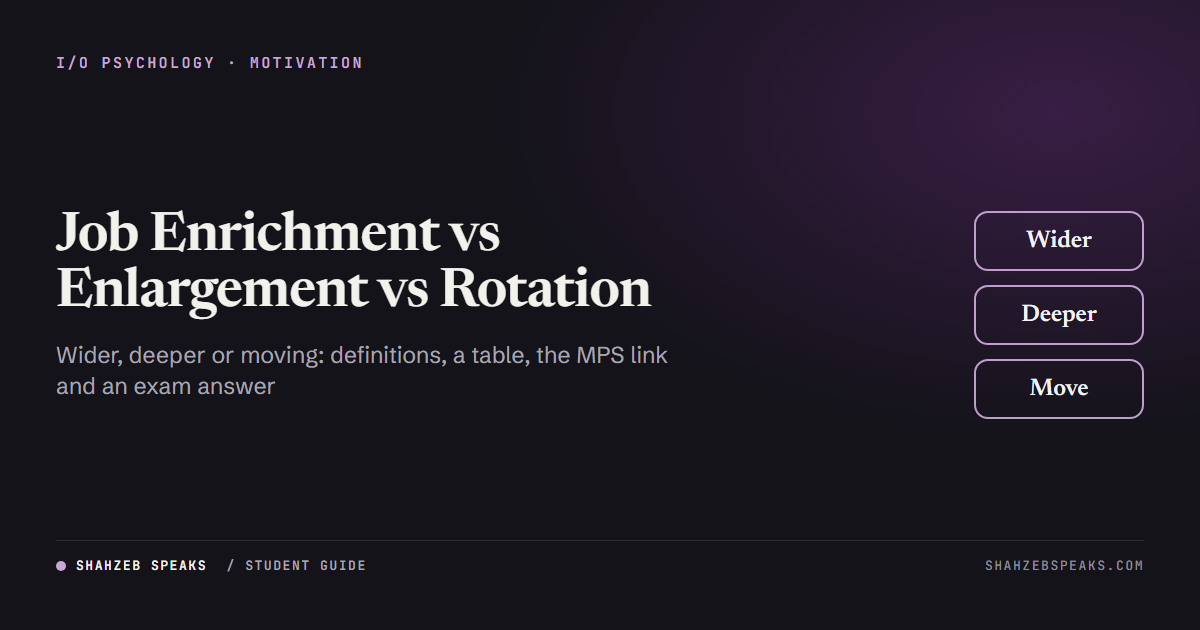
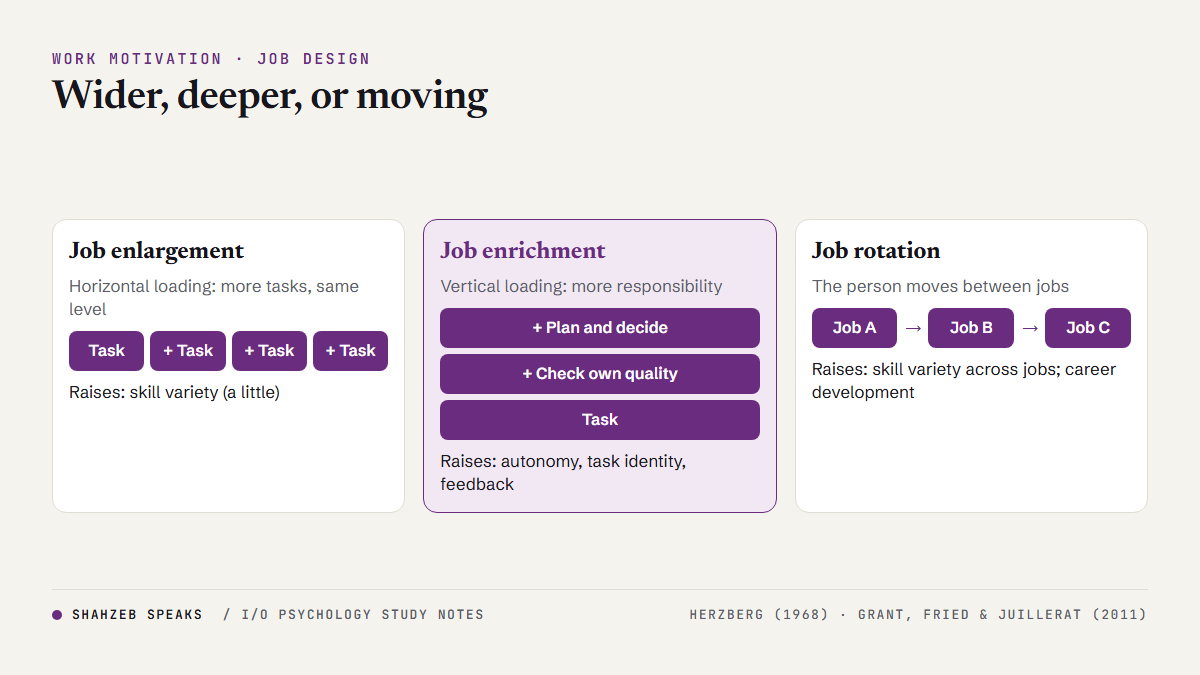
Job enlargement adds more tasks at the same level (horizontal). Job enrichment adds higher-level responsibility, such as planning, decisions and checking your own work (vertical). Job rotation moves people between different jobs over time. Herzberg (1968) argued that only enrichment motivates; later research by Campion and colleagues largely supports him.
These three job design methods appear together in almost every HRM, organisational behaviour and I/O psychology syllabus, and examiners love to ask for the difference. This page gives you a clear definition of each, a comparison table, a worked example from a textile mill, what the research actually found, how all three connect to Hackman and Oldham’s Job Characteristics Model and the Motivating Potential Score, an exam answer structure and practice MCQs.
What is job enlargement?
Job enlargement means adding more tasks of a similar level to a job. The job becomes wider, not deeper. Herzberg called this horizontal job loading. A review chapter by Grant, Fried and Juillerat (2011) defines enlargement as adding requirements at the same level to expand the scope of the job.
Example: a bank clerk who only entered cheque details now also files the cheques and stamps deposit slips. There is more variety, but no more say over the work.
Enlargement can reduce boredom from very repetitive work. Its risk is that it simply gives people more to do. Herzberg’s well-known criticism was that adding more meaningless tasks does not make a job more meaningful.
What is job enrichment?
Job enrichment means adding higher-level responsibilities to a job, so the person plans, decides, controls quality and gets feedback on their own work. Herzberg called this vertical job loading in his 1968 Harvard Business Review article “One More Time: How Do You Motivate Employees?”. It follows from his two-factor theory: motivators such as achievement, recognition, responsibility and growth come from the content of the job itself (see Herzberg’s two-factor theory).
Example: the same bank clerk now handles a complete set of customer accounts, resolves routine queries without asking a supervisor, and sees a weekly error report for their own work.
Typical ways to enrich a job are to give a complete piece of work rather than a fragment, to remove some supervisory checks while keeping the person accountable, to let people contact clients directly, and to give direct feedback from the work.
What is job rotation?
Job rotation means moving employees between different jobs or departments at planned intervals. The jobs themselves may not change; the person moves. Management trainee programmes in banks and multinational companies often work this way, and a nurse may rotate between wards.
Rotation is mainly a development and variety tool. In a study of 255 employees, Campion, Cheraskin and Stevens (1994) found that rotation was predicted by tenure and performance, and was related to career outcomes such as salary growth and promotion, and to employees’ sense that they were gaining skills.
Job enrichment vs job enlargement vs job rotation: comparison table
| Point | Job enlargement | Job enrichment | Job rotation |
|---|---|---|---|
| What changes | More tasks at the same level | More responsibility, control and feedback | The person moves between jobs |
| Direction | Horizontal loading | Vertical loading | Lateral movement over time |
| Linked to | Reducing monotony | Herzberg’s motivators; Job Characteristics Model | Training, career development, cover for absences |
| Main JCM dimension raised | Skill variety (a little) | Autonomy, task identity, feedback | Skill variety across jobs |
| Main benefit | Less boredom, more flexible staff | Higher intrinsic motivation and satisfaction | Broader skills, better understanding of the organisation |
| Main risk | Overload: “more of the same” | Needs training and trust; not everyone wants it | Learning time and lost productivity in each move |
| Example (textile mill) | A checker inspects fabric and also labels and packs rolls | A checker owns a whole batch, decides on rework and sees daily defect data | A trainee spends three months each in spinning, weaving and finishing |
What did the research find?
The clearest test comes from Michael Campion and Carol McClelland, who studied job redesign among clerical staff and managers in a financial services organisation. As summarised by Grant, Fried and Juillerat (2011):
- First study (1991): enlarged jobs were linked to higher satisfaction, less boredom, a better chance of catching errors and better customer service, but they needed more training, higher skills and higher pay.
- Follow-up two years later (1993): the method mattered. Jobs enlarged by adding more low-level tasks became increasingly costly: people were less satisfied and efficient, felt more overloaded, made more errors and gave poorer service. Jobs that were instead enriched with higher-level responsibility (understanding the organisation’s procedures and rules) showed mostly benefits: more satisfaction, less overload, fewer errors and better service.
Grant and colleagues conclude that these results support Herzberg’s and Hackman and Oldham’s argument that enrichment brings greater benefits than enlargement. A large meta-analysis by Humphrey, Nahrgang and Morgeson (2007) also found that motivational job characteristics such as autonomy and feedback are related to satisfaction and other work outcomes, though no meta-analysis can tell you how a specific redesign will work in your organisation.
How the three link to the Job Characteristics Model and MPS
Hackman and Oldham’s Job Characteristics Model (1975, 1976) describes five core job dimensions: skill variety, task identity, task significance, autonomy and feedback. They combine them into the Motivating Potential Score:
MPS = ((skill variety + task identity + task significance) ÷ 3) × autonomy × feedback
Because autonomy and feedback multiply the score, a job low on either has low motivating potential, however varied it is. This is the mathematical reason enlargement (which mainly adds variety) does little, while enrichment (which raises autonomy and feedback) does a lot.
Worked example: a fabric checker in a textile mill
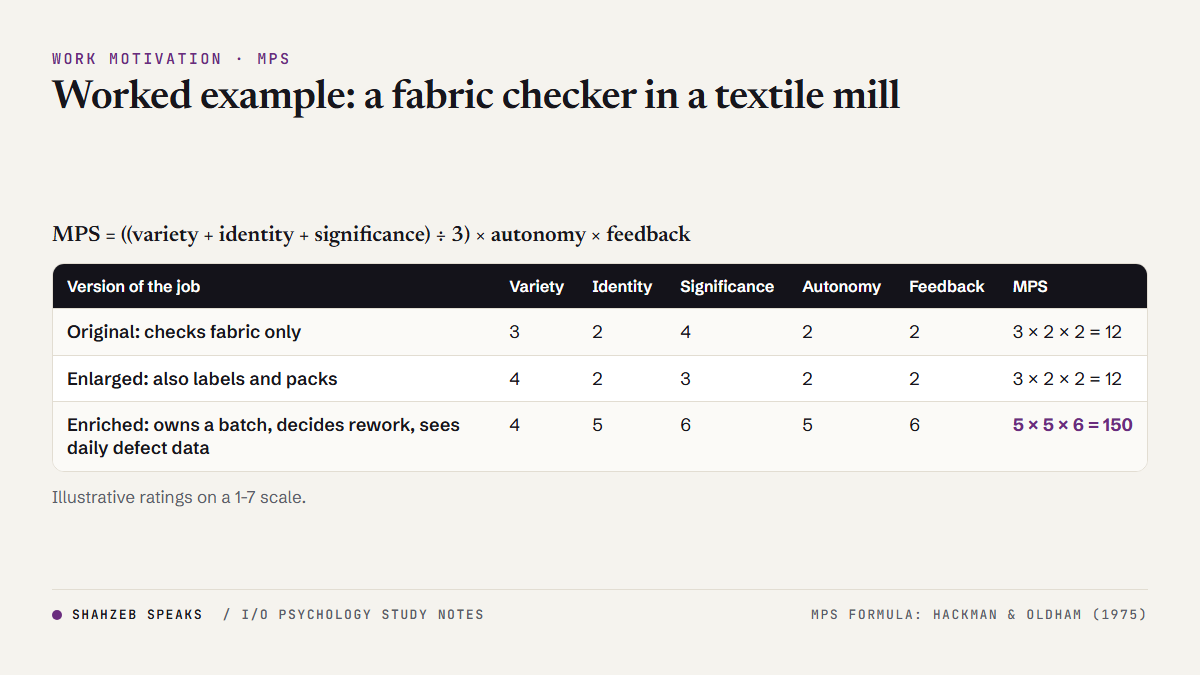
The ratings below are illustrative, on the 1-7 scale used with the Job Diagnostic Survey.
| Version of the job | Variety | Identity | Significance | Autonomy | Feedback | MPS |
|---|---|---|---|---|---|---|
| Original: checks fabric only | 3 | 2 | 4 | 2 | 2 | 3 × 2 × 2 = 12 |
| Enlarged: also labels and packs | 4 | 2 | 3 | 2 | 2 | 3 × 2 × 2 = 12 |
| Enriched: owns a batch, decides rework, sees daily defect data | 4 | 5 | 6 | 5 | 6 | 5 × 5 × 6 = 150 |
Enlargement raised variety a little and changed nothing else, so the MPS stayed at 12. Enrichment raised identity, significance, autonomy and feedback, and the MPS rose to 150. Try your own ratings in the free Motivating Potential Score calculator.
When to use which
- Use enlargement when work is extremely repetitive and short-cycle, and you add tasks that fit naturally together, without overloading people.
- Use enrichment when you want higher motivation and quality, and people have (or can be trained in) the skills to take on decisions. Hackman and Oldham’s model expects people with strong growth needs to respond best.
- Use rotation for training, succession planning and covering absences, or to break up physically tiring work, and plan for the learning time each move costs.
The three can be combined: a management trainee can rotate across departments (rotation) and be given ownership of a project in each (enrichment).
10-mark answer structure: “Differentiate between job enlargement, job enrichment and job rotation”
- Introduce job design and say all three aim to reduce the problems of narrow, repetitive jobs.
- Define job enlargement (horizontal loading, more tasks at the same level) with an example.
- Define job enrichment (vertical loading, Herzberg 1968) with an example and link to motivators.
- Define job rotation (moving between jobs) with an example; cite Campion et al. (1994) on career outcomes.
- Give a comparison table with at least 5 rows.
- Link to the Job Characteristics Model and write the MPS formula; explain why autonomy and feedback matter most.
- Add research evidence: Campion and McClelland’s follow-up found task enlargement became costly while enrichment brought mostly benefits.
- Conclusion: enrichment motivates, enlargement adds variety, rotation develops; the right choice depends on the goal.
Model opening line: “Job enlargement, job enrichment and job rotation are three job design methods: enlargement widens a job horizontally, enrichment deepens it vertically, and rotation moves the employee between jobs.”
Practice MCQs: job enrichment vs enlargement vs rotation
Practice questions written to the usual HRM and I/O psychology syllabus.
-
Herzberg’s term for job enrichment is:
- Horizontal job loading
- Vertical job loading
- Job rotation
- Job evaluation
Show answer
B. Enrichment adds responsibility and control, which Herzberg called vertical loading. Horizontal loading is enlargement, rotation moves people, and job evaluation sets pay.
-
A data-entry operator now also scans and files the documents she enters. This is:
- Job enrichment
- Job enlargement
- Job rotation
- Job sharing
Show answer
B. She has more tasks at the same level but no more decision-making, so it is enlargement.
-
A hospital ward clerk is given authority to order routine supplies within a budget and receives a monthly report on stock-outs. This is mainly:
- Job enlargement
- Job rotation
- Job enrichment
- Scientific management
Show answer
C. Authority (autonomy) and a direct report (feedback) are vertical additions. Scientific management would narrow the job instead.
-
Using the MPS formula, which change raises the score the most for a job rated 4 on variety, identity and significance, 2 on autonomy and 2 on feedback?
- Raise variety from 4 to 6
- Raise autonomy from 2 to 5
- Raise significance from 4 to 5
- Raise identity from 4 to 5
Show answer
B. The MPS goes from 4 × 2 × 2 = 16 to 4 × 5 × 2 = 40. Raising variety to 6 gives only about 4.67 × 2 × 2 ≈ 19, and the other two options add even less.
-
According to Campion and McClelland’s follow-up study, what happened to jobs enlarged by adding more low-level tasks?
- They became increasingly costly, with more overload and errors
- They had no effects at all
- They produced the highest satisfaction
- They removed the need for training
Show answer
A. Over time, task enlargement brought lower satisfaction and efficiency, more overload, more errors and poorer service. Enriched jobs showed mostly benefits.
-
Which is NOT a usual purpose of job rotation?
- Developing broader skills
- Covering for absent colleagues
- Giving an employee permanent authority over a complete product
- Preparing trainees for management roles
Show answer
C. Giving authority over a complete piece of work is enrichment. The other three are standard reasons for rotation.
-
Campion, Cheraskin and Stevens (1994) found that job rotation was related to:
- Lower salary growth
- Career outcomes such as promotion and salary growth, and perceived skill gains
- Higher absenteeism only
- No measurable outcomes
Show answer
B. In their study of 255 employees, rotation was linked to promotion, salary growth and employees’ sense of gaining skills.
-
Why does job enlargement often fail to raise the MPS much?
- It mainly adds skill variety, while autonomy and feedback multiply the score
- The MPS formula ignores variety
- Enlargement lowers task significance to zero
- MPS only applies to managers
Show answer
A. Variety is averaged with identity and significance, but autonomy and feedback are multipliers. The formula does include variety, and MPS applies to any job.
-
A management trainee spends four months each in credit, operations and branch banking. This is:
- Job enrichment
- Job enlargement
- Job rotation
- Job analysis
Show answer
C. The person moves between different jobs over time, which is rotation.
Practise on your phone
The free I/O Psychology Prep app has 410 explained
questions, flashcards and an exam countdown, and works offline. Get it on Google Play
· About the app
Questions students ask
What is the main difference between job enrichment and job enlargement?
Enlargement adds more tasks at the same level (horizontal), so the job gets wider. Enrichment adds responsibility, control and feedback (vertical), so the job gets deeper. Herzberg argued only enrichment motivates.
Is job rotation a type of job enlargement?
No. In enlargement one job gets more tasks. In rotation the person moves between separate jobs over time. Both can add variety, which is why students confuse them.
Who introduced job enrichment?
Frederick Herzberg made job enrichment widely known, especially through his 1968 Harvard Business Review article, which contrasted vertical job loading (enrichment) with horizontal job loading (enlargement). Hackman and Oldham’s Job Characteristics Model later gave it a measurable form.
What is an example of job enrichment?
A call centre agent who is allowed to resolve refunds up to a set amount without a supervisor, handles a customer’s case from start to finish, and sees her own satisfaction scores each week. That adds autonomy, task identity and feedback.
What does job enrichment mean in simple Urdu or Hindi terms?
In simple words: enlargement is getting more of the same kind of work; enrichment is getting more responsibility and control over your work; rotation is changing seats between different jobs from time to time. Use the English terms in your exam answer.
Which is best for motivation?
Enrichment, according to Herzberg, the Job Characteristics Model and Campion and McClelland’s follow-up study. Rotation is best for development, and enlargement for reducing monotony, as long as it does not overload people.
Practise on your phone
The free I/O Psychology Prep app has 410 explained
questions, flashcards and an exam countdown, and works offline. Get it on Google Play
· About the app
References
- Herzberg, F. (1968). One more time: How do you motivate employees? Harvard Business Review, 46(1), 53-62. Reprinted January 2003. https://hbr.org/2003/01/one-more-time-how-do-you-motivate-employees
- Hackman, J. R., & Oldham, G. R. (1975). Development of the Job Diagnostic Survey. Journal of Applied Psychology, 60(2), 159-170. https://doi.org/10.1037/h0076546
- Hackman, J. R., & Oldham, G. R. (1976). Motivation through the design of work: Test of a theory. Organizational Behavior and Human Performance, 16(2), 250-279. https://doi.org/10.1016/0030-5073(76)90016-7
- Campion, M. A., & McClelland, C. L. (1993). Follow-up and extension of the interdisciplinary costs and benefits of enlarged jobs. Journal of Applied Psychology, 78(3), 339-351. https://doi.org/10.1037/0021-9010.78.3.339
- Campion, M. A., Cheraskin, L., & Stevens, M. J. (1994). Career-related antecedents and outcomes of job rotation. Academy of Management Journal, 37(6), 1518-1542. https://doi.org/10.2307/256797
- Humphrey, S. E., Nahrgang, J. D., & Morgeson, F. P. (2007). Integrating motivational, social, and contextual work design features: A meta-analytic summary and theoretical extension of the work design literature. Journal of Applied Psychology, 92(5), 1332-1356. https://doi.org/10.1037/0021-9010.92.5.1332
- Grant, A. M., Fried, Y., & Juillerat, T. (2011). Work matters: Job design in classic and contemporary perspectives. In S. Zedeck (Ed.), APA handbook of industrial and organizational psychology, Vol. 1 (pp. 417-453). American Psychological Association. https://doi.org/10.1037/12169-013
Part of the Work Motivation Theories hub. Read next: Job Characteristics Model and MPS, Herzberg’s two-factor theory, Maslow vs Herzberg and the work motivation MCQs.