

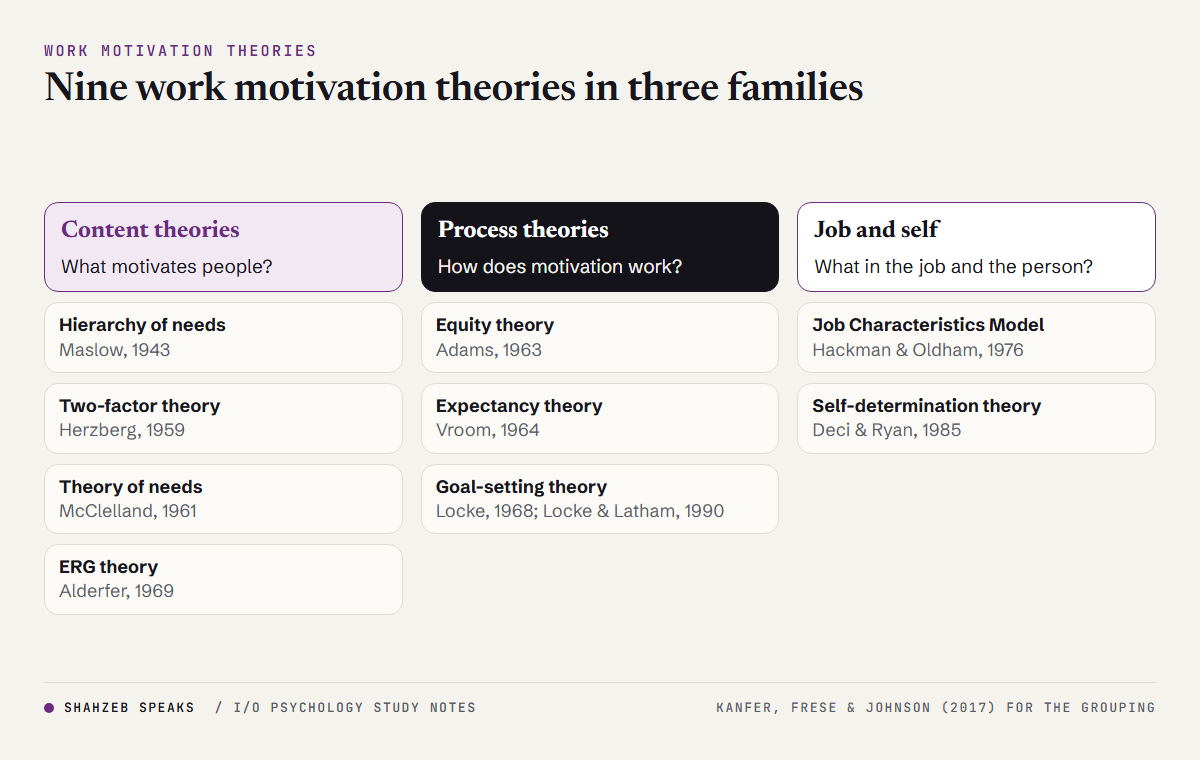
Work motivation theories explain why people start, direct and keep up effort at work. Content theories ask what motivates people (Maslow 1943, Herzberg 1959, McClelland 1961, Alderfer 1969). Process theories ask how motivation works (Adams 1963, Vroom 1964, Locke 1968). The Job Characteristics Model (1976) and self-determination theory (1985) focus on the job and the self.
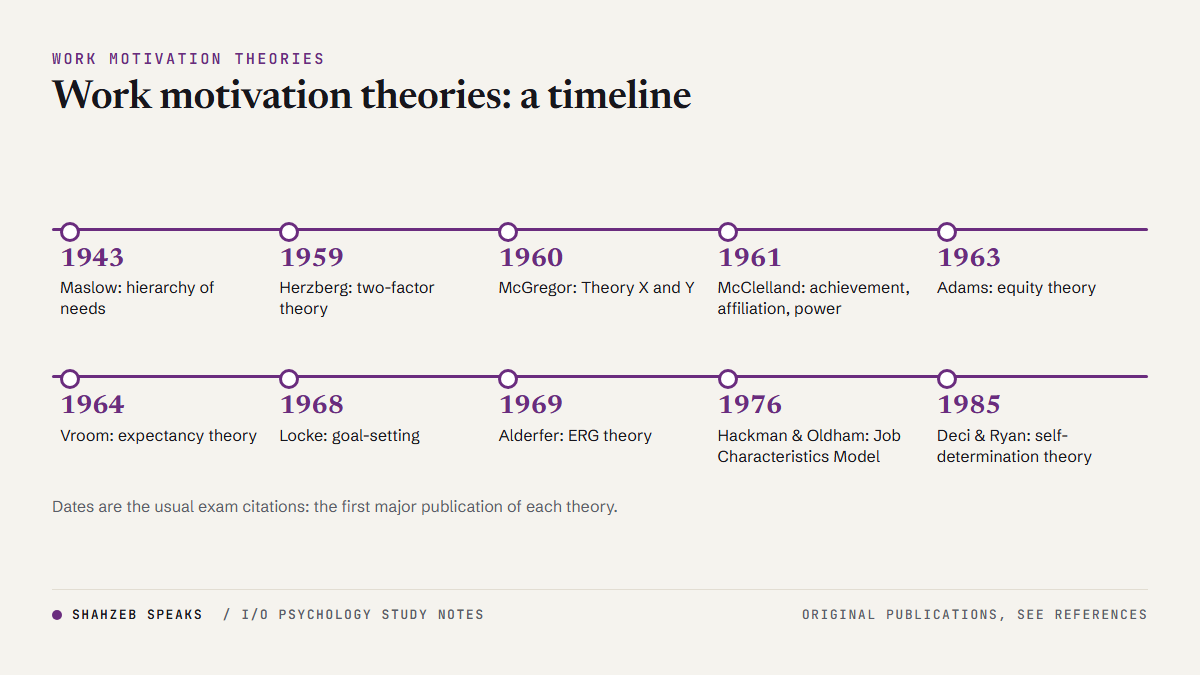
If you are studying organisational behaviour, HRM or I/O psychology, motivation is one of the biggest units on the syllabus, and the questions repeat: “Distinguish between content and process theories”, “Compare any two theories of motivation”, “Which theory is most useful for managers?” This page is the hub for all of them. It puts nine theories in one comparison table, sorts them into families with a diagram and a timeline, explains each in plain words, tells you honestly which ones the research supports, shows how to apply them to a real workplace, and gives you a 10-mark exam structure and 10 practice MCQs with explanations. Each theory also has its own detailed page, linked as you go.
What is work motivation?
Most textbooks describe motivation through three features of behaviour:
- Direction: what a person chooses to put effort into (finishing the report or chatting with friends).
- Intensity: how hard they try once they have chosen.
- Persistence: how long they keep trying, especially when it gets difficult.
Motivation is not the same as performance. Performance also depends on ability, training, tools and the situation. A highly motivated new cashier can still make mistakes, and a skilled but unmotivated one can do the minimum.
Motivation is also not the same as job satisfaction. A person can enjoy a job and still put in little effort, or dislike a job and work very hard to earn a promotion out of it. Satisfaction is covered in my page on job satisfaction theories and measures.
Content vs process theories: what is the difference?
This is the classic exam question, and it has a short answer you should memorise.
- Content theories ask what motivates people. They name needs or factors inside the person or the job: Maslow’s five needs, Herzberg’s motivators, McClelland’s need for achievement, Alderfer’s existence, relatedness and growth.
- Process theories ask how motivation works. They describe the thinking a person goes through before and during effort: “Will my effort pay off?” (Vroom), “Am I treated fairly compared with others?” (Adams), “What exactly am I aiming for?” (Locke and Latham).
Kanfer, Frese and Johnson (2017), reviewing a century of work motivation research in the Journal of Applied Psychology, grouped theories by their main focus: content (motives and traits), context (features of the job and environment) and process (how people choose and strive). That third “context” family is useful because some important theories, such as the Job Characteristics Model, do not fit neatly into the old two-way split. In this page I group the Job Characteristics Model and self-determination theory as “job and self” theories.
| Point | Content theories | Process theories |
|---|---|---|
| Main question | What motivates people? | How does motivation work? |
| Focus | Needs and factors inside the person or the job | Thinking: expectations, comparisons, goals |
| Examples | Maslow, Herzberg, McClelland, Alderfer (ERG) | Vroom (expectancy), Adams (equity), Locke and Latham (goal-setting) |
| Treats people as | Having similar needs | Reasoning differently in different situations |
| Manager’s question | Which needs can I meet? | Which expectations, comparisons or goals can I change? |
| Main weakness | Needs are hard to measure and vary across people | Can assume people calculate more carefully than they do |
All 9 motivation theories compared in one table
This is the table to copy into your notes. The “evidence today” column is my short summary of the research cited further down the page.
| Theory | Who and year | Type | Core idea | Key exam terms | Evidence today |
|---|---|---|---|---|---|
| Hierarchy of needs | Abraham Maslow, 1943 | Content | Five needs; a higher need comes forward as lower ones are mostly met | Physiological, safety, love (belonging), esteem, self-actualisation; prepotency | Weak for the fixed order (Wahba and Bridwell, 1976) |
| ERG theory | Clayton Alderfer, 1969 | Content | Three needs that can act at the same time; frustrated higher needs push people back to lower ones | Existence, relatedness, growth; frustration-regression | More flexible than Maslow; taught mainly as an improvement on it |
| Two-factor theory | Frederick Herzberg, Bernard Mausner and Barbara Snyderman, 1959 | Content | Satisfaction and dissatisfaction come from different factors | Hygiene factors, motivators, job enrichment | Split may come from the interview method (House and Wigdor, 1967; King, 1970) |
| Theory of needs | David McClelland, 1961 | Content | Three learned needs, in different strengths in each person | nAch, nAff, nPow; picture-story (TAT-style) measures | Useful ideas; reliability of story-based measures questioned (Entwisle, 1972) |
| Equity theory | J. Stacy Adams, 1963, 1965 | Process | People compare their outcome-to-input ratio with others and act to restore fairness | Inputs, outcomes, referent other, under-reward, over-reward | Fairness clearly matters; grew into organisational justice research |
| Expectancy theory | Victor Vroom, 1964 | Process | Effort depends on expecting success, linking success to rewards, and valuing those rewards | Expectancy, instrumentality, valence; MF = E × I × V | Modest support; correlations lower than early reviews suggested (Van Eerde and Thierry, 1996) |
| Goal-setting theory | Edwin Locke, 1968; Locke and Gary Latham, 1990, 2002 | Process | Specific, difficult goals produce higher performance than easy or “do your best” goals | Specificity, difficulty, commitment, feedback | Strongest and most consistent support (Locke and Latham, 2002) |
| Job Characteristics Model | J. Richard Hackman and Greg Oldham, 1975, 1976 | Job design (context) | Five job dimensions create three psychological states that drive motivation | Skill variety, task identity, task significance, autonomy, feedback; MPS; growth need strength | Supported with caveats (Fried and Ferris, 1987; Humphrey and colleagues, 2007) |
| Self-determination theory | Edward Deci and Richard Ryan, 1985, 2000 | Needs plus quality of motivation | Meeting needs for autonomy, competence and relatedness builds autonomous motivation | Autonomous vs controlled motivation; intrinsic vs extrinsic | Large and growing body of research (Deci, Olafsen and Ryan, 2017) |
McGregor’s Theory X and Theory Y (1960) is often taught in the same unit. It is not a theory of what motivates workers so much as a description of the assumptions managers hold about them, which is why I have kept it out of the nine. It is still worth knowing, and it links Maslow to modern ideas about autonomy.
Content theories explained
Maslow’s hierarchy of needs (1943)
Abraham Maslow proposed five groups of needs: physiological, safety, love (belonging), esteem and self-actualisation. When a lower need is badly unmet, it dominates; as it becomes more satisfied, the next need comes forward. Maslow himself said the order is not rigid and that a need does not have to be fully met before the next appears. At work, the theory reminds managers that a worker worried about rent or safety will not respond to talk of self-fulfilment. Wahba and Bridwell (1976) reviewed the research and found only partial support, with little evidence for five distinct needs in a fixed order.
Alderfer’s ERG theory (1969)
Clayton Alderfer reduced Maslow’s five needs to three: existence (material and physical needs), relatedness (relationships) and growth (development). Two changes matter for exams. First, several needs can be active at once. Second, the frustration-regression idea: if a person cannot satisfy a higher need, such as growth, they may turn back to a lower one, such as asking for more pay. The page on ERG theory vs Maslow covers this in detail.
Herzberg’s two-factor theory (1959)
Herzberg, Mausner and Snyderman interviewed about 200 engineers and accountants in the Pittsburgh area about times they felt exceptionally good or bad about their jobs. Good times were mostly about the job’s content (achievement, recognition, the work itself, responsibility, advancement, growth); bad times mostly about its context (company policy, supervision, salary, working conditions, relations with others, security). Herzberg concluded that hygiene factors only prevent dissatisfaction, while motivators create satisfaction. Critics argued the split may come from the critical incident interviews, because people credit themselves for good events and blame their surroundings for bad ones. Its lasting legacy is job enrichment. Full details: Herzberg’s two-factor theory and Maslow vs Herzberg.
McClelland’s theory of needs (1961)
David McClelland focused on three needs that people learn through experience rather than being born with: the need for achievement (nAch: to do things better and meet standards of excellence), affiliation (nAff: warm, close relationships) and power (nPow: to influence others). Everyone has all three in different strengths. His best-known work, The Achieving Society (1961), linked achievement motivation to entrepreneurship and economic growth. The needs were measured by asking people to write stories about ambiguous pictures, a method based on the Thematic Apperception Test; Entwisle (1972) questioned the reliability of these story-based measures. Read more: McClelland’s theory of needs.
Process theories explained
Vroom’s expectancy theory (1964)
Victor Vroom argued that people choose how much effort to give by weighing three beliefs:
- Expectancy (E): “If I try hard, will I perform well?” (effort to performance)
- Instrumentality (I): “If I perform well, will I get the outcome?” (performance to reward)
- Valence (V): “Do I value that outcome?”
The usual exam formula is motivational force = E × I × V. Because the terms are multiplied, if any one is close to zero, motivation collapses. A sales officer who believes targets are impossible (low E), or that bonuses go to the manager’s favourites (low I), or who does not care about the prize on offer (low V) will not push, however strong the other two beliefs are. Van Eerde and Thierry (1996) combined 77 studies and found the average correlations were somewhat lower than earlier narrative reviews had suggested. Try the numbers yourself with my free expectancy theory calculator, which also has a student section on the formula.
Adams’s equity theory (1963, 1965)
J. Stacy Adams proposed that people compare the ratio of their outcomes (pay, recognition, promotion) to their inputs (effort, skill, time, qualifications) with the same ratio for a referent other, such as a colleague. If the ratios feel unequal, the person feels tension and acts to restore balance: by working less, asking for more, changing how they see the comparison, choosing a different person to compare with, or leaving. Adams presented it as a special case of Festinger’s cognitive dissonance. The theory explains why the same pay rise can please one employee and anger another, and it grew into the wider field of organisational justice. Full guide with a worked example: equity theory of motivation.
Locke and Latham’s goal-setting theory (1968, 1990)
Edwin Locke (1968) proposed that conscious goals regulate effort. With Gary Latham he built the theory over decades; their 2002 review in American Psychologist summarised 35 years of research. The core finding: specific, difficult goals lead to higher performance than easy goals or a vague “do your best”, provided the person is committed, gets feedback and has the ability. Goals work by directing attention, raising effort, increasing persistence and prompting people to find better strategies. Full guide: goal-setting theory.
Job and self: the Job Characteristics Model and SDT
Hackman and Oldham’s Job Characteristics Model (1975, 1976)
This model moves the focus from the person to the job. Five core dimensions (skill variety, task identity, task significance, autonomy and feedback) create three psychological states (experienced meaningfulness, experienced responsibility and knowledge of results), which lead to high internal motivation, quality performance and satisfaction, especially for people high in growth need strength. The Motivating Potential Score combines the dimensions:
MPS = [(Skill variety + Task identity + Task significance) ÷ 3] × Autonomy × Feedback
Fried and Ferris (1987) reviewed nearly 200 studies and found job characteristics related to both attitudes and behaviour, though the exact links to the psychological states were weaker than predicted. Humphrey, Nahrgang and Morgeson (2007) combined 259 studies and extended the model with social features of work. Score any job with my free Motivating Potential Score calculator, and see the full guide on the Job Characteristics Model and the practical comparison of job enrichment vs enlargement vs rotation.
Deci and Ryan’s self-determination theory (1985, 2000)
Self-determination theory (SDT) says people have three basic psychological needs: autonomy (feeling that you choose your actions), competence (feeling effective) and relatedness (feeling connected to others). When these needs are met, people are more self-motivated and healthier; when they are thwarted, motivation and well-being drop (Ryan and Deci, 2000). At work the key distinction is between autonomous motivation (doing the work because it is interesting or personally important) and controlled motivation (doing it because of pressure, rewards or guilt). Deci, Olafsen and Ryan (2017) reviewed the workplace research and linked need satisfaction to autonomous motivation, high-quality performance and wellness. Full guide: self-determination theory at work.
Which motivation theory is best?
Students ask this in almost every class, and examiners like a reasoned answer. Here is mine, based on the research cited on this page.
- Best supported: goal-setting theory. Decades of studies in many settings point the same way (Locke and Latham, 2002).
- Well supported, with caveats: the Job Characteristics Model (Fried and Ferris, 1987; Humphrey and colleagues, 2007) and self-determination theory (Deci, Olafsen and Ryan, 2017).
- Useful, more modest support: expectancy theory (Van Eerde and Thierry, 1996) and equity theory, whose central idea that fairness matters is now part of organisational justice research.
- Popular, weakly supported in strict form: Maslow’s hierarchy (Wahba and Bridwell, 1976) and Herzberg’s two-factor split (House and Wigdor, 1967; King, 1970). Teach them, know them, but do not present them as proven.
The better exam answer, though, is that the theories are not rivals. They answer different questions, so a good manager uses several. The diagram below is the way I teach students to choose.
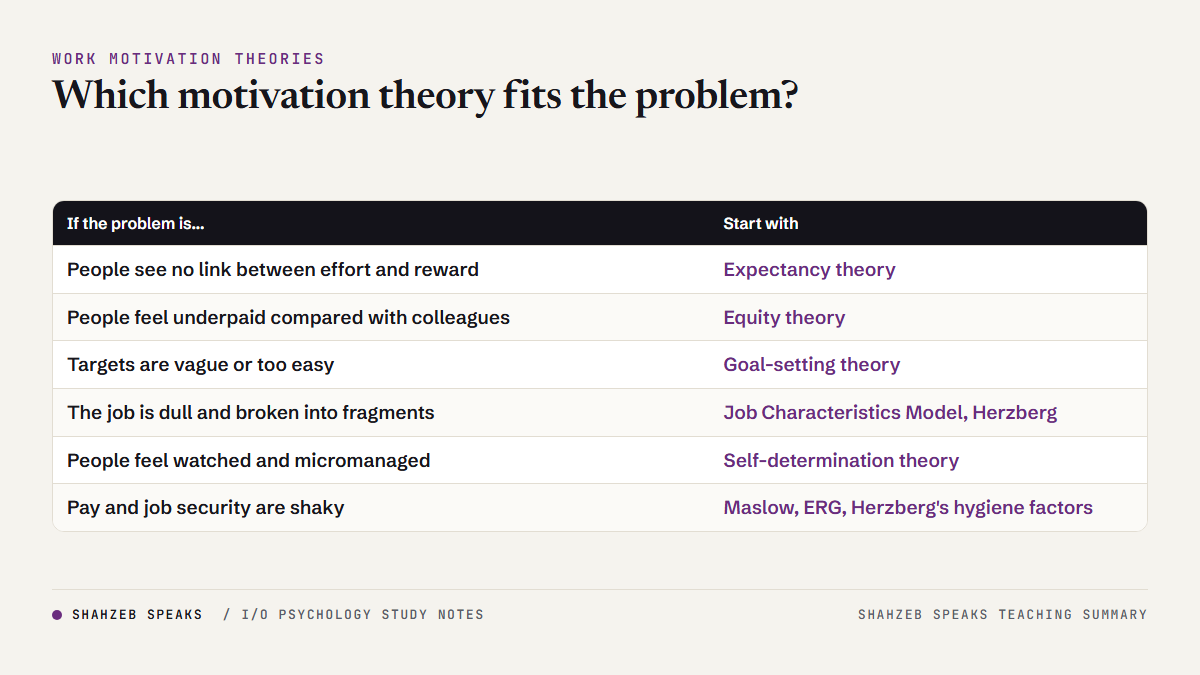
- People see no link between effort and reward: start with expectancy theory.
- People feel underpaid compared with colleagues: start with equity theory.
- Targets are vague or too easy: start with goal-setting theory.
- The job is dull and broken into fragments: start with the Job Characteristics Model and Herzberg.
- People feel watched and micromanaged: start with self-determination theory.
- Pay and job security are shaky: start with Maslow, ERG and Herzberg’s hygiene factors.
Applying the theories: a Pakistani workplace example
Here is one case analysed through several theories, the way a good assignment does it. The hospital and the numbers are illustrations, not a study.
A private hospital in Karachi is losing staff nurses from its medical ward. Exit conversations mention three things: night shifts are assigned unfairly, the yearly increment is the same for everyone regardless of effort, and nurses say they “just follow orders” from doctors and the ward in-charge.
- Equity theory: nurses who work more night shifts than colleagues on the same pay see their outcome-to-input ratio as worse. Expect reduced effort, complaints or resignation. A fair, published rota addresses this directly.
- Expectancy theory: if every nurse gets the same increment, instrumentality is close to zero: extra effort leads to no extra outcome. Linking part of the increment, or a training place, to clear criteria raises it.
- Self-determination theory and the JCM: “just following orders” signals low autonomy. Giving experienced nurses responsibility for a group of patients from admission to discharge raises autonomy and task identity, and a ward board showing patient outcomes adds feedback.
- Goal-setting: instead of “improve patient care”, the ward agrees specific targets, such as completing every discharge education checklist, and reviews progress weekly.
- Maslow and Herzberg: if salaries arrive late or transport home after night shifts is unsafe, none of the above will work until those basic and hygiene problems are fixed.
This kind of multi-theory analysis scores well because it shows you understand that each theory explains a different part of the same problem. If you are interested in how this field works locally, my page on industrial psychology in Pakistan covers it.
Motivation, job attitudes and the rest of Hub B
Motivation sits next to job attitudes on most syllabuses, and examiners often link them. These pages complete the unit:
- Job satisfaction: theories and how it is measured
- Meyer and Allen’s three-component model of commitment
- Organizational citizenship behavior (OCB)
- Counterproductive work behavior (CWB)
- Job enrichment vs job enlargement vs job rotation
For wider reading on the site, see the psychology of employee recognition and the psychology of meaningful work.
10-mark answer structure: “Distinguish between content and process theories of motivation”
- Definition of motivation: direction, intensity and persistence of effort.
- Content theories defined: what motivates; needs and factors. Name 3-4 with authors and years (Maslow 1943, Herzberg 1959, McClelland 1961, Alderfer 1969).
- Process theories defined: how motivation works; expectations, comparisons and goals (Adams 1963, Vroom 1964, Locke 1968).
- One content theory in brief: e.g. Herzberg’s hygiene factors and motivators.
- One process theory in brief: e.g. Vroom’s E × I × V.
- Comparison table: main question, focus, view of people, manager’s question, weakness.
- Beyond the split: the Job Characteristics Model and SDT; Kanfer, Frese and Johnson (2017) add “context”.
- Evidence: goal-setting strongest; Maslow and Herzberg weakest in strict form.
- Example: one workplace analysed with one content and one process theory.
- Conclusion: the two families answer different questions, so managers need both.
Model opening line: “Content theories of motivation, such as those of Maslow (1943) and Herzberg (1959), explain what motivates people, while process theories, such as Vroom’s (1964) expectancy theory and Adams’s (1963) equity theory, explain how people decide how much effort to give.”
Practice MCQs: work motivation theories
Practice questions written to the published syllabus, not past-paper questions. For 25 more, see the work motivation MCQ set.
-
Which of these is a process theory of motivation?
- Maslow’s hierarchy of needs
- McClelland’s theory of needs
- Vroom’s expectancy theory
- Alderfer’s ERG theory
Show answer
C. Expectancy theory explains how people decide on effort. The other three are content theories naming needs.
-
A clerk believes that even excellent work will not lead to promotion, because promotions go by seniority. Which part of expectancy theory is low?
- Expectancy
- Instrumentality
- Valence
- Equity
Show answer
B. Instrumentality is the belief that performance leads to the outcome. Expectancy is effort to performance, valence is how much the outcome is valued, and equity is a different theory.
-
“Existence, relatedness and growth” are the needs in:
- Herzberg’s theory
- Alderfer’s ERG theory
- Self-determination theory
- McClelland’s theory
Show answer
B. ERG stands for existence, relatedness, growth. SDT’s needs are autonomy, competence and relatedness; McClelland’s are achievement, affiliation and power.
-
Which theory has the most consistent research support according to the reviews cited on this page?
- Maslow’s hierarchy
- Herzberg’s two-factor theory
- Goal-setting theory
- Theory X and Theory Y
Show answer
C. Locke and Latham (2002) summarised 35 years of consistent findings. Maslow and Herzberg have weak support in strict form; Theory X and Y is a set of managerial assumptions rather than a tested model.
-
An employee discovers a newer colleague doing the same work earns more, and starts leaving early. Which theory best explains this?
- Equity theory
- Job Characteristics Model
- Maslow’s hierarchy
- Goal-setting theory
Show answer
A. He compares his outcome-to-input ratio with a referent and reduces his inputs to restore balance. The other theories do not centre on comparison with others.
-
Which statement about content and process theories is correct?
- Content theories explain how people choose effort; process theories list needs
- Content theories explain what motivates; process theories explain how motivation works
- Both families were developed after 1980
- Process theories ignore the person’s thinking
Show answer
B. A reverses the two. Most of both families date from 1943 to 1969, and process theories are built on the person’s thinking.
-
In self-determination theory, which is NOT one of the three basic psychological needs?
- Autonomy
- Competence
- Relatedness
- Power
Show answer
D. Power is one of McClelland’s needs. SDT’s three are autonomy, competence and relatedness.
-
A manager replaces “do your best this month” with “process 40 loan files with zero document errors this month” and reviews progress weekly. Which theory is she applying?
- Equity theory
- Goal-setting theory
- ERG theory
- Two-factor theory
Show answer
B. A specific, challenging goal with feedback is the core of goal-setting theory. None of the others focuses on goal specificity.
-
Kanfer, Frese and Johnson (2017) grouped work motivation theories by their focus on content, process and:
- Context
- Culture
- Compensation
- Conflict
Show answer
A. Context covers features of the job, work role and environment, which is where the Job Characteristics Model sits.
-
Which theory would you use first if workers say the job is dull, fragmented and gives no sense of the finished result?
- Expectancy theory
- Job Characteristics Model
- Equity theory
- Maslow’s physiological needs
Show answer
B. Low skill variety and task identity are job design problems, the focus of the JCM. Expectancy and equity deal with reward beliefs and fairness; physiological needs are about basic survival.
Practise on your phone
The free I/O Psychology Prep app has 410 explained
questions, flashcards and an exam countdown, and works offline. Get it on Google Play
· About the app
Questions students ask
What are the main theories of work motivation?
The nine usually taught are Maslow’s hierarchy of needs, Alderfer’s ERG theory, Herzberg’s two-factor theory and McClelland’s theory of needs (content theories); Adams’s equity theory, Vroom’s expectancy theory and Locke and Latham’s goal-setting theory (process theories); and Hackman and Oldham’s Job Characteristics Model and Deci and Ryan’s self-determination theory.
What is the difference between content and process theories of motivation?
Content theories explain what motivates people by naming needs or factors, such as Maslow’s five needs. Process theories explain how motivation works as a thinking process, such as Vroom’s expectancy, instrumentality and valence or Adams’s comparisons of fairness.
Which motivation theory is most widely supported by research?
Goal-setting theory. Locke and Latham’s 2002 review summarised 35 years of research showing that specific, difficult goals lead to higher performance than vague or easy goals, when people are committed and get feedback.
Is Maslow’s theory still used in management?
It is still widely taught because it is easy to understand, and its main lesson, that unmet basic needs crowd out higher ones, is useful. But research gives little support to five distinct needs in a fixed order (Wahba and Bridwell, 1976), so treat it as a teaching framework rather than a proven model.
Which motivation theory is best for Pakistani organisations?
No single theory. Where pay is low or late, Maslow and Herzberg’s hygiene factors are the starting point. Where pay is reasonable, equity (fair pay and rotas), expectancy (clear links between effort and reward) and goal-setting usually give the quickest gains, and job enrichment helps where work is repetitive.
What is the formula for expectancy theory?
Motivational force = Expectancy × Instrumentality × Valence. Because the three are multiplied, a near-zero value on any one makes motivation close to zero. You can try examples with the free expectancy theory calculator.
Practise on your phone
The free I/O Psychology Prep app has 410 explained
questions, flashcards and an exam countdown, and works offline. Get it on Google Play
· About the app
References
- Adams, J. S. (1963). Towards an understanding of inequity. Journal of Abnormal and Social Psychology, 67(5), 422-436. https://doi.org/10.1037/h0040968
- Adams, J. S. (1965). Inequity in social exchange. Advances in Experimental Social Psychology, 2, 267-299. https://doi.org/10.1016/S0065-2601(08)60108-2
- Alderfer, C. P. (1969). An empirical test of a new theory of human needs. Organizational Behavior and Human Performance, 4(2), 142-175. https://doi.org/10.1016/0030-5073(69)90004-X
- Deci, E. L., Olafsen, A. H., & Ryan, R. M. (2017). Self-determination theory in work organizations: The state of a science. Annual Review of Organizational Psychology and Organizational Behavior, 4, 19-43. https://doi.org/10.1146/annurev-orgpsych-032516-113108
- Deci, E. L., & Ryan, R. M. (1985). Intrinsic motivation and self-determination in human behavior. Plenum.
- Entwisle, D. R. (1972). To dispel fantasies about fantasy-based measures of achievement motivation. Psychological Bulletin, 77(6), 377-391. https://doi.org/10.1037/h0020021
- Festinger, L. (1957). A theory of cognitive dissonance. Stanford University Press.
- Fried, Y., & Ferris, G. R. (1987). The validity of the job characteristics model: A review and meta-analysis. Personnel Psychology, 40(2), 287-322. https://doi.org/10.1111/j.1744-6570.1987.tb00605.x
- Hackman, J. R., & Oldham, G. R. (1975). Development of the Job Diagnostic Survey. Journal of Applied Psychology, 60(2), 159-170. https://doi.org/10.1037/h0076546
- Hackman, J. R., & Oldham, G. R. (1976). Motivation through the design of work: Test of a theory. Organizational Behavior and Human Performance, 16(2), 250-279. https://doi.org/10.1016/0030-5073(76)90016-7
- Herzberg, F., Mausner, B., & Snyderman, B. B. (1959). The motivation to work. Wiley.
- House, R. J., & Wigdor, L. A. (1967). Herzberg’s dual-factor theory of job satisfaction and motivation: A review of the evidence and a criticism. Personnel Psychology, 20(4), 369-390. https://doi.org/10.1111/j.1744-6570.1967.tb02440.x
- Humphrey, S. E., Nahrgang, J. D., & Morgeson, F. P. (2007). Integrating motivational, social, and contextual work design features: A meta-analytic summary and theoretical extension of the work design literature. Journal of Applied Psychology, 92(5), 1332-1356. https://doi.org/10.1037/0021-9010.92.5.1332
- Kanfer, R., Frese, M., & Johnson, R. E. (2017). Motivation related to work: A century of progress. Journal of Applied Psychology, 102(3), 338-355. https://doi.org/10.1037/apl0000133
- King, N. (1970). Clarification and evaluation of the two-factor theory of job satisfaction. Psychological Bulletin, 74(1), 18-31. https://doi.org/10.1037/h0029444
- Locke, E. A. (1968). Toward a theory of task motivation and incentives. Organizational Behavior and Human Performance, 3(2), 157-189. https://doi.org/10.1016/0030-5073(68)90004-4
- Locke, E. A., & Latham, G. P. (1990). A theory of goal setting and task performance. Prentice Hall.
- Locke, E. A., & Latham, G. P. (2002). Building a practically useful theory of goal setting and task motivation: A 35-year odyssey. American Psychologist, 57(9), 705-717. https://doi.org/10.1037/0003-066X.57.9.705
- Maslow, A. H. (1943). A theory of human motivation. Psychological Review, 50(4), 370-396. https://doi.org/10.1037/h0054346
- McClelland, D. C. (1961). The achieving society. Van Nostrand.
- McGregor, D. (1960). The human side of enterprise. McGraw-Hill.
- Ryan, R. M., & Deci, E. L. (2000). Self-determination theory and the facilitation of intrinsic motivation, social development, and well-being. American Psychologist, 55(1), 68-78. https://doi.org/10.1037/0003-066X.55.1.68
- Van Eerde, W., & Thierry, H. (1996). Vroom’s expectancy models and work-related criteria: A meta-analysis. Journal of Applied Psychology, 81(5), 575-586. https://doi.org/10.1037/0021-9010.81.5.575
- Vroom, V. H. (1964). Work and motivation. Wiley.
- Wahba, M. A., & Bridwell, L. G. (1976). Maslow reconsidered: A review of research on the need hierarchy theory. Organizational Behavior and Human Performance, 15(2), 212-240. https://doi.org/10.1016/0030-5073(76)90038-6
This is the hub of the work motivation section. Start with Maslow vs Herzberg or the Job Characteristics Model, test yourself with the I/O psychology MCQs hub, and see the wider subject in the I/O psychology study guide.