
Goal-setting theory was first set out by Edwin Locke (1968) and developed with Gary Latham (1990, 2002). Its core finding is that specific, difficult goals lead to higher performance than easy goals or a vague “do your best”, as long as the person is committed, gets feedback and has the ability to reach the goal.
This guide is for students who need goal-setting theory for an exam answer, an assignment or a thesis chapter. It covers what Locke and Latham actually found, the four ways goals work, the moderators, the famous truck driver study, how the theory differs from SMART goals and from Vroom’s expectancy theory, and where goals go wrong. It ends with a 10-mark answer plan, 10 practice MCQs with explanations and the original references.
Goal-setting theory is a process theory of motivation: it explains how conscious goals direct and energise action, rather than listing human needs. Locke and Latham call it among the most valid and practical theories of employee motivation, and the size of the evidence base supports that claim. For the full map of theories, see the work motivation theories pillar.
What is goal-setting theory? Locke and Latham in brief
A goal, in Locke’s sense, is the object or aim of an action: for example, to reach a set level of performance within a set time. The theory starts from a simple premise taken from T. A. Ryan: conscious goals affect action.
- Locke (1968), “Toward a theory of task motivation and incentives”, in Organizational Behavior and Human Performance, is the first full statement: conscious goals and intentions regulate task performance. Later work treats goals as one route through which incentives such as money affect performance (Locke & Latham, 2002).
- Locke and Latham (1990), A Theory of Goal Setting and Task Performance, is the book that brought the research up to that date together.
- Locke and Latham (2002), “Building a practically useful theory of goal setting and task motivation: A 35-year odyssey”, in American Psychologist, is the paper most courses assign. Most of the facts in this guide come from it.
Locke’s early studies were mostly in the laboratory; Latham ran many of the field studies with loggers, truck drivers, engineers and other employees. The theory was built inductively, from results, rather than worked out first and tested later.
The two core findings: specific and difficult goals
1. Harder goals lead to higher performance. Locke and Latham found a positive, linear relationship: the most difficult goals produced the highest effort and performance. Performance levelled off only when people reached the limits of their ability or stopped being committed to a very hard goal. In the meta-analyses they summarise, goal difficulty effect sizes (d) ranged from .52 to .82.
2. Specific, difficult goals beat “do your best”. Telling people to do their best sounds motivating, but it has no external standard, so each person decides for themselves what “best” means. Specific, difficult goals consistently led to higher performance than do-your-best instructions, with effect sizes from .42 to .80. In Locke and Latham’s words, when people are asked to do their best, “they do not do so.”
Notice the combination. A specific goal is not enough on its own, because a specific goal can be easy (“make 10 calls today” for an agent who usually makes 60). Specificity reduces confusion about what is wanted; difficulty raises effort.
The evidence base is large. By 2002, specific difficult goals had raised performance on more than 100 different tasks, with more than 40,000 participants in at least eight countries, in laboratory, simulation and field settings, over periods from 1 minute to 25 years.
How goals work: the four mechanisms
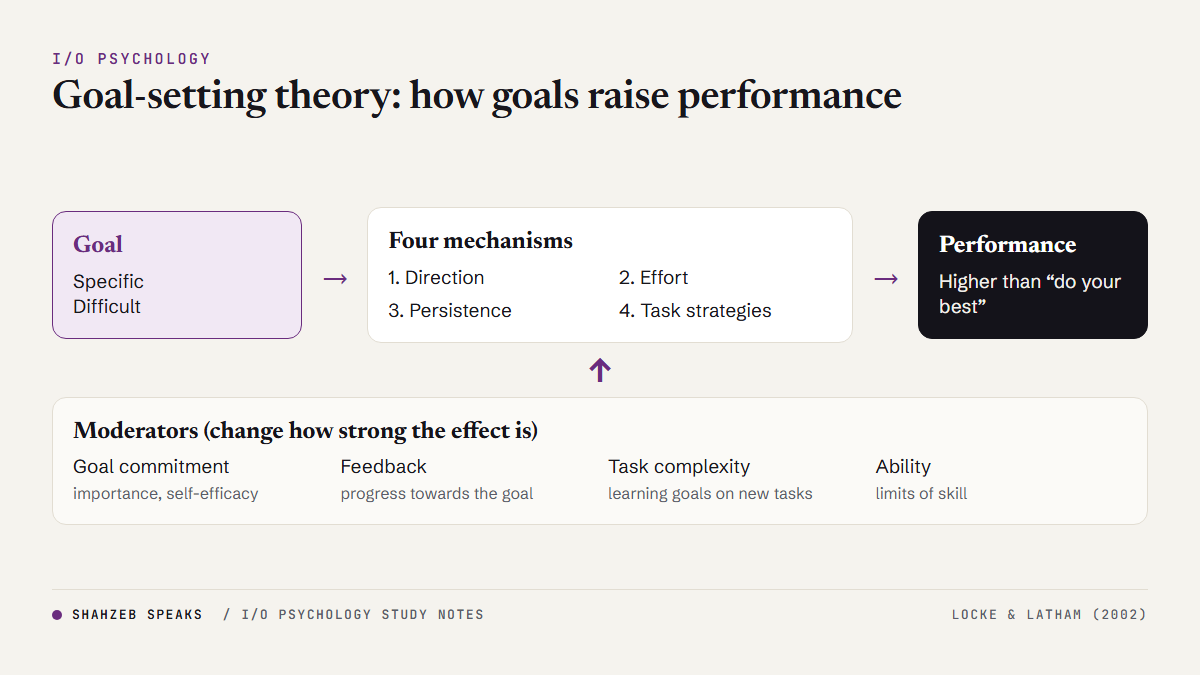
Locke and Latham (2002) describe four mechanisms through which goals affect performance:
- Direction. Goals focus attention and effort on goal-relevant activities and away from irrelevant ones. In one study, people given feedback on several aspects of a driving task improved only on the aspects they had goals for.
- Effort (energising). Higher goals lead to greater effort than low goals.
- Persistence. Hard goals make people keep going longer when they control their time. Tight deadlines speed up the pace of work.
- Task strategies. Goals lead people to use, find or plan the knowledge and strategies the task needs. Truck drivers given a load goal modified their trucks so they could judge the weight before reaching the weighing station.
Moderators: when do goals work best?
A moderator is a factor that changes how strong the goal-performance link is. Locke and Latham (2002) discuss three in detail, and the core finding itself assumes a fourth (ability).
Goal commitment
The link is strongest when people are committed to the goal, and commitment matters most when the goal is hard. Commitment rises when reaching the goal feels important (for example, a public commitment, or outcomes the person cares about) and when the person believes they can reach it, which is self-efficacy, Bandura’s term for task-specific confidence.
Students often ask whether participation in setting goals is needed. Latham and Erez reached opposite results, so they ran joint experiments with Locke as mediator (Latham, Erez & Locke, 1988). The answer: an assigned goal works as well as a participatively set one, if the reason for the goal is explained. A goal assigned tersely (“Do this”) without explanation led to clearly lower performance.
Feedback
People need summary feedback that shows progress towards the goal. Without it they cannot adjust effort or strategy. Goals plus feedback work better than goals alone. If a textile mill’s target is 500 shirts a shift, the line supervisor who posts the hourly count is using this moderator.
Task complexity
Goal effects are smaller on complex tasks, where people first have to discover the right strategy. In the Wood, Mento and Locke (1987) meta-analysis, the effect of specific difficult goals versus do-your-best was .77 for the least complex tasks but .41 for the most complex. On a complex air traffic control simulation, Kanfer and Ackerman (1989) found that a performance goal actually got in the way of learning. Winters and Latham (1996) then showed the fix: on complex, new tasks, set a specific difficult learning goal (for example, “find five strategies”) rather than a performance goal. Proximal (short-term) goals also help on new, complex tasks.
Ability and situational constraints
Performance levels off when people reach the limits of their ability. A goal cannot make up for missing skills or broken equipment.
Evidence in real workplaces: loggers and truck drivers
The best-known field study is Latham and Baldes (1975). Unionised logging truck drivers were assigned a specific, difficult goal for loading their trucks. Their loads rose from about 60% to 90% of the legal allowable weight, and the company saved $250,000 in nine months, as summarised by Locke and Latham (2002). Loggers cut more trees with specific goals, and engineers and scientists who set goals on a behavioural performance index outperformed those urged to do their best.
Locke and Latham also describe the high-performance cycle: high goals lead to high performance, which, when rewarded, leads to satisfaction and higher self-efficacy, which leads people to accept even higher goals. In this cycle, satisfaction is the result of performance, not its cause, which helps explain why job satisfaction alone does not predict productivity strongly.
Goal-setting theory vs SMART goals vs expectancy theory
Two comparisons appear in exams and in the questions students type into Google: goal-setting theory vs SMART goals, and goal-setting theory vs expectancy theory.
SMART comes from George Doran’s (1981) short article in Management Review, “There’s a S.M.A.R.T. way to write management’s goals and objectives”. In Doran’s version the letters stood for Specific, Measurable, Assignable, Realistic and Time-related; “Achievable” and “Relevant” are later variants. SMART is a practical checklist for writing objectives, not a research-based theory. It overlaps with goal-setting theory on specificity and deadlines, but its “Realistic/Achievable” letter can push managers towards safe, easy goals, while the theory’s main finding is that difficult goals produce more.
Vroom’s expectancy theory (1964) says motivation is a product of expectancy (effort will lead to performance), instrumentality (performance will lead to rewards) and valence (how much the reward is wanted). Higher expectancy should mean more effort. But harder goals have lower expectancy of success, and goal-setting theory says they produce more performance. Locke, Motowidlo and Bobko (1986) resolved this: within one goal level, higher expectancy means higher performance (Vroom is right); across goal levels, the harder goals with lower expectancy still produce higher performance (Locke is right). You can practise the expectancy side with the Vroom expectancy theory calculator.
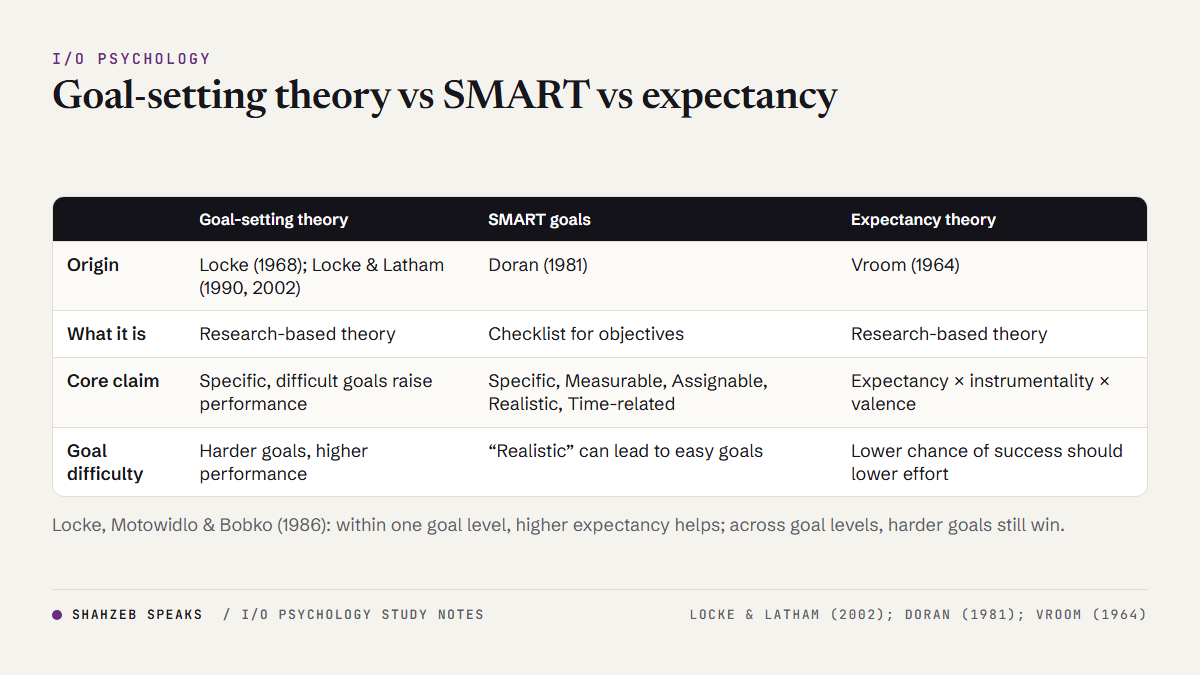
| Point | Goal-setting theory | SMART goals | Expectancy theory |
|---|---|---|---|
| Origin | Locke (1968); Locke & Latham (1990, 2002) | Doran (1981), a management article | Vroom (1964) |
| What it is | Research-based theory of motivation | Checklist for writing objectives | Research-based theory of motivational choice |
| Core claim | Specific, difficult goals raise performance | Objectives should be specific, measurable, assignable, realistic and time-related | Effort = expectancy × instrumentality × valence |
| View of difficulty | Harder goals, higher performance (up to ability) | “Realistic” can lead to easy goals | Lower chance of success should lower effort |
| Key moderators | Commitment, feedback, task complexity, ability | None tested | Value of rewards, belief in links |
| Best use | Designing targets and appraisal | Writing a clear objective | Explaining why rewards do or do not motivate |
Criticism: when goals go wrong
Ordóñez, Schweitzer, Galinsky and Bazerman (2009) argued in “Goals gone wild” that the benefits of goal setting have been overstated. They named side effects: a narrow focus that neglects non-goal areas, a rise in unethical behaviour, distorted risk preferences, corrosion of organisational culture and reduced intrinsic motivation. Their best-known example is Sears in the early 1990s, where a sales quota of $147 an hour for auto repair staff was followed by overcharging and unnecessary repairs.
Locke and Latham (2009) replied that these failures come from ignoring the theory’s own conditions (wrong goals, no feedback, performance goals on complex tasks, no ethics checks), not from goal setting itself. For your exam, the balanced line is: goal setting is one of the best-supported theories in I/O psychology, but goals must be chosen with care, matched to the task, and checked for side effects.
Other limits worth one line each: goal conflict (personal bonus goals can clash with the organisation’s goals), the difficulty of setting goals for complex or creative jobs, and the risk that “hard” goals become impossible goals that kill commitment. A pharmaceutical sales team in Lahore given a 40% growth target in a falling market is a likely case of the last one.
10-mark answer structure
- Definition (who, year): goal-setting theory, Locke (1968), developed by Locke and Latham (1990, 2002); a process theory; conscious goals regulate action.
- Core findings: difficult goals give higher performance (linear, up to ability); specific difficult goals beat “do your best” (d .42 to .80).
- Mechanisms: direction, effort, persistence, task strategies.
- Moderators: goal commitment (importance, self-efficacy, explained assigned goals), feedback, task complexity (learning goals), ability.
- Evidence: Latham and Baldes (1975) truck drivers, 60% to 90% of legal weight; high-performance cycle.
- Comparison: one paragraph on SMART (Doran, 1981) and one on expectancy theory (Locke, Motowidlo & Bobko, 1986).
- Criticism: Ordóñez et al. (2009) side effects; Locke and Latham’s (2009) reply.
- Application: a local example such as monthly targets in a bank branch or a call centre.
- Conclusion: strong evidence, but goals need commitment, feedback and the right type for the task.
Model opening line: “Goal-setting theory, first proposed by Edwin Locke (1968) and developed with Gary Latham (1990, 2002), states that specific and difficult goals, combined with commitment and feedback, lead to higher task performance than easy or vague goals such as ‘do your best’.”
Practice MCQs: goal-setting theory
Practice questions written to the published syllabus (not past-paper questions).
-
Who first set out goal-setting theory in a 1968 paper?
- Victor Vroom
- Edwin Locke
- Edward Deci
- J. Stacy Adams
Show answer
B. Locke’s 1968 paper in Organizational Behavior and Human Performance is the starting point. Vroom gave expectancy theory, Deci self-determination theory, Adams equity theory.
-
According to Locke and Latham, which goal usually produces the highest performance?
- “Do your best”
- A specific, easy goal
- A specific, difficult goal
- No goal, to reduce pressure
Show answer
C. Specific difficult goals outperformed do-your-best goals across many studies. A specific easy goal is clear but sets a low standard.
-
Which is NOT one of the four mechanisms through which goals affect performance?
- Direction of attention
- Persistence
- Task strategies
- Hygiene factors
Show answer
D. Hygiene factors belong to Herzberg’s two-factor theory. The four mechanisms are direction, effort, persistence and strategies.
-
A manager gives a new trainee a hard sales target on a complex task the trainee has never done. Goal-setting research suggests it would be better to set:
- No goal at all
- A specific, difficult learning goal
- An even harder performance goal
- A goal set only by the trainee
Show answer
B. On new, complex tasks, performance goals can block learning (Kanfer & Ackerman, 1989); specific learning goals worked better (Winters & Latham, 1996). A harder performance goal makes the problem worse.
-
Latham, Erez and Locke (1988) found that an assigned goal works as well as a participatively set goal when:
- It is paired with a cash bonus
- The reason for the goal is explained
- It is easy
- It is kept secret from co-workers
Show answer
B. Tersely assigned goals without explanation led to lower performance; explained assigned goals did as well as participative ones. Money and ease were not the deciding factor.
-
In Latham and Baldes (1975), what happened after logging truck drivers were given a specific, difficult goal?
- Loads rose from about 60% to 90% of the legal weight
- Accidents doubled
- Nothing changed because they were unionised
- Loads fell because of stress
Show answer
A. Loads rose from about 60% to 90% of the legal allowable weight, saving the company $250,000 in nine months. The other options are not what the study found.
-
How did Locke, Motowidlo and Bobko (1986) resolve the conflict between goal-setting and expectancy theory?
- By showing expectancy theory was wrong
- By separating expectancy within a goal level from expectancy across goal levels
- By adding a hygiene factor
- By replacing goals with rewards
Show answer
B. Within one goal level, higher expectancy predicts higher performance; across levels, harder goals (lower expectancy) still produce more. Neither theory was thrown out.
-
In Doran’s (1981) original SMART, what did the “A” stand for?
- Achievable
- Ambitious
- Assignable
- Agreed
Show answer
C. Doran used Assignable (who will do it). Achievable is a later, more common variant; ambitious and agreed are other later versions.
-
Which side effect of goal setting was NOT among those listed by Ordóñez et al. (2009)?
- Narrow focus that neglects non-goal areas
- A rise in unethical behaviour
- Frustration-regression
- Reduced intrinsic motivation
Show answer
C. Frustration-regression is Alderfer’s ERG idea. Ordóñez et al. named narrow focus, unethical behaviour, distorted risk preferences, corroded culture and reduced intrinsic motivation.
-
In the high-performance cycle, job satisfaction is best described as:
- The cause of high performance
- The result of high performance that is rewarded
- Unrelated to goals
- A moderator of task complexity
Show answer
B. High goals lead to high performance; rewards then produce satisfaction and self-efficacy, which support higher goals. Satisfaction is a result, not the starting cause.
Practise on your phone
The free I/O Psychology Prep app has 410 explained
questions, flashcards and an exam countdown, and works offline. Get it on Google Play
· About the app
More practice across all the theories: work motivation MCQs.
Questions students ask
What is goal-setting theory in simple words?
Clear and challenging goals make people work better than vague or easy ones. Goals tell you where to put your attention, push you to try harder and keep going, and make you look for better ways to do the task, as long as you accept the goal and can see your progress.
What are the five principles of goal setting?
Management websites often list five: clarity, challenge, commitment, feedback and task complexity. That list is a simplified summary of Locke and Latham’s findings. In exams, use the theory’s own terms: specific and difficult goals, goal commitment, feedback and task complexity.
Is goal-setting theory the same as SMART goals?
No. SMART (Doran, 1981) is a checklist for writing objectives. Goal-setting theory is a body of research. They share specificity and deadlines, but the theory stresses difficult goals, while SMART’s “realistic” or “achievable” can lead to easy ones.
What is the difference between goal-setting theory and expectancy theory?
Expectancy theory predicts that a higher chance of success raises motivation. Goal-setting theory shows that harder goals, with lower chances of success, raise performance. Locke, Motowidlo and Bobko (1986) showed both are true at different levels of comparison.
Is goal-setting a content or process theory?
A process theory. It explains how goals shape effort and performance, not which needs people have.
What are the limitations of goal-setting theory?
Goals can narrow focus, encourage cheating or risk-taking, and harm learning on complex tasks if the wrong type of goal is set. Personal goals can conflict with team or organisational goals. Very hard goals lose commitment if people stop believing they can reach them.
Practise on your phone
The free I/O Psychology Prep app has 410 explained
questions, flashcards and an exam countdown, and works offline. Get it on Google Play
· About the app
References
- Doran, G. T. (1981). There’s a S.M.A.R.T. way to write management’s goals and objectives. Management Review, 70(11), 35-36.
- Kanfer, R., & Ackerman, P. L. (1989). Motivation and cognitive abilities: An integrative/aptitude-treatment interaction approach to skill acquisition. Journal of Applied Psychology, 74(4), 657-690. https://doi.org/10.1037/0021-9010.74.4.657
- Latham, G. P., & Baldes, J. J. (1975). The “practical significance” of Locke’s theory of goal setting. Journal of Applied Psychology, 60(1), 122-124. https://doi.org/10.1037/h0076354
- Locke, E. A. (1968). Toward a theory of task motivation and incentives. Organizational Behavior and Human Performance, 3(2), 157-189. https://doi.org/10.1016/0030-5073(68)90004-4
- Locke, E. A., & Latham, G. P. (1990). A theory of goal setting and task performance. Prentice Hall.
- Locke, E. A., & Latham, G. P. (2002). Building a practically useful theory of goal setting and task motivation: A 35-year odyssey. American Psychologist, 57(9), 705-717. https://doi.org/10.1037/0003-066X.57.9.705
- Locke, E. A., & Latham, G. P. (2009). Has goal setting gone wild, or have its attackers abandoned good scholarship? Academy of Management Perspectives, 23(1), 17-23. https://doi.org/10.5465/amp.2009.37008000
- Locke, E. A., Motowidlo, S. J., & Bobko, P. (1986). Using self-efficacy theory to resolve the conflict between goal-setting theory and expectancy theory in organizational behavior and industrial/organizational psychology. Journal of Social and Clinical Psychology, 4(3), 328-338. https://doi.org/10.1521/jscp.1986.4.3.328
- Ordóñez, L. D., Schweitzer, M. E., Galinsky, A. D., & Bazerman, M. H. (2009). Goals gone wild: The systematic side effects of overprescribing goal setting. Academy of Management Perspectives, 23(1), 6-16. https://doi.org/10.5465/amp.2009.37007999
- Vroom, V. H. (1964). Work and motivation. Wiley.
- Wood, R. E., Mento, A. J., & Locke, E. A. (1987). Task complexity as a moderator of goal effects: A meta-analysis. Journal of Applied Psychology, 72(3), 416-425. https://doi.org/10.1037/0021-9010.72.3.416
Goal-setting theory is one of nine theories compared in the work motivation theories guide. Read it alongside equity theory, self-determination theory at work, the job characteristics model, Maslow vs Herzberg, Herzberg’s two-factor theory and Theory X and Theory Y. Goals are also central to appraisal; see the psychology of performance reviews.