

Theory X and Theory Y are two sets of assumptions managers hold about people, described by Douglas McGregor in The Human Side of Enterprise (1960). Theory X assumes people dislike work and must be controlled. Theory Y assumes people can find work natural, direct themselves and seek responsibility. Ouchi’s Theory Z (1981) added Japanese-style long-term, consensus management.
This page is for students answering “Explain McGregor’s Theory X and Theory Y with examples” or “Compare Theory X, Y and Z”. You get the assumptions of each theory side by side, real-life workplace examples, a comparison table of X, Y and Z, the main criticisms, a 10-mark answer structure and 10 practice MCQs with explanations.
One correction first, because it costs students marks: Theory X and Theory Y are not two kinds of worker, and they are not two leadership styles in the strict sense. They are two sets of beliefs a manager holds about human nature. McGregor’s argument was that those beliefs shape how the manager designs jobs, controls people and rewards them, and that the way people are managed then shapes how they behave.
Who was Douglas McGregor?
Douglas McGregor (1906-1964) was a psychologist who taught at the Massachusetts Institute of Technology (MIT) and was president of Antioch College from 1948 to 1954. He first set out the ideas in a 1957 article called “The Human Side of Enterprise” and developed them in a 1960 book of the same title, published by McGraw-Hill. He was writing for managers in American industry, and he drew on Abraham Maslow’s hierarchy of needs: if workers’ lower needs are mostly met, management has to offer chances to meet higher needs, such as participation, challenging work and good relations in the work group.
Theory X: the assumptions and an example
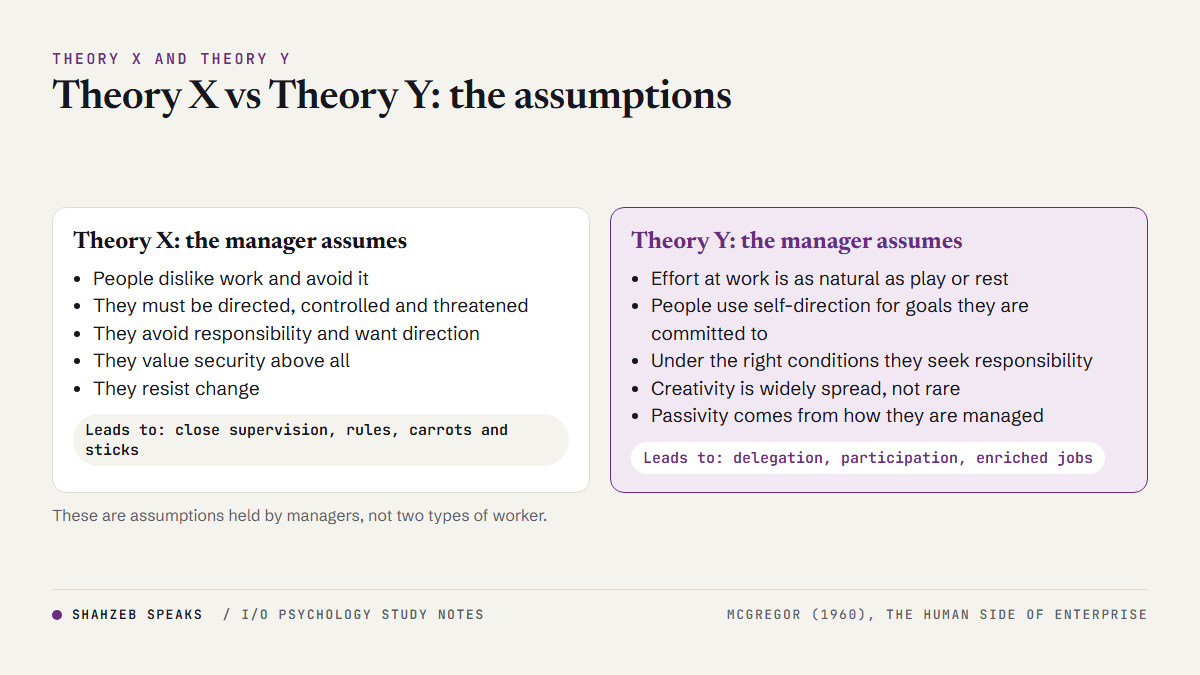
McGregor called the traditional view of management Theory X. A manager who holds Theory X assumptions believes that:
- The average person dislikes work and will avoid it if possible.
- So people must be directed, controlled and threatened with punishment to make them put in enough effort.
- Most people avoid responsibility and prefer to be told what to do.
- They put their own concerns above the organisation’s, value security above everything, and resist change.
McGregor argued that management built on these beliefs relies on close supervision, detailed rules, and carrots and sticks: rewards for compliance and punishment for mistakes.
Example in real life: in a call centre run on Theory X lines, every call is scripted, toilet breaks are timed, a supervisor listens in to catch mistakes, pay deductions follow each missed target, and agents are never asked how the process could improve. The manager reads high turnover as proof that “these people don’t want to work”, which confirms the original belief.
Theory Y: the assumptions and an example
McGregor’s alternative, Theory Y, starts from different beliefs. A Theory Y manager assumes that:
- Putting physical and mental effort into work is as natural as play or rest.
- Control and threats are not the only way to get effort; people will use self-direction and self-control for goals they are committed to.
- Commitment follows from the rewards of achievement, especially the satisfaction of higher needs.
- Under the right conditions, people learn not only to accept responsibility but to seek it.
- The ability to use imagination and creativity to solve problems is widely spread, not rare.
- If people seem passive or resistant, it is because of their experience in organisations, not their nature.
The last point is the key to the whole theory. If people become passive because of how they are managed, then Theory X assumptions can create the very behaviour they expect.
Example in real life: a university department head who holds Theory Y assumptions lets lecturers design their own courses within the approved outline, agrees research goals with each person rather than imposing them, and shares decisions about timetables in a staff meeting. She still checks results (course feedback, publications), but she does not watch every lecture. McGregor’s practical ideas included delegation, participation in decisions, enriched jobs and appraisal in which people help set their own targets.
Theory X vs Theory Y: differences in a table
| Point | Theory X | Theory Y |
|---|---|---|
| View of work | People dislike work and avoid it | Work is as natural as play or rest |
| How to get effort | Direction, control, threats | Commitment to goals and self-control |
| Responsibility | People avoid it and want direction | People seek it under the right conditions |
| Creativity | Found in a few people | Widely spread in the workforce |
| Main needs used | Lower needs: pay, security, fear of loss | Higher needs: esteem, achievement, self-actualisation |
| Management style it leads to | Close supervision, rules, carrots and sticks | Delegation, participation, enriched jobs |
| Decisions | Made at the top | Shared with employees |
| Typical workplace example | Scripted call centre with timed breaks | University department where lecturers design their own courses |
What is Ouchi’s Theory Z?
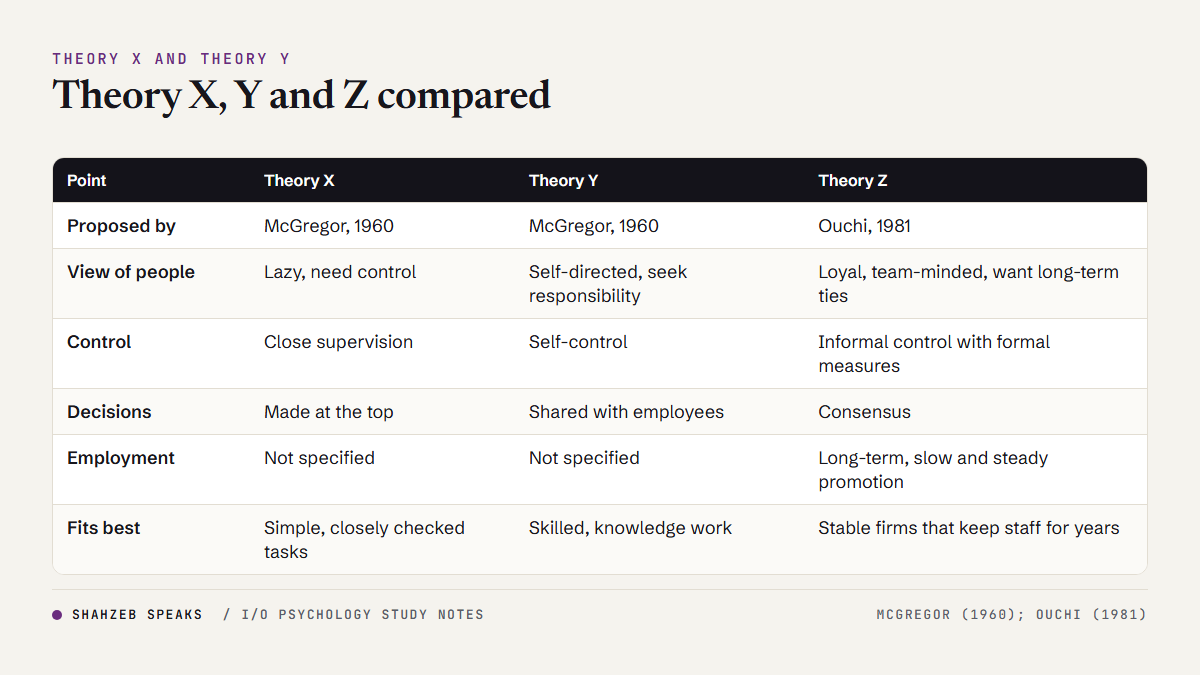
Theory Z was not McGregor’s. It came from William Ouchi, a management professor, in his 1981 book Theory Z: How American Business Can Meet the Japanese Challenge (Addison-Wesley). Earlier, Ouchi and Jaeger (1978) had compared a typical American organisation (Type A) with a typical Japanese one (Type J) and described a mixed form, Type Z, that fitted American society. Ouchi said firms should use the Japanese system as a model, not copy it blindly.
The features usually listed for a Theory Z organisation are:
- A strong company philosophy and culture that employees understand and share.
- Long-term employment, with slow, steady evaluation and promotion.
- Decisions reached by consensus, with employees taking part.
- Generalist career paths: people learn many parts of the organisation instead of one narrow speciality.
- Informal, implicit control, backed by formal measures of performance.
- Individual responsibility, recognised within the context of the team.
- Holistic concern for employees’ well-being, including their families.
So where Theory X and Theory Y are about a manager’s beliefs, Theory Z is about the design of the whole organisation: long-term loyalty in both directions, shared decisions and a strong culture.
An exam trap: Abraham Maslow also wrote a paper called “Theory Z” (1969, in the Journal of Transpersonal Psychology) about self-transcendence. When your syllabus says “Theory Z” in a management or I/O context, it means Ouchi.
Theory X, Y and Z in Pakistani workplaces
These are illustrations to help you build an exam example, not findings from a study.
- Theory X: a garment factory floor where supervisors check every piece, fine workers for errors and decide everything. In simple, closely checked, high-volume work, a manager may feel this is the only workable approach, especially with a high turnover of untrained staff. McGregor would ask whether the turnover is partly caused by the control.
- Theory Y: a software house in Karachi or Lahore where developers choose how to solve problems, estimate their own tasks and review each other’s code. Close supervision would slow skilled knowledge work and push good people to leave.
- Theory Z: a large family-owned business group or a public-sector bank where people join young, stay for decades, rotate through departments and are promoted slowly by seniority and loyalty. Some features look like Theory Z (long-term employment, generalist careers, concern for families); others, such as top-down decisions, do not.
A good exam point: many organisations mix the three. A bank can run its cash counters on Theory X rules for security reasons while running its product team on Theory Y lines. If you want to see what over-control does to people, my article on the psychology of micromanagement is a modern Theory X case study. For the field in this country more broadly, see industrial psychology in Pakistan.
Criticism of Theory X and Theory Y
- Too simple: real managers and real workers are not purely X or Y. Many people want autonomy in some parts of the job and clear direction in others.
- Theory Y is not always better: Morse and Lorsch (1970), in “Beyond Theory Y”, argued that Theory Y does not explain motivation in every situation. In their contingency view, what matters is the fit between the task, the organisation and the people. Highly predictable work may run well with more structure.
- Weak direct evidence: the evidence that holding Theory Y beliefs leads to better results is described as mixed. McGregor wrote a persuasive argument rather than a tested model.
- Can be used as a tool: some critics have called Theory Y a way to get more effort out of people without sharing the gains. If employees work harder and take more responsibility for the same pay, they may feel used.
- Organisations slip back: firms that adopt Theory Y practices have sometimes returned to Theory X control in hard economic times.
What has lasted is McGregor’s central point: a manager’s assumptions about people are not neutral. They shape job design, appraisal and control, and so they shape behaviour. Later work on job design, such as the Job Characteristics Model, and on autonomy, such as self-determination theory, gives this idea much stronger research support.
10-mark answer structure: “Explain McGregor’s Theory X and Theory Y. How is Theory Z different?”
- Introduction (who, year): Douglas McGregor, MIT, The Human Side of Enterprise (1960); two sets of assumptions managers hold about people.
- Theory X: 4 assumptions (dislike of work, need for control and threats, avoid responsibility, value security); resulting style.
- Theory Y: 4-5 assumptions (work natural, self-direction, seek responsibility, creativity widespread, passivity learnt); resulting style.
- Link to Maslow: X relies on lower needs, Y on higher needs.
- Table: a short X vs Y comparison table.
- Examples: one Theory X and one Theory Y workplace, ideally local.
- Theory Z: Ouchi (1981); long-term employment, consensus decisions, generalist careers, holistic concern; organisation-level, not manager beliefs.
- Criticism: too simple; Morse and Lorsch (1970) contingency view; mixed evidence.
- Conclusion: assumptions shape behaviour; the best approach depends on the task and people.
Model opening line: “McGregor (1960) argued that every managerial decision rests on assumptions about human nature, and he grouped these into two sets: Theory X, which assumes people dislike work and must be controlled, and Theory Y, which assumes people can direct themselves and seek responsibility.”
Practice MCQs: Theory X and Theory Y
Practice questions written to the published syllabus (not past-paper questions).
-
Theory X and Theory Y were set out in which book?
- The Motivation to Work (1959)
- The Human Side of Enterprise (1960)
- Theory Z (1981)
- Work Redesign (1980)
Show answer
B. McGregor’s 1960 book. A is Herzberg and colleagues, C is Ouchi, and D is Hackman and Oldham.
-
Theory X and Theory Y are best described as:
- Two types of employee
- Two sets of assumptions managers hold about people
- Two stages of group development
- Two kinds of job analysis
Show answer
B. They describe managers’ beliefs about human nature. Treating them as types of worker is the most common mistake.
-
Which assumption belongs to Theory Y?
- The average person dislikes work
- People must be threatened with punishment to work
- Effort at work is as natural as play or rest
- People value security above everything
Show answer
C. The other three are Theory X assumptions.
-
A manager times every break, scripts every call and deducts pay for each error. Her assumptions are closest to:
- Theory Y
- Theory X
- Theory Z
- Self-determination theory
Show answer
B. Close control and punishment follow from Theory X. Theory Y and SDT stress self-direction, and Theory Z stresses long-term trust and consensus.
-
McGregor’s thinking drew most directly on which earlier theory?
- Maslow’s hierarchy of needs
- Vroom’s expectancy theory
- Fiedler’s contingency model
- Taylor’s time-and-motion study
Show answer
A. He argued that once lower needs are met, management must offer ways to meet higher needs. Vroom (1964) and Fiedler came after him; Taylor represents the control-based approach he criticised.
-
Which is NOT a feature of Ouchi’s Theory Z organisation?
- Long-term employment
- Consensus decision-making
- Rapid promotion based on short-term results
- Holistic concern for employees and their families
Show answer
C. Theory Z promotes slowly and steadily. A, B and D are core Theory Z features.
-
Who proposed Theory Z in a management context?
- Douglas McGregor
- William Ouchi
- Elton Mayo
- Frederick Herzberg
Show answer
B. Ouchi (1981). McGregor proposed X and Y; Mayo is linked with the Hawthorne studies; Herzberg with two-factor theory.
-
According to McGregor, why might employees appear lazy and passive?
- Because that is human nature
- Because of their experience of how organisations manage them
- Because they have high growth need strength
- Because their pay is too high
Show answer
B. Theory Y holds that passivity is learnt from organisational experience. A is the Theory X view; C and D do not follow from McGregor.
-
Morse and Lorsch’s “Beyond Theory Y” (1970) argued that:
- Theory X is always better
- Theory Y does not explain motivation in all situations; fit between task, organisation and people matters
- Theory Z should replace both
- Managers’ assumptions do not matter
Show answer
B. Theirs is a contingency view. They did not claim X is always better, did not propose Theory Z, and did not dismiss assumptions.
-
A software house lets developers estimate their own tasks and choose how to solve problems. This practice reflects:
- Theory X control
- Theory Y self-direction
- Herzberg’s hygiene factors
- Scientific management
Show answer
B. Trusting people to direct their own work is Theory Y. Hygiene factors are about pay and conditions, and scientific management is close to Theory X.
Practise on your phone
The free I/O Psychology Prep app has 410 explained
questions, flashcards and an exam countdown, and works offline. Get it on Google Play
· About the app
For more practice across all motivation theories, try the work motivation MCQ set.
Questions students ask
What is the main difference between Theory X and Theory Y?
Theory X assumes people dislike work, avoid responsibility and must be controlled and threatened. Theory Y assumes work is natural, people can direct themselves towards goals they are committed to, and they seek responsibility under the right conditions. Each set of beliefs leads to a different way of managing.
Who gave Theory X and Theory Y?
Douglas McGregor, a psychologist at MIT, first in a 1957 article and then in his 1960 book The Human Side of Enterprise.
What are examples of Theory X and Theory Y in real life?
Theory X: a call centre with scripted calls, timed breaks and pay deductions for mistakes. Theory Y: a university department or software team where people set their own goals, choose methods and share decisions, with results checked rather than every step watched.
What is Theory Z and who gave it?
Theory Z was proposed by William Ouchi in 1981. It describes an organisation that blends American and Japanese management: long-term employment, slow promotion, consensus decisions, generalist careers, informal control with formal measures, individual responsibility within the team, and concern for employees’ whole lives.
Is Theory Y better than Theory X?
Not in every situation. Theory Y fits skilled, complex and creative work. Contingency writers such as Morse and Lorsch (1970) argued that the best approach depends on the task, the organisation and the people. Most organisations mix elements of both.
How is Theory X and Theory Y related to Maslow?
McGregor used Maslow’s hierarchy. Theory X management relies on lower needs (pay, security, fear of losing the job). Theory Y argues that, once lower needs are mostly met, people are motivated by higher needs such as esteem and self-actualisation, so management should create chances to meet them.
Practise on your phone
The free I/O Psychology Prep app has 410 explained
questions, flashcards and an exam countdown, and works offline. Get it on Google Play
· About the app
References
- Maslow, A. H. (1943). A theory of human motivation. Psychological Review, 50(4), 370-396. https://doi.org/10.1037/h0054346
- McGregor, D. (1960). The human side of enterprise. McGraw-Hill.
- Morse, J. J., & Lorsch, J. W. (1970). Beyond Theory Y. Harvard Business Review, 48(3).
- Ouchi, W. G. (1981). Theory Z: How American business can meet the Japanese challenge. Addison-Wesley.
- Ouchi, W. G., & Jaeger, A. M. (1978). Type Z organization: Stability in the midst of mobility. Academy of Management Review, 3(2), 305-314. https://doi.org/10.2307/257670
This page is part of my guide to work motivation theories. Read next: Maslow vs Herzberg, McClelland’s theory of needs and goal-setting theory. For managers’ approaches more broadly, see leadership theories in I/O psychology.