
McClelland’s theory of needs (also called acquired needs or three needs theory) was developed by David McClelland, most fully in The Achieving Society (1961). It says three learned needs drive behaviour at work: achievement (nAch), affiliation (nAff) and power (nPow). Each person has a different mix, measured with stories written about pictures.
This guide is for students revising McClelland for an exam or using his needs in an assignment on managers and leadership. It explains the three needs with workplace examples, where the theory came from (Murray’s needs and the Thematic Apperception Test), the managerial motive pattern found in AT&T managers, how McClelland differs from Maslow and Herzberg, the criticism, a 10-mark answer plan and 10 MCQs with explanations.
McClelland’s theory is a content theory of motivation: it names what motivates people. Unlike Maslow, it has no ladder, and it treats the needs as learned through life rather than inborn. For the full set of theories in one table, see the work motivation theories pillar.
Who was McClelland and where did the theory come from?
David C. McClelland (1917-1998) was an American psychologist who taught at Harvard from 1956 to 1987. His work built on Henry Murray, who in Explorations in Personality (1938) proposed a long list of human needs, including needs for achievement, affiliation and dominance (the forerunner of the power motive).
Murray and Christiana Morgan had created the Thematic Apperception Test (TAT), first described by Morgan and Murray in 1935. A person is shown ambiguous pictures and asked to write or tell a story about each one. The idea is that people project their own concerns into the stories.
McClelland, with John Atkinson, Russell Clark and Edgar Lowell, developed a way to score these stories for the achievement motive, published in The Achievement Motive (1953). In The Achieving Society (1961) McClelland went further, arguing that the level of achievement motivation in a society is linked to its economic growth. Later work added the power motive (McClelland, 1975, Power: The Inner Experience) and the affiliation motive to the same framework.
That is why the needs are written with a small “n”: nAch, nAff and nPow come from Murray’s notation, “need for”.
The three needs: nAch, nAff and nPow
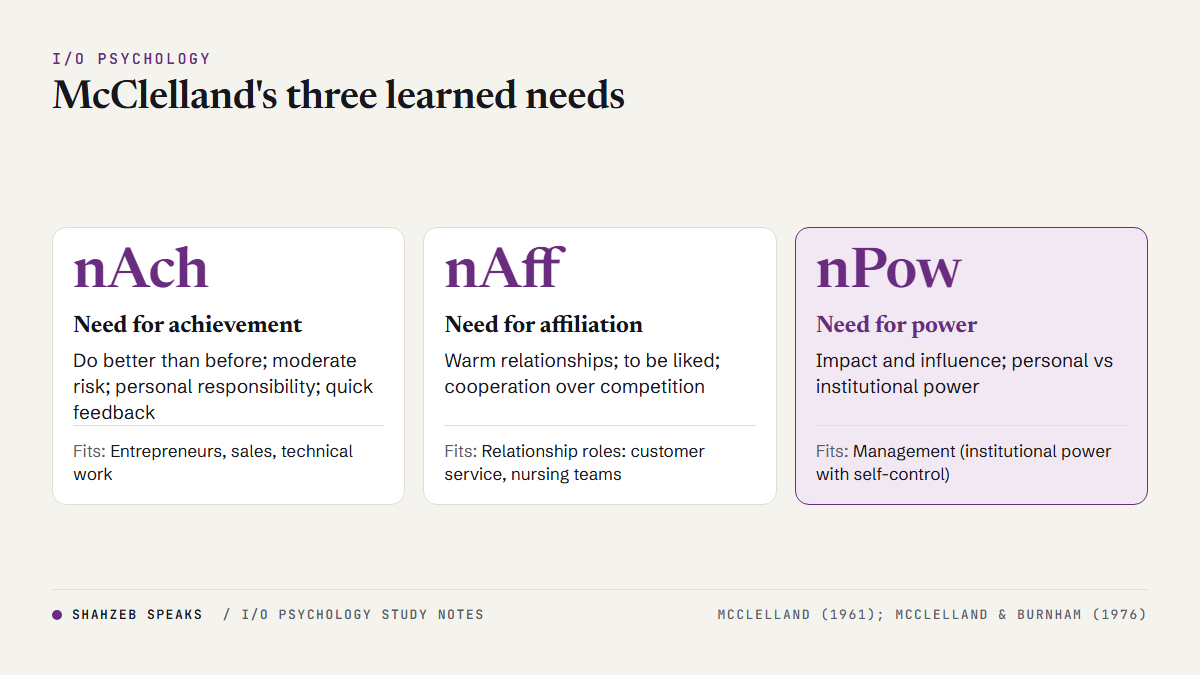
Need for achievement (nAch)
The desire to do something better or more efficiently than it has been done before, and to master challenges. People high in nAch, as McClelland described them, prefer:
- Moderately difficult tasks, where success is possible but not certain. Very easy tasks give no sense of achievement; very hard ones depend on luck. Atkinson, McClelland’s student, showed that effort was highest at moderate task difficulty.
- Personal responsibility for the result, so success is clearly their own.
- Quick, concrete feedback on how well they are doing.
Example: a sales officer at a microfinance bank in Faisalabad who tracks her own numbers daily and wants a target that stretches her. High-nAch people often do well as entrepreneurs, in sales and in technical work where individual performance is visible.
Need for affiliation (nAff)
The desire for warm, friendly relationships and to be liked and accepted. High-nAff people prefer cooperation to competition and work well in roles built on relationships, such as customer service, nursing teams or HR roles focused on employee welfare. As managers, they can struggle to give hard feedback or make unpopular decisions, because they want to keep everyone happy.
Need for power (nPow)
The desire to have impact, influence and control over others. McClelland separated two forms:
- Personal power: wanting control for one’s own sake, often with little self-restraint.
- Institutional (socialised) power: wanting influence to achieve the organisation’s goals, combined with self-control.
McClelland argued that institutional power is the motive that good managers need, which surprises students who assume power motivation is a bad thing.
How are the needs measured? The TAT and PSE
McClelland measured motives with picture stories, not questionnaires. Modern versions are often called the Picture Story Exercise (PSE). A person writes short stories about several pictures (for example, people in an office or a laboratory), and trained coders count story content that shows concern with excellence (achievement), with relationships (affiliation) or with impact on others (power).
Why stories? McClelland, Koestner and Weinberger (1989) argued that story-based measures capture implicit motives, which people are not fully aware of, while questionnaires capture self-attributed (explicit) motives, what people say about themselves. The two often do not correlate well, and they predict different things: implicit motives predict long-term behaviour patterns, while self-reports predict responses to specific choices.
Spangler (1992) ran two meta-analyses comparing TAT and questionnaire measures of nAch. Both related positively to outcomes on average, and the TAT correlations were on average larger. TAT measures related most strongly to outcomes such as career success when the incentives came from the task itself, while questionnaires did better when the incentives were social or external. This helped answer the earlier criticism that the TAT was too unreliable to be useful.
A note on copyright: the original picture sets and scoring manuals are published materials. Do not reproduce the pictures in assignments; describe the method and cite it.
The managerial motive pattern: what makes a good manager?
This is the part of McClelland that examiners like most, because it is counter-intuitive.
McClelland and Burnham (1976), “Power is the great motivator” in the Harvard Business Review, described three types of managers: affiliative managers, who need to be liked more than they need to get things done; personal-power managers; and institutional managers, who are motivated by power used for the organisation and combine it with self-control. The institutional managers were linked to better morale in their work units: more clarity about goals and more team spirit.
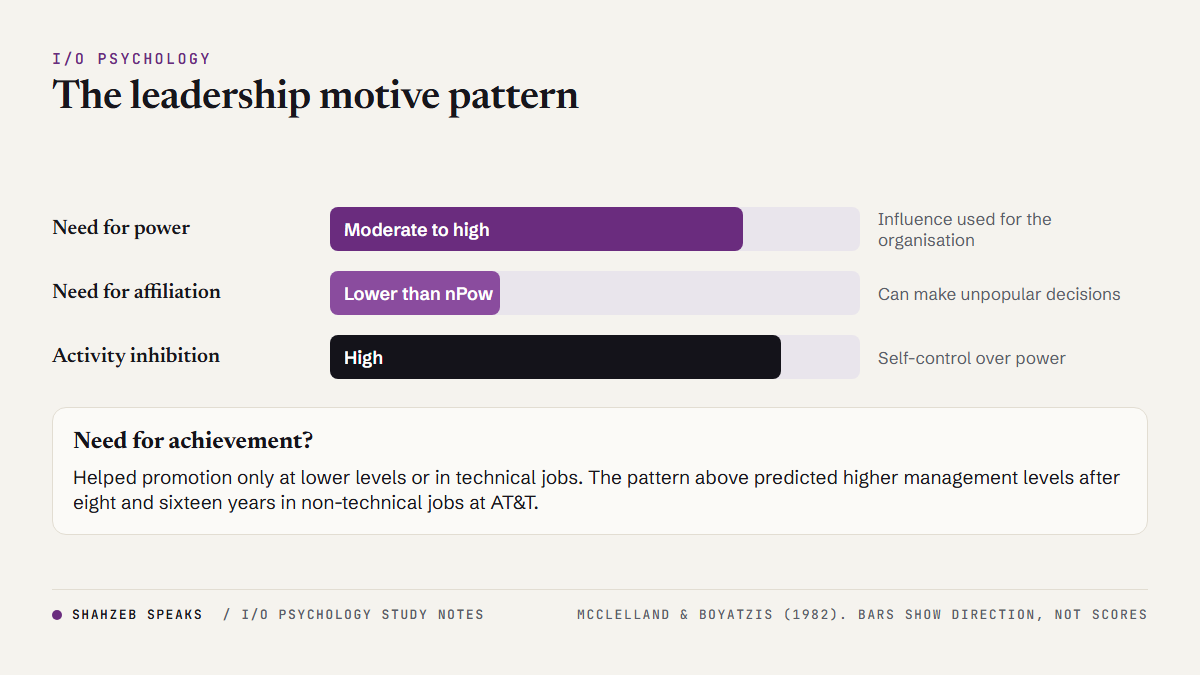
McClelland and Boyatzis (1982), in the Journal of Applied Psychology, followed managers at AT&T over the long term. They defined the leadership motive pattern (LMP): moderate to high nPow, nPow higher than nAff, and high activity inhibition (self-control). Managers with this pattern in non-technical jobs had reached higher levels of management after eight and sixteen years. Need for achievement helped promotion only at lower levels or in technical jobs, where advancement depends on one’s own contribution.
The lesson for HR in Pakistan or India is practical. The best salesperson in a pharmaceutical company (high nAch) is often promoted to sales manager, and then struggles, because the job now depends on influencing others, not on personal results. McClelland’s work explains why.
Can needs be learned? The Kakinada study
Because McClelland saw needs as acquired, he believed they could be trained. In the 1960s he and his colleagues ran achievement motivation training for small business owners in Kakinada, in Andhra Pradesh, India, reported in Motivating Economic Achievement by McClelland and Winter (1969). Secondary accounts report that trained business owners afterwards worked harder, invested more and started more new ventures than comparison groups. For South Asian students this is a useful local example: one of the classic field tests of a motivation theory took place in India.
Later research has supported a link between achievement motivation and entrepreneurship. A meta-analysis by Collins, Hanges and Locke (2004) found that achievement motivation was related both to choosing an entrepreneurial career and to entrepreneurial performance.
McClelland vs Maslow, Herzberg and Alderfer
| Point | McClelland (1961) | Maslow (1943) | Alderfer ERG (1969) | Herzberg (1959) |
|---|---|---|---|---|
| Needs | Achievement, affiliation, power | Physiological, safety, belonging, esteem, self-actualisation | Existence, relatedness, growth | Hygiene factors and motivators |
| Origin of needs | Learned through experience and culture | Largely innate | Innate, but strength varies | Job factors, not needs as such |
| Hierarchy? | No; a profile of three | Yes, lower before higher | Flexible; several at once | No; two separate sets |
| Measurement | Picture stories (TAT/PSE) | Not specified by Maslow | Questionnaires | Critical incident interviews |
| Main use at work | Matching people to roles; selecting and developing managers | General understanding of needs | Explaining regression when growth is blocked | Job enrichment |
A rough mapping for exams: nAff is close to Maslow’s belonging and Alderfer’s relatedness; nAch and nPow are close to esteem and growth. But do not say they are the same: McClelland’s needs are learned and form a profile, not a ladder. For more, see ERG theory vs Maslow, Maslow vs Herzberg and Herzberg’s two-factor theory.
Criticism of McClelland’s theory
- Measurement is costly and debated. Story coding needs trained scorers and time. Early critics questioned the reliability of the TAT, though later meta-analyses (Spangler, 1992) were more favourable.
- Implicit and explicit motives disagree. A person may say they want power but not show it in stories, which makes practical use in HR difficult.
- Societal claims are contested. The argument in The Achieving Society that a nation’s achievement motivation drives its economic growth is much harder to defend than the findings about individuals.
- Cultural bias. Achievement as individual excellence may be valued differently in collectivist cultures, where group success matters more.
- Limited links to everyday management practice. Most organisations cannot run picture-story tests, so the theory is used more as a way of thinking about people than as a tool.
10-mark answer structure
- Definition (who, year): David McClelland, The Achieving Society (1961), building on Murray (1938) and McClelland et al. (1953); learned (acquired) needs; a content theory.
- nAch: definition plus three features (moderate risk, personal responsibility, feedback) and a job example.
- nAff: definition, strengths, the problem for managers.
- nPow: personal vs institutional power.
- Measurement: TAT/PSE; implicit vs self-attributed motives (McClelland, Koestner & Weinberger, 1989).
- Managerial motive pattern: McClelland and Burnham (1976); McClelland and Boyatzis (1982) leadership motive pattern; nAch matters at lower or technical levels.
- Application: selection and promotion, the best salesperson made manager; Kakinada training.
- Comparison: two lines vs Maslow (no hierarchy, learned needs).
- Criticism and conclusion.
Model opening line: “McClelland’s theory of needs, developed by David McClelland (1961), holds that three learned needs, for achievement, affiliation and power, shape how people behave at work, and that the right mix depends on the job, with effective senior managers showing high institutional power, lower affiliation and strong self-control.”
Practice MCQs: McClelland’s theory of needs
Practice questions written to the published syllabus (not past-paper questions).
-
Which three needs are in McClelland’s theory?
- Existence, relatedness and growth
- Achievement, affiliation and power
- Autonomy, competence and relatedness
- Safety, esteem and self-actualisation
Show answer
B. A is Alderfer, C is self-determination theory, D is part of Maslow.
-
McClelland’s main method for measuring needs was based on:
- Critical incident interviews
- Stories written about ambiguous pictures (TAT)
- Job analysis questionnaires
- Peer ratings
Show answer
B. Story content was coded for motive imagery. Critical incidents were Herzberg’s method.
-
A person high in nAch is most likely to choose which task?
- A very easy task they will surely complete
- A task with a moderate chance of success and clear feedback
- A lottery-style task decided by luck
- A team task where credit is shared equally
Show answer
B. High-nAch people prefer moderate difficulty, personal responsibility and feedback. Easy tasks give no challenge; luck removes personal responsibility; shared credit hides their own contribution.
-
According to McClelland and Boyatzis (1982), the leadership motive pattern is:
- High nAch, high nAff, low nPow
- Moderate to high nPow, nPow above nAff, high activity inhibition
- Low nPow, high nAff, low self-control
- High nAch and nothing else
Show answer
B. This pattern predicted promotion in non-technical management over 8 and 16 years. High nAch alone helped only at lower or technical levels.
-
Which statement about McClelland’s theory is NOT correct?
- The needs are learned through life experience
- Each person has a different mix of the three needs
- Lower needs must be satisfied before higher needs appear
- The needs can be measured with picture stories
Show answer
C. That is Maslow’s hierarchy. McClelland’s needs form a profile, not a ladder.
-
The best sales officer in a bank is promoted to branch manager and struggles. McClelland’s work suggests the most likely reason is that:
- Her nAch suited individual sales, but the new job needs influence over others (nPow)
- Her hygiene factors fell
- She lost relatedness needs
- She has amotivation
Show answer
A. Management success depends more on the power motive with self-control. B is Herzberg, C is ERG, D is SDT vocabulary.
-
McClelland and Burnham (1976) found that the most effective managers were:
- Affiliative managers
- Personal-power managers
- Institutional managers with high power and self-control
- Managers with no strong needs
Show answer
C. Institutional managers were linked to better morale, clearer goals and team spirit. Affiliative managers put being liked first; personal-power managers lack restraint.
-
Where did McClelland and colleagues run achievement motivation training for business owners in the 1960s?
- Kakinada, India
- Hawthorne, USA
- Lahore, Pakistan
- Manila, Philippines
Show answer
A. The Kakinada programme is reported in McClelland and Winter (1969). Hawthorne is the site of the Western Electric studies.
-
McClelland, Koestner and Weinberger (1989) argued that story measures and questionnaires differ because they capture:
- Hygiene and motivator factors
- Implicit and self-attributed (explicit) motives
- Valence and instrumentality
- Inputs and outcomes
Show answer
B. Stories tap implicit motives; questionnaires tap what people say about themselves. The other pairs belong to Herzberg, Vroom and Adams.
-
Which is McClelland’s major 1961 book?
- Motivation and Personality
- The Achieving Society
- Work and Motivation
- The Human Side of Enterprise
Show answer
B. A is Maslow (1954), C is Vroom (1964), D is McGregor (1960).
Practise on your phone
The free I/O Psychology Prep app has 410 explained
questions, flashcards and an exam countdown, and works offline. Get it on Google Play
· About the app
Mixed practice across all theories: work motivation MCQs.
Questions students ask
What is McClelland’s theory of needs in simple words?
People are driven by three learned needs: to achieve, to be liked and to have influence. Everyone has all three in different amounts, and the strongest one shapes the work they enjoy and how they behave as managers.
Why is it called the acquired needs theory?
Because McClelland believed the needs are acquired, or learned, through childhood, culture and experience, rather than being inborn. This is also why he thought they could be strengthened through training.
What is the difference between McClelland and Maslow?
Maslow proposed five largely innate needs in a hierarchy. McClelland proposed three learned needs with no order, measured through picture stories, and focused on how they affect work and management.
Which need is best for a manager?
McClelland’s research points to a high need for institutional power, a lower need for affiliation and strong self-control. A high need for achievement helps at lower or technical levels but is not enough for senior management.
What is the TAT in McClelland’s theory?
The Thematic Apperception Test, created by Morgan and Murray (1935). People write stories about ambiguous pictures, and coders score the stories for achievement, affiliation and power themes.
What are the limitations of McClelland’s theory?
Picture-story measures need trained coders, implicit and self-reported motives often disagree, the claims about whole societies are contested, and the emphasis on individual achievement may not fit every culture equally.
Practise on your phone
The free I/O Psychology Prep app has 410 explained
questions, flashcards and an exam countdown, and works offline. Get it on Google Play
· About the app
References
- Collins, C. J., Hanges, P. J., & Locke, E. A. (2004). The relationship of achievement motivation to entrepreneurial behavior: A meta-analysis. Human Performance, 17(1), 95-117. https://doi.org/10.1207/S15327043HUP1701_5
- McClelland, D. C. (1961). The achieving society. Van Nostrand.
- McClelland, D. C. (1975). Power: The inner experience. Irvington.
- McClelland, D. C., Atkinson, J. W., Clark, R. A., & Lowell, E. L. (1953). The achievement motive. Appleton-Century-Crofts.
- McClelland, D. C., & Boyatzis, R. E. (1982). Leadership motive pattern and long-term success in management. Journal of Applied Psychology, 67(6), 737-743. https://doi.org/10.1037/0021-9010.67.6.737
- McClelland, D. C., & Burnham, D. H. (1976). Power is the great motivator. Harvard Business Review, 54(2), 100-110. (Reprinted in Harvard Business Review, January 2003.)
- McClelland, D. C., Koestner, R., & Weinberger, J. (1989). How do self-attributed and implicit motives differ? Psychological Review, 96(4), 690-702. https://doi.org/10.1037/0033-295X.96.4.690
- McClelland, D. C., & Winter, D. G. (1969). Motivating economic achievement. Free Press.
- Morgan, C. D., & Murray, H. A. (1935). A method for investigating fantasies: The Thematic Apperception Test. Archives of Neurology and Psychiatry, 34(2), 289-306. https://doi.org/10.1001/archneurpsyc.1935.02250200049005
- Murray, H. A. (1938). Explorations in personality. Oxford University Press.
- Spangler, W. D. (1992). Validity of questionnaire and TAT measures of need for achievement: Two meta-analyses. Psychological Bulletin, 112(1), 140-154. https://doi.org/10.1037/0033-2909.112.1.140
McClelland is one of nine theories compared in the work motivation theories guide. Read it next to self-determination theory at work, Theory X and Theory Y, the job characteristics model and, for how motives connect to leadership, the leadership theories guide. More on the theorists themselves: I/O psychology theorists.