

ERG theory was proposed by Clayton Alderfer (1969, 1972) as a revision of Maslow’s hierarchy. It groups Maslow’s five needs into three: Existence, Relatedness and Growth. Unlike Maslow, several needs can be active at once, and when a higher need is blocked, people can fall back to a lower one (frustration-regression).
This page is for students who are asked to compare ERG theory with Maslow, a common short-note and 10-mark question in organisational behaviour and I/O psychology papers. You will find how the five levels map onto three, the differences in a table, frustration-regression with workplace examples, a diagram for your answer sheet, the criticism of both theories, a 10-mark answer plan, 10 MCQs with explanations and the original references.
Both are content theories of motivation: they say what people need. For the process theories and the full comparison of nine theories, see the work motivation theories pillar.
Maslow’s hierarchy in one paragraph
Abraham Maslow set out his theory in “A theory of human motivation” in Psychological Review (1943) and in the book Motivation and Personality (1954). He proposed five sets of needs: physiological, safety, love and belonging, esteem and self-actualisation. Lower needs are prepotent: they dominate behaviour until they are reasonably satisfied, and then the next level emerges. Textbooks draw this as a pyramid, but Maslow never drew one; the pyramid was added by management writers around 1960 (Bridgman, Cummings & Ballard, 2019). Maslow himself said a need does not have to be 100% satisfied before the next one appears; textbooks often skip this point. The full Maslow comparison with Herzberg is on the Maslow vs Herzberg page.
What is Alderfer’s ERG theory?
Clayton Alderfer (1940-2015) was an American organisational psychologist. He first tested his model in “An empirical test of a new theory of human needs”, published in Organizational Behavior and Human Performance in 1969, and developed it in the book Existence, Relatedness, and Growth: Human Needs in Organizational Settings (1972). He wanted a needs theory that fitted data from real organisations better than Maslow’s five levels.
- Existence (E): material and physical needs: food, water, pay, fringe benefits, safe working conditions.
- Relatedness (R): relationships with others who matter: family, friends, co-workers, supervisors; being accepted and recognised by them.
- Growth (G): developing yourself and your abilities, doing creative or productive work, completing meaningful tasks.
Alderfer ordered the categories by how concrete they are. Existence needs are the most concrete and easiest to check (a salary is a number). Relatedness needs depend on other people. Growth needs are the least concrete because what counts as growth is unique to each person.
How Maslow’s five needs map onto ERG
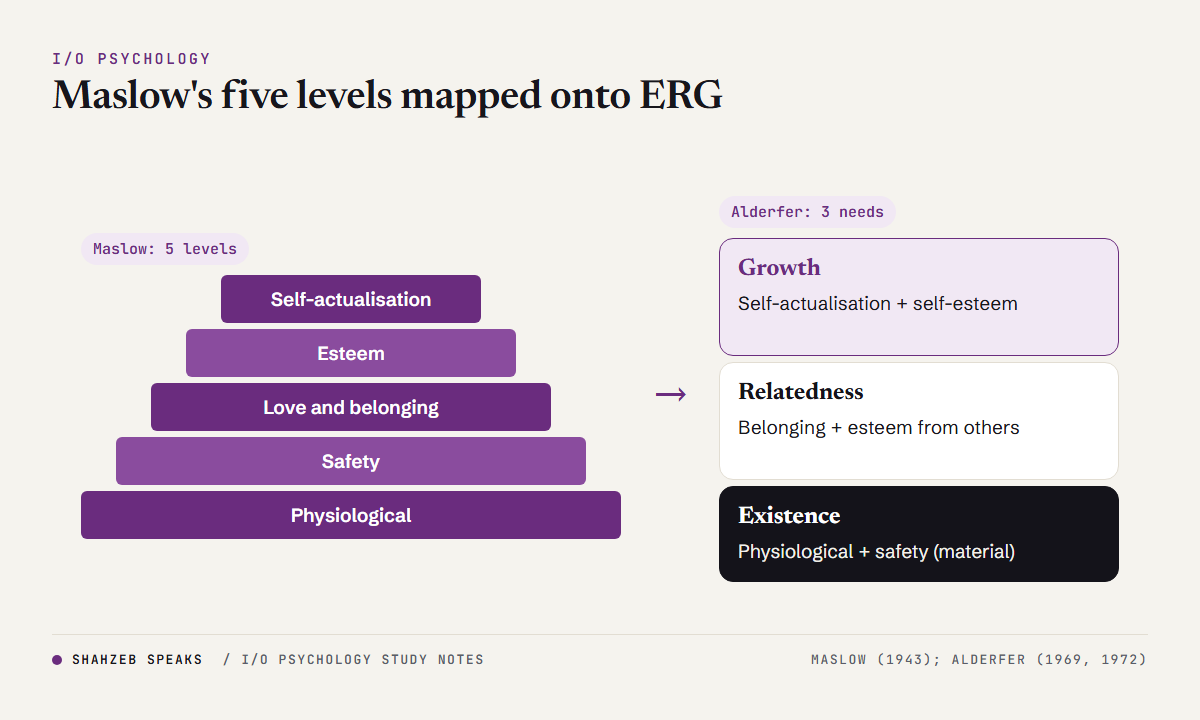
| Maslow’s level | ERG category | Workplace example |
|---|---|---|
| Physiological | Existence | A wage that covers food and rent |
| Safety (physical and material) | Existence | Safe machines in a textile mill; a permanent contract |
| Love and belonging | Relatedness | Friendly colleagues, a fair supervisor |
| Esteem from others | Relatedness | Recognition at the monthly branch meeting |
| Self-esteem | Growth | Confidence from mastering a new skill |
| Self-actualisation | Growth | Leading a project you designed; training to become a trainer |
This mapping is the standard textbook version. In exams, write that the mapping is “roughly” one to one, because Alderfer’s categories were defined in their own terms, not as a renaming of Maslow.
Satisfaction-progression and frustration-regression
The movement between needs is where ERG really differs from Maslow. Three ideas are usually taught:
- Satisfaction-progression: when a need is satisfied, a person tends to move on to desire the next, less concrete need. Maslow had this too, but in ERG it is not required: a person can desire growth without existence needs being fully met.
- Frustration-regression: when a higher need is frustrated, the desire for a lower, more concrete need increases. Someone who is repeatedly blocked from growth may put more energy into relationships or pay.
- Satisfaction-strengthening: some textbooks add that a satisfied need can stay strong or grow; growth needs in particular can increase the more they are satisfied, because doing interesting work makes you want more of it.
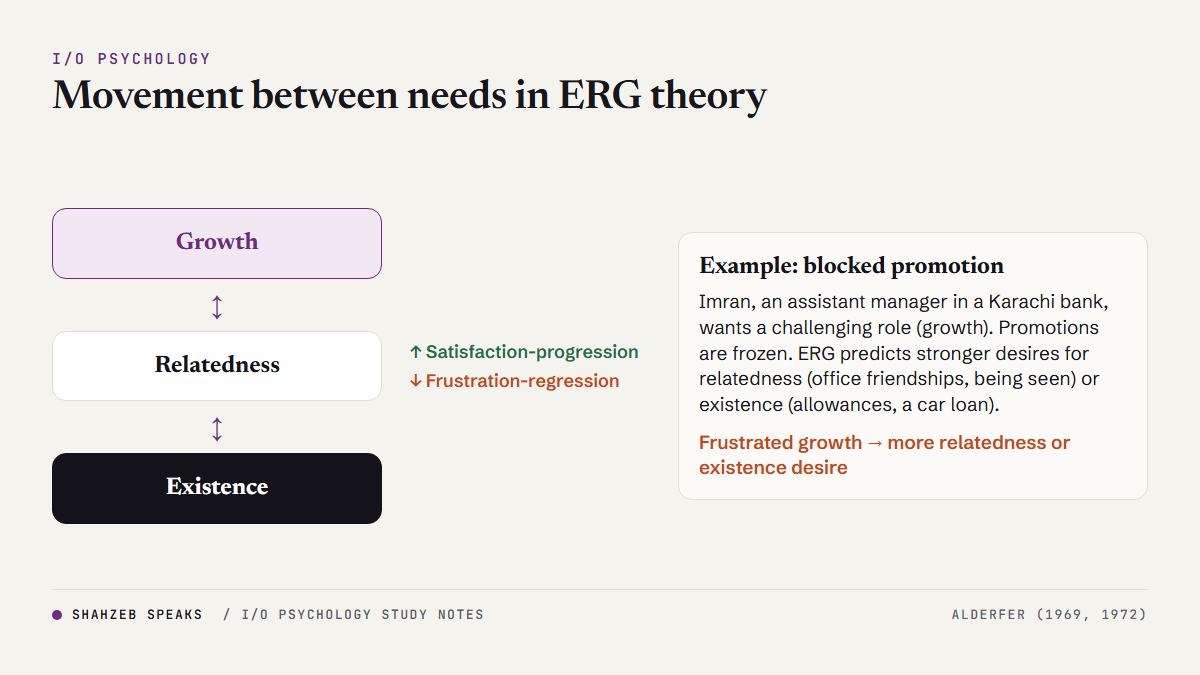
A frustration-regression example at work
Imran is an assistant manager in a bank in Karachi. He wants a challenging role (growth), but promotions are frozen for two years. ERG predicts that his frustrated growth need may turn into stronger relatedness desires (he spends more energy on office friendships and on being seen by senior staff) or even existence desires (he pushes harder for allowances and a car loan). A manager who reads this only as “Imran is greedy” misses the point: the real problem is the blocked growth need. Offering a stretch project, a training role or a lateral move could address it.
Maslow’s theory cannot easily explain Imran: in a strict hierarchy, a person who has reached the growth level should not move back down while lower needs remain satisfied.
ERG theory vs Maslow: the differences in a table
| Point | Maslow (1943, 1954) | Alderfer ERG (1969, 1972) |
|---|---|---|
| Number of needs | Five levels | Three categories |
| Movement | Upward: satisfaction-progression | Up and down: satisfaction-progression and frustration-regression |
| Needs active at once | Mainly one dominant level at a time | Several needs can be active at the same time |
| Must lower needs be met first? | Yes, lower needs are prepotent | No; growth can be pursued before existence needs are fully met |
| Order for everyone? | Same order for most people | Order can differ between people and situations (the “starving artist”) |
| Basis | Clinical observation and theory | Developed with questionnaire data from organisations |
| Main message for managers | Meet lower needs before expecting higher ones to motivate | When growth is blocked, expect people to push for pay and relationships instead |
A useful short version for exams: ERG is more flexible (fewer categories, no fixed order, needs at once) and adds regression. The “starving artist”, who puts creative growth ahead of food and comfort, fits ERG but is hard to explain with Maslow.
What does the research say?
Maslow: Wahba and Bridwell (1976) reviewed the research on the need hierarchy in “Maslow reconsidered”. They found little clear evidence that needs form five distinct categories arranged in the hierarchy Maslow described, and only partial support for the theory overall. This is the most cited review for criticising Maslow.
ERG: Alderfer built ERG with data from organisations and, with Benjamin Schneider, developed questionnaire measures of need satisfaction (Schneider & Alderfer, 1973). ERG is usually presented as fitting the data better than Maslow’s five levels because it makes fewer, looser claims. But honest reporting matters here: I have not found a large modern meta-analysis testing frustration-regression directly, so treat it as a useful idea with limited direct evidence rather than a proven law.
Need theories in general: Gagné and Deci (2005) note that critics such as Miner (1990) faulted these “humanistic” need theories for weak empirical support, while newer theories such as self-determination theory built their needs on experimental evidence. In I/O psychology today, ERG and Maslow are taught mainly as history and as useful frameworks for thinking, while goal-setting theory and SDT carry more of the research weight.
Criticism of ERG theory
- Hard to test. If needs can move up, move down or be active together, almost any behaviour can be explained after the fact, which makes the theory hard to falsify.
- Limited direct evidence for frustration-regression. The idea is intuitive but less tested than the classification itself.
- Still a needs theory. Like Maslow, it says what people need but not how they choose between actions; process theories such as goal-setting and expectancy theory fill that gap.
- Culture. The boundary between relatedness and growth may look different in collectivist workplaces, where belonging to the group and personal growth are closely tied.
Still, ERG remains a good lens for managers: when pay demands or office politics rise suddenly, ask whether growth has been blocked.
10-mark answer structure
- Introduction (who, year): both are content theories; Maslow (1943, 1954); Alderfer’s ERG (1969, 1972) as a revision.
- Maslow briefly: five levels and prepotency.
- ERG: existence, relatedness, growth with one workplace example each.
- Mapping diagram: draw the five levels beside the three categories.
- Movement: satisfaction-progression, frustration-regression, with one example such as a blocked promotion.
- Differences table: number of needs, fixed vs flexible order, one vs several needs active, regression.
- Evidence: Wahba and Bridwell (1976) on Maslow; ERG fits data better but frustration-regression is less tested.
- Criticism: hard to falsify; needs theories explain what, not how.
- Conclusion: ERG is the more flexible and realistic of the two, especially for explaining regression at work.
Model opening line: “Alderfer’s ERG theory (1969, 1972) revised Maslow’s five-level hierarchy into three needs, existence, relatedness and growth, and added the frustration-regression principle, so that needs can be active together and a blocked higher need can strengthen a lower one.”
Practice MCQs: ERG theory vs Maslow
Practice questions written to the published syllabus (not past-paper questions).
-
What do the letters E, R and G stand for in Alderfer’s theory?
- Esteem, Recognition, Growth
- Existence, Relatedness, Growth
- Effort, Reward, Goals
- Existence, Respect, Gratification
Show answer
B. The other options mix in terms from other theories or invent new ones.
-
Which principle is found in ERG theory but not in Maslow’s hierarchy?
- Satisfaction-progression
- Frustration-regression
- Prepotency of lower needs
- Self-actualisation
Show answer
B. Both theories include upward progression; prepotency and self-actualisation are Maslow’s ideas. Regression after frustration is ERG’s addition.
-
In ERG terms, Maslow’s physiological and safety needs belong mainly to:
- Existence
- Relatedness
- Growth
- Hygiene
Show answer
A. Material and physical needs are existence needs. Hygiene is Herzberg’s term.
-
An engineer whose promotion is blocked starts focusing on office friendships and allowances. ERG theory calls this:
- Satisfaction-progression
- Frustration-regression
- Equity restoration
- Introjected regulation
Show answer
B. A frustrated growth need increases desire for more concrete needs. C is Adams’s equity theory; D is SDT.
-
Which statement is NOT true of ERG theory?
- More than one need can be active at the same time
- The order of needs can differ between people
- Lower needs must be fully satisfied before growth needs appear
- It has three categories of needs
Show answer
C. That is closer to a strict reading of Maslow. ERG allows growth to be pursued before existence needs are fully met.
-
In which journal did Alderfer publish his 1969 test of ERG theory?
- Psychological Review
- Organizational Behavior and Human Performance
- Harvard Business Review
- Journal of Applied Psychology
Show answer
B. “An empirical test of a new theory of human needs” (1969). Maslow’s 1943 paper was in Psychological Review.
-
“Recognition from colleagues” in Maslow’s esteem level would sit mainly in which ERG category?
- Existence
- Relatedness
- Growth
- None, ERG drops esteem
Show answer
B. Esteem from others depends on relationships, so it goes with relatedness; self-esteem goes with growth.
-
Wahba and Bridwell’s (1976) review of Maslow’s theory concluded that:
- The five-level hierarchy was strongly confirmed
- There was little clear evidence for five distinct needs in Maslow’s order
- ERG theory was proven false
- Pay is a motivator
Show answer
B. They found only partial support. They did not test ERG’s falsity, and D is about Herzberg’s debate.
-
The “starving artist” who puts creative work before food and comfort is best explained by:
- Maslow’s strict hierarchy
- ERG theory’s flexible order of needs
- Herzberg’s hygiene factors
- Theory X
Show answer
B. ERG allows growth to come before existence needs are met. A strict hierarchy predicts the opposite; C and D are unrelated.
-
Alderfer ordered his three categories mainly by how:
- Expensive they are for the employer
- Concrete they are, from existence (most) to growth (least)
- Common they are in collectivist cultures
- Quickly they can be measured with the TAT
Show answer
B. Existence needs are the most concrete and easiest to verify; growth needs the least. The TAT belongs to McClelland’s research.
Practise on your phone
The free I/O Psychology Prep app has 410 explained
questions, flashcards and an exam countdown, and works offline. Get it on Google Play
· About the app
Mixed practice across all theories: work motivation MCQs.
Questions students ask
What is the main difference between ERG theory and Maslow?
Maslow has five needs in a fixed order, satisfied mostly one level at a time. ERG has three needs that can be active together, in different orders for different people, and adds frustration-regression: a blocked higher need increases the desire for a lower one.
Who proposed ERG theory and in which year?
Clayton P. Alderfer, in a 1969 article in Organizational Behavior and Human Performance, developed further in his 1972 book Existence, Relatedness, and Growth.
What is frustration-regression in simple words?
When you cannot get what you want at a higher level, such as growth, you turn back to wanting more of something easier, such as friendships or money.
Is ERG theory better than Maslow?
It is more flexible and fits organisational data better, which is why many textbooks prefer it. But it is harder to test, and neither theory has strong modern evidence compared with goal-setting or self-determination theory.
How is ERG theory used at work?
Managers can use it to read sudden demands for pay or social attention as a possible sign of blocked growth, and respond with development, new responsibility or a lateral move, not only with money.
Is ERG a content or process theory?
A content theory: it classifies what people need. Its regression idea adds some process, but it does not explain how people choose actions the way expectancy theory does.
Practise on your phone
The free I/O Psychology Prep app has 410 explained
questions, flashcards and an exam countdown, and works offline. Get it on Google Play
· About the app
References
- Alderfer, C. P. (1969). An empirical test of a new theory of human needs. Organizational Behavior and Human Performance, 4(2), 142-175. https://doi.org/10.1016/0030-5073(69)90004-X
- Alderfer, C. P. (1972). Existence, relatedness, and growth: Human needs in organizational settings. Free Press.
- Bridgman, T., Cummings, S., & Ballard, J. (2019). Who built Maslow’s pyramid? A history of the creation of management studies’ most famous symbol and its implications for management education. Academy of Management Learning & Education, 18(1), 81-98. https://doi.org/10.5465/amle.2017.0351
- Gagné, M., & Deci, E. L. (2005). Self-determination theory and work motivation. Journal of Organizational Behavior, 26(4), 331-362. https://doi.org/10.1002/job.322
- Maslow, A. H. (1943). A theory of human motivation. Psychological Review, 50(4), 370-396. https://doi.org/10.1037/h0054346
- Maslow, A. H. (1954). Motivation and personality. Harper.
- Schneider, B., & Alderfer, C. P. (1973). Three studies of measures of need satisfaction in organizations. Administrative Science Quarterly, 18(4), 489-505. https://doi.org/10.2307/2392201
- Wahba, M. A., & Bridwell, L. G. (1976). Maslow reconsidered: A review of research on the need hierarchy theory. Organizational Behavior and Human Performance, 15(2), 212-240. https://doi.org/10.1016/0030-5073(76)90038-6
ERG and Maslow are two of the nine theories compared in the work motivation theories guide. Read next: Maslow vs Herzberg, Herzberg’s two-factor theory, McClelland’s theory of needs, the job characteristics model and Theory X and Theory Y.