
Self-determination theory (SDT), developed by Edward Deci and Richard Ryan (1985, 2000), says people are most motivated and well when three basic needs are met: autonomy, competence and relatedness. Applied to work by Gagné and Deci (2005), it separates autonomous motivation from controlled motivation, rather than just asking how much motivation someone has.
This page is for students who meet SDT in an organisational behaviour or I/O psychology course, and for thesis students planning to measure work motivation. You get the three needs with workplace examples, the continuum of motivation as a diagram, what the research says about rewards, how SDT differs from Maslow, Herzberg and goal-setting theory, a 10-mark answer plan, 10 practice MCQs with explanations and the original references.
Many SDT pages online are written for school teachers or medical-entrance students. This one stays with work: managers, pay, targets and jobs. For the wider map of theories, see the work motivation theories pillar.
What is self-determination theory?
SDT grew out of Edward Deci’s experiments in the early 1970s on rewards and intrinsic motivation, which means doing an activity because it is interesting or enjoyable in itself. Deci and Ryan set out the theory in their 1985 book Intrinsic Motivation and Self-Determination in Human Behavior, and summarised it for a wide audience in two papers in 2000: one in American Psychologist (Ryan & Deci, 2000) and one in Psychological Inquiry (Deci & Ryan, 2000).
The step that made SDT useful for I/O psychology came in 2005, when Marylène Gagné and Edward Deci published “Self-determination theory and work motivation” in the Journal of Organizational Behavior. They argued that the main difference between SDT and most other work motivation theories is its focus on the type of motivation (autonomous versus controlled) rather than the total amount.
That is the idea to hold on to. Two bank officers can work equally hard. One works because she values serving customers well; the other works only because the branch manager is watching. SDT predicts that the first will perform better on complex work, keep going without supervision and feel better doing it.
The three basic needs: autonomy, competence, relatedness
SDT treats these as universal psychological needs, in the sense of “nutriments” essential for growth and well-being, not as wants that differ from person to person.
| Need | Meaning | Supported at work by | Thwarted at work by |
|---|---|---|---|
| Autonomy | Acting with a sense of volition and choice; endorsing what you do | Choice over how to do tasks, a meaningful reason for rules, managers who listen | Micromanagement, threats, surveillance, “because I said so” |
| Competence | Feeling effective and able to master challenges | Training, optimal challenge, useful informational feedback | Impossible targets, only negative feedback, no training |
| Relatedness | Feeling connected to and cared about by others | Supportive team, respectful supervisor, belonging | Isolation, cliques, toxic competition between colleagues |
Autonomy is the need students most often get wrong. It does not mean independence or working alone. A junior doctor on a hospital ward follows strict protocols, yet can feel autonomous if she understands and agrees with why the protocols exist. Autonomy is about endorsement, not about having no rules.
In a study in Bulgaria and the United States, Deci and colleagues (2001) measured employees’ satisfaction of the three needs and found it related positively to work engagement and well-being in both countries, which supports the claim that the needs matter in collectivist as well as individualist cultures. That point is useful for students in Pakistan, India or the Philippines who are asked whether a “Western” theory applies at home.
The continuum of motivation (with diagram)
The most examined part of SDT is the self-determination continuum. It runs from amotivation, through four types of extrinsic motivation, to intrinsic motivation. Each step reflects how far a reason for acting has been internalised, that is, taken in and made one’s own.
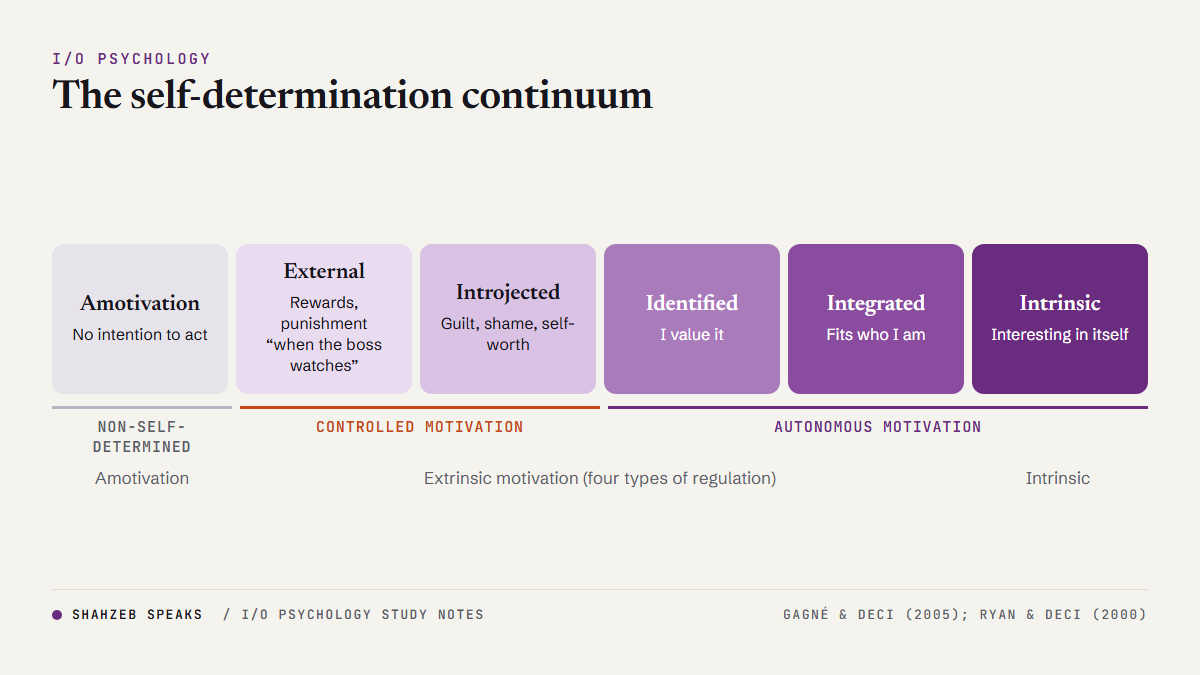
- Amotivation: no intention to act; the person does not really know why they are doing the job. “I don’t know why I bother.”
- External regulation: acting to get a reward or avoid a punishment. Gagné and Deci’s example: “I work when the boss is watching.” This is the classic, controlled form of extrinsic motivation.
- Introjected regulation: the pressure is inside the person but not accepted as their own: guilt, shame or the need to feel worthy. “I stay late because I’d feel guilty leaving before the others.”
- Identified regulation: the person values the behaviour for their own goals. “I fill in the patient charts carefully because accurate records keep patients safe.”
- Integrated regulation: the value fits with the person’s other values and identity. Gagné and Deci use nurses: for an integrated nurse, caring is central to who she is, so even dull tasks make sense.
- Intrinsic motivation: doing the activity because it is interesting or enjoyable in itself.
Controlled motivation = external + introjected regulation. Autonomous motivation = identified + integrated regulation + intrinsic motivation. Note two points that examiners like. First, extrinsic motivation can be autonomous (identified and integrated). Second, the continuum is not a stage theory: people do not have to pass through each step in order.
Rewards and intrinsic motivation: the undermining effect
In Deci’s (1971) laboratory experiments, students who were paid to solve interesting puzzles later spent less of their free time on the puzzles than students who were not paid. This came to be called the undermining effect. The part of SDT that explains it is cognitive evaluation theory: tangible rewards, deadlines, surveillance and evaluations can make people feel controlled, shifting the perceived locus of causality from inside to outside, which lowers intrinsic motivation. Choice and positive feedback do the opposite.
The finding was debated for years. A meta-analysis of 128 laboratory experiments (Deci, Koestner & Ryan, 1999) confirmed that positive feedback raises intrinsic motivation while expected, tangible rewards tied to doing the task lower it. The same analysis also found the limits, which matter at work:
- Rewards given regardless of task engagement (such as a salary) or unexpected rewards (such as a surprise bonus) did not undermine intrinsic motivation.
- Rewards for high-quality performance given in a supportive rather than pressuring way could raise intrinsic motivation compared with no reward and no feedback.
So SDT does not say “pay kills motivation”. It says the way rewards are given matters: as information about competence, or as control. A sales incentive announced with “hit this or you are out” is likely to be felt as control; the same bonus explained as recognition of skill is less likely to be.
SDT at work: managers, autonomy support and evidence
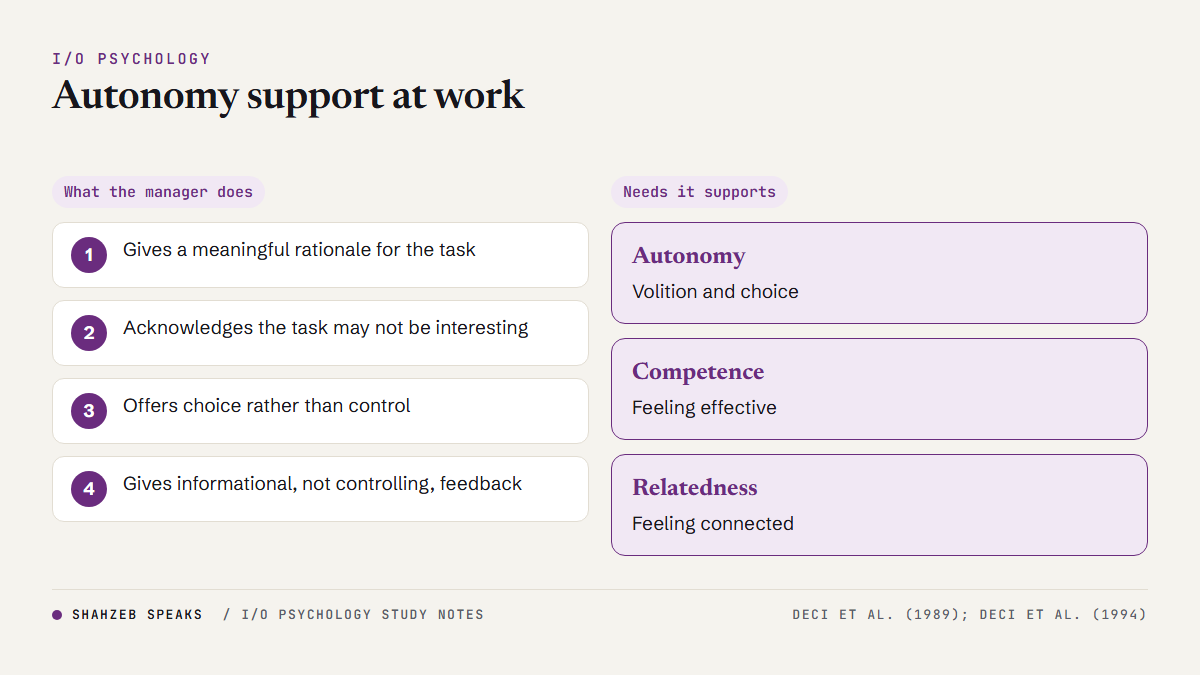
The workplace evidence centres on autonomy support from managers. Deci, Connell and Ryan (1989) studied a large US corporation and defined autonomy support as managers acknowledging employees’ perspectives, giving relevant information in a non-controlling way, offering choice and encouraging self-initiation instead of pressure. Employees of more autonomy-supportive managers were more satisfied and trusted top management more. The study also trained managers in this style.
In a laboratory experiment, Deci, Eghrari, Patrick and Leone (1994) identified three things that helped people internalise a dull task: a meaningful rationale, acknowledging that the task may not be interesting, and an emphasis on choice rather than control. These are practical tools for any supervisor, from a call centre team lead to a head of department.
Baard, Deci and Ryan (2004) found that managers’ autonomy support and employees’ own autonomy orientation predicted need satisfaction, which in turn predicted performance evaluations and well-being. A later review by Van den Broeck and colleagues (2016) gathered the research on the three needs at work, and Deci, Olafsen and Ryan (2017) summarised the field in the Annual Review of Organizational Psychology and Organizational Behavior.
For a thesis: the Multidimensional Work Motivation Scale (MWMS) by Gagné and colleagues (2015) was validated in seven languages and nine countries and measures the motivation types on the continuum. Check the authors’ terms of use before you use it, and do not reprint its items in your thesis appendix without permission. The site’s composite reliability and AVE calculator helps when you report its reliability.
SDT vs Maslow, Herzberg and goal-setting theory
| Point | SDT | Maslow / Alderfer | Herzberg | Goal-setting |
|---|---|---|---|---|
| Main focus | Type (quality) of motivation | Which needs drive behaviour | What satisfies vs dissatisfies | Goals that raise performance |
| Needs | 3 universal needs, all at once | 5 levels (Maslow) or 3 groups (ERG) | Hygiene factors and motivators | Not a needs theory |
| Hierarchy? | No | Yes (Maslow); flexible (ERG) | No | No |
| View of rewards | Depends on whether they feel controlling or informational | Satisfy lower needs | Pay is a hygiene factor | Work through goals and commitment |
| Key years | Deci & Ryan 1985, 2000; Gagné & Deci 2005 | Maslow 1943; Alderfer 1969 | Herzberg et al. 1959 | Locke 1968; Locke & Latham 1990, 2002 |
Gagné and Deci (2005) noted one point of agreement with goal-setting theory: a meaningful rationale helps people accept goals (Locke and Latham) and helps them internalise tasks (SDT). They also noted overlap with the job characteristics model: autonomy, task significance and feedback in a job tend to promote autonomous motivation. For the need theories, see Maslow vs Herzberg and ERG theory vs Maslow.
A note on popular books: Daniel Pink’s Drive (2009) popularised SDT as “autonomy, mastery and purpose”. That is a simplification. In exams, use SDT’s own terms: autonomy, competence and relatedness.
Criticism and limits of SDT
- Rewards debate. Some researchers argue the undermining effect is small or limited in real jobs. Most of the evidence on it comes from laboratory tasks, as Gagné and Deci (2005) themselves noted.
- Measuring the continuum. Neighbouring types (identified and integrated) are hard to separate in questionnaires, so many studies combine them.
- Cultural questions. Critics ask whether autonomy matters as much in hierarchical or collectivist cultures. SDT’s answer is that autonomy means endorsement, not independence, and cross-cultural studies such as Deci et al. (2001) support the needs in a collectivist setting; the debate continues.
- Broad scope. Because SDT covers education, health, sport and work, students can end up writing about classrooms in a work motivation answer. Keep your examples at work.
10-mark answer structure
- Definition (who, year): SDT by Deci and Ryan (1985, 2000), applied to work by Gagné and Deci (2005); focus on type, not amount, of motivation.
- Three basic needs: autonomy, competence, relatedness, each with one workplace example.
- Continuum: draw it: amotivation, external, introjected, identified, integrated, intrinsic; mark controlled vs autonomous.
- Internalisation: extrinsic motivation can become autonomous; not a stage theory.
- Rewards: cognitive evaluation theory, Deci (1971), Deci, Koestner and Ryan (1999) meta-analysis of 128 experiments and its limits.
- Workplace evidence: autonomy support (Deci et al., 1989), Baard et al. (2004).
- Comparison: one line each vs Maslow and Herzberg.
- Criticism: lab-based reward evidence, measurement, culture.
- Conclusion: practical advice for managers: rationale, choice, informational feedback, belonging.
Model opening line: “Self-determination theory, developed by Edward Deci and Richard Ryan (1985, 2000) and applied to work by Gagné and Deci (2005), holds that the quality of motivation matters more than its quantity, and that autonomous motivation flourishes when the needs for autonomy, competence and relatedness are satisfied.”
Practice MCQs: self-determination theory
Practice questions written to the published syllabus (not past-paper questions).
-
Which three needs does self-determination theory propose?
- Existence, relatedness, growth
- Autonomy, competence, relatedness
- Achievement, affiliation, power
- Safety, esteem, self-actualisation
Show answer
B. A is Alderfer’s ERG, C is McClelland, D mixes Maslow’s levels.
-
An employee says, “I only work hard when the supervisor is on the floor.” On the SDT continuum this is:
- External regulation
- Identified regulation
- Integrated regulation
- Intrinsic motivation
Show answer
A. Behaviour depends on an outside contingency (being watched). Identified and integrated forms involve valuing the work; intrinsic means enjoying it.
-
A nurse double-checks medicine doses because she would feel ashamed if colleagues saw a mistake. This is:
- Amotivation
- Introjected regulation
- Integrated regulation
- Intrinsic motivation
Show answer
B. The pressure (shame, self-worth) is inside her but not fully accepted as her own value. If she checked because she values patient safety, it would be identified regulation.
-
Which forms make up autonomous motivation in SDT?
- External and introjected regulation
- Amotivation and external regulation
- Identified and integrated regulation, and intrinsic motivation
- Only intrinsic motivation
Show answer
C. Well-internalised extrinsic motivation counts as autonomous. A is controlled motivation; D forgets that extrinsic motivation can be autonomous.
-
Which statement about the SDT continuum is NOT correct?
- It runs from amotivation to intrinsic motivation
- People must pass through each stage in order
- Extrinsic motivation can be autonomous
- Introjected regulation is a controlled form
Show answer
B. Gagné and Deci (2005) state it is not a stage theory. The other three statements are correct.
-
The Deci, Koestner and Ryan (1999) meta-analysis found that tangible rewards did NOT undermine intrinsic motivation when they were:
- Expected and tied to doing the task
- Unexpected, or not tied to task engagement
- Large
- Given with surveillance
Show answer
B. Unexpected rewards and rewards independent of engagement (like salary) did not undermine it. Expected, engagement-contingent rewards and surveillance tend to undermine it.
-
Which sub-theory of SDT explains how rewards and feedback affect intrinsic motivation?
- Cognitive evaluation theory
- Expectancy theory
- Equity theory
- Two-factor theory
Show answer
A. Cognitive evaluation theory deals with whether events feel controlling or informational. The others are separate theories by Vroom, Adams and Herzberg.
-
Deci et al. (1994) found three factors that helped people internalise an uninteresting task. Which is NOT one of them?
- A meaningful rationale
- Acknowledging the task may be uninteresting
- Emphasising choice rather than control
- Offering a large cash bonus
Show answer
D. The three factors were rationale, acknowledgement and choice. A bonus was not one of them and could feel controlling.
-
The main difference between SDT and most other work motivation theories, according to Gagné and Deci (2005), is that SDT focuses on:
- The total amount of motivation
- The type of motivation, autonomous versus controlled
- Pay comparison with others
- A five-level hierarchy of needs
Show answer
B. SDT stresses quality over quantity. C is equity theory and D is Maslow.
-
A team lead explains why a new reporting rule exists, admits it is tedious and lets agents choose when in the shift to complete it. In SDT terms she is showing:
- Autonomy support
- External regulation
- Amotivation
- Frustration-regression
Show answer
A. Rationale, acknowledgement and choice are autonomy-supportive behaviours. External regulation describes the employee’s reason, not the manager’s style; D is from ERG theory.
Practise on your phone
The free I/O Psychology Prep app has 410 explained
questions, flashcards and an exam countdown, and works offline. Get it on Google Play
· About the app
Mixed practice across all theories: work motivation MCQs.
Questions students ask
What is self-determination theory in simple words?
People do their best work and feel better when they feel they have a choice, feel capable and feel connected to others. When work feels forced, motivation becomes fragile and depends on rewards and pressure.
Who developed self-determination theory and when?
Edward L. Deci and Richard M. Ryan at the University of Rochester. The main book is from 1985, with key summary papers in 2000. Gagné and Deci applied it to work motivation in 2005.
Is SDT a content or process theory?
It has elements of both. It names three needs (content) but its main contribution is how motivation becomes internalised and how social conditions shift it from controlled to autonomous (process). In exams, say this directly.
What is the difference between intrinsic and extrinsic motivation in SDT?
Intrinsic motivation is doing something because it is interesting in itself. Extrinsic motivation is doing it for a separate outcome. SDT’s twist is that extrinsic motivation ranges from controlled (external, introjected) to autonomous (identified, integrated).
How can managers apply SDT at work?
Give reasons for rules, offer choice in how work is done, give feedback that informs rather than threatens, provide training and reachable challenges, and build a team where people feel they belong.
Does money reduce motivation according to SDT?
Not in general. Expected rewards tied to doing an interesting task can lower intrinsic motivation, but salary, unexpected bonuses and rewards given as recognition in a supportive way do not have this effect in the meta-analysis.
Practise on your phone
The free I/O Psychology Prep app has 410 explained
questions, flashcards and an exam countdown, and works offline. Get it on Google Play
· About the app
References
- Baard, P. P., Deci, E. L., & Ryan, R. M. (2004). Intrinsic need satisfaction: A motivational basis of performance and well-being in two work settings. Journal of Applied Social Psychology, 34(10), 2045-2068. https://doi.org/10.1111/j.1559-1816.2004.tb02690.x
- Deci, E. L. (1971). Effects of externally mediated rewards on intrinsic motivation. Journal of Personality and Social Psychology, 18(1), 105-115. https://doi.org/10.1037/h0030644
- Deci, E. L., Connell, J. P., & Ryan, R. M. (1989). Self-determination in a work organization. Journal of Applied Psychology, 74(4), 580-590. https://doi.org/10.1037/0021-9010.74.4.580
- Deci, E. L., Koestner, R., & Ryan, R. M. (1999). A meta-analytic review of experiments examining the effects of extrinsic rewards on intrinsic motivation. Psychological Bulletin, 125(6), 627-668. https://doi.org/10.1037/0033-2909.125.6.627
- Deci, E. L., Olafsen, A. H., & Ryan, R. M. (2017). Self-determination theory in work organizations: The state of a science. Annual Review of Organizational Psychology and Organizational Behavior, 4, 19-43. https://doi.org/10.1146/annurev-orgpsych-032516-113108
- Deci, E. L., & Ryan, R. M. (1985). Intrinsic motivation and self-determination in human behavior. Plenum. https://doi.org/10.1007/978-1-4899-2271-7
- Deci, E. L., & Ryan, R. M. (2000). The “what” and “why” of goal pursuits: Human needs and the self-determination of behavior. Psychological Inquiry, 11(4), 227-268. https://doi.org/10.1207/S15327965PLI1104_01
- Deci, E. L., Ryan, R. M., Gagné, M., Leone, D. R., Usunov, J., & Kornazheva, B. P. (2001). Need satisfaction, motivation, and well-being in the work organizations of a former Eastern Bloc country. Personality and Social Psychology Bulletin, 27, 930-942.
- Gagné, M., & Deci, E. L. (2005). Self-determination theory and work motivation. Journal of Organizational Behavior, 26(4), 331-362. https://doi.org/10.1002/job.322
- Gagné, M., Forest, J., Vansteenkiste, M., Crevier-Braud, L., Van den Broeck, A., Aspeli, A. K., et al. (2015). The Multidimensional Work Motivation Scale: Validation evidence in seven languages and nine countries. European Journal of Work and Organizational Psychology, 24(2), 178-196. https://doi.org/10.1080/1359432X.2013.877892
- Pink, D. H. (2009). Drive: The surprising truth about what motivates us. Riverhead Books.
- Ryan, R. M., & Deci, E. L. (2000). Self-determination theory and the facilitation of intrinsic motivation, social development, and well-being. American Psychologist, 55(1), 68-78. https://doi.org/10.1037/0003-066X.55.1.68
- Van den Broeck, A., Ferris, D. L., Chang, C.-H., & Rosen, C. C. (2016). A review of self-determination theory’s basic psychological needs at work. Journal of Management, 42(5), 1195-1229. https://doi.org/10.1177/0149206316632058
SDT is one of nine theories compared in the work motivation theories guide. Read it next to goal-setting theory, Herzberg’s two-factor theory, Theory X and Theory Y and McClelland’s theory of needs. Related reading on this site: the psychology of meaningful work and why micromanagement backfires.