
In the Philippine Psychometricians Licensure Examination, Industrial-Organizational Psychology is one of four subjects and carries 20% of the grade. The PRC Board of Psychology’s 2023 table of specifications gives it 100 items across five areas: organization theory, structures and systems, HRD and HRM, team dynamics, and organizational change and development.
This industrial psychology reviewer is for BS Psychology graduates in the Philippines who are preparing for the psychometrician board exam. It starts from the official document, not from a review-centre handout: the Board’s own table of specifications (TOS), so you know exactly what the subject covers and how the 100 items are split. Then it gives short notes for each area, a review plan, and 25 practice questions written to the published syllabus, each with an explanation.
I am an Industrial and Organizational Psychologist (MSc) in Karachi, not a Filipino review-centre lecturer. What I can offer is the I/O content itself, checked against original sources, and a careful reading of what the PRC has published. Where a fact can change (dates, weights), I say which PRC document it comes from so you can check the latest version.
What does the Industrial Psychology subject cover in the psychometrician board exam?
The scope is set by Professional Regulatory Board of Psychology Resolution No. 02, Series of 2023, signed on 5 April 2023 and published in the Business Mirror on 24 April 2023. It adopted “Enhanced Tables of Specifications” for both licensure exams and applies from the June 2023 exam onwards. It replaced the older Resolution No. 19 (s. 2014). The tables themselves are in Annex A and B; Annex B is for psychometricians.
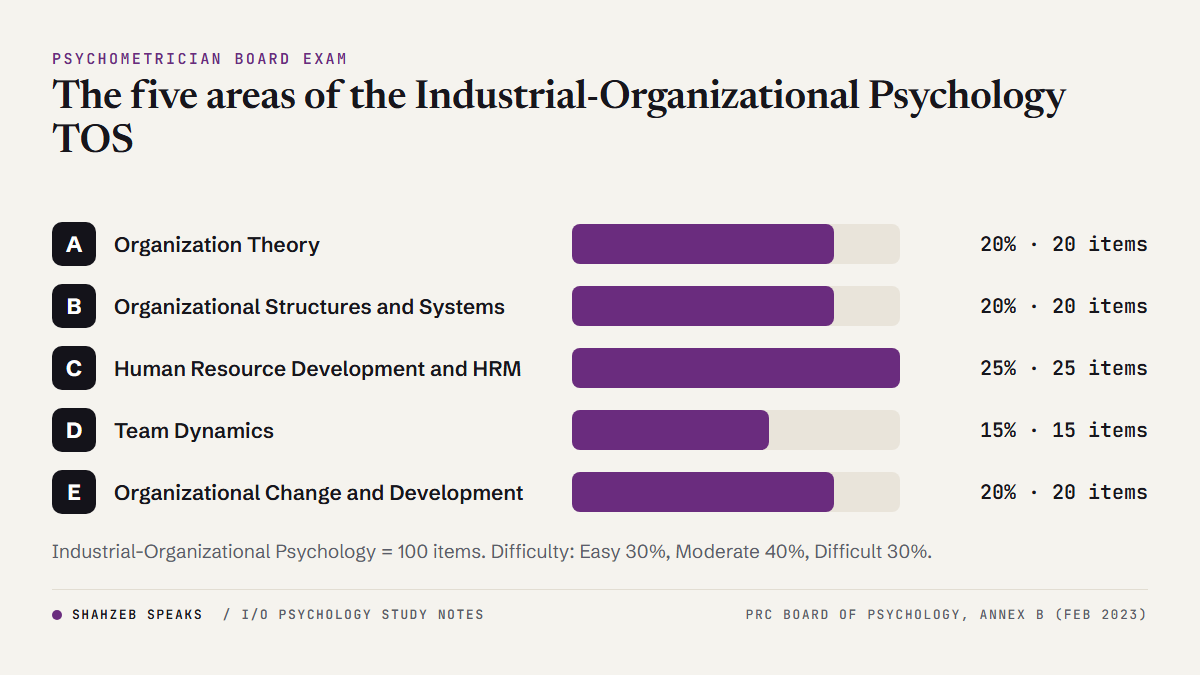
In Annex B (dated “as of February 2023”), the subject is called Industrial-Organizational Psychology. It has a weight of 20%, is pitched at Philippine Qualifications Framework (PQF) Level 6 (the bachelor’s level), and has 100 items. The difficulty mix is Easy 30%, Moderate 40% and Difficult 30%.
| Area in the TOS | Weight | Items | What the competencies ask for |
|---|---|---|---|
| A. Organization Theory | 20% | 20 | Describe and apply classical, neo-classical, modern, contingency, motivation and open systems theories; explain how organizations use theory to improve structure, leadership, motivation, communication and culture |
| B. Organizational Structures and Systems | 20% | 20 | Pros and cons of functional, multi-divisional, flat, matrix, team, network and hierarchical structures; job design, departmentation, delegation, span of control, chain of command; aligning structure with business strategy |
| C. Human Resource Development and Human Resource Management | 25% | 25 | HRD vs HRM, HRD vs OD, HRD vs training; HRD activities (training, learning, career development, talent management, performance appraisal, engagement); HRM activities (manpower planning, staffing, developing, monitoring, maintaining, managing relationships, evaluating); HR manager vs HRD manager |
| D. Team Dynamics | 15% | 15 | Why team dynamics matter, stages of team development, group processes, common team problems and how to fix them |
| E. Organizational Change and Development | 20% | 20 | Change vs OD, OD vs transformation, drivers of change, types of large-scale change, OD interventions, change strategies |
| Total | 100% | 100 | Easy 30%, Moderate 40%, Difficult 30% |
One small note if you read the PRC file yourself: the third area is printed with the letter “B” a second time. It is clearly the third block (its competencies are numbered 3.1 to 3.5), so I call it C here.
Notice what is not on the list. Older I/O courses spend weeks on employee selection, test validity, job analysis and performance appraisal methods. In this TOS, appraisal appears only as one HRD activity, and selection appears as “staffing” under HRM. The 2023 subject leans towards the organizational side: theory, structure, HR systems, teams and change. Your review should follow the TOS, not the table of contents of your college textbook.
How is the psychometrician board exam weighted, and what score do you need?
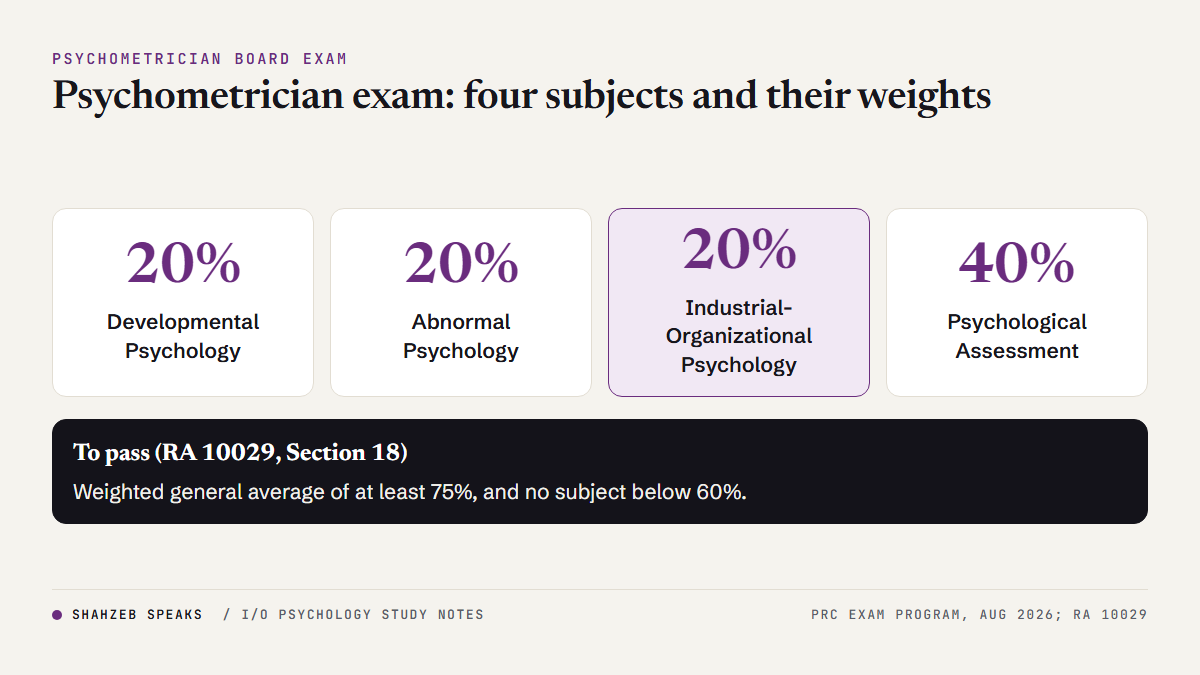
The law, Republic Act No. 10029 (Philippine Psychology Act of 2009), lists four psychometrician subjects in Section 15: Theories of Personality, Abnormal Psychology, Industrial Psychology and Psychological Assessment. The same section lets the Board re-cluster, modify, add or drop subjects. The 2023 TOS used that power: Annex B lists Developmental Psychology in place of Theories of Personality.
The PRC exam program for the August 2026 Psychometricians Licensure Examination (dated 2 March 2026) shows the current order and weights. Industrial-Organizational Psychology is a three-hour morning paper on the second day.
| Day and time (August 2026 program) | Subject | Relative weight |
|---|---|---|
| Day 1, 8:00 to 11:00 a.m. | Developmental Psychology | 20% |
| Day 1, 1:00 to 4:00 p.m. | Abnormal Psychology | 20% |
| Day 2, 8:00 to 11:00 a.m. | Industrial-Organizational Psychology | 20% |
| Day 2, 1:00 to 4:00 p.m. | Psychological Assessment | 40% |
Section 18 of RA 10029 sets the passing rule: a weighted general average of at least 75%, with no subject below 60%. If your average is 75% or more but one subject is below 60%, you may retake that subject within the next two years and must score at least 75% in it.
Dates move, so check them. The PRC’s 2026 schedule listed the psychometrician exam for 19 and 20 August 2026; it was then rescheduled to 1 and 2 September 2026 (PRC Resolution No. 2237, s. 2026), and the Pampanga venue moved again to 17 and 18 September 2026. The same subjects and weights were used for the May 2026 special exams in Hong Kong, Singapore and Taiwan. For the next exam, look for the PRC’s schedule of licensure examinations for the coming year on prc.gov.ph; I have not seen a 2027 date published yet.
Industrial psychology reviewer: notes for the five TOS areas
These notes follow the TOS order. They are a map, not a replacement for a full textbook. Each block ends with the kind of item the TOS competency suggests.
A. Organization theory (20 items)
Classical theory treats the organization as a machine. Frederick Taylor’s Principles of Scientific Management (1911) studied tasks scientifically to find “one best way”, selected and trained workers for each task, and tied pay to output. Henri Fayol (1916) described the five functions of management (planning, organizing, commanding, coordinating and controlling) and his principles of management, such as unity of command and scalar chain. Max Weber described bureaucracy: a hierarchy of offices, written rules, division of labour, impersonal treatment and appointment on merit.
Neo-classical (human relations) theory grew out of the Hawthorne studies at Western Electric. Roethlisberger and Dickson’s report (1939) showed that informal groups, social needs and supervision style shaped output, not just pay and lighting. Compare the two schools in Taylor vs Mayo.
Modern and open systems theory sees the organization as an open system: it takes inputs (people, money, materials), transforms them (throughput) and sends outputs into an environment that feeds back. Von Bertalanffy (1950) set out open systems in biology; Katz and Kahn (1966) applied the idea to organizations.
Contingency theory says there is no one best way: the right structure depends on the situation. Burns and Stalker (1961) found that mechanistic (rigid, rule-bound) structures suited stable environments and organic (flexible) structures suited changing ones. Lawrence and Lorsch (1967) showed that firms in uncertain environments need more differentiation between departments and stronger integration to hold them together.
Motivation theory is listed as an organization theory in the TOS, so revise the main work-motivation theories (Maslow, Herzberg, McGregor, Vroom, equity, goal setting) from the work motivation theories comparison.
Likely item type: a short case about a hospital or BPO company, and you pick the theory that explains it.
B. Organizational structures and systems (20 items)
- Functional: grouped by specialist function (HR, finance, operations). Deep expertise; weak coordination across functions.
- Multi-divisional: separate divisions by product or region, each with its own functions. Good for diverse businesses; duplicated resources.
- Hierarchical (tall): many levels and narrow spans of control. Close supervision; slow decisions.
- Flat: few levels and wide spans. Fast decisions and more autonomy; managers can be overloaded.
- Matrix: employees report to a functional manager and a project or product manager at the same time. Flexible; dual reporting causes role conflict.
- Team-based: work is organized around cross-functional teams rather than departments.
- Network: a small core firm coordinates outside partners who do much of the work (for example outsourced manufacturing or a contact centre).
The TOS also names the building blocks of any structure: job design (what each job contains), departmentation (how jobs are grouped), delegation (passing authority down), span of control (how many people report to one manager) and chain of command (the line of authority from top to bottom). Learn one clear definition of each; definition items in this area are mostly at the “remembering” level.
C. Human resource development and human resource management (25 items, the largest area)
HRM is the wider set of people-management functions: manpower planning, staffing (recruitment and selection), developing, monitoring, maintaining (pay, benefits, welfare), managing employee relations and evaluating. HRD is the part that develops people: training, learning, career development, talent management, performance appraisal used for growth, and engagement. Organization development (OD) works on the whole organization’s health and effectiveness through planned, behavioural-science-based change; HRD works mainly on individuals and groups. Training builds skills for the present job; development prepares people for future roles.
A useful way to remember it: the HR manager asks “Do we have the right people, paid and treated fairly?” The HRD manager asks “Are our people learning and growing?” Our I/O psychology vs HRM page goes deeper on where the fields overlap. For the HRD activities, see training needs analysis and methods of performance appraisal.
Likely item type: “Which activity belongs to HRD rather than HRM?” and analyzing items (competency 3.4 alone has 8 analyzing-level items).
D. Team dynamics (15 items)
Tuckman (1965) reviewed small-group studies and proposed four stages: forming (polite, unsure), storming (conflict over roles and goals), norming (shared rules and cohesion) and performing (focus on the task). Tuckman and Jensen (1977) added a fifth stage, adjourning, when the group breaks up. The full notes are on Tuckman’s stages.
Group processes that affect effectiveness include cohesion, norms, roles, communication and decision making. Common problems: social loafing, where people put in less effort in a group than alone (Latané, Williams and Harkins, 1979); groupthink, where a cohesive group stops weighing alternatives in order to keep agreement (Janis, 1972); unresolved conflict; and unclear roles. Fixes include making individual contributions visible, assigning a devil’s advocate, setting clear goals and roles, and team-building.
E. Organizational change and development (20 items)
Change is any alteration in how an organization works. OD is planned, long-term change that uses behavioural science to improve effectiveness and well-being. Transformation is a deep change in strategy, culture or structure, usually organization-wide. Drivers of change can be external (technology, competition, regulation, the economy) or internal (new leaders, poor performance, growth).
Two models appear in most reviewers. The three-step model of unfreezing, moving (changing) and refreezing is usually credited to Kurt Lewin (1947); historians such as Cummings, Bridgman and Brown (2016) argue that later writers packaged it into a neat model. John Kotter (1995) listed eight steps, starting with establishing a sense of urgency and forming a guiding coalition, and ending with anchoring the new approaches in the culture. Coch and French (1948) found that factory workers who took part in planning a change resisted it less.
OD interventions to know: survey feedback, team building, process consultation, sensitivity (T-group) training, coaching, job redesign and structural change. Evaluating which intervention fits a case is a difficult-level skill, so practise with scenarios.
What the difficulty split tells you about how to review
Annex B also shows how many items sit at each level of Bloom’s taxonomy. Only 9 items are pure recall (“remembering”). The largest group, 40 items, asks you to apply; 22 ask you to analyze and 8 to evaluate. No items are at the “creating” level.
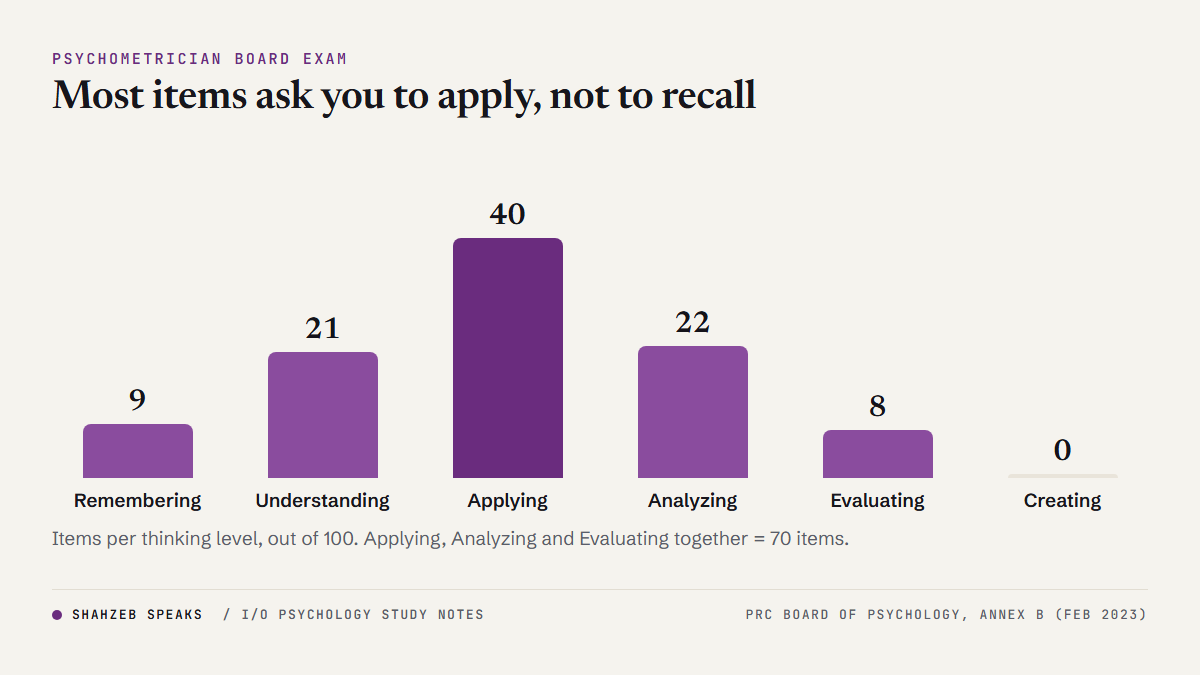
So memorising lists is not enough. For every theory and structure, practise saying: “In this situation, which one is it, and why not the others?” That is how the practice questions below are written.
How to review for Industrial-Organizational Psychology (a six-week plan)
- Week 1, map: print the Annex B table. Tick each competency as you finish it. Read one I/O textbook chapter on organizations and one on HRM (Aamodt’s Industrial/Organizational Psychology covers most I/O topics; add a management or organizational behaviour text for structure and OD).
- Week 2, Area A: make a one-page table of the six theory groups: who, year, key idea, criticism. Use our one-page industrial psychology notes as a model.
- Week 3, Area B: draw each structure as a small chart. Write one advantage and one disadvantage for each.
- Week 4, Area C: this is 25 items. Build a three-column table: HRM, HRD, OD. Place every activity in a column.
- Week 5, Areas D and E: learn Tuckman, social loafing, groupthink, Lewin and Kotter, and the OD interventions, each with one Philippine workplace example (a BPO team, a hospital ward, a bank branch).
- Week 6, timed practice: answer mixed questions under time pressure. Review every wrong answer by writing why the right option fits better.
10-mark answer structure: managing organizational change
- Definition: organizational change vs organization development (OD as planned, behavioural-science-based, long-term change).
- Drivers: two external (technology, competition) and one internal (new leadership or poor results).
- Model 1: the three steps usually credited to Lewin (1947): unfreeze, move, refreeze, each in one line.
- Model 2: Kotter’s (1995) eight steps, grouped as create urgency, build a coalition and vision, act and win early, anchor in culture.
- Resistance: why people resist and how participation reduces it (Coch and French, 1948).
- Example: a Manila BPO moving from on-site to hybrid work, mapped onto the steps.
- Evaluation: models are simple; real change is messy and needs constant communication.
- Conclusion: one line on why OD needs both structure and people.
Model opening line: “Organizational change is any shift in how an organization works; organization development is the planned, behavioural-science-based version of it, aimed at both effectiveness and employee well-being.”
For the board exam’s multiple-choice items, use the same order in your head: name the concept, check which model fits the case, then rule out the options that describe a different area of the TOS.
Practice questions written to the published syllabus (25 items)
These are my own practice questions, written to the competencies in the PRC’s 2023 table of specifications. They are not actual board exam items. The spread follows the TOS weights: 5 on organization theory, 5 on structures, 6 on HRD and HRM, 4 on team dynamics and 5 on change and OD. For topic sets, go to the I/O psychology MCQ hub, especially the history, training and performance appraisal sets.
-
A Cebu manufacturing plant times every movement of its packers with a stopwatch, fixes the single best method and pays a bonus per carton above the standard. Which school of thought is this?
- Human relations
- Scientific management
- Open systems theory
- Contingency theory
Show answer
B. Time study, one best method and output-linked pay are Taylor’s scientific management (1911). Human relations focuses on social needs, open systems on environment exchange, and contingency on fitting structure to situation.
-
Which statement is NOT part of Weber’s description of bureaucracy?
- A clear hierarchy of offices
- Written rules applied impersonally
- Appointment and promotion based on personal loyalty to the owner
- Division of labour into defined duties
Show answer
C. Weber’s bureaucracy rests on merit and technical qualification, not personal loyalty. The other three are core features of his model.
-
A call centre manager notices that agents in one team keep their call numbers at a level the team agrees on, regardless of the incentive scheme. Which body of work first drew attention to this kind of informal group norm?
- Fayol’s principles of management
- The Hawthorne studies
- Burns and Stalker’s study of innovation
- Von Bertalanffy’s general systems theory
Show answer
B. The Hawthorne research (reported by Roethlisberger and Dickson, 1939) showed that informal groups set their own output norms. Fayol wrote about management functions, Burns and Stalker about structure and environment, and von Bertalanffy about systems in biology.
-
A hospital in Davao takes in patients, staff and medicine, turns them into treated patients, and changes its services after feedback from the local health office. Which view of organizations does this description fit best?
- Classical organization theory
- Open systems theory
- Theory X
- Bureaucratic theory
Show answer
B. Inputs, throughput, outputs and feedback from the environment are the language of open systems (Katz and Kahn, 1966). Classical and bureaucratic theory treat the organization as a closed machine; Theory X is a set of beliefs about workers.
-
Burns and Stalker (1961) would predict that a software start-up in a fast-changing market performs best with which kind of structure?
- Mechanistic, with strict rules and a tall hierarchy
- Organic, with flexible roles and lateral communication
- Bureaucratic, with written procedures for every case
- Functional, with no cross-department contact
Show answer
B. Their contingency finding was that organic structures suit changing environments and mechanistic ones suit stable environments. Options A, C and D all describe rigid structures that fit stable conditions.
-
A bank has 12 levels of management and each manager supervises 3 people. Which description fits?
- Flat structure with a wide span of control
- Tall structure with a narrow span of control
- Matrix structure with dual reporting
- Network structure with outsourced partners
Show answer
B. Many levels plus few direct reports means a tall (hierarchical) structure with a narrow span. A flat structure has few levels and wide spans; matrix and network describe reporting and partner arrangements, not just height.
-
An engineer in a construction firm reports to the engineering head and also to the manager of the airport project she is assigned to. Which structure is this, and what is its typical drawback?
- Functional; slow promotions
- Matrix; role conflict from two bosses
- Multi-divisional; duplication of resources
- Flat; overloaded managers
Show answer
B. Reporting to a functional head and a project manager at the same time is the matrix structure, and conflicting demands from two bosses are its best-known cost. The other pairs describe different structures.
-
“Grouping jobs into units such as departments, by function, product or region” defines which element of structure?
- Delegation
- Span of control
- Departmentation
- Chain of command
Show answer
C. Departmentation is how jobs are grouped. Delegation passes authority down, span of control is the number of direct reports, and chain of command is the line of authority.
-
A food company runs separate units for snacks, beverages and frozen foods, each with its own marketing, sales and finance staff. What structure is this?
- Functional
- Multi-divisional
- Team-based
- Matrix
Show answer
B. Self-contained product divisions, each with its own functions, define the multi-divisional form. A functional structure would have one company-wide marketing department instead.
-
A clothing brand keeps design and marketing in-house but contracts out sewing, delivery and customer service to other firms. Which structure is this?
- Network
- Hierarchical
- Functional
- Flat
Show answer
A. A small core firm coordinating outside partners is a network structure. Hierarchical, functional and flat describe internal arrangements, not outsourcing.
-
Which activity belongs to HRD rather than to the wider HRM function?
- Computing overtime pay
- Designing a career-development path for junior nurses
- Processing government contributions
- Drafting the leave policy
Show answer
B. Career development is a core HRD activity. Payroll, statutory contributions and leave policy are HRM “maintaining” activities.
-
What best separates organization development (OD) from human resource development (HRD)?
- OD only deals with hiring; HRD deals with firing
- OD targets the whole organization’s effectiveness through planned change; HRD focuses mainly on developing individuals and groups
- OD is done by line managers; HRD is done by the government
- There is no difference; the terms are the same
Show answer
B. OD is system-wide, planned and based on behavioural science; HRD centres on learning and growth of people. Options A and C are false, and D ignores the distinction the TOS asks you to make.
-
A BPO trains new agents for two weeks on its call-handling software. Their team leaders attend a year-long leadership programme for future site-manager roles. Which pair is correct?
- Both are development
- Agents: training; team leaders: development
- Agents: development; team leaders: training
- Both are organization development
Show answer
B. Training builds skills for the current job in the short term; development prepares people for future roles. Neither programme changes the whole organization, so it is not OD.
-
Which list contains only HRM activities named in the TOS?
- Manpower planning, staffing, maintaining, evaluating
- Survey feedback, team building, process consultation
- Forming, storming, norming, performing
- Unfreezing, moving, refreezing
Show answer
A. These are the HRM activities in competency 3.4. Option B lists OD interventions, C lists Tuckman’s stages and D lists the change steps credited to Lewin.
-
A hospital HR head says: “We filled all 40 nursing posts this year.” The HRD head says: “Only half of our nurses finished their required training.” Whose concern is it that the nurses are not growing in skill?
- Only the HR manager’s
- Mainly the HRD manager’s
- The finance department’s
- Nobody’s, because the posts are filled
Show answer
B. Learning and skill growth is the HRD manager’s core role; filling posts (staffing) is HRM. A full headcount does not solve a training gap, which rules out D.
-
Talent management, as an HRD activity, is best described as:
- Paying everyone the same salary
- Identifying, developing and keeping people with high potential for key roles
- Recording attendance with biometrics
- Disciplining employees who break rules
Show answer
B. Talent management means finding, growing and retaining key people. Equal pay, attendance tracking and discipline are maintenance or employee-relations tasks, not development.
-
A new project team argues about who leads and what the goal is, two weeks after first meeting. According to Tuckman (1965), which stage is this?
- Forming
- Storming
- Norming
- Performing
Show answer
B. Conflict over roles and goals marks storming. Forming is polite and uncertain, norming builds shared rules, and performing is task-focused.
-
Which stage did Tuckman and Jensen (1977) add to the original four?
- Reforming
- Adjourning
- Transforming
- Conforming
Show answer
B. Adjourning, the break-up of the group, was added in 1977. The other words are not stages in the model.
-
In a group report, four students do almost all the work while two contribute little because “the grade is shared anyway”. What is this called, and what is one fix?
- Groupthink; appoint a devil’s advocate
- Social loafing; make each person’s contribution visible and graded
- Storming; wait for norming
- Role ambiguity; add more members
Show answer
B. Reduced effort in a group is social loafing (Latané, Williams and Harkins, 1979), and identifiable individual contributions reduce it. Groupthink is about poor decisions from pressure to agree, and adding members usually makes loafing worse.
-
A close-knit management team approves a risky expansion. Nobody voices doubts because they do not want to spoil the harmony. Which concept explains this, and whose work is it?
- Groupthink; Janis
- Social facilitation; Zajonc
- Social loafing; Ringelmann
- Role conflict; Kahn
Show answer
A. Janis (1972) described groupthink: cohesive groups suppress dissent to keep agreement. The other concepts concern performance in front of others, effort in groups and conflicting role demands.
-
Which statement correctly separates organizational change from organization development?
- All change is OD
- OD is a planned, behavioural-science-based, long-term kind of change; change can be any alteration, planned or not
- OD only means downsizing
- Change is always planned; OD is never planned
Show answer
B. OD is one specific, planned approach to change. Options A, C and D reverse or narrow the definitions.
-
A manager tells staff that the old paper filing system has caused repeated losses and shows them the cost, before introducing a digital system. In the three-step model credited to Lewin, which step is this?
- Unfreezing
- Moving
- Refreezing
- Adjourning
Show answer
A. Showing why the old way no longer works prepares people to let go of it, which is unfreezing. Moving is the change itself, refreezing makes it stick, and adjourning belongs to Tuckman’s model.
-
In Kotter’s (1995) eight steps, what comes first?
- Create short-term wins
- Establish a sense of urgency
- Anchor new approaches in the culture
- Communicate the vision
Show answer
B. Kotter begins with urgency. Short-term wins come in the middle, communicating the vision comes after the vision is created, and anchoring in the culture is the last step.
-
An OD consultant gives all employees a confidential questionnaire, then meets each department to discuss its own results and plan actions. Which intervention is this?
- Survey feedback
- Sensitivity training
- Job rotation
- Performance appraisal
Show answer
A. Collecting data and feeding it back to groups for action planning is survey feedback. Sensitivity training uses unstructured group sessions, job rotation moves people between jobs, and appraisal rates individuals.
-
Coch and French (1948) compared groups of factory workers facing a change in their jobs. Which finding is the one usually cited?
- Higher pay removed all resistance
- Groups that took part in planning the change resisted it less
- Change should never be explained to workers
- Resistance was linked only to age
Show answer
B. Participation in designing the change reduced resistance. The study did not show pay alone solving it, did not advise secrecy, and did not reduce resistance to age.
Practise on your phone
The free I/O Psychology Prep app has 410 explained questions, flashcards and an exam countdown, and works offline. Get it on Google Play · About the app
Questions students ask
What percentage of the psychometrician board exam is industrial psychology?
20%. Both the PRC Board’s 2023 table of specifications (Annex B) and the PRC’s 2026 exam programs list Industrial-Organizational Psychology at 20%, the same as Developmental Psychology and Abnormal Psychology. Psychological Assessment carries 40%.
How many items are in the Industrial-Organizational Psychology subject?
The 2023 table of specifications sets 100 items: 20 on organization theory, 20 on structures and systems, 25 on HRD and HRM, 15 on team dynamics and 20 on organizational change and development.
Which book should I use as my industrial psychology reviewer?
Use the TOS as your guide and one solid I/O textbook, such as Aamodt’s Industrial/Organizational Psychology: An Applied Approach, for the HR and motivation topics. Add a management or organizational behaviour text for organization theory, structure and OD, since the 2023 TOS gives these more weight than many I/O textbooks do. For other titles, see best books for I/O psychology.
Is Theories of Personality still a psychometrician subject?
RA 10029 lists Theories of Personality, but it lets the Board change subjects. The 2023 Annex B and the 2026 exam programs list Developmental Psychology instead. Always check the latest PRC exam program before your exam.
Are the questions on this page from the actual board exam?
No. They are practice questions written to the published syllabus. Real board items are confidential, and anyone selling “actual” or “leaked” questions is not giving you anything you can trust.
What score do I need to pass?
Under Section 18 of RA 10029, you need a weighted general average of at least 75% and no subject below 60%. A candidate with an average of 75% or more but one subject below 60% can retake that subject within two years.
When is the next psychometrician board exam?
Check the PRC’s schedule of licensure examinations on prc.gov.ph. In 2026 the exam was set for 19 and 20 August and rescheduled to 1 and 2 September; the year’s schedule is announced by PRC resolution.
Practise on your phone
Set your board exam date in the free I/O Psychology Prep app and its exam countdown plans your review, with 410 explained questions and flashcards that work offline. Get it on Google Play · About the app
References
- Professional Regulatory Board of Psychology. (2023). Resolution No. 02, Series of 2023: Adoption and promulgation of the enhanced table of specifications for the subjects in the psychologists and psychometricians licensure examinations (with Annexes A and B). Professional Regulation Commission. https://www.prc.gov.ph/sites/default/files/2023-02%20publishedPSYCHO.pdf and Annex A and B
- Republic of the Philippines. (2010). Republic Act No. 10029: Philippine Psychology Act of 2009. https://www.prc.gov.ph/sites/default/files/Psychology%20-%20Board%20Law_0.pdf
- Professional Regulatory Board of Psychology. (2026). Program for the August 19-20, 2026 Psychologists and Psychometricians Licensure Examination (2 March 2026). Professional Regulation Commission. https://www.prc.gov.ph/sites/default/files/RA2026/RmAssgn-Psychometrician-Cebu-Aug2026.pdf
- Professional Regulation Commission. (2026). 2026 schedule of examination. https://www.prc.gov.ph/2026-schedule-examination
- Aamodt, M. G. (2023). Industrial/organizational psychology: An applied approach (9th ed.). Cengage.
- Burns, T., & Stalker, G. M. (1961). The management of innovation. Tavistock.
- Coch, L., & French, J. R. P. (1948). Overcoming resistance to change. Human Relations, 1(4), 512-532. https://doi.org/10.1177/001872674800100408
- Cummings, S., Bridgman, T., & Brown, K. G. (2016). Unfreezing change as three steps: Rethinking Kurt Lewin’s legacy for change management. Human Relations, 69(1), 33-60. https://doi.org/10.1177/0018726715577707
- Janis, I. L. (1972). Victims of groupthink. Houghton Mifflin.
- Katz, D., & Kahn, R. L. (1966). The social psychology of organizations. Wiley.
- Kotter, J. P. (1995). Leading change: Why transformation efforts fail. Harvard Business Review, 73(2), 59-67.
- Latané, B., Williams, K., & Harkins, S. (1979). Many hands make light the work: The causes and consequences of social loafing. Journal of Personality and Social Psychology, 37(6), 822-832. https://doi.org/10.1037/0022-3514.37.6.822
- Lawrence, P. R., & Lorsch, J. W. (1967). Differentiation and integration in complex organizations. Administrative Science Quarterly, 12(1), 1-47. https://doi.org/10.2307/2391211
- Lewin, K. (1947). Frontiers in group dynamics. Human Relations, 1(1), 5-41. https://doi.org/10.1177/001872674700100103
- Roethlisberger, F. J., & Dickson, W. J. (1939). Management and the worker. Harvard University Press.
- Taylor, F. W. (1911). The principles of scientific management. Harper & Brothers.
- Tuckman, B. W. (1965). Developmental sequence in small groups. Psychological Bulletin, 63(6), 384-399. https://doi.org/10.1037/h0022100
- Tuckman, B. W., & Jensen, M. A. C. (1977). Stages of small-group development revisited. Group & Organization Studies, 2(4), 419-427. https://doi.org/10.1177/105960117700200404
- von Bertalanffy, L. (1950). The theory of open systems in physics and biology. Science, 111(2872), 23-29. https://doi.org/10.1126/science.111.2872.23
More exam prep: go back to the I/O psychology MCQ hub, or try the leadership MCQs, the motivation MCQs and the 10 I/O case studies. For the Psychological Assessment subject, the item analysis calculator and reliability in psychological testing are good next steps.