
An I/O psychology case study describes a workplace problem and asks you to diagnose it with a named theory, recommend an evidence-based fix and say how you would measure the result. Below are 10 original teaching cases from call centres, mills, banks, hospitals and tech firms in Pakistan, India, the Philippines and the US, each with questions and model answers.
Case questions appear in BS and MSc papers, MBA organisational behaviour exams, viva voce and job interviews for HR roles. They are harder than MCQs because nobody tells you which chapter the answer is in. This page gives you practice at that skill: 10 cases, 26 questions, and a model answer for each one that names the theory, applies it to the facts and suggests what to do.
Please note: all ten cases are fictional, written for teaching. The organisations, people and numbers are invented. The theories and research cited in the answers are real and listed in the references. Try to write your own answer before you open each model answer; a few lines in rough is enough.
The 10 cases at a glance
| Case | Setting | Problem | Main theories |
|---|---|---|---|
| 1 | Call centre, Karachi | New agents quit within 90 days | Met expectations; realistic job previews |
| 2 | Distribution centre, Ohio, US | Hiring test with a pass-rate gap | Adverse impact; four-fifths rule; job analysis |
| 3 | Software firm, Bengaluru | Top engineer fails as team lead | Peter principle; job analysis for promotion |
| 4 | Textile mill, Lahore | Safety training learned but not used | Kirkpatrick’s four levels; transfer of training |
| 5 | Bank branches, Multan | 94% of officers rated “outstanding” | Leniency error; frame-of-reference training |
| 6 | Fintech start-up, Mumbai | Promises withdrawn after an acquisition | Psychological contract breach and violation; justice |
| 7 | University department, Islamabad | Staff stop helping each other | Organisational citizenship behaviour |
| 8 | BPO night shift, Manila | Drained agents, rising sick leave | Job demands-resources model; burnout |
| 9 | Electronics plant, Cebu | Near-miss reports vanish | Safety climate; incentives |
| 10 | Software team, Karachi, Dubai and London | Team members stay silent | Tuckman’s stages; psychological safety |
Recruitment, selection and promotion cases
Case 1: The call centre that kept losing new agents
Setting: a 400-seat call centre in Karachi that handles customer service for an overseas energy supplier. Theories: met expectations, realistic job previews.
In one year, the share of new agents who leave within 90 days has risen to 40%. Exit interviews repeat one sentence: “The job was not what the recruiter told me.” Recruiters are paid a bonus for every hire. Shift patterns change every week, and average handling time is tracked to the second. Pay is in line with other centres in the city.
Question 1.1. What is the most likely cause of the early turnover, and which research explains it?
Model answer
The pattern points to unmet expectations. New agents arrive with a rosier picture of the job than the reality of changing shifts and tight monitoring. Wanous and colleagues’ (1992) meta-analysis linked met expectations with higher satisfaction, commitment and intention to stay among newcomers. Paying recruiters per hire gives them a reason to oversell the job. Pay is at market level and nothing in the exit data mentions pay, so it is a weaker explanation.
Question 1.2. Recommend an intervention and justify it.
Model answer
Give applicants a realistic job preview (RJP): a short video and a floor visit showing real calls, the shift rota and the handling-time screen. Meta-analyses show RJPs reduce turnover, though the effect is modest (Premack and Wanous, 1985); Earnest, Allen and Landis (2011) found the effect works partly because applicants see the organisation as honest. Pair it with two structural changes: pay recruiters on 90-day retention instead of hires, and fix shift patterns at least a month ahead.
Question 1.3. How would you know whether it worked?
Model answer
Track 90-day survival for each monthly hiring group and compare groups hired before and after the change. Add a short “Was the job what you expected?” check at day 30. Because three changes start together, the centre cannot say which one worked; a phased start (RJP first, recruiter pay a month later) would allow that.
Case 2: A hiring test with a pass-rate gap
Setting: a distribution centre in Ohio, US, hiring forklift operators. Theories: adverse impact, the four-fifths rule, job analysis.
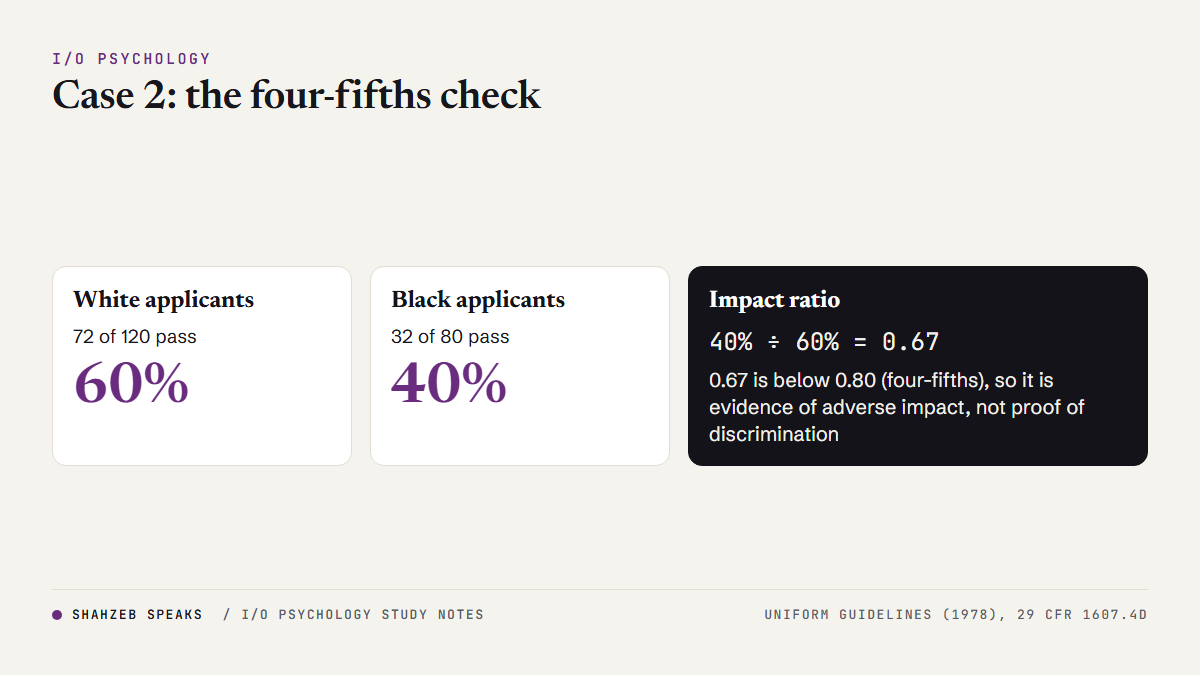
The centre uses an off-the-shelf, 50-item timed verbal reasoning test as a pass/fail screen. It has never been validated locally. Last year 72 of 120 White applicants passed (60%) and 32 of 80 Black applicants passed (40%). A recent job analysis says the job needs reading safety labels, spatial judgement and pre-shift equipment checks.
Question 2.1. Calculate the impact ratio and interpret it.
Model answer
Impact ratio = 40% ÷ 60% = 0.67. Under the US Uniform Guidelines (1978, section 1607.4D), a selection rate below four-fifths (80%) of the highest group’s rate is generally regarded as evidence of adverse impact. 0.67 is well below 0.80. This is evidence that needs a response; it is not by itself proof of unlawful discrimination. You can check figures like these with the adverse impact calculator.
Question 2.2. What should the company do next?
Model answer
First, ask whether the test is job-related. The job analysis lists reading labels, spatial judgement and equipment checks, while the test is heavy on verbal reasoning, so some of what it measures may not be needed for the job. The company should collect validity evidence for its procedure and, as the Guidelines ask (section 1607.3B), use the procedure with less adverse impact when two procedures are about equally valid. Options include a work sample of equipment checks, a reading test pitched at the level of real safety labels, and a structured interview built from the job analysis.
Case 3: The star engineer who struggled as a team lead
Setting: a 300-person software firm in Bengaluru. Theories: the Peter principle, job analysis for promotion, assessment centres.
Rohan was the firm’s most productive developer for three years, so when a team lead post opened, he got it. Six months later, two of his eight engineers have resigned, deadlines are slipping, and he spends evenings rewriting his team’s code instead of reviewing it with them. He tells HR he misses “real work”.
Question 3.1. What went wrong in the promotion decision?
Model answer
The firm promoted on performance in the current job instead of on the knowledge, skills and abilities the new job needs. Coding speed does not predict delegation, coaching or handling conflict. This is the pattern popularly called the Peter principle. Benson, Li and Shue (2019) found evidence of it in sales firms: the best salespeople were more likely to be promoted, and then did worse as managers than other promoted staff.
Question 3.2. What should the firm do now, and for future promotions?
Model answer
Now: give Rohan coaching and clear expectations for the lead role, and offer an honest route back to a senior technical role without loss of face. For the future: run a job analysis of the team lead role, then select leads with tools that measure those KSAOs, such as structured interviews and exercises like those used in assessment centres. A dual career ladder lets strong engineers gain pay and status without having to manage people.
Training and appraisal cases
Case 4: Safety training that changed nothing on the floor
Setting: a spinning mill near Lahore. Theories: Kirkpatrick’s four levels, Baldwin and Ford’s transfer model.
After two hand injuries, all 60 machine operators attend a two-day lockout and machine-guarding course. Average test scores rise from 55% before the course to 90% after it. Three months later, supervisors’ spot checks show that most operators still clear jams without switching the machine off. One line supervisor says, “The targets have not changed. If I stop the line for every jam, I miss my numbers.”
Question 4.1. Using Kirkpatrick’s four levels, which level succeeded and which failed?
Model answer
Level 2, learning, succeeded: test scores rose from 55% to 90%. Level 3, behaviour, failed: the spot checks show the procedure is not used on the job. Level 1 (reaction) was not reported, and level 4 (results, such as injuries) has not been measured yet. The case is a good example of why good learning scores do not guarantee behaviour change (Alliger et al., 1997).
Question 4.2. Use Baldwin and Ford’s (1988) model to explain the failure.
Model answer
Baldwin and Ford name three inputs to transfer: trainee characteristics, training design and the work environment. The first two look fine because operators learned the material. The problem is the work environment: production targets punish stopping the line, and the supervisor does not support the new behaviour. Tracey, Tannenbaum and Kavanagh (1995) showed that the transfer climate and support at work affect whether trained skills are used.
Question 4.3. What would you change?
Model answer
Change the environment, not the course. Adjust targets so that safe stops are allowed, brief supervisors before the next course and make them responsible for safe-stop checks, put a lockout checklist on each machine, and recognise lines with full compliance. Then measure behaviour again at one and three months, and track injuries as the results measure.
Case 5: When everyone is “outstanding”
Setting: a bank’s 25 branches in and around Multan. Theories: rating errors, frame-of-reference training.
In the annual appraisal, 94% of officers are rated “outstanding”. The bonus pool is fixed, so nearly everyone receives the same small bonus. The strongest officers feel unrewarded, and HR cannot use the ratings to pick candidates for promotion. Branch managers say giving lower ratings “creates bad feeling” in small teams.
Question 5.1. Name the rating problem and its likely causes.
Model answer
This is leniency error: ratings are bunched at the top of the scale, so they no longer separate strong from average performers. Likely causes are managers’ wish to avoid conflict in small teams, the absence of any accountability for ratings, and unclear standards for what “outstanding” means at each branch.
Question 5.2. Recommend changes, with evidence.
Model answer
Run frame-of-reference training, in which raters study the performance dimensions with real examples of each rating level and practise until they agree (Bernardin and Buckley, 1981). Woehr and Huffcutt’s (1994) review found this type of training improved rating accuracy more than the other approaches studied. Add behavioural anchors to the scale, hold calibration meetings across branches, and separate the developmental conversation from the bonus decision. More on rating errors is in the performance appraisal errors guide.
Practise on your phone
The free I/O Psychology Prep app has 410 explained
questions, flashcards and an exam countdown, and works offline. Get it on Google Play
· About the app
Attitudes and psychological contract cases
Case 6: Promises withdrawn after an acquisition
Setting: a 120-person fintech start-up in Mumbai, bought by a large bank. Theories: psychological contract breach and violation, organisational justice.
Before the deal, the founders told staff that their stock options would vest early on any sale and that they could keep working from home two days a week. After the deal, the bank applies its standard vesting rules and requires five office days. In a town hall, an engineer says, “They lied to us.” Eleven people resign in two months.
Question 6.1. Is this breach, violation or both?
Model answer
Both. Breach is the perception that promises were not kept: early vesting and hybrid work. Violation is the emotional reaction that can follow, here anger and a sense of betrayal (“They lied to us”) (Morrison and Robinson, 1997). The contract had transactional parts (options) and relational parts (trust in the founders’ word), and both were hit.
Question 6.2. What outcomes would research predict if nothing changes?
Model answer
Zhao and colleagues’ (2007) meta-analysis linked breach with lower trust, job satisfaction and commitment, higher intention to leave, and lower citizenship behaviour and performance. The resignations are an early sign; those who stay may withdraw effort.
Question 6.3. What can the new leadership do?
Model answer
Treat it as a fairness problem. Explain the reasons honestly, give notice before changes, let staff raise concerns, and apply rules consistently; these are the procedural and interactional parts of justice, which Colquitt and colleagues (2001) found are related to trust, commitment and other outcomes. Where possible, offer a partial remedy, such as a transition period for office days or retention grants. The psychological contract post covers breach and repair in more depth.
Case 7: The department where nobody helps any more
Setting: a social sciences department at a public university in Islamabad. Theories: organisational citizenship behaviour, social exchange.
A new promotion policy counts only publications and teaching hours. Within a year, senior lecturers stop mentoring junior colleagues, skip committee meetings and refuse to cover classes for sick colleagues. The chair complains about “selfish” staff. Staff say the policy shows that “only papers count”.
Question 7.1. Which behaviour is disappearing? Use Organ’s dimensions.
Model answer
Organisational citizenship behaviour, which is discretionary and not formally rewarded (Organ, 1988). Mentoring juniors and covering classes are altruism (helping specific colleagues). Attending committee meetings is civic virtue (taking part in the life of the organisation).
Question 7.2. Why might the policy have caused this?
Model answer
OCB is linked to how people feel about their job and how fairly they think they are treated (Bateman and Organ, 1983; Organ, 1988). When the organisation signals that it values only narrow outputs, staff may read the exchange as purely transactional and stop giving extra effort. The time spent on citizenship also now competes directly with the activities that bring promotion.
Question 7.3. What would you recommend?
Model answer
Recognise service and mentoring in the promotion criteria with simple evidence (for example, mentee feedback and committee records), explain the criteria openly, and apply them consistently. Be careful not to turn all helping into compulsory duties, because then it is no longer discretionary. See the OCB guide for its dimensions and measures.
Stress, safety and team cases
Case 8: The night shift that drained everyone
Setting: a BPO in Manila serving a US healthcare billing client on the night shift. Theories: job demands-resources model, burnout.
Agents take calls from upset patients about medical bills for most of the shift. Team leads watch screen time and send messages if a break runs one minute over. Agents cannot choose break times. Sick leave has doubled in a year. In a focus group, agents say they feel “empty” by 4 a.m. and that they now think of callers as “tickets, not people”.
Question 8.1. Classify the job demands and the missing job resources.
Model answer
Demands: emotional demands from upset callers, night work and close monitoring. Missing resources: autonomy over breaks, supportive supervision and useful feedback. The JD-R model predicts that high demands with few resources lead to exhaustion and withdrawal (Demerouti et al., 2001).
Question 8.2. Which burnout dimensions do the agents’ words show?
Model answer
“Empty by 4 a.m.” describes emotional exhaustion. Thinking of callers as “tickets, not people” describes depersonalisation (cynicism). These are two of the three dimensions measured by Maslach and Jackson (1981); the third is reduced personal accomplishment.
Question 8.3. Propose a primary intervention and a way to measure it.
Model answer
A primary intervention changes the job: give agents some control over break timing within limits, allow a short recovery pause after abusive calls, and retrain team leads to coach rather than police. Measure burnout before and three months after, for example with the Copenhagen Burnout Inventory (Kristensen et al., 2005; see the CBI calculator), and track sick leave and turnover.
Case 9: Near-miss reports that vanished
Setting: an electronics assembly plant in Cebu. Theories: safety climate, the effect of incentives.
Management introduces a monthly cash bonus for every line with zero recorded incidents. Recorded incidents fall to zero within three months. Near-miss reports also fall, from about 30 a month to two. Five months later a worker suffers a serious hand injury on a machine that two near misses had been “talked about but not reported”.
Question 9.1. Why did reporting collapse?
Model answer
The bonus rewarded the absence of reports, not the absence of danger. Reporting a near miss could cost the whole line its bonus, so workers stopped reporting. Zohar (1980) described safety climate as employees’ shared perceptions of how much safety is really valued; here workers learned that management valued clean numbers more than honest information.
Question 9.2. What should the plant do instead?
Model answer
Stop rewarding zero recorded incidents. Reward leading indicators such as near misses reported and hazards fixed, make reporting free of blame, and have managers visibly act on each report within a set time. Measure safety climate with a survey and track reports, fixes and injuries. Clarke’s (2006) meta-analysis found that safety climate is related to safety performance and accident involvement.
Case 10: The hybrid team that stopped speaking up
Setting: a nine-person software team split across Karachi, Dubai and London, formed four months ago by merging two teams. Theories: Tuckman’s stages, psychological safety.
Meetings are scheduled for London’s afternoon and are dominated by the London members. Karachi engineers rarely speak on calls and raise problems in private messages afterwards. A bug reaches customers even though two engineers had noticed it and said nothing in the review meeting.
Question 10.1. Where is the team in Tuckman’s model?
Model answer
Tuckman (1965) described forming, storming, norming and performing; adjourning was added later (Tuckman and Jensen, 1977). This team is stuck between forming and storming: disagreements exist but are not voiced in the group, so the open conflict that leads to shared norms has not happened. It is not performing, as the missed bug shows.
Question 10.2. What is missing, and why does it matter?
Model answer
Psychological safety, the shared belief that the team is safe for interpersonal risk-taking such as admitting mistakes or questioning others (Edmondson, 1999). Edmondson linked it with team learning behaviour, which includes speaking up about errors. Without it, people who notice problems stay silent, as the two engineers did.
Question 10.3. What should the team lead do?
Model answer
Rotate meeting times across time zones, use structured turn-taking in reviews, and add a written channel where issues can be raised before meetings. The lead should admit their own mistakes and ask directly for dissent. Run a blameless review of the bug focused on the process, and agree written team norms. The post on psychological safety at work has more on what leaders can do.
How to answer a case study question in an exam
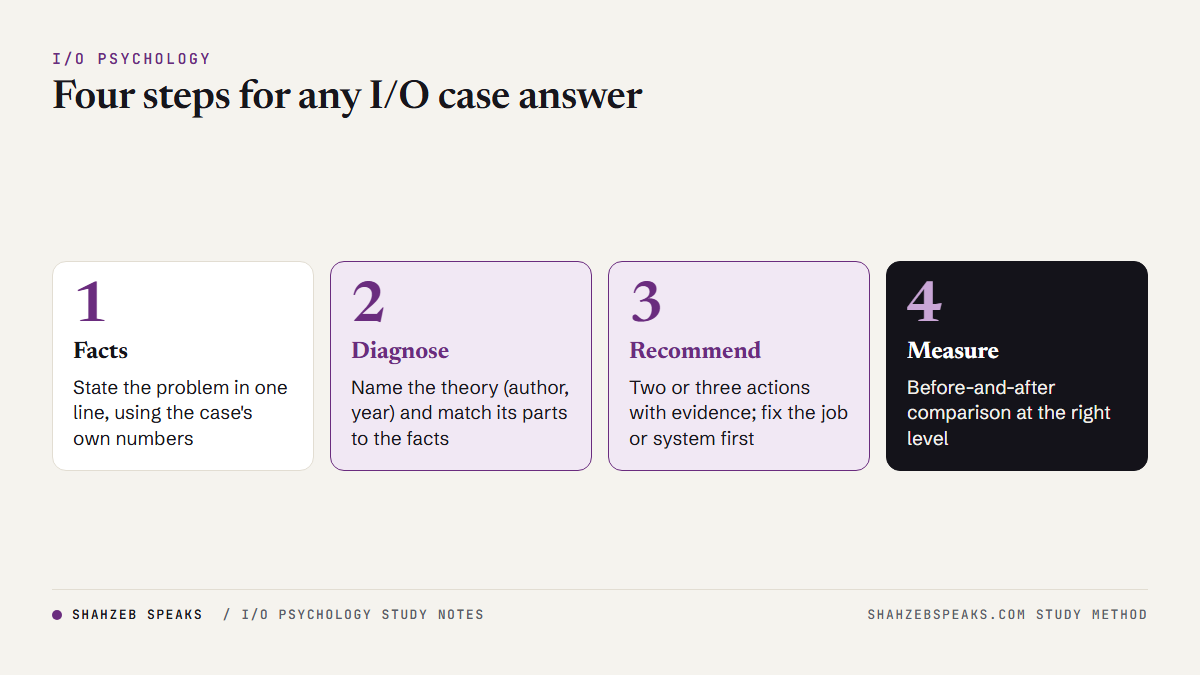
10-mark answer structure for any I/O case
- Problem in one line: state what is going wrong, using the case’s own facts (for example, “40% of new agents leave within 90 days”).
- Diagnosis: name one or two theories with author and year, and say which part of each theory the facts match.
- Evidence: one research finding that supports your diagnosis (a meta-analysis is strongest).
- Recommendations: two or three actions, each linked to the theory, starting with changes to the job or system before changes to people.
- Measurement: how you would know it worked, with a before-and-after comparison and the right level (behaviour, turnover, injuries).
- Limits: one trade-off or risk, such as several changes starting at once.
- Conclusion: one sentence that ties the fix back to the cause.
Model opening line: “The case shows a problem of early turnover that is best explained by unmet expectations (Wanous et al., 1992), made worse by recruiter incentives that reward overselling the job.”
Questions students ask
What is a case study in I/O psychology?
A short description of a real or realistic workplace problem used to test whether you can apply theory. You are expected to diagnose the problem, recommend action and justify it with research, not just define terms.
Are these case studies real?
No. They are fictional teaching cases. The settings are typical of workplaces in Pakistan, India, the Philippines and the US, but the organisations and numbers are invented. The theories and studies used in the answers are real.
How long should a case study answer be?
For a 10-mark question, about one to one and a half pages, or roughly 400 to 500 words. Spend more words on applying the theory to the facts than on defining it.
Which theories come up most in case questions?
Motivation theories, job analysis and selection, training evaluation, appraisal errors, job attitudes, stress models and leadership. Practise the MCQ sets on the I/O psychology MCQs hub so the theory names come to you quickly.
Can I use these cases for a class presentation?
Yes, for study and teaching. Link back to this page as the source, and add your own analysis; examiners reward your reasoning, not the case text.
Where can I read more about I/O psychology as a career?
Start with the I/O psychology study guide. If you are in Pakistan, there is also a page on the scope of industrial psychology in Pakistan.
Practise on your phone
The free I/O Psychology Prep app has 410 explained
questions, flashcards and an exam countdown, and works offline. Get it on Google Play
· About the app
References
- Alliger, G. M., Tannenbaum, S. I., Bennett, W., Jr., Traver, H., & Shotland, A. (1997). A meta-analysis of the relations among training criteria. Personnel Psychology, 50(2), 341–358. https://doi.org/10.1111/j.1744-6570.1997.tb00911.x
- Baldwin, T. T., & Ford, J. K. (1988). Transfer of training: A review and directions for future research. Personnel Psychology, 41(1), 63–105. https://doi.org/10.1111/j.1744-6570.1988.tb00632.x
- Bateman, T. S., & Organ, D. W. (1983). Job satisfaction and the good soldier: The relationship between affect and employee “citizenship”. Academy of Management Journal, 26(4), 587–595. https://doi.org/10.2307/255908
- Benson, A., Li, D., & Shue, K. (2019). Promotions and the Peter principle. Quarterly Journal of Economics, 134(4), 2085–2134. https://doi.org/10.1093/qje/qjz022
- Bernardin, H. J., & Buckley, M. R. (1981). Strategies in rater training. Academy of Management Review, 6(2), 205–212. https://doi.org/10.5465/amr.1981.4287782
- Clarke, S. (2006). The relationship between safety climate and safety performance: A meta-analytic review. Journal of Occupational Health Psychology, 11(4), 315–327. https://doi.org/10.1037/1076-8998.11.4.315
- Colquitt, J. A., Conlon, D. E., Wesson, M. J., Porter, C. O. L. H., & Ng, K. Y. (2001). Justice at the millennium: A meta-analytic review of 25 years of organizational justice research. Journal of Applied Psychology, 86(3), 425–445. https://doi.org/10.1037/0021-9010.86.3.425
- Demerouti, E., Bakker, A. B., Nachreiner, F., & Schaufeli, W. B. (2001). The job demands-resources model of burnout. Journal of Applied Psychology, 86(3), 499–512. https://doi.org/10.1037/0021-9010.86.3.499
- Earnest, D. R., Allen, D. G., & Landis, R. S. (2011). Mechanisms linking realistic job previews with turnover: A meta-analytic path analysis. Personnel Psychology, 64(4), 865–897. https://doi.org/10.1111/j.1744-6570.2011.01230.x
- Edmondson, A. (1999). Psychological safety and learning behavior in work teams. Administrative Science Quarterly, 44(2), 350–383. https://doi.org/10.2307/2666999
- Equal Employment Opportunity Commission, Civil Service Commission, Department of Labor, & Department of Justice. (1978). Uniform guidelines on employee selection procedures. 29 C.F.R. § 1607. https://www.law.cornell.edu/cfr/text/29/1607.4
- Kristensen, T. S., Borritz, M., Villadsen, E., & Christensen, K. B. (2005). The Copenhagen Burnout Inventory: A new tool for the assessment of burnout. Work & Stress, 19(3), 192–207. https://doi.org/10.1080/02678370500297720
- Maslach, C., & Jackson, S. E. (1981). The measurement of experienced burnout. Journal of Occupational Behaviour, 2(2), 99–113. https://doi.org/10.1002/job.4030020205
- Morrison, E. W., & Robinson, S. L. (1997). When employees feel betrayed: A model of how psychological contract violation develops. Academy of Management Review, 22(1), 226–256. https://doi.org/10.2307/259230
- Organ, D. W. (1988). Organizational citizenship behavior: The good soldier syndrome. Lexington Books.
- Premack, S. L., & Wanous, J. P. (1985). A meta-analysis of realistic job preview experiments. Journal of Applied Psychology, 70(4), 706–719. https://doi.org/10.1037/0021-9010.70.4.706
- Tracey, J. B., Tannenbaum, S. I., & Kavanagh, M. J. (1995). Applying trained skills on the job: The importance of the work environment. Journal of Applied Psychology, 80(2), 239–252. https://doi.org/10.1037/0021-9010.80.2.239
- Tuckman, B. W. (1965). Developmental sequence in small groups. Psychological Bulletin, 63(6), 384–399. https://doi.org/10.1037/h0022100
- Tuckman, B. W., & Jensen, M. A. C. (1977). Stages of small-group development revisited. Group & Organization Studies, 2(4), 419–427. https://doi.org/10.1177/105960117700200404
- Wanous, J. P., Poland, T. D., Premack, S. L., & Davis, K. S. (1992). The effects of met expectations on newcomer attitudes and behaviors: A review and meta-analysis. Journal of Applied Psychology, 77(3), 288–297. https://doi.org/10.1037/0021-9010.77.3.288
- Woehr, D. J., & Huffcutt, A. I. (1994). Rater training for performance appraisal: A quantitative review. Journal of Occupational and Organizational Psychology, 67(3), 189–205. https://doi.org/10.1111/j.2044-8325.1994.tb00562.x
- Zhao, H., Wayne, S. J., Glibkowski, B. C., & Bravo, J. (2007). The impact of psychological contract breach on work-related outcomes: A meta-analysis. Personnel Psychology, 60(3), 647–680. https://doi.org/10.1111/j.1744-6570.2007.00087.x
- Zohar, D. (1980). Safety climate in industrial organizations: Theoretical and applied implications. Journal of Applied Psychology, 65(1), 96–102. https://doi.org/10.1037/0021-9010.65.1.96
Keep practising: the I/O psychology MCQs hub links every topic set, including training MCQs, job attitudes MCQs and stress and burnout MCQs. For the selection side, read recruitment vs selection.