
Occupational stress is the strain that follows when work demands exceed a person’s resources. Exams test five models: Selye’s general adaptation syndrome (1950), Lazarus and Folkman’s transactional model (1984), Karasek’s demand-control model (1979), Siegrist’s effort-reward imbalance (1996) and the job demands-resources model (Demerouti et al., 2001). Burnout has three dimensions: exhaustion, cynicism or depersonalisation, and reduced efficacy (Maslach and Jackson, 1981).
This page is for students revising occupational stress, burnout and wellbeing for semester exams, competitive papers or a thesis proposal. It has a short summary, a table comparing the five stress models, a 10-mark answer plan and 25 practice questions with explanations. These are practice questions written to the published syllabus (stress is a set topic in Punjab University’s Industrial Psychology outline), not past-paper questions.
The trick with stress MCQs is matching the right parts to the right model: “control” belongs to Karasek, “esteem” and “overcommitment” belong to Siegrist, and “resources” belongs to JD-R. The table below sorts them out before you start.
Occupational stress and burnout in 480 words
Terms. A stressor is a demand in the environment (workload, a rude customer, night shifts). Strain is the person’s reaction: psychological (anxiety, exhaustion), physical (headaches, blood pressure) or behavioural (absence, mistakes).
General adaptation syndrome. Selye (1950) described the body’s response to any prolonged stressor in three stages: alarm, resistance and exhaustion.
Transactional model. Lazarus and Folkman (1984) argued that stress depends on appraisal. In primary appraisal the person asks whether the situation matters and whether it is a threat, a harm or a challenge. In secondary appraisal they ask what they can do about it. Coping can be problem-focused (changing the situation) or emotion-focused (managing the feelings).
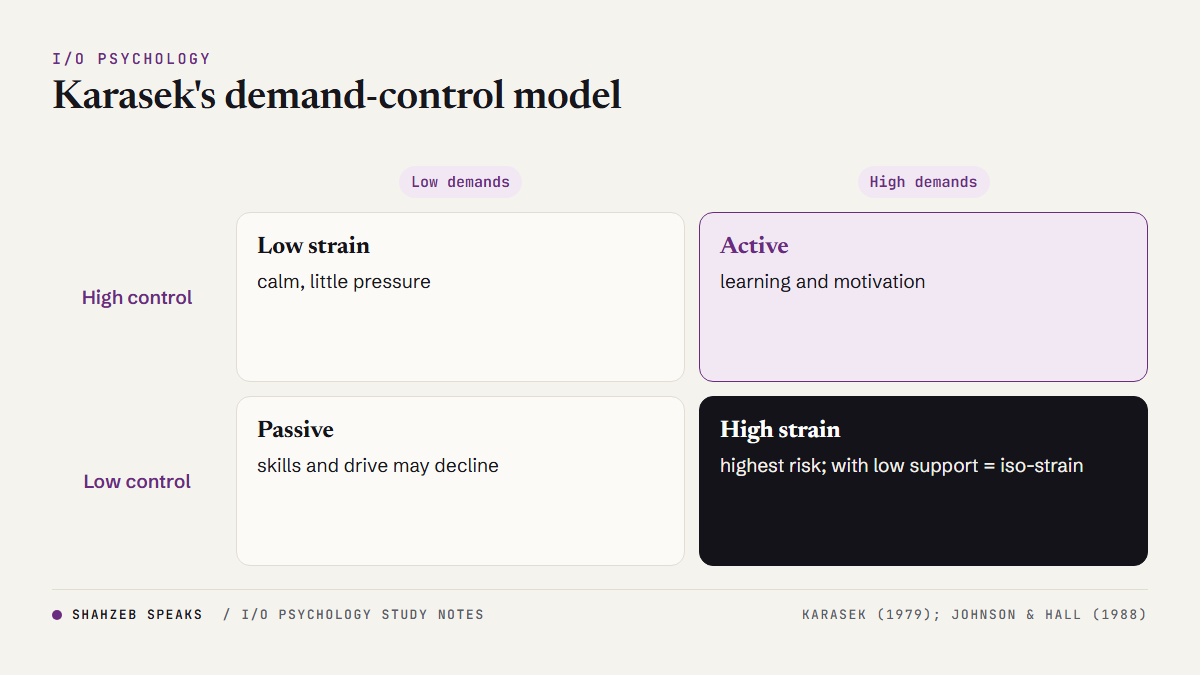
Demand-control model. Karasek (1979) crossed job demands with decision latitude (control). High demands with low control give a high-strain job; high demands with high control give an active job, linked with learning and motivation. Low demands with high control is a low-strain job (calm, little pressure), and low demands with low control is a passive job, in which skills and drive may decline. Johnson and Hall (1988) added workplace social support: high demands, low control and low support is called iso-strain.
Effort-reward imbalance. Siegrist (1996) proposed that strain follows when high effort meets low reward, where reward means money, esteem and security or career opportunities. Overcommitment, a personal pattern of excessive striving, adds to the risk.
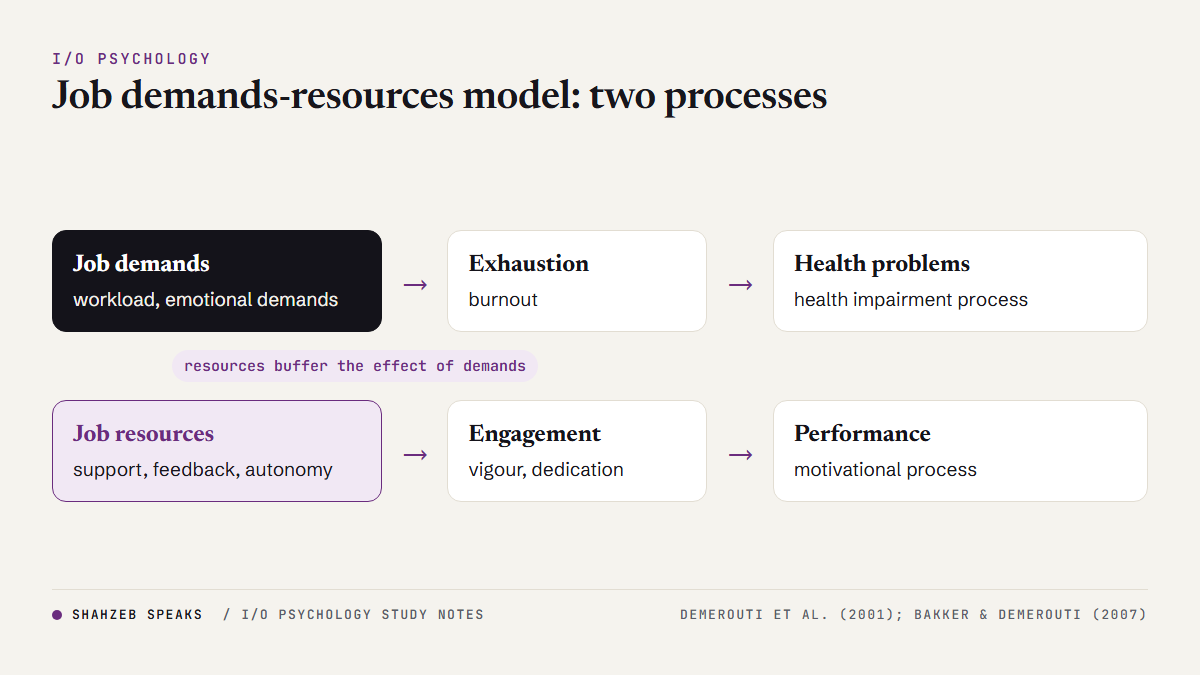
Job demands-resources model. Demerouti, Bakker, Nachreiner and Schaufeli (2001) grouped all job characteristics into demands (which cost effort) and resources (which help achieve goals, reduce demands or support growth). Bakker and Demerouti (2007) describe two processes: high demands lead to exhaustion and health problems, and resources lead to engagement and performance. Resources can also buffer the effect of demands.
Burnout. Maslach and Jackson (1981) measured three dimensions: emotional exhaustion, depersonalisation and reduced personal accomplishment, later described as exhaustion, cynicism and inefficacy (Maslach, Schaufeli and Leiter, 2001). In 2019 the World Health Organization included burn-out in ICD-11 as an occupational phenomenon, not a medical condition, and limited it to the work context. The Copenhagen Burnout Inventory (Kristensen et al., 2005) measures personal, work-related and client-related burnout.
Challenge and hindrance stressors. Cavanaugh and colleagues (2000) separated challenge stressors (workload, responsibility, time pressure) from hindrance stressors (red tape, role ambiguity, office politics). A meta-analysis found challenge stressors had a positive link with performance through motivation, while hindrance stressors had a negative one (LePine, Podsakoff and LePine, 2005).
Work and family. Greenhaus and Beutell (1985) described three forms of work-family conflict: time-based, strain-based and behaviour-based. Conflict runs both ways, work-to-family and family-to-work (Netemeyer, Boles and McMurrian, 1996).
Interventions. Primary interventions remove the stressor, secondary interventions help people manage it, and tertiary interventions treat those already affected. In a meta-analysis of stress management programmes, cognitive-behavioural interventions had larger effects than other types (Richardson and Rothstein, 2008).
The five stress models compared
| Model | Authors (year) | Core idea | Key terms to write |
|---|---|---|---|
| General adaptation syndrome | Selye (1950) | The body responds to any prolonged stressor in the same way | Alarm, resistance, exhaustion |
| Transactional model | Lazarus and Folkman (1984) | Stress depends on how the person appraises the situation | Primary and secondary appraisal; problem- and emotion-focused coping |
| Demand-control (-support) | Karasek (1979); Johnson and Hall (1988) | High demands are harmful when control is low | High strain, active, passive, low strain; iso-strain |
| Effort-reward imbalance | Siegrist (1996) | Strain follows when effort is not matched by reward | Money, esteem, security or career; overcommitment |
| Job demands-resources | Demerouti et al. (2001) | Demands drain energy; resources build motivation | Health impairment and motivational processes; buffering |
Practice MCQs: occupational stress and burnout (25 questions)
-
What is the correct order of the stages in Selye’s general adaptation syndrome?
- Resistance, alarm, exhaustion
- Alarm, exhaustion, resistance
- Alarm, resistance, exhaustion
- Exhaustion, alarm, resistance
Show answer
C. The body first reacts (alarm), then adapts (resistance), and if the stressor continues its resources run out (exhaustion). The other orders scramble the sequence.
-
Kobasa (1979) studied executives who stayed healthy under high stress and called the trait hardiness. Its three parts are:
- Commitment, control and challenge
- Alarm, resistance and exhaustion
- Vigour, dedication and absorption
- Time, strain and behaviour
Show answer
A. Hardy people feel committed to what they do, believe they have control, and see change as a challenge. B is Selye’s GAS, C is engagement, and D lists the forms of work-family conflict.
-
A new bank officer is told she will present to the regional head on Monday. She first asks herself, “Does this matter, and is it a threat to me?” In the transactional model, this is:
- Secondary appraisal
- Primary appraisal
- Emotion-focused coping
- The resistance stage
Show answer
B. Primary appraisal judges whether the event is relevant and whether it is a threat, harm or challenge. Secondary appraisal asks what can be done; coping and the resistance stage come from other parts of the theory or from Selye.
-
She then asks, “Do I have the slides, the time and someone to rehearse with?” This is:
- Secondary appraisal
- Primary appraisal
- Depersonalisation
- The alarm stage
Show answer
A. Secondary appraisal evaluates coping options and resources (Lazarus and Folkman, 1984). Depersonalisation is a burnout dimension and the alarm stage belongs to Selye.
-
Which of these is a problem-focused coping strategy?
- Watching a film to forget about a deadline
- Venting to a friend about the boss
- Breaking the overdue report into tasks and asking the manager for a two-day extension
- Practising breathing exercises before a meeting
Show answer
C. Problem-focused coping acts on the cause of stress. Distraction, venting and relaxation manage the emotion, so they are emotion-focused.
-
A call-centre agent works to a strict script, cannot choose when to take breaks and has a target of 120 calls a day. In Karasek’s (1979) model this is a:
- Low-strain job
- Passive job
- Active job
- High-strain job
Show answer
D. High demands (targets) combined with low decision latitude (script, fixed breaks) is the high-strain quadrant. Active jobs combine high demands with high control; passive and low-strain jobs have low demands.
-
A senior surgeon faces heavy demands but decides how to run each operation and her schedule. Karasek would classify this as:
- An active job, linked with learning and motivation
- A high-strain job
- A passive job
- An iso-strain job
Show answer
A. High demands with high control is the active quadrant, which Karasek linked with learning and new behaviour patterns rather than strain. High strain needs low control; passive jobs have low demands.
-
Johnson and Hall (1988) extended Karasek’s model. What did they add, and what is the riskiest combination called?
- Rewards; effort-reward imbalance
- Workplace social support; iso-strain (high demands, low control, low support)
- Appraisal; transactional stress
- Personality; Type A behaviour
Show answer
B. Adding social support gave the demand-control-support model, and isolated high-strain workers are said to be in iso-strain. Rewards belong to Siegrist, appraisal to Lazarus and Folkman, and Type A to Friedman and Rosenman.
-
In Siegrist’s (1996) effort-reward imbalance model, which of these is NOT one of the reward types?
- Money
- Esteem
- Security or career opportunities
- Decision latitude
Show answer
D. ERI rewards are money, esteem and security or career opportunities. Decision latitude (control) is the key resource in Karasek’s model, which is why students mix them up.
-
In the ERI model, a nurse who cannot say no to extra shifts and keeps thinking about work at home shows:
- Overcommitment, the intrinsic component of ERI
- Continuance commitment
- High decision latitude
- Sportsmanship
Show answer
A. Overcommitment is a personal pattern of excessive striving that raises the risk of strain. Continuance commitment is about the cost of leaving, decision latitude is Karasek’s control, and sportsmanship is an OCB dimension.
-
In the job demands-resources model, which of these is a job demand rather than a job resource?
- Supervisor support
- Performance feedback
- Emotional demands of dealing with angry customers
- Autonomy over how to do the work
Show answer
C. Demands cost sustained physical or psychological effort, and dealing with angry customers is a classic emotional demand. Support, feedback and autonomy help people reach goals and cope, so they are resources.
-
According to Bakker and Demerouti (2007), the “health impairment process” in JD-R runs:
- Resources → engagement → performance
- High demands → exhaustion (burnout) → health problems
- Low rewards → overcommitment → heart disease
- Appraisal → coping → reappraisal
Show answer
B. The health impairment process starts with demands that drain energy. A is the motivational process, C mixes in ERI terms, and D describes the transactional model.
-
A hospital ward in Lahore has very high workload, but nurses have a supportive head nurse and regular feedback. JD-R predicts that:
- Resources can buffer the effect of the high demands on strain
- Resources make no difference once demands are high
- Feedback always increases strain
- The nurses cannot burn out
Show answer
A. JD-R proposes that job resources can buffer (weaken) the effect of demands on strain. Buffering reduces risk; it does not remove it, so D overstates it.
-
Which of these is NOT one of the three burnout dimensions measured by Maslach and Jackson (1981)?
- Emotional exhaustion
- Depersonalisation
- Reduced personal accomplishment
- Absorption
Show answer
D. Absorption is a dimension of work engagement. The three burnout dimensions are emotional exhaustion, depersonalisation (cynicism) and reduced personal accomplishment (inefficacy).
-
A ward nurse starts calling patients “bed 12” and “bed 14” and treats them in a cold, detached way. Which burnout dimension does this show?
- Emotional exhaustion
- Depersonalisation
- Reduced personal accomplishment
- Hardiness
Show answer
B. Depersonalisation is a detached, impersonal response to the people you serve. Exhaustion is feeling drained, reduced accomplishment is feeling ineffective, and hardiness is a protective trait.
-
How did the World Health Organization classify burn-out in ICD-11 (announced May 2019)?
- As a mental disorder that can be diagnosed in any setting
- As a form of depression
- As an occupational phenomenon, not a medical condition, referring only to the work context
- It removed burn-out from the classification entirely
Show answer
C. WHO describes burn-out as a syndrome from chronic workplace stress that has not been successfully managed, listed among factors influencing health status, and says it should not be applied outside work. It is not classed as a disease or as depression.
-
The Copenhagen Burnout Inventory (Kristensen et al., 2005) has three subscales. They are:
- Personal, work-related and client-related burnout
- Exhaustion, cynicism and inefficacy
- Alarm, resistance and exhaustion
- Demands, control and support
Show answer
A. The CBI separates personal, work-related and client-related burnout. B is the Maslach model, C is Selye and D is Karasek’s extended model. You can score it with the Copenhagen Burnout Inventory calculator.
-
Leiter and Maslach (2004) linked burnout to six areas of worklife. Which is NOT one of them?
- Workload
- Fairness
- Values
- Commute length
Show answer
D. The six areas are workload, control, reward, community, fairness and values. Commute length may be stressful, but it is not one of their six.
-
Following Cavanaugh and colleagues (2000), which pair are hindrance stressors?
- High workload and time pressure
- Role ambiguity and red tape
- High responsibility and job scope
- A challenging new project and a tight deadline
Show answer
B. Hindrance stressors block goals and growth, such as unclear roles, red tape and office politics. The other pairs are challenge stressors, which are demanding but can bring growth.
-
LePine, Podsakoff and LePine’s (2005) meta-analysis found that challenge stressors and hindrance stressors relate to performance:
- In the same negative way
- Not at all
- In opposite directions: challenge stressors positively (through motivation), hindrance stressors negatively
- Only through pay
Show answer
C. Both kinds of stressor relate to strain, but they differ in their link with motivation and performance. That is the main point of the challenge-hindrance framework.
-
A police officer uses the same commanding, suspicious tone at home that he uses on duty, and his family complain. Greenhaus and Beutell (1985) would call this:
- Time-based conflict
- Strain-based conflict
- Behaviour-based conflict
- Role ambiguity
Show answer
C. Behaviour-based conflict happens when behaviour expected in one role is unsuitable in the other. Time-based conflict is about hours, strain-based about fatigue or irritability carrying over, and role ambiguity is unclear expectations within one role.
-
An engineer in Pune often arrives late and distracted because he is caring for a sick parent at night. Which direction of conflict is this?
- Work-to-family conflict
- Family-to-work conflict
- Effort-reward imbalance
- Person-job misfit
Show answer
B. Family demands are interfering with work, so this is family-to-work conflict (Netemeyer, Boles and McMurrian, 1996 measured both directions). Work-to-family runs the other way, and the other two options are different concepts.
-
A garment factory changes its roster so that no worker does more than two night shifts in a row. This is which level of stress intervention?
- Primary: reducing the stressor at its source
- Secondary: teaching people to manage stress
- Tertiary: treating people who are already ill
- Not an intervention
Show answer
A. Changing the work itself is primary prevention. A stress management workshop would be secondary, and counselling or a return-to-work plan would be tertiary.
-
Richardson and Rothstein’s (2008) meta-analysis of stress management programmes found that the largest effects came from:
- Organisation-wide newsletters
- Cognitive-behavioural interventions
- One-off motivational talks
- Pay rises alone
Show answer
B. Cognitive-behavioural programmes produced larger effects than the other intervention types they compared. Newsletters, talks and pay rises were not intervention types in that analysis.
-
Which statement about stressors and strain is correct?
- A stressor is the person’s reaction; strain is the event
- Stressors and strain mean exactly the same thing
- Strain only means physical illness
- A stressor is a demand in the environment; strain is the person’s psychological, physical or behavioural reaction
Show answer
D. The stressor is the cause (for example, an abusive customer) and strain is the effect (anxiety, headaches, absence). A reverses them, B merges them, and C leaves out psychological and behavioural strain.
Practise on your phone
The free I/O Psychology Prep app has 410 explained
questions, flashcards and an exam countdown, and works offline. Get it on Google Play
· About the app
The JD-R model in one picture
Questions 11 to 13 test the two processes in the job demands-resources model. Draw it as two lanes. In the top lane, job demands such as workload and emotional demands lead to exhaustion and then to health problems. In the bottom lane, job resources such as support, feedback and autonomy lead to engagement and then to performance. Between the lanes, resources buffer the effect of demands.
How to answer a long question on stress models
10-mark answer structure: “Critically compare two models of occupational stress”
- Definition: occupational stress as the process in which work demands exceed a person’s resources; separate stressor from strain.
- Model 1, Karasek (1979): demands and decision latitude, the four quadrants, and Johnson and Hall’s (1988) support extension. Draw the two-by-two grid.
- Model 2, JD-R (Demerouti et al., 2001): demands and resources, the two processes and buffering (Bakker and Demerouti, 2007).
- Comparison: Karasek names one resource (control); JD-R lets any job resource count and adds engagement. Mention ERI (Siegrist, 1996) as a third view centred on reward.
- Local example: a Karachi call centre (high demands, low control) versus a university department (high demands, more control).
- Critical points: most evidence is cross-sectional and self-reported; JD-R is flexible enough that almost anything fits, which makes it hard to falsify.
- Practical implication: primary interventions such as job redesign and more control, not only stress workshops.
- Conclusion: the models agree that demands become harmful when resources are missing.
Model opening line: “Occupational stress is best understood as an imbalance between what a job demands and the resources a worker has to meet it; Karasek’s demand-control model and the job demands-resources model describe that imbalance in different ways.”
Questions students ask
What are the main models of occupational stress?
Selye’s general adaptation syndrome, Lazarus and Folkman’s transactional model, Karasek’s demand-control(-support) model, Siegrist’s effort-reward imbalance model and the job demands-resources model. The occupational stress models guide covers each one in depth.
What is the difference between the demand-control model and JD-R?
Karasek’s model uses one resource, control (decision latitude). JD-R allows any job resource (support, feedback, autonomy, development) and adds a motivational process that leads to engagement. More in the JD-R model explainer.
What are the three dimensions of burnout?
Emotional exhaustion, depersonalisation (cynicism) and reduced personal accomplishment (inefficacy). The WHO’s 2019 description uses the same three ideas. For the wider picture, see the post on the psychology of workplace burnout.
Is burnout a medical diagnosis?
Not in ICD-11. The WHO lists burn-out as an occupational phenomenon, a reason people may contact health services, not as a medical condition.
Is all stress bad for performance?
Research on challenge and hindrance stressors suggests not. Challenge stressors such as workload and responsibility can motivate people, while hindrance stressors such as red tape and role ambiguity tend to lower performance (LePine, Podsakoff and LePine, 2005). Both kinds still relate to strain.
Which burnout scale can I use in my thesis?
The Maslach Burnout Inventory is a licensed, paid instrument. The Copenhagen Burnout Inventory is widely used in student research; check its terms with the authors’ published paper before use, and do not print items from any licensed scale.
Practise on your phone
The free I/O Psychology Prep app has 410 explained
questions, flashcards and an exam countdown, and works offline. Get it on Google Play
· About the app
References
- Bakker, A. B., & Demerouti, E. (2007). The job demands-resources model: State of the art. Journal of Managerial Psychology, 22(3), 309–328. https://doi.org/10.1108/02683940710733115
- Cavanaugh, M. A., Boswell, W. R., Roehling, M. V., & Boudreau, J. W. (2000). An empirical examination of self-reported work stress among U.S. managers. Journal of Applied Psychology, 85(1), 65–74. https://doi.org/10.1037/0021-9010.85.1.65
- Demerouti, E., Bakker, A. B., Nachreiner, F., & Schaufeli, W. B. (2001). The job demands-resources model of burnout. Journal of Applied Psychology, 86(3), 499–512. https://doi.org/10.1037/0021-9010.86.3.499
- Greenhaus, J. H., & Beutell, N. J. (1985). Sources of conflict between work and family roles. Academy of Management Review, 10(1), 76–88. https://doi.org/10.2307/258214
- Johnson, J. V., & Hall, E. M. (1988). Job strain, work place social support, and cardiovascular disease: A cross-sectional study of a random sample of the Swedish working population. American Journal of Public Health, 78(10), 1336–1342. https://doi.org/10.2105/AJPH.78.10.1336
- Karasek, R. A. (1979). Job demands, job decision latitude, and mental strain: Implications for job redesign. Administrative Science Quarterly, 24(2), 285–308. https://doi.org/10.2307/2392498
- Kobasa, S. C. (1979). Stressful life events, personality, and health: An inquiry into hardiness. Journal of Personality and Social Psychology, 37(1), 1–11. https://doi.org/10.1037/0022-3514.37.1.1
- Kristensen, T. S., Borritz, M., Villadsen, E., & Christensen, K. B. (2005). The Copenhagen Burnout Inventory: A new tool for the assessment of burnout. Work & Stress, 19(3), 192–207. https://doi.org/10.1080/02678370500297720
- Lazarus, R. S., & Folkman, S. (1984). Stress, appraisal, and coping. Springer.
- Leiter, M. P., & Maslach, C. (2004). Areas of worklife: A structured approach to organizational predictors of job burnout. In P. L. Perrewé & D. C. Ganster (Eds.), Research in occupational stress and well-being (Vol. 3, pp. 91–134). Elsevier. https://doi.org/10.1016/S1479-3555(03)03003-8
- LePine, J. A., Podsakoff, N. P., & LePine, M. A. (2005). A meta-analytic test of the challenge stressor–hindrance stressor framework. Academy of Management Journal, 48(5), 764–775. https://doi.org/10.5465/amj.2005.18803921
- Maslach, C., & Jackson, S. E. (1981). The measurement of experienced burnout. Journal of Occupational Behaviour, 2(2), 99–113. https://doi.org/10.1002/job.4030020205
- Maslach, C., Schaufeli, W. B., & Leiter, M. P. (2001). Job burnout. Annual Review of Psychology, 52, 397–422. https://doi.org/10.1146/annurev.psych.52.1.397
- Netemeyer, R. G., Boles, J. S., & McMurrian, R. (1996). Development and validation of work–family conflict and family–work conflict scales. Journal of Applied Psychology, 81(4), 400–410. https://doi.org/10.1037/0021-9010.81.4.400
- Richardson, K. M., & Rothstein, H. R. (2008). Effects of occupational stress management intervention programs: A meta-analysis. Journal of Occupational Health Psychology, 13(1), 69–93. https://doi.org/10.1037/1076-8998.13.1.69
- Selye, H. (1950). Stress and the general adaptation syndrome. British Medical Journal, 1(4667), 1383–1392. https://doi.org/10.1136/bmj.1.4667.1383
- Siegrist, J. (1996). Adverse health effects of high-effort/low-reward conditions. Journal of Occupational Health Psychology, 1(1), 27–41. https://doi.org/10.1037/1076-8998.1.1.27
- World Health Organization. (2019, May 28). Burn-out an “occupational phenomenon”: International Classification of Diseases. https://www.who.int/news/item/28-05-2019-burn-out-an-occupational-phenomenon-international-classification-of-diseases
More practice: return to the I/O psychology MCQs hub, or try the job attitudes MCQs and the research methods MCQs. For the wider topic, see the leadership, teams and the organisation hub and the workplace burnout statistics page.