
The Job Demands-Resources (JD-R) model, introduced by Demerouti, Bakker, Nachreiner and Schaufeli in 2001, sorts every job feature into demands (which cost effort) and resources (which help get work done). Demands drive a health-impairment process towards exhaustion and burnout; resources drive a motivational process towards engagement and performance.
This guide is for students who meet the JD-R model in an occupational health or I/O psychology course, and especially for thesis students, because it is one of the most used frameworks in research on burnout and work engagement. You get clear definitions with examples, the dual-process diagram, the evidence (with sample sizes), how JD-R differs from Karasek’s older model, the main criticism, how to use it in a thesis, an exam structure and 10 practice MCQs.
What is the job demands-resources model?
Older stress models each picked a small set of job features. Karasek’s demand-control model looks at demands and decision latitude; Siegrist’s effort-reward imbalance model looks at effort and rewards (both are compared in our guide to occupational stress models). Bakker and Demerouti (2007) argued that these models are too narrow, because every job has its own risk factors. A call-centre agent, a nurse and a software developer face very different pressures.
The JD-R model solves this with two broad categories that can be filled with whatever matters in a given job:
- Job demands: the physical, psychological, social or organisational parts of a job that require sustained effort and therefore carry physical or psychological costs. Examples: high workload, time pressure, emotional demands from customers or patients, role conflict, an unfavourable physical environment.
- Job resources: the parts of a job that help achieve work goals, reduce job demands and their costs, or stimulate personal growth and learning. Examples: autonomy, social support from colleagues, supervisor coaching, performance feedback, development opportunities.
Demands are not bad in themselves. They become a problem when meeting them requires high effort from which the employee does not recover.
The two processes: health impairment and motivation
The heart of the model is that demands and resources start two different psychological processes.
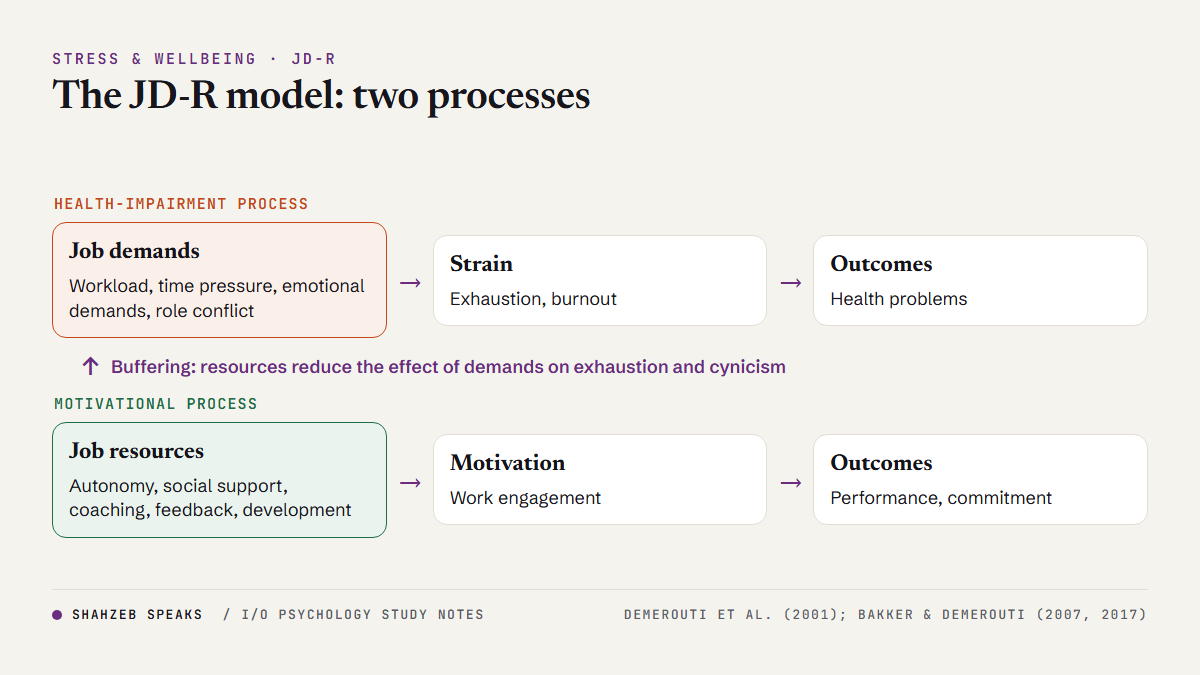
1. The health-impairment process
High, chronic job demands use up an employee’s energy. Over time this leads to exhaustion, burnout and, eventually, health problems. In the first JD-R study, job demands were mainly related to the exhaustion part of burnout (Demerouti et al., 2001).
2. The motivational process
Job resources motivate. They help people reach goals, learn and feel connected, which leads to work engagement (a positive, energetic state of being absorbed in work) and to better performance and commitment. In the 2001 study, a lack of resources was mainly related to disengagement, the other part of burnout.
3. Buffering: resources protect against demands
Resources can also soften the effect of demands. Bakker, Demerouti and Euwema (2005) studied 1,012 employees of a large higher-education institute. In 18 of 32 possible combinations of a specific demand and a specific resource, the combination of high demands and low resources produced the highest exhaustion and cynicism. Autonomy, feedback and support made heavy demands less draining.
What does the research show?
| Study | Sample | Main finding |
|---|---|---|
| Demerouti, Bakker, Nachreiner & Schaufeli (2001) | 374 employees in human services, industry and transport | Demands mainly related to exhaustion; lack of resources mainly to disengagement; same pattern in all three groups |
| Schaufeli & Bakker (2004) | Four occupational samples, total 1,698 | Burnout mainly predicted by demands (and lack of resources); engagement predicted only by resources; burnout linked to health problems |
| Bakker, Demerouti & Euwema (2005) | 1,012 employees in higher education | Resources buffered the effect of demands on exhaustion and cynicism in 18 of 32 combinations |
| Xanthopoulou et al. (2007) | 714 Dutch employees | Personal resources (self-efficacy, organisation-based self-esteem, optimism) did not buffer demands but linked job resources to engagement |
| Crawford, LePine & Rich (2010) | Meta-analysis | Challenge demands were positively related to engagement; hindrance demands negatively; all demands related to burnout |
Two findings matter most for exams. First, Schaufeli and Bakker (2004) showed that burnout and engagement are not simple opposites: they were negatively related but shared only 10 to 25 per cent of their variance, and they had different causes and effects. Burnout mediated the link between demands and health problems, while engagement mediated the link between resources and turnover intention.
Second, Crawford, LePine and Rich (2010) split demands into two kinds. Challenge demands (such as responsibility or a demanding but meaningful project) can feel like a chance to grow and were linked to higher engagement. Hindrance demands (such as red tape, role conflict or office politics) were linked to lower engagement. Both kinds were linked to burnout. So “reduce all demands” is too simple advice.
By 2017, Bakker and Demerouti described how the model had grown into “JD-R theory”, noting that it had been applied in thousands of organisations and had inspired hundreds of studies (Bakker & Demerouti, 2017).
JD-R examples from real jobs
The examples below are illustrations of how a student or HR team would fill the model for different jobs. They are not data from a study.
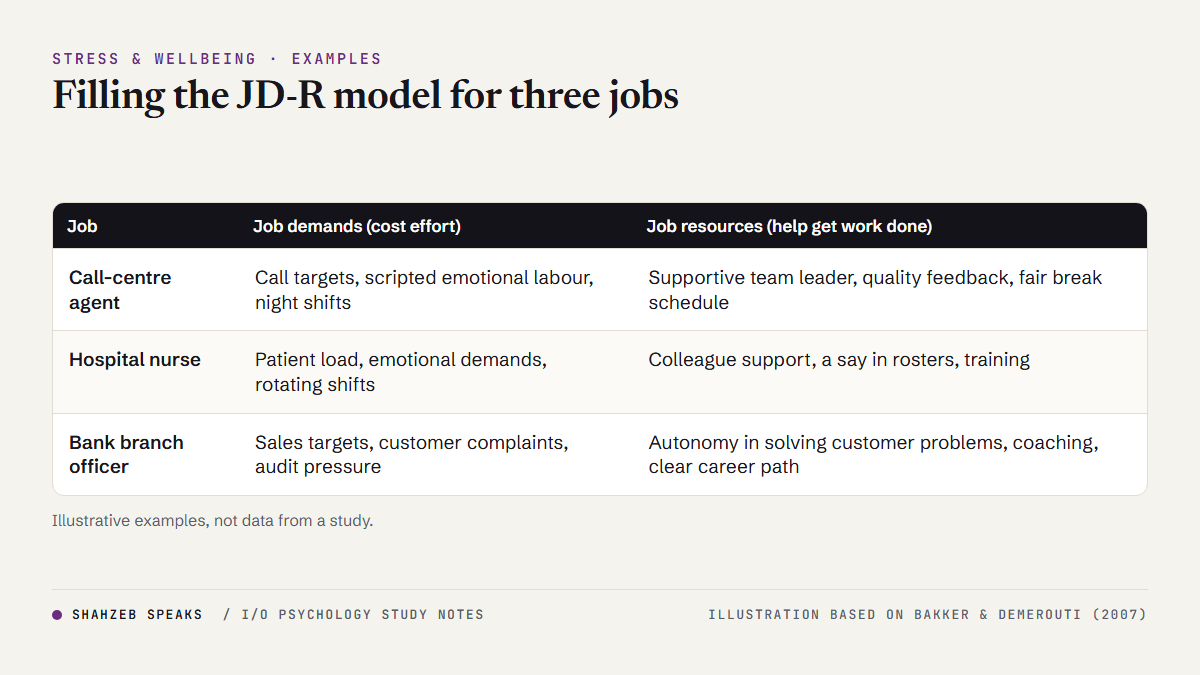
- Call-centre agent (Karachi or Manila): demands include call targets, scripted emotional labour and night shifts; resources include a supportive team leader, quality feedback and a fair break schedule.
- Hospital nurse: demands include patient load, emotional demands and rotating shifts; resources include colleague support, a say in rosters and training.
- Bank branch officer: demands include sales targets, customer complaints and audit pressure; resources include autonomy in solving customer problems, coaching from the branch manager and a clear career path.
A useful idea from the same research group is job crafting: employees themselves changing the level of their job demands and job resources, for example by asking for feedback or taking on a challenging project. Tims and Bakker (2010), writing in the SA Journal of Industrial Psychology, described job crafting as a form of proactive behaviour, and Tims, Bakker and Derks (2012) later published a job crafting scale.
JD-R vs Karasek’s demand-control model
| Point | Demand-control (Karasek, 1979) | JD-R (Demerouti et al., 2001) |
|---|---|---|
| Job features | Fixed: psychological demands and decision latitude (control) | Open: any demand and any resource relevant to the job |
| Outcomes | Mainly strain and ill health (plus learning in “active” jobs) | Both negative (burnout, health) and positive (engagement, performance) |
| Processes | Strain from high demands with low control | Two processes: health impairment and motivation, plus buffering |
| Main use | Occupational health, cardiovascular research | Burnout and engagement research, employee surveys, interventions |
What are the criticisms of the JD-R model?
- Too flexible to test. Schaufeli and Taris (2014) argued that the JD-R model is better seen as a heuristic framework than a true theory: because almost anything can count as a demand or a resource, it is hard to falsify, and the model does not explain why a particular feature is a demand or a resource.
- Demands are not all alike. The challenge vs hindrance findings (Crawford et al., 2010) show the original “demands are costly” idea needs refining.
- Mostly self-report and cross-sectional data. Many JD-R studies survey people once, so the direction of effects is uncertain. The 2001 study did add observer ratings of working conditions.
- Strength. Its flexibility is also why it works so well in practice: an organisation in Lahore or Johannesburg can measure the demands and resources that matter in its own jobs.
How to use the JD-R model in a thesis
JD-R is a popular framework for MS and MPhil theses because it gives clear hypotheses. A typical design: measure two or three demands, two or three resources, burnout and engagement, then test (1) demands to burnout, (2) resources to engagement, (3) resources moderating demands. Measures used in this research include the Oldenburg Burnout Inventory (validated in the 2001 study, with exhaustion and disengagement factors), the Copenhagen Burnout Inventory (personal, work-related and client-related burnout; Kristensen et al., 2005) and the Utrecht Work Engagement Scale by Schaufeli and Bakker. Check each scale’s licence or terms with its authors before use.
If you collect Copenhagen Burnout Inventory data, our free Copenhagen Burnout Inventory calculator scores it for you. For more topic ideas, see I/O psychology thesis topics and scales for I/O theses. For the wider picture on burnout, read our posts on the psychology of workplace burnout and workplace burnout statistics.
10-mark answer structure
- Definition (who, year): Demerouti, Bakker, Nachreiner and Schaufeli (2001); reviewed by Bakker and Demerouti (2007, 2017).
- Job demands: definition plus two examples.
- Job resources: definition plus two examples.
- Health-impairment process: demands lead to exhaustion, burnout and health problems.
- Motivational process: resources lead to engagement and performance.
- Buffering: resources reduce the effect of demands (Bakker et al., 2005).
- Evidence: Demerouti et al. (2001), Schaufeli and Bakker (2004), challenge vs hindrance demands (Crawford et al., 2010).
- Example: one job (nurse, call-centre agent, teacher) mapped into demands and resources.
- Evaluation: heuristic rather than theory (Schaufeli & Taris, 2014); self-report data; comparison with Karasek.
- Conclusion: manage both sides: reduce hindrance demands and build resources.
Model opening line: “The job demands-resources model (Demerouti et al., 2001) proposes that all working conditions can be grouped into job demands, which drive a health-impairment process towards burnout, and job resources, which drive a motivational process towards engagement and can buffer the effect of demands.”
Practice MCQs: job demands-resources model
Practice questions written to the published syllabus. Try each one before opening the answer.
-
In the JD-R model, work engagement is driven mainly by:
- Job demands
- Job resources
- Effort-reward imbalance
- Low decision latitude
Show answer
B. Resources start the motivational process. Demands drive the health-impairment process; C and D belong to Siegrist’s and Karasek’s models.
-
Who introduced the JD-R model in 2001?
- Karasek and Theorell
- Demerouti, Bakker, Nachreiner and Schaufeli
- Lazarus and Folkman
- Maslach and Jackson
Show answer
B. The 2001 Journal of Applied Psychology paper introduced it. Karasek and Theorell wrote on healthy work, Lazarus and Folkman on appraisal and coping, Maslach and Jackson on the burnout inventory.
-
A nurse has a heavy patient load but a supportive charge nurse and a say in her roster. According to the buffering hypothesis:
- The support will increase her workload
- The resources will reduce the effect of the demands on exhaustion
- Resources only matter when demands are low
- Demands and resources are unrelated
Show answer
B. Resources such as support and autonomy can soften the impact of demands (Bakker et al., 2005). A, C and D contradict the hypothesis.
-
Which is a job resource rather than a job demand?
- Time pressure
- Emotional demands from customers
- Performance feedback
- Role conflict
Show answer
C. Feedback helps people reach goals and learn. A, B and D require sustained effort and are demands.
-
In Demerouti et al. (2001), a lack of job resources was mainly related to which part of burnout?
- Exhaustion
- Disengagement
- Depersonalisation of patients only
- Physical illness
Show answer
B. Demands went with exhaustion; lack of resources went with disengagement. C is not a dimension of the Oldenburg inventory used in the study; D was not the burnout component tested.
-
Crawford, LePine and Rich (2010) found that demands appraised as challenges were:
- Negatively related to engagement
- Positively related to engagement
- Unrelated to burnout
- The same as hindrance demands
Show answer
B. Challenge demands went with higher engagement, hindrance demands with lower engagement. All demands were related to burnout, so C is wrong; D ignores the distinction.
-
Which statement best summarises Schaufeli and Taris’s (2014) criticism of the JD-R model?
- It only applies to nurses
- It is a flexible heuristic rather than a true theory, so it is hard to falsify
- It ignores burnout
- It uses only observer ratings
Show answer
B. Because almost anything can be a demand or resource, the model does not explain why. A, C and D are false: it applies to any job, centres on burnout and mostly uses self-reports.
-
Schaufeli and Bakker (2004) found that burnout and engagement:
- Are exact opposites on one scale
- Are negatively related but have different causes and consequences
- Are both predicted only by job demands
- Are unrelated
Show answer
B. They shared only 10 to 25 per cent of their variance and had different predictors. Engagement was predicted only by resources, so C is wrong; A and D overstate or deny the link.
-
An employee asks her manager for more feedback and volunteers for a challenging project to make her job more interesting. In JD-R research this is called:
- Job crafting
- Social loafing
- Psychological contract breach
- Overcommitment
Show answer
A. Job crafting is employees changing their own demands and resources (Tims & Bakker, 2010). B is reduced effort in groups, C is a broken promise, D is part of Siegrist’s model.
-
Which is NOT a difference between the JD-R model and Karasek’s demand-control model?
- JD-R allows any job feature to be a demand or resource
- JD-R includes positive outcomes such as engagement
- JD-R adds a motivational process
- Only JD-R recognises that job demands can cause strain
Show answer
D. Both models agree that demands can cause strain; Karasek’s model is built on that idea. A, B and C are real differences.
Score burnout data for your thesis
Collected Copenhagen Burnout Inventory responses? The free Copenhagen Burnout Inventory calculator scores personal, work-related and client-related burnout. More research tools are on our free tools page.
More practice: occupational stress and burnout MCQs and the full I/O psychology MCQ hub.
Questions students ask
What is the JD-R model in simple words?
Every job has things that drain you (demands) and things that help you (resources). Too many demands without recovery lead to burnout; enough resources lead to engagement, and resources also protect you from the effects of demands.
Who developed the job demands-resources model?
Evangelia Demerouti, Arnold Bakker, Friedhelm Nachreiner and Wilmar Schaufeli, in a 2001 paper in the Journal of Applied Psychology. Bakker and Demerouti reviewed and extended it in 2007 and 2017.
What is the difference between burnout and engagement in the JD-R model?
Burnout (exhaustion and disengagement) comes mainly from high demands and low resources, and is linked to health problems. Engagement comes from resources and is linked to performance and staying. They are related but are not simply opposites (Schaufeli & Bakker, 2004).
What are examples of job demands and job resources?
Demands: workload, time pressure, emotional demands, role conflict, shift work. Resources: autonomy, social support, supervisor coaching, feedback, training and career opportunities.
Is JD-R a model or a theory?
It started as a model in 2001. Bakker and Demerouti (2017) describe how it developed into JD-R theory, while critics such as Schaufeli and Taris (2014) see it as a flexible heuristic. In an exam, mention both views.
How is JD-R different from Karasek’s model?
Karasek’s model uses two fixed features, demands and control. JD-R lets any demand or resource in, adds a motivational process towards engagement, and studies positive as well as negative outcomes.
References
- Bakker, A. B., & Demerouti, E. (2007). The job demands-resources model: State of the art. Journal of Managerial Psychology, 22(3), 309–328. https://doi.org/10.1108/02683940710733115
- Bakker, A. B., & Demerouti, E. (2017). Job demands–resources theory: Taking stock and looking forward. Journal of Occupational Health Psychology, 22(3), 273–285. https://doi.org/10.1037/ocp0000056
- Bakker, A. B., Demerouti, E., & Euwema, M. C. (2005). Job resources buffer the impact of job demands on burnout. Journal of Occupational Health Psychology, 10(2), 170–180. https://doi.org/10.1037/1076-8998.10.2.170
- Crawford, E. R., LePine, J. A., & Rich, B. L. (2010). Linking job demands and resources to employee engagement and burnout: A theoretical extension and meta-analytic test. Journal of Applied Psychology, 95(5), 834–848. https://doi.org/10.1037/a0019364
- Demerouti, E., Bakker, A. B., Nachreiner, F., & Schaufeli, W. B. (2001). The job demands-resources model of burnout. Journal of Applied Psychology, 86(3), 499–512. https://doi.org/10.1037/0021-9010.86.3.499
- Karasek, R. A., Jr. (1979). Job demands, job decision latitude, and mental strain: Implications for job redesign. Administrative Science Quarterly, 24(2), 285–308. https://doi.org/10.2307/2392498
- Kristensen, T. S., Borritz, M., Villadsen, E., & Christensen, K. B. (2005). The Copenhagen Burnout Inventory: A new tool for the assessment of burnout. Work & Stress, 19(3), 192–207. https://doi.org/10.1080/02678370500297720
- Schaufeli, W. B., & Bakker, A. B. (2004). Job demands, job resources, and their relationship with burnout and engagement: A multi-sample study. Journal of Organizational Behavior, 25(3), 293–315. https://doi.org/10.1002/job.248
- Schaufeli, W. B., & Taris, T. W. (2014). A critical review of the job demands-resources model: Implications for improving work and health. In G. F. Bauer & O. Hämmig (Eds.), Bridging occupational, organizational and public health (pp. 43–68). Springer. https://doi.org/10.1007/978-94-007-5640-3_4
- Tims, M., & Bakker, A. B. (2010). Job crafting: Towards a new model of individual job redesign. SA Journal of Industrial Psychology, 36(2), Article 841. https://doi.org/10.4102/sajip.v36i2.841
- Tims, M., Bakker, A. B., & Derks, D. (2012). Development and validation of the job crafting scale. Journal of Vocational Behavior, 80(1), 173–186. https://doi.org/10.1016/j.jvb.2011.05.009
- Xanthopoulou, D., Bakker, A. B., Demerouti, E., & Schaufeli, W. B. (2007). The role of personal resources in the job demands-resources model. International Journal of Stress Management, 14(2), 121–141. https://doi.org/10.1037/1072-5245.14.2.121
Practise on your phone
The free I/O Psychology Prep app has 410 explained
questions, flashcards and an exam countdown, and works offline. Get it on Google Play
· About the app
This post is part of our guide to leadership theories in I/O psychology, which covers leadership, teams and the organisation. Related reading: occupational stress models, the job characteristics model and the psychological contract. New to the field? Start with the I/O psychology study guide or read about industrial psychology in Pakistan.