
The main occupational stress models are Karasek’s demand-control model (1979), extended with social support by Johnson and Hall (1988); Siegrist’s effort-reward imbalance model (1996); and Lazarus and Folkman’s transactional model of stress and coping (1984). The first two explain which jobs are stressful; the transactional model explains how each person appraises and copes with stress.
This guide is for students revising occupational stress for an I/O psychology, occupational health or HRM exam, and for thesis students choosing a stress model and questionnaire. You get each model with its key terms, a demand-control quadrant diagram, the evidence (including large studies on heart disease), the questionnaires used to measure each model, a comparison table, an exam structure and 10 practice MCQs.
First, two terms. A stressor is a demand or condition in the environment (workload, a rude customer, job insecurity). Strain is the person’s reaction to it: psychological (anxiety, exhaustion), physical (raised blood pressure) or behavioural (absence, mistakes). Stress models try to explain which stressors lead to strain, for whom and why.
Karasek’s demand-control model (1979)
Robert Karasek published his job strain model in Administrative Science Quarterly in 1979, testing it with national survey data from the United States and Sweden. His key point was that strain does not come from job demands alone. It comes from the combination of two job features:
- Job demands: psychological pressure of workload, such as working very fast or hard, and being short of time.
- Job decision latitude (control): how much say the worker has, made up of skill discretion (using and learning skills, varied work) and decision authority (freedom to decide how to do the work).
Crossing high and low demands with high and low control gives four types of job:
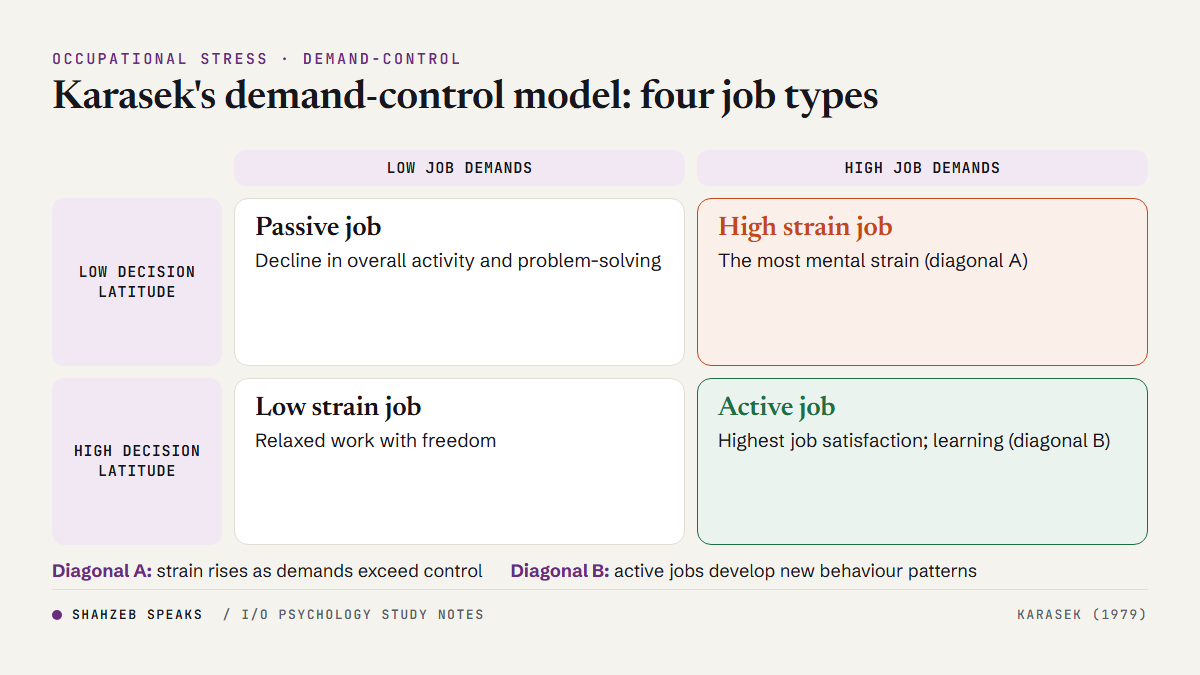
- High strain job (high demands, low control): the most mental strain. Example: a call-centre agent with strict call-time targets, scripts and no say in breaks.
- Active job (high demands, high control): demanding but challenging, with the highest job satisfaction and the development of new behaviour patterns. Example: a hospital consultant or a senior engineer.
- Low strain job (low demands, high control): relaxed work with freedom. Example: a librarian in a quiet university library with control over routines.
- Passive job (low demands, low control): Karasek predicted a decline in overall activity and problem-solving. Example: a monotonous machine-minding job.
Karasek’s practical message was striking: redesigning work to give workers more decision latitude could reduce mental strain without reducing the demands that may be needed for output (Karasek, 1979).
Adding social support: the demand-control-support model
Jeffrey Johnson and Ellen Hall (1988) studied a random, representative sample of 13,779 Swedish workers. Workers with high demands, low control and low co-worker support (an “iso-strain” job, meaning isolated high strain) had an age-adjusted prevalence ratio of 2.17 for cardiovascular disease compared with workers in low-demand, high-control, high-support jobs. Because the study was cross-sectional, the authors stressed that it could not prove cause and effect.
What the evidence says
Van der Doef and Maes (1999) reviewed 63 samples published between 1979 and 1997. They found considerable support for the strain hypothesis (high-strain and iso-strain jobs have the lowest well-being) but less consistent support for the buffer hypothesis (that control or support reduces the harm of high demands). Control seemed to buffer only when it matched the specific demands of the job.
The largest test is a meta-analysis of individual participant data from 13 European cohort studies with 197,473 people (Kivimäki et al., 2012). After adjusting for sex and age, people reporting job strain had a 23 per cent higher risk of coronary heart disease (hazard ratio 1.23). The authors estimated the population attributable risk at 3.4 per cent and concluded that tackling workplace stress would have a much smaller effect on heart disease than tackling standard risk factors such as smoking. That is an honest finding worth quoting in an exam: job strain matters, but it is one risk among many.
Siegrist’s effort-reward imbalance (ERI) model
Johannes Siegrist introduced the effort-reward imbalance model in 1986 and described it in the first issue of the Journal of Occupational Health Psychology (Siegrist, 1996). Its core idea is reciprocity: work is a social exchange, and high-cost, low-gain conditions are especially stressful.
- Effort: extrinsic effort means the demands of the job, such as work pressure.
- Rewards: money, esteem and status control, which includes promotion prospects and job security.
- Overcommitment: intrinsic effort, a personal coping pattern such as a high need for control, which can make people keep giving high effort even when rewards are low. Later reviews treat it as a personal characteristic (van Vegchel et al., 2005).
Example: a junior doctor in a busy public hospital works long shifts, is rarely thanked, earns little and has no secure post. Even if she has some control over clinical decisions, ERI predicts strain because what she gives is far more than what she gets back. In Siegrist’s 1996 paper, low status control combined with high effort predicted new cardiovascular events in a prospective study of blue-collar men.
Evidence: van Vegchel, de Jonge, Bosma and Schaufeli (2005) reviewed 45 ERI studies published from 1986 to 2003. The main (extrinsic) hypothesis, that high effort with low reward raises the risk of poor health, had considerable support. Results for overcommitment were inconsistent, and its moderating role had hardly been tested.
Lazarus and Folkman’s transactional model of stress and coping
The first two models look at the job. Richard Lazarus and Susan Folkman, in Stress, Appraisal, and Coping (1984), looked at the person. In their transactional model, stress is a relationship between the person and the environment that the person appraises as taxing their resources and threatening their well-being. The same event can be stressful for one employee and not for another.
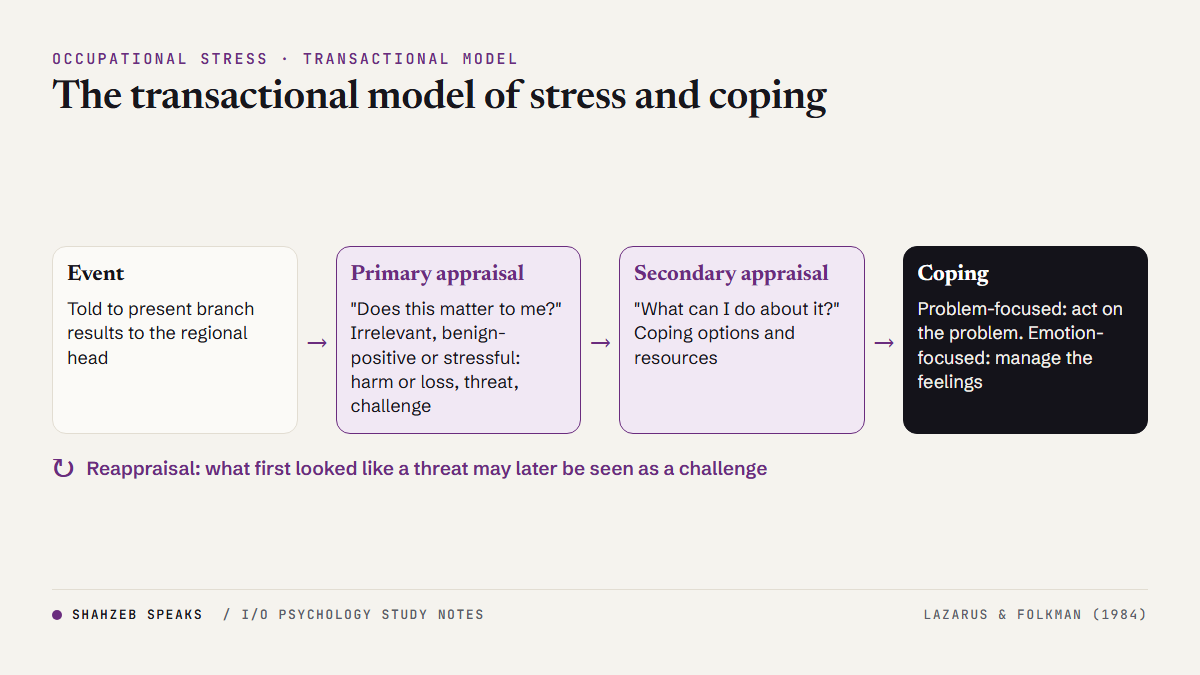
- Primary appraisal: “Does this matter to me?” The event may be judged irrelevant, benign-positive or stressful. A stressful appraisal can mean harm or loss (already happened), threat (may happen) or challenge (a chance to gain or grow).
- Secondary appraisal: “What can I do about it?” The person evaluates the coping options and resources available.
- Coping: problem-focused coping acts on the problem itself (planning, asking for help, changing the situation); emotion-focused coping manages the feelings (seeking comfort, distancing, reframing).
- Reappraisal: as the situation unfolds, the appraisal changes. What first looked like a threat may later be seen as a challenge.
Example: a bank officer is told she will present the branch results to the regional head. If she sees it as a threat and believes she has no support, she feels strain. If she sees it as a challenge and knows a colleague will help her prepare, the same event may motivate her. This is also why the challenge vs hindrance distinction appears in the job demands-resources model.
Occupational stress models compared in one table
| Model | Who, year | Core idea | Most stressful condition | Common measure |
|---|---|---|---|---|
| Demand-control | Karasek (1979) | Strain comes from demands combined with low decision latitude | High strain job: high demands, low control | Job Content Questionnaire (Karasek et al., 1998) |
| Demand-control-support | Johnson & Hall (1988) | Social support added as a third dimension | Iso-strain: high demands, low control, low support | Job Content Questionnaire |
| Effort-reward imbalance | Siegrist (1986, 1996) | Strain comes from a lack of reciprocity between effort and reward | High effort, low reward, plus overcommitment | ERI questionnaire (Siegrist et al., 2004) |
| Transactional model | Lazarus & Folkman (1984) | Stress depends on the person’s appraisal and coping | Events appraised as threat or harm with too few coping resources | Appraisal and coping questionnaires |
| Job demands-resources | Demerouti et al. (2001) | Any demand drains energy; any resource motivates and buffers | High demands with low resources | Job-specific demand and resource scales, burnout and engagement scales |
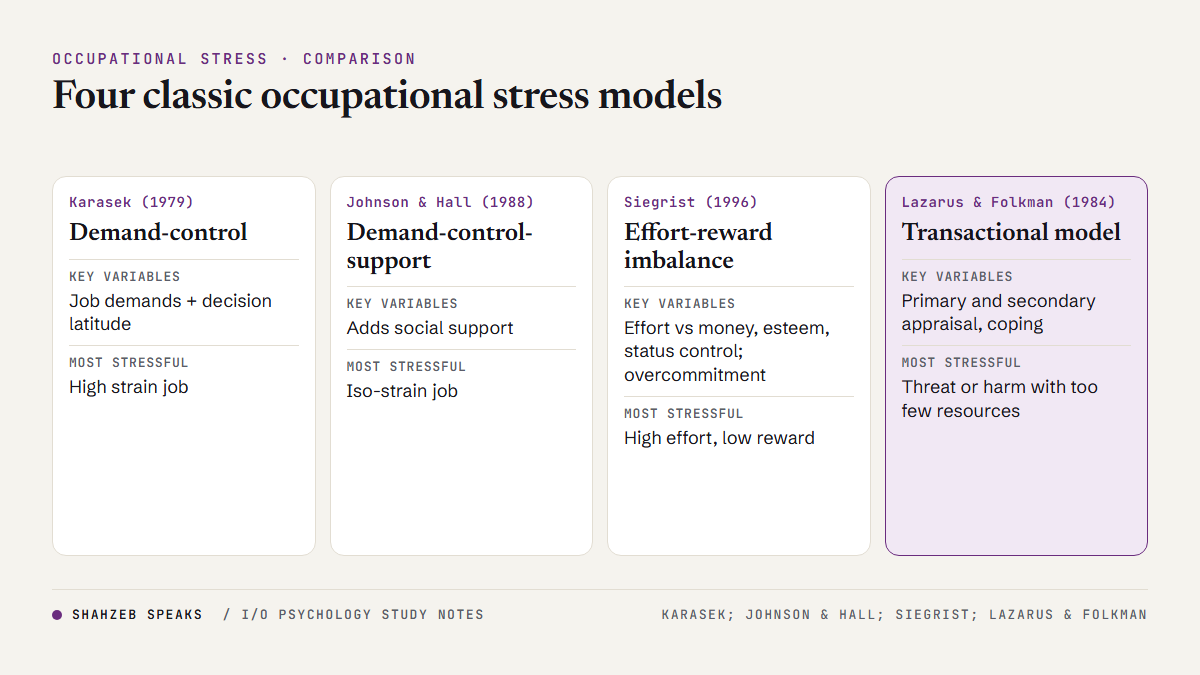
How to choose for an exam or thesis: use demand-control when the question is about job design and control; use ERI when pay, recognition, job insecurity or promotion are central (common in public-sector and contract jobs); use the transactional model when the question is about individual differences, appraisal or coping; and use JD-R when you want to study burnout and engagement together.
Occupational stress questionnaires and scales
Students often search for an “occupational stress scale” or “questionnaire”. Each model has its own measures. Do not copy their items from the internet into your thesis appendix; obtain them from the authors or official source and follow their terms.
- Job Content Questionnaire (JCQ): measures demands, decision latitude and social support for the demand-control-support model (Karasek et al., 1998).
- ERI questionnaire: measures effort, reward and overcommitment. Siegrist et al. (2004) tested it with data from five European countries and found satisfactory internal consistency and a confirmed factor structure.
- HSE Management Standards Indicator Tool: a 35-item questionnaire from the UK Health and Safety Executive covering six areas of work design: demands, control, support, relationships, role and change. It is available from the HSE Management Standards pages.
- Burnout measures: if your outcome is burnout, the Copenhagen Burnout Inventory measures personal, work-related and client-related burnout (Kristensen et al., 2005). Our free Copenhagen Burnout Inventory calculator scores it.
For context on why these models matter, read our posts on the psychology of workplace burnout, burnout statistics and employee mental health during a crisis.
10-mark answer structure (“Discuss models of occupational stress”)
- Definitions: stressor vs strain; occupational stress as strain arising from work conditions.
- Demand-control (Karasek, 1979): demands and decision latitude; the four quadrants; high strain vs active jobs.
- Social support (Johnson & Hall, 1988): iso-strain; 13,779 Swedish workers.
- Effort-reward imbalance (Siegrist, 1996): effort, reward (money, esteem, status control), overcommitment, reciprocity.
- Transactional model (Lazarus & Folkman, 1984): primary and secondary appraisal, problem- vs emotion-focused coping.
- Evidence: strain hypothesis supported, buffering less consistent (Van der Doef & Maes, 1999); Kivimäki et al. (2012) HR 1.23 for heart disease; ERI main hypothesis supported (van Vegchel et al., 2005).
- Comparison: job-focused models vs the person-focused transactional model; table if allowed.
- Application: one local workplace (call centre, public hospital, bank) analysed with two models.
- Conclusion: the models complement each other; interventions should change both job design and coping.
Model opening line: “Occupational stress models fall into two groups: job-focused models such as Karasek’s (1979) demand-control model and Siegrist’s (1996) effort-reward imbalance model, which identify stressful job conditions, and the person-focused transactional model of Lazarus and Folkman (1984), which explains how individuals appraise and cope with those conditions.”
Practice MCQs: occupational stress models
Practice questions written to the published syllabus. Try each one before opening the answer.
-
According to Karasek (1979), the most mental strain occurs in jobs that combine:
- High demands and high decision latitude
- High demands and low decision latitude
- Low demands and low decision latitude
- Low demands and high decision latitude
Show answer
B. This is the high strain job. A is the active job, C the passive job and D the low strain job.
-
A senior engineer has heavy deadlines but full freedom over how to solve problems. In Karasek’s model this is:
- A passive job
- A high strain job
- An active job
- An iso-strain job
Show answer
C. High demands with high control make an active job, linked to learning and satisfaction. Iso-strain needs low control and low support.
-
Johnson and Hall (1988) extended Karasek’s model by adding:
- Overcommitment
- Social support
- Primary appraisal
- Job resources
Show answer
B. Co-worker social support was the third dimension, giving the demand-control-support model. A is Siegrist’s, C is Lazarus and Folkman’s, D is from JD-R.
-
The central idea of Siegrist’s effort-reward imbalance model is:
- Reciprocity: high effort with low reward causes strain
- Control buffers all demands
- Stress depends only on personality
- Groups move through stages
Show answer
A. ERI is about a failed exchange between effort and rewards. B is the buffer hypothesis of demand-control, C ignores the job, D is Tuckman.
-
Which is NOT one of the rewards in Siegrist’s model?
- Money
- Esteem
- Status control, such as job security
- Decision authority
Show answer
D. Decision authority is part of Karasek’s decision latitude. Money, esteem and status control are ERI rewards.
-
A teacher thinks: “This inspection could expose my weak lessons.” In Lazarus and Folkman’s terms, this is a primary appraisal of:
- Challenge
- Threat
- Benign-positive
- Irrelevant
Show answer
B. Anticipating possible harm is a threat appraisal. Challenge would focus on a chance to gain or grow; benign-positive and irrelevant are not stressful appraisals.
-
An employee facing a heavy workload makes a plan and asks her manager to reprioritise tasks. This is:
- Emotion-focused coping
- Problem-focused coping
- Overcommitment
- Reappraisal only
Show answer
B. Acting on the problem itself is problem-focused coping. Emotion-focused coping manages feelings; overcommitment is a pattern in ERI.
-
Van der Doef and Maes (1999) found that the demand-control(-support) literature gave:
- Strong support for buffering, weak support for strain
- Considerable support for the strain hypothesis, less consistent support for buffering
- No support for any hypothesis
- Support only in the United States
Show answer
B. The additive strain predictions were well supported; the moderating role of control and support was less consistent. A reverses the finding; C and D are false.
-
In the Kivimäki et al. (2012) meta-analysis of 13 European cohorts, the hazard ratio for coronary heart disease among people with job strain was about:
- 0.80
- 1.23
- 2.17
- 5.00
Show answer
B. The age- and sex-adjusted hazard ratio was 1.23. 2.17 is Johnson and Hall’s prevalence ratio for iso-strain, a different study and measure; A and D are not from either study.
-
Which statement about the transactional model is NOT correct?
- The same event can be stressful for one person and not another
- Secondary appraisal asks what can be done about the situation
- Appraisals can change through reappraisal
- Stress is defined only by the objective level of job demands
Show answer
D. The transactional model defines stress through the person’s appraisal of the person-environment relationship, not by objective demands alone. A, B and C are correct.
Practise on your phone
The free I/O Psychology Prep app has 410 explained
questions, flashcards and an exam countdown, and works offline. Get it on Google Play
· About the app
More practice: occupational stress and burnout MCQs and the full I/O psychology MCQ hub.
Questions students ask
What is an occupational stress model?
A theory that explains which features of work lead to strain, and why. Job-focused models (Karasek, Siegrist, JD-R) look at conditions such as demands, control and rewards; person-focused models (Lazarus and Folkman) look at how individuals appraise and cope.
What is the difference between Karasek’s model and Siegrist’s model?
Karasek’s model is about demands and control over the work. Siegrist’s model is about the exchange between effort and rewards such as pay, esteem and job security, and adds a personal factor, overcommitment. A job can have good control yet still be stressful under ERI if rewards are low.
What are the four quadrants of the demand-control model?
High strain (high demands, low control), active (high demands, high control), low strain (low demands, high control) and passive (low demands, low control).
What is the transactional model of stress?
Lazarus and Folkman’s (1984) model, in which stress arises when a person appraises a situation as taxing their resources. It has primary appraisal (is this a threat, harm or challenge?), secondary appraisal (what can I do?), coping (problem- or emotion-focused) and reappraisal.
Which occupational stress questionnaire should I use for my thesis?
Match the questionnaire to your model: the Job Content Questionnaire for demand-control-support, the ERI questionnaire for effort-reward imbalance, or the HSE Management Standards Indicator Tool for a broad work-design audit. Check each tool’s terms of use first.
Is occupational stress linked to heart disease?
Yes, modestly. In a meta-analysis of 197,473 people, job strain was linked to a 23 per cent higher risk of coronary heart disease, but the authors note that standard risk factors such as smoking matter much more at population level (Kivimäki et al., 2012).
References
- Demerouti, E., Bakker, A. B., Nachreiner, F., & Schaufeli, W. B. (2001). The job demands-resources model of burnout. Journal of Applied Psychology, 86(3), 499–512. https://doi.org/10.1037/0021-9010.86.3.499
- Johnson, J. V., & Hall, E. M. (1988). Job strain, work place social support, and cardiovascular disease: A cross-sectional study of a random sample of the Swedish working population. American Journal of Public Health, 78(10), 1336–1342. https://doi.org/10.2105/AJPH.78.10.1336
- Karasek, R. A., Jr. (1979). Job demands, job decision latitude, and mental strain: Implications for job redesign. Administrative Science Quarterly, 24(2), 285–308. https://doi.org/10.2307/2392498
- Karasek, R., Brisson, C., Kawakami, N., Houtman, I., Bongers, P., & Amick, B. (1998). The Job Content Questionnaire (JCQ): An instrument for internationally comparative assessments of psychosocial job characteristics. Journal of Occupational Health Psychology, 3(4), 322–355. https://doi.org/10.1037/1076-8998.3.4.322
- Kivimäki, M., Nyberg, S. T., Batty, G. D., Fransson, E. I., Heikkilä, K., Alfredsson, L., et al. (2012). Job strain as a risk factor for coronary heart disease: A collaborative meta-analysis of individual participant data. The Lancet, 380(9852), 1491–1497. https://doi.org/10.1016/S0140-6736(12)60994-5
- Kristensen, T. S., Borritz, M., Villadsen, E., & Christensen, K. B. (2005). The Copenhagen Burnout Inventory: A new tool for the assessment of burnout. Work & Stress, 19(3), 192–207. https://doi.org/10.1080/02678370500297720
- Lazarus, R. S., & Folkman, S. (1984). Stress, appraisal, and coping. Springer.
- Siegrist, J. (1996). Adverse health effects of high-effort/low-reward conditions. Journal of Occupational Health Psychology, 1(1), 27–41. https://doi.org/10.1037/1076-8998.1.1.27
- Siegrist, J., Starke, D., Chandola, T., Godin, I., Marmot, M., Niedhammer, I., & Peter, R. (2004). The measurement of effort–reward imbalance at work: European comparisons. Social Science & Medicine, 58(8), 1483–1499. https://doi.org/10.1016/S0277-9536(03)00351-4
- Van der Doef, M., & Maes, S. (1999). The job demand-control(-support) model and psychological well-being: A review of 20 years of empirical research. Work & Stress, 13(2), 87–114. https://doi.org/10.1080/026783799296084
- van Vegchel, N., de Jonge, J., Bosma, H., & Schaufeli, W. (2005). Reviewing the effort–reward imbalance model: Drawing up the balance of 45 empirical studies. Social Science & Medicine, 60(5), 1117–1131. https://doi.org/10.1016/j.socscimed.2004.06.043
Practise on your phone
The free I/O Psychology Prep app has 410 explained
questions, flashcards and an exam countdown, and works offline. Get it on Google Play
· About the app
This post is part of our guide to leadership theories in I/O psychology, which covers leadership, teams and the organisation. Related reading: the job demands-resources model, the psychological contract and the job characteristics model. New to the field? Start with the I/O psychology study guide or read about industrial psychology in Pakistan.