

It is late, the work is not finished, and one half-written email keeps returning to your mind. You are not trying to remember it. You are trying to sleep, or to watch something else, or to enjoy a quiet evening, and still it knocks. The Zeigarnik effect is the name usually given to that knock: an unfinished task stays active in the mind in a way a finished task does not, and the honest version of the story is more useful, and more surprising, than the textbook version.
I am an Industrial and Organizational Psychologist in Karachi, and I write about what workplace and consumer research actually shows. The Zeigarnik effect is worth a careful guide because it is quoted everywhere, from productivity blogs to app design, and quoted wrong in one important respect. The famous claim, that you remember unfinished tasks better than finished ones, did not survive a 2025 meta-analysis. What did survive is arguably more practical: unfinished tasks pull at attention, they make it harder to focus on the next thing, they can spoil sleep, and a specific plan, not mere completion, can release that pull. This guide separates the claim that failed from the finding that held, then turns the finding into a method you can use tonight.
“Your mind is not keeping a perfect record of unfinished work. It is keeping a watch. A plan tells the watch it can stand down.” — Workplace Psychology Analysis, ShahzebSpeaks
🔬 Chapter 1: The short answer — what the Zeigarnik effect is
The Zeigarnik effect, in its original form, is the claim that interrupted or unfinished tasks are remembered better than completed tasks. The claim comes from Bluma Zeigarnik, working in Kurt Lewin’s laboratory in Berlin in the 1920s. The explanation she offered, drawn from Lewin’s field theory, was that starting a task creates a kind of tension, a readiness to continue, which stays in place until the task is finished. Finishing releases the tension. Interruption leaves it running, so the task stays accessible and easy to bring to mind.
That short answer needs a correction, and the correction is the reason this guide exists. A meta-analysis published in 2025 found, on average, no memory advantage for interrupted tasks at all. Interrupted and completed tasks were recalled at essentially the same rate. So if you stop in the middle of a chapter hoping the unfinished material will lodge itself in memory, the best current evidence does not support that tactic. What the same body of research does support is different and, for daily life, more relevant: an unfinished goal stays active, it intrudes on other tasks, and people tend to return to it when they get the chance. The rest of this guide follows that distinction closely, because most practical advice built on the Zeigarnik effect confuses remembering with nagging, and they are not the same thing.
☕ Chapter 2: Berlin in the 1920s — the waiter, the puzzles, and the ratio 1.9
The story most retellings start with is a café anecdote. Lewin, dining with students in Berlin, is said to have noticed that a waiter could recall a complicated unpaid order in detail, then forget it completely once the bill was paid. Treat that anecdote as what it is: an observation that prompted an experiment, not evidence in itself. It does not appear in Zeigarnik’s data, and the details vary between retellings, with Vienna sometimes substituted for Berlin. The experiment matters more than the anecdote.
Zeigarnik gave participants a series of small tasks, such as puzzles, arithmetic, and making small objects. Some tasks were allowed to finish. Others were interrupted partway through. Later, participants were asked which tasks they had worked on. In her main experiment, interrupted tasks were recalled about twice as well as completed ones, a ratio of 1.9. Her report appeared in 1927 in the journal Psychologische Forschung, under the title, in English translation, “On finished and unfinished tasks”. The idea travelled quickly because it felt true. Anyone who has left a task half done knows the feeling of it lingering. The problem is that a feeling of lingering is not the same as better recall, and later researchers, working in different rooms, with different participants and different pressures, often could not reproduce the recall advantage.
Zeigarnik herself found conditions under which the advantage weakened or disappeared: tired participants, recall a day later, participants who knew all the tasks in advance, and a sudden change of situation before recall. Those limits were in the original work, but they rarely survive into popular summaries. A result that depends on who is in the room, how tired they are, and what they expect is not a law of memory. It is a conditional finding, and the 2025 evidence suggests the conditions that produced it were common in early laboratories and are rarer now.
📊 Chapter 3: The 2025 correction — what a meta-analysis actually found
In 2025, Romain Ghibellini and Beat Meier published a meta-analysis of the Zeigarnik and Ovsiankina effects in Humanities and Social Sciences Communications. A meta-analysis pools many studies and asks what they show together, rather than what any single study claimed. For the Zeigarnik memory claim, they pooled 38 publications. The weighted ratio of interrupted to completed tasks recalled was 0.99. A ratio of 1.0 would mean no difference at all. Interrupted tasks made up about 49% of everything participants recalled, which is what you would expect if interruption made no difference. Their conclusion, in plain words, was that the Zeigarnik effect, as a memory effect, lacks universal validity.
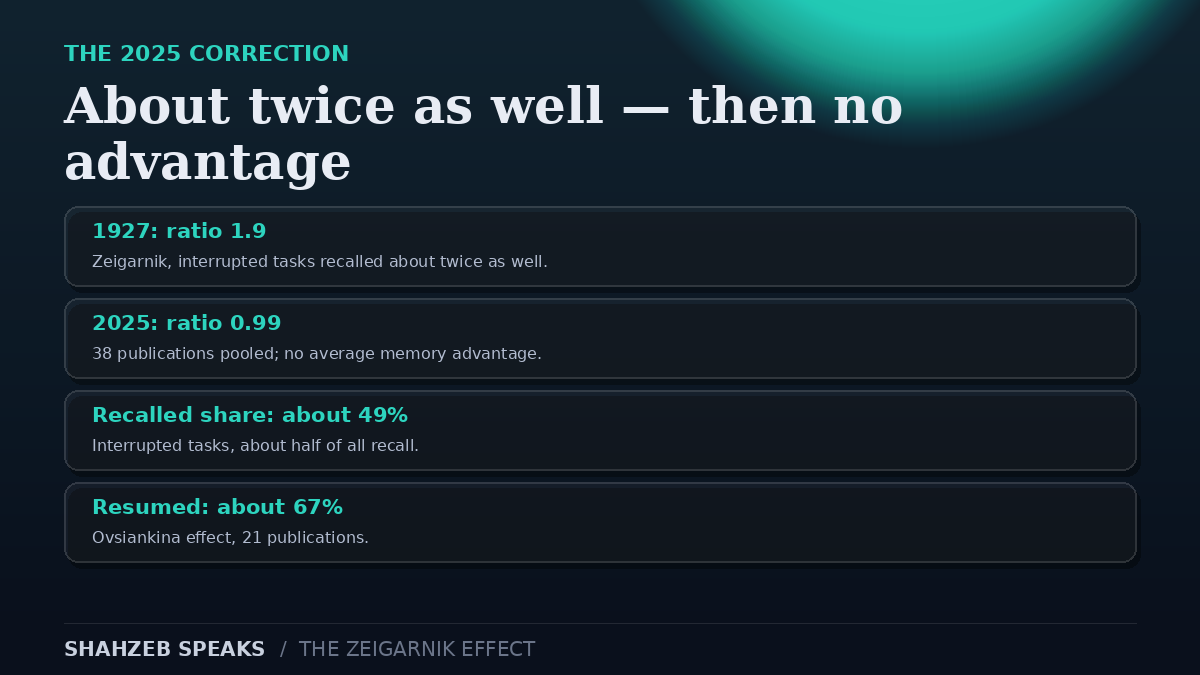
| Finding | Result | What it means |
|---|---|---|
| Zeigarnik 1927, main experiment | Ratio 1.9 | Interrupted tasks recalled about twice as often |
| Ghibellini & Meier 2025, 38 publications | Ratio 0.99 | No average memory advantage |
| Interrupted share of recall, 2025 | About 49% | About half, as chance would predict |
| Ovsiankina resumption, 21 publications | About 67% | People return to interrupted tasks about two times in three |
That result does not mean Zeigarnik was careless, or that every later study was wrong. It means the memory advantage is not a stable, general effect. The authors suggest, as a hypothesis rather than a proven cause, that older studies more often had a strong authority figure in the experimenter, high involvement in the task, and few competing demands. Modern participants, interrupted while sorting cards in a room full of distractions, do not reliably show the same pattern. Whether that explanation is right is still open. What is settled, on this evidence, is narrower: do not build a study method, a product, or a management practice on the promise that interruption improves memory. Build it, if at all, on the separate finding in the next chapter, which held up.
There is a wider lesson here for anyone who reads psychology online. A famous effect can be real in its original data, widely repeated, and still not generalise. The honest summary is not “the Zeigarnik effect is false”. It is “the memory part is unreliable, the attention part is better supported, and the return part is the strongest of the three”. Keeping those three apart is the difference between using research and merely quoting it.
↩️ Chapter 4: The finding that held — you go back, about two times in three
A year after Zeigarnik’s study, her colleague Maria Ovsiankina studied a different question: when people are interrupted, do they resume the task when they get the chance? That tendency is now called the Ovsiankina effect, and it is the part of the story that the 2025 meta-analysis found to be a general tendency. Across 21 publications, about 67% of interrupted tasks were resumed. In plain terms, given the opportunity, people picked the interrupted task back up about two times in three.
That distinction changes how you should use the idea. If your goal is to remember facts, interruption is a weak tool. If your goal is to return to a task, starting it is a strong tool. A half-written draft, a half-built slide deck, a half-read report: each has a pull that a task never started does not have. Starting creates the open loop. Finishing is not the only way to manage it, as the next chapter shows, but starting is the step that creates the motivation to return. That is why the common advice “just start, even for five minutes” has more support than the advice “stop mid-chapter and your brain will remember it”. The first advice uses resumption. The second relies on a memory advantage that, on average, is not there.
Designers use the same pull, sometimes well and sometimes badly. A series that ends on an unresolved question, a course that shows a progress bar at 80%, a game that pauses mid-level: each leaves a loop open and relies on the urge to close it. Whether that is helpful or manipulative depends on the same test used throughout this site: does the person know the loop is open, can they close it on their terms, and does closing it serve their goal or only the designer’s? A progress bar that helps a student return to a course is a tool. A cliffhanger that keeps a child watching past bedtime is a different matter, even though the mechanism is related.
✅ Chapter 5: The plan that quiets the loop — Masicampo and Baumeister
The most useful experiment in this whole story was published in 2011, not 1927. E. J. Masicampo and Roy Baumeister asked a pointed question in the Journal of Personality and Social Psychology, in a paper titled “Consider it done!”: does an unfinished goal need to be finished to stop interfering, or does it only need to be planned? Across several studies, they activated an important unfulfilled goal, such as an upcoming exam, then measured what happened on an unrelated task. Unfinished goals caused intrusive thoughts during reading, made goal-related words more accessible, and worsened performance on an anagram task. Then came the twist. Participants who were allowed to formulate a specific plan for the unfulfilled goal showed no such interference. The plan eliminated the activation effects.
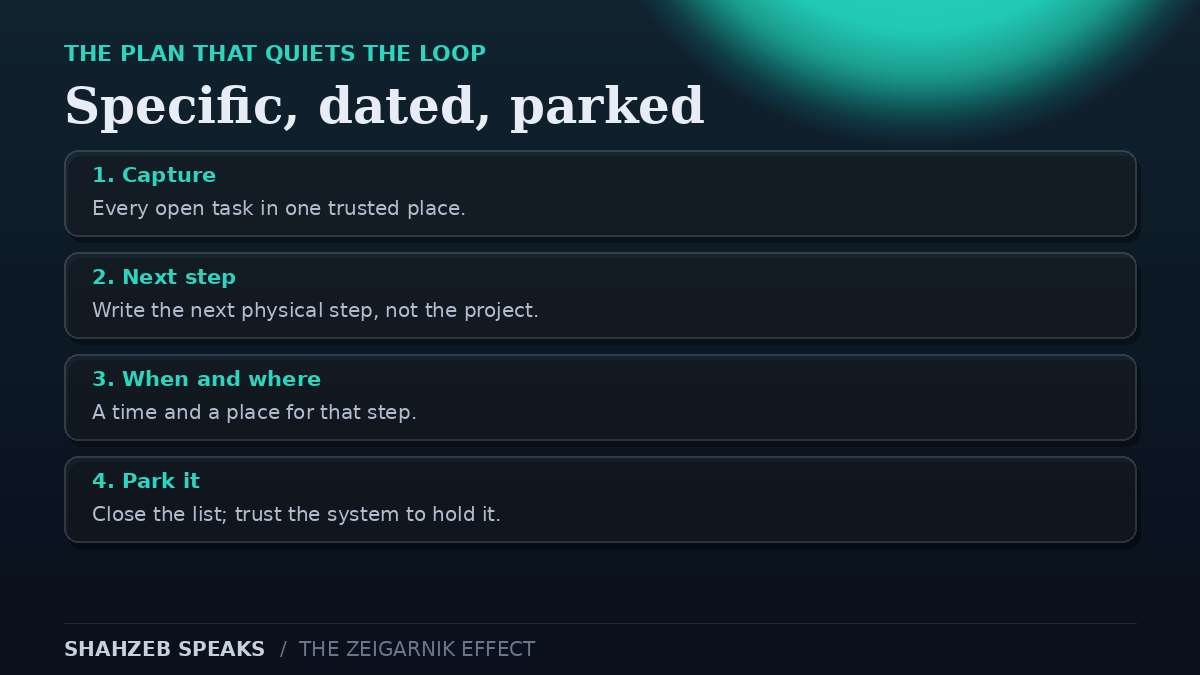
The key word is specific. A vague intention, such as “I will deal with that soon”, did not discharge the effect. A specific plan did: when, where, and how the goal would be pursued. The authors’ interpretation is that making a plan satisfies the mind’s goal-monitoring system for now. The drive to attain the goal is suspended, and can be resumed at the specified later time. In ordinary language, the mind does not demand completion. It demands a credible commitment that the task will not be dropped. Once it has that, it can stand down and let you focus on something else.
That finding gives a practical method, and it is short enough to use every evening. First, capture every open task in one place you trust, not in three notebooks and a phone note you never open. Second, for each task, write the next physical step, not the whole project: “send the draft to Sara”, not “finish the report”. Third, attach a time and a place: “tomorrow at 10:00, at my desk, before email”. Fourth, close the list and stop reviewing it. The plan works because it is specific and because it is parked somewhere you believe you will check. A plan you do not trust is just another intention, and the loop will keep knocking. A plan you do trust is a delegation, from your working memory to a system outside it.
Managers can use the same method at the end of a meeting, and it is arguably more valuable there than anywhere else. A meeting that ends with five open items and no owner, no next step, and no date leaves five loops running in five heads. A meeting that ends with each item assigned, with a next step and a date, closes those loops for the evening, even though nothing has been completed. The work is not done. The worry about the work has a place to rest.
🌙 Chapter 6: Why open loops spoil sleep — and the five-minute fix
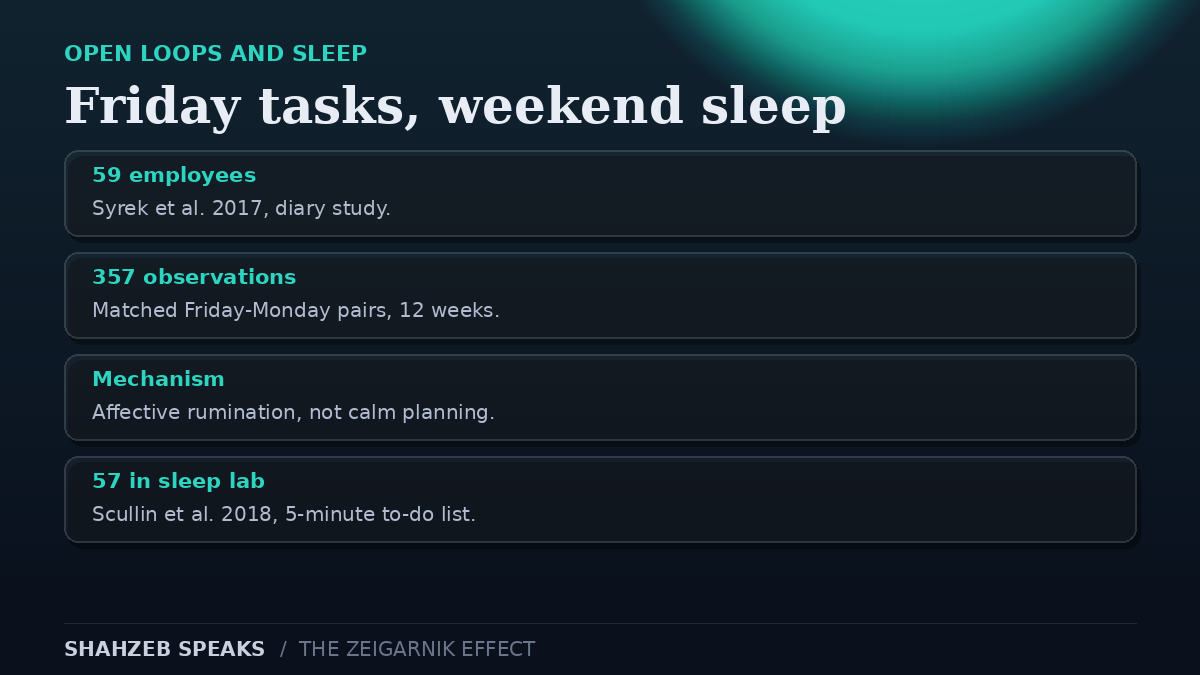
Unfinished work does not only intrude during the day. It follows people home. In 2017, Christine Syrek and colleagues published a diary study in the Journal of Occupational Health Psychology that tracked 59 employees across 357 matched Friday and Monday observations over 12 weeks. Unfinished tasks at the end of the working week predicted worse weekend sleep, and the link ran through affective rumination: worried, emotional replay of work, rather than calm problem-solving thought. Problem-solving pondering was related to less sleep impairment, but its indirect effect was not significant. The pattern over time mattered too: higher levels of unfinished tasks across three months were related to greater weekend sleep impairment than a single bad week. Open loops accumulate.
A related idea helps explain the daytime cost. Sophie Leroy’s 2009 work on attention residue found that when you switch away from an unfinished task, part of your attention stays behind with it, and performance on the next task suffers. That is the office version of the same mechanism: you move to a new meeting, but a slice of attention is still holding the previous, unfinished conversation. It is not a character flaw. It is what an open goal does. The remedy is the same as in the evening: either finish the task, or give it a specific plan and a parking place, so the residue has somewhere to go.
The sleep experiment that fits this picture best is small, and this guide states its limits plainly. In 2018, Michael Scullin and colleagues at Baylor University tested 57 healthy young adults aged 18 to 30 in a sleep laboratory. Each spent five minutes before bed writing either a to-do list of tasks to complete over the next few days, or a list of tasks already completed. The to-do-list group fell asleep significantly faster than the completed-list group, and within the to-do group, more specific lists were associated with faster sleep onset. Secondary reports put the averages at about 16 minutes against about 25 minutes. The study had no no-intervention control group, and its participants had no sleep problems, so it shows faster sleep onset in a lab, not a cure for insomnia. Still, it fits Masicampo and Baumeister neatly: writing the list offloads the loop, and the mind, told the tasks are handled, stops rehearsing them.
🛠️ Chapter 7: Using open loops well — and spotting when they use you
Used well, an open loop is a starting aid. Begin a difficult task for ten minutes, stop at a clear next step, and write that step down. The next morning, the task is easier to resume, not because you remember it better in some magical sense, but because you have a starting point and a pull to return. Used well in learning, a progress indicator shows how far you have come and what remains, which helps you plan the next session. Used well in writing, a note that says “next: the example from the 2025 paper” is worth more than a note that says “continue chapter”. Specificity is the whole trick.
Used badly, open loops become a source of constant low-level stress. A to-do list with 40 items, none with a date, is not a plan. It is 40 loops running at once, each competing for attention, each reminding you that you are behind. A notification badge that never clears, an inbox that never reaches zero, a course that always shows “in progress”: each keeps a loop open without giving you a credible closing step. The remedy is not to finish everything, which is impossible. It is to choose, each evening, which loops stay open tonight and which get a plan. Park the rest in a list you review weekly, not nightly. A loop with a review date is handled. A loop with no date is just noise.
There is also a limit to the plan method, and honesty requires stating it. A plan quiets intrusive thoughts about a goal you believe you can pursue. It does not resolve a goal that is impossible, a conflict that needs a conversation, or anxiety that has a clinical cause. If unfinished work regularly prevents sleep, or if intrusive thoughts are distressing and persistent, the right step is not a better to-do list. It is a conversation with a manager about workload, or with a clinician about sleep and anxiety. A psychological finding is a tool for ordinary loops, not a treatment for every kind of worry.
❓ Questions I am asked most often
What is the Zeigarnik effect in simple terms?
It is the idea that unfinished tasks stay active in the mind more than finished ones. The original 1927 claim was about memory: interrupted tasks were recalled about twice as well. The 2025 evidence says that memory advantage does not hold on average, while the pull to return to an unfinished task does.
Is the Zeigarnik effect real?
Partly. The memory claim is unreliable: a 2025 meta-analysis of 38 publications found a recall ratio of 0.99, meaning no average advantage. The resumption finding is stronger: about 67% of interrupted tasks were resumed. The attention finding, that unfinished goals intrude and can be quieted by a plan, is supported by Masicampo and Baumeister (2011).
Does stopping mid-task help me remember?
On current evidence, no. Zeigarnik measured recall of the tasks themselves, not of material learned while doing them, and the advantage faded with tiredness and with a day’s delay. For study, spaced practice and retrieval practice have far stronger support than deliberate interruption. Use starting a task to build momentum, not stopping to build memory.
What is the Ovsiankina effect?
It is the tendency to resume an interrupted task when given the chance, studied by Maria Ovsiankina in 1928. It is often confused with the Zeigarnik effect, but it is a different finding: one is about recall, the other about returning. The returning finding held up in the 2025 meta-analysis, at about 67%.
How do I stop unfinished tasks ruining my sleep?
Write a specific to-do list for five minutes before bed: each task, its next step, and when and where you will do it. In a 2018 sleep-lab study of 57 young adults, the to-do-list group fell asleep significantly faster than a completed-list group. Keep the list specific and parked in one trusted place, and do not review it again that night.
Why does a plan work better than just intending to do it?
Because a plan answers the mind’s question: will this be dropped? A vague intention leaves that question open, so the goal stays active. A specific plan, with a time, a place, and a next step, tells the monitoring system the task is handled for now. Masicampo and Baumeister found that such plans eliminated the intrusive-thought effects of unfulfilled goals.
📬 Which unfinished task keeps knocking for you?
Try the five-minute plan tonight, then tell me whether the loop quieted. Contact me and name the task, the next step you wrote, and whether you slept better or simply focused better the next morning.
For the broader field behind this guide, see my homepage on industrial psychology in Pakistan, and for related reading, see decision fatigue and the sunk cost fallacy.
Sources
- Zeigarnik, B. (1927). On finished and unfinished tasks. Psychologische Forschung, 9, 1-85.
- Ovsiankina, M. (1928). Die Wiederaufnahme unterbrochener Handlungen. Psychologische Forschung, 11, 302-379.
- Ghibellini, R., & Meier, B. (2025). Interruption, recall and resumption: a meta-analysis of the Zeigarnik and Ovsiankina effects. Humanities and Social Sciences Communications, 12, 962.
- Masicampo, E. J., & Baumeister, R. F. (2011). Consider it done! Plan making can eliminate the cognitive effects of unfulfilled goals. Journal of Personality and Social Psychology, 101(4), 667-683.
- Leroy, S. (2009). Why is it so hard to do my work? The challenge of attention residue when switching between work tasks. Organizational Behavior and Human Decision Processes, 109(2), 168-181.
- Syrek, C. J., Weigelt, O., Peifer, C., & Antoni, C. H. (2017). Zeigarnik’s sleepless nights. Journal of Occupational Health Psychology, 22(2), 225-238.
- Scullin, M. K., Krueger, M. L., Ballard, H. K., Pruett, N., & Bliwise, D. L. (2018). The effects of bedtime writing on difficulty falling asleep. Journal of Experimental Psychology: General, 147(1), 139-146.