

You open a new account, accept the settings as they appear, and move on. Months later you discover you agreed to something you never chose, or failed to join something you meant to join. Nothing was forced on you. The form simply started in one place, and you stayed there. The default effect is that pull: when an option is pre-selected, most people stick with it, even when changing it would take only a click.
I am an Industrial and Organizational Psychologist in Karachi, and I write about what workplace and consumer research actually shows. The default effect matters because it is not a trick used only by marketers. It shapes organ donation, retirement saving, privacy, and now the feeds and disclosures that governments are rewriting in 2026. This guide works through the classic evidence, the important correction from England, and the October 2026 opt-out rules in Australia, the United States and California, then gives a fair way to design defaults and a checklist for spotting unfair ones.
“A default is a decision made on your behalf until you object. The question is never whether defaults work. It is whether the person who set them deserves that trust.” — Consumer Psychology Analysis, ShahzebSpeaks
🔬 Chapter 1: The short answer — what the default effect is
The default effect is the tendency to stay with the option that applies when you take no action. If a form enrols you unless you tick a box to leave, most people stay enrolled. If the same form requires you to tick a box to join, most people stay out. The preference in your head may be identical in both cases. The outcome is not, because doing nothing is the easiest action, and the pre-selected option also reads as a recommendation, a safe choice, and the choice that avoids a loss.
That last point explains why defaults are so powerful and so easy to misuse. A default removes friction from one path and adds it to the other. It also changes what a decision feels like: opting out feels like rejecting something, while opting in feels like taking on something new. Psychologists Richard Thaler and Cass Sunstein called this choice architecture in their 2008 book Nudge: the way options are presented shapes choice without removing freedom, because the person can still choose differently. The ethical test, which runs through this guide, is whether that freedom is real in practice, or only on paper.
📊 Chapter 2: The two studies that made defaults famous
The first study is organ donation. In 2003, Eric Johnson and Daniel Goldstein published “Do Defaults Save Lives?” in Science. Comparing European countries, they found that countries with opt-out systems, where you are presumed to be a donor unless you object, had effective consent rates above 85%, while countries with opt-in systems, where you must register to donate, had rates below 30%. In their online experiment, flipping the default alone moved consent from 42% under opt-in to 82% under opt-out. The famous pair in the comparison was Austria, at about 99%, and Germany, at about 12%, two neighbouring countries with similar attitudes to donation in surveys, but opposite starting points on the form.
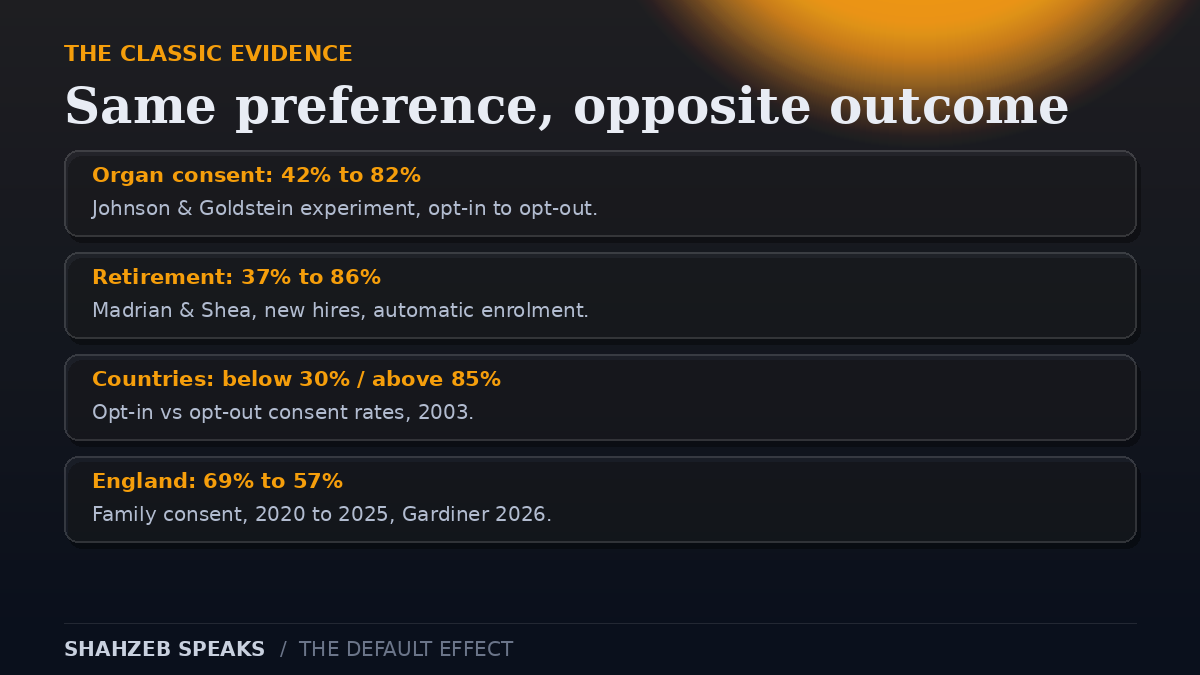
| Study | Opt-in result | Opt-out result |
|---|---|---|
| Johnson & Goldstein 2003, organ consent (countries) | Below 30% | Above 85% |
| Johnson & Goldstein 2003, online experiment | 42% | 82% |
| Madrian & Shea 2001, retirement participation | 37% | 86% |
| England, family consent after deemed consent | 69% (2020) | 57% (2025) |
The second study is retirement saving. In 2001, Brigitte Madrian and Dennis Shea studied a large American employer that switched its 401(k) pension plan from opt-in to automatic enrolment. Among new hires, participation rose from 37% under opt-in to 86% under automatic enrolment, a 49-point difference, and the gap held at three to 15 months of tenure. Automatic enrolment also narrowed gaps: groups least likely to enrol under opt-in, including younger and lower-paid workers, enrolled at much higher rates when the default changed. That is the best case for defaults. It is also, as the next chapters show, an incomplete case, because Madrian and Shea found that most automatically enrolled workers stayed at the employer’s default contribution rate and fund. A default that gets people in can also keep them at a rate too low to retire on, if nobody prompts them to raise it.
🧠 Chapter 3: Why we stick — three mechanisms, not laziness
Calling the default effect laziness misses how it works, and therefore misses how to design against it. Three mechanisms do most of the work. The first is effort and inertia. Changing a default costs attention, time, and a small amount of worry about getting it wrong. When the stakes feel unclear, that cost is enough. The second is endorsement. A pre-selected option reads as the recommended option, especially when it comes from an employer, a government, or a familiar brand. People reasonably infer that someone who knows more chose this starting point for a reason. The third is loss aversion, described by Daniel Kahneman and Amos Tversky in 1979: losses weigh more heavily than equal gains. Opting out of a pension feels like losing a benefit; opting out of a donation feels like withdrawing a gift. My guide on loss aversion in marketing works through that asymmetry in commercial settings.
A fourth mechanism matters in practice: the default hides the decision. Many people never notice a setting at all, because it arrives buried in onboarding, in a long terms page, or in a screen they passed at speed. That is not a choice made badly. It is a choice never made, which is why transparency matters more than clever wording. A default that is visible, explained in plain words, and reversible is a nudge. A default that is hidden, confusing, or hard to reverse is a trap, whatever the designer calls it.
⚠️ Chapter 4: The correction — England shows defaults are not magic
England is the cautionary tale every designer should read before copying the organ donation example. Wales moved to deemed consent, a soft opt-out system, on 1 December 2015. England followed on 20 May 2020, Scotland in 2021, and Northern Ireland in 2023. Under deemed consent, adults are considered potential donors unless they have recorded a decision not to donate or belong to an excluded group, and families are still consulted. A 2026 paper by David Gardiner in Transplant International, five years after England and the Netherlands changed their systems, reports an uncomfortable result: in England, the family consent rate fell from 69% to 57% between 2020 and 2025, and donor numbers remained below pre-pandemic levels.
Registration did rise: in January 2026, 44% of England’s 57.7 million residents were registered, with 40% recording an opt-in decision and 4% an opt-out, compared with 35% opt-in and 2% opt-out in January 2020. So the law changed the register, but not, on its own, the harder moment: a family, in grief, being asked whether donation should proceed. The lesson is precise. A default changes the paperwork. It does not change the conversation, the trust, or the hospital process that surrounds it, and when families do not understand or trust the system, consent can fall even as registration rises. Anyone who quotes the 2003 cross-country figures without the 2026 English follow-up is selling half a study. Defaults are powerful at the point of enrolment and weak at the point of action, unless the rest of the system supports them.
🏛️ Chapter 5: October 2026 — the opt-out argument moves into law
The default effect stopped being a textbook example in October 2026 and became a live legal argument in three places at once. Each case turns on the same question: should the starting point favour the company, the citizen, or the user, and how easy must it be to change?
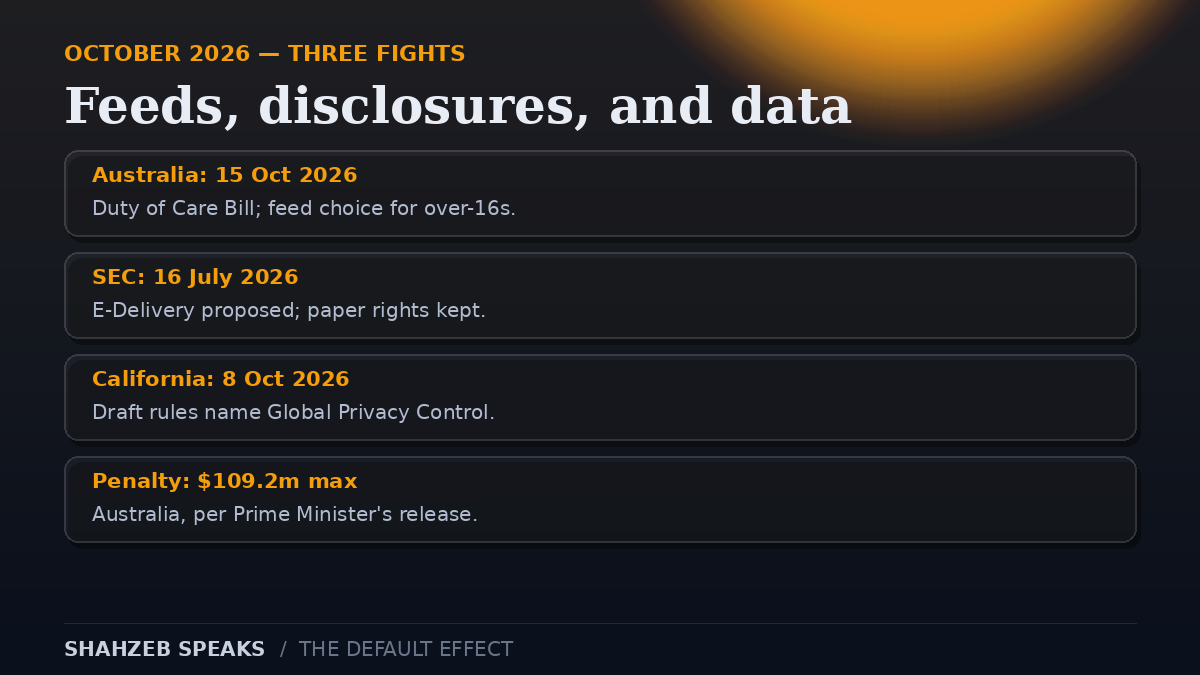
Australia: the feed. On 15 October 2026, the Online Safety Amendment (Digital Duty of Care) Bill 2026 was introduced to the House of Representatives. Under the government’s “My Feed, My Way” plan, announced 8 September 2026, platforms must offer users a choice of default feed. Australians over 16 will be able to opt in or opt out of algorithmic recommendations, in the words of Communications Minister Anika Wells, while for under-16s, specified features including algorithmic recommenders, endless feeds and engagement-feedback mechanics must be switched off. Breach of the duty carries a maximum penalty of $109.2 million, according to the Prime Minister’s release. Note the design carefully: for adults, the algorithm remains the starting position until the user acts. That is an opt-out, not a ban, and its success will depend on how visible and how easy the choice is, not only on whether the choice exists.
United States: the disclosure. On 16 July 2026, the Securities and Exchange Commission voted to propose Regulation E-Delivery, which would make electronic delivery the default method for required disclosures under federal securities laws, replacing a framework that required investors to opt in to electronic delivery and otherwise defaulted to paper. Under the proposal, a covered entity could rely on electronic delivery where the recipient has provided an electronic address, has received prominent advance disclosure, and has not opted out. Recipients would keep the right to paper copies free of charge, and investors currently receiving paper would receive two paper transition notices, at least 180 days and then about 30 days before transition. The comment period ran to 21 September 2026. This is a default in the public interest on its face — cheaper, faster, greener — but it is also a default that can quietly exclude the reader who never sees an email, which is why the paper safeguards matter as much as the efficiency.
California: the data sale. Draft California Privacy Protection Agency rules dated 8 October 2026, called the OOPS amendments, would name Global Privacy Control, a browser signal, as an example of an opt-out preference signal businesses must honour for sale and sharing of personal information. The draft, discussed in trade summaries ahead of a board meeting on 5 and 6 November 2026, would also require a business to show on its website whether it processed the signal, for example with a message such as “Opt-Out Request Honoured”. The California case is the mirror image of Australia: here the user sets the default once, in the browser, and the business must respect it across the browser, device and associated profile. As of 2 November 2026, neither the Australian Bill nor the SEC proposal nor the California draft should be described as enacted law. They are proposals and drafts, and this guide describes them that way.
🛒 Chapter 6: Defaults in everyday design — where to look
Once you know the pattern, you see it everywhere, and most of it is ordinary. A subscription that renews unless you cancel is an opt-out. A free trial that converts to a paid plan unless you cancel is an opt-out with a deadline. A shopping site that pre-ticks a warranty, a charity donation, or a newsletter box is an opt-out. A phone that turns on personalised ads, location history, or data sharing unless you dig into settings is an opt-out. None of these is automatically unfair. A pre-ticked box for a genuinely useful, clearly priced, easily cancelled service is different from a pre-ticked box for a costly add-on buried three screens deep. The difference is not the mechanism. It is the cost of the mistake, the clarity of the disclosure, and the ease of reversal.
Workplace defaults deserve the same scrutiny. Automatic enrolment in a pension is a good default, as Madrian and Shea showed, but only if the default rate is adequate and workers are prompted to review it. A default meeting length, a default notification setting, or a default performance rating in a system can quietly shape a whole organisation’s behaviour, because busy people accept the starting point. My guides on nudge theory examples and choice overload cover the related point: fewer, clearer choices, with a sensible default, often help more than an endless menu that nobody finishes.
✅ Chapter 7: Designing a fair default — a checklist
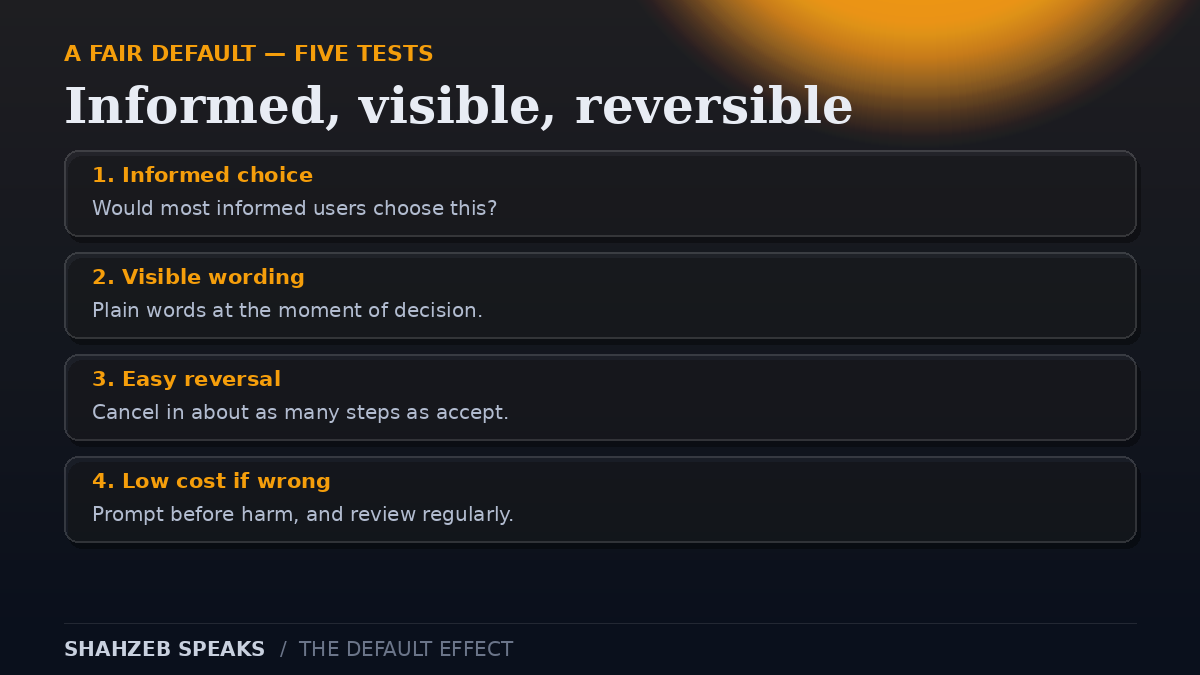
A fair default passes five tests. First, would most informed users choose this if they had time to think? If not, the default is exploiting inertia, not serving preference. Second, is the default visible at the moment of decision, in plain words, not in small print? Third, can the user reverse it in about the same number of steps as accepting it? A one-click accept and a five-screen cancel is not a choice. Fourth, is the cost of being wrong low, or is there a prompt before harm occurs, such as a reminder before a trial converts? Fifth, does the default get reviewed? Pension defaults need an annual prompt to raise contributions. Privacy defaults need a prompt when the product changes. A default set once and never revisited becomes stale, and stale defaults are how good intentions become traps.
For a personal audit, open the three settings that matter most: subscriptions, privacy and data sharing, and notifications. For each, ask: did I choose this, or did it arrive chosen? If it arrived chosen, decide now, while you are thinking clearly, rather than later, when a renewal email or a data breach forces the question. For managers and designers, the equivalent audit is simpler and harder: list every default your product or process sets, write down who benefits from each one, and publish the list internally. If any default benefits only the setter, and only because users do not notice it, change it. That single exercise would have prevented most of the opt-out controversies in this guide.
❓ Questions I am asked most often
What is the default effect in simple terms?
It is the tendency to stick with the option that applies when you do nothing. If you are enrolled unless you opt out, most people stay enrolled. If you must opt in to join, most people stay out. The preference may be the same; the starting point changes the outcome.
How big is the default effect?
Large in enrolment, variable in outcomes. Johnson and Goldstein found organ consent above 85% under opt-out versus below 30% under opt-in across countries, and 42% to 82% in their experiment. Madrian and Shea found retirement participation of 37% versus 86%. A 2019 meta-analysis reported a large average effect with wide variation, so defaults should not be quoted as a fixed size.
Are defaults manipulation?
Not always. A visible, reversible default that most informed people would choose, such as automatic pension enrolment with a fair rate, is a nudge. A hidden, hard-to-reverse default that benefits only the setter, such as a pre-ticked costly add-on, is manipulation in practice, whatever it is called in the design document.
What did England’s organ donation law actually achieve?
Registration rose: by January 2026, 44% of residents were registered, up from 37% in total in January 2020. But family consent fell from 69% to 57% between 2020 and 2025, and donor numbers stayed below pre-pandemic levels. The law changed paperwork more than it changed the family conversation, which is where donation is finally agreed.
What is Australia’s 2026 opt-out proposal?
The Digital Duty of Care Bill, introduced 15 October 2026, would require platforms to offer a choice of default feed. Over-16s could opt in or opt out of algorithmic recommendations; under-16s would have specified features switched off. It is a proposal, not enacted law as of 2 November 2026, and its effect will depend on how easy the choice is to find.
How do I check my own defaults?
Open subscriptions, privacy and notification settings in the three apps you use most. For each pre-selected option, ask whether you chose it, what it costs if you are wrong, and how many steps reversal takes. Decide now, while you are thinking clearly, and set a calendar reminder to review subscription defaults before each renewal.
📬 Which default caught you out?
If a pre-ticked box, a trial conversion, or a settings default cost you time or money, tell me which one. Contact me and describe the default, and whether reversing it took one step or five.
For the broader field behind this guide, see my homepage on industrial psychology in Pakistan, and for related reading, see the framing effect and social proof.
Sources
- Johnson, E. J., & Goldstein, D. (2003). Do defaults save lives? Science, 302(5649), 1338-1339.
- Madrian, B. C., & Shea, D. F. (2001). The power of suggestion: Inertia in 401(k) participation and savings behavior. Quarterly Journal of Economics, 116(4), 1149-1187.
- Thaler, R. H., & Sunstein, C. R. (2008). Nudge: Improving Decisions About Health, Wealth, and Happiness. Yale University Press.
- Kahneman, D., & Tversky, A. (1979). Prospect theory: An analysis of decision under risk. Econometrica.
- Gardiner, D. (2026). Five years after introduction of an opt-out consent system for organ donation; lessons learned from England and the Netherlands. Transplant International, 39, 16664.
- O’Neill, S., et al. (2024). Trends in organ donation in England, Scotland and Wales in the context of the COVID-19 pandemic and ‘opt-out’ legislation. PLOS ONE, 19(7), e0306541.
- Prime Minister of Australia (2026). My Feed, My Way. 8 September 2026. (Via secondary summary, October 2026.)
- Cooley (2026). From Opt In to Opt Out: SEC Proposes Electronic Delivery as Default. 21 July 2026.
- California Privacy Protection Agency (2026). Draft OOPS rules, 8 October 2026. (Via trade summary, October 2026; board meeting 5-6 November 2026.)