
Imagine you are offered two programmes to fight a disease expected to kill 600 people. Programme A will save 200 of them. Programme B offers a one-in-three chance of saving all 600, and a two-in-three chance of saving no one. Now imagine the same two programmes described differently: Programme C means 400 people will die. Programme D offers a one-in-three chance that nobody dies, and a two-in-three chance that 600 die. Most people choose A in the first wording and D in the second — even though A and C are identical, as are B and D. The framing effect is one of psychology’s most replicated findings: the same choice feels like a different decision depending on how it is worded — and the studies below show exactly how large the swing can be.
This guide walks through the landmark experiments behind the framing effect: the 1981 Asian disease problem that started it all, the ground-beef study that showed wording can change how food tastes, the medical research that changed how doctors talk about surgery, the credit-card lobby’s famous preference for “discount” over “surcharge” wording, the defaults that quietly shape organ donation and retirement saving — and the peer-reviewed evidence on where framing stops working. Every number below is traceable to its source, and where the evidence is thin, I say so plainly.
I am an Industrial and Organizational Psychologist in Karachi. I study how wording shapes decisions — in performance reviews, incentive schemes, and the marketing messages people respond to every day. Framing is the cognitive bias I encounter most often, and the one most misunderstood.
“The frame is never neutral. Every choice you are offered has already been edited — by whoever wrote the options — before you ever see it.”
— Consumer Psychology Analysis, ShahzebSpeaks
⚡ Chapter 1: The short answer
The framing effect is the tendency to make different choices depending on whether options are presented as gains or losses — even when the options are mathematically identical. In Tversky and Kahneman’s 1981 experiment, 72% of respondents chose the safe programme when it was framed as “200 people will be saved”, but only 22% chose the identical programme when it was framed as “400 people will die”. A 50-point swing, from wording alone.
Why does this matter to you? Because framing is not an academic curiosity. It is the reason “75% lean” sells better than “25% fat” for the same beef, why a “cash discount” feels friendlier than a “credit-card surcharge” for the same price gap, and why the same medical treatment looks better described as a probability of living than of dying. Marketers, doctors, and policymakers use frames deliberately — and the science on when they work (and when they fail) is richer and more honest than the pop-psychology version you have probably heard.
Framing belongs to a family of presentation effects. If this topic interests you, you will also recognise how anchoring reshapes what counts as a fair price and how the decoy effect steers choices between options. But framing is the oldest and best-tested of the three — so let us start at the experiment that proved it.
🧠 Chapter 2: The Asian disease problem — where it all began
On 30 January 1981, Amos Tversky and Daniel Kahneman published “The Framing of Decisions and the Psychology of Choice” in Science (vol. 211, no. 4481, pp. 453–458). Their respondents were “students at Stanford University and at the University of British Columbia who answered brief questionnaires in a classroom setting.” The experiment was simple — and devastating for the idea that humans are rational choosers.
Problem 1 (N = 152), gains frame: “If Program A is adopted, 200 people will be saved. [72 per cent]” / “If Program B is adopted, there is 1/3 probability that 600 people will be saved, and 2/3 probability that no people will be saved. [28 per cent]”
Problem 2 (N = 155), losses frame: “If Program C is adopted 400 people will die. [22 per cent]” / “If Program D is adopted there is 1/3 probability that nobody will die, and 2/3 probability that 600 people will die. [78 per cent]”
The reversal — same maths, opposite choices
| Frame | Certain option | Risky option |
| Gains (“lives saved”, N = 152) | Program A — “200 will be saved” → 72% | Program B — 1/3 chance all saved → 28% |
| Losses (“lives lost”, N = 155) | Program C — “400 will die” → 22% | Program D — 2/3 chance 600 die → 78% |
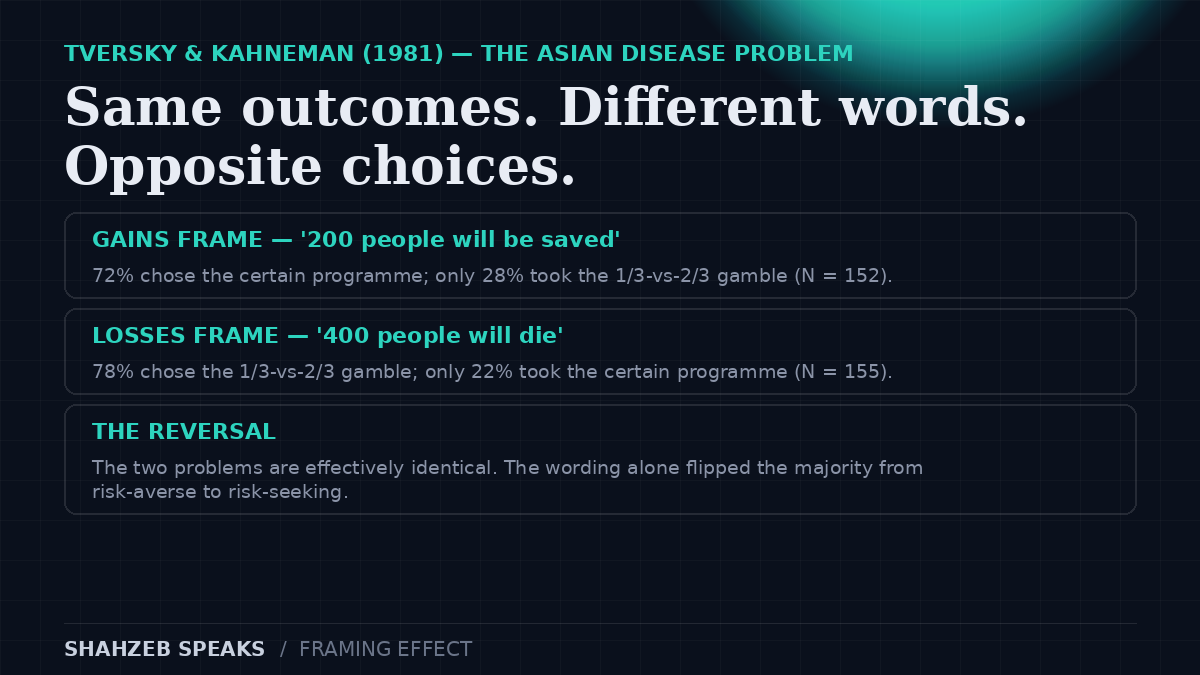
The authors were explicit about what they had found: the two problems were “effectively identical”, and the wording difference — “lives saved” versus “lives lost” — produced “a pronounced shift from risk aversion to risk taking”. When outcomes are framed as gains, people turn cautious. When the same outcomes are framed as losses, people start gambling. That is the core mechanism of the framing effect, and it earned Kahneman a share of the 2002 Nobel Prize in Economics.
One objection worth answering early: these were students answering a classroom questionnaire. Tversky and Kahneman reported that they had “observed this reversal in several groups of respondents, including university faculty and physicians” — it was not a quirk of undergraduates. Still, keep the classroom setting in mind: it is a hypothetical choice, not a real one. The studies in the chapters ahead move steadily closer to the real world.
🧩 Chapter 3: Not one effect — three kinds of framing
Before going further, a useful correction. In 1998, Irwin Levin, Sandra Schneider and Gary Gaeth argued that “framing” is not one single effect but a family of them. They proposed three distinct types, and the distinction matters because different types respond to different countermeasures.
1. Risky-choice framing
The Asian disease problem is the textbook case: a choice between a certain outcome and a gamble, where the frame (gains or losses) flips which one looks better. The flip from risk aversion to risk taking is the signature pattern.
2. Attribute framing
Here there is no gamble — just one attribute described positively or negatively. “75% lean” versus “25% fat” ground beef is the classic. Nothing is risky; the description itself makes the product feel better or worse. This is the type marketers use most, because most purchases are evaluations of attributes, not gambles.
3. Goal framing
This type covers persuasive messages: does the message stress the benefits of doing something, or the costs of not doing it? “Get screened — early detection saves lives” versus “Skip screening and you risk missing early detection.” Same goal, different lever.
The reason the typology matters: an intervention that fixes one type may not fix another. Asking “what would this look like in the opposite frame?” works well for risky-choice framing, but attribute framing often survives even when you know both versions — as the next experiment shows.
🥩 Chapter 4: The ground-beef test — when wording changes taste
In 1988, Levin and Gaeth ran one of the most elegant demonstrations of attribute framing in the literature. They took 96 introductory psychology students at the University of Iowa and asked them to evaluate ground beef — labelled either “75% lean” (positive frame) or “25% fat” (negative frame) — before and after actually tasting it. Paper: “How consumers are affected by the framing of attribute information before and after consuming the product”, Journal of Consumer Research, 15(3), 374–378.
The result on the fat/lean scale (1–7, higher = more favourable) is the number to remember. In the label-only condition — no tasting — the “75% lean” beef scored 5.15 against 2.83 for the “25% fat” beef: a 2.32-point gap (p < 0.01) for the identical product. The frame did not just change what people said — it changed what they perceived. The “75% lean” beef was also rated less greasy (4.49 vs 2.96), higher quality (5.33 vs 3.66) and better tasting (5.69 vs 4.43) — all from the label alone.
“75% lean” vs “25% fat” — fat/lean ratings (1–7 scale)
| Condition | “75% lean” | “25% fat” | Gap |
| Label only (no tasting) | 5.15 | 2.83 | 2.32 (p < 0.01) |
| Label, then taste | 4.67 | 3.57 | 1.10 (p < 0.01) |
| Taste, then label | 4.05 | 3.45 | 0.60 (p < 0.10) |
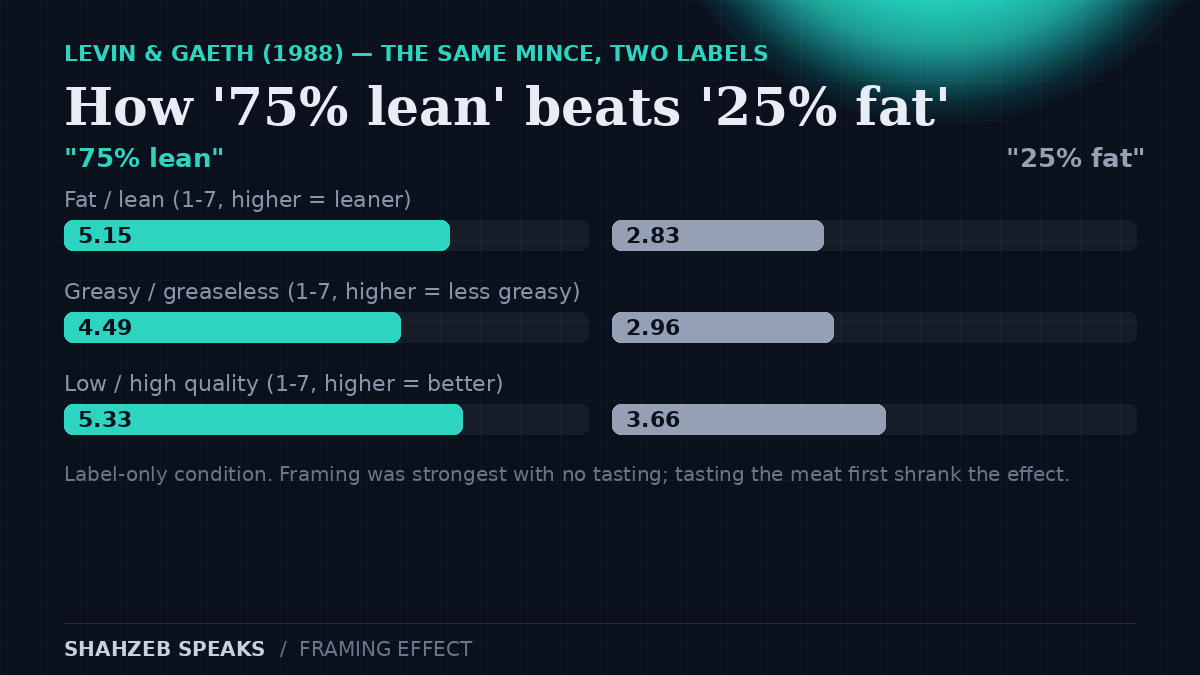
But the study’s deeper lesson is the one in the last row of that table. The framing effect “was largest when subjects did not taste the meat at all”, next largest when they tasted after labelling, and “smallest when subjects tasted the meat before being given the label.” Direct experience weakened the frame. That is both a caveat and a practical defence: frames bite hardest where you have no direct evidence of your own. Marketing works best on first impressions precisely because there is no tasting beforehand.
There is a workplace angle here too. Job candidates, performance ratings, project proposals — all are usually judged from labels first, experience later. The beef study suggests the order of information is not neutral: whatever comes first gets to set the frame. I have written about how this plays out in social proof at work — the same principle of presentation doing the judging before the evidence arrives.
🏥 Chapter 5: When doctors choose the words
The framing effect is not confined to hypothetical diseases and beef labels. In 1982, Barbara McNeil, Stephen Pauker, Harold Sox and Amos Tversky took it into medicine: “On the elicitation of preferences for alternative therapies”, New England Journal of Medicine, 306(21), 1259–1262.
The sample was serious: 238 ambulatory patients with different chronic medical conditions, 491 graduate students, and 424 physicians. Each was asked to imagine having lung cancer and to choose between surgery and radiation therapy, with the outcomes framed as the probability of living versus the probability of dying.
The result, from the abstract: “In all three populations, the attractiveness of surgery, relative to radiation therapy, was substantially greater … when the problem was framed in terms of the probability of living rather than in terms of the probability of dying.” Patients, students, and doctors — all three groups moved with the frame. The authors concluded that “awareness of these effects among physicians and patients could help reduce bias and improve the quality of medical decision making.”
An honesty note, because this blog does not inflate: you may have seen specific percentages quoted for this study (some say 84% versus 50%). Those figures come from blog retellings, not from the paper — the published abstract reports only the direction of the effect, not its size, and the full text sits behind a paywall. I report only what the paper itself verifies. The direction alone is striking enough: three populations, the same treatments, different choices from different words.
The medical stakes also explain why framing resists simple debunking. “90% survival” and “10% mortality” are the same number, but one comforts and the other alarms — and in a consent conversation, comfort is doing real work. The ethical question is not whether doctors should frame (they cannot avoid it) but which frame a patient is entitled to hear first. The honest practice: both.
💳 Chapter 6: Cash discounts, surcharges — and the law
Framing is not only something researchers observe. Sometimes it is something lobbyists deliberately engineer. Richard Thaler’s 1980 paper “Toward a positive theory of consumer choice” (Journal of Economic Behavior & Organization, 1, 39–60) gives the classic case: “Credit cards provide a particularly clear example. Until recently, credit card companies banned their affiliated stores from charging higher prices to credit card users. A bill to outlaw such agreements was presented to Congress. When it appeared likely that some kind of bill would pass, the credit card lobby turned its attention to form rather than substance. Specifically, it preferred that any difference between cash and credit card customers take the form of a cash discount rather than a credit card surcharge.”
Read that carefully. The lobby accepted that the price difference would exist — and fought over the wording. A “cash discount” frames card users as missing out on a bonus; a “credit-card surcharge” frames them as being punished. The arithmetic is identical; the psychology is not. Thaler used the episode as evidence that “form rather than substance” is exactly where economic battles are fought.
Regulators eventually agreed the form mattered. Under the EU’s revised Payment Services Directive (PSD2), applicable from 13 January 2018, merchants are prohibited from adding surcharges on consumer debit and credit card payments where both banks are in the European Economic Area. The European Commission estimated the ban “could save more than €550m per year for EU consumers.” The pre-ban surcharges show why it mattered: MoneySavingExpert reported in January 2018 that British Airways charged a 1% fee of up to £20 on credit cards, Ryanair charged 2%, the DVLA charged a £2.50 fee, and Flybe charged 3% on credit card and PayPal transactions. Every one of those fees felt different depending on whether it was presented as a “discount for cash” or a “charge for cards” — which is precisely the point the lobby had understood decades earlier.
This is loss framing in the wild, and it is closely tied to how loss aversion shapes marketing: a surcharge reads as a loss taken from you, a missed discount reads as a gain you simply did not collect. The pain differs; the price does not.
🗳️ Chapter 7: Defaults — the quietest frame of all
The most consequential frames are the ones you never notice: defaults. A default option frames every alternative as a deviation, and the evidence that deviations are rare is dramatic.
In 2003, Eric Johnson and Daniel Goldstein published “Do defaults save lives?” in Science (302(5649), 1338–1339). Their online experiment asked 161 people whether they would be organ donors under one of three setups. Under an opt-in default, 42% agreed. Under an opt-out default, 82% agreed. Under a neutral forced choice with no default, 79% agreed. The neutral condition is the revealing one: when people actually have to choose, most say yes — but the opt-in default buries that preference under inertia.
The cross-country pattern they documented points the same way. In opt-in countries (Denmark, the Netherlands, the UK, Germany), effective consent rates ranged from 4.25% to 27.5%; in opt-out countries (Austria, Belgium, France, Hungary, Poland, Portugal, Sweden), from 85.9% to 99.98%. And the context is grim: a US poll they cited found 85% of Americans approve of organ donation, yet fewer than half had made a decision and only 28% had signed a donor card; since 1995, more than 45,000 people in the United States had died waiting for a suitable donor organ.
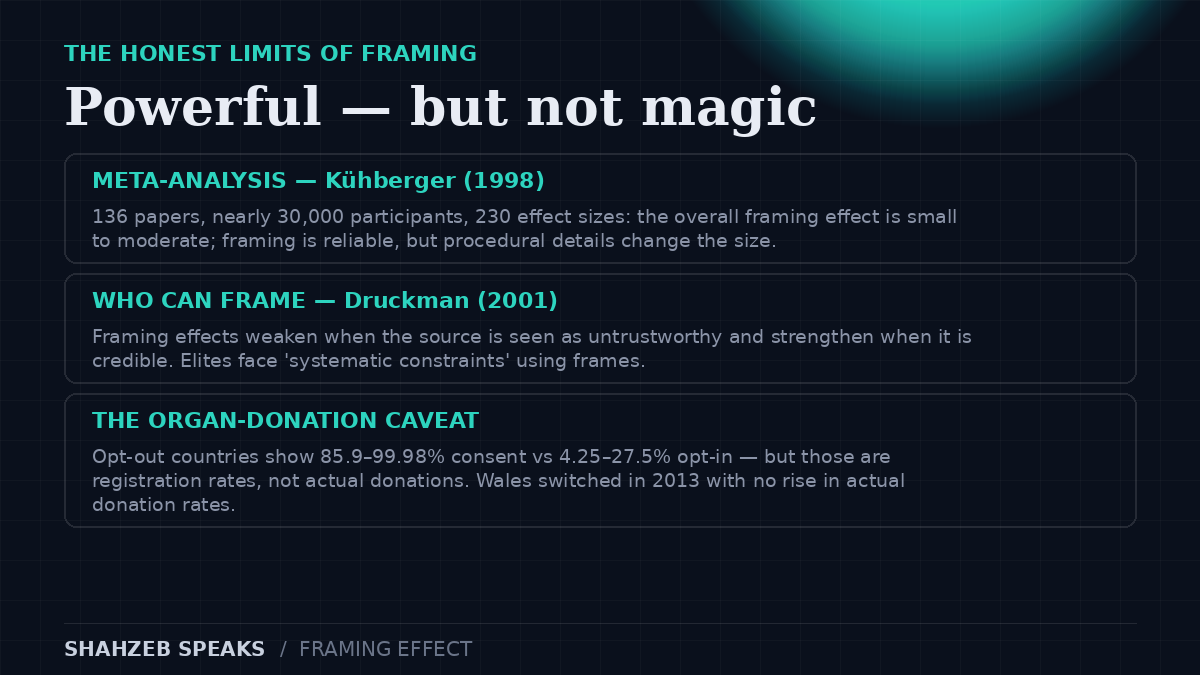
Now the honesty caveat — and it is a big one. The famous graph shows organ-donor consent/registration rates, not actual organ-donor rates. Economist Tyler Cowen has pointed out that the gap in real donations is much smaller: Wales switched to presumed consent in 2013 and saw no increase in actual donation rates, and best estimates suggest switching regimes might raise actual donation by roughly 25% — real, but nothing like the consent-rate graph implies. A default changes what people sign; changing what hospitals actually retrieve is a separate, harder problem. Keep this distinction whenever someone shows you that chart.
Retirement saving tells the same story with cleaner data. In 2001, Brigitte Madrian and Dennis Shea showed what happened when one company flipped its 401(k) from opt-in to automatic enrolment: “Although none of the economic features of the plan changed, this switch to automatic enrollment dramatically changed the savings behavior of employees.” The company’s default contribution rate and investment allocation exerted “a strong influence” on savings, as a “substantial fraction” of workers simply stuck with both defaults — driven by “participant inertia” and by employees “taking the default as investment advice on the part of the company.” Economists Choi, Laibson and Madrian, studying three companies that adopted automatic enrolment in 1997–1998, found that participation “increased to between 86% and 96% after automatic enrollment took effect.” No feature changed except the frame — and the frame did almost all the work.
Defaults are framing with the wording removed: the choice architecture itself does the persuading. For more on designing that architecture deliberately, see nudge theory in action — defaults are its single most powerful tool.
⚖️ Chapter 8: The honest limits — when framing fails
Everything above is real. But the pop-psychology version of the framing effect — the idea that wording magically overrides reason every time — is not. The peer-reviewed record is more interesting, and more useful, than the myth.
In 1998, Anton Kühberger ran the definitive check: a meta-analysis of 136 empirical papers reporting framing experiments with nearly 30,000 participants and 230 effect sizes. His finding, published in Organizational Behavior and Human Decision Processes: “the overall framing effect between conditions is of small to moderate size and … profound differences exist between research designs.” His conclusion: “framing is a reliable phenomenon, but … procedural features of experimental settings have a considerable effect on effect sizes.” The strongest effects came from scenarios closest to the Asian disease problem; some types of scenarios, in his data, produced no framing effects at all.
Then there is the messenger. In 2001, James Druckman ran two laboratory experiments on “who can frame” and found that framing effects were attenuated when the message source was viewed as untrustworthy and enhanced when viewed as credible — concluding that “contrary to many portrayals, elites face systematic constraints to using frames to influence and manipulate public opinion.” In other words: the frame’s power is rented from the framer’s credibility. A distrusted source cannot simply word its way past you.
And even survey scales frame. A peer-reviewed paper reporting Schwarz, Knäuper, Hippler, Noelle-Neumann and Clark (1991) found that when people were asked how successful they had been in life, 34% reported high success when the scale ran from −5 to 5, versus only 13% when it ran from 0 to 10. The numbers on the ruler changed the answers — worth remembering every time you design a questionnaire, and worth treating cautiously, since this figure reaches me only via a citing paper.
The evidence at a glance — and the honest grade for each
| Study | What it showed | Honest grade |
| Tversky & Kahneman 1981 | 50-point preference reversal from wording alone | Strong — seen in several groups, incl. faculty and physicians |
| Levin & Gaeth 1988 | Label moved ratings 2.32 points; tasting weakened it | Strong for labels; direct experience attenuates it |
| McNeil et al. 1982 | Surgery more attractive in the “living” frame, in 3 populations | Moderate — the abstract reports direction, not size |
| Johnson & Goldstein 2003 | Defaults moved donor consent 42% → 82% | Strong for consent — NOT actual donation rates |
| Madrian & Shea 2001 | Auto-enrolment “dramatically changed” 401(k) behaviour | Strong |
| Thaler 1980 | Lobby fought for “discount” over “surcharge” wording | Verified case of deliberate strategic framing |
| Kühberger 1998 (meta-analysis) | Overall small-to-moderate effect across 230 effect sizes | The honest baseline for the whole field |
| Druckman 2001 | Untrustworthy sources weaken frames; credible ones strengthen them | Strong boundary condition |
So where does that leave you? Three practical rules survive the whole literature. First, reword the choice yourself before deciding: convert gains to losses and back, and watch whether your answer changes. Second, distrust the messenger before the message: a frame from an untrustworthy source is doing less work than you think. Third, get direct experience where you can: tasters judged the beef more honestly than label-readers, and there is no substitute for tasting the meat before you buy it — literally or otherwise.
❓ Questions I am asked most often
What is the framing effect?
The framing effect is the tendency to make different decisions depending on how options are worded, even when the options are identical. The classic proof is Tversky and Kahneman’s 1981 experiment: 72% chose a programme described as saving 200 lives, but only 22% chose the same programme described as letting 400 die. Marketers, doctors and policymakers all use wording deliberately — knowing the frame helps you see it.
What is the Asian disease problem?
In 1981, Tversky and Kahneman gave 152 students a choice between programmes for an outbreak expected to kill 600 people: 72% picked the certain option (“200 will be saved”). A second group of 155 got the identical options reframed around deaths: only 22% picked the certain option (“400 will die”). The authors called the problems “effectively identical” — the swing from risk aversion to risk taking came from wording alone.
What are examples of framing in marketing?
“75% lean” outsells “25% fat” for the same beef (Levin & Gaeth, 1988). A “cash discount” feels friendlier than a “credit-card surcharge” for the same price gap — the credit-card lobby deliberately chose the first wording (Thaler, 1980). Subscription pages preselect the annual plan. Defaults are frames too: opt-out systems win 82% donor consent versus 42% for opt-in (Johnson & Goldstein, 2003).
How do you avoid the framing effect?
Reword the choice yourself before deciding. Convert gains to losses and back: “200 saved” means “400 die” — read both versions and check whether your answer changes. In studies, direct experience weakened framing: tasters judged the beef more alike than label-readers did (Levin & Gaeth, 1988). Slow the decision down, weigh who is doing the framing, and ask what the numbers look like in the opposite frame.
Is the framing effect the same as anchoring?
No, though they are cousins. Anchoring is when an initial number drags your estimate toward it — a starting price reshapes what “cheap” means. Framing is when the same option feels different depending on its description: “200 saved” versus “400 die”. One works on the number you start from; the other works on the words around the choice. Both exploit how easily judgment follows presentation rather than substance.
Why do doctors’ words change treatment choices?
Because patients hear survival or death first and the maths second. In McNeil, Pauker, Sox and Tversky’s 1982 study of 238 patients, 491 students and 424 physicians, surgery looked “substantially” more attractive when outcomes were framed as the probability of living rather than dying. The authors concluded that awareness of these effects “could help reduce bias and improve the quality of medical decision making”. Ask for both frames before consenting.
Does framing always work?
No. A 1998 meta-analysis of 136 papers with nearly 30,000 participants found the overall effect “small to moderate” — “a reliable phenomenon”, but one that procedural details shrink or erase (Kühberger). Framing also depends on the messenger: effects weaken when the source seems untrustworthy and strengthen when it seems credible (Druckman, 2001). And direct experience, as with tasting the beef, attenuates it. Framing is real, not magic.
Is your team’s messaging framed for the right outcome?
I help organisations test how wording shapes customer and employee decisions — with evidence, not guesswork. Contact me here.
If this is your first time on the site: I write about the psychology of work and the marketplace as an industrial psychology in Pakistan practitioner. For the closest cousin of framing in pricing, see how loss aversion shapes marketing.
Sources
- Tversky, A., & Kahneman, D. (1981). The framing of decisions and the psychology of choice. Science, 211(4481), 453–458. https://doi.org/10.1126/science.7455683
- Levin, I. P., & Gaeth, G. J. (1988). How consumers are affected by the framing of attribute information before and after consuming the product. Journal of Consumer Research, 15(3), 374–378. https://doi.org/10.1086/209174
- McNeil, B. J., Pauker, S. G., Sox, H. C., & Tversky, A. (1982). On the elicitation of preferences for alternative therapies. New England Journal of Medicine, 306(21), 1259–1262. https://doi.org/10.1056/NEJM198205273062103
- Johnson, E. J., & Goldstein, D. (2003). Do defaults save lives? Science, 302(5649), 1338–1339.
- Madrian, B. C., & Shea, D. F. (2001). The power of suggestion: Inertia in 401(k) participation and savings behavior. Quarterly Journal of Economics, 116(4), 1149–1187. NBER WP 7682.
- Choi, J. J., Laibson, D., & Madrian, B. (2002). Defined contribution pensions: Plan rules, participant decisions, and the path of least resistance. In J. Poterba (Ed.), Tax Policy and the Economy, Vol. 16 (pp. 67–113). MIT Press.
- Thaler, R. H. (1980). Toward a positive theory of consumer choice. Journal of Economic Behavior & Organization, 1(1), 39–60.
- Kühberger, A. (1998). The influence of framing on risky decisions: A meta-analysis. Organizational Behavior and Human Decision Processes, 75(1), 23–55. https://doi.org/10.1006/obhd.1998.2781
- Druckman, J. N. (2001). On the limits of framing effects: Who can frame? Journal of Politics, 63(4), 1041–1066.
- Levin, I. P., Schneider, S. L., & Gaeth, G. J. (1998). All frames are not created equal: A typology and critical analysis of framing effects. Organizational Behavior and Human Decision Processes, 76(2), 149–188.
- Schwarz, N., Knäuper, B., Hippler, H.-J., Noelle-Neumann, E., & Clark, F. (1991). Rating scales: Numeric values may change the meaning of scale labels. Public Opinion Quarterly, 55(4), 570–582. (Figures as reported in a citing paper.)
- European Central Bank. (2018). The revised Payment Services Directive (PSD2). https://www.ecb.europa.eu/press/intro/mip-online/2018/html/1803_revisedpsd.fr.html
- European Commission statement on PSD2 surcharge ban (via European Interest, 2018).
- MoneySavingExpert. Card surcharge examples pre-PSD2 ban (Jan 2018).
- Cowen, T. (2018). Presumed consent in Wales falls short. Marginal Revolution.
- Association for Psychological Science. Observer report on Johnson & Goldstein (2003) organ-donation defaults.