
Picture the final round of a hiring process. Instead of one more interview, you spend two days at a central location: an in-basket overflowing with memos, a group of strangers arguing over a business case while assessors watch from the corners, a role-play with an “angry client”, a presentation you prepared overnight. This is an assessment centre — and employers keep paying for it because the evidence says it works. Assessment centres predict job performance at around .37, one of the strongest validities in selection science — but the scores inside them do not measure what most people think they measure.
This guide explains what an assessment centre actually is, walks through the five exercise types you will meet, lays out the meta-analytic evidence study by study — Gaugler and colleagues (1987), Schmidt and Hunter (1998), Arthur and colleagues (2003) — and then turns to the uncomfortable finding the field has wrestled with for forty years: the ratings track exercises, not the dimensions they claim to assess. Every number below is traceable to its source, and where the evidence is thin or second-hand, I say so plainly.
I am an Industrial and Organizational Psychologist in Karachi. I work with selection methods — interviews, psychometric tests, and yes, assessment centres — and I have watched organisations buy expensive centre programmes while misunderstanding what the scores mean. This is the honest version: what assessment centres are, what they predict, and where they mislead.
“An assessment centre is the most valid selection method most employers never properly understand: the overall score predicts performance — the dimension scores mostly predict which exercise you just did.”
— Workplace Psychology Analysis, ShahzebSpeaks
⚡ Chapter 1: The short answer
An assessment centre is a standardised evaluation of behaviour: several trained observers watch candidates perform job-related simulations — in-baskets, group discussions, role-plays, case analyses, presentations — and pool their judgments. The average centre runs about seven exercises over two days (Gaugler, Rosenthal, Thornton & Benson, 1987). Do they work? Yes — the overall rating predicts job performance at around .36–.37 (Gaugler et al., 1987; Schmidt & Hunter, 1998), corrected coefficients that place assessment centres among the most valid predictors in selection science. But two caveats matter enormously. First, adding an assessment centre on top of a cognitive ability test buys surprisingly little extra prediction — about a 4% gain (Schmidt & Hunter, 1998, Table 1). Second, the dimension scores (your “communication: 7/10”) mostly reflect which exercise you were doing, not the dimension named — a finding called the construct-validity problem, documented since Sackett and Dreher (1982). The practical rule: trust the overall rating; treat dimension-level feedback with suspicion.
If you hire, or you are about to be assessed, the chapters ahead give you the full evidence — the exercises, the numbers, the paradox, and the costs. For the closest relatives of this topic, see how companies use psychometric tests in selection and why structured interviews beat unstructured ones.
📋 Chapter 2: What an assessment centre actually is
The authoritative definition comes from the International Task Force on Assessment Center Guidelines (2000/2009): an assessment centre is “a standardized evaluation of behavior based on multiple inputs. Several trained observers and techniques are used. Judgments about behavior are made, in major part, from specifically developed assessment simulations. These judgments are pooled in a meeting among the assessors or by a statistical integration process.” Note what the definition insists on: multiple observers, multiple techniques, simulations built for the purpose, and pooled judgment. A single interview with two interviewers is not an assessment centre. A day of varied exercises with several assessors comparing notes is.
Schmidt and Hunter (1998) describe the typical programme this way: candidates spend “one to several days at a central location where they are observed participating in such exercises as leaderless group discussions and business games. Various ability and personality tests are usually administered, and in-depth structured interviews are also part of most assessment centers.” So the centre is rarely simulations alone — it usually bundles tests and interviews around the exercises, which matters when you read the validity numbers: the .37 figure reflects the whole package, not the simulations in isolation.
One more definitional point, because it causes confusion: an “assessment centre” is a method, not a place. The word “centre” survives from the era when candidates travelled to a central location for two days. Today the exercises may run in a hotel, an office, or online — what makes it an assessment centre is the multi-exercise, multi-assessor, simulation-based design.
🧰 Chapter 3: The five exercises you will meet
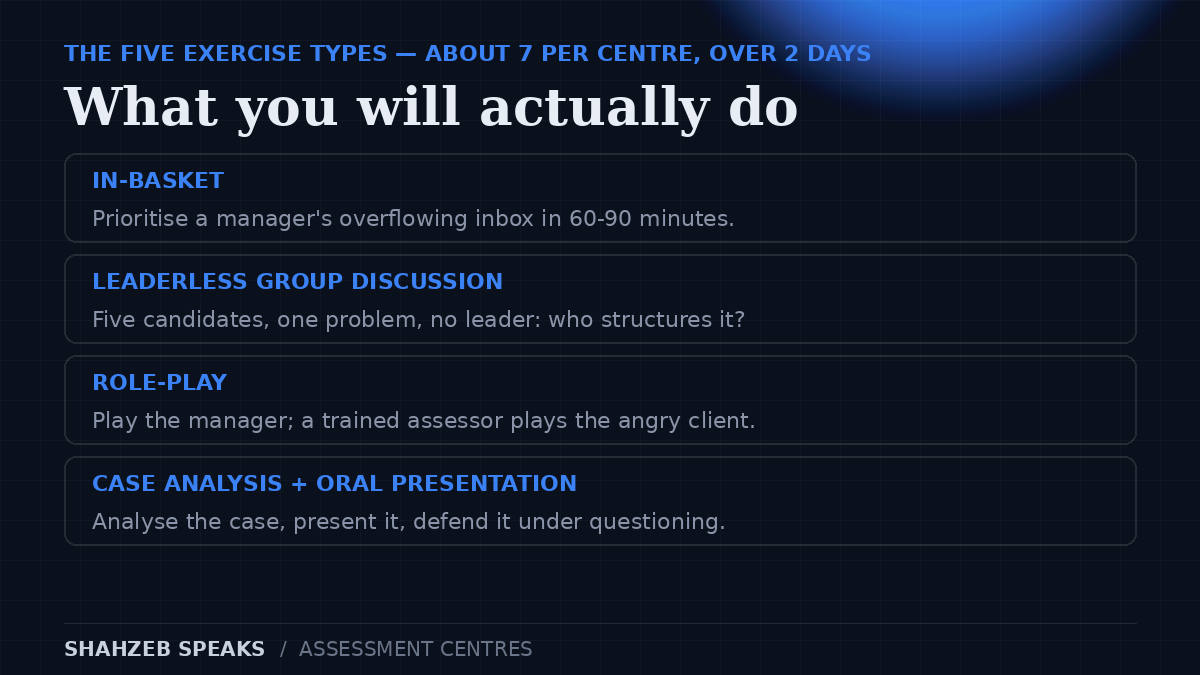
The literature converges on five generic exercise types (Lievens, Dilchert & Ones, 2009): in-baskets, case analyses, role-plays, oral presentations, and group discussions. Here is what each one asks of you — and what the assessors are watching for.
1. The in-basket (or in-tray)
You inherit a manager’s overflowing inbox: memos, emails, reports, complaints, meeting requests. In a fixed time — often 60 to 90 minutes — you must prioritise, delegate, decide, and schedule. Assessors score organising and planning, decision quality, and delegation. It is the exercise type most studied in the validity literature, and one of the two that explains the most variance in ratings (Bowler & Woehr, 2006).
2. The leaderless group discussion
Five or six candidates, one business problem, no appointed leader. The assessors watch who structures the discussion, who listens, who influences, and who derails. This is where “influencing others” and “consideration of others” are supposedly measured — and where the construct-validity problem bites hardest, because strong performance here tends to look like strong performance on everything.
3. The role-play
You play the manager; an assessor plays the difficult employee, the angry client, or the underperforming team member. The scenario tests interpersonal behaviour under pressure: feedback delivery, conflict handling, empathy. Because the “other person” is a trained role-player following a script, the exercise is more standardised than it looks.
4. The case analysis
A business case with financials, market data, and competing options. You analyse it — alone or in preparation for a presentation — and recommend a course of action. This is the exercise that most directly taps problem solving, the dimension with the strongest validity evidence (Arthur et al., 2003).
5. The oral presentation
You present your analysis or a prepared topic to the assessors, then defend it under questioning. Along with the in-basket, the oral presentation explains the most variance in assessment centre ratings (Bowler & Woehr, 2006) — which is worth remembering the next time someone tells you their “communication dimension” score measures a stable trait.
The typical assessment centre — at a glance
| Feature | What the research reports |
| Exercises per centre | About 7 exercises or assessments on average (Gaugler et al., 1987) |
| Duration | About 2 days at a central location (Gaugler et al., 1987) |
| Exercise types | In-baskets, case analyses, role-plays, oral presentations, group discussions |
| Assessors | Several trained observers; judgments pooled in a meeting or statistically |
| Extras | Ability and personality tests plus in-depth structured interviews are part of most centres (Schmidt & Hunter, 1998) |
| Used for | Jobs from first-line supervisors to senior management (Gaugler et al., 1987) |
📊 Chapter 4: The validity evidence — what assessment centres predict
This is the chapter the whole article exists for, so let me lay the numbers out exactly as the meta-analyses report them. All the coefficients below are corrected validities (adjusted for measurement error in the performance criterion and, where noted, range restriction) — which means they estimate the true relationship, not the raw correlation you would see in a single study.
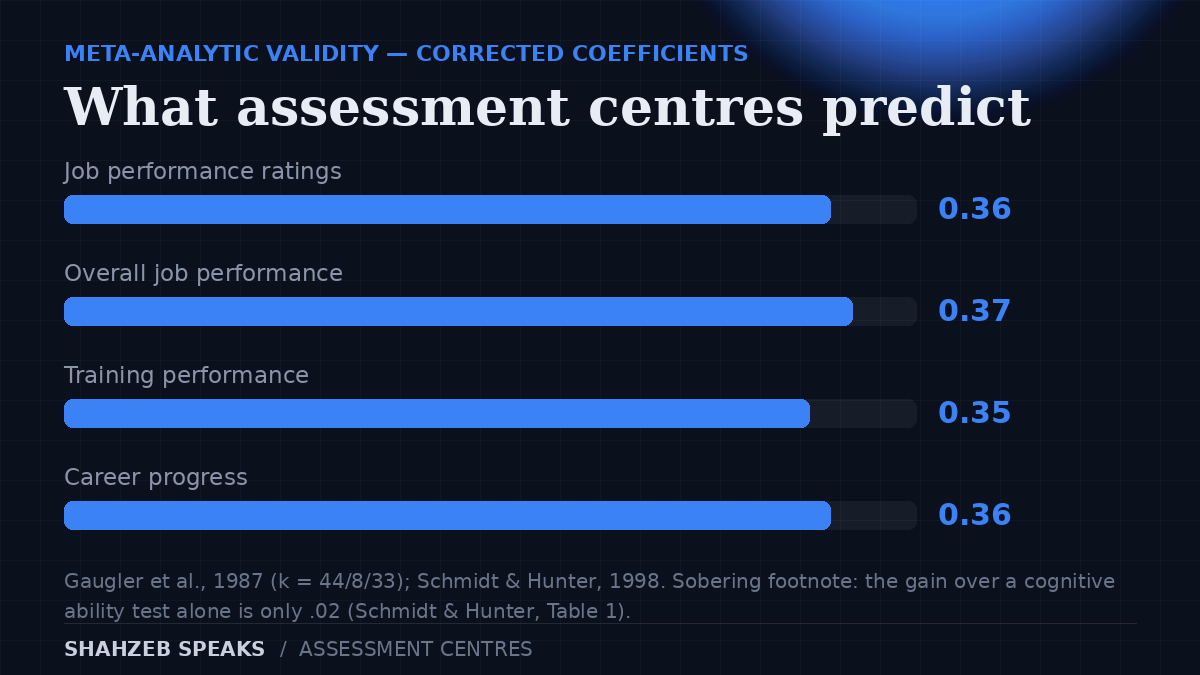
The foundational meta-analysis is Gaugler, Rosenthal, Thornton and Bentson (1987). Their mean corrected validities: .36 for performance ratings (44 studies, 4,180 people), .33 for dimension-level performance ratings (9 studies, 748 people), .35 for training performance (8 studies, 1,062 people), and .36 for career progress — promotions, salary increases, rank attained (33 studies, 4,907 people). One figure I am deliberately not printing: the same reproduction garbles the “potential ratings” cell, so I leave it out rather than guess.
Schmidt and Hunter (1998), in their landmark review of selection-method validities in Psychological Bulletin, report assessment centres’ mean validity for overall job performance as .37 — corrected, like the rest of their table, “for the downward bias due to measurement error in the measure of job performance and range restriction on the predictor.” Their source for the figure is Gaugler et al. (1987, Table 8). Later meta-analytic estimates of the overall rating’s criterion validity range from .27 to .47 (Arthur et al., 2003; Gaugler et al., 1987; Hermelin et al., 2007; Monahan et al., 2013), and Hermelin, Lievens and Robertson (2007) confirmed the overall rating is a good predictor of supervisor ratings specifically. Russell and Kuhnert (1992) add that the validity “does not vary across managerial positions” — it generalises.
Assessment centre validity — the headline numbers (all corrected coefficients)
| Criterion | Validity | Source |
| Job performance ratings | .36 (k = 44, N = 4,180) | Gaugler et al., 1987 |
| Overall job performance | .37 | Schmidt & Hunter, 1998 |
| Training performance | .35 (k = 8, N = 1,062) | Gaugler et al., 1987 |
| Career progress (promotions, pay, rank) | .36 (k = 33, N = 4,907) | Gaugler et al., 1987 |
| Later meta-analytic range | .27–.47 | Arthur et al., 2003; Hermelin et al., 2007; Monahan et al., 2013 |
Now the first caveat, and it is a big one for anyone building a selection system. Schmidt and Hunter also report incremental validity: what an assessment centre adds on top of a general mental ability test. The assessment centre alone: .37. Combined with GMA: multiple R of .53. The gain: .02 — a 4% increase (their Table 1; the body text rounds this slightly differently, so I cite the table). Why so small? Because the two overlap heavily: assessment centre ratings correlate about .50 with cognitive ability (Collins, 1998, via Schmidt & Hunter), and 74% of the centres Gaugler et al. examined included a written intelligence test. If you already test ability, the centre is largely re-measuring it through behaviour. That does not make centres useless — .37 is .37 — but it should discipline the business case: the marginal gain over a good ability test plus a structured interview is modest.
🎯 Chapter 5: Which dimensions actually predict performance
Assessment centres do not produce one score; they produce dimension scores — “communication”, “drive”, “organising and planning” — rated in each exercise. Arthur, Day, McNelly and Edens (2003) asked which of these dimensions actually predict job performance. From 34 articles reporting dimension-level validities, they collapsed 168 different dimension labels into six: consideration/awareness of others, communication, drive, influencing others, organising and planning, and problem solving, extracting 258 independent data points.
Their headline result: the six dimensions’ estimated true validities ranged from .25 to .39 (the authors’ term, as reported in the published abstract — I have not verified against the full paper whether these are corrected or observed coefficients, so I report the range exactly as the authors phrase it). More telling: a regression-based composite of four of the six dimensions explained 20% of the variance in job performance, versus 14% for Gaugler et al.’s overall assessment rating. Dimension-level scoring, done right, can outperform the single overall score.
And the winners, reported via Lievens, Dilchert and Ones (2009): “ratings on the AC constructs of organizing and planning, problem solving, and influencing others emerged as the most valid predictors of job performance.” Communication — the dimension everyone assumes matters most — is not in the top three. Neither are consideration of others or drive. If you are designing a centre, weight the dimensions the evidence favours; if you are being assessed, know that the case analysis and the in-basket carry more predictive weight than the small talk.
🪞 Chapter 6: The paradox — the scores measure the exercises, not the dimensions
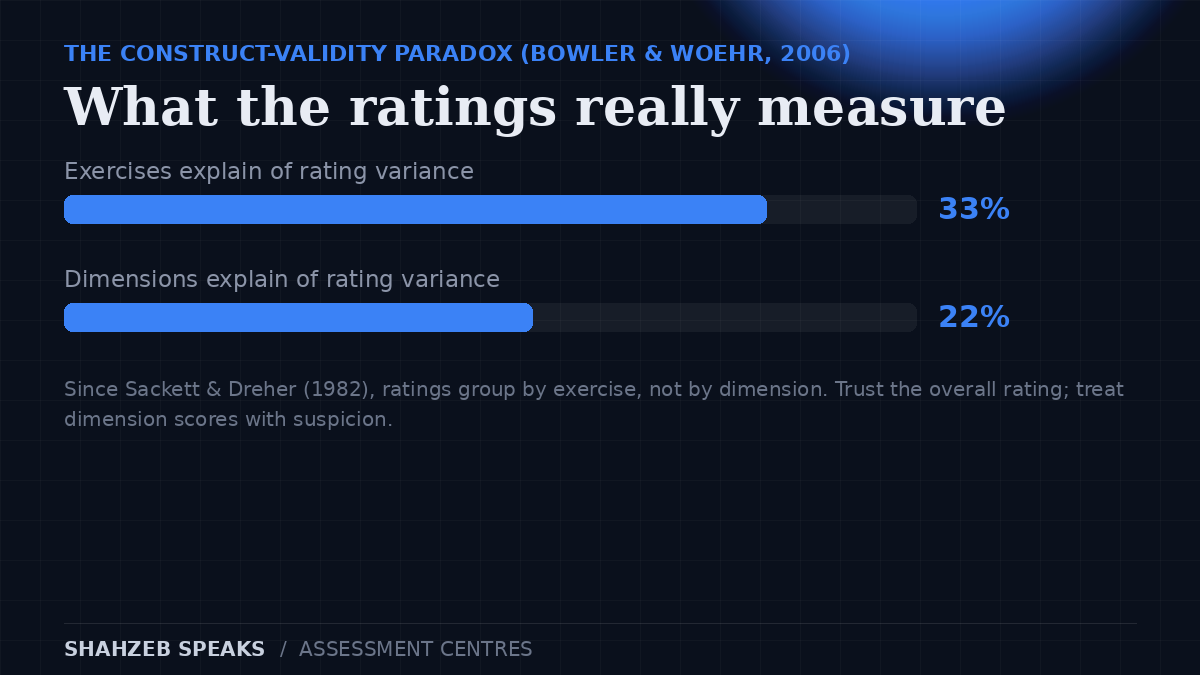
Here is the finding that has haunted assessment centres for over forty years. In 1982, Paul Sackett and George Dreher published “Constructs and assessment center dimensions: Some troubling empirical findings” in the Journal of Applied Psychology. Their factor-analytic result: ratings grouped by exercise, not by dimension. Your “communication” score in the group discussion correlated more strongly with your “drive” score in the same discussion than with your “communication” score in the role-play. The dimensions, statistically, were not there — the exercises were. A 1988 follow-up by Sackett and Harris confirmed that exercise factors predominated in new data and in other authors’ studies.
Bowler and Woehr (2006) quantified the split in a meta-analysis of the internal structure of assessment centre ratings: exercises explained 33% of the variance in ratings — especially in-basket and oral presentation exercises — while dimensions explained 22%. Communication, influencing others, organising and planning and problem solving explained significantly more variance than consideration/awareness of others and drive. So dimensions are not nothing — 22% is substantial — but the exercise you are doing shapes your scores more than the trait being scored.
The paradox, as the literature states it: assessment centres “demonstrate both content and criterion-related validity” (Gaugler et al., 1987) while the dimension ratings lack clean construct validity. They predict performance without cleanly measuring what they claim to measure. For selection decisions, the paradox barely matters — the overall rating predicts, and that is what hiring needs. For development feedback, it matters enormously: telling a candidate their “drive: 4/10” when the score mostly reflects how they handled one in-basket is misleading. The honest practice: use overall ratings for selection; treat dimension scores as exercise-contaminated hypotheses, not diagnoses.
A field example sharpens the point. Chan (1996) validated an assessment centre for police officers in Singapore (N = 46): exercise variance predominated, and the centre “was not predictive of job performance. However, it predicted promotions received.” Read that twice. The centre predicted who got promoted without predicting who performed well — which is either evidence that promotions track something other than performance, or a warning about what the ratings capture. I report it as the authors did, without choosing between those readings.
⚖️ Chapter 7: The honest trade-offs — cost, fairness, and when to use one
Assessment centres have real advantages beyond the validity numbers. A peer-reviewed review cites “strong predictive validity, decreased adverse impact as compared to cognitive ability tests, and the ability to measure and combine ratings on a wide range of criteria — especially those that are interpersonal in nature” (citing Eurich et al., 2009; Thornton, Rupp & Hoffman, 2015). The fairness point deserves emphasis: cognitive ability tests show the largest subgroup differences of any common predictor, and assessment centres shrink that gap while keeping validity high. I am not printing specific subgroup-difference values — the peer-reviewed text I verified supports only the directional claim — but the direction is well established and it is one of the strongest arguments for centres.
The costs are equally real. Seven exercises, two days, several trained assessors per candidate: assessment centres are among the most expensive selection methods per hire. That cost explains the adoption pattern. In SHRM’s Talent Access benchmarking, only 4% of organisations reported using assessment centres for management candidates, 3% for middle management, and 3% for non-management individual contributors (n ≈ 244–248 per column; figures via search excerpt of the official SHRM report). Earlier surveys found higher use for senior roles: Robertson and Makin (1986) estimated just over a quarter of organisations with more than 500 employees used assessment centres, and a 1999 UK survey by the Roffey Park Management Institute reported 62% of respondents used them (43% used development centres) — both figures via SHL’s 2013 best-practice guidelines, a vendor document, so treat them as indicative rather than precise.
So when is a centre worth it? When the role is senior enough that a bad hire costs more than the centre; when interpersonal behaviour is the job (management, client-facing roles, policing); and when you need the fairness advantage over ability testing. When is it not? High-volume hiring, where structured interviews plus work samples deliver most of the validity at a fraction of the cost — and remember the incremental-validity finding: if you already run a good ability test and a structured interview, the centre’s marginal gain is small. Spend the money where the .37 actually buys something new.
🕰️ Chapter 8: A short history — from wartime selection to the boardroom
The method was born in war. The Office of Strategic Services — America’s wartime intelligence agency — built multi-assessor staff assessment procedures “in response to immediate war-time selection needs” (OSS, 1948, via Russell & Kuhnert, 1992). German military psychologists had used multiple-assessor techniques for officer selection in the late 1930s (Thornton & Byham, 1982, via a doctoral dissertation citing them — I label this second-hand). The logic was the same then as now: watch people do the job, or something like it, and have several trained judges compare notes.
The civilian breakthrough came at AT&T. The company’s Management Progress Study — begun in the mid-to-late 1950s (sources differ: DDI’s own account says “late 1950s”, SHL’s 2013 guidelines say 1956, so I give the range rather than pick a year) — assessed people entering management positions in the Bell Telephone operating companies and tracked their careers for years (Bray, Campbell, & Grant, 1974). Douglas Bray had earlier “developed and implemented the first private sector assessment center for managerial selection at Michigan Bell” (Bray, 1964, via Russell & Kuhnert, 1992). From there the method spread through large employers worldwide — and the validity evidence in Chapters 4 and 5 is, in large part, the accumulated record of that spread.
❓ Questions I am asked most often
What is an assessment centre?
An assessment centre is a standardised, multi-exercise selection method: several trained assessors observe candidates performing job-related simulations — in-baskets, group discussions, role-plays, case analyses, presentations — and pool their judgments. The average centre runs about seven exercises over two days (Gaugler et al., 1987). It is a method, not a place: the exercises can run anywhere.
Do assessment centres actually work?
Yes — they are among the most valid selection methods available. Meta-analyses report corrected validities of .36 for job performance ratings (Gaugler et al., 1987) and .37 for overall job performance (Schmidt & Hunter, 1998). But the gain over a cognitive ability test alone is small (about .02), and the dimension-level scores have a well-documented construct-validity problem. Trust the overall rating most.
What exercises happen at an assessment centre?
The five standard types are the in-basket (prioritising a manager’s inbox), the leaderless group discussion, the role-play (difficult conversation with a trained actor), the case analysis, and the oral presentation. Most centres also include ability and personality tests and a structured interview (Schmidt & Hunter, 1998). Prepare by practising timed prioritisation and structured group discussion, not by memorising answers.
Are assessment centres fair?
Fairer than the main alternative. Peer-reviewed reviews credit assessment centres with decreased adverse impact compared with cognitive ability tests, while retaining strong predictive validity (Thornton, Rupp & Hoffman, 2015, via a citing review). Multiple assessors and multiple exercises also dilute the bias of any single judge. They are not bias-free — no method is — but the direction of the evidence favours them on fairness.
How should I prepare for an assessment centre?
Practise the behaviours, not the content: timed in-basket prioritisation, structuring a group discussion, giving feedback in a role-play, and presenting analysis under questioning. The evidence says problem solving, organising and planning, and influencing others are the most valid dimensions (Arthur et al., 2003) — so show structured thinking and clear prioritisation. And remember the exercises explain more of your scores than the dimensions do, so perform consistently across all of them.
Why do companies still use interviews if assessment centres are better?
Cost and scale. A centre needs several trained assessors for one to two days per candidate group; a structured interview needs one trained interviewer for an hour. For high-volume or junior hiring, structured interviews plus work samples capture most of the validity at a fraction of the price. Centres earn their keep for senior, managerial, and high-stakes public-sector roles.
What is the construct-validity problem in assessment centres?
Since Sackett and Dreher (1982), factor analyses have shown that assessment centre ratings group by exercise rather than by dimension: your “communication” score in the group discussion resembles your “drive” score in the same exercise more than your “communication” score in the role-play. Bowler and Woehr (2006) quantified it: exercises explain 33% of rating variance, dimensions 22%. The overall rating still predicts performance — but dimension-level feedback should be treated cautiously.
Designing selection for a senior or high-stakes role?
I help organisations build evidence-based selection — assessment centres, structured interviews, and testing that survives scrutiny. Contact me here.
If this is your first time on the site: I write about the psychology of work and the marketplace as an industrial psychology in Pakistan practitioner. For the test-based side of selection, see what actually predicts job performance in personality testing.
Sources
- Gaugler, B. B., Rosenthal, D. B., Thornton, G. C., & Bentson, C. (1987). Meta-analysis of assessment center validity. Journal of Applied Psychology, 72(3), 493–511. (Figures via Russell & Kuhnert, 1992, Table 1.)
- Schmidt, F. L., & Hunter, J. E. (1998). The validity and utility of selection methods in personnel psychology: Practical and theoretical implications of 85 years of research findings. Psychological Bulletin, 124(2), 262–274.
- Arthur, W., Jr., Day, E. A., McNelly, T. L., & Edens, P. S. (2003). A meta-analysis of the criterion-related validity of assessment center dimension constructs. Personnel Psychology, 56(1), 125–154. (Dimension validities .25–.39 via published abstract.)
- Sackett, P. R., & Dreher, G. F. (1982). Constructs and assessment center dimensions: Some troubling empirical findings. Journal of Applied Psychology, 67(4), 401–410.
- Sackett, P. R., & Harris, M. M. (1988). Honesty testing: Employee honesty, reliability, and trust. Journal of Business and Psychology, 2, 241–253. (Confirming the 1982 exercise-factor finding.)
- Bowler, M. C., & Woehr, D. J. (2006). A meta-analytic evaluation of the impact of dimension and exercise factors on assessment center ratings. Journal of Applied Psychology, 91(5), 1114–1124. (Via Lievens, Dilchert & Ones, 2009.)
- Lievens, F., Dilchert, S., & Ones, D. S. (2009). The relative importance of language factors in the prediction of first job performance. Human Performance, 22(4), 373–385. (Cited for dimension lists and validity summaries.)
- Hermelin, E., Lievens, F., & Robertson, I. T. (2007). The validity of assessment centres for the prediction of supervisory performance ratings: A meta-analysis. International Journal of Selection and Assessment, 15(4), 405–411. (Via Lievens, Dilchert & Ones, 2009.)
- Russell, C. J., & Kuhnert, K. W. (1992). New frontiers in management selection systems: Where measurement technologies and theory collide. The Leadership Quarterly, 3(2), 109–135.
- Chan, D. (1996). Criterion and construct validation of an assessment centre. Journal of Social Behavior and Personality, 11(5), 63–77. (Via Lievens, Dilchert & Ones, 2009.)
- International Task Force on Assessment Center Guidelines (2009). Guidelines and ethical considerations for assessment center operations. (Definition via secondary quotations.)
- SHRM. Talent Access benchmarking report (Region West): selection techniques used to assess candidates. (Figures via search excerpt.)
- SHL (2013). Guidelines for best practice in the use of assessment and development centres. (Historical adoption figures.)