
Imagine your employer offers you a deal: keep your full salary, work one day less every week, and change nothing about your output. No catch, no compressed 10-hour days — just Friday gone, pay untouched. It sounds like a fantasy cooked up in a staff-room daydream. But between 2015 and 2026, thousands of real companies across a dozen countries actually ran this experiment — and the world’s largest trial, 61 British companies and roughly 2,900 workers, ended with 92% of them refusing to go back. The four-day work week is the most-tested idea in modern management — and the evidence, honestly read, says it works for wellbeing, mostly holds for output, and comes with caveats the cheerleaders prefer not to mention.
This guide covers what the “100-80-100” model actually means, what the UK’s landmark 2022 trial found (with the numbers corrected where the headlines got sloppy), the 2025 Nature Human Behaviour study that finally added a control group, what happened in Iceland, Belgium, Germany, Portugal and Spain, the serious criticisms from economists and the CIPD, and who the four-day week genuinely suits. Every number below is traceable to its source, and where a finding is self-reported, small-sampled or company-claimed, I say so plainly.
I am an Industrial and Organizational Psychologist in Karachi. I study how work is designed — and the four-day week is, at heart, a work-design intervention, not a perk. I read the trial reports so you do not have to, including the footnotes.
“The four-day week is not a gift of time. It is a redesign of work: the trials that succeeded all changed how work was done first — fewer meetings, sharper focus, clearer priorities — and the extra day off was the reward for the redesign, not the cause of it.”
— Workplace Psychology Analysis, ShahzebSpeaks
⚡ Chapter 1: The short answer
Yes, the four-day week works — with conditions. In the UK’s 2022 trial (61 companies, ~2,900 workers), 71% of employees reported less burnout, 39% less stress, resignations fell 57% and sick days 65% — though the researchers themselves note the last two are too small-sampled to call statistically significant. A 2025 Nature Human Behaviour study of 2,896 workers across 141 organisations in six countries, with 12 control companies, found genuine wellbeing gains with a dose–response pattern. Revenue did not collapse: UK trial revenue rose 1.4% on average among the 23 firms that shared financial data, and 56 of 61 companies continued the policy. But every large trial was run by volunteers, most outcomes are self-reported, productivity itself was barely measured directly, and the organisers are open advocates of the policy. The short answer: shorter hours reliably improve wellbeing; they do not reliably harm output; and the “just close on Friday” version was never what was tested.
📐 Chapter 2: The 100-80-100 model — what it actually means
Almost every serious trial runs on the 100-80-100 model: 100% of pay, for 80% of the time, in exchange for 100% of productivity. The principle was introduced by Andrew Barnes at his New Zealand firm Perpetual Guardian in 2018, after he read an Economist piece on low productive hours; he and Charlotte Lockhart later founded the nonprofit 4 Day Week Global, which uses the model as the basis for its coordinated trials.
Three things it is not. It is not compressed hours — four 10-hour days is the same work in a different shape, and Belgium’s much-reported 2022 law is exactly that: workers may fit the same ~38-hour week into four longer days, with no cut in total time. It is not a nine-day fortnight. And it is not simply “Fridays off”: in the UK trial, only 32% of responding companies gave everyone Fridays off — the rest used staggered, decentralised or annualised models. The defining feature is a genuine ~20% reduction in hours with pay held constant, which is why the productivity question matters so much.
🇬🇧 Chapter 3: The UK trial — the biggest one ever run
From June to December 2022, 61 British companies employing roughly 2,900 people ran the world’s largest four-day-week pilot. It was organised by 4 Day Week Global with the UK 4 Day Week Campaign; the research was led by academics at the University of Cambridge and Boston College (Juliet Schor, Wen Fan), with University College Dublin and Oxford involvement and the think tank Autonomy. Companies spent two months in pre-trial preparation — workshops, coaching, peer support — redesigning how work got done before cutting hours. The report, The results are in: The UK’s four-day week pilot, was published on 21 February 2023.
The wellbeing results were striking, and they are worth quoting precisely because the headlines often were not. 71% of employees reported reduced burnout; 39% said they were less stressed; 54% reported fewer negative emotions; anxiety fell from 2.26 to 1.96 on a four-point scale. Job satisfaction rose from 7.12 to 7.69 out of 10; 43% said their mental health improved against 16% who said it declined; and 15% of employees said no amount of money would induce them back to a five-day schedule.
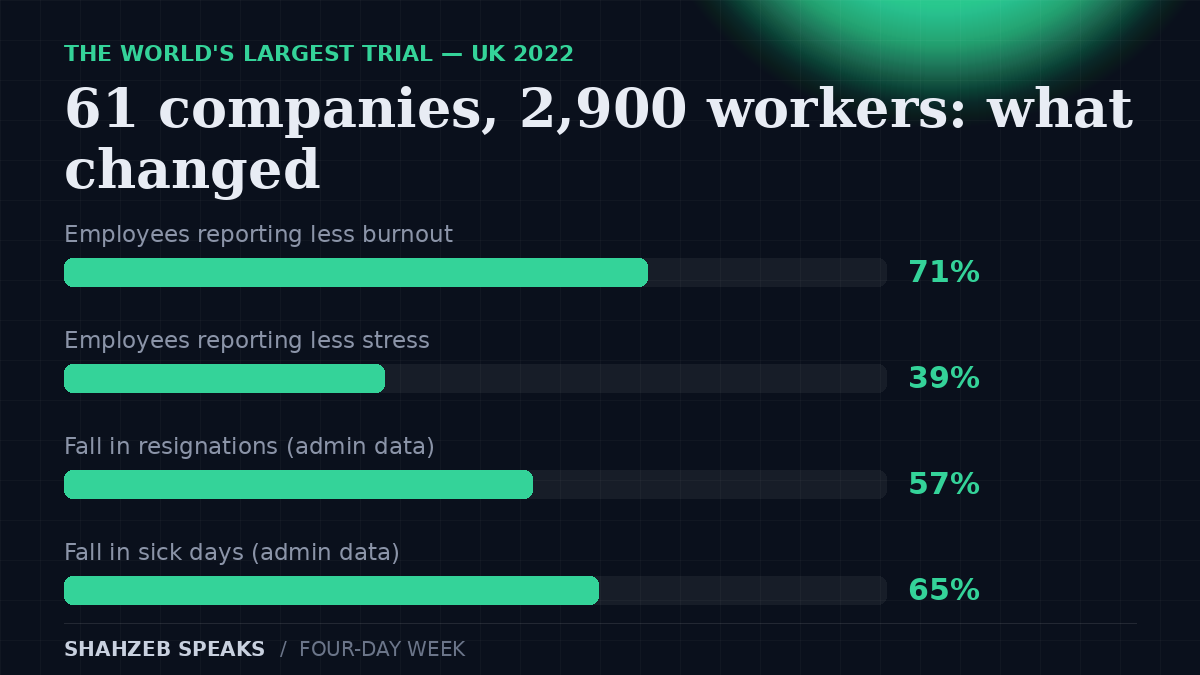
Now the corrections, because this blog does not cherry-pick. The famous “57% less likely to quit” is a misframing: resignations fell 57% (from 2.0 to 0.8 per 100 employees) compared with the same period the previous year — company admin data, and the researchers state the sample is too small to call it statistically significant. Same for the 65% fall in sick days (2.0 to 0.7 per employee per month). The “+35% revenue” figure the campaign markets is a year-on-year comparison of the trial period against the same six months of 2021 across 24 self-reporting, growing companies — with no control group. Do not read it as trial-caused profit growth. The cleaner revenue number: +1.4% on average from trial start to end, across the 23 companies (38% of the 61) that supplied usable financial data — which is to say, output did not fall off a cliff.
And the bottom line that matters most: 56 of the 61 companies (92%) said they would continue after the trial, 18 making it permanent immediately. At the one-year follow-up (Autonomy, February 2024), at least 54 of 61 were still on a four-day policy, with 31 (51%) permanent. Companies vote with their rosters.
🔬 Chapter 4: The science catches up — Nature, 2025
The fairest criticism of the UK trial was that it had no control group — so in 2025 the evidence base grew teeth. Fan, Schor, Kelly and Gu published “Work time reduction via a 4-day workweek finds improvements in workers’ well-being” in Nature Human Behaviour (vol. 9(10), pp. 2153–2168, October 2025): 2,896 employees across 141 organisations in six countries (Australia, Canada, Ireland, New Zealand, the UK and the USA), running six-month income-preserving trials after pre-trial work reorganisation — with 12 control companies (~285–290 employees) that did not change hours.
The headline: improvements in burnout, job satisfaction, mental health and physical health in the trial group — “a pattern not observed in 12 control companies.” Two details elevate this above the campaign reports. First, a dose–response pattern: larger individual-level hour cuts produced larger wellbeing gains (the average cut was ~5 hours a week; those cutting 8+ hours gained most) — dose–response is what you expect from a real effect, not a placebo. Second, the authors identified three mediators: improved self-reported work ability, reduced sleep problems, and decreased fatigue. Their conclusion: “income-preserving four-day workweeks are an effective organizational intervention for enhancing workers’ well-being.”
The authors also listed their own limitations, which I will not bury: companies volunteered, they skewed smaller and toward higher-income English-speaking countries, the control group was small, nothing was randomised, and outcomes were self-reported — employees might exaggerate benefits to keep the extra day. One check against the honeymoon critique: 12-month follow-up data showed wellbeing stayed high. The science is getting better. It is not yet randomised.
🌍 Chapter 5: The world map — Iceland to Valencia
The UK was the largest trial, not the first. Iceland (2015–2019) ran two large public-sector trials covering 2,500+ workers — over 1% of the country’s working population — mostly moving from 40 to 35–36 hours at the same pay. The Alda/Autonomy analysis (Haraldsson & Kellam, 2021) found productivity and service provision “remained the same or improved across the majority of trial workplaces,” with stress and burnout falling. The aftermath is the real story: by June 2021, about 86% of Iceland’s working population had moved to shorter hours or won the right to negotiate them through union contracts — though the actual cuts were modest (as little as 13 minutes a day in some public-sector deals). Headlines called it a “four-day week”; the report describes a shorter working week. Precision matters.
Belgium is the cautionary tale about legislation. The February 2022 labour deal gave full-time employees the right to request a four-day week with no pay loss — but it is compressed hours (the same ~38 hours over four longer days), employers may refuse with written reasons, and uptake is tiny: just 0.8% of private-sector employees were on the regime as of March 2025 (Acerta Consult, 224,000 employees surveyed). A separate Belgian pilot of genuinely shorter hours with full pay ended with a single organisation completing it out of ~25 interested. Laws do not change behaviour; work redesign does.
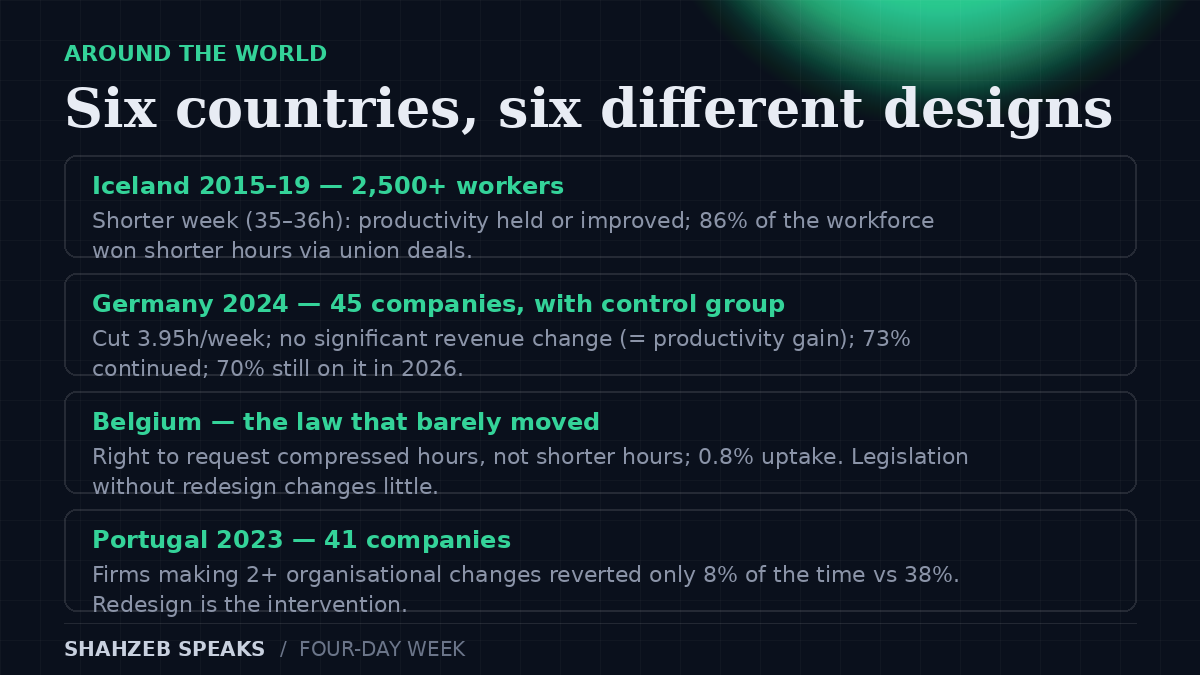
Germany (2024) ran the best-designed European pilot: 45 companies on the 100:80:100 principle for six months from February 2024, researched by the University of Münster with consultancy Intraprenör — with a control group. Companies cut 3.95 hours a week on average; there was no significant change in revenue or profit, which the researchers read as evidence of at least some productivity gain (same output, fewer hours). 73% of organisations continued; participants slept 38 minutes more per week than controls. A February 2026 follow-up found 70% still on some form of reduced hours. Portugal (2023), a government-backed pilot of 41 companies and 1,000+ workers (Gomes & Fontinha, 2024), cut average hours 13.7% — and produced the single most useful process finding in the whole literature: companies that made two or more organisational changes (usually cutting meeting number and length) reverted to five days only 8% of the time, versus 38% for those that made one change or none. Redesign is the intervention; the day off is the dividend.
Spain’s Valencia experiment (2023) was the oddest and most human: the city scheduled local holidays on four consecutive Mondays (10 April–7 May 2023), affecting ~360,000 workers. An independent expert commission found better self-perceived health, lower stress, healthier habits — and, charmingly, less nitrogen dioxide on the four Mondays. But smokers and drinkers increased tobacco and alcohol use, retailers reported lower sales (one outlet: −20%), and emergency services may have been overstretched. Children benefited most, via parents’ work–life balance. A shorter week is not a free lunch; it redistributes the bill.
🧯 Chapter 6: The honest criticisms
Every serious claim in this article survives contact with its critics — but the critics deserve their hearing, because several are right.
Self-selection. “Organisations in the [UK] trial represent a self-selecting sample,” says Jon Boys, senior labour-market economist at the CIPD — the trials “fall short of the robust evidence that many require, particularly policymakers.” Companies that volunteer for a four-day-week trial are the ones that think it might work. The Portuguese researchers said it themselves: their self-selected sample “informs the debate but does not justify implementation by legislation.”
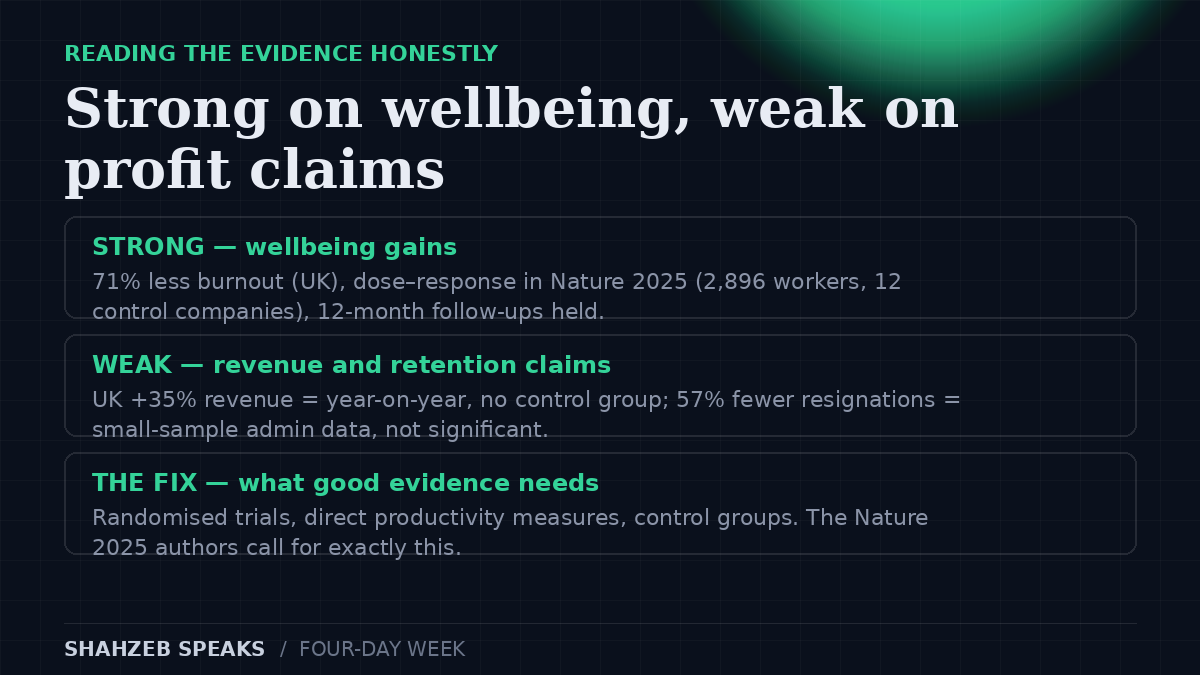
Self-reported outcomes. Scientific American, reporting the 2025 Nature study, put it plainly: “because companies signed up for the trial voluntarily, the results might overestimate the true effect… because all outcomes were self-reported, employees might have exaggerated the benefits in the hope of keeping their extra day off. The authors call for randomized studies.” The authors agree.
Productivity was barely measured. Economist Pedro Gomes (Birkbeck) notes the UK trial “left productivity out of its common metrics” — tracking revenue, absenteeism and resignations instead, with companies self-rating the productivity effect 7.5/10. Juliet Schor herself has identified “the shortage of direct productivity measurements as a limitation” of the evidence base. An independent evidence-base review (September 2026) graded the retention/absenteeism evidence as weak (small samples, non-significance) and the revenue evidence as weak for gains — summarising the fair conclusion as “no measurable harm in organisations that chose to try it.”
The organisers are advocates. 4 Day Week Global is an advocacy nonprofit; Autonomy is a pro-shorter-hours think tank. As IOSH Magazine’s Bridget Leathley wrote, “the involvement of two organisations with ‘four-day week’ in their title suggests they didn’t set out to disprove their hypothesis.” That does not invalidate the data — the academics are real and the methods are published — but it means the framing deserves a sceptical read.
The counterpoint. Gallup’s June 2022 US data found 34% of four-day workers feeling burned out often or always, versus 29% of five-day workers — though Gallup asked about days, not hours, sweeping in compressed 40-hour schedules. Gallup’s deeper conclusion is the one worth keeping: the quality of the work experience has 2.5–3× the effect on wellbeing that days or hours do. A miserable four-day week beats nothing; a well-designed five-day week beats a badly-designed four-day one.
🧰 Chapter 7: Who it works for — and the playbook
The pattern across every trial is consistent: the four-day week works where work can be redesigned — meetings cut, focus protected, priorities clarified — and struggles where presence is the product (retail floors, hospitals, emergency services). Knowledge work, agencies, tech, professional services: the volunteers cluster here for a reason.
The public-sector proof exists too. South Cambridgeshire District Council — staff doing 100% of contracted work in ~80% of contracted hours, no pay cut — was analysed by the universities of Salford, Bradford and Cambridge: 21 of 24 monitored services improved or stayed the same, job applications rose over 120%, turnover fell over 40%, and the council saved £399,263 a year by replacing agency staff with permanent hires. It voted the policy permanent in July 2025 — the first UK council to do so. It is also the most scrutinised case: in October 2025 the communities secretary wrote that he was “deeply disappointed,” citing declines in housing services; the council rejected the criticism, noting its housing service remained in the top quarter nationally for re-letting speed. Even the successes get audited. Good.
The four-day week at a glance — what the trials found
| Trial | Headline finding |
| UK 2022 (61 companies, ~2,900 workers) | 71% less burnout, 39% less stress; 56 of 61 continued (92%) |
| Nature 2025 (2,896 workers, 141 orgs, 6 countries) | Wellbeing gains vs 12 control companies; dose–response pattern |
| Iceland 2015–19 (2,500+ workers) | Productivity maintained or improved; 86% of workforce won shorter hours |
| Germany 2024 (45 companies, with control) | No significant revenue/profit change on fewer hours; 73% continued |
| Portugal 2023 (41 companies) | 2+ organisational changes → only 8% reverted (vs 38%) |
| South Cambridgeshire council (public sector) | 21 of 24 services held or improved; £399k/year saved; permanent Jul 2025 |
| Belgium (law, not trial) | Compressed hours, not shorter; only 0.8% uptake — laws ≠ behaviour |
The playbook, distilled from the trials that stuck: redesign before you reduce (the two-month UK prep, Portugal’s meeting culls); measure output, not hours (the trials’ weakest spot is your opportunity); let teams choose the model (only a third of UK firms did pure “Fridays off”); and pilot with a control group if you can — Germany showed it is possible. As of October 2026, the UK’s 4 Day Week Foundation lists 260+ accredited employers, and 4 Day Week Global says its programmes have covered 500+ companies (its own claim). The movement is past the pilot stage. The evidence is past the anecdote stage. What it is not past is the need for randomised trials — the authors themselves say so.
If burnout is the reason you are reading this, the mechanism is worth understanding on its own: I have covered the psychology of workplace burnout and the 2026 burnout statistics in depth. And if your organisation is wrestling with where work happens at all, read why return-to-office mandates backfire — the four-day week and the RTO fight are the same argument wearing different clothes.
❓ Questions I am asked most often
What is the 100-80-100 model?
100% of pay, for 80% of the time, in exchange for 100% of productivity. Introduced by Andrew Barnes at Perpetual Guardian (New Zealand) in 2018 and popularised by the nonprofit 4 Day Week Global, it underpins most serious trials. It is a genuine ~20% hours cut at full pay — not compressed hours (four 10-hour days) and not a nine-day fortnight.
Do four-day work weeks actually increase productivity?
The honest answer: productivity was barely measured directly. The UK trial tracked revenue (+1.4% on average among 23 reporting firms), resignations and sick days instead of output per hour; Germany’s controlled trial found no significant revenue or profit change on ~4 fewer hours a week, which researchers read as some productivity gain. The fair summary from an independent review: “no measurable harm in organisations that chose to try it.”
What did the UK four-day week trial find?
61 companies and ~2,900 workers, June–December 2022: 71% of employees reported less burnout, 39% less stress, 54% fewer negative emotions; resignations fell 57% and sick days 65% (company admin data, small samples — not statistically significant). 56 of 61 companies continued afterwards; a year later, 54 were still on it. Research led by Cambridge and Boston College academics; report published 21 February 2023.
Is there peer-reviewed evidence for the four-day week?
Yes — Fan, Schor, Kelly and Gu (2025) in Nature Human Behaviour: 2,896 employees across 141 organisations in six countries, with 12 control companies. Wellbeing (burnout, job satisfaction, mental and physical health) improved in the trial group but not controls, with a dose–response pattern — bigger hour cuts, bigger gains. The authors note the limits themselves: volunteer companies, no randomisation, self-reported outcomes.
Why did Belgium’s four-day week law fail?
It did not fail so much as mislead: Belgium’s 2022 law lets workers request fitting the same ~38-hour week into four longer days — compressed hours, not shorter hours — and employers can refuse with written reasons. Uptake is 0.8% of private-sector employees (March 2025). A separate pilot of genuinely shorter hours attracted ~25 interested organisations and exactly one finisher. Legislation without work redesign changes little.
Which companies kept the four-day week permanently?
At the UK trial’s one-year follow-up (February 2024), 54 of the original 61 companies were still on a four-day policy, 31 of them permanently. South Cambridgeshire District Council voted its four-day week permanent in July 2025 — the first UK council to do so. As of October 2026, the UK’s 4 Day Week Foundation lists 260+ accredited employers (its own tally).
Does the four-day week work for every job?
No. The trials cluster in knowledge work — tech, agencies, professional services — where output can be redesigned around fewer meetings and deeper focus. Roles where presence is the product (retail floors, wards, emergency services) rarely appear in the trials. Gallup’s wider finding is the useful one: the quality of the work experience affects wellbeing 2.5–3× more than days or hours do.
Thinking about a shorter week for your team?
I help organisations redesign work on evidence, not hype — pilots, measurement, and honest readouts. Contact me here.
If this is your first time on the site: I write about the psychology of work and the marketplace as an industrial psychology in Pakistan practitioner. For the burnout mechanism behind these trials, see the psychology of workplace burnout; for the wider flexibility debate, why RTO mandates backfire.
Sources
- 4 Day Week Global / Autonomy. The results are in: The UK’s four-day week pilot (report, 21 Feb 2023).
- Fan, W., Schor, J. B., Kelly, O., & Gu, G. (2025). Work time reduction via a 4-day workweek finds improvements in workers’ well-being. Nature Human Behaviour, 9(10), 2153–2168.
- Haraldsson, G. D., & Kellam, J. (2021). Going Public: Iceland’s Journey to a Shorter Working Week. Alda & Autonomy.
- Gomes, P., & Fontinha, R. (2024). Four-Day Week: Results from Portuguese Trial (final report, Jul 2024).
- University of Münster / Intraprenör. Germany 4-day-week pilot — first results (2024); two-year follow-up (Feb 2026).
- 4 Day Week Global. South Africa 2023 pilot results; Brazil 2024 pilot results; US/Ireland 2022 pilot results (Schor et al.).
- Universities of Salford, Bradford & Cambridge. South Cambridgeshire District Council four-day-week analysis (2023–2025).
- Reuters. Belgium permits four-day week to boost work flexibility (15 Feb 2022); UK four-day-week trial results (21 Feb 2023).
- Reuters. 4-day work week boosts Spanish workers’ health, pilot shows — Valencia (17 Oct 2023).
- BBC. Four-day week “an overwhelming success” in Iceland (2021).
- NPR. Dozens of UK companies will keep the 4-day workweek after pilot (21 Feb 2023).
- Scientific American. Biggest trial of four-day workweek finds workers happier (Jul 2025).
- People Management (CIPD). Four-day week: exploring conundrums — Jon Boys on self-selection.
- IOSH Magazine. Four-day week study delivers resoundingly positive results — Bridget Leathley (6 Jul 2023).
- Facilitate Magazine. Companies stick with four-day week one year on — Autonomy follow-up (26 Feb 2024).
- Workplace Journal / LocalGov. South Cambridgeshire votes four-day week permanent (Jul 2025).
- RNZ. Unilever sees revenue grow despite staff reducing time on the job (2 Nov 2022).
- 4 Day Week Foundation (UK). Accredited employer tally — 260+ (accessed 14 Oct 2026; campaign’s own figure).
- CEOtudent. Four-day week evidence base: what global pilots reveal (independent review, Sep 2026).
- FinChannel. Four-day workweeks are showing benefits — but the evidence has limits (Sep 2026).