
A psychological contract is an employee’s belief about the promises and obligations that exist between them and their employer, beyond the written contract. Denise Rousseau (1989, 1995) defined the modern concept. Breach is the thought that a promise was broken; violation is the emotional reaction to it, such as anger and betrayal (Morrison & Robinson, 1997).
This guide is for students meeting the psychological contract in I/O psychology, HRM or organisational behaviour, and for thesis students who want to study breach, trust or turnover. It covers where the idea came from, Rousseau’s definition, transactional vs relational contracts (and the four types), the difference between breach and violation with a diagram, what the research shows, how the idea explains layoffs and quiet quitting, an exam structure and 10 practice MCQs.
What is a psychological contract?
Your written employment contract lists your salary, hours and duties. But when you accept a job you also believe many things that are not written anywhere: that you will be trained, that hard work will lead to promotion, that your manager will treat you fairly, that the company will not drop you at the first sign of trouble. The employer also believes things about you: that you will stay a reasonable time, work extra hours in a crunch, and keep company information private. These unwritten beliefs about mutual obligations are the psychological contract.
Rousseau (1989) defined it as an individual’s belief about the terms and conditions of a reciprocal exchange agreement between that person and another party. Three points in this definition matter for exams:
- It is individual. It exists in the employee’s mind. Two people in the same job can hold different psychological contracts.
- It is about promises, not just expectations. The employee believes something was promised, openly or by implication, in return for something they give.
- It is reciprocal. Each side owes the other something.
Where did the idea come from?
Chris Argyris used the phrase “psychological work contract” in his 1960 book Understanding Organizational Behavior, describing an unspoken understanding between a group of workers and their foreman. Harry Levinson and colleagues developed the idea in Men, Management, and Mental Health (1962), based on interviews with 874 employees, and described the contract as mutual expectations that are largely implicit and unspoken.
The concept became a major research area after Denise Rousseau’s 1989 paper. She moved the focus from the relationship between two parties to the individual employee’s own beliefs, which made it easier to study with questionnaires. Her 1995 book, Psychological Contracts in Organizations, is the standard reference.
Transactional vs relational psychological contracts
In a study of 224 graduating MBA students who had just accepted job offers, Rousseau (1990) found two types of obligation:
- Transactional: high pay and career advancement in exchange for hard work. The deal is short-term, specific and mainly economic.
- Relational: job security in exchange for loyalty and a minimum length of stay. The deal is long-term, open-ended and built on trust.
Employees who believed the employer owed them relational obligations expected to stay longer with the firm, while transactional obligations went with a “careerist” motive (Rousseau, 1990). Think of a fresh graduate who joins a Lahore software house to gain two years of experience and a good salary before moving abroad (mainly transactional), compared with a branch officer who has spent 15 years at the same bank and expects the bank to look after him (mainly relational).
In her 1995 book Rousseau extended this into four types, using two questions: how long is the relationship expected to last, and how clearly is performance spelled out?
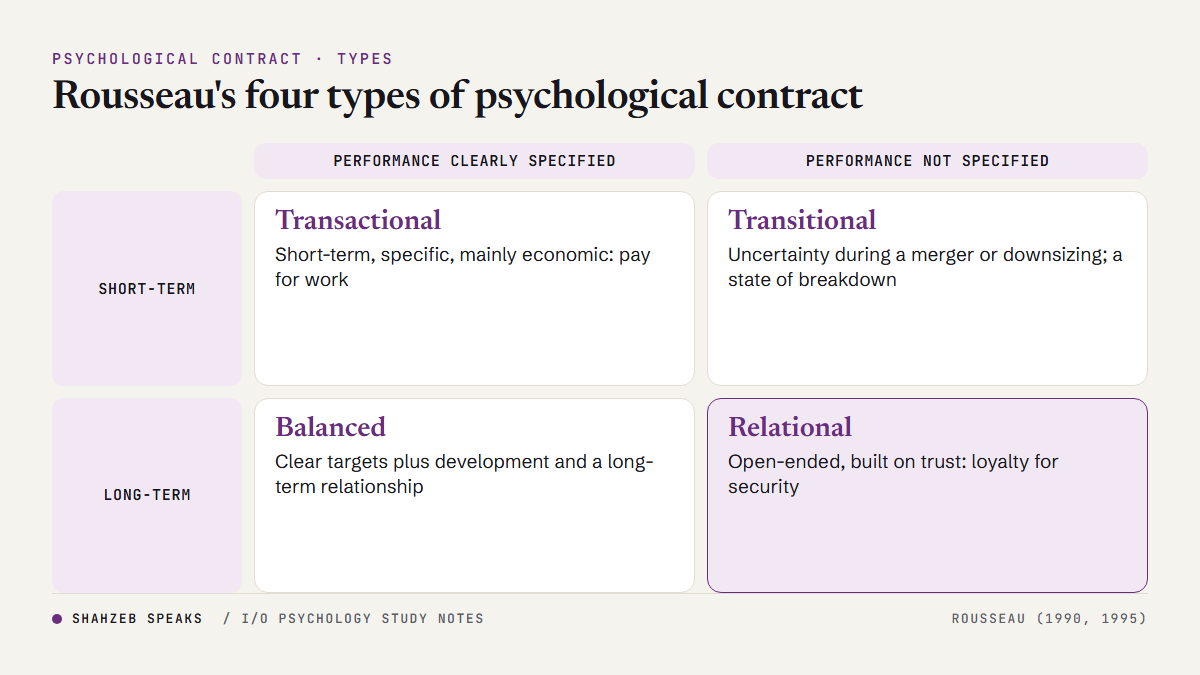
| Type | Duration | Performance terms | Example |
|---|---|---|---|
| Transactional | Short-term | Clearly specified | Six-month contract to install a new payroll system |
| Relational | Long-term, open-ended | Not clearly specified | Long-serving bank officer who expects security for loyalty |
| Balanced | Long-term, open-ended | Clearly specified | Permanent employee with clear targets and development in return |
| Transitional | Short-term or uncertain | Not specified | Staff during a merger or downsizing, unsure what anyone owes anyone |
Rousseau treated the transitional type less as a real contract and more as a state of breakdown during organisational change, when the old deal no longer holds and a new one has not formed.
Breach vs violation: what is the difference?
This distinction comes from Elizabeth Morrison and Sandra Robinson (1997), in a paper titled “When employees feel betrayed”. Before them, researchers used the two words loosely. Morrison and Robinson separated them:
- Perceived breach is a cognition: the employee’s judgement that the organisation has failed to meet one or more of its obligations in the psychological contract.
- Violation is an emotional reaction that may follow breach: anger, resentment, a sense of injustice and betrayal.
Breach does not automatically produce violation. Morrison and Robinson described two main reasons why a promise goes unmet. Reneging is when the organisation knows about an obligation and does not keep it (for example, a promised bonus is cancelled to save money). Incongruence is when the two sides honestly understood the promise differently (the employee heard “you will be promoted in a year”; the manager meant “you could be considered”). Whether the employee then feels violated depends on how they interpret what happened, especially why they think the promise was broken.
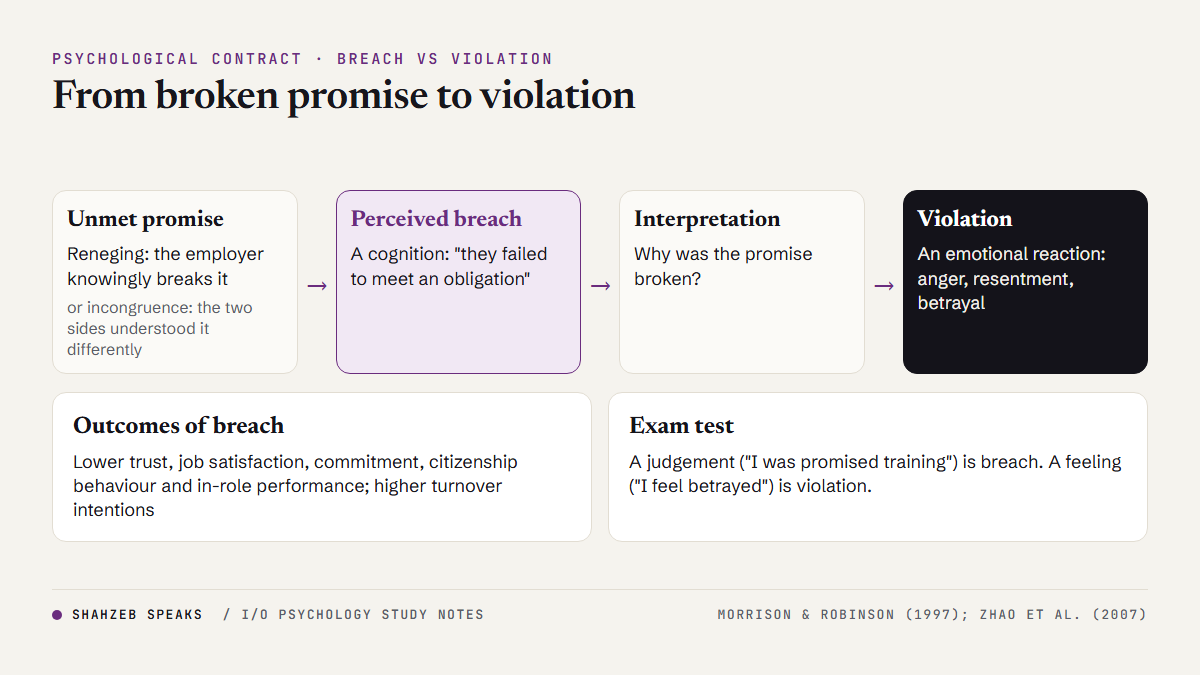
A quick test for exams: if the sentence describes a judgement (“I was promised training and did not get it”), it is breach. If it describes a feeling (“I feel betrayed and angry”), it is violation.
What does research say about psychological contract breach?
Breach is common. Robinson and Rousseau (1994) surveyed 128 management graduates twice: at graduation and two years later. A majority, 54.8 per cent, reported that their employer had violated their psychological contract. Violation was positively related to turnover and negatively related to trust, satisfaction and intention to stay. The paper’s title says it all: “Not the exception but the norm”.
Breach harms attitudes and behaviour. Zhao, Wayne, Glibkowski and Bravo (2007) meta-analysed the effects of breach on eight work outcomes. Breach was related to all of them except actual turnover. Their model showed that emotions (violation and mistrust) carry the effect of breach to attitudes (job satisfaction, organisational commitment, turnover intentions) and to behaviour (organisational citizenship behaviour and in-role performance).
That is why the psychological contract is linked to so many other topics in your syllabus: organisational commitment, organisational citizenship behaviour, equity theory and organisational justice.
Psychological contracts in real workplaces: layoffs and quiet quitting
The idea helps explain two workplace patterns students often write about.
Layoff survivors. When a company cuts jobs, the people who keep their jobs often lose trust and commitment. In psychological contract terms, the relational promise of security has been broken for everyone, not only for those who left. Our post on layoff survivor syndrome covers the research on this.
Quiet quitting. Doing only what the written contract requires can be read as an employee moving from a relational to a transactional contract after feeling let down. That is an interpretation, not a proven cause; see our review of quiet quitting research.
Onboarding. Many psychological contracts are formed during recruitment and the first months. Clear and honest promises at this stage reduce incongruence later; see employee onboarding in the first 90 days.
10-mark answer structure
- Definition (who, year): Rousseau (1989): an individual’s belief about the terms of a reciprocal exchange with the employer; origins in Argyris (1960) and Levinson et al. (1962).
- Key features: individual, promise-based, reciprocal, mostly unwritten.
- Types: transactional vs relational (Rousseau, 1990), then balanced and transitional (Rousseau, 1995), with one example each.
- Breach vs violation: Morrison and Robinson (1997): breach is a cognition, violation an emotional reaction; reneging vs incongruence.
- Evidence: Robinson and Rousseau (1994), 54.8 per cent reported violation within two years; Zhao et al. (2007) meta-analysis of outcomes.
- Application: a Pakistani or Indian workplace example, such as a bank merger or a software house that cancels promised promotions.
- Evaluation: subjective and hard to measure; individual-level focus; whose obligations count (the “employer” is many agents).
- Conclusion: managing promises honestly protects trust, commitment and performance.
Model opening line: “The psychological contract, defined by Rousseau (1989), is an employee’s belief about the reciprocal obligations between themselves and their employer; when those obligations are seen as broken, the cognitive judgement of breach can turn into the emotional experience of violation (Morrison & Robinson, 1997).”
Practice MCQs: the psychological contract
Practice questions written to the published syllabus. Try each one before opening the answer.
-
Who is most associated with the modern definition of the psychological contract as an individual’s belief about reciprocal obligations?
- Edgar Schein
- Denise Rousseau
- J. Stacy Adams
- Frederick Herzberg
Show answer
B. Rousseau (1989, 1995) defined and developed the modern concept. Schein wrote on culture, Adams on equity, Herzberg on motivators and hygiene factors.
-
According to Morrison and Robinson (1997), perceived breach is best described as:
- An emotional reaction of anger and betrayal
- A cognition that the organisation failed to meet an obligation
- A written clause in the employment contract
- A decision to resign
Show answer
B. Breach is a judgement; A describes violation. C is the formal contract, and D is a possible outcome, not breach itself.
-
An employee says: “I feel betrayed. I gave this company everything.” This statement mainly expresses:
- Violation
- Incongruence
- A transactional contract
- Reneging
Show answer
A. Feelings of betrayal and anger are violation. Incongruence and reneging are reasons a promise goes unmet; C is a contract type.
-
A manager tells a new hire she “could be considered for promotion next year”. She hears it as a firm promise. When no promotion comes, the cause of the unmet promise is best called:
- Reneging
- Incongruence
- Job crafting
- Adjourning
Show answer
B. The two sides understood the promise differently. Reneging would mean the employer knowingly broke a promise; C and D belong to other topics.
-
Which describes a relational psychological contract?
- Short-term, clearly specified, mainly economic
- Long-term, open-ended, built on loyalty and security
- Short-term with no clear terms during a merger
- A written collective bargaining agreement
Show answer
B. Relational contracts exchange loyalty for security over the long term. A is transactional, C is transitional, and D is a formal legal agreement.
-
In Robinson and Rousseau’s (1994) study of management graduates, what share reported that their psychological contract had been violated within two years?
- About 10 per cent
- About 25 per cent
- 54.8 per cent
- 90 per cent
Show answer
C. A majority, 54.8 per cent, reported violation, which is why the authors called it “not the exception but the norm”. The other figures are not from the study.
-
In the meta-analysis by Zhao et al. (2007), breach was related to all eight outcomes EXCEPT:
- Job satisfaction
- Organisational commitment
- Actual turnover
- Organisational citizenship behaviour
Show answer
C. Breach was not related to actual turnover in the meta-analysis, though it was related to turnover intentions. A, B and D were all related to breach.
-
A contractor is hired for six months to install a payroll system with clear deliverables. Which of Rousseau’s types fits best?
- Relational
- Balanced
- Transitional
- Transactional
Show answer
D. Short duration and clearly specified performance make it transactional. Balanced is long-term with clear terms; relational is long-term and open; transitional reflects uncertainty during change.
-
Who first used the phrase “psychological work contract”?
- Chris Argyris (1960)
- Denise Rousseau (1989)
- Elton Mayo (1933)
- Douglas McGregor (1960)
Show answer
A. Argyris used it in Understanding Organizational Behavior (1960). Rousseau developed the modern concept later; Mayo and McGregor are linked to human relations and Theory X/Y.
-
Which statement about the psychological contract is NOT correct?
- It exists in the individual employee’s perception
- It includes beliefs about promises that were never written down
- Two employees in the same job always hold the same psychological contract
- It involves obligations on both sides
Show answer
C. Because it is individual and perceptual, two people in the same job can hold different contracts. A, B and D are correct features.
Practise on your phone
The free I/O Psychology Prep app has 410 explained
questions, flashcards and an exam countdown, and works offline. Get it on Google Play
· About the app
More practice: job satisfaction, commitment, OCB and CWB MCQs and the full I/O psychology MCQ hub.
Questions students ask
What is the psychological contract theory of Rousseau (1995)?
In Psychological Contracts in Organizations (1995), Rousseau described the psychological contract as an individual’s beliefs about the terms of exchange with an organisation, shaped by promises made openly or by implication. She set out four types (transactional, relational, balanced, transitional) and explained how contracts form, change and are broken.
What is the difference between breach and violation?
Breach is the thought that the organisation failed to keep a promise. Violation is the emotional reaction that may follow, such as anger and betrayal. Morrison and Robinson (1997) separated the two because not every breach leads to strong feelings.
What is the difference between transactional and relational contracts?
Transactional contracts are short-term, specific and economic (pay for work). Relational contracts are long-term, open-ended and based on trust (loyalty for security). Rousseau (1990) found both types among new MBA graduates.
Why is the psychological contract important in HRM?
Because breach is common and is linked to lower trust, job satisfaction, commitment, citizenship behaviour and performance, and to higher intentions to quit (Zhao et al., 2007). Honest recruitment, clear promises and explaining changes reduce breach.
Is the psychological contract legally binding?
No. It is a set of beliefs, not a legal document. Some obligations may overlap with law or the written contract, but the psychological contract itself cannot be enforced in court.
How is the psychological contract measured?
Usually with questionnaires that ask employees what they believe the employer promised and how well it has delivered. Zhao et al. (2007) distinguished global measures (overall breach) from composite measures (breach item by item). Check the licence of any published scale before using it in a thesis.
References
- Argyris, C. (1960). Understanding organizational behavior. Dorsey Press.
- Levinson, H., Price, C. R., Munden, K. J., Mandl, H. J., & Solley, C. M. (1962). Men, management, and mental health. Harvard University Press.
- Morrison, E. W., & Robinson, S. L. (1997). When employees feel betrayed: A model of how psychological contract violation develops. Academy of Management Review, 22(1), 226–256. https://doi.org/10.5465/amr.1997.9707180265
- Robinson, S. L., & Rousseau, D. M. (1994). Violating the psychological contract: Not the exception but the norm. Journal of Organizational Behavior, 15(3), 245–259. https://doi.org/10.1002/job.4030150306
- Rousseau, D. M. (1989). Psychological and implied contracts in organizations. Employee Responsibilities and Rights Journal, 2(2), 121–139. https://doi.org/10.1007/BF01384942
- Rousseau, D. M. (1990). New hire perceptions of their own and their employer’s obligations: A study of psychological contracts. Journal of Organizational Behavior, 11(5), 389–400. https://doi.org/10.1002/job.4030110506
- Rousseau, D. M. (1995). Psychological contracts in organizations: Understanding written and unwritten agreements. Sage.
- Zhao, H., Wayne, S. J., Glibkowski, B. C., & Bravo, J. (2007). The impact of psychological contract breach on work-related outcomes: A meta-analysis. Personnel Psychology, 60(3), 647–680. https://doi.org/10.1111/j.1744-6570.2007.00087.x
Practise on your phone
The free I/O Psychology Prep app has 410 explained
questions, flashcards and an exam countdown, and works offline. Get it on Google Play
· About the app
This post is part of our guide to leadership theories in I/O psychology, which covers leadership, teams and the organisation, and it links closely to work motivation theories. Related reading: Schein’s model of organizational culture, the job demands-resources model and LMX theory. New to the field? Start with the I/O psychology study guide or read about industrial psychology in Pakistan.