
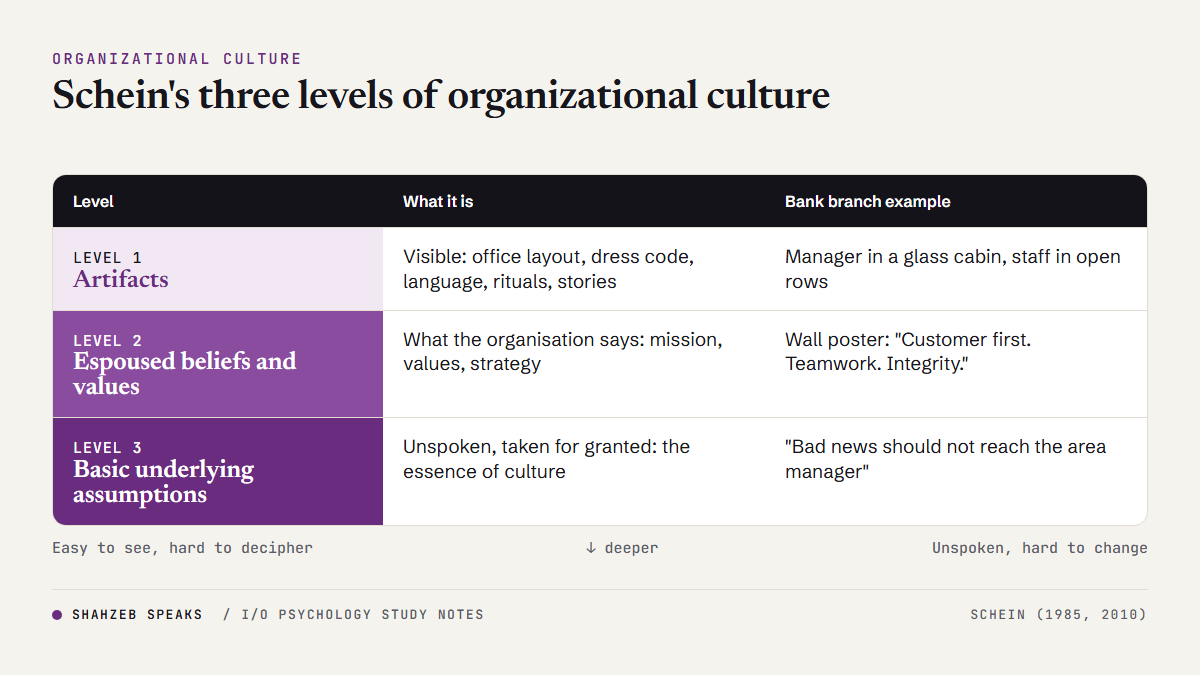
Schein’s model of organizational culture, set out by Edgar Schein in 1985, says culture exists at three levels: artifacts (what you can see and hear), espoused beliefs and values (what the organisation says it values), and basic underlying assumptions (unspoken beliefs members take for granted). The assumptions are the real core of culture.
This guide is for students who meet “organizational culture” in an I/O psychology, organisational behaviour or HRM paper, and for thesis students who need to measure culture or climate. You get the three levels with a worked example from a bank branch, a diagram, how leaders create and embed culture, a clear table on culture vs climate, Cameron and Quinn’s competing values framework and its OCAI questionnaire, the main criticisms, an exam structure and 10 practice MCQs.
Who was Edgar Schein and what is his model?
Edgar H. Schein (1928–2023) was a social psychologist who taught at the MIT Sloan School of Management from 1956 and wrote dozens of books on careers, culture and group dynamics. His book Organizational Culture and Leadership first appeared in 1985. The fourth edition came out in 2010, and a fifth edition, written with his son Peter Schein, appeared in 2017. Most exam answers cite Schein (1985) for the original model or Schein (2010) for the edition most libraries hold.
Schein’s central idea is that culture is something a group learns. As a group solves its problems of surviving in its environment (external adaptation) and of working together (internal integration), some ways of thinking work well. Over time these ways stop being questioned and are taught to new members as the correct way to see, think and feel. That learned, taken-for-granted layer is what he calls culture (Schein, 2010).
Because culture runs this deep, Schein argued that you cannot understand it by looking only at the surface. He described three levels, from the most visible to the least visible.
What are the three levels of culture in Schein’s model?
Level 1: Artifacts
Artifacts are everything you can see, hear and feel when you walk into an organisation: the office layout, dress code, logos, language and jargon, ceremonies, stories, written policies and how people greet each other. Artifacts are easy to observe but hard to decipher. A visitor can see that the manager of a bank branch sits in a glass cabin while staff sit in open rows, but cannot tell from that alone what it means to the people who work there.
Level 2: Espoused beliefs and values
Espoused values are what the organisation says it believes: mission and vision statements, values posters, strategy documents, the answers managers give when asked “why do you do it this way?”. In our bank branch, the wall poster says “Customer first. Teamwork. Integrity.” Espoused values can match how people really behave, or they can be aspirations, or they can be public relations. Students lose marks when they treat a values statement as the culture itself.
Level 3: Basic underlying assumptions
Basic assumptions are beliefs so taken for granted that members no longer notice them or discuss them. They guide behaviour without being said. In the bank branch, an unspoken assumption might be “bad news should not reach the area manager” or “a junior who questions a senior is being disrespectful”. If that assumption is there, a “speak up” poster (level 2) will not change much. Schein argued that this level is the essence of culture, and that you understand a culture only when you can name its shared assumptions.
The gap between level 2 and level 3 is where most culture problems sit. An organisation that espouses openness but assumes that mistakes must be hidden will feel unsafe to its staff. Our post on psychological safety at work shows what this looks like inside teams, and signs of a toxic workplace covers what happens when the hidden assumptions are harmful.
How do leaders create and embed culture?
For Schein, culture and leadership are two sides of the same coin. Founders bring their own assumptions, and if those assumptions lead to success, the group adopts them. Schein described six primary embedding mechanisms through which leaders teach culture, whether they mean to or not:
- What leaders pay attention to, measure and control.
- How leaders react to critical incidents and crises.
- How leaders allocate resources.
- Deliberate role modelling, teaching and coaching.
- How leaders allocate rewards and status.
- How leaders recruit, select, promote and remove people.
He treated structure, systems, rituals, stories and formal statements as secondary mechanisms. They reinforce culture only when they match what leaders actually do. Example: a hospital that promotes the doctor with the most private patients, not the one with the best teaching record, has told staff what it values more clearly than any mission statement. This links to fairness at work; see our post on organisational justice.
Culture vs climate: what is the difference?
This is one of the most common exam and viva questions. The two ideas overlap, and researchers argued about them for years (Denison, 1996). In a review in the Annual Review of Psychology, Schneider, Ehrhart and Macey (2013) gave short working definitions: organisational climate is the meaning people attach to the bundles of experiences they have at work (policies, practices, what gets rewarded), and organisational culture is the basic assumptions and values that guide life in the organisation.
| Point | Organisational culture | Organisational climate |
|---|---|---|
| What it is | Shared basic assumptions and values | Shared perceptions of policies, practices and what is rewarded |
| Depth | Deep, often unspoken (Schein’s level 3) | Closer to the surface, about daily experience |
| Typical question | “Why do we do things this way?” | “What happens here, and what gets rewarded?” |
| Usual method | Interviews, observation, values surveys | Employee surveys averaged to the team or unit |
| Focus | The organisation as a whole | Often a “climate for” something: safety, service, inclusion |
| Key sources | Schein (1985, 2010) | Zohar (1980) on safety climate; Schneider et al. (2013) |
A simple way to remember it: climate is what employees experience; culture is the set of assumptions that explains why that experience exists. Safety climate is the classic example: Zohar (1980) studied how workers in industrial organisations perceived the importance of safety, and climate “for” a specific outcome is now a whole research area.
Cameron and Quinn’s competing values framework and the OCAI
Schein’s model explains what culture is, but it does not give you a questionnaire. When students need to measure culture for a thesis, the most common choice is the Organizational Culture Assessment Instrument (OCAI) by Kim Cameron and Robert Quinn, built on the competing values framework.
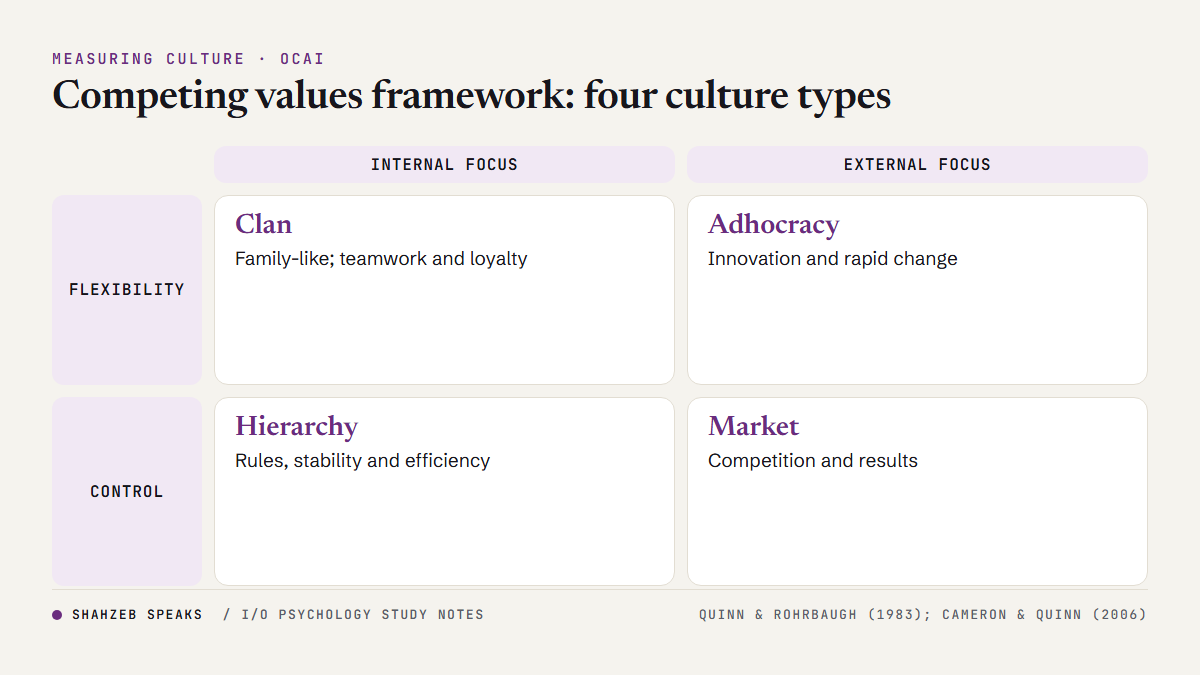
The framework comes from Quinn and Rohrbaugh (1983), who asked organisational researchers to judge how effectiveness criteria relate. Two of the value dimensions they found, flexibility vs control and internal vs external focus, form a grid with four culture types:
- Clan: flexible and internally focused; a family-like place with teamwork and loyalty.
- Adhocracy: flexible and externally focused; innovation and rapid change.
- Market: controlled and externally focused; competition and results.
- Hierarchy: controlled and internally focused; rules, stability and efficiency.
The OCAI covers six dimensions of culture: dominant characteristics, organizational leadership, management of employees, organizational glue, strategic emphases and criteria of success. For each dimension, respondents divide 100 points across four statements, one for each culture type, once for the culture “now” and once for the culture they would “prefer” (Cameron & Quinn, 2006). The gap between now and preferred is what makes it useful for change projects.
What does the evidence say? Hartnell, Ou and Kinicki (2011) meta-analysed 84 studies with 94 samples. Clan, adhocracy and market cultures were positively linked to effectiveness criteria (employee attitudes, operational performance and financial performance), though not always as predicted, and the results gave only mixed support for the framework’s assumptions about how the four types relate to each other.
Thesis note: the OCAI is copyrighted. Do not copy its statements into your appendix from a website. The instrument is printed in Cameron and Quinn’s book; researchers translating or adapting it have asked Kim Cameron for written permission, so check the current terms before you use it. If you are still choosing a topic, our I/O psychology thesis topics and scales for theses pages list options with licence notes.
What are the criticisms of Schein’s model?
- It assumes one shared culture. Joanne Martin (1992) argued that many organisations are better described by subcultures (sales vs IT, head office vs branches) or by ambiguity, where people do not share clear assumptions at all.
- It can look static. Mary Jo Hatch (1993) said Schein’s model of assumptions, values and artifacts leaves gaps about symbols and processes, and proposed a “cultural dynamics” model showing how culture is constantly made and remade through interpretation.
- It is hard to measure. Assumptions are unspoken by definition, so surveys capture values and climate more easily than the deepest level. Schein favoured interviews and joint inquiry with insiders.
- Strength. It explains why slogans, perks and new posters rarely change culture: they work at levels 1 and 2 while the assumptions at level 3 stay the same.
10-mark answer structure
- Definition (who, year): Schein (1985; 4th ed. 2010) defined culture as a pattern of shared basic assumptions a group learns while solving problems of external adaptation and internal integration, then teaches to new members.
- Level 1, artifacts: visible structures, layout, dress, language, rituals; easy to see, hard to decipher.
- Level 2, espoused beliefs and values: stated strategies, goals and philosophies; may or may not match behaviour.
- Level 3, basic underlying assumptions: taken-for-granted beliefs; the essence of culture.
- Example: one organisation (bank branch, hospital, university department) traced through all three levels, showing a gap between levels 2 and 3.
- Role of leaders: primary embedding mechanisms, such as attention, reactions to crises, rewards and promotion.
- Culture vs climate: two or three lines with Schneider et al. (2013).
- Evaluation: Martin (1992) on subcultures; Hatch (1993) on dynamics; difficulty measuring assumptions; measurement through the OCAI (Cameron & Quinn).
- Conclusion: lasting change needs change at the level of assumptions, not only artifacts.
Model opening line: “Schein (1985) argued that organizational culture exists at three levels, visible artifacts, espoused beliefs and values, and basic underlying assumptions, and that the assumptions, being unspoken and taken for granted, are the true core of a culture.”
Practice MCQs: Schein’s model of organizational culture
Practice questions written to the published syllabus. Try each one before opening the answer.
-
According to Schein, the deepest level of organizational culture is:
- Artifacts
- Espoused beliefs and values
- Basic underlying assumptions
- Organisational climate
Show answer
C. Assumptions are taken for granted and are the essence of culture. Artifacts are the surface; espoused values sit in the middle; climate is a separate construct, not one of Schein’s levels.
-
A bank’s mission statement on the wall says “We value teamwork”. At which level of Schein’s model is this statement?
- Basic assumptions
- Espoused beliefs and values
- Climate strength
- Primary embedding mechanism
Show answer
B. It is a stated value. The poster itself is a physical artifact, but what it states is an espoused value; whether people really believe it is a question for level 3. C is a climate idea and D refers to leader actions.
-
Which is NOT one of Schein’s primary embedding mechanisms?
- What leaders pay attention to, measure and control
- How leaders react to critical incidents
- How leaders allocate rewards and status
- The design of the company logo
Show answer
D. Design features and formal symbols are secondary mechanisms that only reinforce culture. A, B and C are primary mechanisms.
-
A new employee notices that everyone stands when the director enters, though no policy requires it. This behaviour is best described as:
- An artifact
- An espoused value
- A psychological contract
- A job resource
Show answer
A. Observable behaviour and rituals are artifacts. The assumption behind it (perhaps about status) is level 3. C and D belong to other topics.
-
Schneider, Ehrhart and Macey (2013) describe organisational climate as:
- The basic assumptions that guide life in an organisation
- The meanings people attach to their experiences at work, such as policies and practices
- The founder’s personality
- The written values statement
Show answer
B. Climate is about shared perceptions of experiences, policies and rewards. A is their definition of culture; C and D are not definitions of climate.
-
In the competing values framework, a culture that is flexible and externally focused, valuing innovation, is called:
- Clan
- Hierarchy
- Adhocracy
- Market
Show answer
C. Adhocracy combines flexibility and external focus. Clan is flexible and internal; hierarchy is controlled and internal; market is controlled and external.
-
When completing the OCAI, respondents:
- Rate 30 items on a 7-point scale
- Divide 100 points across four statements for each of six dimensions, for “now” and “preferred”
- Write an essay about their organisation
- Rank leaders from best to worst
Show answer
B. The OCAI uses a 100-point allocation across the four culture types on six dimensions, twice. The other formats do not describe it.
-
Who argued that many organisations are better described by subcultures or ambiguity than by one shared culture?
- Joanne Martin
- Bruce Tuckman
- Denise Rousseau
- Robert Karasek
Show answer
A. Martin (1992) offered integration, differentiation and fragmentation perspectives. Tuckman studied group development, Rousseau the psychological contract, Karasek job strain.
-
A company launches new values posters and casual Fridays, but managers still punish anyone who reports a mistake. Using Schein, why is culture unlikely to change?
- The posters are too small
- The changes are at the artifact and espoused value levels, while the underlying assumption about mistakes is untouched
- Climate always changes before culture
- Culture is decided only by national culture
Show answer
B. Leader reactions to incidents are a primary embedding mechanism and keep teaching the old assumption. A is trivial; C and D are not claims of Schein’s model.
-
Safety climate research is most closely linked with:
- Zohar (1980)
- Schein (1985)
- Tuckman (1965)
- Siegrist (1996)
Show answer
A. Zohar’s 1980 study of industrial organisations is the classic safety climate paper. Schein wrote on culture, Tuckman on group stages and Siegrist on effort-reward imbalance.
Practise on your phone
The free I/O Psychology Prep app has 410 explained
questions, flashcards and an exam countdown, and works offline. Get it on Google Play
· About the app
More practice: leadership theories MCQs and the full I/O psychology MCQ hub.
Questions students ask
What are the three levels of culture according to Schein?
Artifacts (visible structures, behaviour, language, rituals), espoused beliefs and values (stated strategies, goals and philosophies) and basic underlying assumptions (unconscious, taken-for-granted beliefs). Schein treated the assumptions as the core of culture.
Is Schein’s model from 1985 or 2010?
Both are correct citations. The model first appeared in Organizational Culture and Leadership (1985). The 4th edition (2010) is the one most often used in courses, and a 5th edition with Peter Schein followed in 2017. Cite the edition you actually read.
What is the difference between organizational culture and climate?
Culture is the deep set of shared assumptions and values; climate is how employees perceive daily policies, practices and rewards. Climate is usually measured with surveys and often refers to a climate “for” something, such as safety or service.
What is the OCAI?
The Organizational Culture Assessment Instrument by Cameron and Quinn, based on the competing values framework. It scores clan, adhocracy, market and hierarchy cultures across six dimensions, for the current and the preferred culture. It is copyrighted, so get it from the authors’ book and check the terms.
Can organizational culture be changed?
Schein’s answer is yes, but slowly, and only when the assumptions change. Leaders change culture mainly through what they pay attention to, how they react to crises, and whom they reward and promote, not through slogans.
What is an example of a basic underlying assumption?
In a hospital ward, an unspoken belief that “junior staff should not question a consultant” is an assumption. Nobody writes it down, yet it shapes whether nurses report errors, whatever the safety policy says.
References
- Cameron, K. S., & Quinn, R. E. (2006). Diagnosing and changing organizational culture: Based on the competing values framework (Rev. ed.). Jossey-Bass.
- Denison, D. R. (1996). What is the difference between organizational culture and organizational climate? A native’s point of view on a decade of paradigm wars. Academy of Management Review, 21(3), 619–654. https://doi.org/10.5465/amr.1996.9702100310
- Hartnell, C. A., Ou, A. Y., & Kinicki, A. (2011). Organizational culture and organizational effectiveness: A meta-analytic investigation of the competing values framework’s theoretical suppositions. Journal of Applied Psychology, 96(4), 677–694. https://doi.org/10.1037/a0021987
- Hatch, M. J. (1993). The dynamics of organizational culture. Academy of Management Review, 18(4), 657–693. https://doi.org/10.5465/amr.1993.9402210154
- Martin, J. (1992). Cultures in organizations: Three perspectives. Oxford University Press.
- Quinn, R. E., & Rohrbaugh, J. (1983). A spatial model of effectiveness criteria: Towards a competing values approach to organizational analysis. Management Science, 29(3), 363–377. https://doi.org/10.1287/mnsc.29.3.363
- Schein, E. H. (1985). Organizational culture and leadership. Jossey-Bass.
- Schein, E. H. (1990). Organizational culture. American Psychologist, 45(2), 109–119. https://doi.org/10.1037/0003-066X.45.2.109
- Schein, E. H. (2010). Organizational culture and leadership (4th ed.). Jossey-Bass.
- Schein, E. H., with Schein, P. (2017). Organizational culture and leadership (5th ed.). Wiley.
- Schneider, B., Ehrhart, M. G., & Macey, W. H. (2013). Organizational climate and culture. Annual Review of Psychology, 64, 361–388. https://doi.org/10.1146/annurev-psych-113011-143809
- Zohar, D. (1980). Safety climate in industrial organizations: Theoretical and applied implications. Journal of Applied Psychology, 65(1), 96–102. https://doi.org/10.1037/0021-9010.65.1.96
Practise on your phone
The free I/O Psychology Prep app has 410 explained
questions, flashcards and an exam countdown, and works offline. Get it on Google Play
· About the app
This post is part of our guide to leadership theories in I/O psychology, which covers leadership, teams and the organisation. Related reading: Tuckman’s stages of group development, the psychological contract and transformational vs transactional leadership. New to the field? Start with the I/O psychology study guide or read about industrial psychology in Pakistan.