
Transactional leadership is an exchange: the leader rewards agreed performance and corrects mistakes (contingent reward, management by exception). Transformational leadership raises followers’ motivation and values through the four I’s: idealised influence, inspirational motivation, intellectual stimulation and individualised consideration. Burns (1978) named the contrast; Bass (1985) showed good leaders use both.
This page is for students comparing transformational and transactional leadership for an exam, an assignment or a thesis. It gives the difference in one table, the history from Burns to Bass, the four I’s with workplace examples, the full range leadership model, how the Multifactor Leadership Questionnaire (MLQ) is used (without reprinting any items), what the meta-analyses found, a 10-mark answer plan and 10 practice MCQs with explanations.
What is the difference between transformational and transactional leadership?
Transactional leadership is based on exchange. The leader makes clear what is expected and what followers will get in return, rewards people who deliver, and steps in when something goes wrong. Think of a sales manager who pays a bonus for every target met and checks the daily numbers for problems.
Transformational leadership goes further. The leader gives people a reason to care about the work beyond the reward: a vision they believe in, a role model they trust, a challenge to think differently and personal attention to their growth. Followers end up doing more than they expected to do, because their own goals and values have shifted.
The two are not opposites. Bass (1985) argued that they are separate dimensions, and that the most effective leaders do both: they run a clear, fair exchange, and they also inspire. This is the single most important point for an exam answer.
| Point | Transactional leadership | Transformational leadership |
|---|---|---|
| Core idea | Exchange: reward for performance, correction for mistakes | Raising followers’ motivation, values and goals |
| Key authors | Burns (1978); Bass (1985) | Burns (1978) “transforming”; Bass (1985); Bass and Avolio’s full range model |
| Components | Contingent reward; management by exception (active and passive) | The four I’s: idealised influence, inspirational motivation, intellectual stimulation, individualised consideration |
| Source of motivation | Extrinsic: pay, bonus, avoiding penalties | Mostly intrinsic: meaning, identification with the leader, growth |
| Focus | Meeting agreed targets; keeping the system running | Change, vision and developing people |
| Typical result | Expected performance | Performance beyond expectations (Bass, 1985) |
| Works well for | Clear, routine, measurable tasks; stable conditions | Change, uncertainty, work that needs extra effort and new ideas |
| Risk if used alone | People do only what is paid for | Vision without clear goals and fair rewards; dependence on one person |
| Measure | MLQ transactional scales | MLQ transformational scales |
Where did the ideas come from? Burns (1978) and Bass (1985)
James MacGregor Burns was an American political scientist and historian. In his book Leadership (1978) he studied political leaders and described two kinds of relationship between leaders and followers. In a transactional relationship, each side exchanges something of value: jobs for votes, support for favours. In a transforming relationship, leader and followers raise each other to higher levels of motivation and morality. For Burns, these were two ends of one line: a leader was mainly one or the other.
Bernard M. Bass brought the idea into organisational psychology in Leadership and Performance Beyond Expectations (Bass, 1985). He changed Burns’s idea in two ways. First, he used the word transformational and focused on leaders in organisations, not only political figures. Second, he argued that transformational and transactional leadership are separate dimensions, not opposite ends of one line. A leader can be high on both. Bass also proposed that transformational leadership adds to the effect of transactional leadership, sometimes called the augmentation effect: the exchange gets people to the expected level, and transformation takes them beyond it.
Bass and Bruce Avolio later built this into the full range leadership model, which runs from no leadership at all (laissez-faire), through transactional behaviours, to transformational behaviours.
The four I’s of transformational leadership
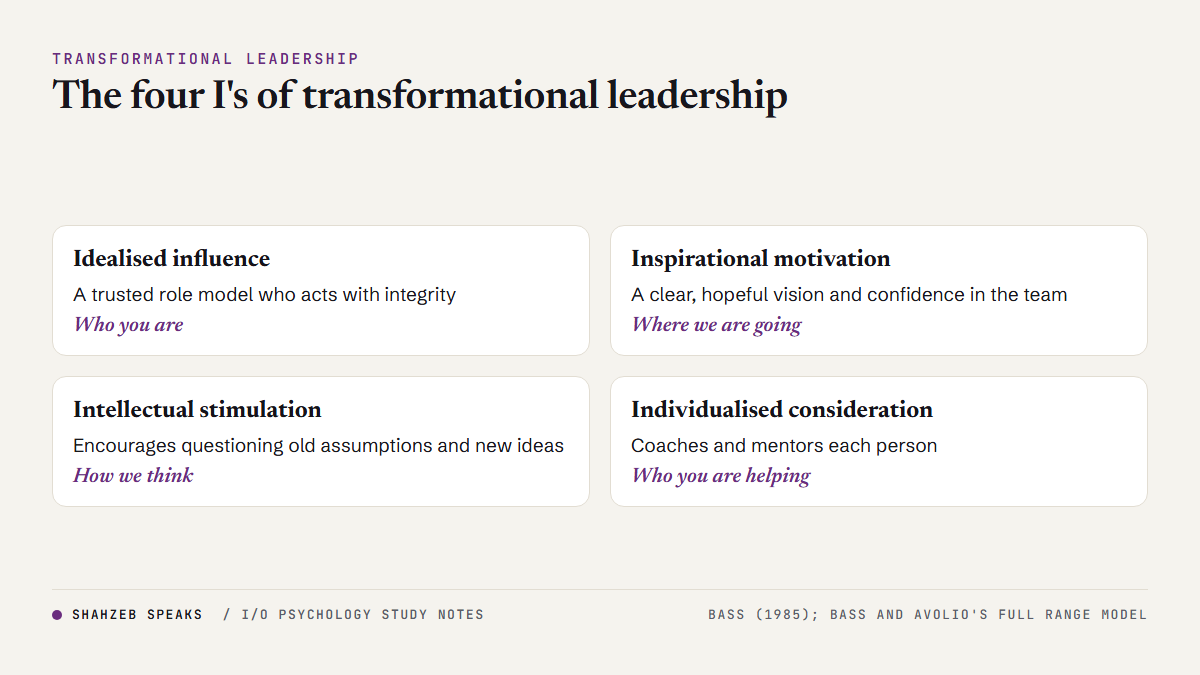
- Idealised influence: the leader acts as a role model that people trust and want to copy. They act with integrity, put the group’s interest ahead of their own and keep promises. In the MLQ this is split into idealised attributes (building trust) and idealised behaviours (acting with integrity). Example: a factory general manager in Sialkot who wears the same safety gear as the line workers and is the first to accept a pay freeze in a bad season.
- Inspirational motivation: the leader gives a clear, hopeful vision and shows confidence that the team can reach it. Example: a hospital nursing director who explains how cutting infection rates will save patients’ lives, and keeps the ward focused on that goal for a year.
- Intellectual stimulation: the leader encourages people to question old assumptions, look at problems in new ways and try new ideas, without being punished for mistakes. Example: a software lead in Bengaluru or Karachi who asks juniors to challenge the current design before the team commits to it.
- Individualised consideration: the leader pays attention to each person’s needs and development, coaching and mentoring them as individuals. Example: a call-centre team lead in Manila who knows which agent wants to move into quality assurance and arranges shadowing for her.
A memory trick for exams: the four I’s go from who you are (idealised influence) to where we are going (inspirational motivation) to how we think (intellectual stimulation) to who you are helping (individualised consideration).
Transactional leadership: contingent reward and management by exception
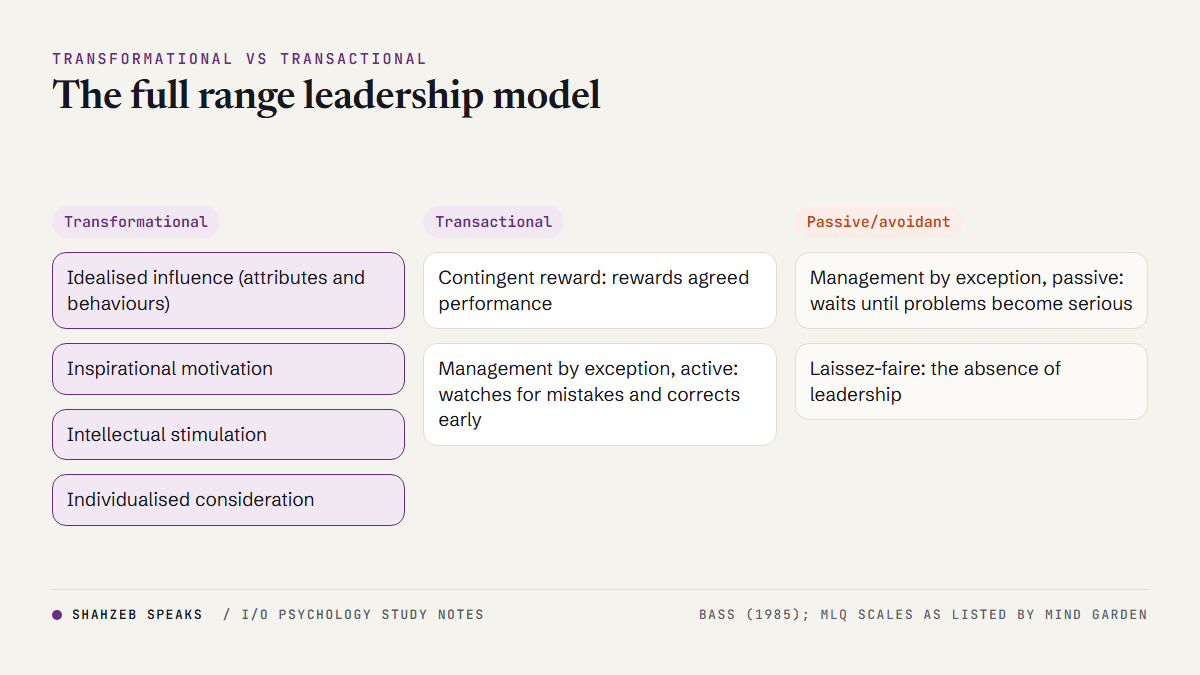
Transactional leadership in the full range model has two parts, with a third “non-leadership” style beside it:
- Contingent reward: the leader agrees goals with followers and gives rewards when the goals are met. This includes praise and recognition, not only money. Example: a bank branch manager who agrees monthly account-opening targets with each officer and publicly recognises those who meet them.
- Management by exception, active: the leader watches for mistakes and deviations from standards and corrects them before they become serious. Example: a quality supervisor in a garment export unit who checks samples every hour.
- Management by exception, passive: the leader waits until problems become serious, then reacts. In the MLQ this is grouped with laissez-faire as passive/avoidant leadership, not as effective transactional leadership.
- Laissez-faire: the absence of leadership. The leader avoids decisions, is absent when needed and delays responses.
Students often write that “transactional leadership is bad”. That is not what the research says. Contingent reward is effective (see below). It is passive management by exception and laissez-faire that are linked with poor outcomes. Leaders who rely mainly on watching for mistakes and punishing them often create the atmosphere described in our posts on micromanagement and toxic workplaces, while contingent reward links to employee recognition.
How is it measured, and what does the research show?
The Multifactor Leadership Questionnaire (MLQ)
The standard measure is the Multifactor Leadership Questionnaire by Bass and Avolio, sold and licensed by Mind Garden. According to the publisher, the commonly used MLQ 5X short form has 45 items on each of the self form (the leader rates themselves) and the rater form (others rate the leader). It measures nine leadership scales: idealised attributes, idealised behaviours, inspirational motivation, intellectual stimulation, individualised consideration, contingent reward, management by exception (active), management by exception (passive) and laissez-faire, plus three outcomes: extra effort, effectiveness and satisfaction. It is copyrighted and must be bought with a licence to administer; its items should not be copied into a thesis or a web page. Because it uses several raters, it is often run as a 360-degree feedback exercise.
The meta-analytic evidence
- Judge and Piccolo (2004) combined 626 correlations from 87 sources. Transformational leadership had an overall validity of .44 across outcomes such as follower satisfaction, motivation and leader effectiveness. But it was strongly correlated with contingent reward (.80) and negatively with laissez-faire (−.65), and for several criteria contingent reward was related to outcomes more strongly than transformational leadership was. When the dimensions were tested together, transformational leadership did not predict leader job performance.
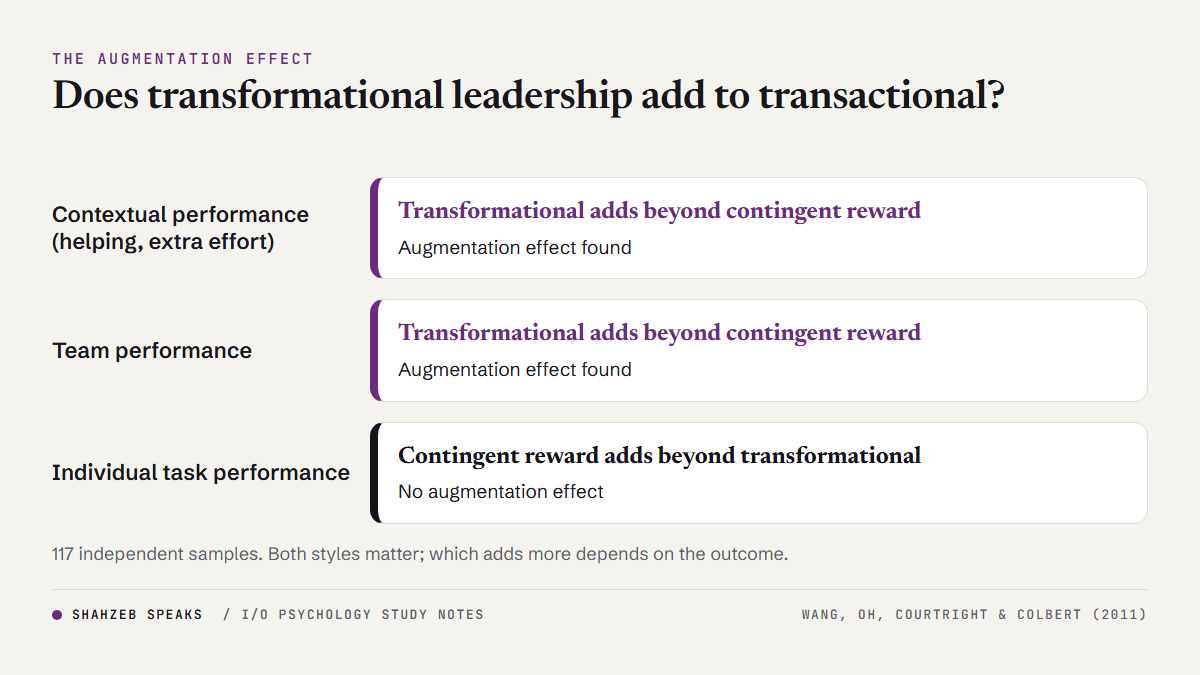
- Wang, Oh, Courtright and Colbert (2011) analysed 117 samples. Transformational leadership was positively related to follower performance at individual, team and organisation levels, and more strongly to contextual performance (helping, extra effort) than to task performance. It added to contingent reward (the augmentation effect) for contextual performance and team performance, but not for individual task performance; there, contingent reward added more beyond transformational leadership.
- Lowe, Kroeck and Sivasubramaniam (1996) is an earlier meta-analytic review of MLQ studies that is still widely cited.
Criticisms
Van Knippenberg and Sitkin (2013) published a strong critique. They argued that charismatic-transformational leadership lacks a clear definition, that the theory does not explain how each dimension works, and that the usual measures mix the leader’s behaviour with its effects (for example, rating a leader as “inspiring” already assumes the outcome). This makes high correlations with outcomes less impressive than they look. Other criticisms: the theory can make leadership sound heroic and leader-centred; it can be misused by self-serving leaders who inspire people towards harmful goals; and newer theories such as authentic and servant leadership overlap with it. Hoch, Bommer, Dulebohn and Wu (2018) found that authentic and ethical leadership added little beyond transformational leadership, while servant leadership added more.
What this means for your answer: transformational leadership has strong support, but the honest summary is “both matter”. Contingent reward is not second-class leadership; it is often what makes the vision believable.
Transformational vs transactional leadership: examples
The same manager can use both styles in one week. Take the regional manager of a Pakistani mobile network’s customer service centres.
- Transactional: she sets clear call-quality targets for each team, pays the monthly incentive to agents who reach them (contingent reward), and reviews the dropped-call report every morning to fix problems early (active management by exception).
- Transformational: she explains that the centres will become the first in the region to resolve most complaints in one call and why that matters to customers (inspirational motivation); she asks agents for ideas to cut repeat calls (intellectual stimulation); she mentors two team leads for promotion (individualised consideration); and she takes difficult escalated calls herself (idealised influence).
- Passive/avoidant (what to avoid): she ignores rising complaint numbers until head office calls (passive management by exception), or is never available when team leads need a decision (laissez-faire).
Transformational leadership also shapes the climate in which people feel able to speak up, which links it to psychological safety at work, and its absence links to burnout.
10-mark answer structure: “Differentiate between transformational and transactional leadership”
- Definitions: transactional = exchange of rewards for performance; transformational = raising followers’ motivation and values (Burns, 1978; Bass, 1985).
- History: Burns’s political “transforming vs transactional”; Bass’s two separate dimensions and augmentation.
- Components of transformational leadership: the four I’s, one line and one example each.
- Components of transactional leadership: contingent reward, management by exception (active, passive); laissez-faire as non-leadership.
- Comparison table: core idea, motivation, focus, result, when it works (6-8 rows).
- Measurement: MLQ (Bass and Avolio), full range model; no items needed.
- Evidence: Judge and Piccolo (2004): .44 overall validity, .80 overlap with contingent reward; Wang et al. (2011) augmentation for contextual and team performance.
- Conclusion: complementary, not opposite; best leaders combine a fair exchange with inspiration; one local example.
Model opening line: “Transactional leadership secures expected performance through a fair exchange of rewards for effort, while transformational leadership, as the title of Bass’s (1985) book puts it, produces performance beyond expectations by changing what followers value.”
Practice MCQs: transformational vs transactional leadership
Practice questions written to the published syllabus of typical I/O psychology courses, not past-paper questions. More on the leadership MCQs page.
-
Who first distinguished “transforming” from “transactional” leadership, in a book on political leaders?
- Bernard Bass
- James MacGregor Burns
- Robert House
- Fred Fiedler
Show answer
B. Burns (1978) introduced the contrast. Bass (1985) adapted it to organisations; House developed path-goal theory and Fiedler the contingency model.
-
How did Bass’s view differ from Burns’s?
- Bass said transactional leadership is always harmful
- Bass treated the two as separate dimensions a leader can combine
- Bass studied only political leaders
- Bass rejected the idea of transformational leadership
Show answer
B. Burns saw one continuum; Bass saw two dimensions that can both be high. Bass did not call transactional leadership harmful, and he focused on organisations rather than only politics.
-
A manager coaches each team member according to their career goals. Which of the four I’s is this?
- Idealised influence
- Inspirational motivation
- Intellectual stimulation
- Individualised consideration
Show answer
D. Attention to each person’s needs and development is individualised consideration. Idealised influence is role modelling, inspirational motivation is vision, intellectual stimulation is challenging assumptions.
-
Which of these is a transactional, not transformational, behaviour?
- Inspirational motivation
- Contingent reward
- Intellectual stimulation
- Idealised influence
Show answer
B. Rewarding agreed performance is contingent reward, a transactional behaviour. The other three are among the four I’s.
-
A supervisor ignores quality problems until a client complains, then reacts. In the full range model this is:
- Management by exception, active
- Management by exception, passive
- Contingent reward
- Intellectual stimulation
Show answer
B. Waiting until problems become serious is passive management by exception, grouped with laissez-faire as passive/avoidant. Active management by exception watches for problems early.
-
In Judge and Piccolo’s (2004) meta-analysis, transformational leadership correlated .80 with:
- Laissez-faire leadership
- Contingent reward
- Follower turnover
- Leader job performance
Show answer
B. The .80 overlap with contingent reward is why the two are hard to separate. Its correlation with laissez-faire was negative (−.65).
-
Wang et al. (2011) found that transformational leadership added to contingent reward for which outcome?
- Individual task performance
- Contextual performance and team performance
- None at all
- Only leader self-ratings
Show answer
B. Augmentation appeared for contextual and team performance. For individual task performance, contingent reward added more beyond transformational leadership.
-
Which statement about the MLQ is correct?
- It is free to copy into any thesis
- It was developed by Bass and Avolio and is licensed through Mind Garden
- It measures only transformational leadership
- It is Fiedler’s measure of leader style
Show answer
B. The MLQ is Bass and Avolio’s licensed instrument and measures the full range, including transactional and laissez-faire scales. Fiedler’s measure is the LPC scale.
-
Which is NOT a criticism raised by van Knippenberg and Sitkin (2013)?
- The concept lacks a clear definition
- Measures mix the leader’s behaviour with its effects
- The causal model for each dimension is not specified
- Transformational leadership has never been studied with meta-analysis
Show answer
D. Several meta-analyses exist (e.g., Judge & Piccolo, 2004). The other three are among the problems van Knippenberg and Sitkin identified.
-
An exam answer says “transactional leadership is always ineffective”. The best correction is:
- Correct, only transformational leadership works
- Contingent reward is effective; passive management by exception and laissez-faire are the weak styles
- Transactional leadership is the same as laissez-faire
- Transactional leadership only works in politics
Show answer
B. Research shows contingent reward predicts many outcomes, sometimes better than transformational leadership. Laissez-faire is the absence of leadership, not transactional leadership.
Practise on your phone
The free I/O Psychology Prep app has 410 explained
questions, flashcards and an exam countdown, and works offline. Get it on Google Play
· About the app
Questions students ask
What are the 4 I’s of transformational leadership?
Idealised influence (being a trusted role model), inspirational motivation (a clear, hopeful vision), intellectual stimulation (encouraging new ways of thinking) and individualised consideration (coaching each person). They come from Bass’s work and the full range leadership model.
Which is better, transformational or transactional leadership?
Neither alone. Transformational leadership has a strong overall link with outcomes, but contingent reward predicts some outcomes as well or better, and the two overlap heavily. The best evidence supports using both: a fair, clear exchange plus inspiration and development.
What is an example of transactional leadership?
A sales manager who agrees monthly targets, pays a bonus to staff who meet them and checks daily reports to correct problems early. That is contingent reward plus active management by exception.
Who gave transformational leadership theory?
James MacGregor Burns introduced “transforming leadership” in 1978, and Bernard Bass developed transformational leadership theory for organisations in 1985. Bass and Bruce Avolio later built the full range leadership model and the MLQ.
Is transformational leadership the same as charismatic leadership?
They overlap heavily, and many researchers treat them together as “charismatic-transformational” leadership. Charisma is closest to idealised influence, but transformational leadership also includes intellectual stimulation and individualised consideration.
Can I use the MLQ in my thesis?
Yes, if you buy a licence from the publisher, Mind Garden. Do not copy items from other theses or websites. Our scales for I/O theses page lists licence notes for common measures.
Revise leadership offline
The free I/O Psychology Prep app has 410 explained
questions, flashcards and an exam countdown, and works offline. Get it on Google Play
· About the app
References
- Bass, B. M. (1985). Leadership and performance beyond expectations. Free Press.
- Burns, J. M. (1978). Leadership. Harper & Row.
- Hoch, J. E., Bommer, W. H., Dulebohn, J. H., & Wu, D. (2018). Do ethical, authentic, and servant leadership explain variance above and beyond transformational leadership? A meta-analysis. Journal of Management, 44(2), 501-529. https://doi.org/10.1177/0149206316665461
- Judge, T. A., & Piccolo, R. F. (2004). Transformational and transactional leadership: A meta-analytic test of their relative validity. Journal of Applied Psychology, 89(5), 755-768. https://doi.org/10.1037/0021-9010.89.5.755
- Lowe, K. B., Kroeck, K. G., & Sivasubramaniam, N. (1996). Effectiveness correlates of transformational and transactional leadership: A meta-analytic review of the MLQ literature. The Leadership Quarterly, 7(3), 385-425. https://doi.org/10.1016/S1048-9843(96)90027-2
- Mind Garden. (n.d.). Multifactor Leadership Questionnaire [Product page]. Retrieved November 3, 2026, from https://www.mindgarden.com/16-multifactor-leadership-questionnaire
- van Knippenberg, D., & Sitkin, S. B. (2013). A critical assessment of charismatic-transformational leadership research: Back to the drawing board? The Academy of Management Annals, 7(1), 1-60. https://doi.org/10.5465/19416520.2013.759433
- Wang, G., Oh, I.-S., Courtright, S. H., & Colbert, A. E. (2011). Transformational leadership and performance across criteria and levels: A meta-analytic review of 25 years of research. Group & Organization Management, 36(2), 223-270. https://doi.org/10.1177/1059601111401017
This comparison is part of the leadership theories in I/O psychology hub. Read next: LMX theory, path-goal theory and Fiedler’s contingency model.