
Leader-member exchange (LMX) theory, developed by George Graen and colleagues (Dansereau, Graen & Haga, 1975; Graen & Uhl-Bien, 1995), says leaders build a different relationship with each follower. High-quality exchanges (the “in-group”) involve mutual trust, respect and obligation; low-quality exchanges (the “out-group”) stay limited to the formal job contract.
This page is for students who need LMX theory for an exam, a class presentation or a thesis. It explains where the theory came from, the difference between the in-group and the out-group in a table, how a leader-member relationship grows (with a diagram), the four stages the theory itself went through, how LMX is measured (without reprinting any scale items), what the research found, and how to write a 10-mark answer. There are 10 practice MCQs with explanations at the end.
What is LMX theory, and who gave it?
Most leadership theories before the 1970s described a leader’s style as if the leader treated the whole team the same way. A manager was “considerate” or “task-focused”, full stop. George Graen and his colleagues questioned this. They asked managers and their staff, over time, to describe their work and their working relationship, and found that different people described the same manager very differently (Graen & Uhl-Bien, 1995).
The first published version was the vertical dyad linkage (VDL) approach (Dansereau, Graen & Haga, 1975). “Vertical” because it is about a manager and the people below them; “dyad” because the unit of study is a pair: one leader and one member. The research showed that leaders do not use one “average leadership style” with everyone. Instead they develop differentiated relationships with each direct report. The name later changed to leader-member exchange (LMX), and Graen and Uhl-Bien (1995) wrote the review most textbooks now use.
The word exchange is the key. The leader and the member each give something and get something: information, support, interesting assignments, extra effort, loyalty. The quality of that exchange is what LMX measures.
Graen and Uhl-Bien (1995) also placed LMX in a larger map of leadership research. Leadership has three domains: the leader, the follower and the relationship between them. Trait and behavioural theories focus on the leader. LMX is the main theory that focuses on the relationship itself. That is why examiners often ask “how is LMX different from other leadership theories?”
In-group vs out-group: what is the difference?
In the early VDL studies, staff in high-quality relationships were said to be in the in-group, and staff in low-quality relationships in the out-group. Graen and Uhl-Bien (1995) describe the in-group as people who act like “trusted assistants” and grow beyond their job descriptions, and the out-group as people who act more like “hired hands” and do what the job description requires. Later writing moved away from the two-box language and treats LMX quality as a continuum from low to high, but the in-group/out-group terms are still what most exam papers use.
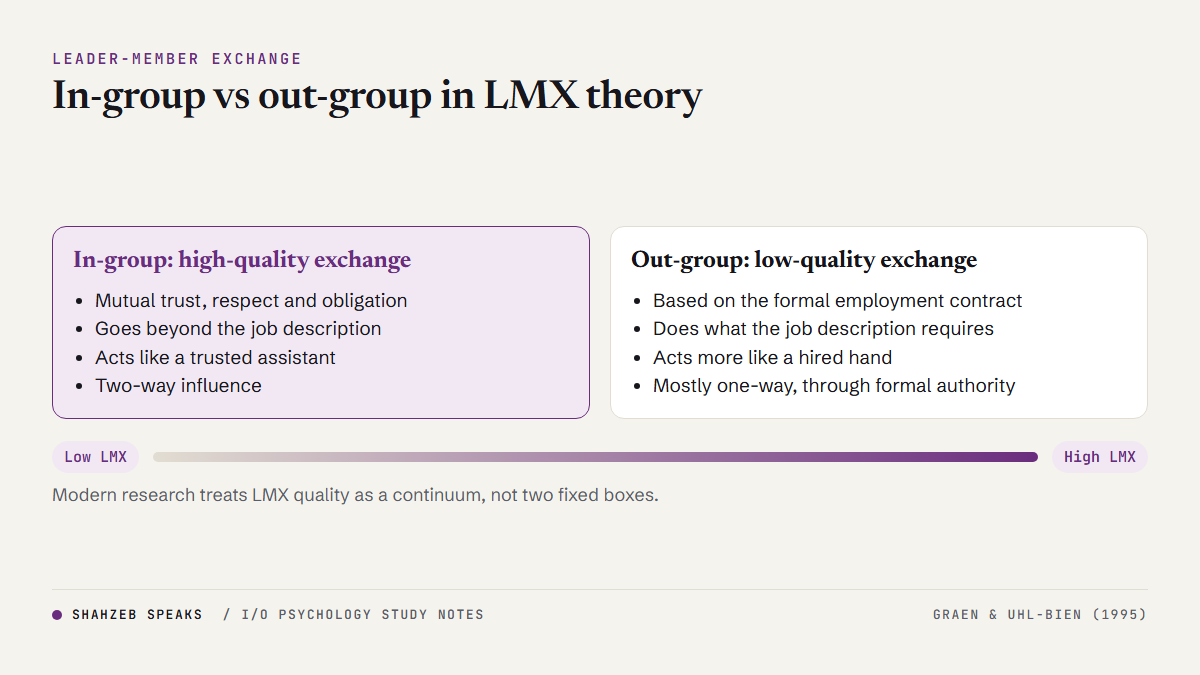
| Feature | In-group (high-quality LMX) | Out-group (low-quality LMX) |
|---|---|---|
| Basis of the relationship | Mutual trust, respect and obligation | The formal employment contract |
| What the member does | Goes beyond the job description; acts like a trusted assistant | Does what the job description requires |
| What the leader gives | Information, support, challenging assignments, attention | What the member needs to do the job |
| Influence | Two-way; the member’s opinion shapes decisions | Mostly one-way, through formal authority |
| Typical outcomes found in research | Higher performance ratings, satisfaction and commitment; lower turnover intentions | The reverse pattern |
| Example in a Karachi bank branch | The officer the manager phones first about a problem account | The officer who hears about a new target at the morning meeting |
Notice that nobody in this picture is “bad”. Out-group members are not lazy; they are doing their contracted job. The theory’s point is that leaders have limited time and trust, and they share it unevenly, often without noticing. That uneven sharing is where the fairness problems come from (see the criticisms below, and our post on organisational justice).
How do LMX relationships develop?
Two descriptions of relationship development appear in textbooks. Both come from Graen’s research group, and you can use either in an exam as long as you name the source.
Role taking, role making, role routinisation (Graen & Scandura, 1987)
This earlier model describes how a new member’s role takes shape. In role taking, the member joins, shows their skills, and the leader forms a first impression. In role making, the two negotiate what the member’s role will really be, and this is where members start to drift into higher- or lower-quality exchanges. In role routinisation, the pattern settles into a stable, ongoing exchange. Not every relationship completes all three stages.
The life cycle of leadership making (Graen & Uhl-Bien, 1995)
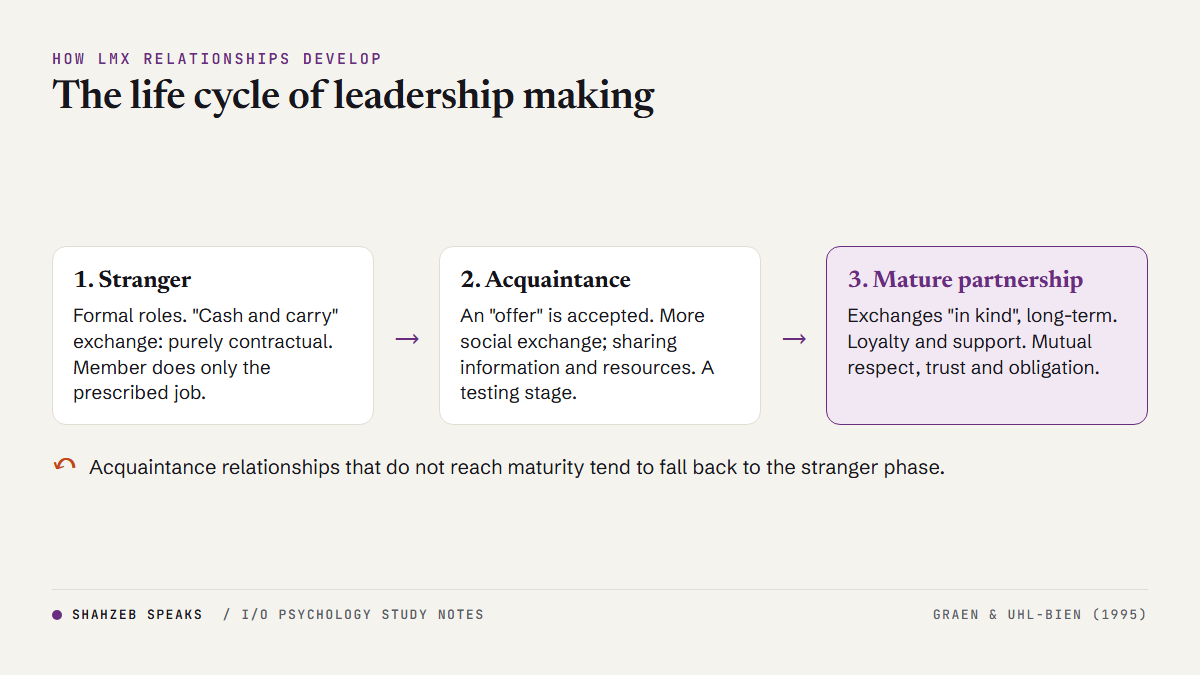
- Stranger phase. Leader and member come together in their formal roles. Exchanges are contractual, a “cash and carry” economic exchange: the leader gives only what the member needs to perform, and the member does only the prescribed job.
- Acquaintance phase. Either side makes an “offer” of a better working relationship, for example the leader offers a career-relevant assignment, or the member volunteers for extra work. If it is accepted, more social exchange follows. They share more information and resources, both personal and work-related. It is a testing stage: favours are still returned equally and within a short time.
- Mature partnership. Exchanges are highly developed and “in kind”, and the return can come much later. Each side can count on the other for loyalty and support. Mutual respect, trust and obligation grow, and the leader’s influence, and the member’s, is at its highest.
Graen and Uhl-Bien (1995) note an important trap: acquaintance-phase relationships that do not move on to maturity tend to fall back to the stranger phase. Their practical message was that leaders should offer partnership-building opportunities to every member, not only to the few they like at first sight.
Picture a new call-centre agent in Manila or Lahore. In the first month, the team lead explains targets and scripts (stranger). The agent offers to cover a difficult night shift; the lead notices and asks the agent to help train newer staff (acquaintance). A year later, the lead consults the agent on rota changes and backs them for promotion, and the agent stays late when the floor is short (mature partnership).
The four stages of LMX theory, and how LMX is measured
The four stages in the theory’s own development
Do not confuse the life cycle of one relationship with the history of the theory. Graen and Uhl-Bien (1995) described four stages in the development of LMX theory itself:
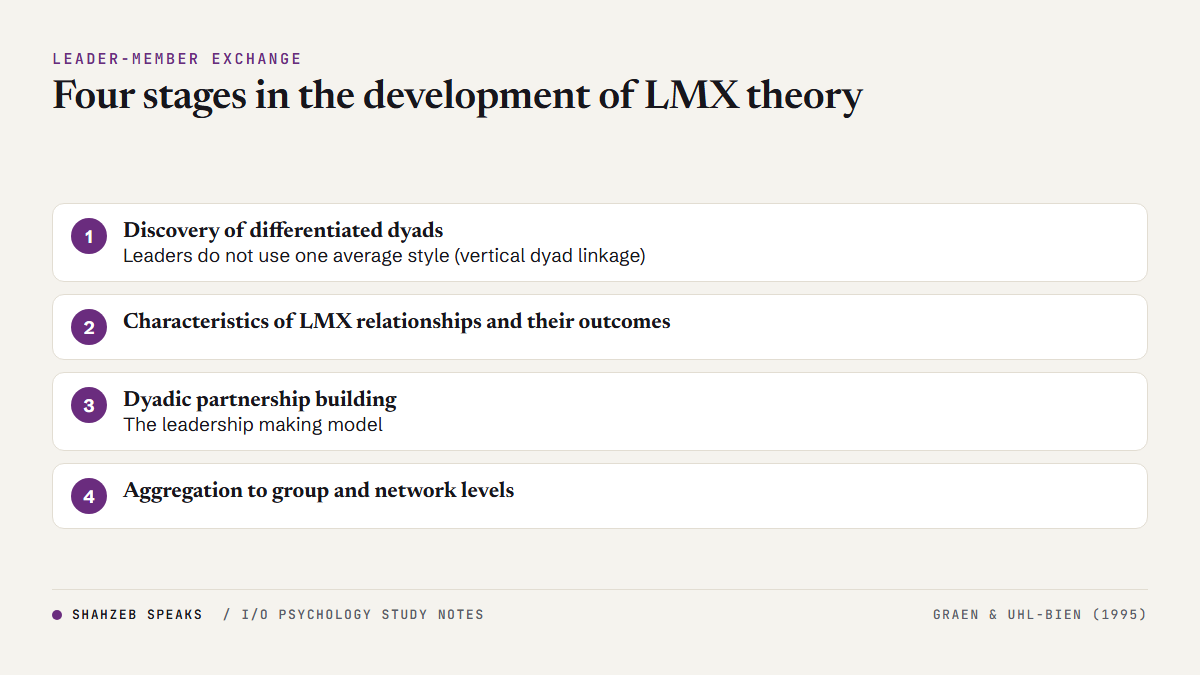
- Stage 1: discovery of differentiated dyads. The VDL studies showed that leaders do not have one average style but different relationships with each member.
- Stage 2: characteristics of LMX relationships and their outcomes. Research asked what high-quality relationships look like and what they lead to in the organisation.
- Stage 3: dyadic partnership building. The “leadership making” model: how leaders can build more high-quality relationships.
- Stage 4: aggregation to group and network levels. How many dyads combine into the larger structure of a team or organisation.
How is LMX measured?
Graen and Uhl-Bien (1995) recommended a seven-item measure, the LMX-7. Each item is answered on a 5-point scale and the items are summed; a parallel leader form asks the same seven questions about the member. The items ask, in broad terms, how well the member knows where they stand, how well the leader understands their problems and potential, and how effective the working relationship is. The authors described LMX as having three dimensions: respect, trust and obligation. The exact item wording is printed in their 1995 article; quote it from there, with citation, if your thesis uses it.
Others argued LMX has several distinct dimensions. Dienesch and Liden (1986) proposed contribution, loyalty and affect, and Liden and Maslyn (1998) developed a multidimensional measure (LMX-MDM) with four dimensions: affect, loyalty, contribution and professional respect. Whether LMX is one dimension or several is still debated. For thesis students, the practical choice is usually between LMX-7 (short, one overall score) and LMX-MDM (more detail). Our scales for I/O theses page has licence notes for common measures.
What does research say about LMX?
LMX is one of the most studied leadership theories. Three meta-analyses are worth knowing by name:
- Gerstner and Day (1997) found that LMX was related to job performance, satisfaction with the supervisor, overall job satisfaction, organisational commitment and role clarity, and negatively related to role conflict and turnover intentions. They also examined measurement issues, including how far leaders and members agree when they rate the same relationship.
- Ilies, Nahrgang and Morgeson (2007) found a positive link between LMX and citizenship behaviour, the helpful extra-role behaviour described in our post on organisational citizenship behaviour.
- Dulebohn, Bommer, Liden, Brouer and Ferris (2012) combined 247 studies (290 samples) covering 21 antecedents and 16 consequences of LMX. Leader characteristics and behaviour explained the most variance in LMX quality, and LMX often acted as the mediator, the link through which leader behaviour affected outcomes. The LMX scale used, the country and the work setting did not change results much, though national power distance and individualism moderated some relationships.
Strengths of LMX theory
- It describes what people actually see at work: managers do have favourites and inner circles.
- It is the main theory that treats the leader-follower relationship as the unit of study.
- It has strong, repeated links with performance, satisfaction, commitment and turnover intentions.
- It gives leaders something concrete to work on: offer every member a chance to move beyond the stranger phase.
Criticisms of LMX theory
- Fairness. An in-group can look like favouritism, and out-group members may see it as unjust. This links LMX to organisational justice and to whether people feel safe to speak up (psychological safety).
- How exactly are high-quality relationships built? The leadership-making model describes phases, but gives limited detail on what to do in each.
- Measurement. Researchers disagree on whether LMX has one dimension or several, and on whether leader and member ratings should agree.
- Cause and effect. Much of the evidence is cross-sectional, so a good performer may earn high LMX as much as high LMX creates a good performer.
Using LMX at work: a South Asian view
In many Pakistani and Indian organisations, LMX-type differences are easy to see: the “trusted” officer who travels with the regional head, the nurse the ward sister relies on for every audit. Because the gap often grows from first impressions, a practical step for a manager is to make the first “offer” deliberately to every new joiner: one stretch task, one honest feedback conversation, one moment of public credit (see employee recognition). For employees, the theory suggests that accepting or making these offers matters; out-group status often reflects a relationship that never moved past the contract, not a fixed judgement. When promises in the exchange are broken, the damage is better explained by the psychological contract.
10-mark answer structure: “Explain leader-member exchange (LMX) theory”
- Definition: LMX (Graen and colleagues; Dansereau, Graen & Haga, 1975; Graen & Uhl-Bien, 1995): leaders form relationships of different quality with each member.
- Origin: vertical dyad linkage, rejection of the “average leadership style”; the dyad as the unit of study.
- In-group vs out-group: trust, respect, obligation vs contractual exchange; a short two-column table.
- Development: stranger, acquaintance, mature partnership (draw the three-step diagram); mention role taking, role making, role routinisation.
- Four stages of the theory (one line each) and measurement (LMX-7; LMX-MDM).
- Research: Gerstner and Day (1997), Dulebohn et al. (2012): performance, satisfaction, commitment, lower turnover intentions.
- Criticisms: fairness, unclear how to build high LMX, measurement, causality.
- Example and conclusion: one workplace example; LMX shows leadership is a relationship, not only a style.
Model opening line: “Leader-member exchange theory holds that leaders do not treat all followers alike; they form high-quality partnerships with some and contract-level exchanges with others, and the quality of each relationship shapes performance and attitudes.”
Practice MCQs: LMX theory
Practice questions written to the published syllabus of typical I/O psychology courses, not past-paper questions. More on the leadership MCQs page.
-
The earliest version of LMX theory was called:
- Path-goal theory
- Vertical dyad linkage
- Contingency model
- Full range leadership
Show answer
B. Dansereau, Graen and Haga (1975) called it the vertical dyad linkage approach. Path-goal is House’s, the contingency model is Fiedler’s, and full range leadership is Bass and Avolio’s.
-
The unit of analysis in LMX theory is:
- The leader’s personality
- The whole work group
- The leader-member pair (dyad)
- The organisation’s culture
Show answer
C. LMX studies each leader-member dyad. Personality is trait theory; group-level and culture views come from other theories (Stage 4 of LMX later aggregates dyads, but the dyad is still the building block).
-
Which finding led to LMX theory?
- Leaders use one average style with all subordinates
- Different subordinates described the same leader very differently
- Extraversion predicts leader emergence
- Task structure determines leader effectiveness
Show answer
B. The VDL studies found differentiated relationships, which rejected the average-style assumption (A). C is trait research; D is part of Fiedler’s model.
-
Which phase of leadership making is described as a “cash and carry” exchange?
- Stranger
- Acquaintance
- Mature partnership
- Role routinisation
Show answer
A. In the stranger phase, exchanges are purely contractual. Acquaintance adds social exchange, mature partnership adds loyalty and long-term reciprocity, and role routinisation belongs to the other (1987) model.
-
An officer is consulted by her manager on decisions, gets the interesting projects and often stays late without being asked. In LMX terms she is most likely:
- In a low-quality exchange
- In a high-quality exchange (in-group)
- In the stranger phase
- Showing management by exception
Show answer
B. Two-way influence, extra resources and extra-role effort mark a high-quality exchange. The stranger phase is contractual; management by exception is a transactional leadership behaviour.
-
According to Graen and Uhl-Bien (1995), what tends to happen to relationships that stall at the acquaintance phase?
- They jump straight to partnership
- They fall back to the stranger phase
- They become transformational
- They stay at acquaintance forever
Show answer
B. The authors say dyads that do not develop to the mature stage eventually fall back to the first stage. They do not jump ahead or become “transformational”, which is a different theory.
-
Which of these is NOT one of Graen and Uhl-Bien’s four stages of LMX theory development?
- Discovery of differentiated dyads
- Dyadic partnership building
- Matching leader style to situational favourableness
- Aggregation to group and network levels
Show answer
C. Matching style to favourableness is Fiedler’s contingency model. The other three are LMX stages 1, 3 and 4 (stage 2 is characteristics and outcomes of LMX relationships).
-
The LMX-7 measure recommended by Graen and Uhl-Bien (1995) has:
- Seven items rated on a 5-point scale
- 45 items in self and rater forms
- 18 bipolar adjective pairs
- Four dimensions scored separately
Show answer
A. LMX-7 has seven 5-point items. 45 items describes the MLQ, adjective pairs describe Fiedler’s LPC scale, and four dimensions describe the multidimensional LMX-MDM.
-
In the meta-analysis by Dulebohn et al. (2012), which group of antecedents explained the most variance in LMX quality?
- Follower characteristics
- Leader characteristics and behaviour
- Contextual variables
- Organisation size
Show answer
B. Leader variables explained the most variance. Follower, relationship and contextual variables were also significant, but smaller; organisation size was not the headline finding.
-
Which is the most common ethical criticism of LMX theory?
- It ignores followers completely
- An in-group can create perceived unfairness for the out-group
- It has no research support
- It assumes leadership style is fixed
Show answer
B. Unequal relationships can feel like favouritism. LMX is built around followers, it has strong research support, and the fixed-style assumption belongs to Fiedler.
Practise on your phone
The free I/O Psychology Prep app has 410 explained
questions, flashcards and an exam countdown, and works offline. Get it on Google Play
· About the app
Questions students ask
Who gave LMX theory?
George Graen and colleagues. The first version was the vertical dyad linkage approach of Dansereau, Graen and Haga (1975), and the best-known review is Graen and Uhl-Bien (1995), which traced the theory over 25 years.
What is LMX theory in simple words?
Your manager does not have the same relationship with everyone in your team. With some people the relationship is built on trust and give-and-take beyond the job; with others it stays at the level of the job contract. LMX theory studies the quality of each of these relationships and what it leads to.
What are the in-group and out-group in LMX?
The in-group are members with high-quality exchanges: mutual trust, respect, obligation and extra effort. The out-group are members with low-quality exchanges limited to the formal job. Current research treats these as two ends of a continuum rather than two fixed groups.
What are the stages of LMX?
For one relationship: stranger, acquaintance and mature partnership (Graen & Uhl-Bien, 1995), or role taking, role making and role routinisation (Graen & Scandura, 1987). For the theory’s history: differentiated dyads, characteristics and outcomes, partnership building, and group and network levels.
How is LMX different from transformational leadership?
Transformational leadership describes what a leader does with followers in general: vision, inspiration, coaching. LMX describes the quality of each separate leader-follower relationship. The two are linked; see transformational vs transactional leadership.
Is LMX a good thesis topic?
Yes, it is widely used in theses because short measures exist (LMX-7) and it links to many outcomes such as commitment, citizenship behaviour and turnover intention. See I/O psychology thesis topics for model designs.
Revise leadership offline
The free I/O Psychology Prep app has 410 explained
questions, flashcards and an exam countdown, and works offline. Get it on Google Play
· About the app
References
- Dansereau, F., Graen, G., & Haga, W. J. (1975). A vertical dyad linkage approach to leadership within formal organizations. Organizational Behavior and Human Performance, 13(1), 46-78. https://doi.org/10.1016/0030-5073(75)90005-7
- Dienesch, R. M., & Liden, R. C. (1986). Leader-member exchange model of leadership: A critique and further development. Academy of Management Review, 11(3), 618-634. https://doi.org/10.2307/258314
- Dulebohn, J. H., Bommer, W. H., Liden, R. C., Brouer, R. L., & Ferris, G. R. (2012). A meta-analysis of antecedents and consequences of leader-member exchange. Journal of Management, 38(6), 1715-1759. https://doi.org/10.1177/0149206311415280
- Gerstner, C. R., & Day, D. V. (1997). Meta-analytic review of leader-member exchange theory: Correlates and construct issues. Journal of Applied Psychology, 82(6), 827-844. https://doi.org/10.1037/0021-9010.82.6.827
- Graen, G. B., & Scandura, T. A. (1987). Toward a psychology of dyadic organizing. Research in Organizational Behavior, 9, 175-208.
- Graen, G. B., & Uhl-Bien, M. (1995). Relationship-based approach to leadership: Development of leader-member exchange (LMX) theory of leadership over 25 years: Applying a multi-level multi-domain perspective. The Leadership Quarterly, 6(2), 219-247. https://doi.org/10.1016/1048-9843(95)90036-5
- Ilies, R., Nahrgang, J. D., & Morgeson, F. P. (2007). Leader-member exchange and citizenship behaviors: A meta-analysis. Journal of Applied Psychology, 92(1), 269-277. https://doi.org/10.1037/0021-9010.92.1.269
- Liden, R. C., & Maslyn, J. M. (1998). Multidimensionality of leader-member exchange: An empirical assessment through scale development. Journal of Management, 24(1), 43-72. https://doi.org/10.1016/S0149-2063(99)80053-1
LMX is part of the leadership theories in I/O psychology hub. Compare it with Fiedler’s contingency model, path-goal theory and transformational vs transactional leadership.