
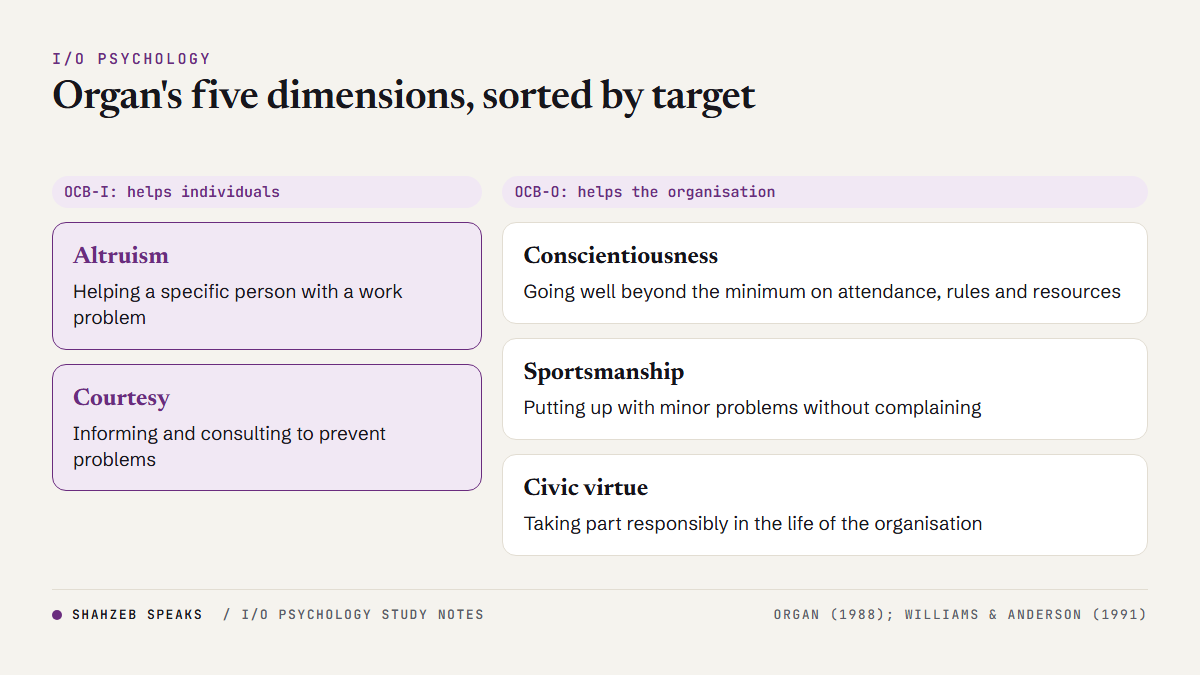
Organizational citizenship behavior (OCB) is helpful, voluntary behaviour at work that goes beyond the formal job and helps the organisation run well. Dennis Organ (1988) described five dimensions: altruism, conscientiousness, sportsmanship, courtesy and civic virtue. Williams and Anderson (1991) later split OCB by target: OCB-I helps individuals, OCB-O helps the organisation.
This guide is for students preparing for an exam question on OCB, or planning a thesis with OCB as a variable. It covers where the idea came from, Organ’s five dimensions with workplace examples, the OCB-I and OCB-O split, how the definition changed in 1997, what predicts OCB, what OCB leads to, its “dark side”, and how to measure it. You also get a 10-mark answer plan, 10 practice MCQs with explanations and the original references.
What is organizational citizenship behavior?
Think of a teacher in a government school in Hyderabad who stays after classes to help a struggling student, warns the next teacher that the projector is broken, and turns up to the optional staff meeting about the new syllabus. None of this is in her job description, nobody pays her for it, and the school would still run without it. But a school full of such teachers runs much better. That is the core of OCB.
Organ’s (1988) definition has three parts. OCB is:
- Discretionary: the employee chooses to do it; it is not an enforceable part of the role.
- Not directly or explicitly rewarded by the formal reward system.
- Helpful in the aggregate: one act is small, but many acts across many people make the organisation work better.
Where did the idea come from?
Daniel Katz (1964) argued that an organisation needs more than people who join, stay and do their prescribed tasks. It also needs spontaneous, innovative behaviour that no job description can list in advance. In 1983, two papers turned this into a research topic:
- Bateman and Organ (1983) asked supervisors to rate a wide range of employee activities and found that these “citizenship” ratings related to job satisfaction (measured with the JDI) more strongly than satisfaction usually relates to performance.
- Smith, Organ and Near (1983) studied 422 employees and their supervisors in 58 departments of two banks. Citizenship had at least two dimensions: altruism (helping specific people) and generalised compliance (a more impersonal, conscientious kind of citizenship). Job satisfaction predicted altruism but not compliance.
Organ’s 1988 book, Organizational Citizenship Behavior: The Good Soldier Syndrome, then set out the five-dimension model that most textbooks teach.
Organ’s five dimensions of OCB, with examples
| Dimension | What it means | Workplace example | Main target |
|---|---|---|---|
| Altruism | Helping a specific person with a work task or problem | A bank officer shows a new colleague how to use the core banking system | Individual (OCB-I) |
| Conscientiousness | Going well beyond the minimum in attendance, punctuality, rules and use of resources | A lab technician never takes extra breaks and switches off equipment to save power | Organisation (OCB-O) |
| Sportsmanship | Putting up with minor problems and inconveniences without complaining | A nurse accepts a reshuffled duty roster during a staff shortage without grumbling | Organisation (OCB-O) |
| Courtesy | Preventing problems for others by informing and consulting them first | An engineer tells the maintenance team before changing a machine setting | Individual (OCB-I) |
| Civic virtue | Taking part responsibly in the life of the organisation | A hospital pharmacist joins the optional medicine-safety committee | Organisation (OCB-O) |
A tip for exams: courtesy and altruism are easy to confuse. Altruism is helping someone with a problem they already have. Courtesy is acting before the problem happens, for example by giving notice or consulting.
OCB-I vs OCB-O: Williams and Anderson (1991)
Williams and Anderson (1991) proposed a simpler, two-part view based on who benefits:
- OCB-I (individual): behaviour that helps specific people and, through them, the organisation. Altruism and courtesy fit here.
- OCB-O (organisation): behaviour that helps the organisation in general, such as following informal rules, giving advance notice of absence, or protecting property. Conscientiousness, sportsmanship and civic virtue fit here.
They also measured in-role behaviour (IRB), the duties the job formally requires. Using supervisor ratings of 127 employees, their factor analysis separated in-role behaviour from the two forms of OCB. This mattered because critics had asked whether “extra-role” behaviour could really be told apart from normal job performance. They also found that job cognitions (intrinsic and extrinsic satisfaction judgements) related differently to the two kinds of OCB.
For a thesis, the OCB-I/OCB-O split is often more practical than five dimensions, because short scales with five sub-dimensions tend to have low reliability for each sub-dimension.
How the definition changed: Organ (1997)
By the 1990s, critics pointed out that helping and civic behaviour often is rewarded (managers notice it in appraisals) and that the line between “in-role” and “extra-role” differs between jobs and between supervisors. Organ (1997) accepted this. He wrote that it was no longer useful to define OCB as extra-role, beyond the job or unrewarded, and proposed defining it along the lines of what Borman and Motowidlo (1993) called contextual performance: behaviour that supports the social and psychological environment in which the core tasks are done.
So, for an exam: the 1988 definition says “discretionary and not formally rewarded”; the 1997 revision says “performance that supports the context of the work”. Both are worth writing down, with the reason for the change.
Podsakoff, MacKenzie, Paine and Bachrach (2000) reviewed the field and found that many labels in the literature described overlapping behaviours. Their review is the best single source if your examiner asks how OCB relates to related ideas such as prosocial behaviour, extra-role behaviour and contextual performance.
What predicts OCB?
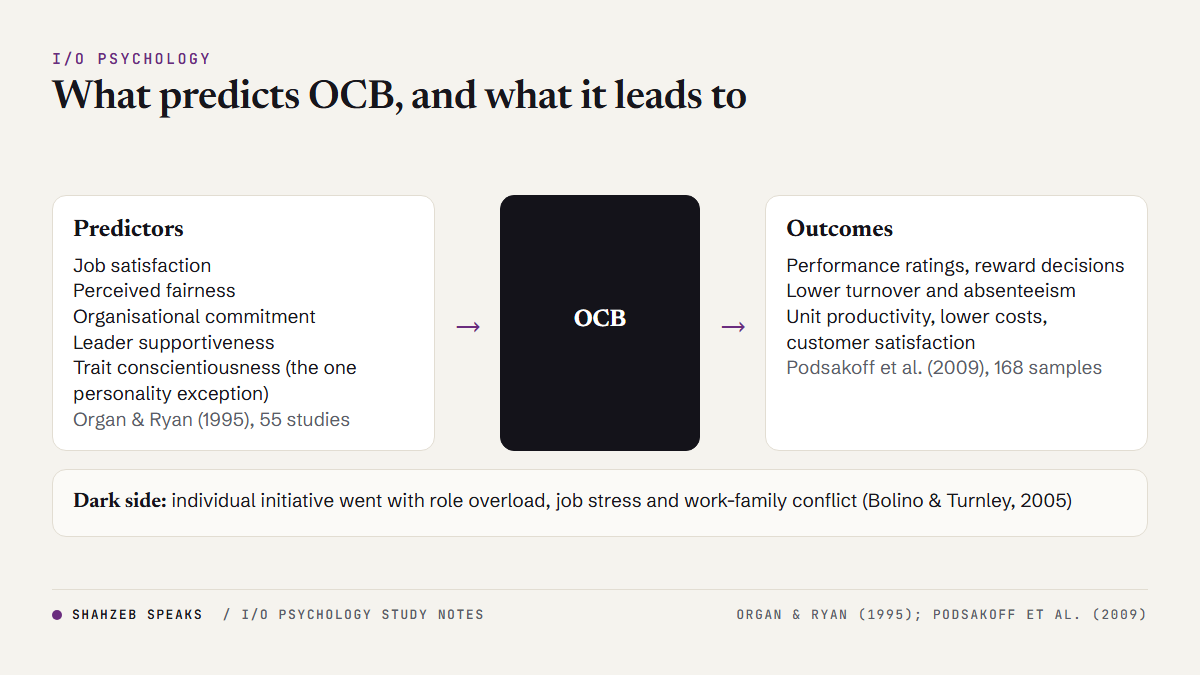
Organ and Ryan (1995) meta-analysed 55 studies. Their main findings:
- Job attitudes predict OCB well. Job satisfaction, perceived fairness, organisational commitment and leader supportiveness all correlated with OCB at roughly the same level.
- Satisfaction was more strongly related to OCB than to in-role performance, at least among non-managerial and non-professional groups.
- Personality predicts OCB less well, except conscientiousness.
- Self-ratings of OCB gave higher correlations than ratings by others, which suggests inflation from common method variance. This is a warning for any thesis that measures both OCB and its predictors with one self-report questionnaire.
The fairness link connects OCB with organisational justice, and the commitment link with Meyer and Allen’s three-component model. For satisfaction, see job satisfaction theories and measures.
Does OCB matter? Outcomes and the dark side
Podsakoff, Whiting, Podsakoff and Blume (2009) meta-analysed 168 samples (51,235 individuals). OCB was related to managers’ ratings of performance, reward decisions, and lower turnover intention, actual turnover and absenteeism. At unit level (38 samples, 3,611 units), OCB was related to productivity, efficiency, lower costs, customer satisfaction and lower unit turnover. Relationships with unit performance were somewhat stronger in longitudinal studies than in cross-sectional ones, which the authors read as some evidence that OCB causes better performance.
OCB also has costs. Bolino and Turnley (2005) studied 98 couples and found that employees high on individual initiative (a form of OCB) reported more role overload, job stress and work-family conflict, and the link with work-family conflict was stronger for women. In workplaces where staying late is expected, “voluntary” help can become an unpaid duty. Fox, Spector, Goh, Bruursema and Kessler (2012) found, with a frequency-based checklist, that OCB and counterproductive behaviour could even be positively related in some samples, and that job stressors went with more OCB, not less. Read more on the opposite construct in counterproductive work behaviour.
How to measure OCB in a thesis
- Podsakoff, MacKenzie, Moorman and Fetter (1990): a 24-item measure of Organ’s five dimensions, usually rated by supervisors.
- Williams and Anderson (1991): OCB-I, OCB-O and in-role behaviour scales, rated by supervisors.
- OCB Checklist (OCB-C), Fox, Spector and colleagues: a frequency checklist (how often the person did each act) in 43-, 36-, 20- and 10-item versions. On 3 November 2026, Paul Spector’s site offered it free for non-commercial research, including student theses, on condition that you share your results with him and keep the copyright notice.
For the first two, I could not find an owner statement on permission, so check with the author/publisher before you print them in your questionnaire. More options are in the table of scales for I/O psychology theses.
Two design points examiners raise:
- Who rates? Self-rated OCB inflates correlations (Organ and Ryan, 1995). Where you can, get supervisor or peer ratings, or at least collect predictors and OCB at different times. See common method bias in research methods for an I/O thesis.
- Agreement or frequency? Fox et al. (2012) argued that agreement-style items and items that describe the absence of bad behaviour can make OCB look like the opposite of CWB. Frequency checklists avoid this.
If supervisors rate several employees each, check rater agreement with the rwg and ICC calculator and the intraclass correlation calculator.
10-mark answer structure
- Definition (1 mark): Organ (1988): discretionary behaviour, not directly rewarded, that in total helps the organisation function.
- Origin (1 mark): Katz (1964) on spontaneous behaviour; Bateman and Organ (1983); Smith, Organ and Near (1983) on altruism and generalised compliance.
- Five dimensions (3 marks): altruism, conscientiousness, sportsmanship, courtesy, civic virtue, each with one local example.
- OCB-I vs OCB-O (1 mark): Williams and Anderson (1991); in-role behaviour as a separate factor.
- Redefinition (1 mark): Organ (1997), OCB as contextual performance.
- Antecedents and outcomes (2 marks): attitudes and fairness predict OCB (Organ and Ryan, 1995); OCB relates to ratings, rewards and lower turnover (Podsakoff et al., 2009).
- Conclusion (1 mark): OCB helps organisations, but it can overload employees (Bolino and Turnley, 2005), so it should stay voluntary and be noticed fairly.
Model opening line: “Organizational citizenship behaviour refers to discretionary employee behaviour, not directly recognised by the formal reward system, that in the aggregate promotes the effective functioning of the organisation (Organ, 1988).”
Practice MCQs: organizational citizenship behavior
Practice questions written to the published syllabus, not past-paper questions.
-
Before changing the delivery schedule, a dispatcher at a Lahore courier company calls the warehouse supervisor so the change does not catch him off guard. Which OCB dimension is this?
- Altruism
- Courtesy
- Sportsmanship
- Civic virtue
Show answer
B. Courtesy is acting ahead of time to prevent problems for others. Altruism would be helping the supervisor after a problem arose, sportsmanship is tolerating inconvenience, and civic virtue is taking part in organisational life.
-
Smith, Organ and Near (1983) found that citizenship behaviour in their bank sample had which two dimensions?
- Altruism and generalised compliance
- OCB-I and OCB-O
- Courtesy and civic virtue
- Helping and voice
Show answer
A. Their 1983 study of 422 bank employees found altruism and generalised compliance. OCB-I and OCB-O came from Williams and Anderson (1991); courtesy and civic virtue are two of Organ’s later five; helping and voice belong to other models.
-
Who argued, in 1964, that organisations need spontaneous and innovative behaviour beyond prescribed roles?
- Dennis Organ
- Daniel Katz
- Larry Williams
- Walter Borman
Show answer
B. Katz (1964) made this argument in “The motivational basis of organizational behavior”. Organ built on it from 1983, Williams co-wrote the 1991 OCB-I/OCB-O paper, and Borman co-wrote the 1993 contextual performance chapter.
-
In his 1997 paper, what did Organ propose about the definition of OCB?
- OCB should be limited to helping co-workers
- OCB should no longer be defined as extra-role or unrewarded, but along the lines of contextual performance
- OCB should be merged with task performance
- OCB should only be measured by self-report
Show answer
B. Organ (1997) dropped the extra-role and unrewarded requirements and aligned OCB with Borman and Motowidlo’s contextual performance. He did not narrow it to helping, merge it with task performance or prescribe self-report.
-
In Organ and Ryan’s (1995) meta-analysis, which type of predictor related most consistently to OCB?
- Job attitudes such as satisfaction and perceived fairness
- Cognitive ability
- Extraversion
- Age and tenure
Show answer
A. Attitudes (satisfaction, fairness, commitment, leader supportiveness) were consistent predictors. Dispositional measures predicted much less well, apart from conscientiousness; cognitive ability and demographics were not the main finding.
-
A student measures job satisfaction and OCB with one self-report questionnaire and finds r = .55. Based on Organ and Ryan (1995), what is the main concern?
- The correlation is too low to publish
- Self-rated OCB tends to inflate correlations through common method variance
- OCB cannot be related to satisfaction
- The sample must be managers only
Show answer
B. Self-ratings gave higher correlations, a sign of shared method bias, so supervisor or time-separated ratings are better. A correlation of .55 is not low, OCB does relate to satisfaction, and nothing requires a managers-only sample.
-
Bolino and Turnley (2005) linked high individual initiative with which outcomes?
- Lower stress and better family life
- Higher role overload, job stress and work-family conflict
- Faster promotion only
- No measurable outcomes
Show answer
B. In 98 couples, employees high on individual initiative reported more overload, stress and work-family conflict. This is the “dark side” of OCB; the study did not find lower stress, it was not about promotion, and the effects were measurable.
-
Which of these was NOT an organisational-level outcome linked to OCB in Podsakoff et al.’s (2009) meta-analysis?
- Productivity
- Customer satisfaction
- Reduced costs
- Higher share price
Show answer
D. The unit-level outcomes were productivity, efficiency, reduced costs, customer satisfaction and unit turnover. Share price was not among them.
-
Williams and Anderson (1991) used supervisor ratings to separate two forms of OCB from what third factor?
- Counterproductive work behaviour
- In-role behaviour
- Job satisfaction
- Organisational commitment
Show answer
B. Their factor analysis distinguished in-role behaviour from OCB-I and OCB-O. Satisfaction and commitment were predictors in the study, not rated behaviours, and CWB was not measured.
-
Using the frequency-based OCB Checklist, Fox et al. (2012) found something that surprised many researchers. What was it?
- OCB and CWB were unrelated in every sample
- OCB and CWB, and stressors and OCB, could be positively related
- OCB was identical to task performance
- Only managers showed OCB
Show answer
B. Without measurement artefacts, they found positive CWB-OCB and stressor-OCB relations, contrary to the usual strong negative link. The other options were not their findings.
Practise on your phone
The free I/O Psychology Prep app has 410 explained
questions, flashcards and an exam countdown, and works offline. Get it on Google Play
· About the app
Questions students ask
What are the 5 dimensions of OCB?
Organ’s (1988) five dimensions are altruism (helping a specific person), conscientiousness (going beyond minimum requirements), sportsmanship (tolerating minor problems without complaint), courtesy (preventing problems by informing others) and civic virtue (taking part responsibly in organisational life).
What is the difference between OCB-I and OCB-O?
OCB-I is aimed at individuals, such as helping a colleague or giving notice before acting. OCB-O is aimed at the organisation as a whole, such as following informal rules or protecting company property. The split comes from Williams and Anderson (1991).
What are examples of OCB at work?
Training a new colleague without being asked, covering a shift in an emergency, informing others before a change, attending optional meetings, suggesting improvements, and not complaining about small inconveniences. In a hospital ward, a nurse who briefs the next shift fully, even when tired, is showing OCB.
Is OCB the same as contextual performance?
They are now very close. Organ (1997) proposed defining OCB along the lines of contextual performance (Borman and Motowidlo, 1993), that is, behaviour that supports the social and psychological setting of the work. Older papers keep the 1988 “extra-role, unrewarded” definition.
Which OCB scale is free for a thesis?
The OCB Checklist (OCB-C) by Fox and Spector is free for non-commercial research if you share results with the author, according to Paul Spector’s site on 3 November 2026. For the Podsakoff et al. (1990) and Williams and Anderson (1991) scales, check with the author/publisher.
Is OCB always good?
No. It can lead to overload, stress and work-family conflict (Bolino and Turnley, 2005), and when it becomes expected it stops being voluntary. Good managers notice and reward it fairly rather than demanding it.
Free calculators for your OCB thesis
For supervisor-rated OCB, check rater agreement with the free rwg and ICC calculator, and check your scale with the composite reliability and AVE calculator and the item analysis calculator. For revision, the free I/O Psychology Prep app is on Google Play.
References
- Bateman, T. S., & Organ, D. W. (1983). Job satisfaction and the good soldier: The relationship between affect and employee “citizenship”. Academy of Management Journal, 26(4), 587-595. https://doi.org/10.2307/255908
- Bolino, M. C., & Turnley, W. H. (2005). The personal costs of citizenship behavior: The relationship between individual initiative and role overload, job stress, and work-family conflict. Journal of Applied Psychology, 90(4), 740-748. https://doi.org/10.1037/0021-9010.90.4.740
- Borman, W. C., & Motowidlo, S. J. (1993). Expanding the criterion domain to include elements of contextual performance. In N. Schmitt & W. C. Borman (Eds.), Personnel selection in organizations (pp. 71-98). Jossey-Bass.
- Fox, S., Spector, P. E., Goh, A., Bruursema, K., & Kessler, S. R. (2012). The deviant citizen: Measuring potential positive relations between counterproductive work behaviour and organizational citizenship behaviour. Journal of Occupational and Organizational Psychology, 85(1), 199-220. https://doi.org/10.1111/j.2044-8325.2011.02032.x
- Katz, D. (1964). The motivational basis of organizational behavior. Behavioral Science, 9(2), 131-146. https://doi.org/10.1002/bs.3830090206
- Organ, D. W. (1988). Organizational citizenship behavior: The good soldier syndrome. Lexington Books.
- Organ, D. W. (1997). Organizational citizenship behavior: It’s construct clean-up time. Human Performance, 10(2), 85-97. https://doi.org/10.1207/s15327043hup1002_2
- Organ, D. W., & Ryan, K. (1995). A meta-analytic review of attitudinal and dispositional predictors of organizational citizenship behavior. Personnel Psychology, 48(4), 775-802. https://doi.org/10.1111/j.1744-6570.1995.tb01781.x
- Podsakoff, N. P., Whiting, S. W., Podsakoff, P. M., & Blume, B. D. (2009). Individual- and organizational-level consequences of organizational citizenship behaviors: A meta-analysis. Journal of Applied Psychology, 94(1), 122-141. https://doi.org/10.1037/a0013079
- Podsakoff, P. M., MacKenzie, S. B., Moorman, R. H., & Fetter, R. (1990). Transformational leader behaviors and their effects on followers’ trust in leader, satisfaction, and organizational citizenship behaviors. The Leadership Quarterly, 1(2), 107-142. https://doi.org/10.1016/1048-9843(90)90009-7
- Podsakoff, P. M., MacKenzie, S. B., Paine, J. B., & Bachrach, D. G. (2000). Organizational citizenship behaviors: A critical review of the theoretical and empirical literature and suggestions for future research. Journal of Management, 26(3), 513-563. https://doi.org/10.1177/014920630002600307
- Smith, C. A., Organ, D. W., & Near, J. P. (1983). Organizational citizenship behavior: Its nature and antecedents. Journal of Applied Psychology, 68(4), 653-663. https://doi.org/10.1037/0021-9010.68.4.653
- Williams, L. J., & Anderson, S. E. (1991). Job satisfaction and organizational commitment as predictors of organizational citizenship and in-role behaviors. Journal of Management, 17(3), 601-617. https://doi.org/10.1177/014920639101700305
This post is part of the I/O psychology thesis topics hub. Related: counterproductive work behaviour, the psychological contract, work motivation theories and the job attitudes MCQs. Students in Pakistan can also read about industrial psychology in Pakistan.