
Job attitudes are how people feel about and evaluate their work. The main ones in I/O exams are job satisfaction (Locke, 1976), organisational commitment with its affective, continuance and normative parts (Allen and Meyer, 1990), and work engagement (Kahn, 1990; Schaufeli et al., 2002). They are linked to behaviours: citizenship (OCB), counterproductive work behaviour (CWB) and the psychological contract.
This page is for students revising the job attitudes chapter for semester papers, competitive exams or a thesis viva. It gives a short summary, one comparison table, a 10-mark answer plan and 25 practice questions with explanations. The questions are practice questions written to the published syllabus; they are not past-paper or board questions.
This chapter is also where many theses start. If you are measuring these variables, read the licence notes at the end of the summary before you put any scale in an appendix.
Job attitudes and work behaviour in 450 words
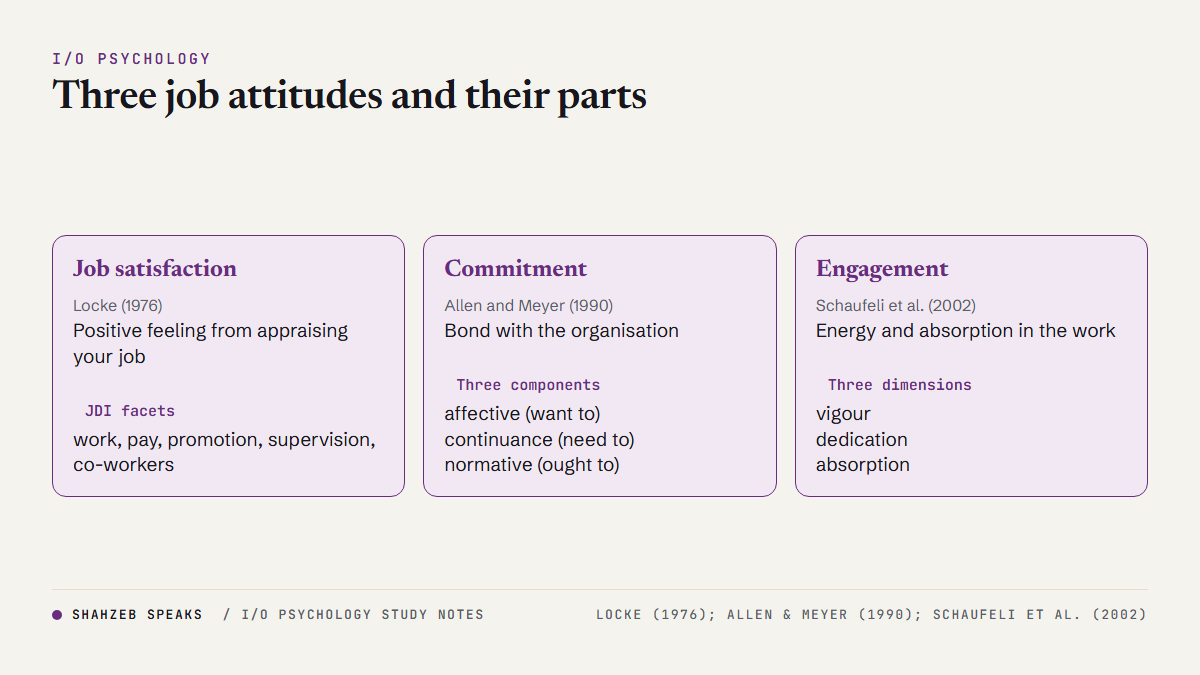
Job satisfaction. Locke (1976) described job satisfaction as a pleasant or positive emotional state that comes from appraising one’s job or job experiences. It can be measured globally or by facets. The Job Descriptive Index (Smith, Kendall and Hulin, 1969) covers five facets: the work itself, pay, promotion opportunities, supervision and co-workers. Spector’s (1985) Job Satisfaction Survey has 36 items across nine facets. Across many studies, the corrected correlation between satisfaction and performance is about .30 (Judge et al., 2001): real, but moderate.
Organisational commitment. Allen and Meyer (1990) and Meyer and Allen (1991) describe three components. Affective commitment is emotional attachment (I stay because I want to). Continuance commitment is awareness of the costs of leaving (I stay because I need to). Normative commitment is a felt obligation (I stay because I ought to). In a meta-analysis, affective commitment had the strongest links with lower turnover and with better performance and citizenship, while continuance commitment was unrelated or negatively related to performance (Meyer et al., 2002).
Organisational citizenship behaviour (OCB). OCB is discretionary behaviour that is not formally rewarded but helps the organisation run (Organ, 1988). Organ’s five dimensions are altruism, conscientiousness, sportsmanship, courtesy and civic virtue. Williams and Anderson (1991) split OCB by target: OCB-I helps individuals, OCB-O helps the organisation.
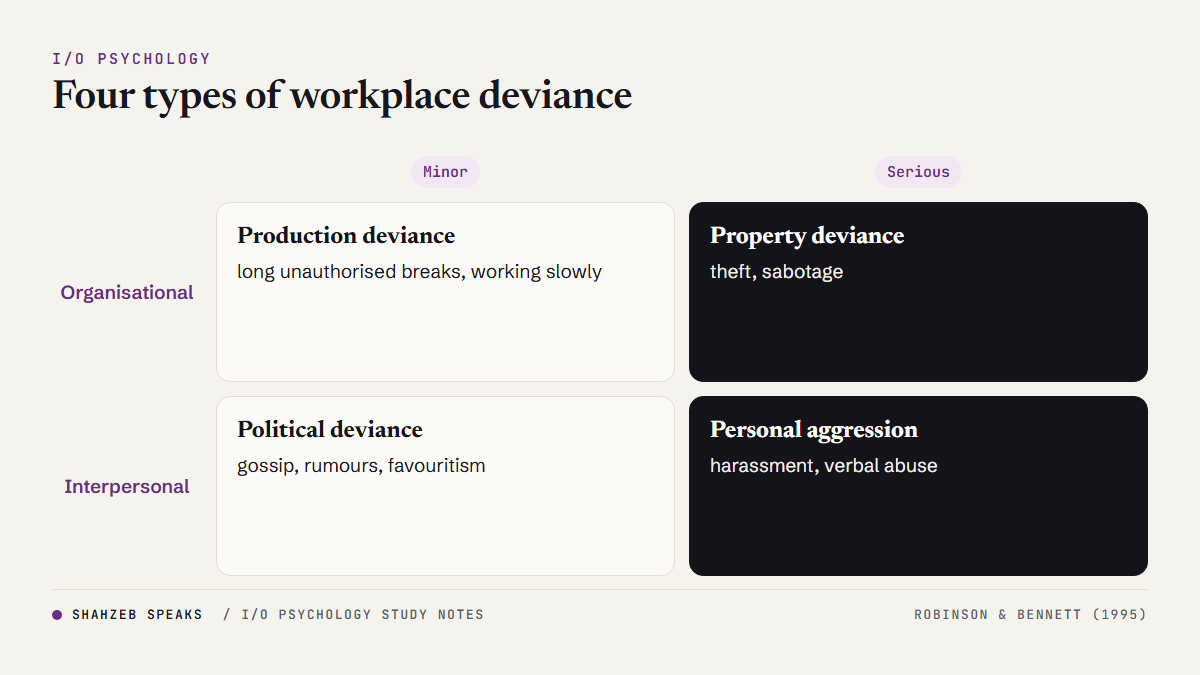
Counterproductive work behaviour (CWB). CWB is voluntary behaviour that harms the organisation or its people. Robinson and Bennett (1995) mapped deviance on two dimensions, minor versus serious and interpersonal versus organisational, which gives four types: production deviance, property deviance, political deviance and personal aggression. Spector et al. (2006) used five dimensions: abuse toward others, production deviance, sabotage, theft and withdrawal. OCB and CWB are only moderately negatively related, so they are separate constructs rather than two ends of one scale (Dalal, 2005).
Engagement. Kahn (1990) described personal engagement as bringing yourself to work physically, cognitively and emotionally, which depends on meaningfulness, safety and availability. Schaufeli et al. (2002) defined work engagement as a positive, fulfilling state of mind marked by vigour, dedication and absorption.
Psychological contract. Rousseau (1989) defined it as an employee’s beliefs about the mutual obligations between them and the employer. Contracts range from transactional (short-term, money-focused) to relational (long-term, loyalty and development). Morrison and Robinson (1997) separated breach, the perception that a promise was not kept, from violation, the emotional reaction of anger and betrayal.
Licence note for thesis students. Scales such as the JDI, the commitment scales and the engagement scales are copyrighted or have terms of use. Name the scale, authors, year and number of items in your methods chapter, and get the items and permission from the authors or publisher. This page does not reprint any scale items.
Job attitudes compared in one table
| Construct | Core idea | Key source | Parts or dimensions | Workplace example |
|---|---|---|---|---|
| Job satisfaction | Positive feeling from appraising your job | Locke (1976) | Global or facets (JDI: work, pay, promotion, supervision, co-workers) | A teacher who likes her classes but not her pay |
| Commitment | Bond with the organisation | Allen and Meyer (1990) | Affective, continuance, normative | A banker who stays for the pension |
| Engagement | Energy and absorption in the work | Kahn (1990); Schaufeli et al. (2002) | Vigour, dedication, absorption | A nurse who loses track of time on a busy shift |
| OCB | Helpful extra-role behaviour | Organ (1988) | Altruism, conscientiousness, sportsmanship, courtesy, civic virtue | Training a new colleague unasked |
| CWB | Voluntary harmful behaviour | Robinson and Bennett (1995) | Production, property, political, personal aggression | Taking long unauthorised breaks |
| Psychological contract | Beliefs about mutual obligations | Rousseau (1989) | Transactional, relational; breach vs violation | A promised promotion that never comes |
Practice MCQs: job attitudes, OCB, CWB and the psychological contract (25 questions)
-
Locke (1976) described job satisfaction as:
- A pleasant or positive emotional state resulting from the appraisal of one’s job or job experiences
- The number of years an employee stays with one employer
- The difference between pay and the market rate
- A personality trait fixed at birth
Show answer
A. Locke’s definition links satisfaction to an evaluation of the job and the feeling that follows. Tenure is a behaviour, pay gaps are one possible cause, and satisfaction is an attitude, not a fixed trait.
-
Which of these is NOT one of the five facets of the Job Descriptive Index (Smith, Kendall and Hulin, 1969)?
- Pay
- Supervision
- Fringe benefits
- Co-workers
Show answer
C. The JDI facets are the work itself, pay, promotion opportunities, supervision and co-workers. Fringe benefits is a facet of Spector’s Job Satisfaction Survey, which is why it is a tempting wrong answer.
-
A 36-item measure of job satisfaction with nine facets, first developed for human service organisations, is:
- The Job Descriptive Index
- Spector’s Job Satisfaction Survey
- The Position Analysis Questionnaire
- The Maslach Burnout Inventory
Show answer
B. Spector (1985) built the JSS with 36 items in nine facets. The JDI has five facets, the PAQ is a job analysis tool and the MBI measures burnout.
-
Judge and colleagues (2001) combined over 300 samples on job satisfaction and job performance. Their corrected mean correlation of about .30 is best described as:
- Zero: satisfaction and performance are unrelated
- Perfect: satisfaction causes performance
- Negative: happy workers perform worse
- A moderate positive relationship
Show answer
D. A correlation of about .30 is moderate and positive. It does not show which causes which, and it is clearly not zero, perfect or negative.
-
An accountant in a Karachi firm says, “I would leave tomorrow, but I would lose my gratuity and I doubt I’d find a job at this salary.” Which component of commitment does this show?
- Affective
- Normative
- Continuance
- Engagement
Show answer
C. Continuance commitment is staying because leaving would cost too much. Affective is wanting to stay, normative is feeling obliged to stay, and engagement is not a commitment component.
-
A junior doctor says, “The hospital paid for my specialist training, so I feel I owe it a few years.” This reflects:
- Normative commitment
- Continuance commitment
- Affective commitment
- Psychological contract violation
Show answer
A. Normative commitment is a sense of obligation (“I ought to stay”). There is no mention of costs (continuance) or emotional attachment (affective), and nothing was broken (violation).
-
In Meyer and colleagues’ (2002) meta-analysis, which commitment component had the strongest links with lower turnover and with better performance and citizenship?
- Continuance
- Affective
- Normative
- All three were equally related
Show answer
B. Affective commitment showed the strongest favourable relationships. Normative was weaker, and continuance commitment was unrelated or negatively related to performance.
-
An employee has high continuance commitment but low affective commitment. What is the most likely pattern?
- Stays, but does only the minimum required
- Leaves at once and works very hard until then
- Shows very high citizenship behaviour
- Becomes highly engaged
Show answer
A. Continuance commitment keeps people in the job, but without emotional attachment there is little reason to go beyond the role. The other options describe high affective commitment or engagement.
-
Which of these is the clearest example of organisational citizenship behaviour?
- A cashier completing her assigned shift
- A nurse staying 15 minutes after her shift, unasked, to show a new colleague the charting system
- A clerk taking an extra-long lunch
- A manager approving overtime pay
Show answer
B. OCB is discretionary, not formally rewarded and helpful. A is in-role duty, C is a counterproductive behaviour and D is a formal managerial task.
-
Which of the following is NOT one of Organ’s (1988) five OCB dimensions?
- Altruism
- Civic virtue
- Sportsmanship
- Absorption
Show answer
D. Organ’s five are altruism, conscientiousness, sportsmanship, courtesy and civic virtue. Absorption is a dimension of work engagement (Schaufeli et al., 2002).
-
During an office move, a team member puts up with a cramped temporary desk for two months without complaining. Which OCB dimension is this?
- Civic virtue
- Courtesy
- Sportsmanship
- Altruism
Show answer
C. Sportsmanship is tolerating minor inconveniences without complaint. Civic virtue is taking part in organisational life, courtesy is preventing problems for others, and altruism is helping a specific person.
-
A lecturer attends optional faculty meetings and reads every policy update so she can give useful input. Which OCB dimension fits best?
- Civic virtue
- Sportsmanship
- Altruism
- Production deviance
Show answer
A. Civic virtue is responsible participation in the life of the organisation. Sportsmanship is about not complaining, altruism is helping a person, and production deviance is a CWB.
-
An agent covers a colleague’s calls while the colleague takes a family emergency phone call. In Williams and Anderson’s (1991) terms this is:
- OCB-O
- OCB-I
- In-role performance
- Personal aggression
Show answer
B. OCB-I is aimed at a specific individual. OCB-O is aimed at the organisation as a whole (for example, following informal rules), in-role is required work, and personal aggression is a type of deviance.
-
Robinson and Bennett (1995) organised workplace deviance on which two dimensions?
- Intentional–accidental and paid–unpaid
- Minor–serious and interpersonal–organisational
- Task–contextual and individual–team
- Formal–informal and public–private
Show answer
B. Their multidimensional scaling study found severity (minor to serious) and target (interpersonal to organisational). The other pairs are not from their typology.
-
Taking long unauthorised breaks and deliberately working slowly fall into which quadrant of Robinson and Bennett’s typology?
- Property deviance
- Political deviance
- Personal aggression
- Production deviance
Show answer
D. Production deviance is minor and aimed at the organisation. Property deviance (serious, organisational) includes theft and sabotage; political deviance (minor, interpersonal) includes gossip and favouritism; personal aggression (serious, interpersonal) includes harassment and verbal abuse.
-
A supervisor spreads rumours about a co-worker and shows favouritism in shift allocation. This is:
- Political deviance
- Property deviance
- Production deviance
- Civic virtue
Show answer
A. Political deviance is minor behaviour aimed at people, such as gossip, blaming others or favouritism. It is not about damaging property or slowing work, and civic virtue is an OCB.
-
Which of these is NOT one of the five CWB dimensions used by Spector et al. (2006)?
- Abuse toward others
- Sabotage
- Civic virtue
- Withdrawal
Show answer
C. Their five dimensions are abuse toward others, production deviance, sabotage, theft and withdrawal. Civic virtue is an OCB dimension.
-
Dalal’s (2005) meta-analysis looked at the relationship between OCB and CWB. What did it conclude?
- They are the same construct measured twice
- They are unrelated
- They are moderately negatively related, so they are separate constructs rather than opposite ends of one scale
- High OCB always means high CWB
Show answer
C. The correlation was negative but only moderate, so a person can show some of both. A and B overstate or understate the link, and D reverses its direction.
-
Kahn (1990) said people engage at work when three psychological conditions are present. Which is NOT one of them?
- Meaningfulness
- Safety
- Availability
- Pay equity
Show answer
D. Kahn’s conditions are meaningfulness, psychological safety and availability (having the physical and emotional resources to engage). Pay equity relates to equity theory, not to Kahn’s model.
-
Schaufeli and colleagues (2002) defined work engagement by three dimensions. They are:
- Vigour, dedication and absorption
- Exhaustion, cynicism and inefficacy
- Affective, continuance and normative
- Altruism, courtesy and civic virtue
Show answer
A. Vigour (energy), dedication (involvement and pride) and absorption (being engrossed). B describes burnout, C is commitment and D lists OCB dimensions.
-
Kahn (1990) described engaged employees as expressing themselves at work in which three ways?
- Financially, socially and legally
- Physically, cognitively and emotionally
- Formally, informally and digitally
- Individually, in teams and in unions
Show answer
B. Kahn’s personal engagement means bringing your physical, cognitive and emotional self into the role. The other lists are not part of his theory.
-
Rousseau (1989) defined the psychological contract as:
- The signed employment contract
- The union’s collective agreement
- An individual’s beliefs about the mutual obligations between them and the organisation
- The job description
Show answer
C. The psychological contract is subjective and mostly unwritten: what the employee believes each side has promised. Written contracts, union agreements and job descriptions are formal documents.
-
A call-centre agent on a six-month contract expects fair pay for hours worked and nothing more, and offers nothing beyond the job. This is closest to a:
- Relational psychological contract
- Transactional psychological contract
- Normative commitment
- Psychological contract violation
Show answer
B. Transactional contracts are short-term, specific and money-focused. Relational contracts involve long-term loyalty and development. Nothing has been broken, so there is no violation.
-
An officer notices that the promotion she was promised at her interview has gone to someone else (1). She then feels angry and betrayed (2). Using Morrison and Robinson (1997):
- (1) is violation and (2) is breach
- (1) is breach and (2) is violation
- Both are breach
- Both are transactional contracts
Show answer
B. Breach is the cognitive perception that a promise was not kept; violation is the emotional reaction that can follow. A swaps them, and C and D ignore the difference.
-
Zhao and colleagues’ (2007) meta-analysis linked psychological contract breach with several outcomes. Which outcome is NOT expected after a breach?
- Lower job satisfaction
- Higher intention to quit
- Lower organisational commitment
- Higher organisational citizenship behaviour
Show answer
D. Breach was associated with lower satisfaction and commitment, higher turnover intentions and lower citizenship behaviour and performance. Citizenship goes down, not up.
Practise on your phone
The free I/O Psychology Prep app has 410 explained
questions, flashcards and an exam countdown, and works offline. Get it on Google Play
· About the app
Robinson and Bennett’s four types of workplace deviance
Questions 14 to 16 are easier if you can draw the two-by-two grid. The horizontal axis runs from minor to serious. The vertical axis runs from organisational (harm aimed at the organisation) to interpersonal (harm aimed at people). Production deviance is minor and organisational, property deviance is serious and organisational, political deviance is minor and interpersonal, and personal aggression is serious and interpersonal.
How to answer a long question on job attitudes
10-mark answer structure: “Discuss job satisfaction and organisational commitment and their consequences for organisations”
- Definitions: job satisfaction (Locke, 1976) and organisational commitment, with the three components (Allen and Meyer, 1990).
- Measurement: global versus facet satisfaction; name the JDI (five facets) and the JSS (nine facets). Say that items need permission.
- Consequences of satisfaction: moderate link with performance, about .30 (Judge et al., 2001).
- Consequences of commitment: affective commitment has the strongest links with lower turnover and more OCB; continuance commitment keeps people without lifting performance (Meyer et al., 2002).
- Behaviours: OCB (Organ’s five dimensions) and CWB (Robinson and Bennett’s four types).
- Local example: a bank branch where staff stay for the gratuity (continuance) but do not help each other; what that predicts.
- Critical point: correlations do not show causation, and most studies use self-reports collected at one time.
- Conclusion: organisations should aim for affective commitment through fair treatment, kept promises and meaningful work.
Model opening line: “Job satisfaction is a positive emotional state that results from appraising one’s job (Locke, 1976), while organisational commitment is the bond an employee feels with the organisation, which Allen and Meyer (1990) divided into affective, continuance and normative components.”
Questions students ask
What is the difference between job satisfaction and organisational commitment?
Satisfaction is about the job (how you feel about your work, pay, boss and colleagues). Commitment is about the organisation (your bond with the employer). You can like your job but feel little attachment to the company, or the other way round. More on measurement is in the job satisfaction theories and measures guide.
What are the three components of commitment?
Affective (want to stay), continuance (need to stay) and normative (ought to stay). The full model is in the Meyer and Allen three-component model post.
What are the five dimensions of OCB?
Organ’s (1988) five are altruism, conscientiousness, sportsmanship, courtesy and civic virtue. Examples and measures are in the OCB guide.
What is counterproductive work behaviour, with examples?
Voluntary behaviour that harms the organisation or its people, such as theft, sabotage, gossip, working slowly or verbal abuse. See the CWB guide for the types and measures.
Is engagement the same as job satisfaction?
No. Satisfaction is an evaluation of the job. Engagement is a state of energy, dedication and absorption while working (Schaufeli et al., 2002). A person can be satisfied but not especially engaged.
What is the difference between psychological contract breach and violation?
Breach is noticing that a promise was not kept; violation is the anger and sense of betrayal that may follow (Morrison and Robinson, 1997). The psychological contract post explains both with examples.
Practise on your phone
The free I/O Psychology Prep app has 410 explained
questions, flashcards and an exam countdown, and works offline. Get it on Google Play
· About the app
References
- Allen, N. J., & Meyer, J. P. (1990). The measurement and antecedents of affective, continuance and normative commitment to the organization. Journal of Occupational Psychology, 63(1), 1–18. https://doi.org/10.1111/j.2044-8325.1990.tb00506.x
- Dalal, R. S. (2005). A meta-analysis of the relationship between organizational citizenship behavior and counterproductive work behavior. Journal of Applied Psychology, 90(6), 1241–1255. https://doi.org/10.1037/0021-9010.90.6.1241
- Judge, T. A., Thoresen, C. J., Bono, J. E., & Patton, G. K. (2001). The job satisfaction–job performance relationship: A qualitative and quantitative review. Psychological Bulletin, 127(3), 376–407. https://doi.org/10.1037/0033-2909.127.3.376
- Kahn, W. A. (1990). Psychological conditions of personal engagement and disengagement at work. Academy of Management Journal, 33(4), 692–724. https://doi.org/10.2307/256287
- Locke, E. A. (1976). The nature and causes of job satisfaction. In M. D. Dunnette (Ed.), Handbook of industrial and organizational psychology (pp. 1297–1349). Rand McNally.
- Meyer, J. P., & Allen, N. J. (1991). A three-component conceptualization of organizational commitment. Human Resource Management Review, 1(1), 61–89. https://doi.org/10.1016/1053-4822(91)90011-Z
- Meyer, J. P., Stanley, D. J., Herscovitch, L., & Topolnytsky, L. (2002). Affective, continuance, and normative commitment to the organization: A meta-analysis of antecedents, correlates, and consequences. Journal of Vocational Behavior, 61(1), 20–52. https://doi.org/10.1006/jvbe.2001.1842
- Morrison, E. W., & Robinson, S. L. (1997). When employees feel betrayed: A model of how psychological contract violation develops. Academy of Management Review, 22(1), 226–256. https://doi.org/10.2307/259230
- Organ, D. W. (1988). Organizational citizenship behavior: The good soldier syndrome. Lexington Books.
- Robinson, S. L., & Bennett, R. J. (1995). A typology of deviant workplace behaviors: A multidimensional scaling study. Academy of Management Journal, 38(2), 555–572. https://doi.org/10.2307/256693
- Rousseau, D. M. (1989). Psychological and implied contracts in organizations. Employee Responsibilities and Rights Journal, 2(2), 121–139. https://doi.org/10.1007/BF01384942
- Schaufeli, W. B., Salanova, M., González-Romá, V., & Bakker, A. B. (2002). The measurement of engagement and burnout: A two sample confirmatory factor analytic approach. Journal of Happiness Studies, 3(1), 71–92. https://doi.org/10.1023/A:1015630930326
- Smith, P. C., Kendall, L. M., & Hulin, C. L. (1969). The measurement of satisfaction in work and retirement. Rand McNally.
- Spector, P. E. (1985). Measurement of human service staff satisfaction: Development of the Job Satisfaction Survey. American Journal of Community Psychology, 13(6), 693–713. https://doi.org/10.1007/BF00929796
- Spector, P. E., Fox, S., Penney, L. M., Bruursema, K., Goh, A., & Kessler, S. (2006). The dimensionality of counterproductivity: Are all counterproductive behaviors created equal? Journal of Vocational Behavior, 68(3), 446–460. https://doi.org/10.1016/j.jvb.2005.10.005
- Williams, L. J., & Anderson, S. E. (1991). Job satisfaction and organizational commitment as predictors of organizational citizenship and in-role behaviors. Journal of Management, 17(3), 601–617. https://doi.org/10.1177/014920639101700305
- Zhao, H., Wayne, S. J., Glibkowski, B. C., & Bravo, J. (2007). The impact of psychological contract breach on work-related outcomes: A meta-analysis. Personnel Psychology, 60(3), 647–680. https://doi.org/10.1111/j.1744-6570.2007.00087.x
More practice: return to the I/O psychology MCQs hub, or try the work motivation MCQs and the occupational stress and burnout MCQs. For the theory, see the work motivation and job attitudes hub and the research summary on quiet quitting.