

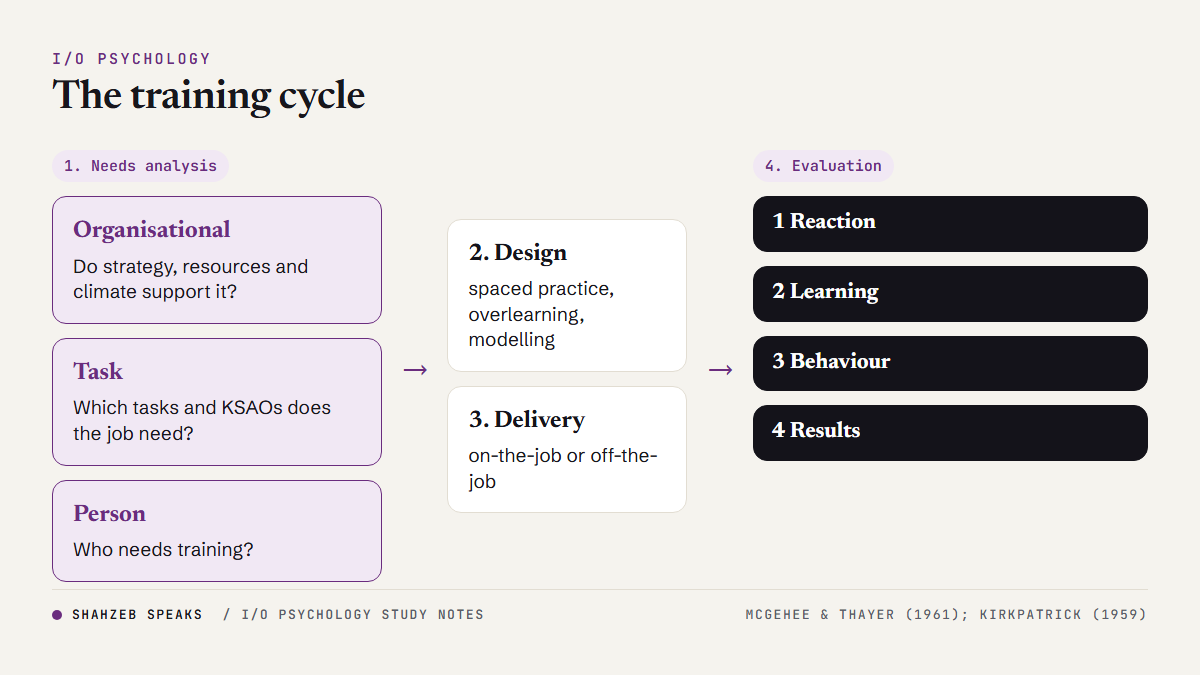
Training in I/O psychology runs in a cycle: a training needs analysis at three levels (organisation, task and person; McGehee and Thayer, 1961), then design and delivery using learning principles, then evaluation, most often with Kirkpatrick’s four levels (reaction, learning, behaviour, results). Transfer, using the skills back on the job, depends on the trainee, the design and the work environment (Baldwin and Ford, 1988).
This page is for students revising the training and development chapter for a semester exam, a viva or a competitive paper. You get a short summary of the whole topic, a table of the four evaluation levels, a 10-mark answer plan and 25 practice questions with explanations. These are practice questions written to the published syllabus (training is a set week in Punjab University’s Industrial Psychology outline, for example), not past-paper questions.
Most wrong answers on this topic come from two confusions: mixing up the three levels of needs analysis, and mixing up “learning” with “behaviour” in the four levels. The questions below test both on purpose.
Training and development in 450 words
Training needs analysis (TNA). Before anything is designed, the organisation asks whether training is the right answer and, if so, what and for whom. McGehee and Thayer (1961) set out three levels that textbooks still use. Organisational analysis asks whether the strategy, resources and climate support the training. Task analysis (they called it operations analysis) uses job analysis data to list the tasks and KSAOs the job needs. Person analysis compares each employee’s performance with the standard to find who needs training. A gap caused by broken equipment, unclear goals or poor incentives will not close with a course.
Learning outcomes. Kraiger, Ford and Salas (1993) grouped what people learn into cognitive outcomes (knowledge), skill-based outcomes (doing) and affective outcomes (attitudes and motivation, including self-efficacy).
Learning principles used in design. Spaced (distributed) practice usually gives better retention than massed practice (Donovan and Radosevich, 1999). Overlearning, practising past the point of first success, improves retention (Driskell, Willis and Copper, 1992). Behaviour modelling, built on Bandura’s social learning theory, shows a model, lets trainees practise and gives feedback; a meta-analysis found its effects were larger on learning than on job behaviour (Taylor, Russ-Eft and Chan, 2005). Identical elements theory (Thorndike and Woodworth, 1901) predicts more transfer when the training situation resembles the job.
Trainee motivation. Colquitt, LePine and Noe (2000) found that personal factors such as self-efficacy, and situational factors such as climate, predict motivation to learn, which in turn predicts learning.
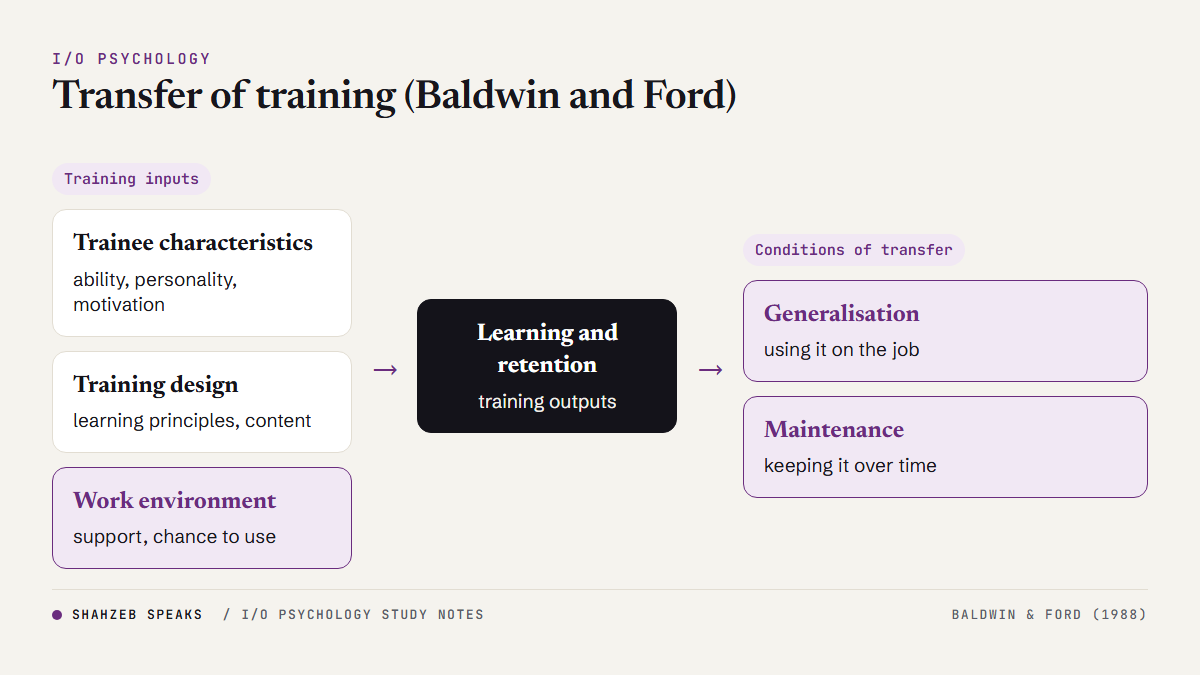
Transfer of training. Baldwin and Ford (1988) describe training inputs (trainee characteristics, training design, work environment) that affect learning and retention, which then affect transfer: generalisation to the job and maintenance over time. Supervisor support and the chance to use the skill matter (Ford et al., 1992; Tracey, Tannenbaum and Kavanagh, 1995).
Evaluation. Kirkpatrick’s four levels began as four articles in 1959. Level 1 is reaction, level 2 learning, level 3 behaviour on the job and level 4 results for the organisation. Jack Phillips later proposed a fifth level, return on investment. Alliger and colleagues (1997) found that whether trainees liked a course was only weakly related to what they learned or did later. Holton (1996) argued that the four levels are a list of outcomes rather than a tested causal model. For strong conclusions you also need a design: measure before and after, with a control group where possible.
Kirkpatrick’s four levels in one table
| Level | Question it answers | Example from a bank’s anti-fraud course | Usual timing |
|---|---|---|---|
| 1. Reaction | Did trainees find it useful and engaging? | End-of-day feedback form | Immediately |
| 2. Learning | Did knowledge, skills or attitudes change? | Test on spotting forged cheques, before and after | End of course |
| 3. Behaviour | Do they use it on the job? | Supervisor checklist of verification steps at the counter | Weeks to months later |
| 4. Results | Did the organisation gain? | Fewer fraud losses per branch | Months later |
Practice MCQs: training and development (25 questions)
-
Which of these is NOT one of the three levels of training needs analysis described by McGehee and Thayer (1961)?
- Organisational analysis
- Task (operations) analysis
- Person analysis
- Market analysis
Show answer
D. The three levels are organisational, task (operations) and person analysis. Market analysis belongs to marketing, not to training needs.
-
Before designing a digital-banking course, a Lahore bank checks whether its strategy, budget and branch managers will support the new skills. This is:
- Person analysis
- Organisational analysis
- Task analysis
- Level 3 evaluation
Show answer
B. Organisational analysis looks at goals, resources and climate. Person analysis looks at individuals, task analysis at the job’s tasks, and level 3 evaluation happens after training.
-
A supervisor compares each teller’s error rate with the branch standard to see who needs refresher training. This is:
- Person analysis
- Organisational analysis
- Job evaluation
- Reaction evaluation
Show answer
A. Person analysis asks who needs training by comparing actual performance with the standard. Job evaluation sets pay and reaction evaluation asks trainees what they thought of a course.
-
Which level of needs analysis relies most directly on job analysis data?
- Organisational analysis
- Person analysis
- Task analysis
- Results evaluation
Show answer
C. Task analysis lists the tasks and KSAOs a job needs, which is what a job analysis provides. The other options use strategy, individual performance or outcome data.
-
Average call handling time at a Manila contact centre rose sharply after a new software release that freezes several times an hour. What should the TNA conclude first?
- All agents need a two-day customer service course
- The gap is caused by the system, not by missing KSAOs, so training is not the first fix
- Only new agents need training
- Agents need a motivation workshop
Show answer
B. Needs analysis first asks whether training is the right answer at all. A software fault will not be solved by teaching people; the other options assume a skill or motivation gap the facts do not show.
-
What is the correct order of Kirkpatrick’s four levels?
- Learning, reaction, results, behaviour
- Reaction, behaviour, learning, results
- Results, behaviour, learning, reaction
- Reaction, learning, behaviour, results
Show answer
D. Reaction (did they like it), learning (did they gain knowledge or skill), behaviour (do they use it at work) and results (did the organisation benefit). The other orders mix the levels.
-
Trainees take a test on new anti-money-laundering rules at the start and end of a course. Which level is being measured?
- Reaction
- Learning
- Behaviour
- Results
Show answer
B. A knowledge test measures learning. Reaction is about opinions of the course, behaviour is about use on the job and results is about organisational outcomes.
-
Three months after a hand-hygiene course, the head nurse observes whether ward nurses follow the new steps between patients. Which level is this?
- Behaviour
- Learning
- Reaction
- Organisational analysis
Show answer
A. Watching whether people use the skill at work is level 3, behaviour. A test in the classroom would be learning, a feedback form would be reaction, and organisational analysis happens before training.
-
Which of these is a level 4 (results) measure?
- Trainees rating the trainer 4.5 out of 5
- Scores on an end-of-course quiz
- A fall in customer complaints at branches whose staff were trained
- A supervisor checklist of the new greeting steps
Show answer
C. Results are organisational outcomes such as complaints, errors, sales or turnover. A is reaction, B is learning and D is behaviour.
-
Alliger and colleagues (1997) combined many studies of training criteria. Which finding is theirs?
- Whether trainees liked a course was only weakly related to their learning and later job behaviour
- Reaction scores predict results almost perfectly
- Learning tests have no relationship with anything
- Results are always high when reactions are high
Show answer
A. Affective reactions (“I enjoyed it”) had weak links with learning and transfer; reactions about usefulness did somewhat better. That is why a feedback form alone cannot show a course worked. The other options overstate or invent relationships.
-
Kraiger, Ford and Salas (1993) grouped learning outcomes into three types. Which is NOT one of them?
- Cognitive
- Skill-based
- Affective
- Financial
Show answer
D. Their three categories are cognitive, skill-based and affective outcomes. Money is an organisational result, not a learning outcome.
-
Which criticism of the four-level framework did Holton (1996) make?
- It has too many levels to be useful
- It is a list of outcomes (a taxonomy) rather than a tested causal model, so success at one level does not guarantee the next
- It ignores reaction measures
- It was designed only for school pupils
Show answer
B. Holton argued that the levels are often treated as a causal chain without evidence, which the weak correlations in Alliger et al. (1997) also suggest. The framework does include reactions and was written for workplace training.
-
In Baldwin and Ford’s (1988) transfer model, which of these is NOT a training input?
- Trainee characteristics
- Training design
- Work environment
- Generalisation and maintenance
Show answer
D. Generalisation and maintenance are the conditions of transfer, the end of the model. The three inputs are trainee characteristics, training design and work environment.
-
A supervisor trained in coaching skills is still using them a year later. In transfer terms, this shows:
- Generalisation
- Maintenance
- Negative transfer
- A reaction effect
Show answer
B. Maintenance means the trained behaviour lasts over time. Generalisation means applying it to the job and to new situations; negative transfer means the training makes performance worse.
-
Machine operators return from a safety course to a line where the supervisor says, “Forget what they taught you, we do it our way here.” Which factor will most reduce transfer?
- Low trainee cognitive ability
- Poor training design
- A work environment with no supervisor support for the new skills
- Too much practice during training
Show answer
C. Supervisor support and a positive transfer climate help trained skills reach the job (Tracey, Tannenbaum and Kavanagh, 1995). Nothing in the case points to ability, design or practice problems.
-
Identical elements theory (Thorndike and Woodworth, 1901) predicts that transfer will be greatest when:
- The training situation closely resembles the job situation
- Training is as general and abstract as possible
- Trainees enjoy the course
- Training happens on a different day of the week
Show answer
A. The more stimuli and responses training shares with the job, the more transfer you get. This is one reason flight and machinery simulators copy real controls. Enjoyment and scheduling are not part of the theory.
-
Staff trained on an old till system keep pressing keys in the old order on a new till and make errors. This is an example of:
- Positive transfer
- Zero transfer
- Negative transfer
- Overlearning
Show answer
C. Negative transfer happens when earlier learning interferes with performance on a new task. Positive transfer helps, zero transfer has no effect, and overlearning is extra practice beyond first mastery.
-
Which schedule is most likely to give better long-term retention for the same total practice time?
- One 8-hour session on a single day
- Four 2-hour sessions spread over two weeks
- One 8-hour session the night before the skill is needed
- No practice, only reading
Show answer
B. Spaced practice usually beats massed practice for retention (Donovan and Radosevich, 1999), although the benefit is smaller for complex tasks. Reading without practice does not build a skill.
-
Fire wardens in a Karachi office tower keep rehearsing the evacuation drill after they can already do it without errors. The learning principle being used is:
- Massed practice
- Negative transfer
- Reaction evaluation
- Overlearning
Show answer
D. Overlearning, practising past the point of first success, improves retention (Driskell, Willis and Copper, 1992). It suits tasks that are rarely done but must work under stress. The other options do not describe extra practice after mastery.
-
Behaviour modelling training (watch a model, practise, get feedback) is based mainly on:
- Bandura’s social learning theory
- Herzberg’s two-factor theory
- Classical conditioning alone
- Fiedler’s contingency model
Show answer
A. Learning by observing and imitating a model comes from Bandura’s social learning theory. Taylor, Russ-Eft and Chan (2005) found its effects were larger on learning than on job behaviour. Herzberg and Fiedler are motivation and leadership theories.
-
Which of these is an on-the-job training method?
- A classroom lecture at the head office
- A two-day off-site case study workshop
- Coaching by a senior operator at the trainee’s own workstation
- An online course taken at home
Show answer
C. On-the-job methods (coaching, apprenticeship, job rotation) happen in the real work setting. Lectures, off-site workshops and home e-learning are off-the-job methods.
-
Which evaluation design gives the strongest basis for saying the training itself caused the improvement?
- A post-test of trained staff only
- Trained and untrained groups, randomly assigned, both measured before and after training
- Asking trainees whether they think they improved
- Comparing this year’s sales with last year’s for the whole company
Show answer
B. A pretest-posttest design with a randomly assigned control group rules out many other explanations, such as general improvement over time. The other designs cannot separate training from other causes.
-
The Solomon four-group design (Solomon, 1949) adds groups that skip the pretest. Its purpose is to check whether:
- Trainees liked the trainer
- Taking the pretest itself changed how people responded to the training
- The training was cheap enough
- Supervisors support transfer
Show answer
B. Comparing pretested and non-pretested groups shows whether the pretest sensitised people. It says nothing about liking, cost or supervisor support.
-
Colquitt, LePine and Noe (2000) reviewed 20 years of research on training motivation. Which trainee characteristic is linked to higher motivation to learn?
- Higher self-efficacy before training
- Not knowing why the course is needed
- Being told the course is a punishment
- Sitting in a larger training room
Show answer
A. Self-efficacy, the belief that you can learn and perform the skill, was among the personal factors related to motivation to learn. The other options are not supported, and the middle two would be expected to lower motivation.
-
An L&D manager converts the drop in fraud losses into rupees and compares it with the cost of the course. This is often called:
- Reaction evaluation
- Training needs analysis
- Job evaluation
- Return on investment, sometimes described as a fifth level
Show answer
D. Comparing monetary benefits with costs is ROI, which Jack Phillips proposed as a fifth level after results. Reaction is opinion, TNA comes before training and job evaluation sets pay. You can try a related approach with the utility analysis calculator.
Practise on your phone
The free I/O Psychology Prep app has 410 explained
questions, flashcards and an exam countdown, and works offline. Get it on Google Play
· About the app
Transfer of training: the model behind questions 13 to 16
Baldwin and Ford’s model is drawn in many exam answers, so it is worth knowing in picture form. On the left are the three training inputs: trainee characteristics (ability, personality, motivation), training design (learning principles, content) and the work environment (support, the chance to use the skill). In the middle is learning and retention. On the right is transfer, split into generalisation (using the skill on the job and in new situations) and maintenance (keeping it over time). Note that the work environment points straight to transfer as well, which is why a good course can still fail in a bad workplace.
How to answer a long question on the training process
10-mark answer structure: “Describe the steps of a training programme, from needs analysis to evaluation”
- Definition: training is a planned effort to help employees learn job-related knowledge, skills and attitudes. Say that it runs as a cycle.
- Needs analysis: the three levels from McGehee and Thayer (1961), one line and one example each. Add that some gaps are not training problems.
- Design: learning objectives, and two or three learning principles with names and years (spaced practice, overlearning, behaviour modelling, identical elements).
- Delivery: on-the-job versus off-the-job methods, with a local example such as a textile mill apprenticeship or bank e-learning.
- Transfer: Baldwin and Ford (1988) inputs and outputs; supervisor support.
- Evaluation: Kirkpatrick’s four levels with one measure each, and the need for a before-and-after design with a control group.
- Critical point: reactions are weakly related to learning and behaviour (Alliger et al., 1997); the levels are not a proven causal chain (Holton, 1996).
- Conclusion: training works when it answers a real need and the workplace lets people use what they learned.
Model opening line: “Training is a planned, systematic effort to build job-related knowledge, skills and attitudes; it works best as a cycle that starts with a needs analysis and ends with an evaluation that feeds the next round.”
Questions students ask
What are the three levels of training needs analysis?
Organisational analysis (does the organisation’s strategy and climate support it?), task analysis (what tasks and KSAOs does the job need?) and person analysis (who needs training?). The full method with an example is in the training needs analysis guide.
What are Kirkpatrick’s four levels of training evaluation?
Reaction, learning, behaviour and results. They come from a series of articles Donald Kirkpatrick began in 1959. The four levels guide has examples and criticism.
What is the difference between learning and behaviour in the four levels?
Learning (level 2) is what trainees know or can do by the end of the course, usually measured with a test. Behaviour (level 3) is whether they actually do it at work weeks or months later, usually measured by observation or supervisor ratings.
What is transfer of training?
Using what was learned in training on the job (generalisation) and keeping it up over time (maintenance). Baldwin and Ford (1988) is the standard model to cite.
Is spaced practice always better than massed practice?
Usually for retention, but not by the same amount for every task. Donovan and Radosevich (1999) found the benefit was smaller for more complex tasks.
Is the Kirkpatrick model still used?
Yes, it is the most widely taught evaluation framework. Researchers accept it as a useful list of outcomes but warn against assuming that a good reaction leads to learning, behaviour and results.
Practise on your phone
The free I/O Psychology Prep app has 410 explained
questions, flashcards and an exam countdown, and works offline. Get it on Google Play
· About the app
References
- Alliger, G. M., Tannenbaum, S. I., Bennett, W., Jr., Traver, H., & Shotland, A. (1997). A meta-analysis of the relations among training criteria. Personnel Psychology, 50(2), 341–358. https://doi.org/10.1111/j.1744-6570.1997.tb00911.x
- Baldwin, T. T., & Ford, J. K. (1988). Transfer of training: A review and directions for future research. Personnel Psychology, 41(1), 63–105. https://doi.org/10.1111/j.1744-6570.1988.tb00632.x
- Colquitt, J. A., LePine, J. A., & Noe, R. A. (2000). Toward an integrative theory of training motivation: A meta-analytic path analysis of 20 years of research. Journal of Applied Psychology, 85(5), 678–707. https://doi.org/10.1037/0021-9010.85.5.678
- Donovan, J. J., & Radosevich, D. J. (1999). A meta-analytic review of the distribution of practice effect: Now you see it, now you don’t. Journal of Applied Psychology, 84(5), 795–805. https://doi.org/10.1037/0021-9010.84.5.795
- Driskell, J. E., Willis, R. P., & Copper, C. (1992). Effect of overlearning on retention. Journal of Applied Psychology, 77(5), 615–622. https://doi.org/10.1037/0021-9010.77.5.615
- Ford, J. K., Quiñones, M. A., Sego, D. J., & Sorra, J. S. (1992). Factors affecting the opportunity to perform trained tasks on the job. Personnel Psychology, 45(3), 511–527. https://doi.org/10.1111/j.1744-6570.1992.tb00858.x
- Holton, E. F., III. (1996). The flawed four-level evaluation model. Human Resource Development Quarterly, 7(1), 5–21. https://doi.org/10.1002/hrdq.3920070103
- Kirkpatrick, D. L. (1959). Techniques for evaluating training programs. Journal of the American Society of Training Directors, 13(11), 3–9.
- Kirkpatrick, D. L. (1994). Evaluating training programs: The four levels. Berrett-Koehler.
- Kraiger, K., Ford, J. K., & Salas, E. (1993). Application of cognitive, skill-based, and affective theories of learning outcomes to new methods of training evaluation. Journal of Applied Psychology, 78(2), 311–328. https://doi.org/10.1037/0021-9010.78.2.311
- McGehee, W., & Thayer, P. W. (1961). Training in business and industry. Wiley.
- Solomon, R. L. (1949). An extension of control group design. Psychological Bulletin, 46(2), 137–150. https://doi.org/10.1037/h0062958
- Taylor, P. J., Russ-Eft, D. F., & Chan, D. W. L. (2005). A meta-analytic review of behavior modeling training. Journal of Applied Psychology, 90(4), 692–709. https://doi.org/10.1037/0021-9010.90.4.692
- Thorndike, E. L., & Woodworth, R. S. (1901). The influence of improvement in one mental function upon the efficiency of other functions (I). Psychological Review, 8(3), 247–261. https://doi.org/10.1037/h0074898
- Tracey, J. B., Tannenbaum, S. I., & Kavanagh, M. J. (1995). Applying trained skills on the job: The importance of the work environment. Journal of Applied Psychology, 80(2), 239–252. https://doi.org/10.1037/0021-9010.80.2.239
More practice: return to the I/O psychology MCQs hub, or try the job analysis MCQs and the performance appraisal MCQs. For the full theory, see the personnel psychology notes and the post on an employee’s first 90 days.