
Training needs analysis (TNA) is the process of finding out whether training is needed, what should be taught and who should be trained. McGehee and Thayer (1961) set out its three levels: organisational analysis (where training is needed and supported), task analysis (what the job requires) and person analysis (who lacks those skills). It is the first step of any training programme.
This page is for I/O psychology, HRM and MBA students who need to explain training needs analysis with its steps and levels, and for anyone writing a TNA for an internship report or a real organisation. It gives the three levels with the questions each answers, the steps in order, the methods for collecting data, a full worked example from a textile mill, a 10-mark answer plan and practice MCQs.
TNA opens the training unit of personnel psychology, and Kirkpatrick’s four levels of training evaluation close it. The personnel psychology notes pillar shows how they connect.
What is training needs analysis, and why do it?
A training need is a gap between the performance an organisation needs and the performance it gets, where the gap comes from missing knowledge or skill. Training needs analysis (also called training needs assessment) is the systematic process of finding those gaps, checking that training is the right answer, and deciding what the training must achieve.
Skipping TNA is the most common reason training fails. Without it, organisations train everyone in whatever course is popular or available, instead of the people who need specific skills. Salas, Tannenbaum, Kraiger and Smith-Jentsch (2012), reviewing the science of training, describe training as a systematic process in which what happens before training (including needs analysis) matters as much as the course itself.
TNA also answers a question managers often skip: is training the answer at all? If staff know how to do the job but lack the tools, time or motivation, training will not fix it. Mager and Pipe’s classic book Analyzing Performance Problems is built around this question: could the person do it if their life depended on it? If yes, the problem is not a skill gap.
The three levels of training needs analysis (McGehee and Thayer, 1961)
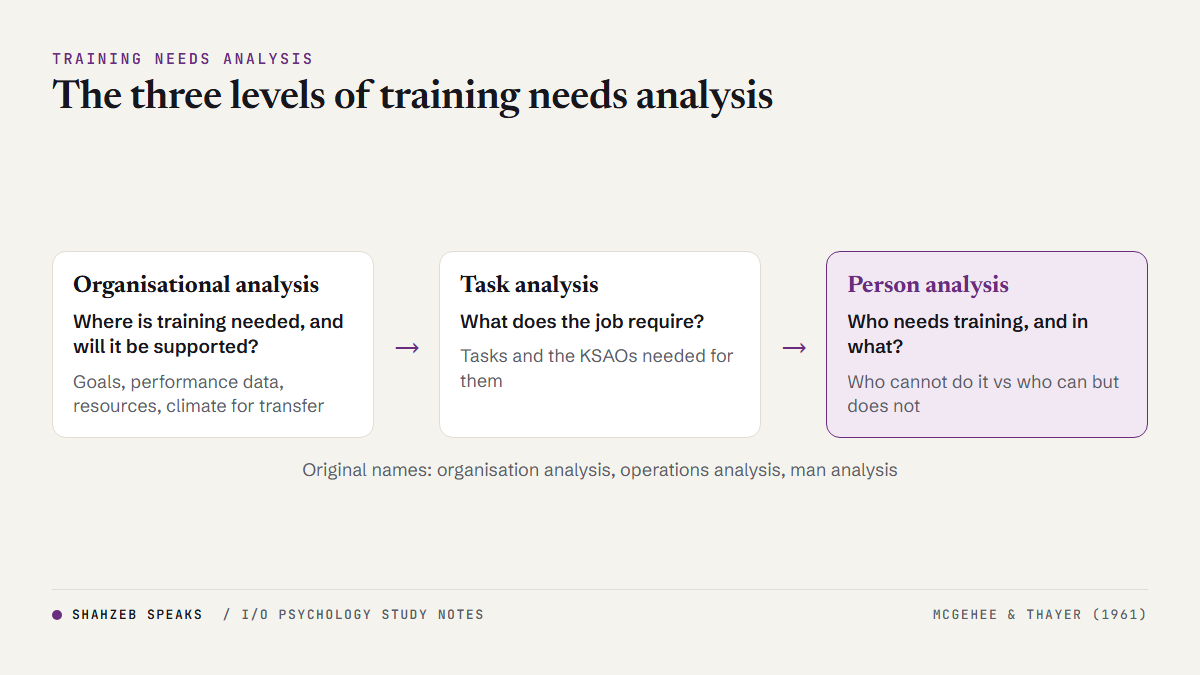
William McGehee and Paul Thayer, in Training in Business and Industry (1961), described three levels of analysis. Their original names were organisation analysis, operations analysis and man analysis; modern textbooks call them organisational, task and person analysis. Herbert and Doverspike (1990) noted that this three-part classification appears in some form in most discussions of needs analysis.
1. Organisational analysis
Question: Where in the organisation is training needed, and will the organisation support it?
Organisational analysis looks at the organisation’s goals and strategy, its performance data (errors, complaints, accidents, sales), the resources available for training (budget, trainers, time), and the climate for transfer: will managers let trained staff use their new skills? Baldwin and Ford (1988), in their review of transfer research, grouped the factors that affect whether training transfers to the job into three: trainee characteristics, training design and the work environment. An organisation that trains supervisors in coaching but then judges them only on output figures has a transfer problem that no course can solve.
2. Task analysis (operations analysis)
Question: What does the job require, and what must be learned to do it well?
Task analysis lists the tasks of the job, rates how important and how frequent each task is, and identifies the knowledge, skills, abilities and other characteristics (KSAOs) needed for each. It draws directly on job analysis methods such as interviews, questionnaires and the critical incident technique, and on the job description and specification (see job description vs job specification). The output is a list of the KSAOs that training should build.
3. Person analysis
Question: Who needs training, and in what?
Person analysis compares each employee’s current performance or skill with what the task analysis says is needed. Sources include performance appraisal results, work records, skill tests, supervisor observations and self-assessments. Herbert and Doverspike (1990) reviewed the use of performance appraisal in needs analysis and offered cautions, because appraisal ratings carry the rater errors described in performance appraisal errors. The key distinction at this level is between people who cannot do the task (a skill gap, so train them) and people who can but do not (a motivation, resource or management problem, so training will not help).
The three levels compared (table)
| Level | Main question | Typical data sources | Output |
|---|---|---|---|
| Organisational analysis | Where is training needed, and will it be supported? | Strategy documents, performance and quality data, budget, interviews with senior managers, climate surveys | Priority units, resources, transfer conditions; decision on whether training is the answer |
| Task analysis (operations analysis) | What does the job require? | Job analysis, job descriptions, SME interviews, task questionnaires, critical incidents | Important tasks and the KSAOs needed for them |
| Person analysis | Who needs training, and in what? | Appraisals, work records, skill tests, observation, self-assessment | List of people with skill gaps; “can’t do” separated from “won’t do” |
Training needs analysis steps
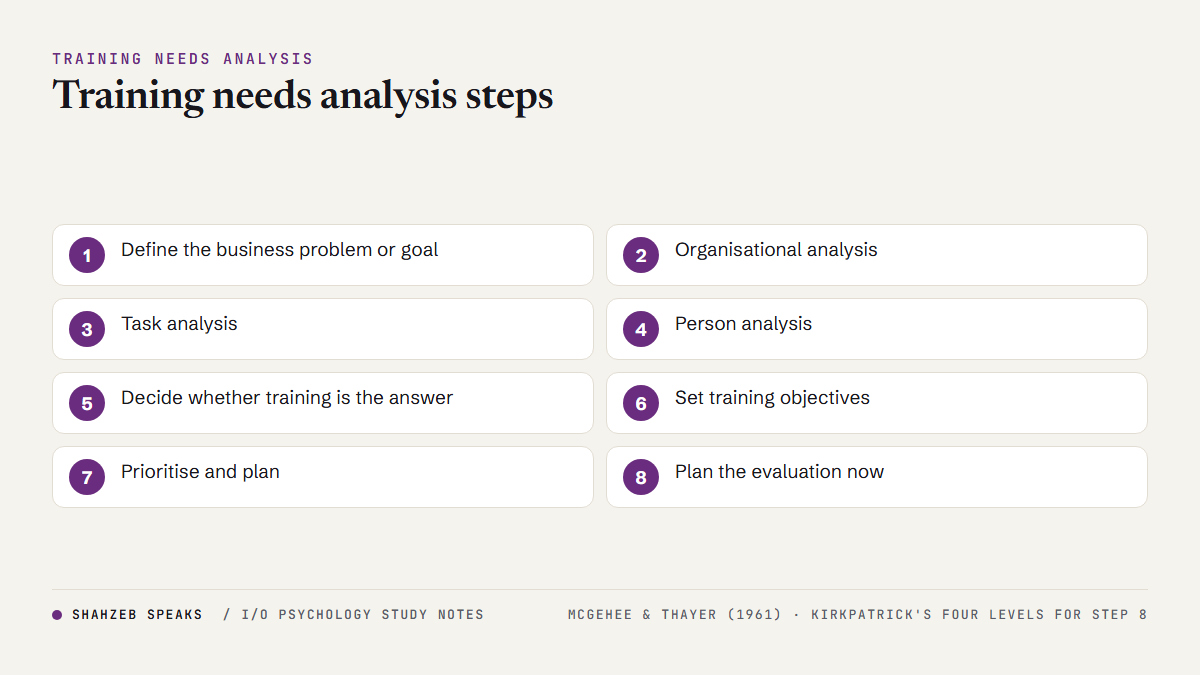
Textbooks number the steps differently, but the logic is the same. A practical sequence:
- Define the business problem or goal. Start from a performance issue or a planned change (new system, new regulation, expansion), not from a course you want to run.
- Organisational analysis. Confirm where the problem is, what it costs, what resources exist and whether the workplace will support new skills.
- Task analysis. List the tasks involved and the KSAOs they need.
- Person analysis. Find who lacks those KSAOs, and separate skill gaps from other causes.
- Decide whether training is the answer. Non-training causes (tools, staffing, targets, incentives) need non-training fixes.
- Set training objectives. Write what trainees will be able to do after training, under what conditions, to what standard.
- Prioritise and plan. Rank needs by importance and cost, choose methods and schedule.
- Plan the evaluation now. Decide how you will measure reaction, learning, behaviour and results (Kirkpatrick’s four levels) using the same gaps you found.
Methods for collecting TNA data
- Interviews with managers, supervisors and experienced staff.
- Questionnaires and surveys, useful for large or spread-out workforces.
- Observation of work as it is done.
- Performance records: quality reports, error logs, complaints, sales, audit findings.
- Tests and skill checks, which give the clearest evidence of a skill gap.
- Focus groups with job holders.
- Critical incidents: examples of effective and ineffective behaviour.
- Performance appraisal data, used with caution because of rater errors.
Useful questions to ask in TNA interviews: What does good performance look like in this job? Where do mistakes happen most? What has changed recently (systems, rules, customers)? If this person had the skill, is there anything that would still stop them using it?
Training needs analysis example: a textile mill
The following is a worked example written for teaching. The numbers are illustrative, not from a real company.
Situation. A textile mill in Faisalabad exports knitwear. Over six months, the rejection rate on one buyer’s orders in the stitching unit has risen, and the buyer has issued a warning. Management’s first idea is “send all 60 operators on a quality course”.
Organisational analysis. Quality data show the problem is concentrated in one stitching unit and on one product line introduced six months ago with a new specification sheet. Keeping the buyer is a strategic priority, there is budget for training, and supervisors say they will give trained operators time to apply new methods. Training is plausible but not yet proven to be the answer.
Task analysis. Interviews with two senior operators and the quality manager, plus observation, identify the key tasks for the new line: reading the new specification sheet, setting stitch density and thread tension for the new fabric, and checking seams against the buyer’s tolerance. The KSAOs: reading technical specifications, machine-setting skill, and knowledge of the buyer’s tolerances.
Person analysis. Defect records by operator show that 18 of the 60 operators produce most of the rejected pieces. A short practical test shows that 13 of those 18 cannot set the machine correctly from the new specification sheet: a genuine skill gap. The other 5 can set it correctly in the test but work on older machines that do not hold tension: an equipment problem, not a training need.
Decision. Train 13 operators (not 60) in reading the new specification and setting the machines, through a half-day hands-on session with a senior operator. Repair or replace the 5 older machines. Evaluate by checking the 13 operators’ test results after training (level 2), their machine settings on the line (level 3) and the unit’s rejection rate over the next two months (level 4).
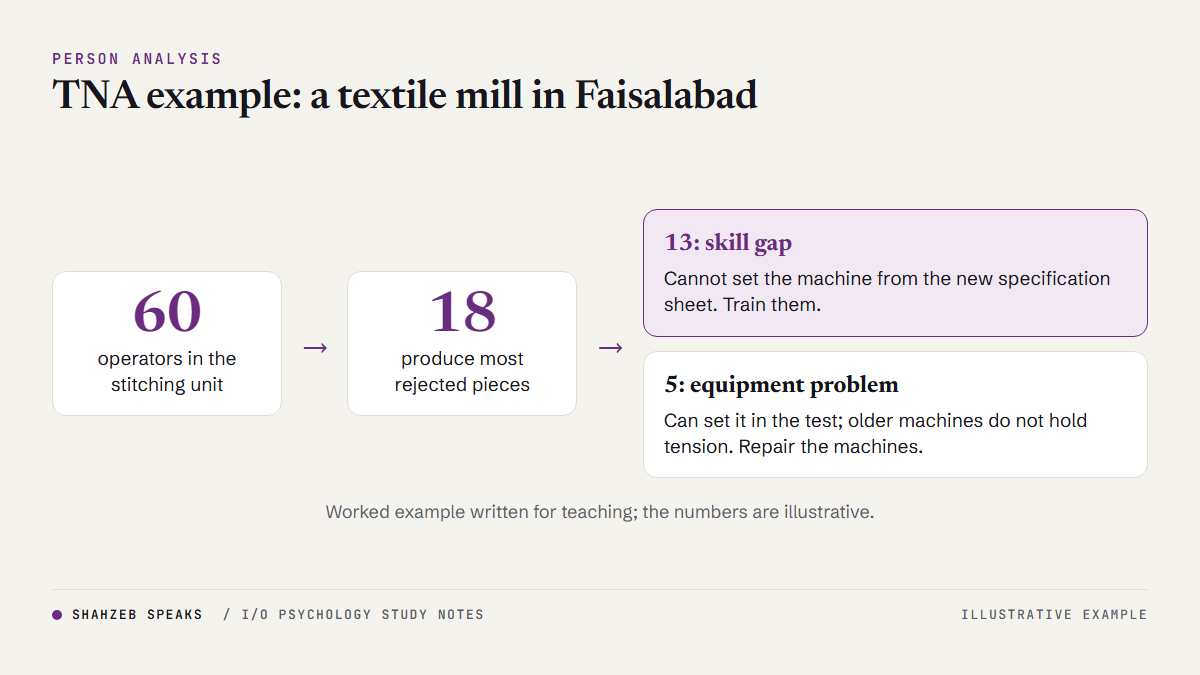
This example shows the value of TNA in one line: it turned a 60-person course into a 13-person session plus a machine repair, aimed at the real causes.
10-mark answer structure
- Definition: TNA is the systematic process of identifying gaps between required and actual performance that training can close; it is the first stage of the training cycle.
- Origin: McGehee and Thayer (1961), three levels (organisation, operations, man analysis).
- Organisational analysis: goals, resources, climate for transfer (Baldwin and Ford, 1988).
- Task analysis: tasks and KSAOs, drawn from job analysis.
- Person analysis: who needs training; “can’t do” vs “won’t do”.
- Steps and methods: list the steps and three or four data collection methods.
- Example: a short local case (textile mill, bank branch, hospital ward).
- Conclusion: TNA prevents wasted training and gives the targets for evaluation.
Model opening line: “Training needs analysis is the systematic identification of performance gaps that training can address; following McGehee and Thayer (1961), it is carried out at three levels, organisational, task and person analysis, which together decide where training is needed, what should be taught and who should be trained.”
Practice MCQs: training needs analysis
Practice questions written to the published syllabus, not past-paper items.
-
The three levels of training needs analysis were described by:
- Kirkpatrick
- McGehee and Thayer
- Smith and Kendall
- Phillips
Show answer
B. McGehee and Thayer (1961). Kirkpatrick and Phillips worked on evaluation; Smith and Kendall on BARS.
-
Checking whether managers will allow trained staff to use new skills is part of:
- organisational analysis
- task analysis
- person analysis
- level 2 evaluation
Show answer
A. The climate for transfer is an organisation-level question. Task analysis is about job requirements; person analysis about individuals.
-
Listing the tasks of a job and the KSAOs needed for each is:
- person analysis
- task analysis
- organisational analysis
- reaction evaluation
Show answer
B. Task (operations) analysis builds the list of tasks and KSAOs, usually from job analysis data.
-
An operator can set the machine perfectly in a test but does not do so on the line because the machine is faulty. The best response is:
- more training for the operator
- fix the equipment, because this is not a training need
- a forced distribution appraisal
- a level 1 reaction survey
Show answer
B. The person can do the task, so the gap is not a skill gap. Training would waste money; the equipment is the cause.
-
In McGehee and Thayer’s original terms, “man analysis” is now called:
- organisational analysis
- task analysis
- person analysis
- job evaluation
Show answer
C. Man analysis became person analysis; operations analysis became task analysis.
-
Which is NOT one of the three levels of TNA?
- Organisational analysis
- Task analysis
- Person analysis
- Results analysis
Show answer
D. “Results” is Kirkpatrick’s fourth evaluation level, not a TNA level.
-
Why should performance appraisal ratings be used with caution in person analysis?
- They are always too low
- They can contain rater errors such as halo and leniency
- They measure organisational climate
- They are not allowed by law
Show answer
B. Rater errors distort ratings, so a low rating may not mean a skill gap (Herbert and Doverspike, 1990, offered cautions on this).
-
A TNA should come before training mainly because it:
- guarantees high reaction scores
- identifies who needs what training and gives targets for evaluation
- replaces the need for evaluation
- sets employees’ salaries
Show answer
B. TNA targets training at real gaps and defines what evaluation should measure. It does not guarantee reactions or replace evaluation.
-
Baldwin and Ford (1988) grouped influences on transfer of training into:
- reaction, learning, behaviour
- trainee characteristics, training design, work environment
- organisation, task, person
- content, construct, criterion
Show answer
B. Their review covered training design, trainee and work-environment factors. Option A is Kirkpatrick, C is TNA levels, D is validity types.
-
A training objective written after TNA should state:
- the trainer’s name
- what trainees will be able to do, under what conditions, to what standard
- the training venue
- the number of tea breaks
Show answer
B. Good objectives describe observable performance, conditions and standard, so they can be evaluated later. Logistics are not objectives.
Practise on your phone
The free I/O Psychology Prep app has 410 explained
questions, flashcards and an exam countdown, and works offline. Get it on Google Play
· About the app
More practice: the training and development MCQs set.
Questions students ask
What are the three levels of training needs analysis?
Organisational analysis (where training is needed and whether the organisation will support it), task analysis (what the job requires) and person analysis (who lacks the required knowledge and skills). McGehee and Thayer described them in 1961.
What are the steps of training needs analysis?
Define the business problem, carry out organisational, task and person analysis, decide whether training is the answer, set training objectives, prioritise and plan, and plan the evaluation. The exact numbering varies between textbooks.
What methods are used to identify training needs?
Interviews, questionnaires, observation, performance records, skill tests, focus groups, critical incidents and performance appraisal data. Tests and work records give the clearest evidence; appraisal ratings need care because of rater errors.
What is the difference between training needs analysis and job analysis?
Job analysis describes what a job involves and what it requires. TNA uses that information (in its task analysis level) and adds organisational and person analysis to decide whether training is needed and for whom.
What is a good example of a training needs analysis?
A factory with rising defects checks where the defects come from (organisation), what the task requires (task), and which operators lack the skill (person). In the example above, this narrowed a plan to train 60 people to training 13 and repairing 5 machines.
When is training not the answer?
When people already know how to do the task but lack tools, time, clear targets or motivation. In those cases, fixing equipment, workloads, incentives or management will help more than a course.
Revise training topics with flashcards
The free I/O Psychology Prep app has 410 explained
questions, flashcards and an exam countdown, and works offline. Get it on Google Play
· About the app
References
- Baldwin, T. T., & Ford, J. K. (1988). Transfer of training: A review and directions for future research. Personnel Psychology, 41(1), 63-105. https://doi.org/10.1111/j.1744-6570.1988.tb00632.x
- Herbert, G. R., & Doverspike, D. (1990). Performance appraisal in the training needs analysis process: A review and critique. Public Personnel Management, 19(3), 253-270. https://doi.org/10.1177/009102609001900303
- Mager, R. F., & Pipe, P. (1984). Analyzing performance problems, or you really oughta wanna (2nd ed.). Pitman Learning.
- McGehee, W., & Thayer, P. W. (1961). Training in business and industry. Wiley.
- Salas, E., Tannenbaum, S. I., Kraiger, K., & Smith-Jentsch, K. A. (2012). The science of training and development in organizations: What matters in practice. Psychological Science in the Public Interest, 13(2), 74-101. https://doi.org/10.1177/1529100612436661
Back to the hub: Personnel psychology notes. Related: Kirkpatrick’s four levels, job analysis methods and capability anxiety and workplace skills.