
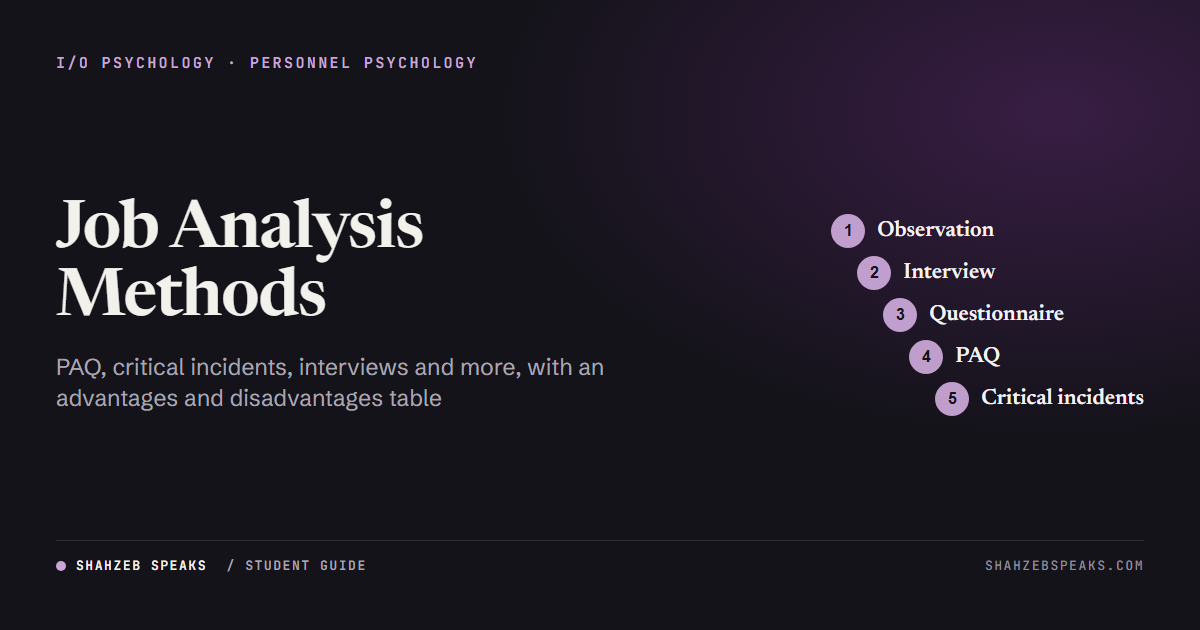
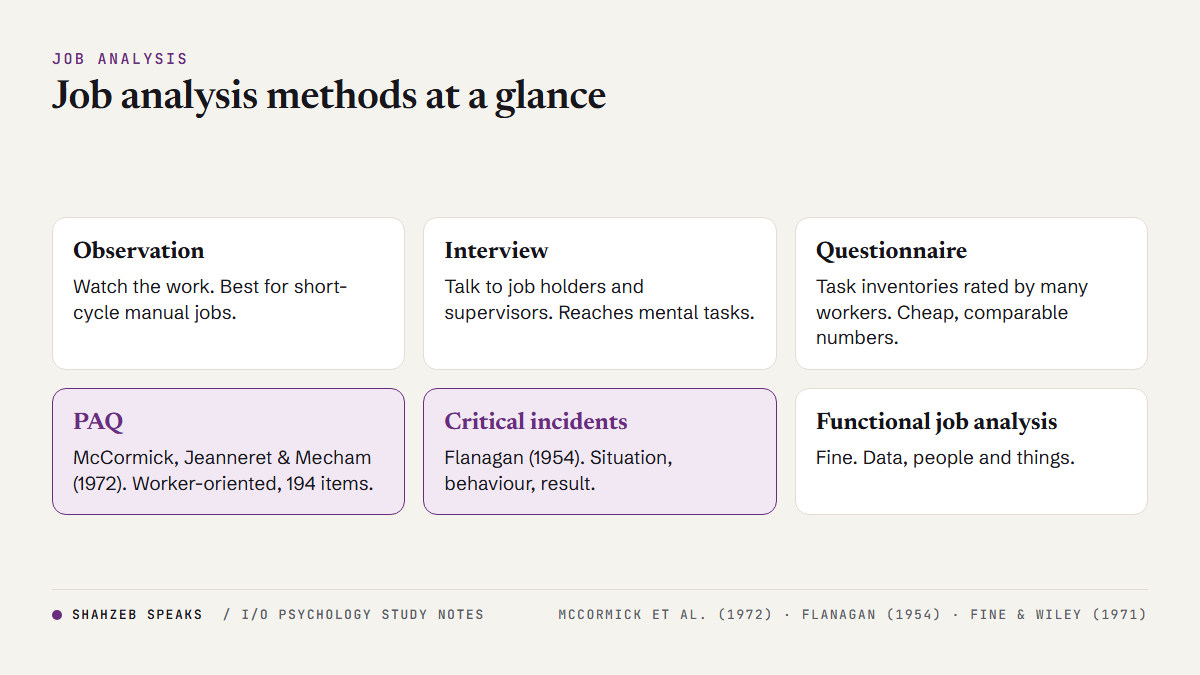
Job analysis methods are the ways an analyst collects facts about a job: observation, interviews, questionnaires, work diaries, the Position Analysis Questionnaire (PAQ; McCormick, Jeanneret and Mecham, 1972), the critical incident technique (Flanagan, 1954) and functional job analysis (Fine). Most real projects combine two or three methods, because each one misses something.
This page is for students who have “job analysis methods with advantages and disadvantages” on a BS, MSc or MBA paper, a PPSC or CSS psychology syllabus, or the Philippine psychometrician board review. It gives you each method in plain words, a table of advantages and disadvantages, the original sources with dates, a 10-mark answer plan and practice MCQs with explanations.
Job analysis is the first topic in personnel psychology for a reason. Everything that comes after it (the job description, the selection test, the appraisal form, the training plan) is only as good as the job analysis underneath. If you want the big picture first, read the personnel psychology notes pillar, then come back here.
What is job analysis, and why does it matter?
Job analysis is the systematic study of a job to find out two things: what the worker does (the tasks, duties and responsibilities) and what the worker needs to do it (the knowledge, skills, abilities and other characteristics, often shortened to KSAOs). The first set of facts becomes the job description. The second set becomes the job specification. The difference between the two is explained with examples in job description vs job specification.
Take a teller in a Pakistani bank branch. A job analysis would list tasks such as counting cash, verifying signatures, posting deposits, answering customer questions and balancing the till at the end of the day. It would then ask what a person needs for those tasks: numerical accuracy, attention to detail, knowledge of the bank’s anti-fraud rules, patience with customers under queue pressure. Once you have that list, you can write an advert, choose a test, design an appraisal form and plan training. Without it, each of those decisions is a guess.
Job analysis also matters legally. In the United States, the Uniform Guidelines on Employee Selection Procedures (1978) expect a selection procedure that has adverse impact on a protected group to be backed by validity evidence, and a job analysis is the usual starting point for that evidence. Even where no such law applies, a test built on a job analysis is easier to defend to a rejected candidate.
Job-oriented vs worker-oriented methods
Textbooks sort methods into two families. Job-oriented (task-oriented) methods describe the work itself: “posts deposits to customer accounts”. Worker-oriented methods describe the human behaviour behind the work in general terms that apply across jobs: “uses numbers”, “makes decisions under time pressure”. McCormick, the main author of the PAQ, used this distinction, and the PAQ is the classic worker-oriented instrument. Functional job analysis and task inventories sit closer to the job-oriented side.
Job analysis methods: the main ones explained
1. Observation
The analyst watches workers do the job and writes down what they do, how often and under what conditions. It works well for jobs with short, visible, repeated cycles: a machine operator in a textile mill, a packer on a production line, a cashier. It works badly for jobs where the important part happens in the head (a credit analyst deciding whether to approve a loan) or happens rarely (a nurse handling a cardiac arrest on the ward). Workers who know they are being watched may also work differently, which is a problem for accuracy.
2. Interview
The analyst talks to job holders (incumbents), their supervisors, or both. Interviews can be individual or in groups, and they work best when the analyst uses a structured list of questions so that every person is asked the same things. Interviews reach the mental parts of the job that observation cannot. The risk is that people describe the job as they wish it were, inflate its difficulty, or forget tasks they do only once a quarter. Morgeson and Campion (1997) listed 16 social and cognitive sources of inaccuracy in job analysis, including self-presentation (making your job sound important) and social influence in group meetings.
3. Questionnaires and task inventories
A questionnaire asks job holders to rate tasks or behaviours, for example how often they do each task and how important it is. A task inventory is a long checklist of tasks written for one job family (all the tasks a call-centre agent might do). Questionnaires reach many people cheaply, which is useful when a company has 300 agents across three cities. They also produce numbers that can be compared across sites. Their weakness is that a questionnaire only asks about what its authors thought to include, and workers with low literacy may struggle with long written forms.
4. Work diaries and logs
Job holders record what they do over a set period, such as every hour for two weeks. Diaries capture variety that a single visit would miss, which suits managerial and professional jobs. They depend heavily on the worker’s discipline: entries are often written at the end of the day from memory.
5. The Position Analysis Questionnaire (PAQ)
The Position Analysis Questionnaire was developed at Purdue University by Ernest McCormick, P. Richard Jeanneret and Robert Mecham, with research published in the Journal of Applied Psychology in 1972. It is a structured, worker-oriented questionnaire: instead of naming tasks, its items (called job elements) describe general human behaviours that appear in many jobs. A trained analyst rates how relevant each element is to the job, mostly on 0 to 5 scales such as extent of use, importance to the job and amount of time.
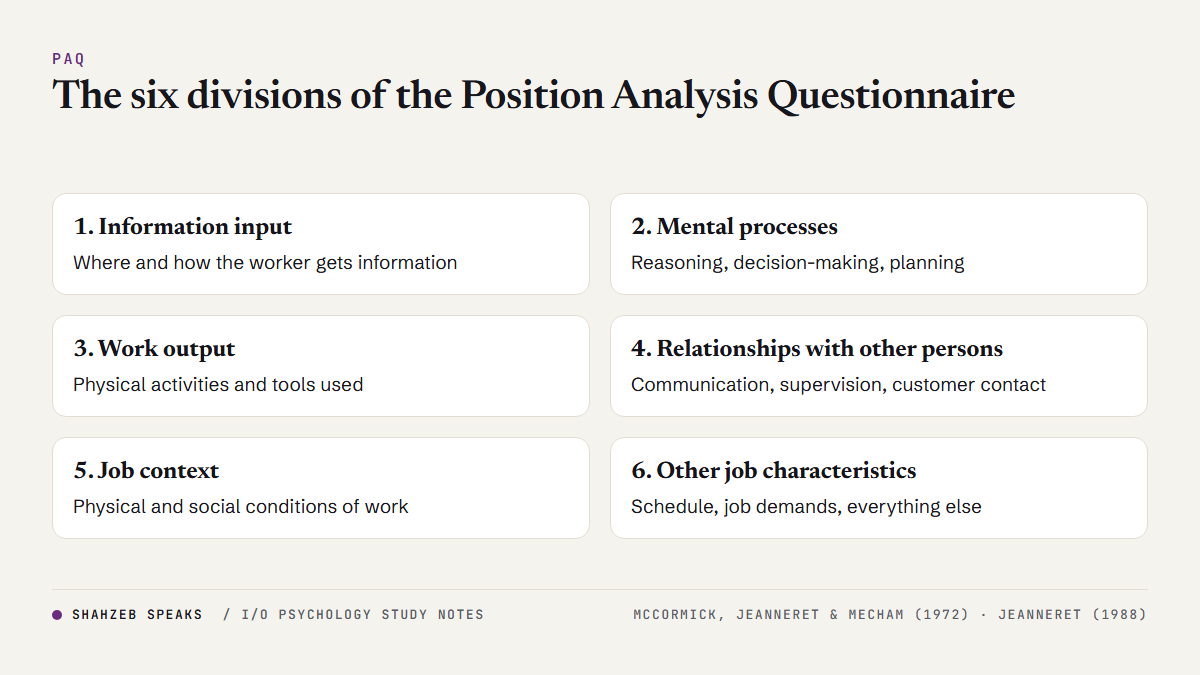
The elements are grouped into six divisions:
- Information input: where and how the worker gets the information used in the job.
- Mental processes: the reasoning, decision-making and planning involved.
- Work output: the physical activities and tools used.
- Relationships with other persons: communication, supervision, customer contact.
- Job context: the physical and social conditions of work.
- Other job characteristics: everything else, such as schedule and job demands.
How many items does the PAQ have? Most textbooks and exam keys say 194. That number comes from Form B of the questionnaire: McCormick and colleagues’ original research report described 189 job elements in Form A and 194 in Form B. Later, Jeanneret (1988), one of the authors, described the 1980 version as having 187 job elements. For an exam, write 194 and, if you have space, add that the count differs slightly between versions. That shows the examiner you know the source.
Because every job is rated on the same elements, PAQ results can be compared across very different jobs. Jeanneret (1988) reports that principal components analysis of PAQ ratings for thousands of jobs produced 45 job dimensions. This is why the PAQ was used to group jobs into families, to estimate the abilities a job requires and to support pay decisions.
6. The critical incident technique (CIT)
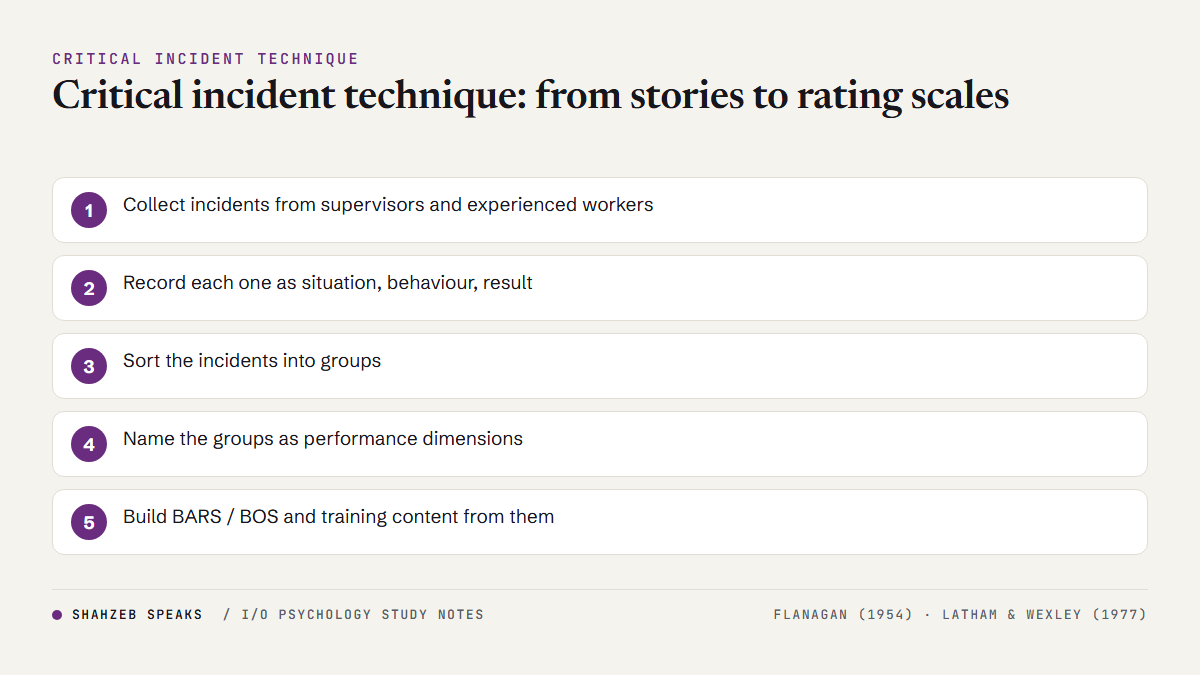
John Flanagan described the critical incident technique in a 1954 paper in Psychological Bulletin. It grew out of his work in the US Army Air Forces’ Aviation Psychology Program during the Second World War. The method collects stories of specific behaviour that made a clear difference to success or failure in the job. Each incident has three parts: the situation, what the person did, and the result.
Here is an example from a hospital ward: “A patient’s relatives were shouting at the reception desk during visiting hours (situation). The staff nurse took them to a side room, listened, and explained when the doctor would see them (behaviour). The ward calmed down and a complaint was avoided (result).” Analysts collect dozens or hundreds of such incidents from supervisors and experienced workers, sort them into groups, and name the groups as performance dimensions (for example, “handling distressed families”).
Critical incidents are the raw material for behaviourally anchored rating scales (BARS) and behavioural observation scales (BOS), which are covered in methods of performance appraisal. Latham and Wexley (1977), for example, built their behavioural observation scales for logging supervisors from 1,204 critical incidents. The weakness of CIT is that it focuses on the extremes, so ordinary day-to-day tasks may be left out, and collecting enough good incidents takes time.
7. Functional job analysis (FJA)
Functional job analysis was developed by Sidney Fine. Its worker-function scales for data, people and things were adopted by the US Dictionary of Occupational Titles, and Fine set out the full method in Fine and Wiley (1971) and Fine and Cronshaw (1999). FJA describes each task in a standard sentence (who does what, with what tools, to produce what result) and rates the task on how much the worker deals with three things: data, people and things. A data entry operator works mostly with data, a counsellor mostly with people, a lathe operator mostly with things. FJA gives very clear task statements, which makes it useful for writing job descriptions and training plans, but it takes trained analysts and time.
Where O*NET fits
Students in many countries are now told to “check O*NET”. The O*NET® database (Occupational Information Network) is a free, US government-sponsored database of occupations that replaced the Dictionary of Occupational Titles (Peterson et al., 2001). It describes each occupation through a content model of worker characteristics, worker requirements, experience requirements, occupational requirements and other areas. O*NET data is a good starting point for a job description or a thesis, but it describes US occupations in general, not your particular job in your organisation, so you still need local job analysis. (O*NET® is a trademark of USDOL/ETA.)
Advantages and disadvantages of job analysis methods (table)
This is the table most students are looking for. Learn the “best for” column: examiners often give a job and ask which method suits it.
| Method | Main advantage | Main disadvantage | Best for |
|---|---|---|---|
| Observation | First-hand, sees the real work and conditions | Misses mental work and rare events; workers may change behaviour when watched | Short-cycle manual jobs (machine operator, packer) |
| Interview | Reaches mental tasks, reasons and rare duties | Self-presentation and inflation; time-consuming | Professional and supervisory jobs |
| Questionnaire / task inventory | Cheap for many workers; gives comparable numbers | Only asks about what the authors included; literacy demands | Large job families across sites (call centres, bank branches) |
| Work diary / log | Captures variety over weeks | Depends on worker discipline; written from memory | Managerial jobs with irregular days |
| PAQ | Standard elements allow comparison across very different jobs | Needs trained analysts and good reading level; generic, so it does not give task statements | Job families, job evaluation, estimating ability requirements |
| Critical incident technique | Concrete behaviour that separates good from poor performance | Focuses on extremes; slow to collect enough incidents | Building BARS/BOS, training content, interview questions |
| Functional job analysis | Clear standard task statements; data, people, things ratings | Needs trained analysts; time-consuming | Job descriptions, training design |
How to choose a job analysis method
Ask four questions before you choose.
- What is the purpose? To build a selection test, you need KSAOs and task importance ratings. To build an appraisal form, critical incidents are better. For job evaluation and pay, the PAQ’s standard elements help.
- Is the work visible? If yes, observation helps. If the work is mostly thinking, use interviews or questionnaires.
- How many people do the job? Three supervisors can be interviewed. Three hundred agents need a questionnaire.
- What time and budget do you have? The PAQ and FJA need trained analysts. A short structured interview plus a task questionnaire is often the practical choice for a small firm.
A sensible combination for a university department’s lab assistant job, for example, would be a day of observation, two interviews with experienced assistants, one with the lab supervisor, and a short task questionnaire to rate how often and how important each task is. The important tasks then feed the job description, and the KSAOs feed the interview questions, which subject matter experts can rate for relevance using the content validity ratio calculator.
Job analysis vs job evaluation: do not mix them up
This is a common exam trap. Job analysis describes the job: its tasks and the KSAOs it needs. Job evaluation uses that description to judge the job’s relative worth to the organisation, so that pay grades can be set fairly. Job analysis comes first; job evaluation is one of its uses. The PAQ appears in both topics because its data was used to estimate job value as well as to describe jobs.
10-mark answer structure
- Definition: job analysis is the systematic collection of information about a job’s tasks and the KSAOs needed to perform them; it produces the job description and job specification.
- Why it matters: one line on its uses (selection, appraisal, training, pay, legal defensibility).
- Classify the methods: job-oriented vs worker-oriented, with one example of each.
- Explain four to five methods, each with one advantage and one disadvantage: observation, interview, questionnaire, PAQ (McCormick, Jeanneret and Mecham, 1972; 194 items, six divisions), critical incident technique (Flanagan, 1954).
- Draw the table of advantages and disadvantages (examiners reward it).
- Local example: a bank teller or call-centre agent analysed with observation plus a questionnaire.
- Conclusion: no single method is complete; combine methods according to purpose, visibility of work, number of incumbents and budget.
Model opening line: “Job analysis is the process of systematically collecting information about what a job involves and what a worker needs to perform it; because no single method captures every part of a job, organisations combine methods such as interviews, questionnaires, the PAQ and the critical incident technique.”
Practice MCQs: job analysis methods
These are practice questions written to the published syllabus, not past-paper questions. Try each one before opening the answer.
-
Who developed the Position Analysis Questionnaire?
- Flanagan
- McCormick, Jeanneret and Mecham
- Fine and Wiley
- Smith and Kendall
Show answer
B. The PAQ came from McCormick, Jeanneret and Mecham at Purdue (published 1972). Flanagan gave us the critical incident technique, Fine functional job analysis, and Smith and Kendall BARS.
-
The PAQ is best described as a:
- job-oriented task inventory for one job
- worker-oriented structured questionnaire usable across jobs
- diary method
- performance appraisal scale
Show answer
B. Its elements describe general human behaviours, so any job can be rated on them. A task inventory is job-oriented and specific to one job family; the PAQ is not a diary or an appraisal scale.
-
A hospital wants to know how nurses handle rare emergencies such as a cardiac arrest. Which method is weakest for this?
- Interviews with senior nurses
- Critical incident technique
- Observation during normal shifts
- Questionnaire to ward staff
Show answer
C. A few days of observation will probably never see the rare event. Interviews, critical incidents and questionnaires can all ask about past emergencies directly.
-
Each critical incident in Flanagan’s technique describes:
- the situation, the behaviour and the result
- the worker’s personality traits
- the job’s pay grade
- the time spent on each task
Show answer
A. An incident is a specific behaviour in context with its outcome. Traits, pay grades and time spent are not what CIT collects.
-
Functional job analysis rates tasks on the worker’s involvement with:
- information, mental processes and output
- data, people and things
- knowledge, skills and abilities
- reactions, learning and behaviour
Show answer
B. Data, people and things are FJA’s three areas. Option A mixes up PAQ divisions, C is KSAs, and D is Kirkpatrick’s training evaluation levels.
-
Which of these is NOT one of the six PAQ divisions?
- Information input
- Mental processes
- Organisational commitment
- Job context
Show answer
C. The six are information input, mental processes, work output, relationships with other persons, job context and other job characteristics. Commitment is a job attitude, not a PAQ division.
-
A call centre with 400 agents in three cities needs comparable data on how often each task is done. The most practical method is:
- individual interviews with every agent
- a task inventory questionnaire
- work diaries kept for six months
- the critical incident technique alone
Show answer
B. A questionnaire reaches many workers cheaply and produces numbers that can be compared across sites. Interviewing 400 people or six months of diaries is too costly; CIT gives incidents, not task frequencies.
-
An employee describes her job as far more complex than it is because she hopes for a higher grade. Morgeson and Campion (1997) would call this a:
- cognitive source of inaccuracy
- social source of inaccuracy such as self-presentation
- sampling error
- halo error
Show answer
B. Making the job sound important is self-presentation, one of the social sources they list. Cognitive sources are about limited or biased information processing; halo is a rating error.
-
Job evaluation differs from job analysis because job evaluation:
- comes before job analysis
- judges the relative worth of jobs for pay purposes
- describes the tasks of a job
- is only used in selection
Show answer
B. Job evaluation sets relative worth (pay grades) and uses job analysis data, so it comes after. Describing tasks is job analysis itself.
-
Critical incidents collected in a job analysis are most directly used to build:
- graphic rating scales of traits
- behaviourally anchored rating scales
- forced distribution systems
- cognitive ability tests
Show answer
B. BARS use critical incidents as the behavioural anchors on each scale point. Trait scales, forced distribution and ability tests do not need incidents.
Practise on your phone
The free I/O Psychology Prep app has 410 explained
questions, flashcards and an exam countdown, and works offline. Get it on Google Play
· About the app
For a longer set on this topic, try the job analysis MCQs page.
Questions students ask
What are the methods of job analysis?
The main methods are observation, interviews, questionnaires and task inventories, work diaries, the Position Analysis Questionnaire, the critical incident technique and functional job analysis. They are often grouped as job-oriented (describing tasks) or worker-oriented (describing human behaviours). Most organisations combine two or three methods.
How many items are in the PAQ?
Textbooks usually say 194 items, grouped into six divisions. The count varies slightly by version: McCormick and colleagues’ original report described 189 elements in Form A and 194 in Form B, and Jeanneret (1988) described the 1980 version as 187 job elements. Write 194 in an exam.
What is the critical incident technique in job analysis?
It is a method described by John Flanagan in 1954 that collects reports of specific behaviours that led to clearly good or clearly poor results in a job. Each incident records the situation, the behaviour and the outcome. Incidents are grouped into performance dimensions and used to build rating scales and training.
Which job analysis method is the best?
No single method is best. The right choice depends on the purpose (selection, appraisal, pay or training), whether the work is visible, how many people do the job and your budget. A structured interview combined with a task questionnaire is the most common practical mix.
What is the difference between job analysis and job description?
Job analysis is the process of studying the job. The job description is one of its products: a written statement of the job’s title, duties and conditions. The other product is the job specification, which lists the qualifications and KSAOs a person needs.
Is O*NET a job analysis method?
Not exactly. The O*NET® database is a large source of occupational information built from job analysis data on US occupations. It is useful as a starting point, but it describes occupations in general, so an organisation still needs its own job analysis for its own jobs.
Revise job analysis in 10 minutes a day
The free I/O Psychology Prep app has 410 explained
questions, flashcards and an exam countdown, and works offline. Get it on Google Play
· About the app
References
- Fine, S. A., & Cronshaw, S. F. (1999). Functional job analysis: A foundation for human resources management. Lawrence Erlbaum. https://doi.org/10.4324/9781410602497
- Fine, S. A., & Wiley, W. W. (1971). An introduction to functional job analysis: A scaling of selected tasks from the social welfare field. W. E. Upjohn Institute for Employment Research.
- Flanagan, J. C. (1954). The critical incident technique. Psychological Bulletin, 51(4), 327-358. https://doi.org/10.1037/h0061470
- Jeanneret, P. R. (1988). Position requirements for space station personnel and linkages to portable microcomputer performance assessment (Report EOTR 88-11, prepared for Essex Corporation under NASA contract NAS9-17326). Jeanneret & Associates. https://ntrs.nasa.gov/citations/19910005406
- Latham, G. P., & Wexley, K. N. (1977). Behavioral observation scales for performance appraisal purposes. Personnel Psychology, 30(2), 255-268. https://doi.org/10.1111/j.1744-6570.1977.tb02092.x
- McCormick, E. J., Jeanneret, P. R., & Mecham, R. C. (1972). A study of job characteristics and job dimensions as based on the Position Analysis Questionnaire (PAQ). Journal of Applied Psychology, 56(4), 347-368. https://doi.org/10.1037/h0033099
- Morgeson, F. P., & Campion, M. A. (1997). Social and cognitive sources of potential inaccuracy in job analysis. Journal of Applied Psychology, 82(5), 627-655. https://doi.org/10.1037/0021-9010.82.5.627
- Peterson, N. G., Mumford, M. D., Borman, W. C., Jeanneret, P. R., Fleishman, E. A., Levin, K. Y., Campion, M. A., Mayfield, M. S., Morgeson, F. P., Pearlman, K., Gowing, M. K., Lancaster, A. R., Silver, M. B., & Dye, D. M. (2001). Understanding work using the Occupational Information Network (O*NET): Implications for practice and research. Personnel Psychology, 54(2), 451-492. https://doi.org/10.1111/j.1744-6570.2001.tb00100.x
- Uniform guidelines on employee selection procedures, 29 C.F.R. pt. 1607 (1978). https://www.ecfr.gov/current/title-29/subtitle-B/chapter-XIV/part-1607
- O*NET Resource Center. (n.d.). O*NET database licence and attribution. https://www.onetcenter.org/license_db.html
Back to the hub: Personnel psychology notes: selection, appraisal and training. Next in the series: job description vs job specification, validity in employee selection, training needs analysis and recruitment vs selection. For the local career picture, see industrial psychology in Pakistan.