
Industrial/organizational psychology appears in all three main Pakistani psychology exams. The FPSC’s CSS Psychology paper (100 marks) has a unit on Organizational/Industrial Psychology, the PPSC’s CCE Psychology paper (100 marks) has the same topic, and FPSC lecturer psychology MCQ tests list it among 11 subject topics. Leadership, motivation, culture, stress, job attitudes, harassment and the glass ceiling recur.
This page is for Pakistani students preparing for a PPSC or FPSC psychology lecturer test, the CSS Psychology optional paper, or the PPSC Combined Competitive Examination (PMS). It does one job: it shows you, from the commissions’ own documents, which industrial/organizational (I/O) topics you are expected to know, and then helps you prepare them. At the end there are 25 practice MCQs with explanations.
I am an Industrial and Organizational Psychologist (MSc) in Karachi. I/O is usually the unit students leave until last, because it feels like “HR” rather than psychology. In fact it is one of the most predictable units in these papers: the syllabus lists the exact topics, and they come from a small number of well-known theories.
Which I/O topics are in the official PPSC, FPSC and CSS psychology syllabi?
I read the current documents on the commissions’ websites on 3 November 2026. Here is what each one says about I/O psychology.
| Exam | Official document | Paper and marks | I/O topics named |
|---|---|---|---|
| CSS Psychology (FPSC) | Revised Scheme and Syllabus for CSS Competitive Examination, CE-2016 and onwards | Optional subject, Group VII (choose one subject of 100 marks); Psychology is code 46, 100 marks | Unit XII: leadership styles, decision making, work motivation, organizational culture, stress and conflict at work and its management, organizational socialization, job related attitude, sexual harassment, glass ceiling, human computer interaction |
| PPSC Combined Competitive Examination (PMS) | PPSC CCE Syllabus: Psychology | Optional paper, total marks 100 | Topic 14: leadership traits, decision-making, work motivation, organizational culture, stress and conflict management in the workplace, job-related attitudes, workplace harassment, glass ceiling and glass cliff effects |
| FPSC Lecturer (Psychology) BS-17 | Schemes and Syllabi, Consolidated Advertisement No. 03/2026 (case F.4-126/2026) | MCQ test: English 20, subject 50, professional 30 | “Organizational/Industrial Psychology” as one of 11 Master’s-level topics, with no sub-topics listed |
| PPSC Lecturer (Psychology) BS-17 | Published with each advertisement on the PPSC syllabus page | Check the advertisement | No lecturer psychology syllabus was listed on the PPSC syllabus page on 3 November 2026 |
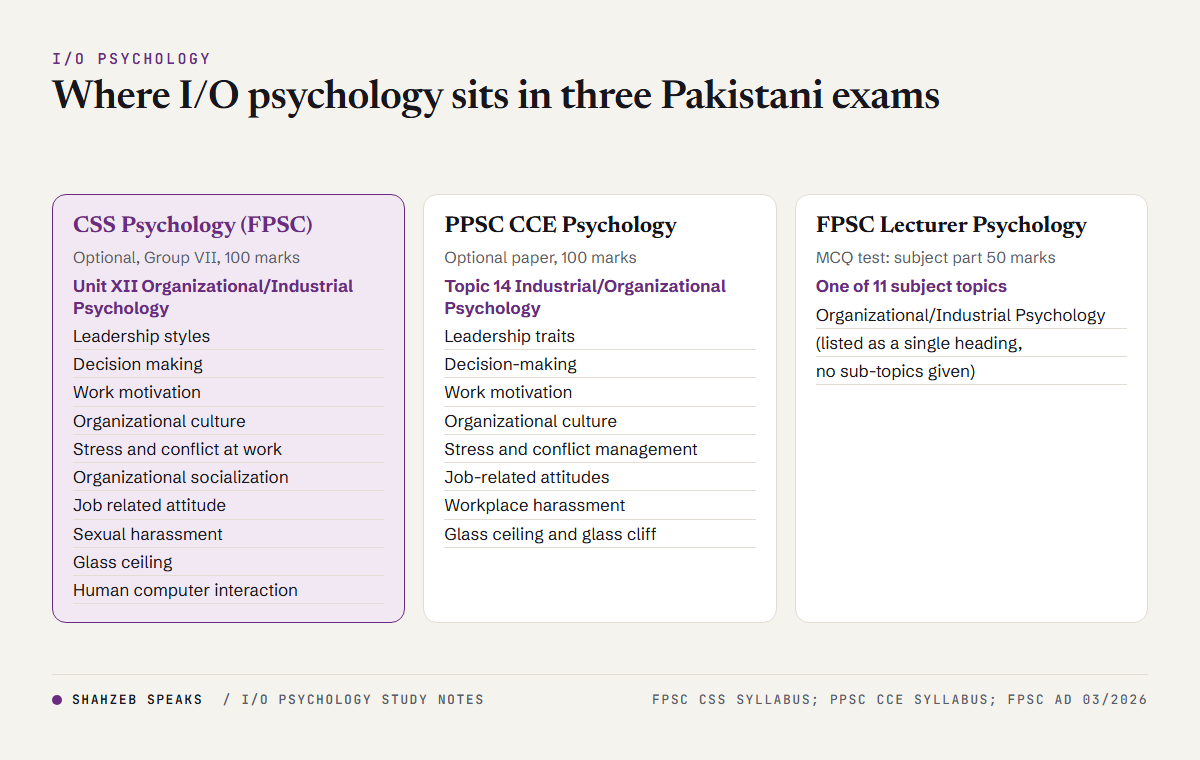
Three things stand out. First, the CSS and PPSC CCE lists are nearly the same; if you prepare one, you have prepared the other. Second, both lists include topics that ordinary I/O textbooks treat briefly, such as workplace harassment and the glass ceiling, and the PPSC list adds the glass cliff. Third, I/O also hides in other units: the CSS Psychological Assessment unit (VI) includes “Selection and Training”, its Motivation and Emotion unit (V) covers theories of motivation, and the PPSC Social Influence unit (10) includes leadership and harassment.
CSS Psychology: what the I/O unit asks, topic by topic
The CSS Psychology syllabus has 14 units, from Nature and Scope of Psychology to Forensic Psychology. Unit XII is Organizational/Industrial Psychology. The first book on its suggested reading list is Aamodt’s Applied Industrial/Organizational Psychology. Here is what each named topic means and the core content an examiner expects.
Leadership styles
Start with the classic study by Lewin, Lippitt and White (1939), who compared autocratic, democratic and laissez-faire leadership in boys’ clubs. Then cover trait, behavioural, contingency and transformational approaches. The full comparison is in leadership theories in I/O psychology, with detail on transformational vs transactional leadership. The PPSC list says “leadership traits”, so learn the trait approach well too.
Decision making
Know the rational model (define the problem, generate options, evaluate, choose, implement), then why people depart from it. Herbert Simon (1955) argued that decision makers have limited information and time, so they “satisfice” (choose an option that is good enough) rather than optimise; this is bounded rationality. Kahneman and Tversky’s (1979) prospect theory showed that people weigh losses more heavily than equal gains. For group decisions, know groupthink (Janis, 1972) and techniques such as brainstorming and the nominal group technique.
Work motivation
Group the theories into need theories (Maslow, Herzberg, McClelland, Alderfer) and process theories (Vroom’s expectancy theory, Adams’s equity theory, Locke’s goal setting). Examiners in Pakistan often ask for a comparison, for example Maslow and Herzberg in a Pakistani organization. Use the tables in work motivation theories compared and Maslow vs Herzberg.
Organizational culture
Schein describes three levels of culture: artifacts (what you can see, such as dress, office layout and rituals), espoused values (what the organization says it values) and basic underlying assumptions (beliefs so deep that people no longer notice them). A Pakistani bank branch may have “customer first” posters (artifact and espoused value) while staff assume that seniority, not merit, decides promotion (an underlying assumption). See Schein’s model of organizational culture.
Stress and conflict at work and its management
For stress, know Selye’s general adaptation syndrome (alarm, resistance, exhaustion), Lazarus and Folkman’s appraisal model, and Karasek’s (1979) job demand-control model, in which high demands combined with low decision latitude produce the most strain. The occupational stress models page compares them. For conflict, Thomas (1976) described five ways of handling it, based on how assertive and how cooperative a person is: competing, collaborating, compromising, avoiding and accommodating.
Organizational socialization
Socialization is how newcomers learn the values, norms and skills needed to become insiders. Feldman (1976) described stages: anticipatory socialization (before joining), accommodation (learning the job and the people) and role management (settling conflicts between work and outside life). Van Maanen and Schein (1979) described socialization tactics, such as formal vs informal and investiture vs divestiture.
Job related attitude
The main job attitudes are job satisfaction, organizational commitment and job involvement. For commitment, learn Meyer and Allen’s (1991) three components: affective (wanting to stay), continuance (needing to stay because leaving costs too much) and normative (feeling obliged to stay). See the three-component model and job satisfaction theories and measures.
Sexual harassment (CSS) and workplace harassment (PPSC)
Give the psychology (power, organizational climate, effects on well-being and performance) and the Pakistani law. The Protection against Harassment of Women at the Workplace Act, 2010 (Act No. IV of 2010) requires each organization to form an inquiry committee of three members, at least one of them a woman. It was amended in 2022 (Act V of 2022), and the Federal Ombudsperson Secretariat for Protection against Harassment (FOSPAH) says its mandate now also covers gender-based discrimination. Quoting the Act correctly is an easy way to stand out in a CSS answer.
Glass ceiling (and the glass cliff, for PPSC)
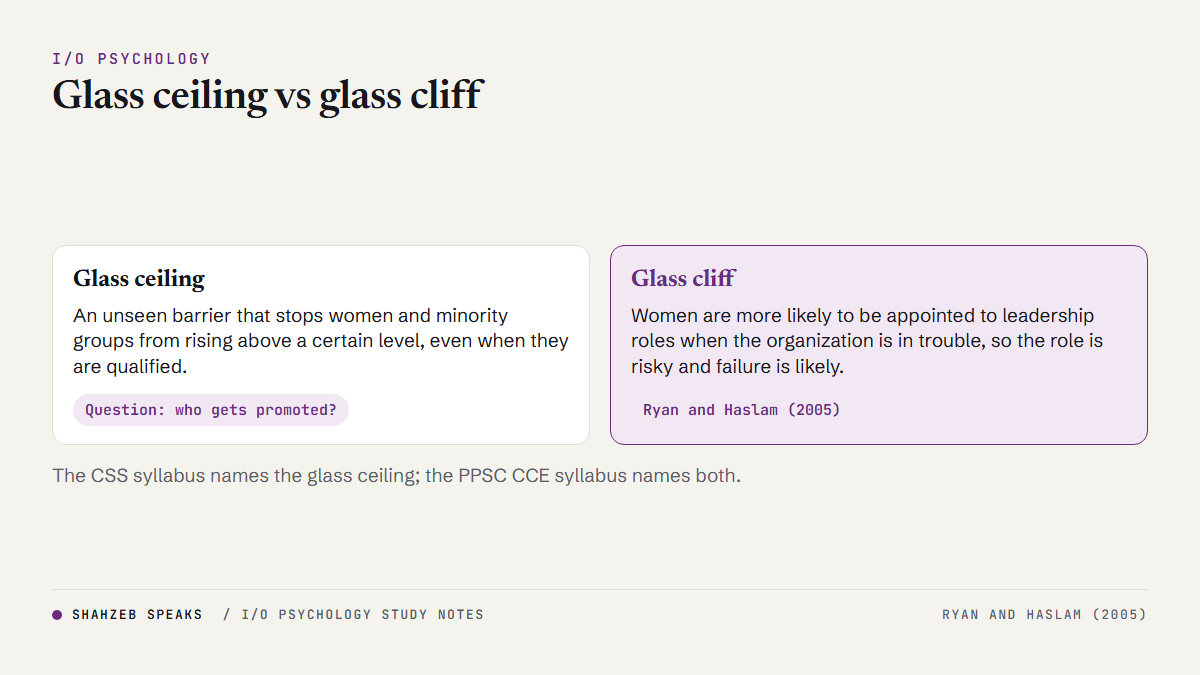
The glass ceiling is an invisible barrier that keeps women and minority groups from rising above a certain level despite their qualifications. The glass cliff is a newer idea: in an archival study of large UK (FTSE 100) companies, Ryan and Haslam (2005) found that women were more likely to be appointed to boards after a period of poor company performance, which puts them in riskier positions.
Human computer interaction
This CSS topic overlaps with engineering psychology (human factors): designing systems, screens and controls to fit human perception, memory and attention, so that errors and fatigue drop. The PPSC reading list includes Norman’s (2008) Cyberpsychology: An Introduction to Human-Computer Interaction. Know the basic aims (usability, error reduction, workload) and one example, such as a bank’s mobile app that confirms a transfer amount in large digits before sending.
PPSC psychology: lecturer tests and the CCE paper
PPSC recruits Lecturers in Psychology (BS-17) for the Punjab Higher Education Department; its results archive, for example, carries a 2017 recommendation notice for Lecturer Psychology (Male), case 128-RB-2017. PPSC publishes a separate syllabus for each advertised post on its syllabus page. When I checked on 3 November 2026, that page had no current lecturer psychology syllabus, so I cannot tell you the subject list or marks split for the next lecturer test. Read the syllabus attached to your own advertisement.
Two official PPSC facts you can rely on now. The CCE Psychology paper is 100 marks and its topic 14 is Industrial/Organizational Psychology (table above). And the PPSC FAQ describes the qualifying marks as 40% in a one-paper written test and 50% in the interview, in the context of how attempts are counted.
Because many past lecturer tests have been Master’s-level MCQ papers covering the whole subject, the safest plan is to prepare I/O at the depth of the CCE topic list, plus selection, training and appraisal from your MSc course.
FPSC lecturer psychology test: format and where I/O fits
FPSC’s syllabus for Consolidated Advertisement No. 03/2026 includes Lecturer (Female) BS-17 posts in the Education Department, Gilgit-Baltistan (case F.4-126/2026), including Psychology. The requirement is a second-class or Grade C Master’s degree in the subject from an HEC-recognised university. The test is objective (MCQ) in three parts.
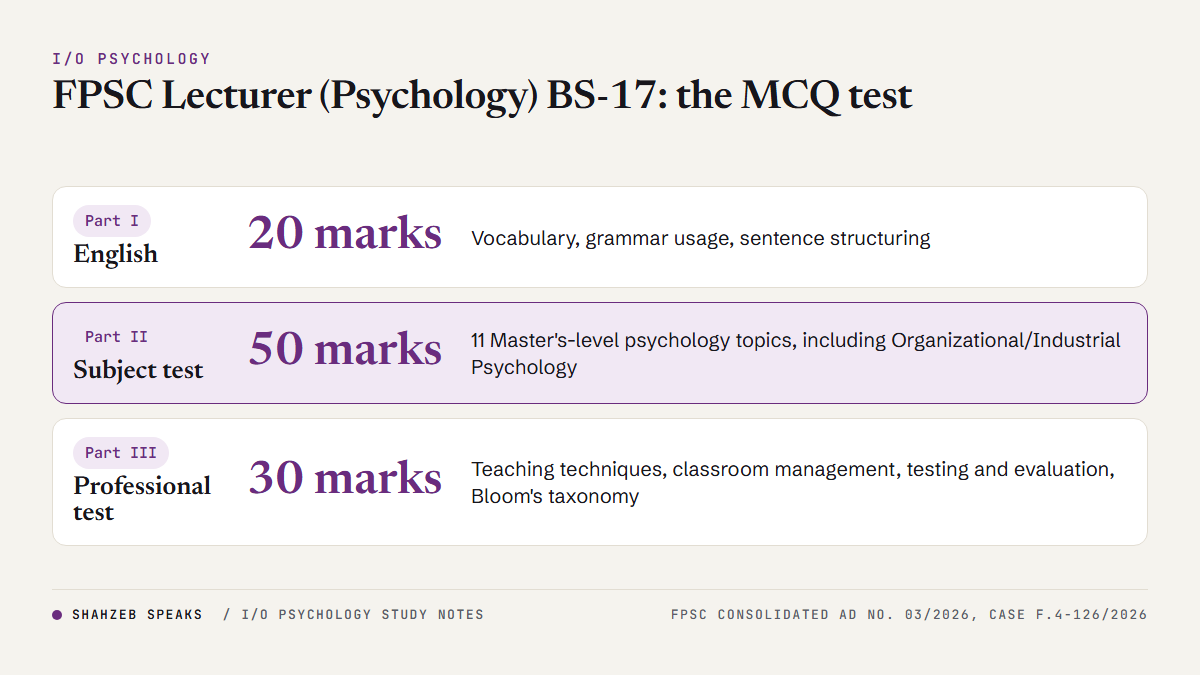
The 11 subject topics are: nature and scope of psychology, biological basis of behaviour, developmental, social, educational, counselling, abnormal and clinical, organizational/industrial, forensic psychology, psychological testing and assessment, and research methodology. The same psychology list appears in FPSC’s syllabi for Advertisements No. 01/2026 and 02/2026. By contrast, FPSC’s Psychologist (BS-17) post at the Armed Forces Institute of Rehabilitation Medicine in Advertisement 01/2026 lists clinical topics only (history of psychology, abnormal, psychotherapies, clinical, counselling, psychological testing), so I/O is not on that test.
How to prepare the I/O part in three weeks
- Week 1, theories: make one table for leadership and one for motivation (theorist, year, key idea, criticism, Pakistani example). Use the one-page industrial psychology notes as a model.
- Week 2, the “Pakistani” topics: culture, harassment law, glass ceiling and glass cliff, stress and conflict. Write a 10-mark answer for each, because these suit long questions in CSS and CCE.
- Week 3, MCQ speed: do 25 questions a day from the I/O psychology MCQ hub and its sets on leadership, motivation, stress and job attitudes. Review every mistake.
For background on the field in this country, see my page on industrial psychology in Pakistan and the scope of I/O psychology in Pakistan.
10-mark answer structure: “The glass ceiling in Pakistani organizations”
- Definition: the glass ceiling as an unseen barrier to the promotion of qualified women and minority groups; contrast it in one line with the glass cliff (Ryan and Haslam, 2005).
- Psychological causes: stereotypes about leadership, in-group favouritism in promotion, and work-family role expectations.
- Organizational causes: informal networks, unclear promotion criteria, lack of mentoring.
- Pakistani context: the Protection against Harassment of Women at the Workplace Act, 2010, its 2022 amendment, and the inquiry committee every organization must form.
- Effects: lower job satisfaction and commitment, turnover, loss of talent.
- Remedies: structured promotion criteria, mentoring, flexible work, enforcement of the 2010 Act.
- Conclusion: the barrier is built from everyday decisions, so it can be removed by changing how those decisions are made.
Model opening line: “The glass ceiling is an invisible barrier that stops qualified women from rising beyond a certain level in organizations, not because of their ability but because of how promotion decisions are made.”
Practice MCQs: I/O psychology for PPSC, FPSC and CSS (25)
These 25 questions are my own practice questions written to the published syllabus topics above. They are not past paper or leaked questions. They follow the CSS and PPSC topic order.
-
In the study by Lewin, Lippitt and White (1939), which three leadership styles were compared?
- Transformational, transactional, laissez-faire
- Autocratic, democratic, laissez-faire
- Task, relationship, situational
- Directive, supportive, participative
Show answer
B. The boys’-club studies compared autocratic, democratic and laissez-faire leadership. Option A mixes in Bass’s later styles, C describes later behavioural and contingency labels, and D comes from path-goal theory.
-
The PPSC syllabus says “leadership traits”. Which statement best describes the trait approach?
- Effective leadership depends only on the situation
- Leaders differ from non-leaders in stable personal characteristics
- Leaders exchange rewards for performance
- Leadership is a relationship that differs with each follower
Show answer
B. The trait approach looks for stable characteristics of leaders. A is the contingency idea, C is transactional leadership and D is LMX theory.
-
A college principal involves her heads of department in deciding the new timetable and accepts the majority view. Which style is this?
- Autocratic
- Democratic
- Laissez-faire
- Bureaucratic
Show answer
B. Sharing the decision with the group is democratic leadership. Autocratic leaders decide alone, laissez-faire leaders leave the group without direction, and bureaucratic is not one of the three classic styles.
-
A manager picks the first supplier whose price and quality are acceptable instead of comparing all 30 suppliers. Simon (1955) called this:
- Optimising
- Satisficing
- Groupthink
- Escalation of commitment
Show answer
B. Choosing a good-enough option under limited time and information is satisficing, part of bounded rationality. Optimising means finding the best option; groupthink and escalation of commitment are different decision errors.
-
Offered a certain cut of Rs. 5,000 in her bonus or a 50% chance of losing Rs. 10,000 (and a 50% chance of losing nothing), an employee picks the gamble, because a sure loss feels so painful. Which theory explains this?
- Prospect theory
- Equity theory
- Two-factor theory
- Attribution theory
Show answer
A. Kahneman and Tversky’s (1979) prospect theory says losses weigh more than equal gains, which makes people take risks to avoid a sure loss. The other theories deal with fairness, job satisfaction and explaining causes of behaviour.
-
Which is NOT a recognised symptom or cause of poor group decisions described by Janis (1972)?
- Illusion of unanimity
- Self-censorship of doubts
- Appointing a devil’s advocate
- Pressure on dissenters
Show answer
C. Appointing a devil’s advocate is a remedy for groupthink, not a symptom. The other three are classic groupthink symptoms.
-
Which of these is a process theory of motivation, not a need theory?
- Maslow’s hierarchy
- McClelland’s theory of needs
- Vroom’s expectancy theory
- Alderfer’s ERG theory
Show answer
C. Expectancy theory explains how people decide how much effort to give, which makes it a process theory. Maslow, McClelland and Alderfer describe what people need.
-
A textile mill raises pay and improves the canteen, but workers still do not feel motivated. According to Herzberg, this is because:
- Pay and canteen are motivators that were badly designed
- Pay and canteen are hygiene factors that prevent dissatisfaction but do not motivate
- Workers have high need for affiliation
- The workers’ expectancy was too high
Show answer
B. In Herzberg’s two-factor theory, pay and working conditions are hygiene factors. Motivation comes from achievement, recognition, responsibility and the work itself. Options C and D use other theories.
-
A clerk works hard because she believes effort will lead to a good appraisal, the appraisal will lead to promotion, and she values promotion. Which theory is this?
- Goal-setting theory
- Expectancy theory
- Equity theory
- Theory X
Show answer
B. Effort to performance (expectancy), performance to reward (instrumentality) and the value of the reward (valence) are Vroom’s three parts. Goal setting focuses on specific, hard goals; equity on fairness compared with others.
-
In Schein’s model, a company’s unspoken belief that “the boss is always right” is an example of:
- An artifact
- An espoused value
- A basic underlying assumption
- A job attitude
Show answer
C. Deep beliefs that people take for granted are basic underlying assumptions. Artifacts are visible things such as dress and office layout; espoused values are what the organization says it values.
-
Which of these is an artifact of organizational culture?
- The belief that loyalty matters more than results
- A uniform and a morning assembly at a hospital
- The mission statement’s claim to value teamwork
- Employees’ job satisfaction scores
Show answer
B. Uniforms and rituals are visible artifacts. A is an underlying assumption, C is an espoused value, and D is a job attitude measure, not a level of culture.
-
In Karasek’s (1979) model, which job is most likely to cause high strain?
- High demands and high decision latitude
- Low demands and low decision latitude
- High demands and low decision latitude
- Low demands and high decision latitude
Show answer
C. High demands with little control is the high-strain job, such as a call-centre agent with strict targets and scripts. High demands with high control is an “active” job, and the low-demand combinations carry less strain.
-
Which sequence matches Selye’s general adaptation syndrome?
- Alarm, resistance, exhaustion
- Resistance, alarm, recovery
- Appraisal, coping, outcome
- Forming, storming, norming
Show answer
A. Selye’s three stages are alarm, resistance and exhaustion. Option C describes the appraisal approach to stress, and D is Tuckman’s group stages.
-
Two department heads disagree about a budget. They work together until they find a solution that fully meets both their needs. In Thomas’s (1976) framework, this is:
- Compromising
- Collaborating
- Accommodating
- Avoiding
Show answer
B. Collaborating is high on both assertiveness and cooperation and aims at a solution that satisfies both sides fully. Compromising means each side gives up part, accommodating means giving in, and avoiding means withdrawing.
-
A new bank officer attends a six-week training programme with other new officers, away from the branch, before starting work. In Van Maanen and Schein’s (1979) terms, this socialization is:
- Individual and informal
- Collective and formal
- Random and variable
- Disjunctive and divestiture
Show answer
B. Training a group of newcomers together (collective) in a separate, structured programme (formal) fits collective and formal tactics. Individual and informal would mean learning alone, on the job.
-
In Feldman’s (1976) model, the stage in which a newcomer learns the tasks and builds relationships with co-workers is:
- Anticipatory socialization
- Accommodation
- Role management
- Refreezing
Show answer
B. Accommodation is the entry stage of learning the job and the people. Anticipatory socialization happens before joining, role management deals with conflicts between work and outside life, and refreezing is a change-management term.
-
An employee says: “I would love to leave, but I would lose my pension and my government house.” Which type of commitment is this?
- Affective
- Normative
- Continuance
- Calculative involvement in OCB
Show answer
C. Staying because leaving would cost too much is continuance commitment (Meyer and Allen, 1991). Affective is emotional attachment, normative is felt obligation, and D is not a component of the model.
-
Which is NOT one of the three main job attitudes usually studied in I/O psychology?
- Job satisfaction
- Organizational commitment
- Job involvement
- General mental ability
Show answer
D. General mental ability is a cognitive ability, not an attitude. Satisfaction, commitment and involvement are the classic job attitudes.
-
Under Pakistan’s Protection against Harassment of Women at the Workplace Act, 2010, each organization must set up:
- A three-member inquiry committee with at least one woman
- A five-member board of directors with two women
- A labour court inside the organization
- A trade union for women only
Show answer
A. Section 3 of the Act requires a three-member inquiry committee, at least one member a woman. The other options are not requirements of the Act.
-
Which statement about workplace harassment is most accurate from an I/O psychology point of view?
- It only affects the person harassed, not the team
- An organizational climate that tolerates harassment raises the risk of it happening
- It is purely a legal matter with no link to performance
- Harassment policies have no role once a law exists
Show answer
B. I/O research treats harassment as linked to organizational climate: where leaders tolerate it, it happens more. It also harms bystanders and team performance, so A and C are wrong, and policies are how the law is applied inside an organization.
-
A qualified woman officer is passed over for promotion several times while less experienced men are promoted, with no written criteria. Which concept fits best?
- Glass cliff
- Glass ceiling
- Halo effect
- Social loafing
Show answer
B. An invisible barrier to promotion despite qualifications is the glass ceiling. The glass cliff is about being appointed to risky roles, the halo effect is a rating error, and social loafing is reduced effort in groups.
-
Ryan and Haslam (2005) described the “glass cliff”. What did their study of large UK companies find?
- Women were never appointed to boards
- Women were more likely to be appointed to boards after a period of poor company performance
- Women’s appointments caused share prices to fall
- Men were more likely to be appointed during crises
Show answer
B. Women tended to be appointed after poor performance, placing them in precarious positions. The study did not show that women caused declines (C), and A and D contradict the finding.
-
The CSS syllabus lists “human computer interaction” under I/O psychology. Which goal best describes this area?
- Selecting employees with high IQ
- Designing systems and screens that fit human perception, memory and attention to reduce errors
- Measuring job satisfaction
- Counselling employees with stress
Show answer
B. HCI, like engineering psychology, fits technology to people. The other options belong to selection, job attitudes and counselling.
-
The CSS Psychological Assessment unit lists “Selection and Training”. A test that predicts later job performance well has high:
- Face validity
- Criterion-related (predictive) validity
- Test-retest reliability only
- Content validity only
Show answer
B. Predicting a later criterion such as performance is predictive validity, a type of criterion-related validity. Face validity is how a test looks to candidates; reliability is consistency, not prediction. More on this in the selection and validity MCQs.
-
The FPSC lecturer psychology test has a 30-mark professional part. Which topic belongs to it, not to the psychology subject part?
- Organizational/Industrial Psychology
- Bloom’s taxonomy
- Forensic psychology
- Research methodology
Show answer
B. Bloom’s taxonomy is listed in Part III (professional test) with teaching techniques, classroom management, and testing and evaluation. The other three are psychology subject topics in Part II.
Practise on your phone
The free I/O Psychology Prep app has 410 explained questions, flashcards and an exam countdown, and works offline. Get it on Google Play · About the app
Questions students ask
Is industrial psychology part of the CSS Psychology syllabus?
Yes. Unit XII of the FPSC’s CSS Psychology syllabus is Organizational/Industrial Psychology. It lists leadership styles, decision making, work motivation, organizational culture, stress and conflict, organizational socialization, job related attitude, sexual harassment, glass ceiling and human computer interaction.
How many marks is the CSS Psychology paper?
Psychology is a 100-mark optional subject in Group VII of the CSS scheme, where candidates choose one subject of 100 marks. The whole written examination is 1,200 marks: 600 compulsory and 600 optional.
What is the syllabus for the PPSC lecturer psychology test?
PPSC publishes the syllabus with each advertisement. On 3 November 2026 there was no lecturer psychology syllabus on its syllabus page, so check your advertisement. Prepare I/O at least to the depth of the PPSC CCE Psychology topic 14.
What is the pattern of the FPSC lecturer psychology test?
In Consolidated Advertisement No. 03/2026 it is an MCQ test: English 20 marks, psychology subject 50 marks (11 Master’s-level topics) and a professional test of 30 marks on teaching and assessment.
Are these PPSC psychology past papers with answers?
No. They are practice questions written to the published syllabus. Past papers are released only by the commissions themselves; the FPSC posts CSS question papers on its website.
Which book should I read for the I/O unit?
Both the CSS and PPSC CCE reading lists start with Aamodt’s Applied Industrial/Organizational Psychology. Use it for motivation, attitudes, leadership and stress, and add the Pakistani harassment law from the Act itself. See also best books for I/O psychology.
Is the glass cliff in the CSS syllabus?
The CSS syllabus names only the glass ceiling. The PPSC CCE syllabus names both the glass ceiling and the glass cliff, so CCE candidates should learn both. Knowing both also helps in a CSS answer.
Practise on your phone
Set your PPSC, FPSC or CSS test date in the free I/O Psychology Prep app and use its exam mode, 410 explained questions and offline flashcards. Get it on Google Play · About the app
References
- Federal Public Service Commission. (n.d.). Revised scheme and syllabus for CSS competitive examination (CE-2016 and onwards). Retrieved 3 November 2026, from https://fpsc.gov.pk/uploads/syllabus/1767002683737_Syllabus-for-CE-2016-and-onwards.pdf
- Federal Public Service Commission. (2026). Schemes and syllabi for screening/professional tests relating to posts advertised under Consolidated Advertisement No. 03/2026. https://www.fpsc.gov.pk/uploads/content/1787309249845_Combined_Ad_No_3_2026.pdf
- Federal Public Service Commission. (2026). Schemes and syllabi of objective type test (MCQ) relating to posts in BS-16 and 17 under Advertisement No. 01/2026. https://www.fpsc.gov.pk/uploads/content/1771388335626_Syllabus_for_post_of_Ad_No_1_2026.pdf
- Punjab Public Service Commission. (n.d.). Combined Competitive Examination (CCE) syllabus: Psychology. Retrieved 3 November 2026, from https://www.ppsc.gop.pk/Forms/PMS/O/21%20Psychology.pdf
- Punjab Public Service Commission. (n.d.). Frequently asked questions. Retrieved 3 November 2026, from https://www.ppsc.gop.pk/faq.aspx
- Federal Ombudsperson Secretariat for Protection against Harassment. (n.d.). Laws and rules: Protection against Harassment of Women at the Workplace Act, 2010 (as amended 2022). https://fospah.gov.pk/SiteImage/Misc/FOSPAH%20Laws%20and%20Rules.pdf
- Feldman, D. C. (1976). A contingency theory of socialization. Administrative Science Quarterly, 21(3), 433-452. https://doi.org/10.2307/2391853
- Janis, I. L. (1972). Victims of groupthink. Houghton Mifflin.
- Kahneman, D., & Tversky, A. (1979). Prospect theory: An analysis of decision under risk. Econometrica, 47(2), 263-291. https://doi.org/10.2307/1914185
- Karasek, R. A. (1979). Job demands, job decision latitude, and mental strain: Implications for job redesign. Administrative Science Quarterly, 24(2), 285-308. https://doi.org/10.2307/2392498
- Lewin, K., Lippitt, R., & White, R. K. (1939). Patterns of aggressive behavior in experimentally created “social climates”. The Journal of Social Psychology, 10(2), 269-299. https://doi.org/10.1080/00224545.1939.9713366
- Meyer, J. P., & Allen, N. J. (1991). A three-component conceptualization of organizational commitment. Human Resource Management Review, 1(1), 61-89. https://doi.org/10.1016/1053-4822(91)90011-Z
- Norman, K. L. (2008). Cyberpsychology: An introduction to human-computer interaction. Cambridge University Press.
- Ryan, M. K., & Haslam, S. A. (2005). The glass cliff: Evidence that women are over-represented in precarious leadership positions. British Journal of Management, 16(2), 81-90. https://doi.org/10.1111/j.1467-8551.2005.00433.x
- Simon, H. A. (1955). A behavioral model of rational choice. The Quarterly Journal of Economics, 69(1), 99-118. https://doi.org/10.2307/1884852
- Thomas, K. W. (1976). Conflict and conflict management. In M. D. Dunnette (Ed.), Handbook of industrial and organizational psychology (pp. 889-935). Rand McNally.
- Van Maanen, J., & Schein, E. H. (1979). Toward a theory of organizational socialization. Research in Organizational Behavior, 1, 209-264.
Keep going: return to the I/O psychology MCQ hub, compare I/O psychology vs HRM, or try the exam guides for the UGC NET and the Philippine psychometrician exam.