
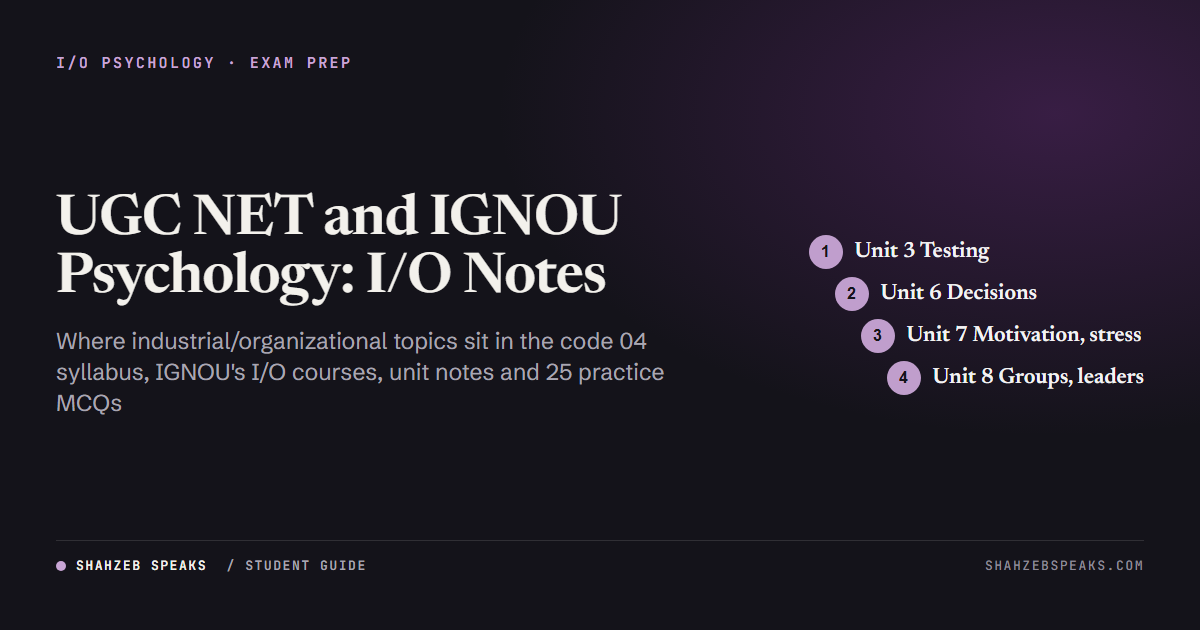
The UGC NET Psychology syllabus (code 04), applicable since the June 2019 exam, has ten units and no separate industrial/organizational unit. I/O questions come through Unit 3 (testing in organizational settings), Unit 6 (decision-making), Unit 7 (achievement and power motivation, stress, conflict) and Unit 8 (social loafing, group dynamics, leadership, equity theory).
This page is for two groups of Indian students. The first is preparing for UGC NET Psychology (code 04) and wants to know which industrial/organizational (I/O) topics can appear. The second is studying I/O or organizational behaviour at IGNOU and needs notes and practice. Both groups search for the same things: “ugc net psychology syllabus”, “industrial psychology ignou notes”, “OB MCQ for UGC NET”. So this page puts the official syllabus, IGNOU’s course structure, short unit notes and 25 practice MCQs in one place.
I am an Industrial and Organizational Psychologist (MSc) in Karachi. I am not affiliated with NTA, UGC or IGNOU. Every exam fact below comes from their own documents, named with the date I read them, so you can check the latest version yourself.
Does the UGC NET Psychology syllabus have an I/O unit?
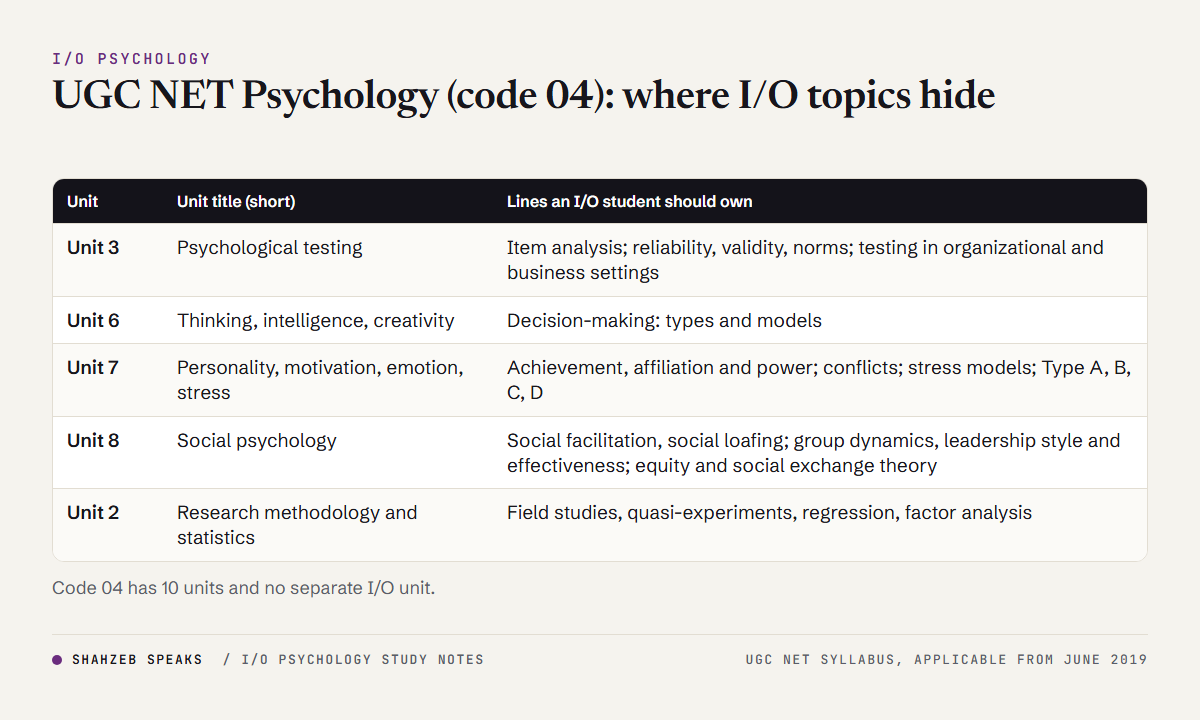
No. The UGC NET Bureau’s list of “Updated Syllabi of UGC-NET (Applicable from June 2019 UGC-NET Onwards)” gives Psychology the code 04, and the Psychology syllabus PDF has ten units: (1) Emergence of Psychology, (2) Research Methodology and Statistics, (3) Psychological Testing, (4) Biological Basis of Behavior, (5) Attention, Perception, Learning, Memory and Forgetting, (6) Thinking, Intelligence and Creativity, (7) Personality, Motivation, Emotion, Stress and Coping, (8) Social Psychology, (9) Human Development and Interventions, and (10) Emerging Areas.
Older UGC NET syllabi and many coaching notes still talk about an “industrial/organizational” section. In the current syllabus, the I/O content is spread across five units. Here is where it sits, using the syllabus’s own words.
| Unit | Line in the official syllabus | What an I/O-prepared candidate should know |
|---|---|---|
| 3. Psychological testing | Test construction (item writing, item analysis); reliability, validity and norms; applications of testing in clinical, “organizational and business”, education, counselling, military settings; career guidance | Item difficulty and discrimination; types of reliability and validity; selection tests, assessment centres, interest inventories |
| 6. Thinking, intelligence and creativity | Decision-making: types and models | Rational model, bounded rationality, heuristics and biases, prospect theory |
| 7. Personality, motivation, emotion, stress and coping | Achievement, affiliation and power; conflicts (sources and types); stress and coping, models, Type A, B, C, D behaviours; stress management strategies | McClelland’s needs, Lewin’s conflict types, Selye and Lazarus, Type A-D, stress inoculation |
| 8. Social psychology | Social facilitation, social loafing; group dynamics, leadership style and effectiveness; equity theory, social exchange theory, relative deprivation | Zajonc, Latané, Lewin-Lippitt-White, Fiedler, Adams, Homans |
| 2. Research methodology and statistics | Field studies, quasi-experimental designs, regression, factor analysis | The methods used in most I/O research and thesis work |
Two practical points follow. First, do not spend weeks on topics that are no longer named, such as a full course on job analysis or training evaluation; they are useful background but not syllabus lines. Second, if you studied I/O or organizational behaviour, you already hold an advantage in Units 3, 7 and 8, which are large units. If you want a management-side syllabus with organizational behaviour and HRM, that is a different NET subject (Management, code 17), not Psychology.
UGC NET exam pattern for Psychology (December 2026 cycle)
The National Testing Agency runs UGC NET. Its official site lists the Information Bulletin for UGC-NET December 2026 (8 October 2026, updated on 16 October 2026 with a corrigendum) and an FAQ for the December 2026 examination. According to NTA’s FAQ, the exam is computer-based and has two papers in one sitting of 180 minutes: Paper I (teaching and research aptitude) with 50 questions for 100 marks, and Paper II (your subject) with 100 questions for 200 marks. There is no negative marking. The October bulletin listed the exam window as 14 to 19 December 2026; NTA posted a correction window for application forms on 2 November 2026. Check your city slip and admit card for your own date.
Because all I/O-type content sits inside Paper II, the topics on this page compete for space with nine other units. The aim is not to master all of I/O, but to be sure of the I/O lines that are actually in the syllabus.
IGNOU courses that cover industrial and organizational psychology
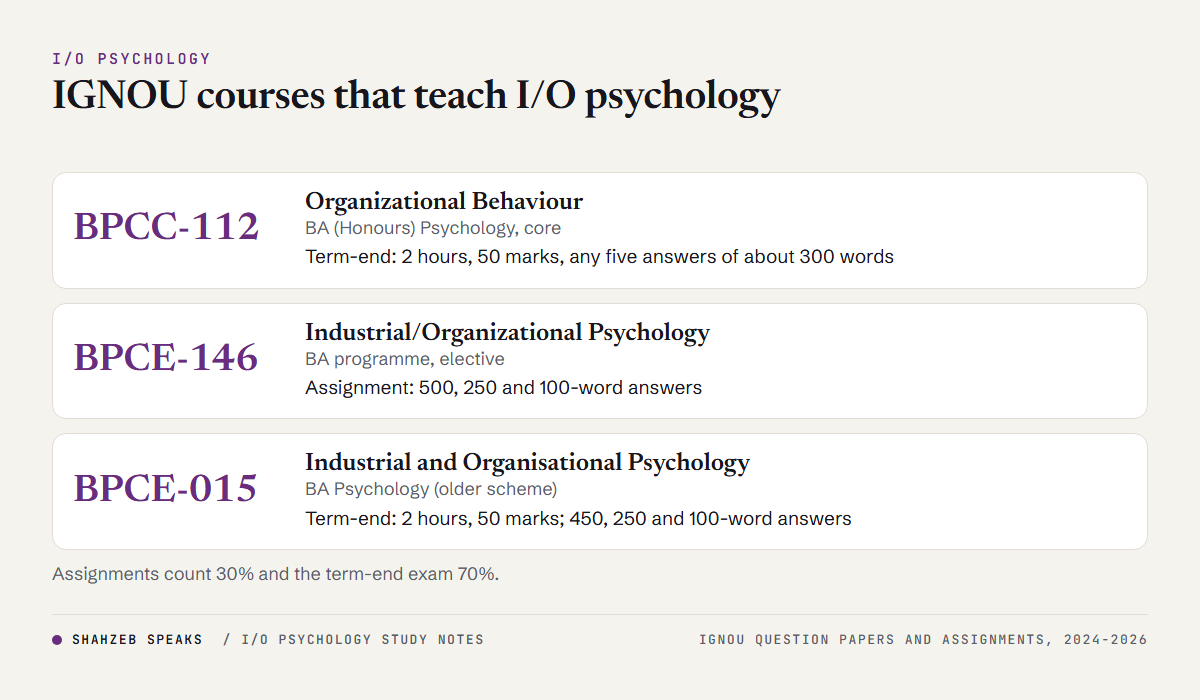
IGNOU’s School of Social Sciences teaches I/O in more than one programme. I checked the course titles and exam formats in IGNOU’s own question papers and assignment booklets on ignou.ac.in.
| Course | Programme | Exam and assignment format (from IGNOU documents) | Topics seen in recent papers |
|---|---|---|---|
| BPCC-112: Organizational Behaviour | BA (Honours) Psychology (BAPCH), core course, 6 credits (4 theory + 2 practical) | Term-end exam June 2026: 2 hours, 50 marks, any five questions in about 300 words, at least two from each section. Assignments 2025-26: three 500-word answers (20 marks each) and eight 100-word answers (5 marks each) | History of OB, communication, leadership (including an Indian perspective), job satisfaction, equity theory, Schein’s levels of culture, OD models |
| BPCE-146: Industrial/Organizational Psychology | BA programme, elective, 6 credits | Assignments 2023-24: two 500-word answers (20 marks), three 250-word answers (10 marks), short 100-word answers | Learning theories at work, leadership theories and challenges |
| BPCE-015: Industrial and Organisational Psychology | Bachelor’s Degree Programme (BA Psychology), older scheme | Term-end exam June 2024: 2 hours, 50 marks; two answers of about 450 words, four of about 250 words, two short notes of about 100 words | Workplace behaviours, accidents and safety, shift work, performance appraisal, recent trends in I/O |
The BPCC-112 and BPCE-146 assignment booklets say assignments carry 30% of the final result and the term-end examination 70%. The booklets also say that answers must be handwritten, in your own words and near the word limit.
Unit notes: the I/O topics in UGC NET code 04
Unit 3: psychological testing in organizations
Item analysis has two key numbers. Item difficulty (p) is the proportion of test-takers who answer an item correctly, so a higher p means an easier item. Item discrimination (D) compares the upper and lower scoring groups; a positive D means strong candidates get the item right more often. You can practise both with the free item analysis calculator.
Reliability is consistency: test-retest (stability over time), parallel forms, split-half (corrected with the Spearman-Brown formula) and internal consistency (Cronbach’s alpha). Validity is whether a test measures what it should: content, criterion-related (concurrent and predictive) and construct validity. In selection, predictive validity matters most, because the employer wants to know who will perform well later. Full notes: reliability in psychological testing and validity in employee selection. Norms let you compare one person’s score with a reference group (percentiles, standard scores).
Unit 6: decision-making, types and models
The rational model assumes that the decision maker defines the problem, lists all options, evaluates each and picks the best. Simon (1955) argued that real people work with limited information, time and mental capacity, so they satisfice: they choose the first option that is good enough. This is bounded rationality. Tversky and Kahneman (1974) described heuristics such as availability, representativeness, and anchoring and adjustment, which save effort but create bias. Their prospect theory (Kahneman and Tversky, 1979) adds that losses weigh more than equal gains. Types of decisions to know: programmed vs non-programmed, individual vs group.
Unit 7: motivation, conflict and stress
Achievement, affiliation and power. McClelland’s work treats these as learned needs. People high in need for achievement like moderately difficult goals, personal responsibility and quick feedback. McClelland and Burnham (1976) argued that effective managers often show a high need for power directed at the institution rather than at themselves, with lower need for affiliation. The full model is on McClelland’s theory of needs.
Conflicts. Lewin’s classic types are approach-approach (two attractive options), avoidance-avoidance (two unattractive options), approach-avoidance (one option with good and bad sides) and double approach-avoidance (two options, each with good and bad sides). A job seeker choosing between a well-paid job in Mumbai far from family and a lower-paid job at home faces a double approach-avoidance conflict.
Stress models and behaviour types. Selye’s general adaptation syndrome has three stages: alarm, resistance and exhaustion. Lazarus’s transactional view says stress depends on appraisal: is this a threat, and can I cope? In the workplace, see occupational stress models such as Karasek’s demand-control model. The syllabus also names Type A, B, C and D behaviour patterns.
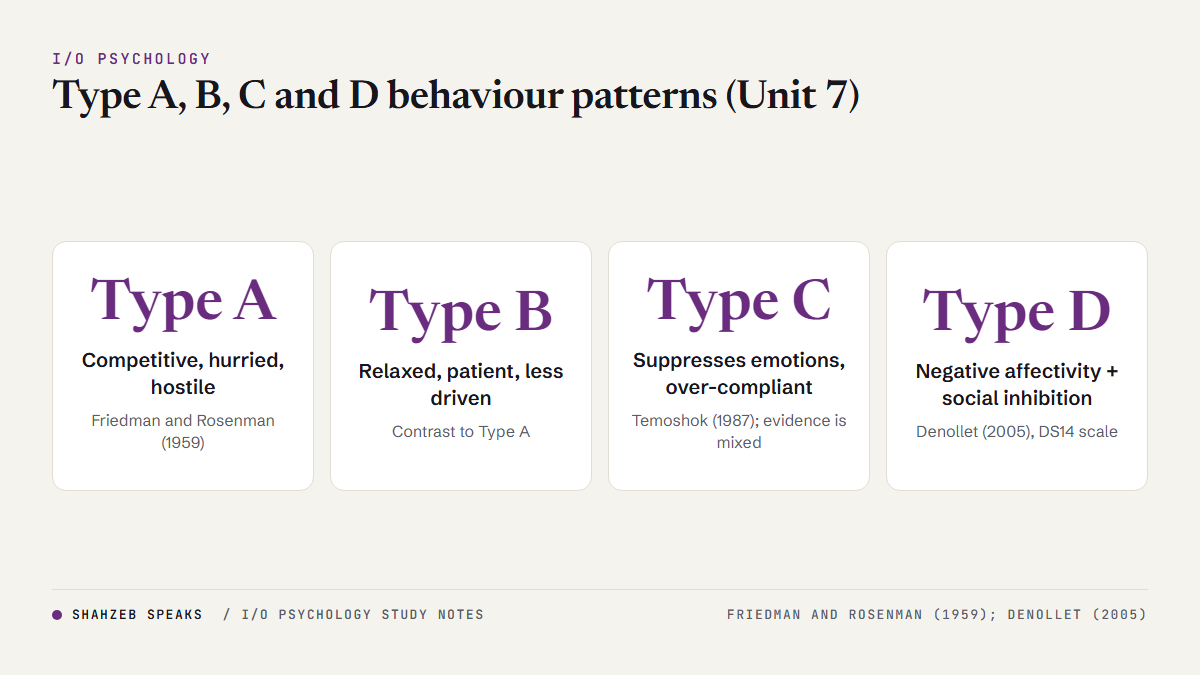
Type A (Friedman and Rosenman, 1959) describes people who are competitive, hurried and easily hostile; Type B people are more relaxed and patient. Type C was described by Temoshok (1987) as a coping style of suppressing negative emotions, especially anger, and being over-compliant; claims that it causes cancer are not supported by the evidence. Type D (Denollet, 2005) combines negative affectivity with social inhibition and is measured with the 14-item DS14. Stress management strategies listed in the syllabus include biofeedback, progressive muscular relaxation, guided imagery, mindfulness and stress inoculation training.
Unit 8: groups, leadership and fairness
Social facilitation: Zajonc (1965) explained that the presence of others raises arousal, which improves performance on simple or well-learned tasks and worsens it on complex or new ones. Social loafing is the drop in individual effort when work is pooled (Latané, Williams and Harkins, 1979). For group dynamics, know cohesion, norms, roles and Tuckman’s stages.
Leadership style and effectiveness: Lewin, Lippitt and White (1939) compared autocratic, democratic and laissez-faire leadership; Fiedler’s contingency model says effectiveness depends on the match between style and situation. Indian students should also know J. B. P. Sinha’s (1980) nurturant-task leader, a style that combines task focus with care for subordinates. Compare the models in leadership theories in I/O psychology.
Equity theory (Adams, 1965) says people compare their ratio of outcomes to inputs with that of others; unequal ratios create tension that people try to reduce. Social exchange theory (Homans, 1958) treats social behaviour as an exchange of rewards and costs. Both explain fairness and commitment at work; see equity theory of motivation.
How to prepare: UGC NET and IGNOU together
- Map first: print the code 04 syllabus and mark the I/O lines in Units 3, 6, 7 and 8. Study those lines, not a whole I/O textbook.
- One-page notes: for each line, write the name, year, core idea and one Indian workplace example (an IT services team, a bank branch, a hospital ward). Our one-page industrial psychology notes show the format.
- For IGNOU: practise writing to the word limits (about 300 words for BPCC-112 term-end answers, 500 words for assignment essays). The exam box below gives a structure.
- For NET: do timed MCQs. Start with the 25 below, then the topic sets on the I/O psychology MCQ hub, especially selection and validity, occupational stress and research methods.
10-mark answer structure (IGNOU, about 300-500 words): “Explain the equity theory of motivation and its managerial implications”
- Definition: Adams (1965); motivation comes from comparing our outcome-to-input ratio with a referent other.
- Key terms: inputs (effort, skill, time), outcomes (pay, praise, promotion), referent (co-worker, friend in another firm, one’s own past).
- The three states: equity, under-reward, over-reward, with the formula written as two ratios.
- Ways people restore equity: change inputs, change outcomes, distort perceptions, change the referent, leave.
- Example: two software engineers in Bengaluru with the same output but different raises.
- Managerial implications: transparent pay criteria, explain decisions, watch for perceived unfairness after appraisals.
- Evaluation: hard to know which referent people choose; individual differences in sensitivity to equity.
- Conclusion: fairness is judged by comparison, so managers must manage perceptions as well as pay.
Model opening line: “Equity theory, proposed by J. Stacy Adams (1965), holds that employees are motivated not by what they receive alone but by whether their ratio of outcomes to inputs matches that of the people they compare themselves with.”
Practice MCQs: I/O topics in UGC NET Psychology (25)
These are my own practice questions written to the published syllabus. They are not previous year questions. They follow the unit order above.
-
In the current UGC NET Psychology (code 04) syllabus, which unit names applications of testing in “organizational and business” settings?
- Unit 2, Research Methodology and Statistics
- Unit 3, Psychological Testing
- Unit 8, Social Psychology
- Unit 10, Emerging Areas
Show answer
B. Unit 3 lists applications of psychological testing in clinical, organizational and business, education, counselling and military settings. The other units do not mention testing applications.
-
An item is answered correctly by 90% of candidates. Its difficulty index (p) is 0.90. What does this tell you?
- The item is very difficult
- The item is very easy
- The item discriminates well
- The item is invalid
Show answer
B. p is the proportion answering correctly, so 0.90 means a very easy item. Difficulty says nothing directly about discrimination or validity.
-
On an item, 20% of the top-scoring group and 60% of the bottom-scoring group answer correctly. What should the test developer conclude?
- The item has positive discrimination and should be kept
- The item has negative discrimination and should be revised or dropped
- The item is perfectly reliable
- The item has high content validity
Show answer
B. When weaker candidates do better than strong ones, discrimination is negative, which usually means a flawed key or misleading wording. Reliability and content validity cannot be judged from one item’s group split.
-
A company correlates selection test scores of new hires with their performance ratings one year later. Which evidence is this?
- Content validity
- Concurrent validity
- Predictive validity
- Face validity
Show answer
C. Test scores now and performance later is predictive validity. Concurrent validity uses current employees and current performance; content and face validity do not involve a criterion.
-
A test is split into odd and even items and the two halves correlate at 0.70. Which formula is used to estimate the reliability of the full-length test?
- Kuder-Richardson 20
- Spearman-Brown prophecy formula
- Pearson’s chi-square
- Fisher’s z
Show answer
B. Spearman-Brown corrects split-half reliability up to full length. KR-20 is an internal consistency index for right/wrong items, and the other two are not reliability corrections. Try the Spearman-Brown calculator.
-
A manager hires the first candidate who meets the minimum requirements instead of interviewing all 40 applicants. In Simon’s terms, she is:
- Optimising
- Satisficing
- Anchoring
- Escalating commitment
Show answer
B. Choosing a good-enough option under limited time and information is satisficing, the core of bounded rationality (Simon, 1955). Anchoring and escalation are biases, not the choice rule.
-
A salary negotiator’s final offer stays close to the first figure mentioned, even when that figure was arbitrary. Which heuristic is this?
- Availability
- Representativeness
- Anchoring and adjustment
- Satisficing
Show answer
C. Tversky and Kahneman (1974) showed that estimates stay close to a starting value. Availability relies on how easily examples come to mind; representativeness on similarity to a stereotype.
-
Which statement reflects prospect theory?
- People value gains and losses of the same size equally
- Losses loom larger than equal gains
- People always choose the option with the highest expected value
- Decisions are made only by groups
Show answer
B. Kahneman and Tversky (1979) found loss aversion: a loss hurts more than an equal gain pleases. Options A and C describe classical expected-value thinking, which the theory challenges.
-
A sales executive prefers targets that are hard but achievable, wants personal credit for results and asks for quick feedback. Which need is dominant?
- Need for affiliation
- Need for achievement
- Need for power
- Safety need
Show answer
B. Moderate risk, personal responsibility and feedback are the marks of high need for achievement in McClelland’s work. Affiliation seeks warm relationships, power seeks influence, and safety is Maslow’s term.
-
McClelland and Burnham (1976) argued that the most effective managers in large organizations tend to have:
- High need for affiliation and low need for power
- High need for power directed at the institution, with lower need for affiliation
- High need for achievement only
- Low scores on all three needs
Show answer
B. They described “institutional” power, aimed at building the organization, as the effective manager’s profile. High affiliation can lead managers to make exceptions to please people; achievement alone suits individual contributors better.
-
A graduate must choose between two jobs: one pays well but is far from home; the other is close to home but pays poorly. Which conflict is this?
- Approach-approach
- Avoidance-avoidance
- Approach-avoidance
- Double approach-avoidance
Show answer
D. Each option has both attractive and unattractive features, which is a double approach-avoidance conflict. Approach-avoidance involves a single option with mixed features.
-
A nurse working repeated night shifts first feels a surge of energy, then copes for weeks, and finally becomes exhausted and ill. Which model describes this sequence?
- Lazarus’s transactional model
- Selye’s general adaptation syndrome
- Karasek’s demand-control model
- Maslow’s hierarchy
Show answer
B. Alarm, resistance and exhaustion are Selye’s three stages. Lazarus focuses on appraisal, Karasek on job demands and control, and Maslow on needs.
-
According to Lazarus’s transactional view, the same deadline stresses one employee and not another mainly because of:
- Their blood group
- Their appraisal of the threat and of their coping resources
- The colour of the office
- Their Type B personality alone
Show answer
B. Stress arises from primary appraisal (is this a threat?) and secondary appraisal (can I cope?). Personality can shape appraisal but is not the whole explanation.
-
Which description matches Type D, as measured with Denollet’s DS14?
- Competitiveness and time urgency
- Negative affectivity combined with social inhibition
- Relaxed and easy-going
- High sensation seeking
Show answer
B. Type D is the “distressed” type: frequent negative emotions plus holding them back in social situations. A is Type A, C is Type B, and D describes Zuckerman’s sensation seeking.
-
Which of these is NOT listed as a stress management strategy in the UGC NET code 04 syllabus?
- Biofeedback
- Progressive muscular relaxation
- Stress inoculation training
- Electroconvulsive therapy
Show answer
D. The syllabus lists biofeedback, music therapy, breathing exercises, progressive muscular relaxation, guided imagery, mindfulness, meditation, yogasana and stress inoculation training. ECT is a psychiatric treatment, not a stress management method.
-
A skilled typist types faster when colleagues are watching, but a trainee makes more errors when watched. Which explanation fits both results?
- Social loafing
- Zajonc’s drive explanation of social facilitation
- Groupthink
- Deindividuation
Show answer
B. Zajonc (1965) said an audience raises arousal, which strengthens dominant responses: correct ones for experts, errors for novices. Social loafing concerns pooled effort, not being watched.
-
In a tug-of-war, each person pulls less hard as more people join the rope. What is this called?
- Social facilitation
- Social loafing
- Conformity
- Reactance
Show answer
B. Reduced individual effort in pooled tasks is social loafing (Latané, Williams and Harkins, 1979). Facilitation is improved performance in front of others; conformity and reactance concern influence.
-
In Lewin, Lippitt and White’s (1939) study, which leadership climate produced the most aggression or hostility in some groups?
- Democratic
- Autocratic
- Transformational
- Servant
Show answer
B. The paper reported much more hostility and aggression in some autocratic groups than in the democratic ones. Transformational and servant leadership are much later concepts.
-
A manager is warm and supportive but also insists firmly on tasks being finished, and subordinates’ growth earns them more freedom over time. This is closest to:
- Laissez-faire leadership
- Sinha’s nurturant-task leader
- Theory X management
- Transactional leadership only
Show answer
B. J. B. P. Sinha (1980) described a leader who combines care (nurturance) with task focus, suited to Indian organizations. Laissez-faire gives no direction; Theory X assumes people avoid work.
-
An engineer learns that a colleague with the same output got a larger raise. According to Adams (1965), which is NOT a way she might restore equity?
- Reduce her own effort
- Ask for a raise
- Change who she compares herself with
- Increase the colleague’s raise herself
Show answer
D. She cannot directly change the colleague’s outcomes. Changing her inputs, seeking more outcomes and changing the referent are all ways named in equity theory.
-
Which theory treats social behaviour at work as a trade of rewards and costs between people?
- Social exchange theory
- Two-factor theory
- Signal detection theory
- Field theory
Show answer
A. Homans (1958) described social behaviour as exchange. Two-factor theory is Herzberg’s, signal detection is a perception theory, and field theory is Lewin’s life-space approach.
-
Fiedler’s contingency model holds that leadership effectiveness depends on:
- The leader’s height and appearance
- The match between the leader’s style and how favourable the situation is
- The number of followers only
- Paying followers more
Show answer
B. Fiedler matched task- or relationship-oriented leaders to situational control (leader-member relations, task structure, position power). See Fiedler’s contingency model.
-
A researcher compares absence rates in two existing branches of a bank, one of which started flexible hours, without random assignment. Which design is this?
- True experiment
- Quasi-experimental design
- Single-subject design
- Latin square design
Show answer
B. Comparing intact groups without random assignment is quasi-experimental, the common design in field research in organizations. A true experiment needs random assignment.
-
A team of researchers reduces 40 job satisfaction items to five underlying dimensions. Which technique does this?
- Multiple regression
- Factor analysis
- Kruskal-Wallis test
- Point-biserial correlation
Show answer
B. Factor analysis finds a smaller set of dimensions behind many items. Regression predicts an outcome, Kruskal-Wallis compares groups, and point-biserial correlates a continuous with a dichotomous variable.
-
An IGNOU student is writing the BPCC-112 term-end exam. According to the June 2026 paper, how many questions must she answer, and in about how many words each?
- Two questions, 1,000 words each
- Five questions, about 300 words each
- Ten questions, about 50 words each
- All questions, no word limit
Show answer
B. The June 2026 BPCC-112 paper asked for any five questions in about 300 words each, with at least two from each section, for 50 marks in 2 hours. Formats can change, so check your own paper’s instructions.
Practise on your phone
The free I/O Psychology Prep app has 410 explained questions, flashcards and an exam countdown, and works offline. Get it on Google Play · About the app
Questions students ask
Is industrial psychology in the UGC NET Psychology syllabus?
Not as a separate unit. The syllabus applicable from June 2019 has ten units, and I/O content appears inside Unit 3 (testing in organizational and business settings), Unit 6 (decision-making), Unit 7 (achievement and power, stress, conflict) and Unit 8 (social loafing, leadership, equity theory).
What is the UGC NET Psychology subject code?
Psychology is code 04 in the UGC NET subject list. The syllabus PDF is published on the UGC NET Bureau’s syllabus page, which lists every subject with its code.
Which IGNOU course is industrial psychology?
In BA (Honours) Psychology it is mainly BPCC-112 Organizational Behaviour. In the BA programme, BPCE-146 is Industrial/Organizational Psychology. Older BA Psychology students had BPCE-015 Industrial and Organisational Psychology. Check your programme guide for your code.
How long should IGNOU answers be?
Follow the paper. The June 2026 BPCC-112 term-end paper asked for about 300 words per answer; the 2025-26 BPCC-112 assignment asked for about 500 words in the long answers and 100 words in the short ones.
Is there negative marking in UGC NET?
NTA’s FAQ for the December 2026 examination says there is no negative marking. Paper I has 50 questions (100 marks) and Paper II has 100 questions (200 marks), in one 180-minute sitting.
Are these UGC NET previous year questions?
No. They are practice questions written to the published syllabus. For real previous papers, use NTA’s and UGC’s own archives.
Do I need to study Management (code 17) for organizational behaviour?
Only if you are taking the Management paper. For Psychology (code 04), study the organizational lines inside Units 3, 6, 7 and 8 shown above.
Practise on your phone
Set your UGC NET or IGNOU exam date in the free I/O Psychology Prep app and use its exam countdown, 410 explained questions and offline flashcards. Get it on Google Play · About the app
References
- University Grants Commission, NET Bureau. (n.d.). Psychology, code no. 04: Syllabus (updated syllabi applicable from June 2019 UGC-NET onwards). Retrieved 3 November 2026, from https://www.ugcnetonline.in/NTA_All_R_Syllabus/04/Psychology_English.pdf (list: https://www.ugcnetonline.in/syllabus-new.php)
- National Testing Agency. (2026). Information bulletin, UGC-NET December 2026 (8 October 2026; updated 16 October 2026) and FAQs for the UGC-NET December 2026 examination. https://ugcnet.nta.nic.in/information-bulletin/
- Indira Gandhi National Open University. (2026). BPCC-112: Organizational Behaviour, term-end examination, June 2026. https://www.ignou.ac.in/viewFile/ldd/qpjune2026/BPCC-112.pdf
- Indira Gandhi National Open University. (2025). BPCC-112 Organizational Behaviour: Tutor marked assignment, July 2025 and January 2026 admission cycle. https://www.ignou.ac.in/viewFile/SOSS/assignments/BPCC-112(E)(25-26).pdf
- Indira Gandhi National Open University. (2023). BPCE-146 Industrial/Organizational Psychology: Assignment, July 2023 – January 2024. webservices.ignou.ac.in
- Indira Gandhi National Open University. (2024). BPCE-015: Industrial and Organisational Psychology, term-end examination, June 2024. webservices.ignou.ac.in
- Adams, J. S. (1965). Inequity in social exchange. Advances in Experimental Social Psychology, 2, 267-299. https://doi.org/10.1016/S0065-2601(08)60108-2
- Denollet, J. (2005). DS14: Standard assessment of negative affectivity, social inhibition, and Type D personality. Psychosomatic Medicine, 67(1), 89-97. https://doi.org/10.1097/01.psy.0000149256.81953.49
- Friedman, M., & Rosenman, R. H. (1959). Association of specific overt behavior pattern with blood and cardiovascular findings. Journal of the American Medical Association, 169(12), 1286-1296. https://doi.org/10.1001/jama.1959.03000290012005
- Homans, G. C. (1958). Social behavior as exchange. American Journal of Sociology, 63(6), 597-606. https://doi.org/10.1086/222355
- Kahneman, D., & Tversky, A. (1979). Prospect theory: An analysis of decision under risk. Econometrica, 47(2), 263-291. https://doi.org/10.2307/1914185
- Latané, B., Williams, K., & Harkins, S. (1979). Many hands make light the work: The causes and consequences of social loafing. Journal of Personality and Social Psychology, 37(6), 822-832. https://doi.org/10.1037/0022-3514.37.6.822
- Lewin, K., Lippitt, R., & White, R. K. (1939). Patterns of aggressive behavior in experimentally created “social climates”. The Journal of Social Psychology, 10(2), 269-299. https://doi.org/10.1080/00224545.1939.9713366
- McClelland, D. C., & Burnham, D. H. (1976). Power is the great motivator. Harvard Business Review, 54(2), 100-110.
- Simon, H. A. (1955). A behavioral model of rational choice. The Quarterly Journal of Economics, 69(1), 99-118. https://doi.org/10.2307/1884852
- Sinha, J. B. P. (1980). The nurturant task leader: A model of the effective executive. Concept Publishing.
- Temoshok, L. (1987). Personality, coping style, emotion and cancer: Towards an integrative model. Cancer Surveys, 6, 545-567.
- Tversky, A., & Kahneman, D. (1974). Judgment under uncertainty: Heuristics and biases. Science, 185(4157), 1124-1131. https://doi.org/10.1126/science.185.4157.1124
- Zajonc, R. B. (1965). Social facilitation. Science, 149(3681), 269-274. https://doi.org/10.1126/science.149.3681.269
Next: go back to the I/O psychology MCQ hub, try the motivation MCQs and leadership MCQs, or see the exam guides for PPSC, FPSC and CSS and the Philippine psychometrician exam.